engine Hyundai Kona 2018 Owner's Manual
[x] Cancel search | Manufacturer: HYUNDAI, Model Year: 2018, Model line: Kona, Model: Hyundai Kona 2018Pages: 523, PDF Size: 33.6 MB
Page 469 of 523
7-57
7
Maintenance
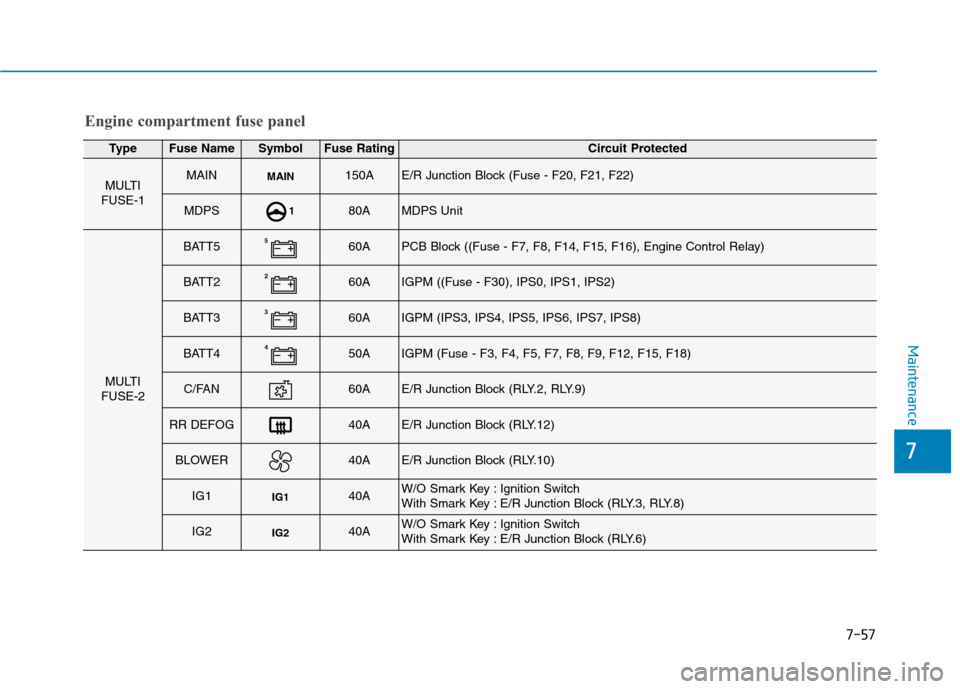
Engine compartment fuse panel
TypeFuse NameSymbolFuse RatingCircuit Protected
MULTI
FUSE-1MAINMAIN150AE/R Junction Block (Fuse - F20, F21, F22)
MDPS180AMDPS Unit
MULTI
FUSE-2
BATT5560APCB Block ((Fuse - F7, F8, F14, F15, F16), Engine Control Relay)
BATT2260AIGPM ((Fuse - F30), IPS0, IPS1, IPS2)
BATT3360AIGPM (IPS3, IPS4, IPS5, IPS6, IPS7, IPS8)
BATT4450AIGPM (Fuse - F3, F4, F5, F7, F8, F9, F12, F15, F18)
C/FAN60AE/R Junction Block (RLY.2, RLY.9)
RR DEFOG40AE/R Junction Block (RLY.12)
BLOWER40AE/R Junction Block (RLY.10)
IG1IG140AW/O Smark Key : Ignition Switch
With Smark Key : E/R Junction Block (RLY.3, RLY.8)
IG2IG240AW/O Smark Key : Ignition Switch
With Smark Key : E/R Junction Block (RLY.6)
Page 470 of 523
7-58
Maintenance
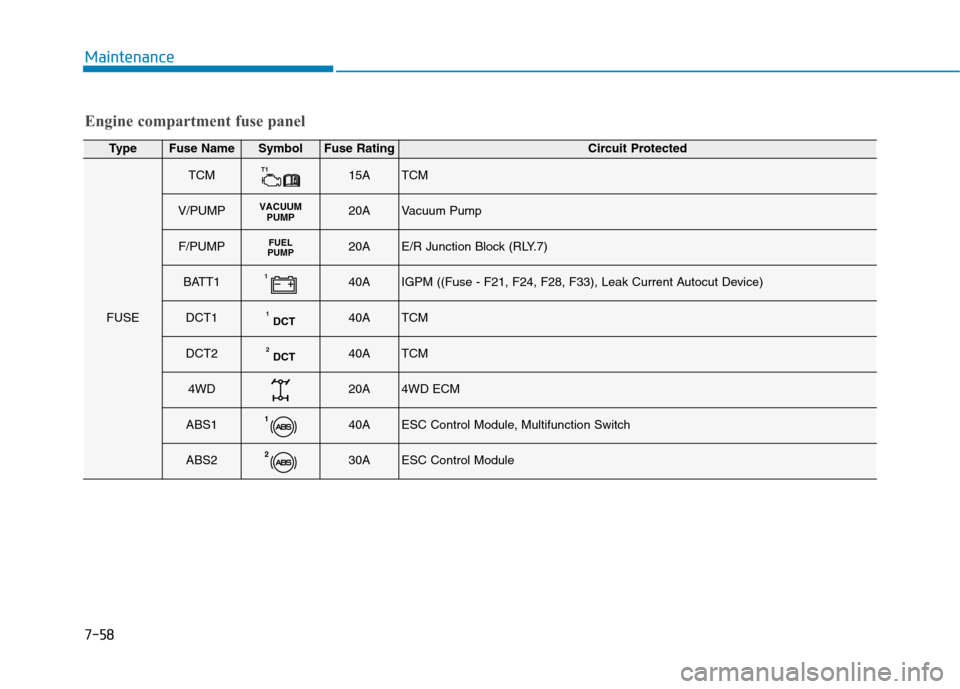
Engine compartment fuse panel
TypeFuse NameSymbolFuse RatingCircuit Protected
FUSE
TCMT115ATCM
V/PUMPVACUUMPUMP20AVacuum Pump
F/PUMPFUEL
PUMP20AE/R Junction Block (RLY.7)
BATT1140AIGPM ((Fuse - F21, F24, F28, F33), Leak Current Autocut Device)
DCT1DCT
140ATCM
DCT2DCT
240ATCM
4WD20A4WD ECM
ABS1140AESC Control Module, Multifunction Switch
ABS2230AESC Control Module
Page 471 of 523
7-59
7
Maintenance
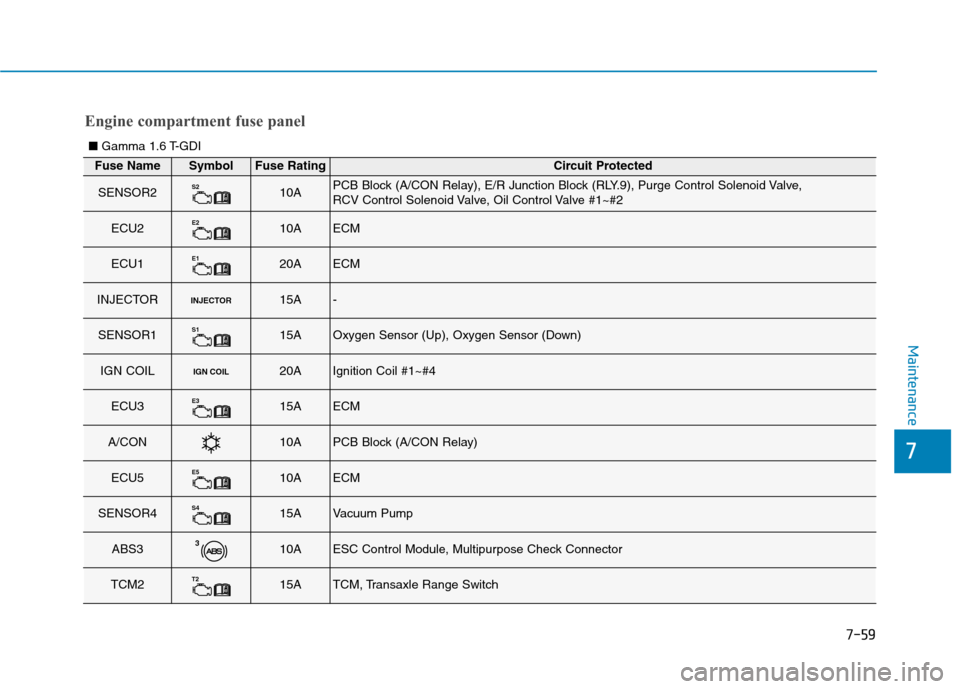
Fuse NameSymbolFuse RatingCircuit Protected
SENSOR2S210APCB Block (A/CON Relay), E/R Junction Block (RLY.9), Purge Control Solenoid Valve,
RCV Control Solenoid Valve, Oil Control Valve #1~#2
ECU2E210AECM
ECU1E120AECM
INJECTORINJECTOR15A-
SENSOR1S115AOxygen Sensor (Up), Oxygen Sensor (Down)
IGN COILIGN COIL20AIgnition Coil #1~#4
ECU3E315AECM
A/CON10APCB Block (A/CON Relay)
ECU5E510AECM
SENSOR4S415AVacuum Pump
ABS3310AESC Control Module, Multipurpose Check Connector
TCM2T215ATCM, Transaxle Range Switch
Engine compartment fuse panel
■ Gamma 1.6 T-GDI
Page 472 of 523
7-60
Maintenance
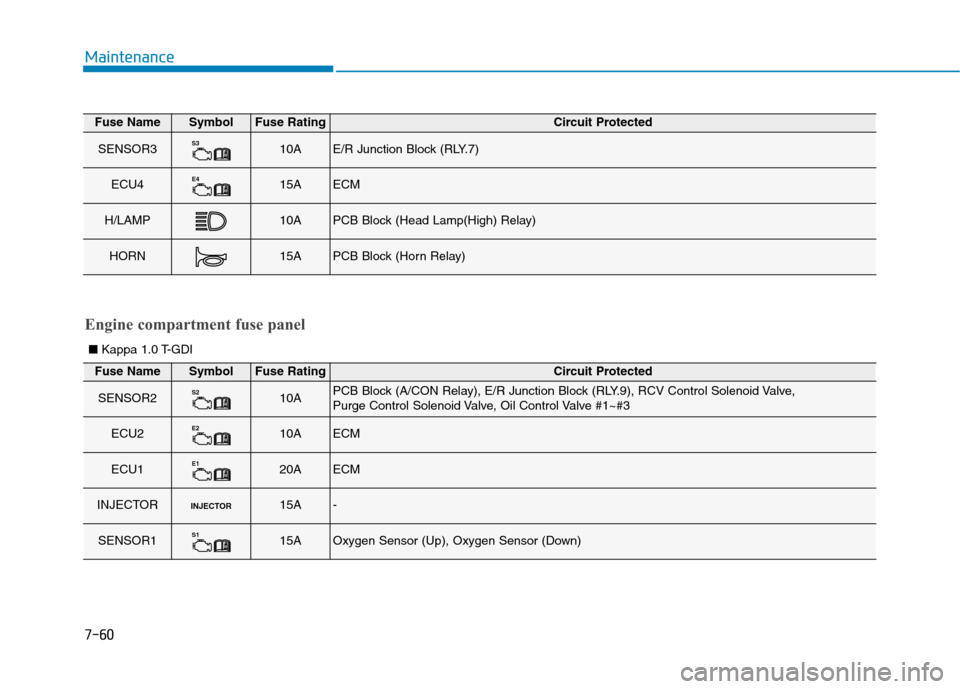
Fuse NameSymbolFuse RatingCircuit Protected
SENSOR3S310AE/R Junction Block (RLY.7)
ECU4E415AECM
H/LAMP10APCB Block (Head Lamp(High) Relay)
HORN15APCB Block (Horn Relay)
Engine compartment fuse panel
■ Kappa 1.0 T-GDI
Fuse NameSymbolFuse RatingCircuit Protected
SENSOR2S210APCB Block (A/CON Relay), E/R Junction Block (RLY.9), RCV Control Solenoid Valve,
Purge Control Solenoid Valve, Oil Control Valve #1~#3
ECU2E210AECM
ECU1E120AECM
INJECTORINJECTOR15A-
SENSOR1S115AOxygen Sensor (Up), Oxygen Sensor (Down)
Page 474 of 523
7-62
Maintenance
Engine compartment fuse panel(Battery terminal cover)
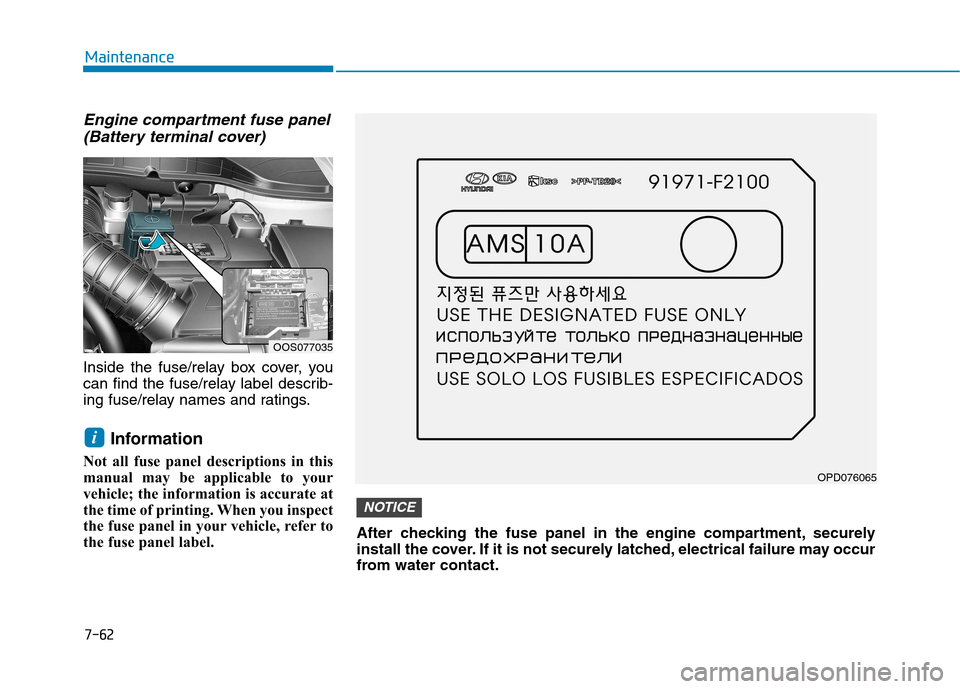
Inside the fuse/relay box cover, you
can find the fuse/relay label describ-
ing fuse/relay names and ratings.
Information
Not all fuse panel descriptions in this
manual may be applicable to your
vehicle; the information is accurate at
the time of printing. When you inspect
the fuse panel in your vehicle, refer to
the fuse panel label.
i
OOS077035
OPD076065
After checking the fuse panel in the engine compartment, securely
install the cover. If it is not securely latched, electrical failure may occur
from water contact.
NOTICE
Page 487 of 523
7-75
7
Maintenance
Stop/Tail lamp
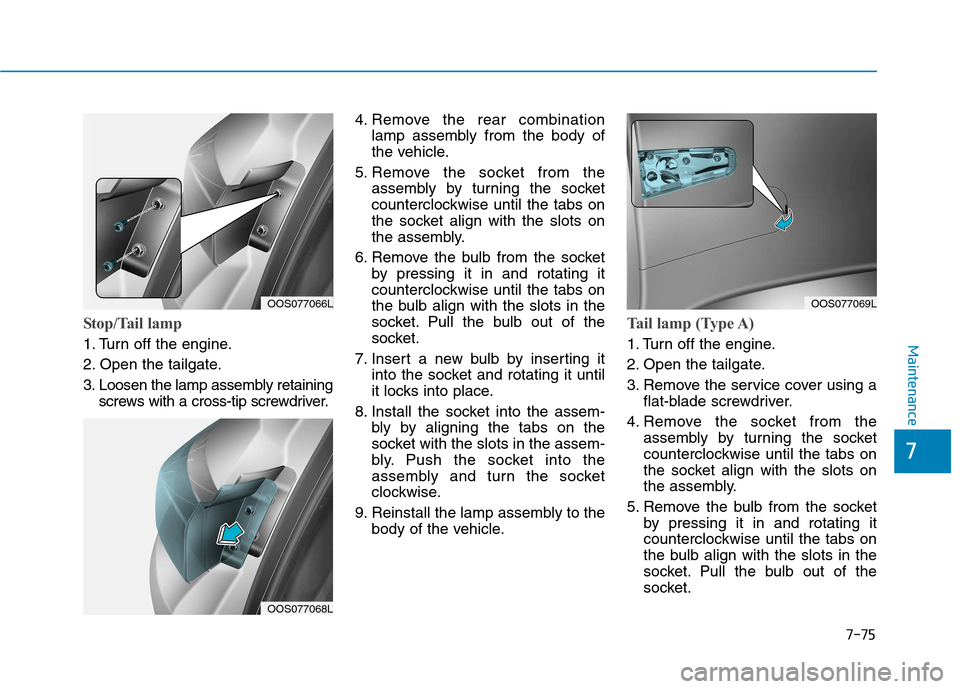
1. Turn off the engine.
2. Open the tailgate.
3. Loosen the lamp assembly retainingscrews with a cross-tip screwdriver. 4. Remove the rear combination
lamp assembly from the body of
the vehicle.
5. Remove the socket from the assembly by turning the socket
counterclockwise until the tabs on
the socket align with the slots on
the assembly.
6. Remove the bulb from the socket by pressing it in and rotating it
counterclockwise until the tabs on
the bulb align with the slots in the
socket. Pull the bulb out of the
socket.
7. Insert a new bulb by inserting it into the socket and rotating it until
it locks into place.
8. Install the socket into the assem- bly by aligning the tabs on the
socket with the slots in the assem-
bly. Push the socket into the
assembly and turn the socket
clockwise.
9. Reinstall the lamp assembly to the body of the vehicle.
Tail lamp (Type A)
1. Turn off the engine.
2. Open the tailgate.
3. Remove the service cover using aflat-blade screwdriver.
4. Remove the socket from the assembly by turning the socket
counterclockwise until the tabs on
the socket align with the slots on
the assembly.
5. Remove the bulb from the socket by pressing it in and rotating it
counterclockwise until the tabs on
the bulb align with the slots in the
socket. Pull the bulb out of the
socket.
OOS077068L
OOS077069LOOS077066L
Page 491 of 523
7-79
7
MaintenanceHigh-pressure washing
When using high-pressure washers,make sure to maintain sufficient dis-
tance from the vehicle.
Insufficient clearance or excessive pressure can lead to component
damage or water penetration.
Do not spray the camera, sensors or its surrounding area directly with a
high pressure washer. Shock
applied from high pressure water
may cause the device to not operate
normally.
Do not bring the nozzle tip close to boots (rubber or plastic covers) or
connectors as they may be dam-
aged if they come into contact with
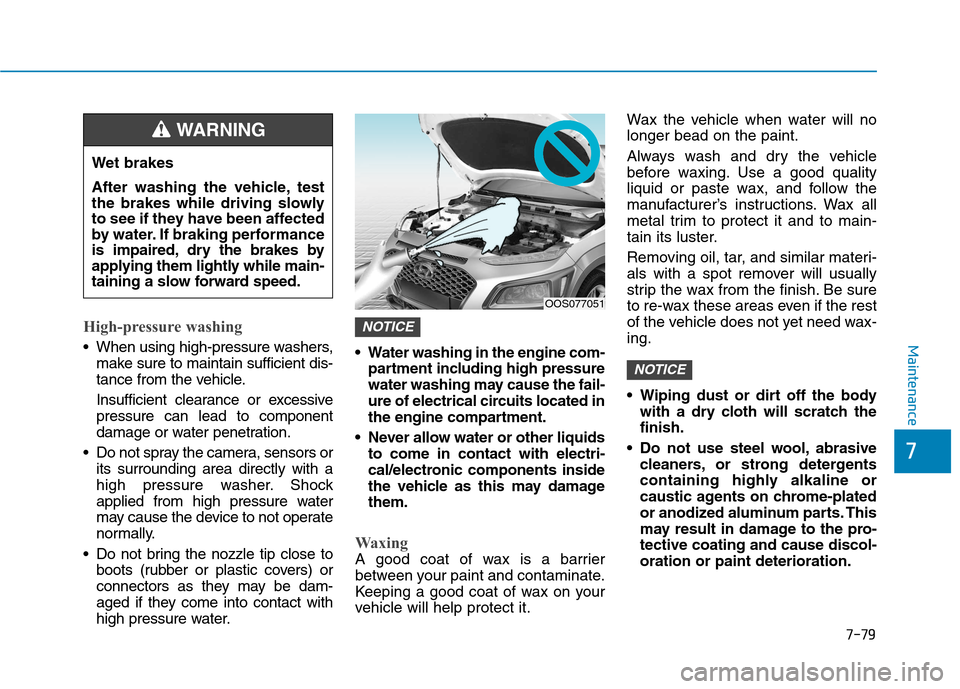
high pressure water. Water washing in the engine com-
partment including high pressure
water washing may cause the fail-
ure of electrical circuits located in
the engine compartment.
Never allow water or other liquids to come in contact with electri-
cal/electronic components inside
the vehicle as this may damagethem.
Waxing
A good coat of wax is a barrier
between your paint and contaminate.
Keeping a good coat of wax on your
vehicle will help protect it. Wax the vehicle when water will nolonger bead on the paint.
Always wash and dry the vehicle
before waxing. Use a good quality
liquid or paste wax, and follow the
manufacturer’s instructions. Wax all
metal trim to protect it and to main-
tain its luster.
Removing oil, tar, and similar materi-
als with a spot remover will usually
strip the wax from the finish. Be sure
to re-wax these areas even if the rest
of the vehicle does not yet need wax-ing.
Wiping dust or dirt off the body
with a dry cloth will scratch the finish.
Do not use steel wool, abrasive cleaners, or strong detergents
containing highly alkaline or
caustic agents on chrome-plated
or anodized aluminum parts. This
may result in damage to the pro-tective coating and cause discol-oration or paint deterioration.
NOTICE
NOTICE
Wet brakes
After washing the vehicle, test
the brakes while driving slowly
to see if they have been affected
by water. If braking performance
is impaired, dry the brakes by
applying them lightly while main-
taining a slow forward speed.
WARNING
OOS077051
Page 497 of 523
7-85
7
Maintenance
EEMM IISS SSIIOO NN CC OO NNTTRR OO LL SS YY SSTT EEMM
The emission control system of your
vehicle is covered by a written limited
warranty. Please see the warranty
information contained in the Service
Passport in your vehicle.
Your vehicle is equipped with an emission control system to meet all
emission regulations. There are three emission control
systems which are as follows.
(1) Crankcase emission control sys-
tem
(2) Evaporative emission control sys- tem
(3) Exhaust emission control systemIn order to ensure the proper function
of the emission control systems, it is
recommended that you have your car
inspected and maintained by an
authorized HYUNDAI dealer in accor-dance with the maintenance schedule
in this manual.
1. Crankcase emission control system
The positive crankcase ventilation
system is employed to prevent air
pollution caused by blow-by gases
being emitted from the crankcase.This system supplies fresh filtered air
to the crankcase through the air
intake hose. Inside the crankcase,
the fresh air mixes with blow-by
gases, which then pass through the
PCV valve into the induction system.
2. Evaporative emission con-trol system
The Evaporative Emission Control
System is designed to prevent fuel
vapors from escaping into the atmos-
phere.
Canister
Fuel vapors generated inside the fueltank are absorbed and stored in the
onboard canister. When the engine is
running, the fuel vapors absorbed in
the canister are drawn into the surgetank through the purge control sole-
noid valve.
Purge Control Solenoid Valve
(PCSV)
The purge control solenoid valve is
controlled by the Engine Control
Module (ECM); when the engine
coolant temperature is low during
idling, the PCSV closes so that evap-
orated fuel is not taken into the
engine. After the engine warms-up
during ordinary driving, the PCSV
opens to introduce evaporated fuel to
the engine.
For the Inspection and Maintenance
Test (with Electronic Stability Control(ESC) system)
To prevent the vehicle from
misfiring during dynamome-
ter testing, turn the Electronic
Stability Control (ESC) sys-
tem off by pressing the ESC
switch.
After dynamometer testing is
completed, turn the ESC sys-
tem back on by pressing the
ESC switch again.
CAUTION
Page 498 of 523
7-86
Maintenance
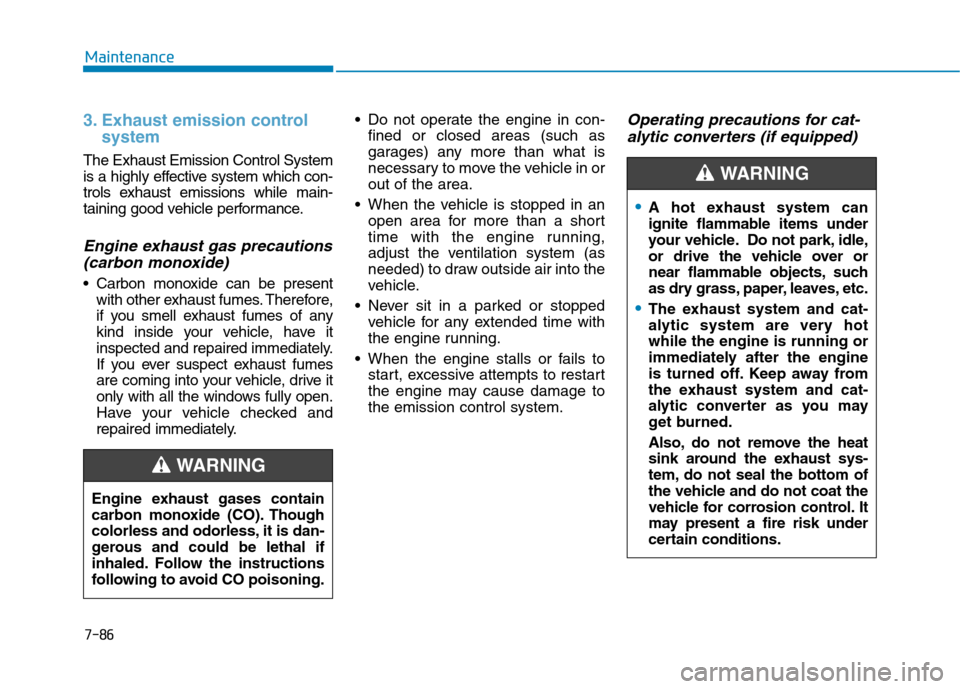
A hot exhaust system can
ignite flammable items under
your vehicle. Do not park, idle,
or drive the vehicle over or
near flammable objects, such
as dry grass, paper, leaves, etc.
The exhaust system and cat-
alytic system are very hotwhile the engine is running or
immediately after the engine
is turned off. Keep away from
the exhaust system and cat-
alytic converter as you may
get burned.
Also, do not remove the heat
sink around the exhaust sys-
tem, do not seal the bottom of
the vehicle and do not coat the
vehicle for corrosion control. It
may present a fire risk under
certain conditions.
WARNING
3. Exhaust emission control system
The Exhaust Emission Control System
is a highly effective system which con-
trols exhaust emissions while main-
taining good vehicle performance.
Engine exhaust gas precautions
(carbon monoxide)
Carbon monoxide can be present with other exhaust fumes. Therefore,
if you smell exhaust fumes of any
kind inside your vehicle, have it
inspected and repaired immediately.
If you ever suspect exhaust fumes
are coming into your vehicle, drive it
only with all the windows fully open.
Have your vehicle checked and
repaired immediately. Do not operate the engine in con-
fined or closed areas (such as
garages) any more than what is
necessary to move the vehicle in orout of the area.
When the vehicle is stopped in an open area for more than a short
time with the engine running,
adjust the ventilation system (as
needed) to draw outside air into the
vehicle.
Never sit in a parked or stopped vehicle for any extended time with
the engine running.
When the engine stalls or fails to start, excessive attempts to restart
the engine may cause damage tothe emission control system.
Operating precautions for cat-
alytic converters (if equipped)
Engine exhaust gases contain
carbon monoxide (CO). Though
colorless and odorless, it is dan-
gerous and could be lethal if
inhaled. Follow the instructions
following to avoid CO poisoning.
WARNING
Page 499 of 523
7-87
7
Maintenance
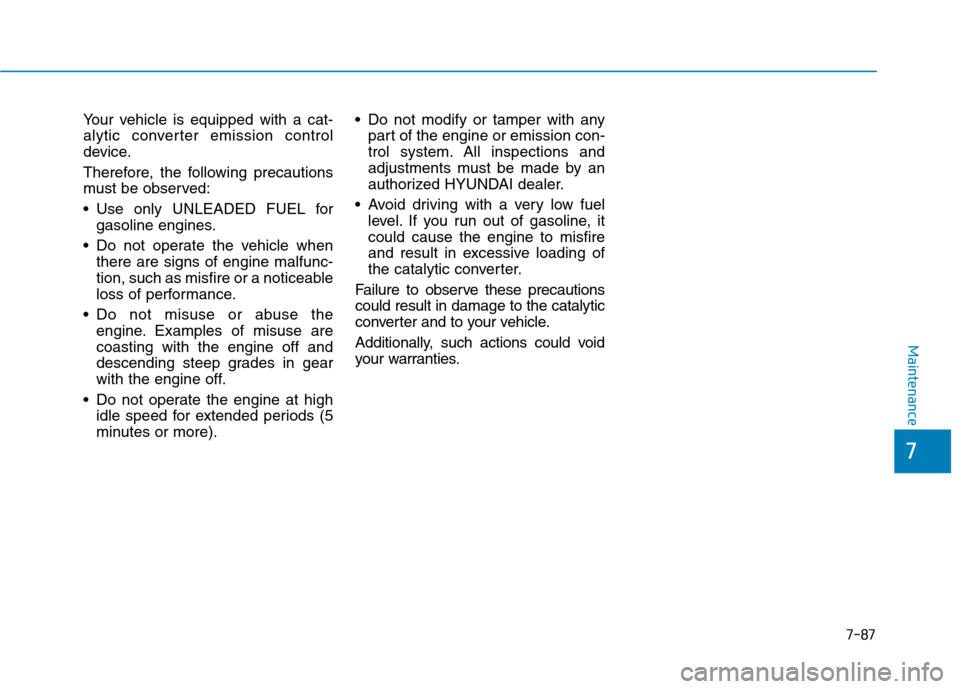
Your vehicle is equipped with a cat-
alytic converter emission control
device.
Therefore, the following precautions
must be observed:
Use only UNLEADED FUEL forgasoline engines.
Do not operate the vehicle when there are signs of engine malfunc-
tion, such as misfire or a noticeable
loss of performance.
Do not misuse or abuse the engine. Examples of misuse arecoasting with the engine off and
descending steep grades in gear
with the engine off.
Do not operate the engine at high idle speed for extended periods (5
minutes or more). Do not modify or tamper with any
part of the engine or emission con-
trol system. All inspections and
adjustments must be made by an
authorized HYUNDAI dealer.
Avoid driving with a very low fuel level. If you run out of gasoline, itcould cause the engine to misfire
and result in excessive loading of
the catalytic converter.
Failure to observe these precautionscould result in damage to the catalytic
converter and to your vehicle.
Additionally, such actions could void
your warranties.