height Hyundai Kona 2018 Owner's Guide
[x] Cancel search | Manufacturer: HYUNDAI, Model Year: 2018, Model line: Kona, Model: Hyundai Kona 2018Pages: 523, PDF Size: 33.6 MB
Page 186 of 523
3-103
Convenient features of your vehicle
3
The following objects may not be
recognized by the sensor:
Sharp or slim objects such asropes, chains or small poles.
Objects, which tend to absorb sen- sor frequency such as clothes,
spongy material or snow.
Parking Distance Warning
(Reverse) system precautions
The Parking Distance Warning (Reverse) system may not soundconsistently depending on the speedand shapes of the objects detected.
The Parking Distance Warning (Reverse) system may malfunction if
the vehicle bumper height or sensorinstallation has been modified or
damaged. Any non-factory installed
equipment or accessories may also
interfere with the sensor perform-
ance.
The sensor may not recognize objects less than 30 cm (11 in.) from
the sensor, or it may sense an incor-
rect distance. Use caution.
When the sensor is frozen or stained with snow, dirt, or water, the sensor
may be inoperative until the stains
are removed using a soft cloth.
Do not push, scratch or strike the sensor with any hard objects that
could damage the surface of the
sensor. Sensor damage could occur. Do not spray the sensors or its sur-
rounding area directly with a high
pressure washer. Shock applied
from high pressure water may cause
the device to not operate normally.
Your new vehicle warranty does
not cover any accidents or dam-
age to the vehicle or injuries toits occupants related to a
Parking Distance Warning
(Reverse) system. Always drive
safely and cautiously.
WARNING
Page 189 of 523
3-106
Convenient features of your vehicle
Non-operational conditions ofParking Distance Warning
(Reverse/Forward) system
Parking Distance Warning
(Reverse/Forward) system may not
operate normally when:
Moisture is frozen to the sensor.
Sensor is covered with foreign mat- ter, such as snow or water, or the
sensor cover is blocked.
There is a possibility of Parking
Distance Warning (Reverse/Forward)
system malfunction when:
Driving on uneven road surfacessuch as unpaved roads, gravel,
bumps, or gradient.
Objects generating excessive noise such as vehicle horns, loud motor-
cycle engines, or truck air brakes
can interfere with the sensor.
Heavy rain or water spray is present.
Wireless transmitters or mobile phones are present near the sensor.
The sensor is covered with snow.
Any non-factory equipment or accessories have been installed, or
if the vehicle bumper height or sen-sor installation has been modified.
Detecting range may decrease when:
Outside air temperature isextremely hot or cold.
Undetectable objects smaller than 1 m and narrower than 14 cm in
diameter.
The following objects may not be
recognized by the sensor:
Sharp or slim objects such asropes, chains or small poles.
Objects, which tend to absorb sen- sor frequency such as clothes,
spongy material or snow.
Parking Distance Warning
(Reverse/Forward) system
precautions
The Parking Distance Warning (Reverse/Forward) system may notsound consistently depending on thespeed and shapes of the objectsdetected.
The Parking Distance Warning (Reverse/Forward) system may mal-
function if the vehicle bumper heightor sensor installation has been mod-
ified or damaged. Any non-factory
installed equipment or accessories
may also interfere with the sensor
performance.
The sensor may not recognize objects less than 30 cm (11 in.) from
the sensor, or it may sense an incor-
rect distance. Use caution.
When the sensor is frozen or stained with snow, dirt, or water, the sensor
may be inoperative until the stains
are removed using a soft cloth.
Do not push, scratch or strike the sensor. Sensor damage could occur.
Do not spray the sensors or its sur- rounding area directly with a high
pressure washer. Shock applied
from high pressure water may cause
the device to not operate normally.
Your new vehicle warranty does
not cover any accidents or dam-
age to the vehicle or injuries toits occupants related to a
Parking Distance Warning
(Reverse/Forward) system.
Always drive safely and cau-
tiously.
WARNING
Page 223 of 523
4-2
Multimedia System
Information
If you install an aftermarket HID headlamp, your vehicle’s audio and
electronic devices may malfunction.
Prevent chemicals such as perfume, cosmetic oil, sun cream, hand clean-
er, and air freshener from contacting
the interior parts because they may
cause damage or discoloration.
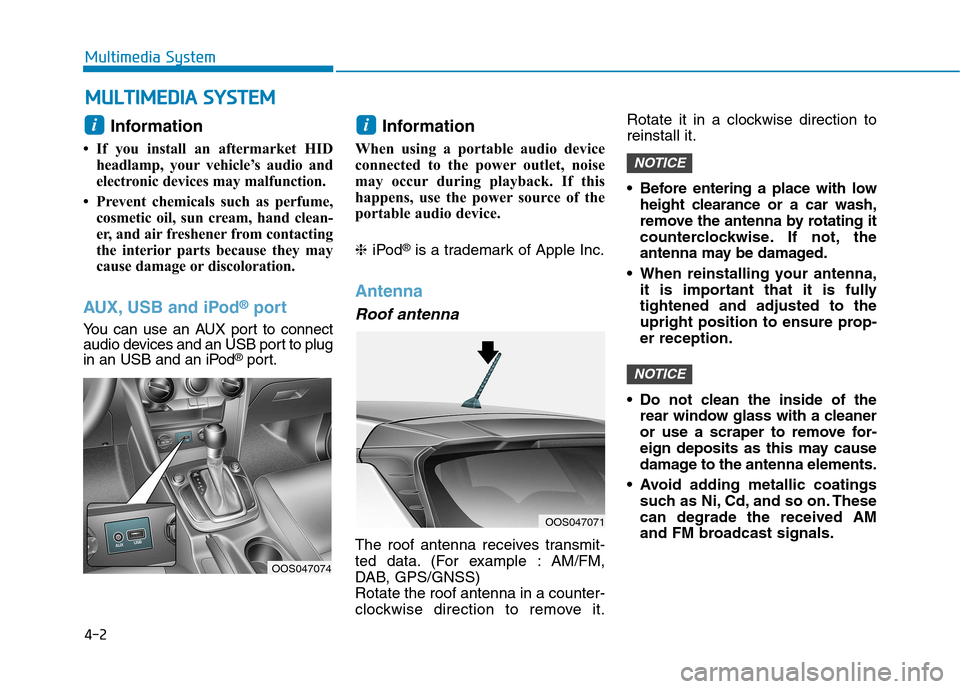
AUX, USB and iPod ®
port
You can use an AUX port to connect
audio devices and an USB port to plug
in an USB and an iPod ®
port. Information
When using a portable audio device
connected to the power outlet, noise
may occur during playback. If this
happens, use the power source of the
portable audio device. ❈ iPod ®
is a trademark of Apple Inc.
Antenna
Roof antenna
The roof antenna receives transmit-
ted data. (For example : AM/FM,
DAB, GPS/GNSS)Rotate the roof antenna in a counter-
clockwise direction to remove it. Rotate it in a clockwise direction toreinstall it.
Before entering a place with low
height clearance or a car wash,
remove the antenna by rotating it
counterclockwise. If not, the
antenna may be damaged.
When reinstalling your antenna, it is important that it is fullytightened and adjusted to the
upright position to ensure prop-er reception.
Do not clean the inside of the rear window glass with a cleaner
or use a scraper to remove for-
eign deposits as this may cause
damage to the antenna elements.
Avoid adding metallic coatings such as Ni, Cd, and so on. Thesecan degrade the received AM
and FM broadcast signals.
NOTICE
NOTICE
ii
MM UULLTT IIMM EEDD IIAA SS YY SSTT EEMM
OOS047071
OOS047074
Page 285 of 523
5-31
Driving your vehicle
5
Anti-lock Brake System (ABS)
ABS is an electronic braking system
that helps prevent a braking skid.
ABS allows the driver to steer and
brake at the same time.
Using ABS
To obtain the maximum benefit from
your ABS in an emergency situation,
do not attempt to modulate your
brake pressure and do not try to
pump your brakes. Depress your
brake pedal as hard as possible.
When you apply your brakes under
conditions which may lock the
wheels, you may hear sounds from
the brakes, or feel a corresponding
sensation in the brake pedal. This is
normal and it means your ABS is
active. ABS does not reduce the time or dis-
tance it takes to stop the vehicle.
Always maintain a safe distance from
the vehicle in front of you.
ABS will not prevent a skid that results from sudden changes in
direction, such as trying to take a
corner too fast or making a sudden
lane change. Always drive at a safe
speed for the road and weather con-
ditions.
An Anti-Lock Braking System
(ABS) or an Electronic Stability
Control (ESC) system will not
prevent accidents due to
improper or dangerous driving
maneuvers. Even though vehi-
cle control is improved during
emergency braking, always
maintain a safe distance
between you and objects ahead
of you. Vehicle speeds should
always be reduced during
extreme road conditions. The
braking distance for vehicles
equipped with ABS or ESC may
be longer than for those without
these systems in the following
road conditions.
Drive your vehicle at reduced
speeds during the followingconditions:
Rough, gravel or snow-cov-
ered roads.
WARNING
On roads where the road sur-
face is pitted or has differentsurface height.
Tire chains are installed on
your vehicle.
The safety features of an ABS
or ESC equipped vehicle should
not be tested by high speed
driving or cornering. This could
endanger the safety of yourself
or others.
Page 315 of 523

5-61
Driving your vehicle
5
- A trailer or carrier is installed. Touse the BCW system, remove the
trailer or carrier from your vehicle.
If any of these conditions occur, the
light on the BCW switch and the sys-
tem will turn off automatically.
When the BCW canceled warning
message is displayed in the cluster,
check to make sure that the rear
bumper is free from any dirt or snowin the areas where the sensor is
located. Remove any dirt, snow, or
foreign material that could interfere
with the radar sensors.
After any dirt or debris is removed,
the BCW system should operate nor-
mally after about 10 minutes of driv-
ing the vehicle.
If the system still does not operate
normally have your vehicle inspected
by an authorized HYUNDAI dealer.
Information
Turn off the system by pressing the
BCW switch and deselecting Rear
Cross-Traffic Collision warning
(RCCW) from the User Settings mode
on the cluster, when using a trailer or
carrier behind your vehicle.
Check Blind-Spot Collision
Warning (BCW) system
If there is a problem with the BCW
system, a warning message will
appear and the light on the switch
will turn off. The system will turn off
automatically. We recommend that
you have your vehicle inspected by
an authorized HYUNDAI dealer.
Limitations of the system
The driver must be cautious in the
below situations, because the sys-
tem may not detect other vehicles or
objects in certain circumstances.
When a trailer or carrier is installed.
The vehicle drives in inclement weather such as heavy rain or
snow.
The sensor is polluted with rain, snow, mud, etc.
The rear bumper where the sensor is located is covered with a foreign
object such as a bumper sticker, a
bumper guard, a bike rack, etc.
The rear bumper is damaged, or the sensor is out of the original
default position.
The vehicle height gets lower or higher due to heavy loading in the
luggage compartment, abnormal
tire pressure, etc.
When the temperature near the rear bumper area is high or low.
i
■Type A■Type B
OOS057078L/OOS057079L
Page 316 of 523
5-62
Driving your vehicle
When the sensors are blocked byother vehicles, walls or parking-lot
pillars.
The vehicle drives on a curved road or through a tollgate.
The vehicle is driven near areas containing metal substances such
as a construction zone, railroad,etc.
There is a fixed object near the vehicle, such as a guardrail, per-son, animal, etc.
While going down or up a steep road where the height of the lane is
different.
When driving through a narrow road with many trees or bushes.
When driving on wet surfaces.
When driving through a large area with few vehicles or structures
around, such as a desert, ruralarea, etc.
A big vehicle is near such as a bus or truck.
When other vehicles are close to your vehicle.
When the other vehicle approach- es very close. When the detected vehicle also
moves back, as your vehicle drives
back.
While changing lanes.
If the vehicle has started at the same time as the vehicle next to
you and has accelerated.
When the other vehicle passes at a very fast speed.
When the vehicle in the next lane moves two lanes away from you
OR when the vehicle two lanes
away moves to the next lane to
you.
The vehicle is turning left or right at a crossroads.
A motorcycle or bicycle is near.
A flat trailer is near.
If there are small objects in the detecting area such as a shopping
cart, a baby stroller or pedestrian.
If there is a low height vehicle such as a sports car.The BCW indicator on the outer
side view mirror may not illuminate
properly when:
The outside rearview mirror hous-ing is damaged.
The mirror is covered with dirt, snow, or debris.
The window is covered with dirt, snow, or debris.
The window is tinted.
Page 454 of 523
7-42
Maintenance
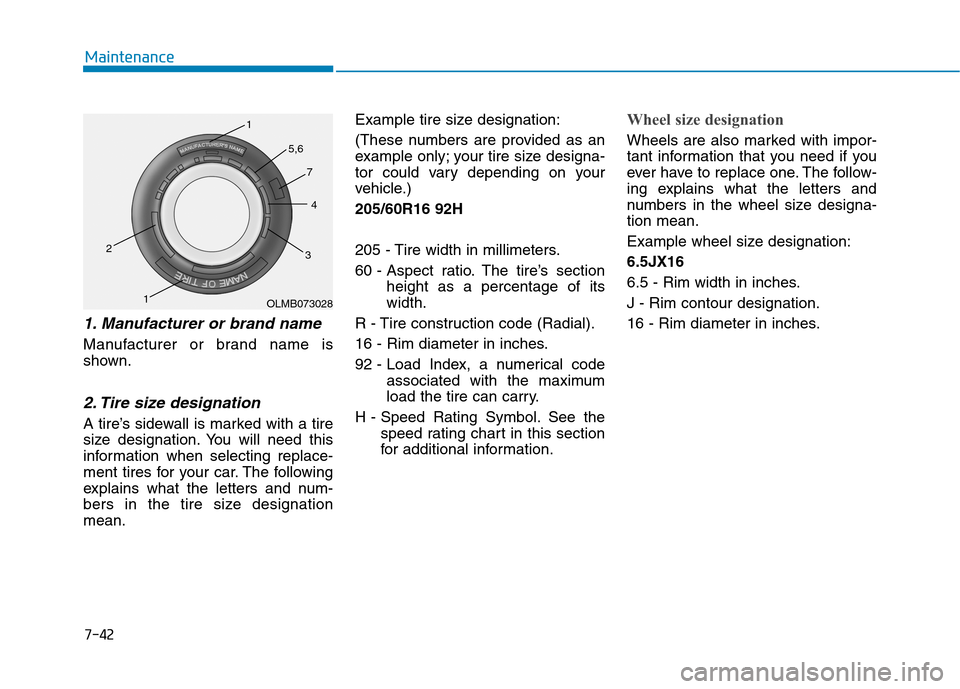
1. Manufacturer or brand name
Manufacturer or brand name is
shown.
2. Tire size designation
A tire’s sidewall is marked with a tire
size designation. You will need this
information when selecting replace-
ment tires for your car. The following
explains what the letters and num-
bers in the tire size designationmean.Example tire size designation:
(These numbers are provided as an
example only; your tire size designa-
tor could vary depending on your
vehicle.) 205/60R16 92H
205 - Tire width in millimeters.
60 - Aspect ratio. The tire’s section
height as a percentage of its width.
R - Tire construction code (Radial).
16 - Rim diameter in inches.
92 - Load Index, a numerical code associated with the maximum
load the tire can carry.
H - Speed Rating Symbol. See the speed rating chart in this section
for additional information.
Wheel size designation
Wheels are also marked with impor-
tant information that you need if you
ever have to replace one. The follow-
ing explains what the letters and
numbers in the wheel size designa-tion mean.
Example wheel size designation:6.5JX16
6.5 - Rim width in inches.J - Rim contour designation.
16 - Rim diameter in inches.
OLMB073028
1
1
2
34
5,6
7
Page 482 of 523
7-70
Maintenance
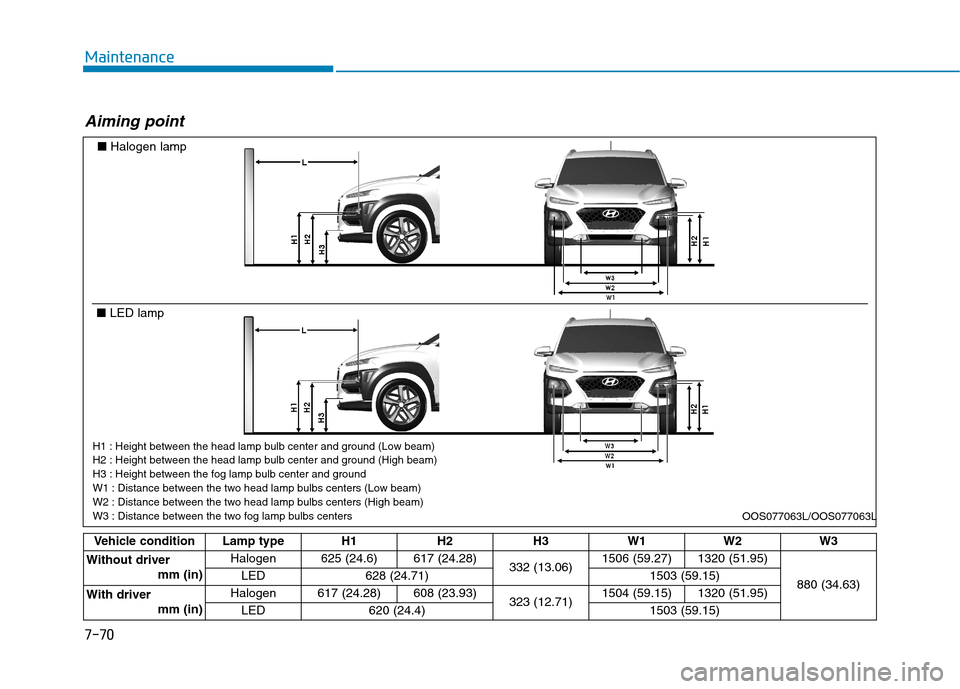
Aiming point
Vehicle condition Lamp type H1 H2 H3 W1 W2 W3
Without driver mm (in) Halogen 625 (24.6) 617 (24.28)
332 (13.06)1506 (59.27) 1320 (51.95)
880 (34.63)
LED 628 (24.71)
1503 (59.15)
With driver mm (in) Halogen 617 (24.28) 608 (23.93)
323 (12.71)1504 (59.15) 1320 (51.95)
LED 620 (24.4) 1503 (59.15)
■Halogen lamp
■ LED lamp
OOS077063L/OOS077063L
H1 : Height between the head lamp bulb center and ground (Low beam) H2 : Height between the head lamp bulb center and ground (High beam)H3 : Height between the fog lamp bulb center and groundW1 : Distance between the two head lamp bulbs centers (Low beam)W2 : Distance between the two head lamp bulbs centers (High beam)W3 : Distance between the two fog lamp bulbs centers
Page 501 of 523
8-2
Specifications & Consumer informationD
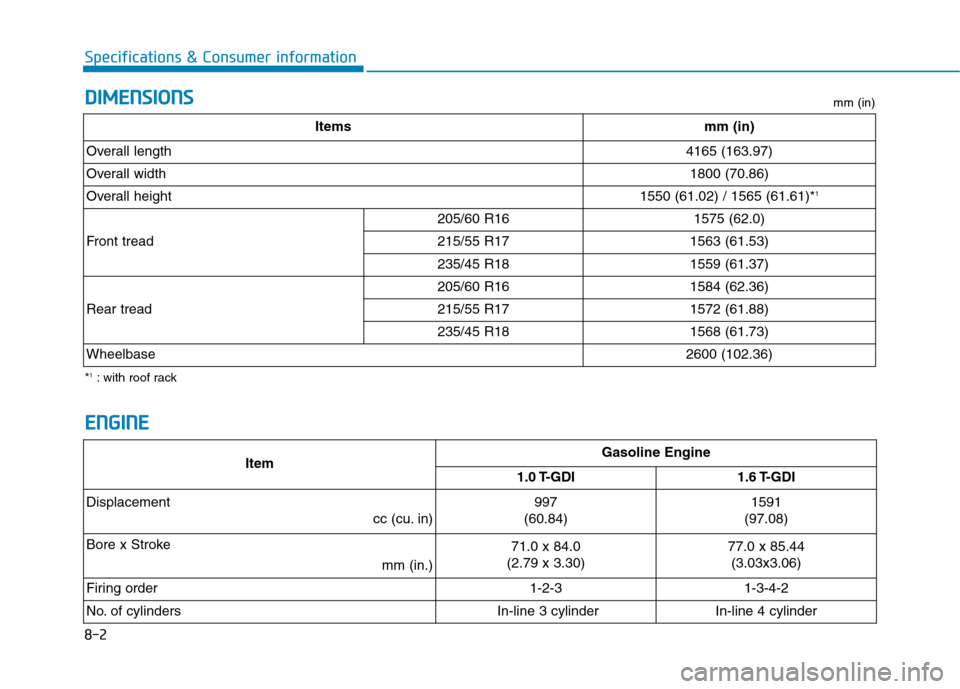
D IIMM EENN SSIIOO NNSS
E
E NN GGIINN EE
ItemGasoline Engine
1.0 T-GDI 1.6 T-GDI
Displacement cc (cu. in)
997
(60.84)1591
(97.08)
Bore x Stroke mm (in.)
71.0 x 84.0
(2.79 x 3.30)77.0 x 85.44 (3.03x3.06)
Firing order
1-2-31-3-4-2
No. of cylinders
In-line 3 cylinderIn-line 4 cylinder
* 1
: with roof rack mm (in)
Itemsmm (in)
Overall length4165 (163.97)
Overall width1800 (70.86)
Overall height1550 (61.02) / 1565 (61.61)*
1
Front tread
205/60 R161575 (62.0)
215/55 R171563 (61.53)
235/45 R181559 (61.37)
Rear tread
205/60 R161584 (62.36)
215/55 R171572 (61.88)
235/45 R181568 (61.73)
Wheelbase2600 (102.36)
Page 516 of 523
I-5
Engine compartment ...............................................1-8, 7-3
Engine compartment panel fuse replacement...............7-48
Engine coolant ..............................................................7-23
Engine coolant temperature gauge ...............................3-39
Engine number ..............................................................8-11
Engine oil......................................................................7-21
Engine specification .......................................................8-2
Engine start/stop button ..................................................5-9
Evaporative emission control System ..........................7-85
Exhaust emission control system .................................7-86
Explanation of scheduled maintenance items ..............7-19
Exterior care .................................................................7-78
Exterior overview ..........................................................1-2
Front view ..................................................................1-2
Rear view ...................................................................1-3
Floor mat anchor(s) ....................................................3-136
Fluid Brake/clutch fluid.....................................................7-26
Washer fluid .............................................................7-27
Forward Collision-Avoidance Assist (FCA) system ....5-63
Four Wheel Drive (4WD).............................................5-41
Front seat adjustment......................................................2-7 Manual adjustment .....................................................2-7
Power adjustment .......................................................2-9
Seatback pocket........................................................2-11
Adjusting the height up and down ...........................2-16 Forward and rearward adjustment ...........................2-16
Removal/Reinstall ....................................................2-17
Fuel filler door ..............................................................3-34
Fuel gauge.....................................................................3-39
Fuel requirements ...........................................................F-6
Unleaded ....................................................................F-6
Leaded ........................................................................F-7
Gasoline containing alcohol and methanol................F-7
Other fuels..................................................................F-7
Use of MTBE.............................................................F-8
Do not use methanol ..................................................F-8
Fuel Additives ............................................................F-8
Operation in foreign countries ...................................F-8
Fuses .............................................................................7-46 Instrument panel fuse replacement ..........................7-47
Fuse switch...............................................................7-48
Blade type fuse.........................................................7-48
Cartridge type fuse ...................................................7-48
Engine compartment panel fuse replacement ..........7-48
Main fuse..................................................................7-49
Multi fuse .................................................................7-49
Fuse/relay panel description ....................................7-50
Gauges and meters........................................................3-38
Glove box ...................................................................3-128
I
Index
F
G