shift Hyundai Kona 2018 Repair Manual
[x] Cancel search | Manufacturer: HYUNDAI, Model Year: 2018, Model line: Kona, Model: Hyundai Kona 2018Pages: 523, PDF Size: 33.6 MB
Page 371 of 523
6-4
What to do in an emergency
If you have a flat tire while driving
If a tire goes flat while you are driving:
Take your foot off the acceleratorpedal and let the vehicle slow
down while driving straight ahead.
Do not apply the brakes immedi-ately or attempt to pull off the road
as this may cause loss of vehiclecontrol resulting in an accident.
When the vehicle has slowed to
such a speed that it is safe to do
so, brake carefully and pull off the
road. Drive off the road as far as
possible and park on firm, level
ground. If you are on a divided
highway, do not park in the median
area between the two traffic lanes. When the vehicle is stopped, press
the hazard warning flasher button,
move the shift lever into P (Park,
for dual clutch transmission vehicle)
or neutral (for manual transmission
vehicle), apply the parking brake,
and place the ignition switch in theLOCK/OFF position.
Have all passengers get out of the vehicle. Be sure they all get out on
the side of the vehicle that is away
from traffic.
When changing a flat tire, follow the instructions provided later in
this chapter.If the engine doesn't turn over
or turns over slowly
Be sure the shift lever is in N(Neutral) or P (Park) if it is dual
clutch transmission vehicle. The
engine starts only when the shift
lever is in N (Neutral) or P (Park).
Check the battery connections to be sure they are clean and tight.
Turn on the interior light. If the light dims or goes out when you operate
the starter, the battery is drained.
Do not push or pull the vehicle to start
it. This could cause damage to your
vehicle. See instructions for "Jump
Starting" provided in this chapter.
II FF TT HH EE EE NN GGIINN EE WW IILL LL NN OO TT
S
S TT AA RRTT
Push or pull starting the vehicle
may cause the catalytic con-
verter to overload which can
lead to damage to the emission
control system.
CAUTION
Page 375 of 523
6-8
What to do in an emergency
If your temperature gauge indicates
overheating, you experience a loss
of power, or hear loud pinging or
knocking, the engine may be over-
heating. If this happens, you should:
1. Pull off the road and stop as soonas it is safe to do so.
2. Place the shift lever in P (Park, for dual clutch transmission vehicle)
or neutral (for manual transmis-
sion/dual clutch transmission vehi-
cle) and set the parking brake. If
the air conditioning is ON, turn it
OFF.
3. If engine coolant is running out under the vehicle or steam is com-ing out from the hood, stop the
engine. Do not open the hood until
the coolant has stopped running
or the steaming has stopped. If
there is no visible loss of engine
coolant and no steam, leave the
engine running and check to be
sure the engine cooling fan is
operating. If the fan is not running,
turn the engine off. 4. Check for coolant leaking from the
radiator, hoses or under the vehi-
cle. (If the air conditioning had been
in use, it is normal for cold water to
be draining from it when you stop.)
5. If engine coolant is leaking out, stop the engine immediately and we rec-
ommend that you call an authorized
HYUNDAI dealer for assistance.
IIFF TT HH EE EE NN GGIINN EE OO VVEERR HH EEAA TTSS
While the engine is
running, keep hands,
clothing and tools
away from the mov-
ing parts such as thecooling fan and drive
belt to prevent seri-
ous injury.
WARNING
NEVER remove the radiator cap or thedrain plug while theengine and radiator
are hot. Hot coolant
and steam may blow out under
pressure, causing serious injury.
Turn the engine off and wait
until the engine cools down.
Use extreme care when remov-
ing the radiator cap. Wrap a
thick towel around it, and turn it
counterclockwise slowly to the
first stop. Step back while the
pressure is released from the
cooling system. When you aresure all the pressure has been
released, press down on the
cap, using a thick towel, and
continue turning counterclock-
wise to remove it.
WARNING
Page 388 of 523
6-21
What to do in an emergency
6
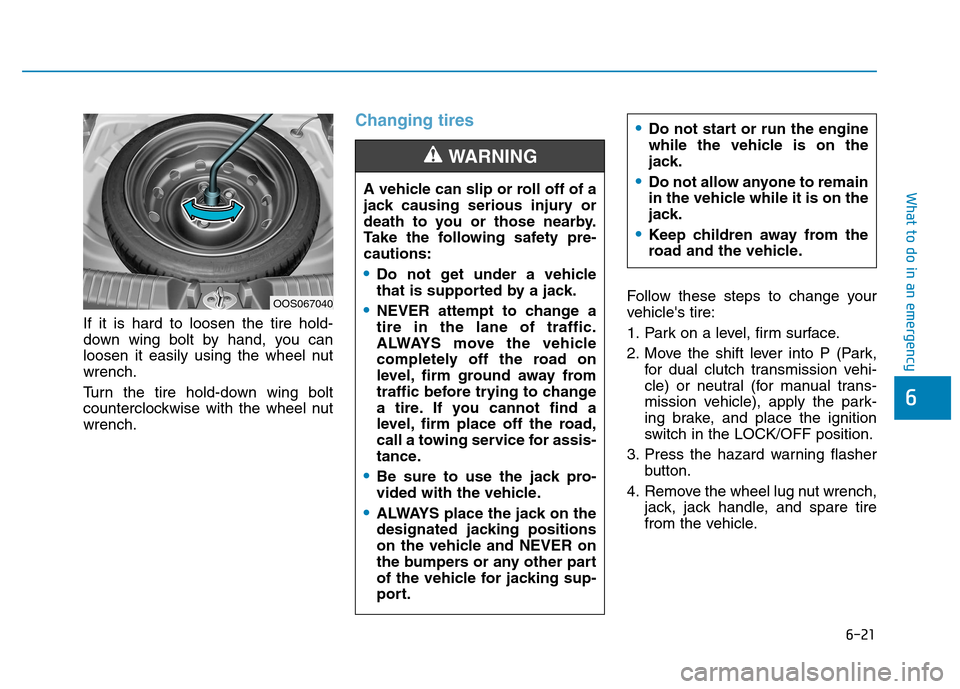
If it is hard to loosen the tire hold-
down wing bolt by hand, you can
loosen it easily using the wheel nutwrench.
Turn the tire hold-down wing bolt
counterclockwise with the wheel nutwrench.
Changing tires
Follow these steps to change your
vehicle's tire:
1. Park on a level, firm surface.
2. Move the shift lever into P (Park,for dual clutch transmission vehi-
cle) or neutral (for manual trans-
mission vehicle), apply the park-
ing brake, and place the ignition
switch in the LOCK/OFF position.
3. Press the hazard warning flasher button.
4. Remove the wheel lug nut wrench, jack, jack handle, and spare tire
from the vehicle.
A vehicle can slip or roll off of a
jack causing serious injury or
death to you or those nearby.
Take the following safety pre-cautions:
Do not get under a vehicle
that is supported by a jack.
NEVER attempt to change a tire in the lane of traffic.
ALWAYS move the vehicle
completely off the road on
level, firm ground away from
traffic before trying to change
a tire. If you cannot find a
level, firm place off the road,
call a towing service for assis-
tance.
Be sure to use the jack pro-
vided with the vehicle.
ALWAYS place the jack on the
designated jacking positions
on the vehicle and NEVER on
the bumpers or any other part
of the vehicle for jacking sup-
port.
WARNING
Do not start or run the engine
while the vehicle is on the
jack.
Do not allow anyone to remain
in the vehicle while it is on the
jack.
Keep children away from the
road and the vehicle.
OOS067040
Page 393 of 523
6-26
What to do in an emergency
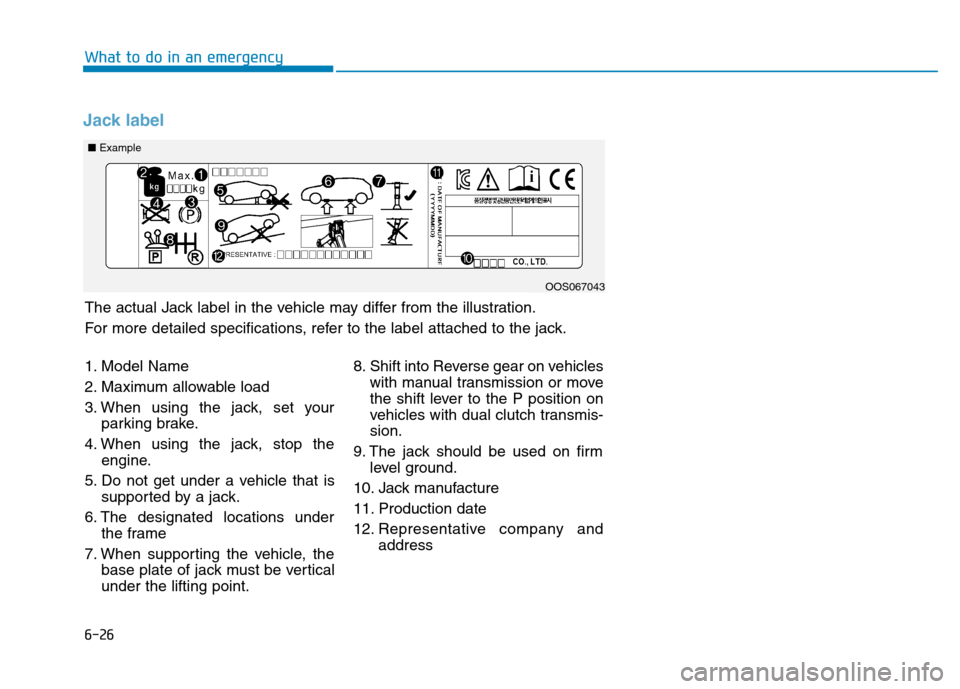
Jack label
■Example
OOS067043
1. Model Name
2. Maximum allowable load
3. When using the jack, set your parking brake.
4. When using the jack, stop the engine.
5. Do not get under a vehicle that is supported by a jack.
6. The designated locations under the frame
7. When supporting the vehicle, the base plate of jack must be vertical under the lifting point. 8. Shift into Reverse gear on vehicles
with manual transmission or move
the shift lever to the P position on
vehicles with dual clutch transmis-sion.
9. The jack should be used on firm level ground.
10. Jack manufacture
11. Production date
12. Representative company and address
The actual Jack label in the vehicle may differ from the illustration.
For more detailed specifications, refer to the label attached to the jack.
Page 409 of 523
6-42
What to do in an emergency
When towing your vehicle in an emergency without wheel dollies:
1. Place the ignition switch in theACC position.
2. Place the shift lever in N (Neutral).
3. Release the parking brake.
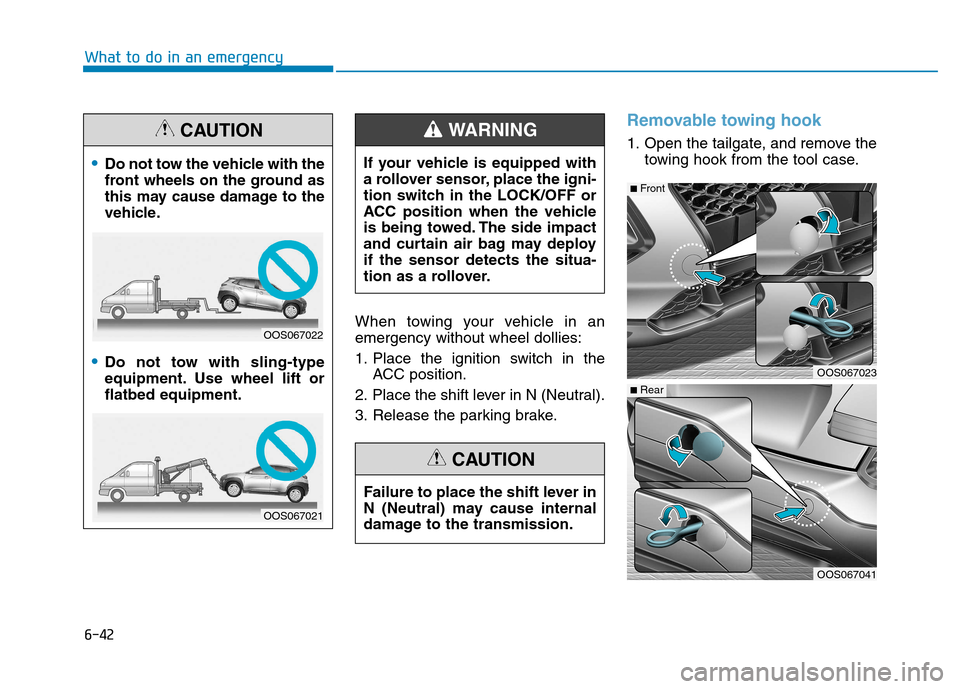
Removable towing hook
1. Open the tailgate, and remove the towing hook from the tool case.
Do not tow the vehicle with the
front wheels on the ground as
this may cause damage to the
vehicle.
Do not tow with sling-type
equipment. Use wheel lift orflatbed equipment.
CAUTION
OOS067022
OOS067021 Failure to place the shift lever in
N (Neutral) may cause internal
damage to the transmission.
CAUTION
If your vehicle is equipped with
a rollover sensor, place the igni-
tion switch in the LOCK/OFF or
ACC position when the vehicle
is being towed. The side impact
and curtain air bag may deployif the sensor detects the situa-
tion as a rollover.
WARNING
OOS067023
OOS067041
■
Front
■Rear
Page 411 of 523
6-44
What to do in an emergency
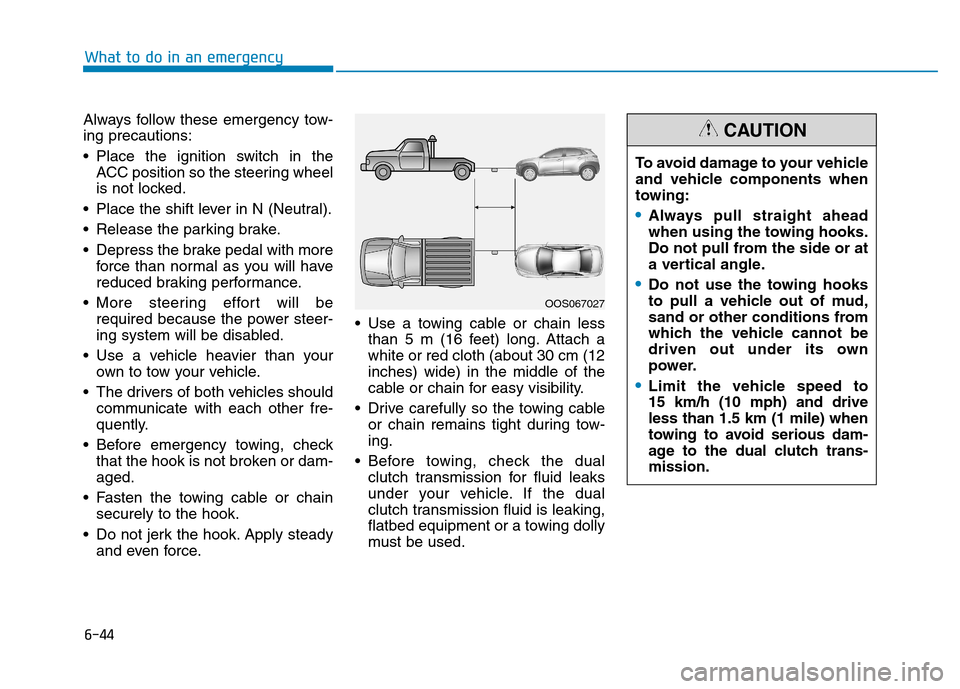
Always follow these emergency tow- ing precautions:
Place the ignition switch in theACC position so the steering wheel
is not locked.
Place the shift lever in N (Neutral).
Release the parking brake.
Depress the brake pedal with more force than normal as you will have
reduced braking performance.
More steering effort will be required because the power steer-
ing system will be disabled.
Use a vehicle heavier than your own to tow your vehicle.
The drivers of both vehicles should communicate with each other fre-
quently.
Before emergency towing, check that the hook is not broken or dam-aged.
Fasten the towing cable or chain securely to the hook.
Do not jerk the hook. Apply steady and even force. Use a towing cable or chain less
than 5 m (16 feet) long. Attach awhite or red cloth (about 30 cm (12inches) wide) in the middle of the
cable or chain for easy visibility.
Drive carefully so the towing cable or chain remains tight during tow-ing.
Before towing, check the dual clutch transmission for fluid leaks
under your vehicle. If the dual
clutch transmission fluid is leaking,
flatbed equipment or a towing dolly
must be used.
OOS067027 To avoid damage to your vehicle
and vehicle components when
towing:
Always pull straight ahead
when using the towing hooks.
Do not pull from the side or at
a vertical angle.
Do not use the towing hooks
to pull a vehicle out of mud,
sand or other conditions from
which the vehicle cannot be
driven out under its own
power.
Limit the vehicle speed to 15 km/h (10 mph) and driveless than 1.5 km (1 mile) when
towing to avoid serious dam-
age to the dual clutch trans-mission.
CAUTION
Page 417 of 523
7-5
7
Maintenance
OOWW NNEERR MM AAIINN TTEENN AANN CCEE
The following lists are vehicle checks and inspections that should be per-
formed by the owner or an authorized
HYUNDAI dealer at the frequencies
indicated to help ensure safe, depend-
able operation of your vehicle.
Any adverse conditions should be
brought to the attention of your dealer
as soon as possible.
These Owner Maintenance vehicle
checks are generally not covered by
warranties and you may be charged
for labor, parts and lubricants used.
Owner maintenance schedule
When you stop for fuel:
Check the engine oil level.
Check the coolant level in the
engine coolant reservoir.
Check the windshield washer fluid level.
Check for low or under-inflated tires.
Performing maintenance work
on a vehicle can be dangerous.
If you lack sufficient knowledge
and experience or the propertools and equipment to do the
work, we
recommend that the
system be serviced by an author-
ized HYUNDAI dealer. ALWAYS
follow these precautions for
performing maintenance work:
Park your vehicle on level
ground, move the shift lever
into the P (Park, for dual
clutch transmission vehicle)
position or neutral (for manu-
al transmission vehicle) posi-
tion, apply the parking brake,
and place the ignition switchin the LOCK/ OFF position.
Block the tires (front and back)
to prevent the vehicle from
moving.
Remove loose clothing or jew-
elry that can become entan-
gled in moving parts.
WARNING If you must run the engine
during maintenance, do so
out doors or in an area withplenty of ventilation.
Keep flames, sparks, or smok-
ing materials away from the
battery and fuel-related parts.
Be careful when checking your
engine coolant level when the
engine is hot. This may result in
coolant being blown out of theopening and cause serious
burns and other injuries.
WARNING
Page 463 of 523
7-51
7
Maintenance
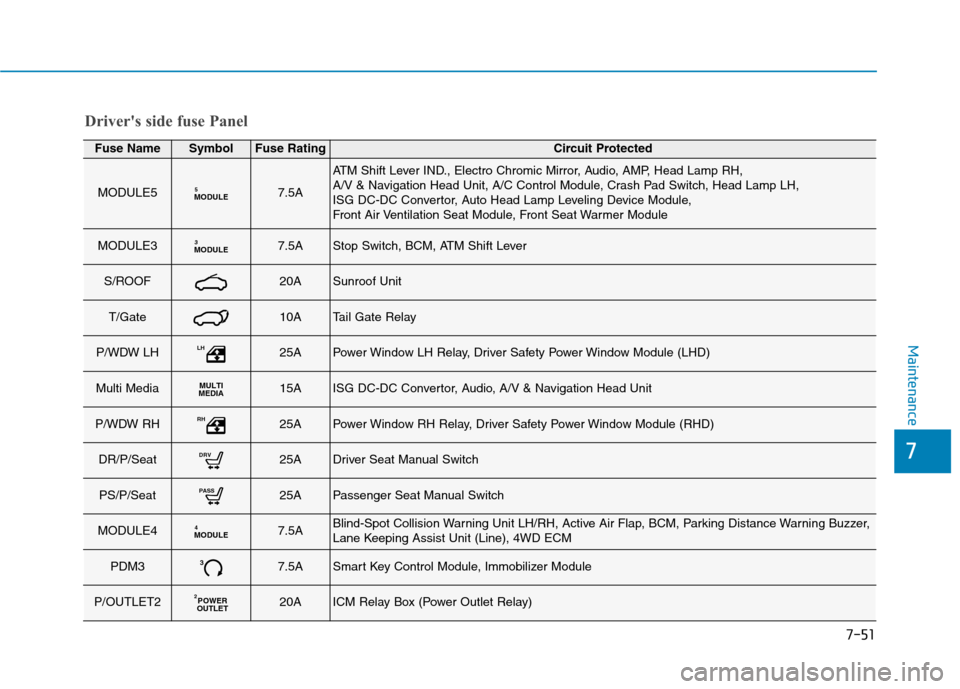
Driver's side fuse Panel
Fuse NameSymbolFuse RatingCircuit Protected
MODULE5MODULE57.5A
ATM Shift Lever IND., Electro Chromic Mirror, Audio, AMP, Head Lamp RH,
A/V & Navigation Head Unit, A/C Control Module, Crash Pad Switch, Head Lamp LH,
ISG DC-DC Convertor, Auto Head Lamp Leveling Device Module,
Front Air Ventilation Seat Module, Front Seat Warmer Module
MODULE3MODULE37.5AStop Switch, BCM, ATM Shift Lever
S/ROOF20ASunroof Unit
T/Gate10ATail Gate Relay
P/WDW LHLH25APower Window LH Relay, Driver Safety Power Window Module (LHD)
Multi MediaMULTI
MEDIA15AISG DC-DC Convertor, Audio, A/V & Navigation Head Unit
P/WDW RHRH25APower Window RH Relay, Driver Safety Power Window Module (RHD)
DR/P/SeatDRV25ADriver Seat Manual Switch
PS/P/SeatPA SS25APassenger Seat Manual Switch
MODULE4MODULE47.5ABlind-Spot Collision Warning Unit LH/RH, Active Air Flap, BCM, Parking Distance Warning Buzzer,
Lane Keeping Assist Unit (Line), 4WD ECM
PDM337.5ASmart Key Control Module, Immobilizer Module
P/OUTLET2POWER
OUTLET
220AICM Relay Box (Power Outlet Relay)
Page 515 of 523
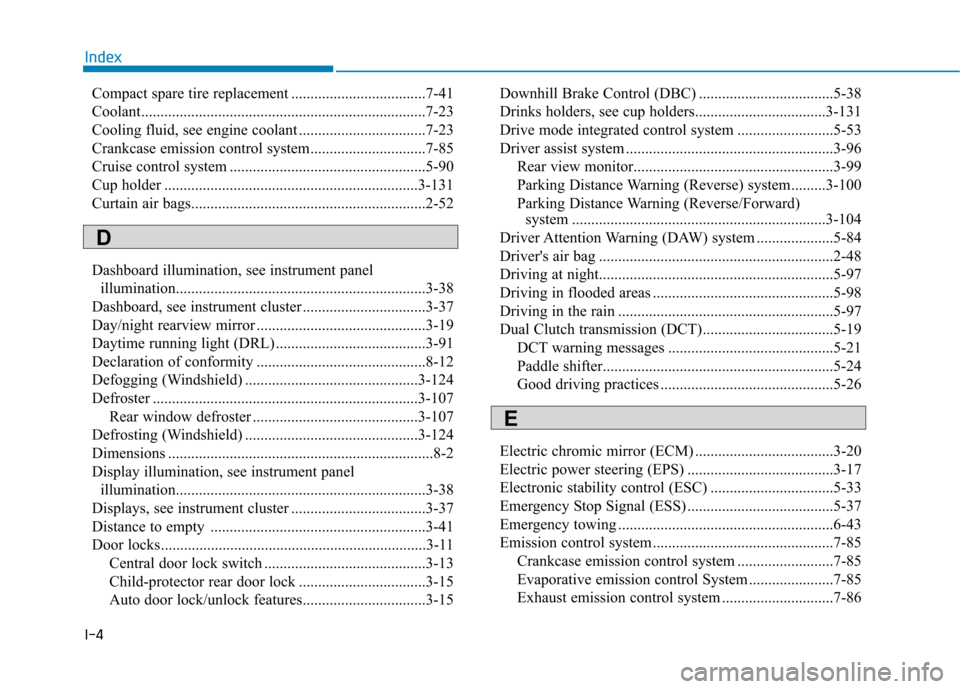
I-4Compact spare tire replacement ...................................7-41
Coolant..........................................................................7-23
Cooling fluid, see engine coolant .................................7-23
Crankcase emission control system..............................7-85
Cruise control system ...................................................5-90
Cup holder ..................................................................3-131
Curtain air bags.............................................................2-52
Dashboard illumination, see instrument panel illumination.................................................................3-38
Dashboard, see instrument cluster ................................3-37
Day/night rearview mirror ............................................3-19
Daytime running light (DRL) .......................................3-91
Declaration of conformity ............................................8-12
Defogging (Windshield) .............................................3-124
Defroster .....................................................................3-107 Rear window defroster ...........................................3-107
Defrosting (Windshield) .............................................3-124
Dimensions .....................................................................8-2
Display illumination, see instrument panel
illumination.................................................................3-38
Displays, see instrument cluster ...................................3-37
Distance to empty ........................................................3-41
Door locks.....................................................................3-11
Central door lock switch ..........................................3-13
Child-protector rear door lock .................................3-15
Auto door lock/unlock features................................3-15 Downhill Brake Control (DBC) ...................................5-38
Drinks holders, see cup holders..................................3-131
Drive mode integrated control system .........................5-53
Driver assist system ......................................................3-96
Rear view monitor....................................................3-99
Parking Distance Warning (Reverse) system.........3-100
Parking Distance Warning (Reverse/Forward) system ..................................................................3-104
Driver Attention Warning (DAW) system ....................5-84
Driver's air bag .............................................................2-48
Driving at night.............................................................5-97
Driving in flooded areas ...............................................5-98
Driving in the rain ........................................................5-97
Dual Clutch transmission (DCT)..................................5-19 DCT warning messages ...........................................5-21
Paddle shifter............................................................5-24
Good driving practices .............................................5-26
Electric chromic mirror (ECM) ....................................3-20
Electric power steering (EPS) ......................................3-17
Electronic stability control (ESC) ................................5-33
Emergency Stop Signal (ESS) ......................................5-37
Emergency towing ........................................................6-43
Emission control system ...............................................7-85 Crankcase emission control system .........................7-85
Evaporative emission control System ......................7-85
Exhaust emission control system .............................7-86
Index
D
E
Page 517 of 523
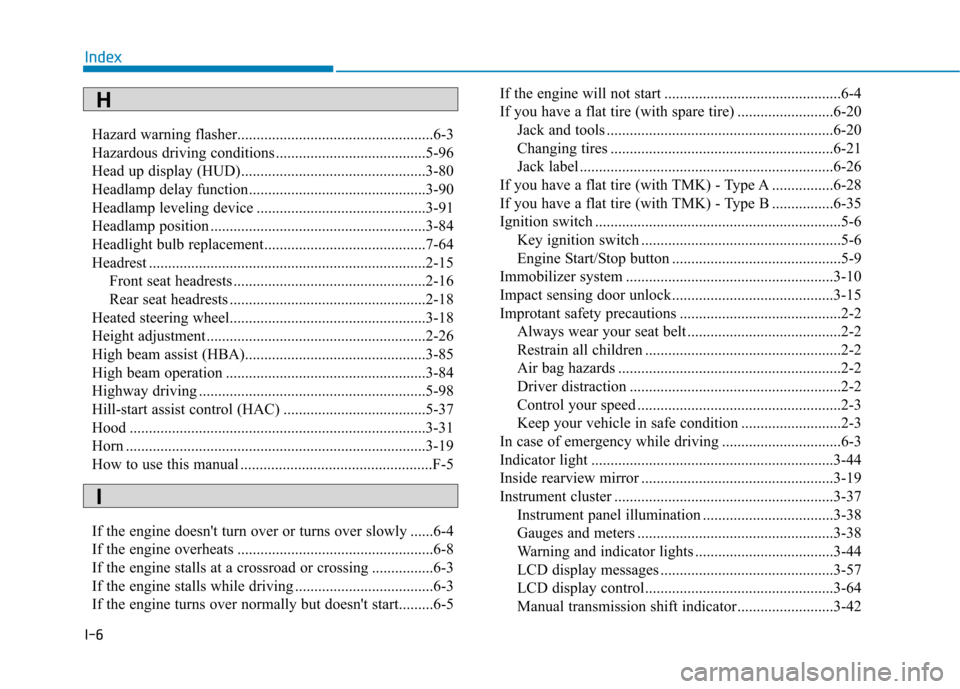
I-6Hazard warning flasher...................................................6-3
Hazardous driving conditions .......................................5-96
Head up display (HUD)................................................3-80
Headlamp delay function..............................................3-90
Headlamp leveling device ............................................3-91
Headlamp position ........................................................3-84
Headlight bulb replacement..........................................7-64
Headrest ........................................................................2-15
Front seat headrests ..................................................2-16
Rear seat headrests ...................................................2-18
Heated steering wheel...................................................3-18
Height adjustment .........................................................2-26
High beam assist (HBA)...............................................3-85
High beam operation ....................................................3-84
Highway driving ...........................................................5-98
Hill-start assist control (HAC) .....................................5-37
Hood .............................................................................3-31
Horn ..............................................................................3-19
How to use this manual ..................................................F-5
If the engine doesn't turn over or turns over slowly ......6-4
If the engine overheats ...................................................6-8
If the engine stalls at a crossroad or crossing ................6-3
If the engine stalls while driving ....................................6-3
If the engine turns over normally but doesn't start.........6-5 If the engine will not start ..............................................6-4
If you have a flat tire (with spare tire) .........................6-20
Jack and tools ...........................................................6-20
Changing tires ..........................................................6-21
Jack label ..................................................................6-26
If you have a flat tire (with TMK) - Type A ................6-28
If you have a flat tire (with TMK) - Type B ................6-35
Ignition switch ................................................................5-6
Key ignition switch ....................................................5-6
Engine Start/Stop button ............................................5-9
Immobilizer system ......................................................3-10
Impact sensing door unlock..........................................3-15
Improtant safety precautions ..........................................2-2 Always wear your seat belt ........................................2-2
Restrain all children ...................................................2-2
Air bag hazards ..........................................................2-2
Driver distraction .......................................................2-2
Control your speed .....................................................2-3
Keep your vehicle in safe condition ..........................2-3
In case of emergency while driving ...............................6-3
Indicator light ...............................................................3-44
Inside rearview mirror ..................................................3-19
Instrument cluster .........................................................3-37 Instrument panel illumination ..................................3-38
Gauges and meters ...................................................3-38
Warning and indicator lights ....................................3-44
LCD display messages .............................................3-57
LCD display control.................................................3-64
Manual transmission shift indicator.........................3-42
Index
H
I