oil change Hyundai Kona 2018 Owner's Manual
[x] Cancel search | Manufacturer: HYUNDAI, Model Year: 2018, Model line: Kona, Model: Hyundai Kona 2018Pages: 523, PDF Size: 33.6 MB
Page 197 of 523
3-114
Convenient features of your vehicle
System maintenance
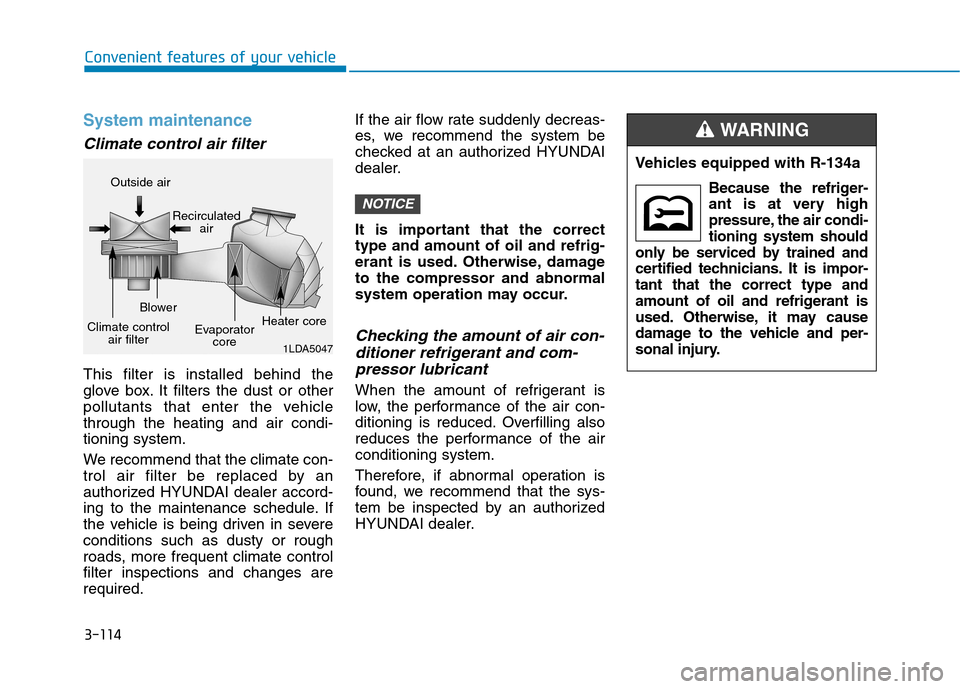
Climate control air filter
This filter is installed behind the
glove box. It filters the dust or other
pollutants that enter the vehiclethrough the heating and air condi-tioning system.
We recommend that the climate con-
trol air filter be replaced by an
authorized HYUNDAI dealer accord-
ing to the maintenance schedule. If
the vehicle is being driven in severeconditions such as dusty or rough
roads, more frequent climate controlfilter inspections and changes arerequired.If the air flow rate suddenly decreas-
es, we recommend the system be
checked at an authorized HYUNDAI
dealer.
It is important that the correct type and amount of oil and refrig-
erant is used. Otherwise, damageto the compressor and abnormal
system operation may occur.
Checking the amount of air con-
ditioner refrigerant and com-
pressor lubricant
When the amount of refrigerant is
low, the performance of the air con-
ditioning is reduced. Overfilling also
reduces the performance of the airconditioning system.
Therefore, if abnormal operation is
found, we recommend that the sys-
tem be inspected by an authorized
HYUNDAI dealer.
NOTICE
1LDA5047
Outside air
Recirculatedair
Climate control air filter Blower
Evaporatorcore Heater core
Vehicles equipped with R-134a
Because the refriger-
ant is at very high
pressure, the air condi-tioning system should
only be serviced by trained and
certified technicians. It is impor-tant that the correct type and
amount of oil and refrigerant is
used. Otherwise, it may cause
damage to the vehicle and per-sonal inju
ry.
WARNING
Page 205 of 523
3-122
Convenient features of your vehicle
Air conditioning system operation
tips
If the vehicle has been parked indirect sunlight during hot weather,
open the windows for a short time
to let the hot air inside the vehicle
escape.
achieved, switch back from therecirculated air to the fresh outsideair position.
To help reduce moisture inside of the windows on rainy or humid
days, decrease the humidity inside
the vehicle by operating the air con-
ditioning system with the windowsand sunroof closed.
Use the air conditioning system every month for a few minutes to
ensure maximum system perform-
ance.
excessively, the difference between
the temperature of the outside airand that of the windshield could
cause the outer surface of the wind-
shield to fog up, causing loss of vis-
ibility. In this case, set the mode
selection button to the position
and set the fan speed control knob
to the lowest speed setting.
System maintenance
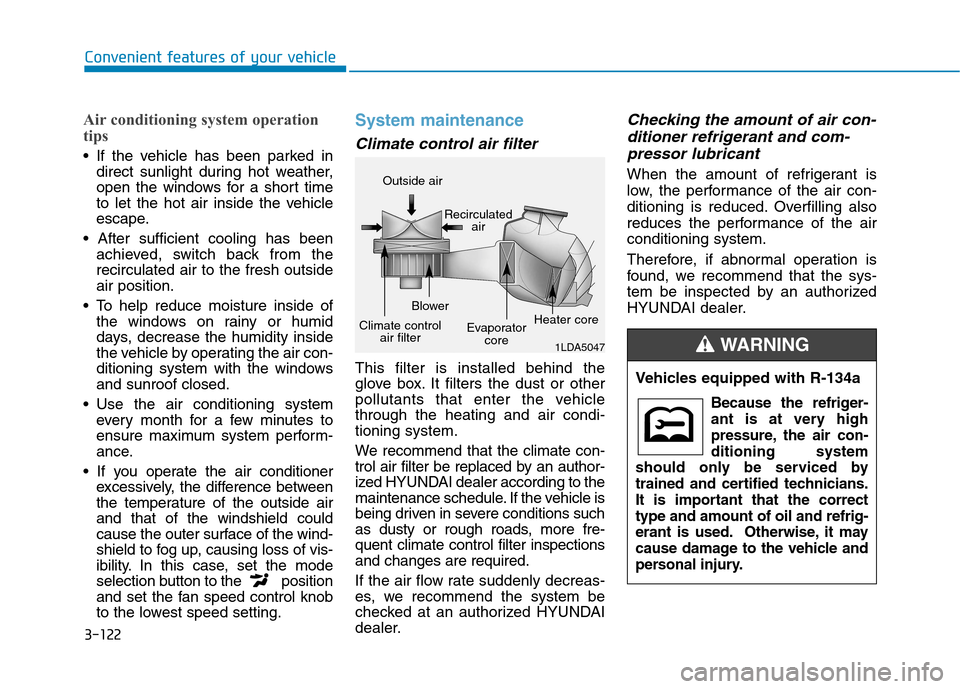
Climate control air filter
This filter is installed behind the
glove box. It filters the dust or other
pollutants that enter the vehiclethrough the heating and air condi-tioning system.
We recommend that the climate con-
trol air filter be replaced by an author-
ized HYUNDAI dealer according to the
maintenance schedule. If the vehicle is
being driven in severe conditions such
as dusty or rough roads, more fre-quent climate control filter inspectionsand changes are required.
If the air flow rate suddenly decreas-
es, we recommend the system be
checked at an authorized HYUNDAI
dealer.
Checking the amount of air con-
ditioner refrigerant and com-
pressor lubricant
When the amount of refrigerant is
low, the performance of the air con-
ditioning is reduced. Overfilling also
reduces the performance of the airconditioning system.
Therefore, if abnormal operation is
found, we recommend that the sys-
tem be inspected by an authorized
HYUNDAI dealer.
1LDA5047
Outside air
Recirculatedair
Climate control air filter Blower
Evaporatorcore Heater core
Vehicles equipped with R-134a
Because the refriger-
ant is at very high
pressure, the air con-ditioning system
should only be serviced by
trained and certified technicians.
It is important that the correcttype and amount of oil and refrig-
erant is used. Otherwise, it may
cause damage to the vehicle and
personal injury.
WARNING
Page 257 of 523
5-3
Driving your vehicle
5
Carbon monoxide (CO) gas is toxic. Breathing CO can cause unconsciousness and death.
Engine exhaust contains carbon monoxide which cannot be seen or smelled.
Do not inhale engine exhaust.
If at any time you smell engine exhaust inside the vehicle, open the windows immediately. Exposure to CO can cause
unconsciousness and death by asphyxiation.
Be sure the exhaust system does not leak.
The exhaust system should be checked whenever the vehicle is raised to change the oil or for any other purpose. If
you hear a change in the sound of the exhaust or if you drive over something that strikes the underneath side of the
vehicle, we recommend that the exhaust system be checked as soon as possible by an authorized HYUNDAI dealer.
Do not run the engine in an enclosed area.
Letting the engine idle in your garage, even with the garage door open, is a hazardous practice. Run the engine only
long enough to start the engine and to move the vehicle out of the garage.
Avoid idling the engine for prolonged periods with people inside the vehicle.
If it is necessary to idle the engine for a prolonged period with people inside the vehicle, be sure to do so only in an
open area with the air intake set at "Fresh" and fan control set to high so fresh air is drawn into the interior.
Keep the air intakes clear.
To assure proper operation of the ventilation system, keep the ventilation air intakes located in front of the windshield
clear of snow, ice, leaves, or other obstructions.
If you must drive with the tailgate open:
Close all windows.
Open instrument panel air vents.
Set the air intake control at "Fresh", the air flow control at "Floor" or "Face", and the fan control set to high.
WARNING
Page 336 of 523
5-82
Driving your vehicle
The vehicle is driven on a steepincline.
The steering wheel is turned sud- denly.
Limitations of the System
The LKA system may operate pre-
maturely even if the vehicle does not
depart from the intended lane, OR,
the LKA system may not assist your
steering or warn you if the vehicle
leaves the intended lane under the
following circumstances:
When the lane and road condi- tions are poor
It is difficult to distinguish the lanemarking from the road surface or
the lane marking is faded or not
clearly marked.
It is difficult to distinguish the color of the lane marker from the road.
There are markings on the road surface that look like a lane marker
that is inadvertently being detected
by the camera.
The lane marker is merged or divided. (e.g. tollgate) The lane number increases or
decreases or the lane marker are
crossing complicatedly.
There are more than two lane markers on the road in front of you.
The lane marker is very thick or thin.
The lanes ahead are not visible due to rain, snow, water on theroad, damaged or stained road
surface, or other factors.
The shadow is on the lane marker by a median strip, trees, etc.
The lanes are incomplete or the area is in a construction zone.
There are crosswalk signs or other symbols on the road.
The lane marker in a tunnel is stained with oil, etc.
The lane suddenly disappears such as at the intersection. When external condition is inter-vened
The brightness outside changes
suddenly such as when entering or
exiting a tunnel, or when passing
under a bridge.
The brightness outside is too low such as when the headlamps are
not on at night or the vehicle isgoing through a tunnel.
There is a boundary structure in the roadway such as a concrete
barrier, guardrail and reflector post
that is inadvertently being detected
by the camera.
When light coming from a street light or an oncoming vehicle is
reflected on a wet road surfacesuch as a puddle in the road.
The field of view in front is obstructed by sun glare.
There is not enough distance between you and the vehicle in
front to be able to detect the lane
marker or the vehicle ahead is driv-
ing on the lane marker.
Page 356 of 523
5-102
Driving your vehicle
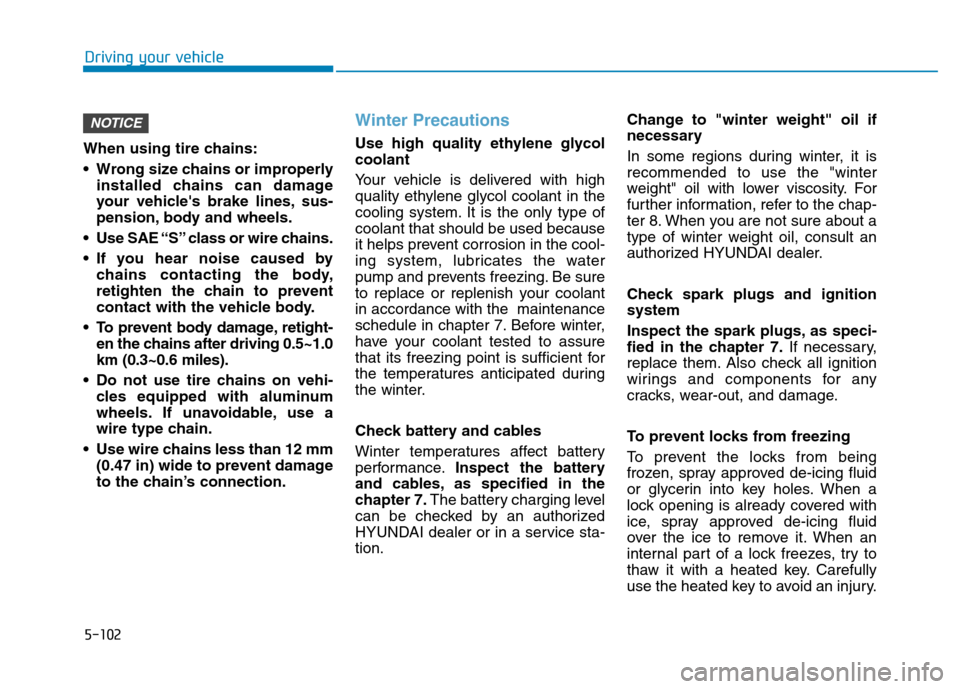
When using tire chains:
Wrong size chains or improperlyinstalled chains can damage
your vehicle's brake lines, sus-
pension, body and wheels.
Use SAE “S” class or wire chains.
If you hear noise caused by chains contacting the body,
retighten the chain to prevent
contact with the vehicle body.
To prevent body damage, retight- en the chains after driving 0.5~1.0km (0.3~0.6 miles).
Do not use tire chains on vehi- cles equipped with aluminum
wheels. If unavoidable, use a
wire type chain.
Use wire chains less than 12 mm (0.47 in) wide to prevent damage
to the chain’s connection.
Winter Precautions
Use high quality ethylene glycol coolant
Your vehicle is delivered with high
quality ethylene glycol coolant in the
cooling system. It is the only type ofcoolant that should be used because
it helps prevent corrosion in the cool-
ing system, lubricates the water
pump and prevents freezing. Be sure
to replace or replenish your coolantin accordance with the maintenance
schedule in chapter 7. Before winter,
have your coolant tested to assure
that its freezing point is sufficient for
the temperatures anticipated during
the winter.
Check battery and cables
Winter temperatures affect battery
performance. Inspect the battery
and cables, as specified in the
chapter 7. The battery charging level
can be checked by an authorized
HYUNDAI dealer or in a service sta-tion. Change to "winter weight" oil if
necessary
In some regions during winter, it is recommended to use the "winter
weight" oil with lower viscosity. For
further information, refer to the chap-
ter 8. When you are not sure about a
type of winter weight oil, consult an
authorized HYUNDAI dealer.
Check spark plugs and ignition system
Inspect the spark plugs, as speci-
fied in the chapter 7.
If necessary,
replace them. Also check all ignition
wirings and components for any
cracks, wear-out, and damage.
To prevent locks from freezing
To prevent the locks from being
frozen, spray approved de-icing fluid
or glycerin into key holes. When a
lock opening is already covered with
ice, spray approved de-icing fluid
over the ice to remove it. When an
internal part of a lock freezes, try to
thaw it with a heated key. Carefully
use the heated key to avoid an injury.
NOTICE
Page 420 of 523
Maintenance
7-8
I : Inspect and if necessary, adjust, correct, clean or replace.
R : Replace or change.
** : The engine oil level should be checked regularly and maintained properly. Operating with an insufficient amount of oil can d
am-
age the engine, and such damage is not covered by warranty.
* 1
: Inspect drive belt tensioner, idler and alternator pulley and if necessary correct or replace.
* 2
: Check the engine oil level and leak every 500 km (350 miles) or before starting a long trip.
* 3
: If good quality gasolines meet Europe Fuel standards (EN228) or equivalents including fuel additives is not available, one bot -
tle of additive is recommended. Additives are available from your authorized HYUNDAI dealer along with information on how to
use them. Do not mix other additives.
* 4
: For your convenience, it can be replaced prior to it's interval when you do maintenance of other items.
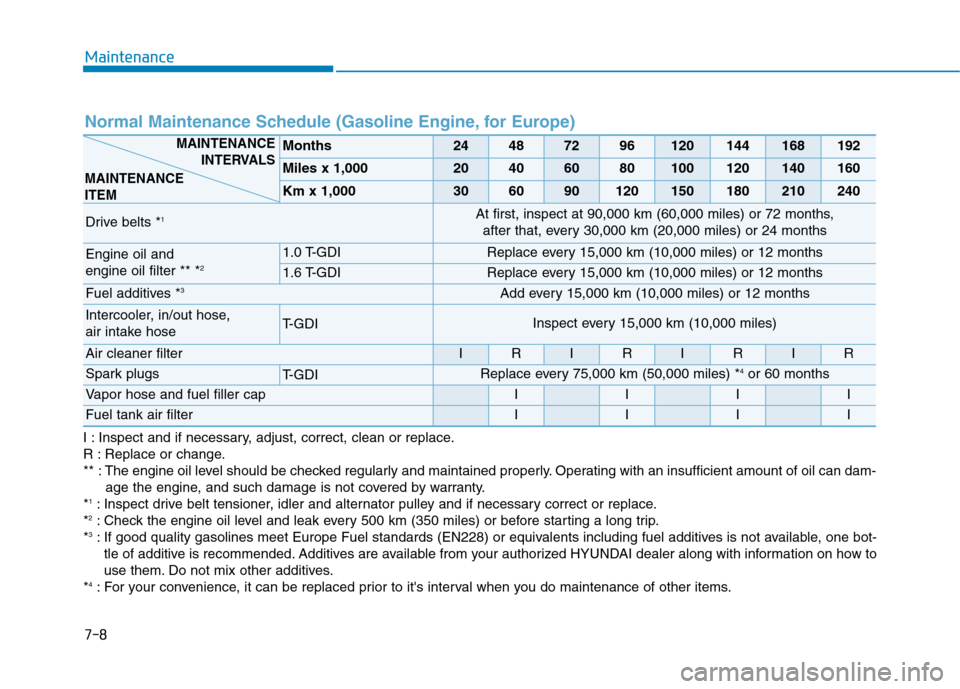
Normal Maintenance Schedule (Gasoline Engine, for Europe)
Months24487296120144168192
Miles x 1,00020406080100120140160
Km x 1,000306090120150180210240
Drive belts * 1At first, inspect at 90,000 km (60,000 miles) or 72 months,
after that, every 30,000 km (20,000 miles) or 24 months
Engine oil and engine oil filter ** * 21.0 T-GDIReplace every 15,000 km (10,000 miles) or 12 months
1.6 T-GDIReplace every 15,000 km (10,000 miles) or 12 months
Fuel additives *3Add every 15,000 km (10,000 miles) or 12 months
Intercooler, in/out hose,
air intake hose T-GDIInspect every 15,000 km (10,000 miles)
Air cleaner filterIRIRIRIR
Spark plugsT-GDIReplace every 75,000 km (50,000 miles) * 4
or 60 months
Vapor hose and fuel filler capIIII
Fuel tank air filterIIII
MAINTENANCE
INTERVALS
MAINTENANCE ITEM
Page 422 of 523
Maintenance
7-10
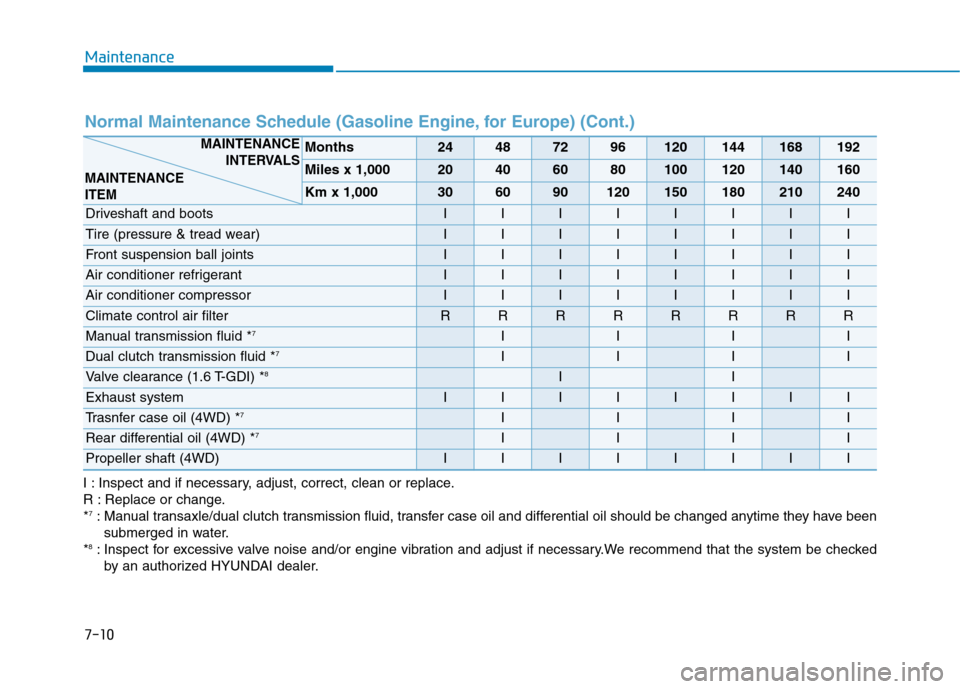
Normal Maintenance Schedule (Gasoline Engine, for Europe) (Cont.)
I : Inspect and if necessary, adjust, correct, clean or replace.
R : Replace or change.*7
: Manual transaxle/dual clutch transmission fluid, transfer case oil and differential oil should be changed anytime they have be en
submerged in water.
* 8
: Inspect for excessive valve noise and/or engine vibration and adjust if necessary.We recommend that the system be checked
by an authorized HYUNDAI dealer.
Months24487296120144168192
Miles x 1,00020406080100120140160
Km x 1,000306090120150180210240
Driveshaft and bootsIIIIIIII
Tire (pressure & tread wear)IIIIIIII
Front suspension ball jointsIIIIIIII
Air conditioner refrigerant IIIIIIII
Air conditioner compressor IIIIIIII
Climate control air filter RRRRRRRR
Manual transmission fluid * 7IIII
Dual clutch transmission fluid * 7IIII
Valve clearance (1.6 T-GDI) *8II
Exhaust systemIIIIIIII
Trasnfer case oil (4WD) *7IIII
Rear differential oil (4WD) * 7IIII
Propeller shaft (4WD)IIIIIIII
MAINTENANCE
INTERVALS
MAINTENANCE ITEM
Page 425 of 523
7-13
7
Maintenance
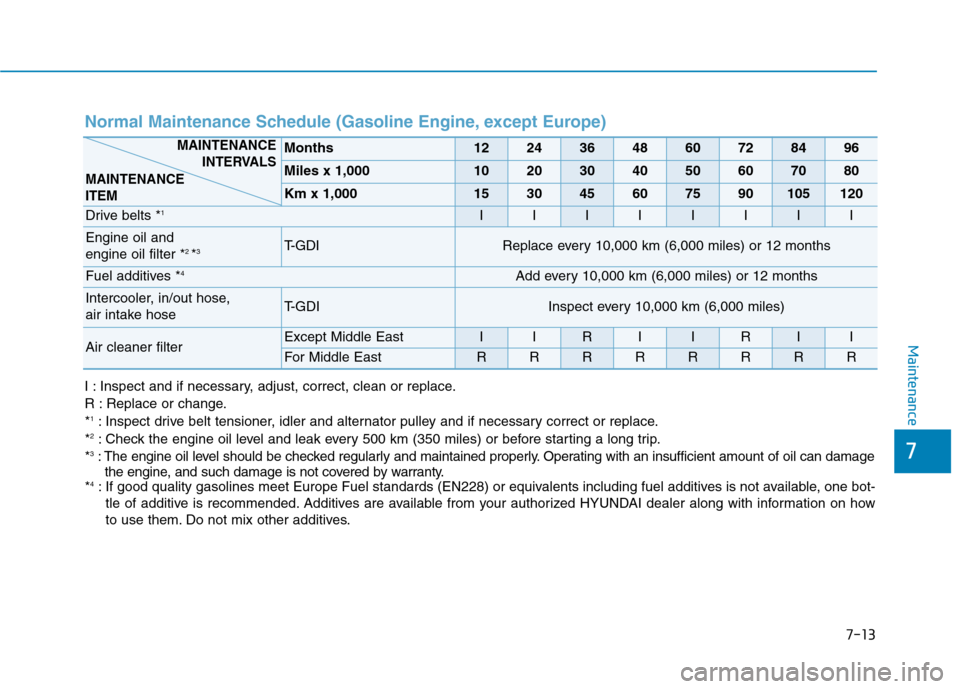
Normal Maintenance Schedule (Gasoline Engine, except Europe)
Months1224364860728496
Miles x 1,0001020304050607080
Km x 1,000153045607590105120
Drive belts *1IIIIIIII
Engine oil and engine oil filter * 2
*3T-GDIReplace every 10,000 km (6,000 miles) or 12 months
Fuel additives * 4Add every 10,000 km (6,000 miles) or 12 months
Intercooler, in/out hose,
air intake hoseT-GDIInspect every 10,000 km (6,000 miles)
Air cleaner filter Except Middle EastIIRIIRII
For Middle EastRRRRRRRR
I : Inspect and if necessary, adjust, correct, clean or replace.
R : Replace or change.*1
: Inspect drive belt tensioner, idler and alternator pulley and if necessary correct or replace.
* 2
: Check the engine oil level and leak every 500 km (350 miles) or before starting a long trip.
* 3
: The engine oil level should be checked regularly and maintained properly. Operating with an insufficient amount of oil can dama ge
the engine, and such damage is not covered by warranty.
* 4
: If good quality gasolines meet Europe Fuel standards (EN228) or equivalents including fuel additives is not available, one bot -
tle of additive is recommended. Additives are available from your authorized HYUNDAI dealer along with information on how
to use them. Do not mix other additives.
MAINTENANCE INTERVALS
MAINTENANCEITEM
Page 428 of 523
Maintenance
7-16
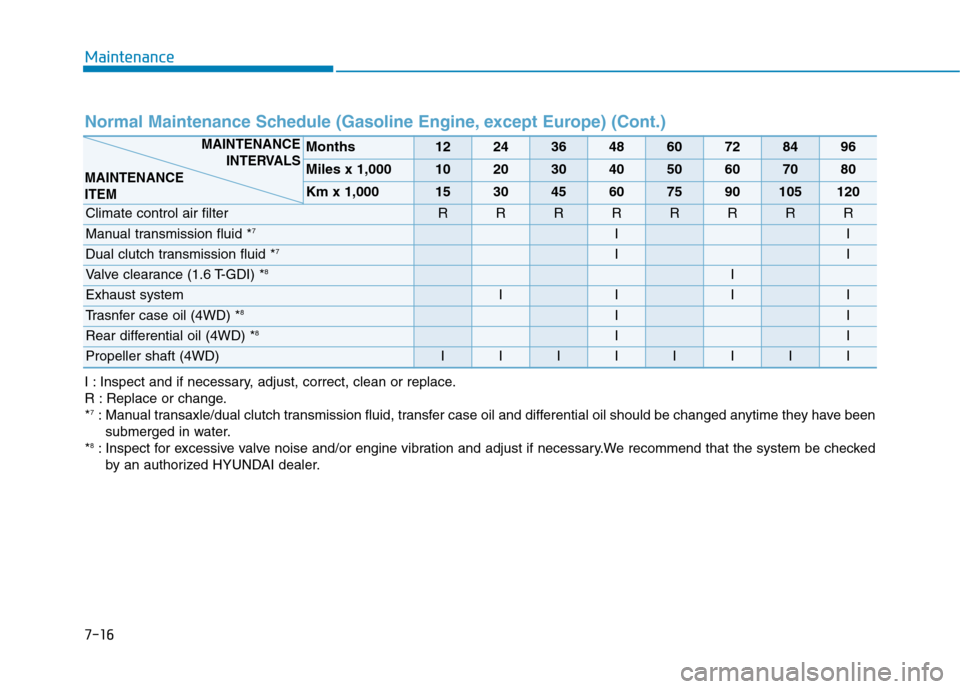
Normal Maintenance Schedule (Gasoline Engine, except Europe) (Cont.)
Months1224364860728496
Miles x 1,0001020304050607080
Km x 1,000153045607590105120
Climate control air filter RRRRRRRR
Manual transmission fluid *7II
Dual clutch transmission fluid * 7II
Valve clearance (1.6 T-GDI) *8I
Exhaust systemIIII
Trasnfer case oil (4WD) *8II
Rear differential oil (4WD) * 8II
Propeller shaft (4WD)IIIIIIII
I : Inspect and if necessary, adjust, correct, clean or replace.
R : Replace or change.*7
: Manual transaxle/dual clutch transmission fluid, transfer case oil and differential oil should be changed anytime they have be en
submerged in water.
* 8
: Inspect for excessive valve noise and/or engine vibration and adjust if necessary.We recommend that the system be checked
by an authorized HYUNDAI dealer.
MAINTENANCE INTERVALS
MAINTENANCEITEM
Page 431 of 523
7-19
7
Maintenance
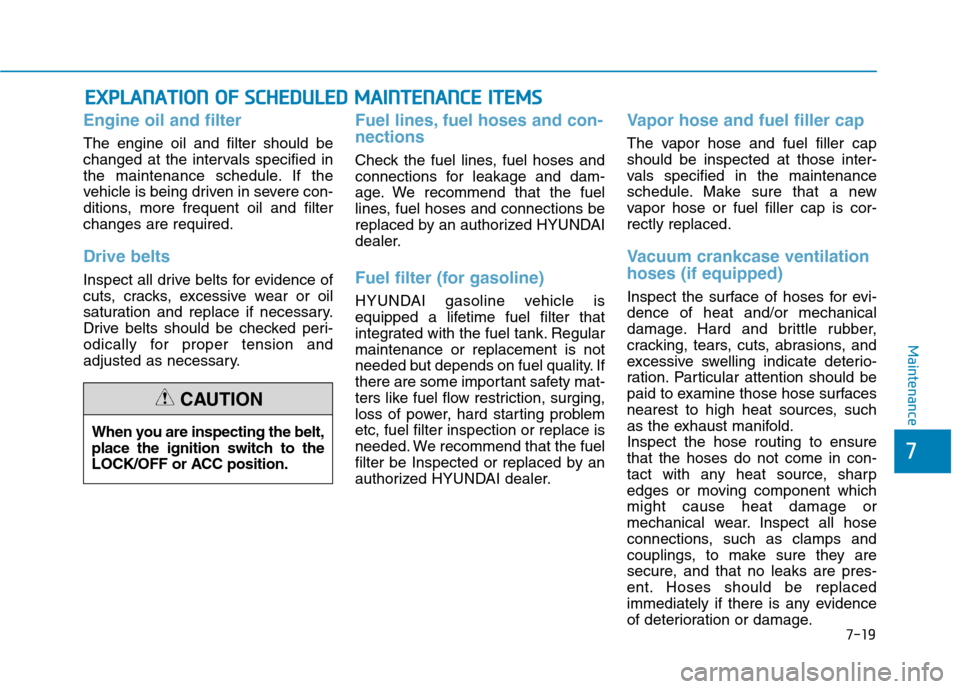
EEXX PPLLAA NN AATTIIOO NN OO FF SS CC HH EEDD UU LLEE DD MM AAIINN TTEENN AANN CCEE IITT EEMM SS
Engine oil and filter
The engine oil and filter should be
changed at the intervals specified in
the maintenance schedule. If the
vehicle is being driven in severe con-
ditions, more frequent oil and filterchanges are required.
Drive belts
Inspect all drive belts for evidence of
cuts, cracks, excessive wear or oil
saturation and replace if necessary.
Drive belts should be checked peri-
odically for proper tension and
adjusted as necessary.
Fuel lines, fuel hoses and con- nections
Check the fuel lines, fuel hoses and
connections for leakage and dam-
age. We recommend that the fuel
lines, fuel hoses and connections be
replaced by an authorized HYUNDAI
dealer.
Fuel filter (for gasoline)
HYUNDAI gasoline vehicle is
equipped a lifetime fuel filter that
integrated with the fuel tank. Regularmaintenance or replacement is not
needed but depends on fuel quality. If
there are some important safety mat-
ters like fuel flow restriction, surging,
loss of power, hard starting problem
etc, fuel filter inspection or replace is
needed. We recommend that the fuel
filter be Inspected or replaced by an
authorized HYUNDAI dealer.
Vapor hose and fuel filler cap
The vapor hose and fuel filler cap should be inspected at those inter-
vals specified in the maintenance
schedule. Make sure that a new
vapor hose or fuel filler cap is cor-rectly replaced.
Vacuum crankcase ventilation hoses (if equipped)
Inspect the surface of hoses for evi- dence of heat and/or mechanical
damage. Hard and brittle rubber,
cracking, tears, cuts, abrasions, and
excessive swelling indicate deterio-
ration. Particular attention should be
paid to examine those hose surfaces
nearest to high heat sources, such
as the exhaust manifold.Inspect the hose routing to ensurethat the hoses do not come in con-
tact with any heat source, sharp
edges or moving component whichmight cause heat damage or
mechanical wear. Inspect all hose
connections, such as clamps and
couplings, to make sure they are
secure, and that no leaks are pres-
ent. Hoses should be replaced
immediately if there is any evidence
of deterioration or damage.
When you are inspecting the belt,
place the ignition switch to the
LOCK/OFF or ACC position.
CAUTION