lock Hyundai Kona 2018 Owner's Manual
[x] Cancel search | Manufacturer: HYUNDAI, Model Year: 2018, Model line: Kona, Model: Hyundai Kona 2018Pages: 523, PDF Size: 33.6 MB
Page 8 of 523
F8
Introduction
Use of MTBE
HYUNDAI recommends avoiding
fuels containing MTBE (Methyl
Tertiary Butyl Ether) over 15.0% vol.
(Oxygen Content 2.7% weight) in
your vehicle.
Fuel containing MTBE over 15.0%
vol. (Oxygen Content 2.7% weight)
may reduce vehicle performance and
produce vapor lock or hard starting.
Do not use methanol
Fuels containing methanol (wood
alcohol) should not be used in your
vehicle.This type of fuel can reduce
vehicle performance and damagecomponents of the fuel system, enginecontrol system and emission controlsystem.
Fuel Additives
HYUNDAI recommends that you useunleaded gasoline which has an
octane rating of RON (Research
Octane Number) 95 / AKI (Anti Knock
Index) 91 or higher (for Europe) or
Octane Rating of RON (Research
Octane Number) 91 / AKI (Anti-Knock
Index) 87 or higher (except Europe).
For customers who do not use goodquality gasolines including fuel addi-
tives regularly, and have problems
starting or the engine does not run
smoothly, one bottle of additives added
to the fuel tank at every 15,000km (for
Europe) / 10,000km (except Europe).
Additives are available from your
authorized HYUNDAI dealer along
with information on how to use them.
Do not mix other additives.
Operation in foreign countries
If you are going to drive your vehicle
in another country, be sure to:
Observe all regulations regarding registration and insurance.
Determine that acceptable fuel is available.
Your New Vehicle Limited
Warranty may not cover dam-
age to the fuel system and any
performance problems that are
caused by the use of fuels con-taining methanol or fuels con-
taining MTBE (Methyl Tertiary
Butyl Ether) over 15.0% vol.
(Oxygen Content 2.7% weight.)
CAUTION
Page 15 of 523
1-4
Your vehicle at a glanceI
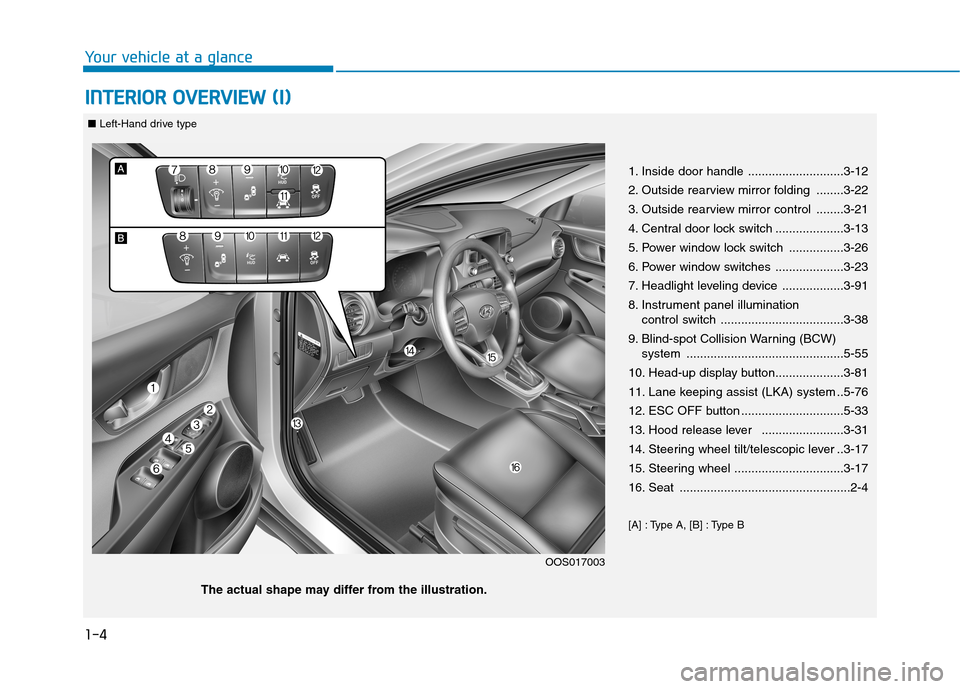
I NN TTEERR IIOO RR OO VVEERR VV IIEE WW (( II))
1. Inside door handle ............................3-12
2. Outside rearview mirror folding ........3-22
3. Outside rearview mirror control ........3-21
4. Central door lock switch ....................3-13
5. Power window lock switch ................3-26
6. Power window switches ....................3-23
7. Headlight leveling device ..................3-91
8. Instrument panel illumination
control switch ....................................3-38
9. Blind-spot Collision Warning (BCW) system ..............................................5-55
10. Head-up display button....................3-81
11. Lane keeping assist (LKA) system ..5-76
12. ESC OFF button ..............................5-33
13. Hood release lever ........................3-31
14. Steering wheel tilt/telescopic lever ..3-17
15. Steering wheel ................................3-17
16. Seat ..................................................2-4
[A] : Type A, [B] : Type B
OOS017003
The actual shape may differ from the illustration.
■ Left-Hand drive type
Page 16 of 523
1-5
Your vehicle at a glance
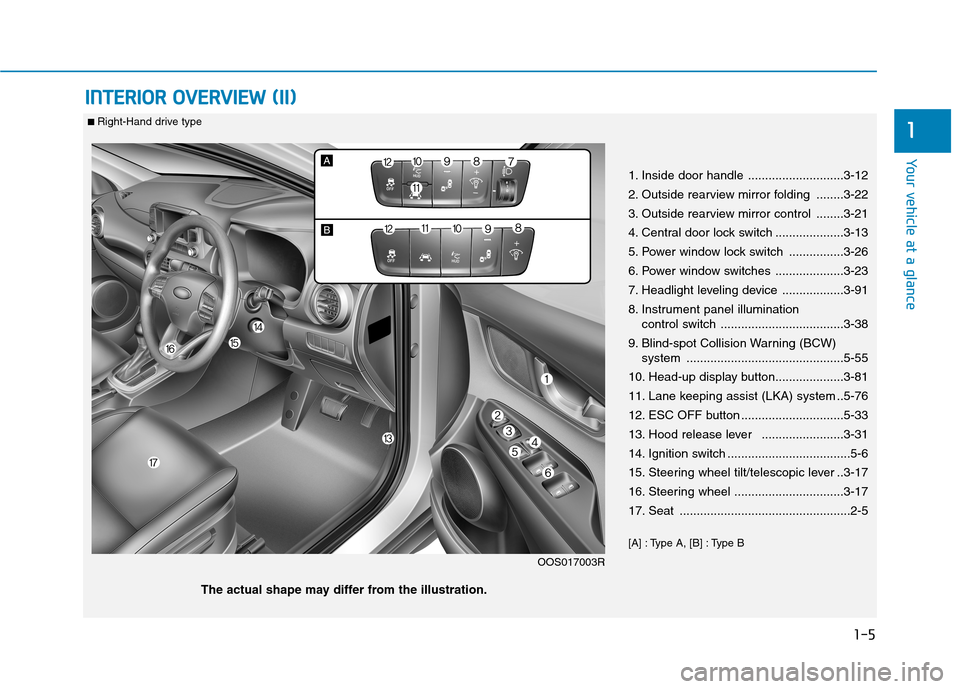
IINN TTEERR IIOO RR OO VVEERR VV IIEE WW (( IIII))
1
1. Inside door handle ............................3-12
2. Outside rearview mirror folding ........3-22
3. Outside rearview mirror control ........3-21
4. Central door lock switch ....................3-13
5. Power window lock switch ................3-26
6. Power window switches ....................3-23
7. Headlight leveling device ..................3-91
8. Instrument panel illumination
control switch ....................................3-38
9. Blind-spot Collision Warning (BCW) system ..............................................5-55
10. Head-up display button....................3-81
11. Lane keeping assist (LKA) system ..5-76
12. ESC OFF button ..............................5-33
13. Hood release lever ........................3-31
14. Ignition switch ....................................5-6
15. Steering wheel tilt/telescopic lever ..3-17
16. Steering wheel ................................3-17
17. Seat ..................................................2-5
[A] : Type A, [B] : Type B
OOS017003R
The actual shape may differ from the illustration.
■ Right-Hand drive type
Page 17 of 523
1-6
Your vehicle at a glanceI
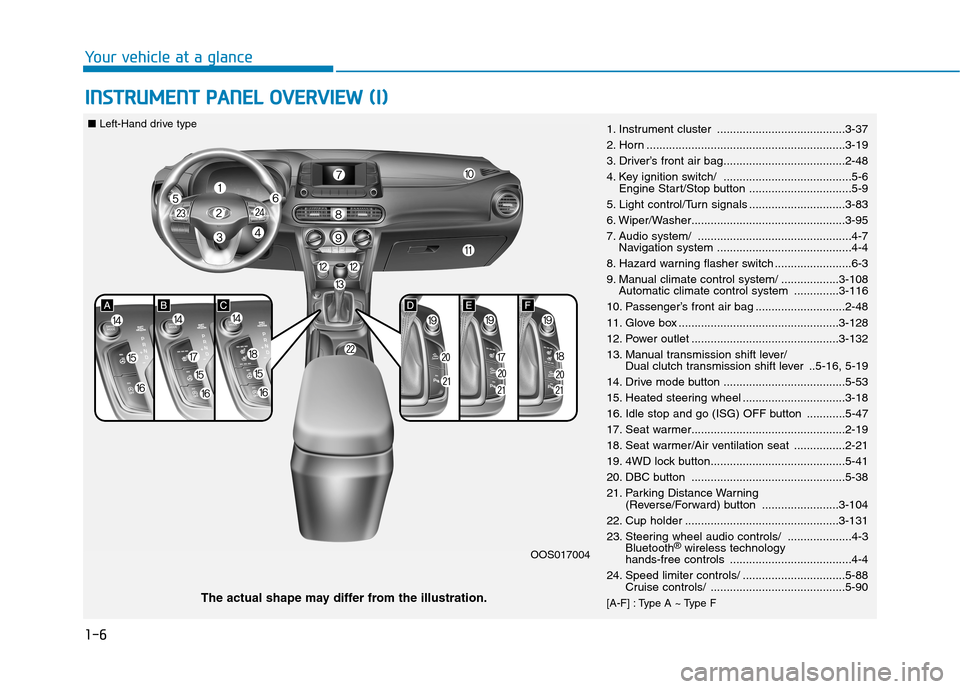
I NN SSTT RR UU MM EENN TT PP AA NN EELL OO VVEERR VV IIEE WW (( II))
1. Instrument cluster ........................................3-37
2. Horn ..............................................................3-19
3. Driver’s front air bag......................................2-48
4. Key ignition switch/ ........................................5-6
Engine Start/Stop button ................................5-9
5. Light control/Turn signals ..............................3-83
6. Wiper/Washer................................................3-95
7. Audio system/ ................................................4-7 Navigation system ..........................................4-4
8. Hazard warning flasher switch ........................6-3
9. Manual climate control system/ ..................3-108 Automatic climate control system ..............3-116
10. Passenger’s front air bag ............................2-48
11. Glove box ..................................................3-128
12. Power outlet ..............................................3-132
13. Manual transmission shift lever/ Dual clutch transmission shift lever ..5-16, 5-19
14. Drive mode button ......................................5-53
15. Heated steering wheel ................................3-18
16. Idle stop and go (ISG) OFF button ............5-47
17. Seat warmer................................................2-19
18. Seat warmer/Air ventilation seat ................2-21
19. 4WD lock button..........................................5-41
20. DBC button ................................................5-38
21. Parking Distance Warning (Reverse/Forward) button ........................3-104
22. Cup holder ................................................3-131
23. Steering wheel audio controls/ ....................4-3 Bluetooth ®
wireless technology
hands-free controls ......................................4-4
24. Speed limiter controls/ ................................5-88 Cruise controls/ ..........................................5-90
[A-F] : Type A ~ Type F
The actual shape may differ from the illustration. OOS017004
■
Left-Hand drive type
Page 18 of 523
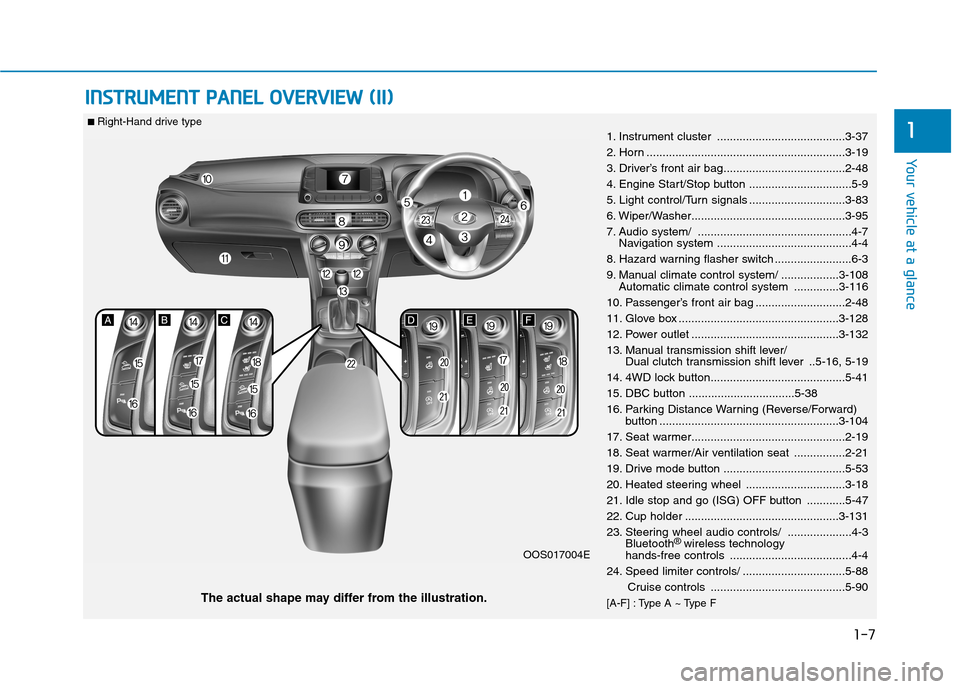
1-7
Your vehicle at a glance
IINN SSTT RR UU MM EENN TT PP AA NN EELL OO VVEERR VV IIEE WW (( IIII))
11. Instrument cluster ........................................3-37
2. Horn ..............................................................3-19
3. Driver’s front air bag......................................2-48
4. Engine Start/Stop button ................................5-9
5. Light control/Turn signals ..............................3-83
6. Wiper/Washer................................................3-95
7. Audio system/ ................................................4-7
Navigation system ..........................................4-4
8. Hazard warning flasher switch ........................6-3
9. Manual climate control system/ ..................3-108 Automatic climate control system ..............3-116
10. Passenger’s front air bag ............................2-48
11. Glove box ..................................................3-128
12. Power outlet ..............................................3-132
13. Manual transmission shift lever/ Dual clutch transmission shift lever ..5-16, 5-19
14. 4WD lock button..........................................5-41
15. DBC button .................................5-38
16. Parking Distance Warning (Reverse/Forward) button ........................................................3-104
17. Seat warmer................................................2-19
18. Seat warmer/Air ventilation seat ................2-21
19. Drive mode button ......................................5-53
20. Heated steering wheel ...............................3-18
21. Idle stop and go (ISG) OFF button ............5-47
22. Cup holder ................................................3-131
23. Steering wheel audio controls/ ....................4-3 Bluetooth ®
wireless technology
hands-free controls ......................................4-4
24. Speed limiter controls/ ................................5-88
Cruise controls ..........................................5-90
[A-F] : Type A ~ Type F
The actual shape may differ from the illustration. OOS017004E
■
Right-Hand drive type
Page 25 of 523
2-6
Safety system of your vehicle
Safety precautions
Adjusting the seats so that you are sit-
ting in a safe, comfortable position
plays an important role in driver and
passenger safety together with theseat belts and air bags in an accident.
Air bags
You can take steps to reduce the risk
of being injured by an inflating air
bag. Sitting too close to an air bag
greatly increases the risk of injury in
the event the air bag inflates. Move
your seat as far back as possible
from front air bags, while still main-
taining control of the vehicle.
Seat belts
Always fasten your seat belt before
starting any trip. At all times, passen-
gers should sit upright and be prop-
erly restrained. Infants and small
children must be restrained in appro-
priate Child Restraint Systems.
Children who have outgrown a
booster seat and adults must be
restrained using the seat belts.
Do not use a cushion that reduces
friction between the seat and the
passenger. The passenger's hips
may slide under the lap portionof the seat belt during an acci-
dent or a sudden stop. Serious or fatal internal injuries could result because the seat
belt cannot operate properly.
WARNING
To reduce the risk of serious
injury or death from an inflating
air bag, take the following pre-cautions:
•Adjust the driver’s seat as far
to the rear as possible main-
taining the ability to control the
vehicle.
Adjust the front passenger seat
as far to the rear as possible.
Hold the steering wheel by the
rim with hands at the 9 o’clock
and 3 o’clock positions to min-
imize the risk of injuries to
your hands and arms.
NEVER place anything or any-
one between you and the air
bag.
Do not allow the front passen-
ger to place feet or legs on the
dashboard to minimize the riskof leg injuries.
WARNING
Take the following precautions
when adjusting your seat belt:
NEVER use one seat belt for more than one occupant.
Always position the seatback
upright with the lap portion of
the seat belt snug and low
across the hips.
NEVER allow children or small
infants to ride on a passenger’slap.
Do not route the seat belt
across your neck, across sharp
edges, or reroute the shoulder
strap away from your body.
Do not allow the seat belt to become caught or jammed.
WARNING
Page 26 of 523
2-7
Safety system of your vehicle
2
Front seats
The front seat can be adjusted by
using the control lever (or knob) or
switches located on the outside of the
seat cushion. Before driving, adjustthe seat to the proper position so that
you can easily control the steering
wheel, foot pedals and controls on the
instrument panel.
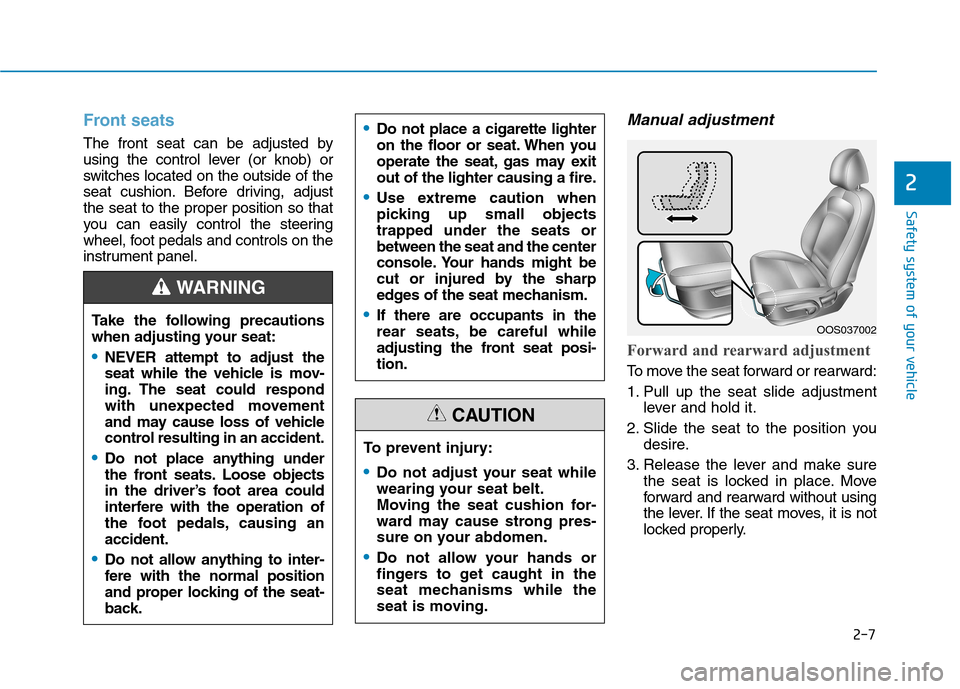
Manual adjustment
Forward and rearward adjustment
To move the seat forward or rearward:
1. Pull up the seat slide adjustmentlever and hold it.
2. Slide the seat to the position you desire.
3. Release the lever and make sure the seat is locked in place. Move
forward and rearward without using
the lever. If the seat moves, it is not
locked properly.
To prevent injury:
Do not adjust your seat while
wearing your seat belt.
Moving the seat cushion for-
ward may cause strong pres-
sure on your abdomen.
Do not allow your hands or
fingers to get caught in the
seat mechanisms while the
seat is moving.
CAUTION
Take the following precautions
when adjusting your seat:
NEVER attempt to adjust the
seat while the vehicle is mov-
ing. The seat could respond
with unexpected movement
and may cause loss of vehicle
control resulting in an accident.
Do not place anything under
the front seats. Loose objects
in the driver’s foot area could
interfere with the operation of
the foot pedals, causing anaccident.
Do not allow anything to inter-
fere with the normal position
and proper locking of the seat-
back.
WARNING
Do not place a cigarette lighter
on the floor or seat. When you
operate the seat, gas may exit
out of the lighter causing a fire.
Use extreme caution when
picking up small objectstrapped under the seats orbetween the seat and the center
console. Your hands might be
cut or injured by the sharp
edges of the seat mechanism.
If there are occupants in the
rear seats, be careful while
adjusting the front seat posi-tion.OOS037002
Page 27 of 523
2-8
Safety system of your vehicle
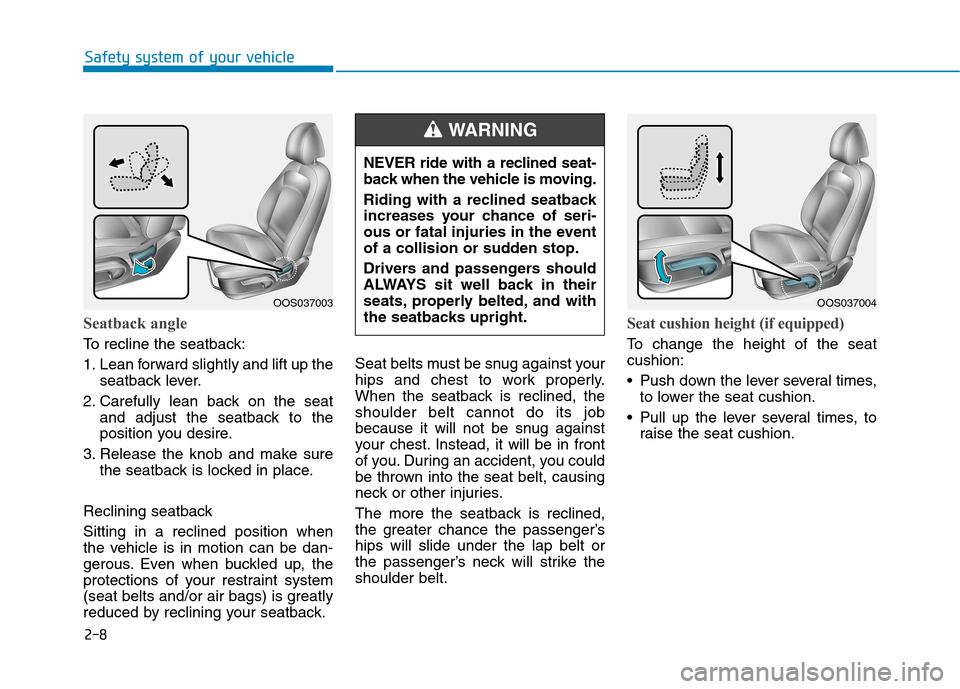
Seatback angle
To recline the seatback:
1. Lean forward slightly and lift up theseatback lever.
2. Carefully lean back on the seat and adjust the seatback to the
position you desire.
3. Release the knob and make sure the seatback is locked in place.
Reclining seatback Sitting in a reclined position when
the vehicle is in motion can be dan-
gerous. Even when buckled up, the
protections of your restraint system
(seat belts and/or air bags) is greatly
reduced by reclining your seatback. Seat belts must be snug against your
hips and chest to work properly.
When the seatback is reclined, theshoulder belt cannot do its job
because it will not be snug against
your chest. Instead, it will be in front
of you. During an accident, you could
be thrown into the seat belt, causing
neck or other injuries.
The more the seatback is reclined,
the greater chance the passenger’ships will slide under the lap belt or
the passenger’s neck will strike theshoulder belt.
Seat cushion height (if equipped)
To change the height of the seat cushion:
Push down the lever several times,
to lower the seat cushion.
Pull up the lever several times, to raise the seat cushion.
OOS037003 NEVER ride with a reclined seat-
back when the vehicle is moving.
Riding with a reclined seatback
increases your chance of seri-
ous or fatal injuries in the event
of a collision or sudden stop.
Drivers and passengers should
ALWAYS sit well back in their
seats, properly belted, and with
the seatbacks upright.
WARNING
OOS037004
Page 32 of 523
2-13
Safety system of your vehicle
2
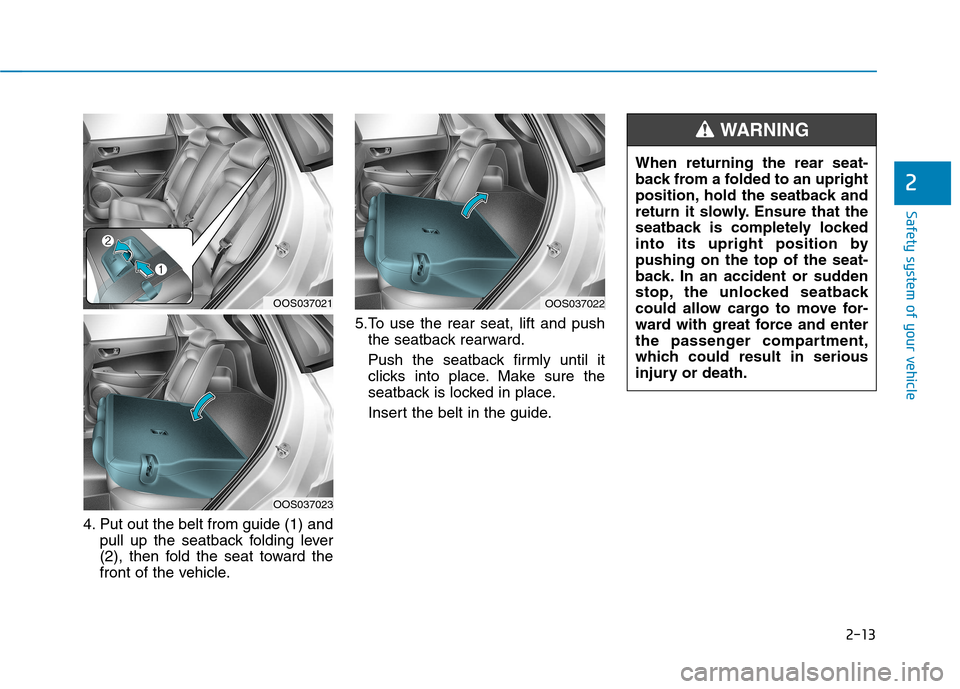
4. Put out the belt from guide (1) andpull up the seatback folding lever
(2), then fold the seat toward the
front of the vehicle. 5.To use the rear seat, lift and push
the seatback rearward.
Push the seatback firmly until it
clicks into place. Make sure the
seatback is locked in place.
Insert the belt in the guide.
OOS037022OOS037021
OOS037023 When returning the rear seat-
back from a folded to an upright
position, hold the seatback and
return it slowly. Ensure that the
seatback is completely locked
into its upright position bypushing on the top of the seat-
back. In an accident or sudden
stop, the unlocked seatback
could allow cargo to move for-
ward with great force and enter
the passenger compartment,
which could result in serious
injury or death.
WARNING
Page 34 of 523
2-15
Safety system of your vehicle
2
Headrest
The vehicle’s front and rear seats have
adjustable headrests. The headrests
provide comfort for passengers, but
more importantly they are designed tohelp protect passengers from whiplash
and other neck and spinal injuries dur-ing an accident, especially in a rearimpact collision.To prevent damage, NEVER hit orpull on the headrests.
NOTICE
To reduce the risk of serious
injury or death in an accident,
take the following precautions
when adjusting your headrests:
Always properly adjust the
headrests for all passengers
BEFORE starting the vehicle.
NEVER let anyone ride in a seat
with the headrest removed.
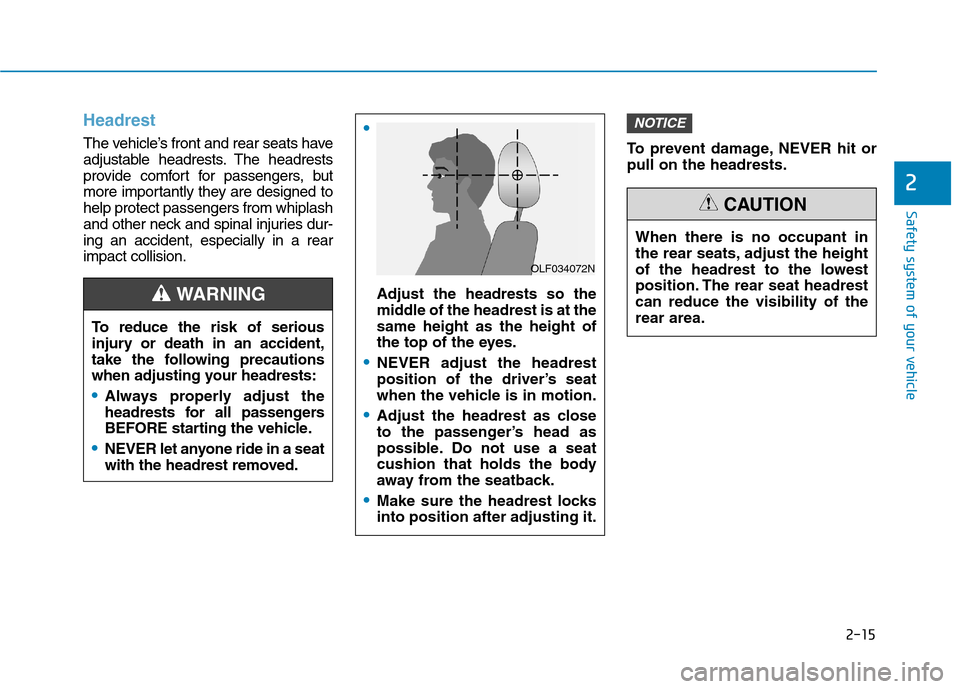
Adjust the headrests so the
middle of the headrest is at thesame height as the height of
the top of the eyes.
NEVER adjust the headrest
position of the driver’s seat
when the vehicle is in motion.
Adjust the headrest as close
to the passenger’s head as
possible. Do not use a seat
cushion that holds the body
away from the seatback.
Make sure the headrest locks into position after adjusting it.
WARNING
OLF034072N
When there is no occupant in
the rear seats, adjust the height
of the headrest to the lowest
position. The rear seat headrestcan reduce the visibility of therear area.
CAUTION