Head Hyundai Kona 2019 Owner's Manual
[x] Cancel search | Manufacturer: HYUNDAI, Model Year: 2019, Model line: Kona, Model: Hyundai Kona 2019Pages: 485, PDF Size: 15.75 MB
Page 13 of 485
1-2
E
EX
X T
TE
ER
R I
IO
O R
R
O
O V
VE
ER
R V
V I
IE
E W
W
Your vehicle at a glance
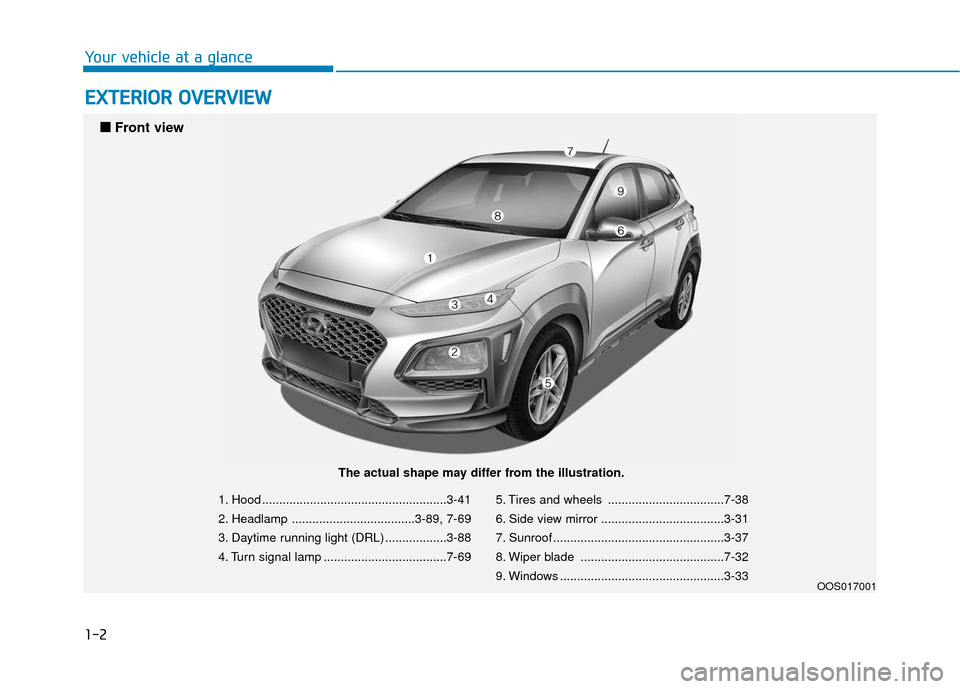
1. Hood ......................................................3-41
2. Headlamp ....................................3-89, 7-69
3. Daytime running light (DRL) ..................3-88
4. Turn signal lamp ....................................7-69 5. Tires and wheels ..................................7-38
6. Side view mirror ....................................3-31
7. Sunroof ..................................................3-37
8. Wiper blade ..........................................7-32
9. Windows ................................................3-33
OOS017001
■
■
Front view
The actual shape may differ from the illustration.
Page 15 of 485
1-4
Your vehicle at a glance
I
IN
N T
TE
ER
R I
IO
O R
R
O
O V
VE
ER
R V
V I
IE
E W
W
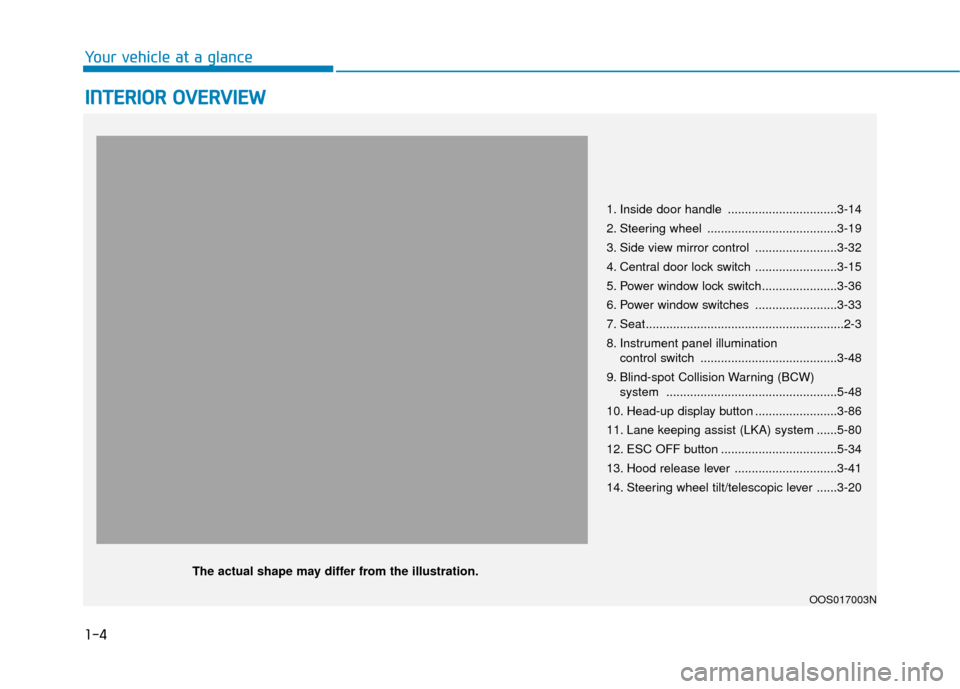
1. Inside door handle ................................3-14
2. Steering wheel ......................................3-19
3. Side view mirror control ........................3-32
4. Central door lock switch ........................3-15
5. Power window lock switch......................3-36
6. Power window switches ........................3-33
7. Seat..........................................................2-3
8. Instrument panel illumination
control switch ........................................3-48
9. Blind-spot Collision Warning (BCW) system ..................................................5-48
10. Head-up display button ........................3-86
11. Lane keeping assist (LKA) system ......5-80
12. ESC OFF button ..................................5-34
13. Hood release lever ..............................3-41
14. Steering wheel tilt/telescopic lever ......3-20
OOS017003N
The actual shape may differ from the illustration.
Page 18 of 485
Safety system of your vehicle
Important Safety Precautions ..............................2-2
Always Wear Your Seat Belt ..........................................2-2
Restrain All Children .........................................................2-2
Air Bag Hazards .................................................................2-2
Driver Distraction ..............................................................2-2
Control Your Speed ...........................................................2-2
Keep Your Vehicle in Safe Condition ............................2-2
Seats ........................................................................\
2-3
Safety Precautions ...........................................................2-4
Front Seats ........................................................................\
.2-5
Rear Seats........................................................................\
.2-11
Head Restraints ...............................................................2-14
Seat Warmers and Air Ventilation Seats ...................2-18
Seat Belts ..............................................................2-21
Seat Belt Safety Precautions .......................................2-21
Seat Belt Warning Light ................................................2-22
Seat Belt Restraint System...........................................2-23
Additional Seat Belt Safety Precautions ...................2-30
Care of Seat Belts...........................................................2-33
Child Restraint System (CRS) .............................2-34
Children Always in the Rear .........................................2-34
Selecting a Child Restraint System (CRS) .................2-35
Installing a Child Restraint System (CRS)..................2-37
Air Bag
- Advanced Supplemental Restraint System ...2-45
Where Are the Air Bags? ..............................................2-47
How Does the Air Bag System Operate?..................2-50
What to Expect After an Air Bag Inflates ................2-55
Occupant Classification System (OCS).......................2-56
Why Didn't My Air Bag Go Off in a Collision? ........2-61
SRS Care ........................................................................\
....2-66
Additional Safety Precautions .....................................2-67
Air Bag Warning Labels .................................................2-67
This chapter provides you with important information about how to protect yourself and your passengers.
It explains how to properly use your seats and seat belts, and how your air bags work.
Additionally, this chapter explains how to properly restrain infants and children in your vehicle.
2
Page 20 of 485
2-3
Safety system of your vehicle
2
S
SE
E A
A T
TS
S
OOS037073N
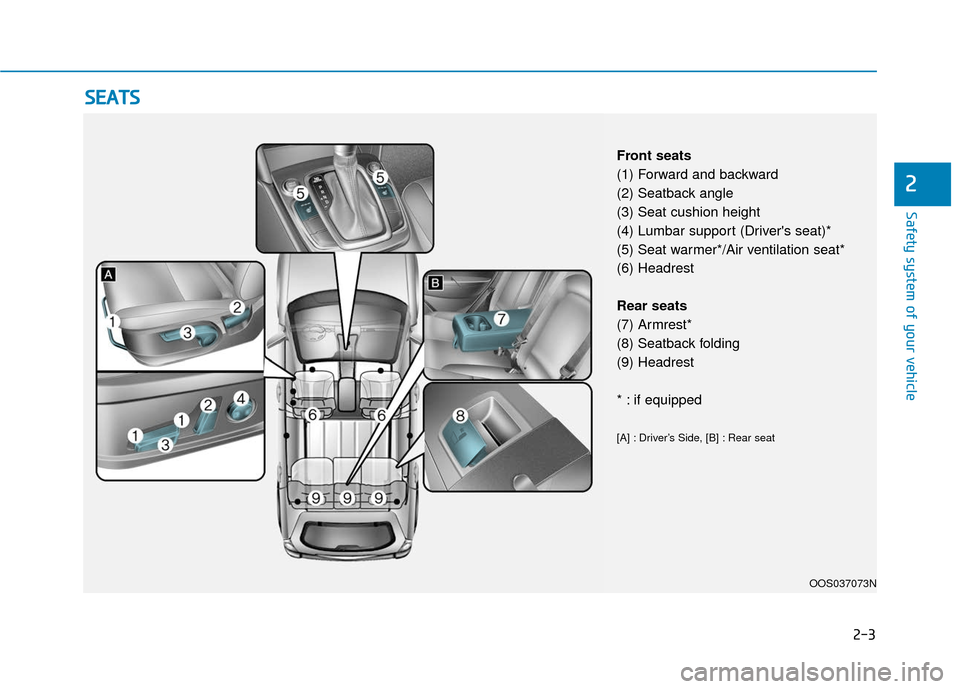
Front seats
(1) Forward and backward
(2) Seatback angle
(3) Seat cushion height
(4) Lumbar support (Driver's seat)*
(5) Seat warmer*/Air ventilation seat*
(6) Headrest
Rear seats
(7) Armrest*
(8) Seatback folding
(9) Headrest
* : if equipped
[A] : Driver’s Side, [B] : Rear seat
Page 28 of 485
2-11
Safety system of your vehicle
2
Rear Seats
Folding the rear seat
The rear seatbacks can be folded to
facilitate carrying long items or to
increase the luggage capacity of the
vehicle.To fold down the rear seatback:
1. Set the front seatback to the
upright position and if necessary,
slide the front seat forward.
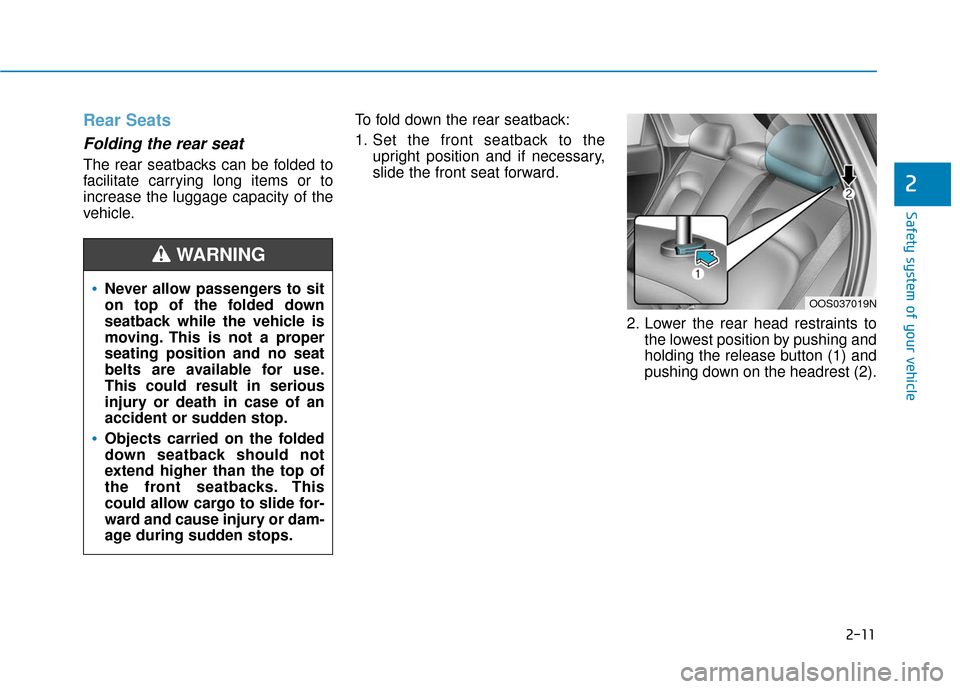
2. Lower the rear head restraints tothe lowest position by pushing and
holding the release button (1) and
pushing down on the headrest (2).
Never allow passengers to sit
on top of the folded down
seatback while the vehicle is
moving. This is not a proper
seating position and no seat
belts are available for use.
This could result in serious
injury or death in case of an
accident or sudden stop.
Objects carried on the folded
down seatback should not
extend higher than the top of
the front seatbacks. This
could allow cargo to slide for-
ward and cause injury or dam-
age during sudden stops.
WARNING
OOS037019N
Page 31 of 485
2-14
Safety system of your vehicleWhen there is no occupant in
the rear seats, adjust the height
of the headrest to the lowest
position. The rear seat headrest
can reduce the visibility of the
rear area.
CAUTION
Head Restraints
The vehicle's front and rear seats
have adjustable head restraints. The
head restraints provide comfort for
passengers, but more importantly
they are designed to help protect
passengers from whiplash and other
neck and spinal injuries during an
accident, especially in a rear impact
collision.To prevent damage, NEVER hit or
pull on the head restraints.
NOTICE
To reduce the risk of serious
injury or death in an accident,
take the following precautions
when adjusting your head
restraints:
Always properly adjust the
head restraints for all passen-
gers BEFORE starting the
vehicle.
NEVER let anyone ride in a
seat with the head restraints
removed.
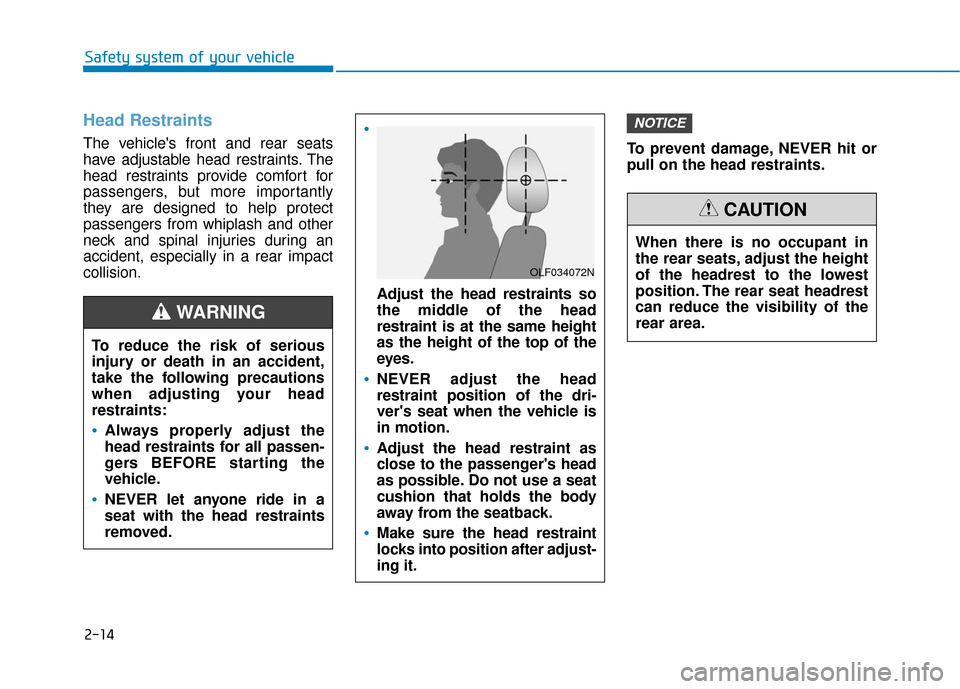
Adjust the head restraints so
the middle of the head
restraint is at the same height
as the height of the top of the
eyes.
NEVER adjust the head
restraint position of the dri-
ver's seat when the vehicle is
in motion.
Adjust the head restraint as
close to the passenger's head
as possible. Do not use a seat
cushion that holds the body
away from the seatback.
Make sure the head restraint
locks into position after adjust-
ing it.
WARNING
OLF034072N
Page 32 of 485
2-15
Safety system of your vehicle
2
Front seat head restraints
The vehicle's front and passenger's
seats are equipped with adjustable
head restraints for the passengers
safety and comfort.
Adjusting the height up and down
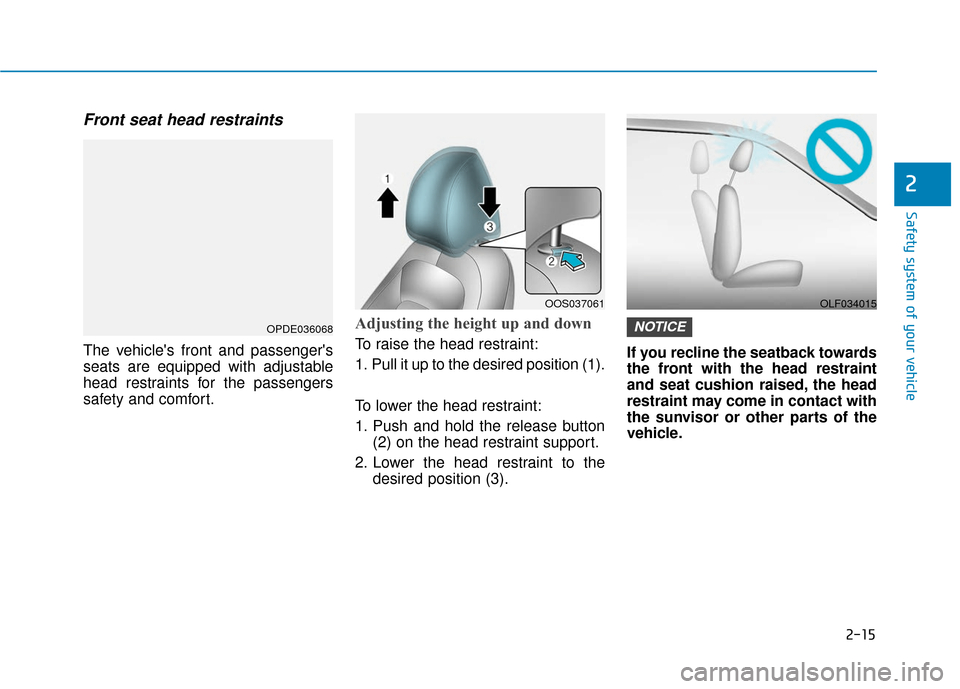
To raise the head restraint:
1. Pull it up to the desired position (1).
To lower the head restraint:
1. Push and hold the release button(2) on the head restraint support.
2. Lower the head restraint to the desired position (3). If you recline the seatback towards
the front with the head restraint
and seat cushion raised, the head
restraint may come in contact with
the sunvisor or other parts of the
vehicle.
NOTICEOPDE036068
OOS037061OLF034015
Page 33 of 485
2-16
Safety system of your vehicle
Removal/Reinstallation
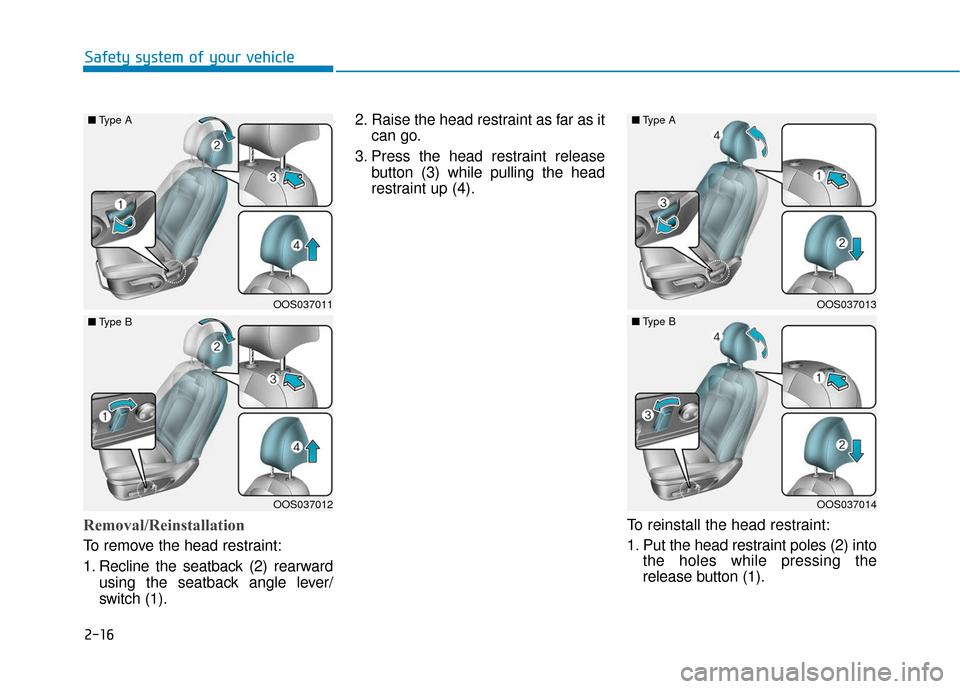
To remove the head restraint:
1. Recline the seatback (2) rearwardusing the seatback angle lever/
switch (1). 2. Raise the head restraint as far as it
can go.
3. Press the head restraint release button (3) while pulling the head
restraint up (4).
To reinstall the head restraint:
1. Put the head restraint poles (2) intothe holes while pressing the
release button (1).
OOS037011
OOS037012
■Type A
■Type B
OOS037013
OOS037014
■Type A
■Type B
Page 34 of 485
2-17
Safety system of your vehicle
2
2. Adjust the head restraint to theappropriate height.
3. Adjust the seatback (4) forward using the seatback angle lever/
switch (3).
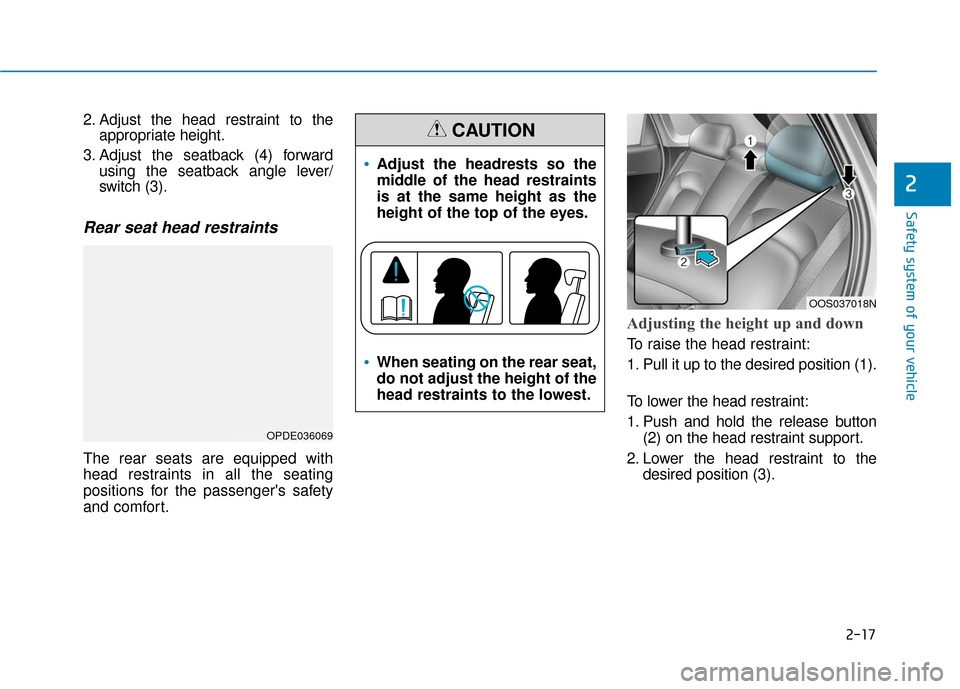
Rear seat head restraints
The rear seats are equipped with
head restraints in all the seating
positions for the passenger's safety
and comfort.
Adjusting the height up and down
To raise the head restraint:
1. Pull it up to the desired position (1).
To lower the head restraint:
1. Push and hold the release button
(2) on the head restraint support.
2. Lower the head restraint to the desired position (3).
OPDE036069
OOS037018N
Adjust the headrests so the
middle of the head restraints
is at the same height as the
height of the top of the eyes.
When seating on the rear seat,
do not adjust the height of the
head restraints to the lowest.
CAUTION
Page 35 of 485
2-18
Safety system of your vehicle
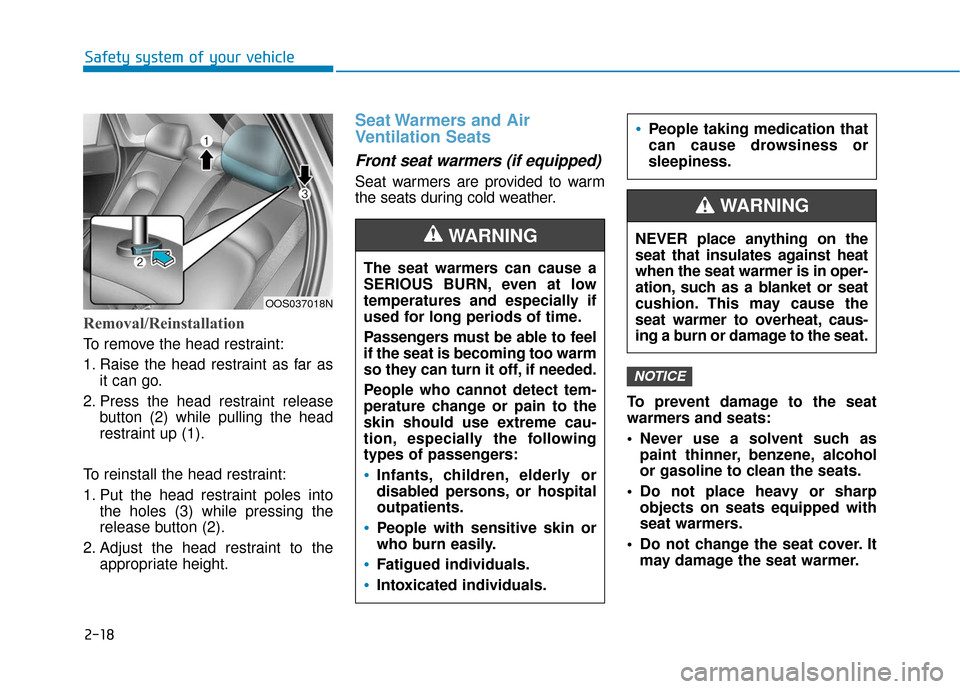
Removal/Reinstallation
To remove the head restraint:
1. Raise the head restraint as far asit can go.
2. Press the head restraint release button (2) while pulling the head
restraint up (1).
To reinstall the head restraint:
1. Put the head restraint poles into the holes (3) while pressing the
release button (2).
2. Adjust the head restraint to the appropriate height.
Seat Warmers and Air
Ventilation Seats
Front seat warmers (if equipped)
Seat warmers are provided to warm
the seats during cold weather.
To prevent damage to the seat
warmers and seats:
Never use a solvent such aspaint thinner, benzene, alcohol
or gasoline to clean the seats.
Do not place heavy or sharp objects on seats equipped with
seat warmers.
Do not change the seat cover. It may damage the seat warmer.
NOTICE
OOS037018N
The seat warmers can cause a
SERIOUS BURN, even at low
temperatures and especially if
used for long periods of time.
Passengers must be able to feel
if the seat is becoming too warm
so they can turn it off, if needed.
People who cannot detect tem-
perature change or pain to the
skin should use extreme cau-
tion, especially the following
types of passengers:
Infants, children, elderly or
disabled persons, or hospital
outpatients.
People with sensitive skin or
who burn easily.
Fatigued individuals.
Intoxicated individuals.
People taking medication that
can cause drowsiness or
sleepiness.
WARNING NEVER place anything on the
seat that insulates against heat
when the seat warmer is in oper-
ation, such as a blanket or seat
cushion. This may cause the
seat warmer to overheat, caus-
ing a burn or damage to the seat.
WARNING