2-56 Hyundai Kona 2020 Owner's Manual
[x] Cancel search | Manufacturer: HYUNDAI, Model Year: 2020, Model line: Kona, Model: Hyundai Kona 2020Pages: 505, PDF Size: 13.47 MB
Page 18 of 505
Safety system of your vehicle
Important Safety Precautions ..............................2-2
Always Wear Your Seat Belt ..........................................2-2
Restrain All Children .........................................................2-2
Air Bag Hazards .................................................................2-2
Driver Distraction ..............................................................2-2
Control Your Speed ...........................................................2-2
Keep Your Vehicle in Safe Condition ............................2-2
Seats ........................................................................\
2-3
Safety Precautions ...........................................................2-4
Front Seats ........................................................................\
.2-5
Rear Seats........................................................................\
.2-11
Head Restraints ...............................................................2-14
Seat Warmers and Air Ventilation Seats ...................2-18
Seat Belts ..............................................................2-21
Seat Belt Safety Precautions .......................................2-21
Seat Belt Warning Light ................................................2-22
Seat Belt Restraint System...........................................2-23
Additional Seat Belt Safety Precautions ...................2-30
Care of Seat Belts...........................................................2-33
Child Restraint System (CRS) .............................2-34
Children Always in the Rear .........................................2-34
Selecting a Child Restraint System (CRS) .................2-35
Installing a Child Restraint System (CRS)..................2-37
Air Bag
- Advanced Supplemental Restraint System ...2-45
Where Are the Air Bags? ..............................................2-47
How Does the Air Bag System Operate?..................2-50
What to Expect After an Air Bag Inflates ................2-55
Occupant Classification System (OCS).......................2-56
Why Didn't My Air Bag Go Off in a Collision? ........2-61
SRS Care ........................................................................\
....2-66
Additional Safety Precautions .....................................2-67
Air Bag Warning Labels .................................................2-67
This chapter provides you with important information about how to protect yourself and your passengers.
It explains how to properly use your seats and seat belts, and how your air bags work.
Additionally, this chapter explains how to properly restrain infants and children in your vehicle.
2
Page 73 of 505
2-56
Safety system of your vehicle
Occupant Classification
System (OCS)
Your vehicle is equipped with an
Occupant Classification System
(OCS) in the front passenger's seat.
Main components of theOccupant Classification System
A detection device located within
the front passenger seat cushion.
Electronic system to determine whether the passenger air bag
systems should be activated or
deactivated.
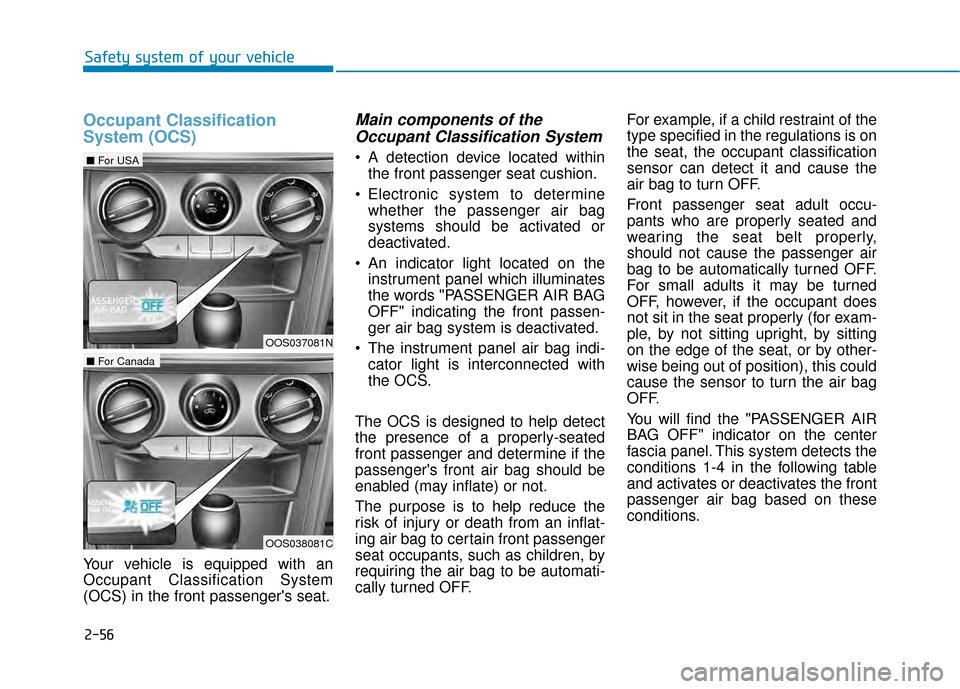
An indicator light located on the instrument panel which illuminates
the words "PASSENGER AIR BAG
OFF" indicating the front passen-
ger air bag system is deactivated.
The instrument panel air bag indi- cator light is interconnected with
the OCS.
The OCS is designed to help detect
the presence of a properly-seated
front passenger and determine if the
passenger's front air bag should be
enabled (may inflate) or not.
The purpose is to help reduce the
risk of injury or death from an inflat-
ing air bag to certain front passenger
seat occupants, such as children, by
requiring the air bag to be automati-
cally turned OFF. For example, if a child restraint of the
type specified in the regulations is on
the seat, the occupant classification
sensor can detect it and cause the
air bag to turn OFF.
Front passenger seat adult occu-
pants who are properly seated and
wearing the seat belt properly,
should not cause the passenger air
bag to be automatically turned OFF.
For small adults it may be turned
OFF, however, if the occupant does
not sit in the seat properly (for exam-
ple, by not sitting upright, by sitting
on the edge of the seat, or by other-
wise being out of position), this could
cause the sensor to turn the air bag
OFF.
You will find the "PASSENGER AIR
BAG OFF" indicator on the center
fascia panel. This system detects the
conditions 1-4 in the following table
and activates or deactivates the front
passenger air bag based on these
conditions.
OOS037081N
■
For USA
OOS038081C
■For Canada
Page 498 of 505

I-2
Accessing Your Vehicle ....................................................3-3Immobilizer System....................................................3-\
11
Remote Key ..................................................................3-3
Smart Key.....................................................................3-6\
Air Bag - Advanced Supplemental Restraint System.....2-45 Additional Safety Precautions ....................................2-67
Air Bag Warning Labels.............................................2-67
How Does the Air Bag System Operate? ...................2-50
Occupant Classification System (OCS) .....................2-56
SRS Care ....................................................................2-66\
What to Expect After an Air Bag Inflates ..................2-55
Where Are the Air Bags? ...........................................2-47
Why Didn't My Air Bag Go Off in a Collision?........2-61
Air cleaner.......................................................................7\
-29 Filter Replacement .....................................................7-29
Air Conditioning System ..................................................8-6
All Wheel Drive (AWD) .................................................5-40 AWD operation...........................................................5-41
Emergency precautions ..............................................5-44
Appearance care..............................................................7-80 Exterior Care ..............................................................7-80
Interior Care ...............................................................7-85 Automatic Climate Control System ..............................3-118
Automatic Temperature Control Mode ....................3-119
Manual Temperature Control Mode .........................3-120
System Maintenance ................................................3-125
System Operation .....................................................3-123
Automatic Transmission .................................................5-14 Automatic Transmission Operation............................5-14
Good Driving Practices ..............................................5-18
Battery ........................................................................\
.....7-35 Battery Recharging .....................................................7-36
For Best Battery Service ............................................7-36
Reset Features ............................................................7-37
Before driving ...................................................................5-4 Before Entering the Vehicle .........................................5-4
Before Starting .............................................................5-4
Blind-spot Collision Warning (BCW) system ................5-47 BCW (Blind-spot Collision Warning) ........................5-48
Detecting sensor .........................................................5-52
Limitations of the System ..........................................5-53
RCCW (Rear Cross-Traffic Collision Warning) ........5-50
Brake fluid ......................................................................7-\
27 Checking the Brake Fluid Level ................................7-27
Index
A
B