engine HYUNDAI KONA 2021 Owners Manual
[x] Cancel search | Manufacturer: HYUNDAI, Model Year: 2021, Model line: KONA, Model: HYUNDAI KONA 2021Pages: 506, PDF Size: 34.9 MB
Page 447 of 506
7-55
7
Maintenance
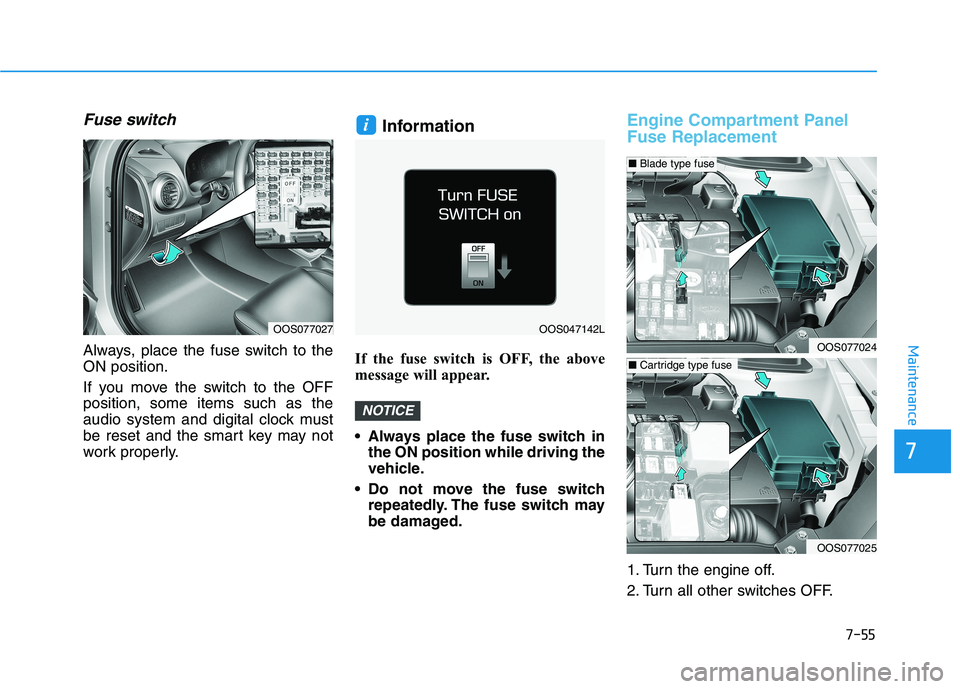
Fuse switch
Always, place the fuse switch to the
ON position.
If you move the switch to the OFF
position, some items such as the
audio system and digital clock must
be reset and the smart key may not
work properly.
Information
If the fuse switch is OFF, the above
message will appear.
Always place the fuse switch in
the ON position while driving the
vehicle.
Do not move the fuse switch
repeatedly. The fuse switch may
be damaged.
Engine Compartment Panel
Fuse Replacement
1. Turn the engine off.
2. Turn all other switches OFF.
NOTICE
i
OOS077027OOS047142L
OOS077024
OOS077025
■Blade type fuse
■Cartridge type fuse
Page 448 of 506
7-56
Maintenance
3. Remove the fuse panel cover by
pressing the tap and pulling up.
4. Check the removed fuse; replace it
if it is blown. To remove or insert
the fuse, use the fuse puller in the
engine compartment fuse panel.
5. Push in a new fuse of the same
rating, and make sure it fits tightly
in the clips. If it fits loosely, consult
an authorized HYUNDAI dealer.
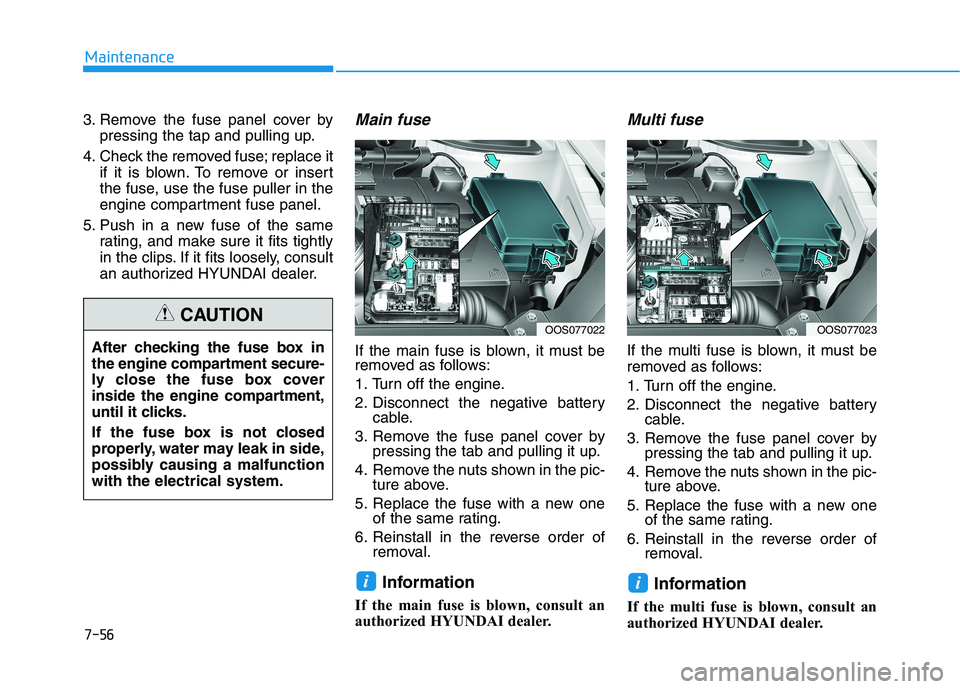
Main fuse
If the main fuse is blown, it must be
removed as follows:
1. Turn off the engine.
2. Disconnect the negative battery
cable.
3. Remove the fuse panel cover by
pressing the tab and pulling it up.
4. Remove the nuts shown in the pic-
ture above.
5. Replace the fuse with a new one
of the same rating.
6. Reinstall in the reverse order of
removal.
Information
If the main fuse is blown, consult an
authorized HYUNDAI dealer.
Multi fuse
If the multi fuse is blown, it must be
removed as follows:
1. Turn off the engine.
2. Disconnect the negative battery
cable.
3. Remove the fuse panel cover by
pressing the tab and pulling it up.
4. Remove the nuts shown in the pic-
ture above.
5. Replace the fuse with a new one
of the same rating.
6. Reinstall in the reverse order of
removal.
Information
If the multi fuse is blown, consult an
authorized HYUNDAI dealer.
ii
After checking the fuse box in
the engine compartment secure-
ly close the fuse box cover
inside the engine compartment,
until it clicks.
If the fuse box is not closed
properly, water may leak in side,
possibly causing a malfunction
with the electrical system.
CAUTIONOOS077022OOS077023
Page 454 of 506
7-62
Maintenance
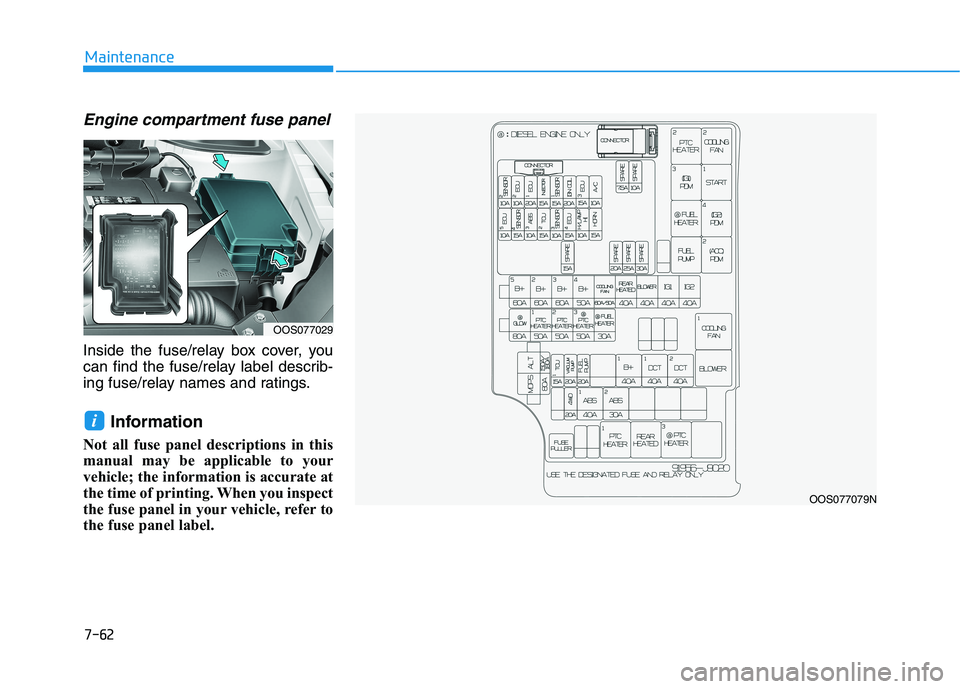
Engine compartment fuse panel
Inside the fuse/relay box cover, you
can find the fuse/relay label describ-
ing fuse/relay names and ratings.
Information
Not all fuse panel descriptions in this
manual may be applicable to your
vehicle; the information is accurate at
the time of printing. When you inspect
the fuse panel in your vehicle, refer to
the fuse panel label.
i
OOS077029
OOS077079N
Page 455 of 506
7-63
7
Maintenance
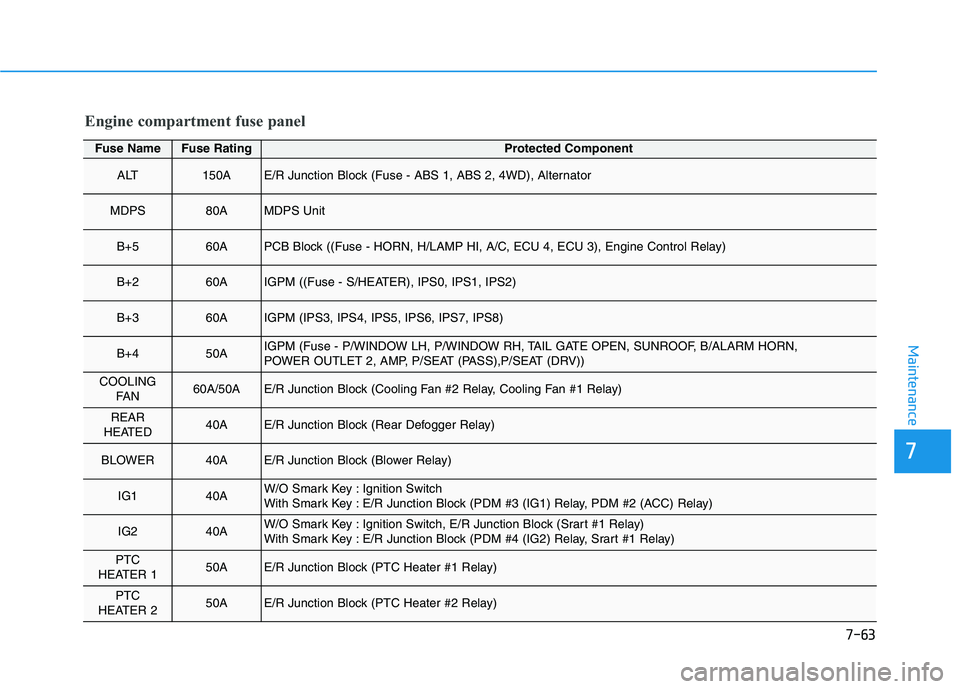
Engine compartment fuse panel
Fuse NameFuse RatingProtected Component
ALT150AE/R Junction Block (Fuse - ABS 1, ABS 2, 4WD), Alternator
MDPS80AMDPS Unit
B+560APCB Block ((Fuse - HORN, H/LAMP HI, A/C, ECU 4, ECU 3), Engine Control Relay)
B+260AIGPM ((Fuse - S/HEATER), IPS0, IPS1, IPS2)
B+360AIGPM (IPS3, IPS4, IPS5, IPS6, IPS7, IPS8)
B+450AIGPM (Fuse - P/WINDOW LH, P/WINDOW RH, TAIL GATE OPEN, SUNROOF, B/ALARM HORN,
POWER OUTLET 2, AMP, P/SEAT (PASS),P/SEAT (DRV))
COOLING
FA N60A/50AE/R Junction Block (Cooling Fan #2 Relay, Cooling Fan #1 Relay)
REAR
HEATED40AE/R Junction Block (Rear Defogger Relay)
BLOWER40AE/R Junction Block (Blower Relay)
IG140AW/O Smark Key : Ignition Switch
With Smark Key : E/R Junction Block (PDM #3 (IG1) Relay, PDM #2 (ACC) Relay)
IG240AW/O Smark Key : Ignition Switch, E/R Junction Block (Srart #1 Relay)
With Smark Key : E/R Junction Block (PDM #4 (IG2) Relay, Srart #1 Relay)
PTC
HEATER 150AE/R Junction Block (PTC Heater #1 Relay)
PTC
HEATER 250AE/R Junction Block (PTC Heater #2 Relay)
Page 456 of 506
7-64
Maintenance
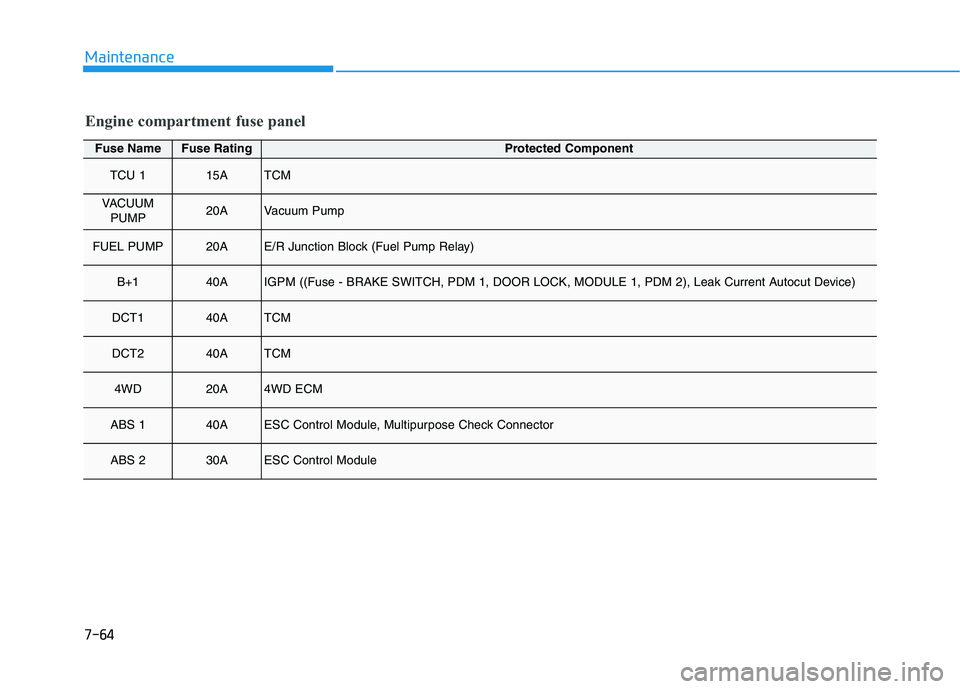
Engine compartment fuse panel
Fuse NameFuse RatingProtected Component
TCU 115ATCM
VACUUM
PUMP20AVacuum Pump
FUEL PUMP20AE/R Junction Block (Fuel Pump Relay)
B+140AIGPM ((Fuse - BRAKE SWITCH, PDM 1, DOOR LOCK, MODULE 1, PDM 2), Leak Current Autocut Device)
DCT140ATCM
DCT240ATCM
4WD20A4WD ECM
ABS 140AESC Control Module, Multipurpose Check Connector
ABS 230AESC Control Module
Page 457 of 506
7-65
7
Maintenance
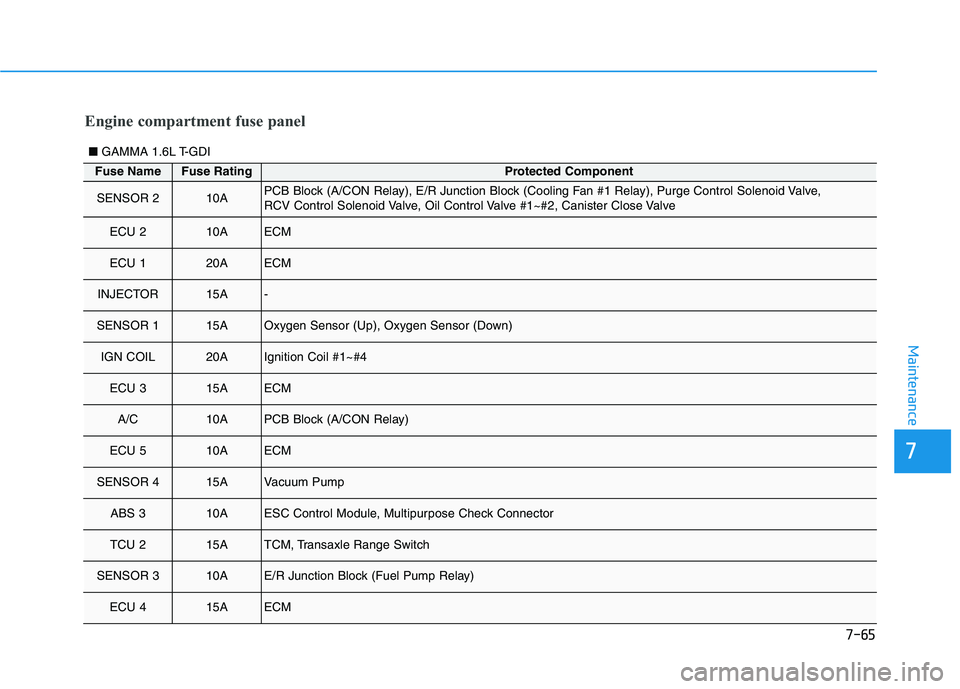
Fuse NameFuse RatingProtected Component
SENSOR 210APCB Block (A/CON Relay), E/R Junction Block (Cooling Fan #1 Relay), Purge Control Solenoid Valve,
RCV Control Solenoid Valve, Oil Control Valve #1~#2, Canister Close Valve
ECU 210AECM
ECU 120AECM
INJECTOR15A-
SENSOR 115AOxygen Sensor (Up), Oxygen Sensor (Down)
IGN COIL20AIgnition Coil #1~#4
ECU 315AECM
A/C10APCB Block (A/CON Relay)
ECU 510AECM
SENSOR 415AVacuum Pump
ABS 310AESC Control Module, Multipurpose Check Connector
TCU 215ATCM, Transaxle Range Switch
SENSOR 310AE/R Junction Block (Fuel Pump Relay)
ECU 415AECM
■ GAMMA 1.6L T-GDI
Engine compartment fuse panel
Page 458 of 506
7-66
Maintenance
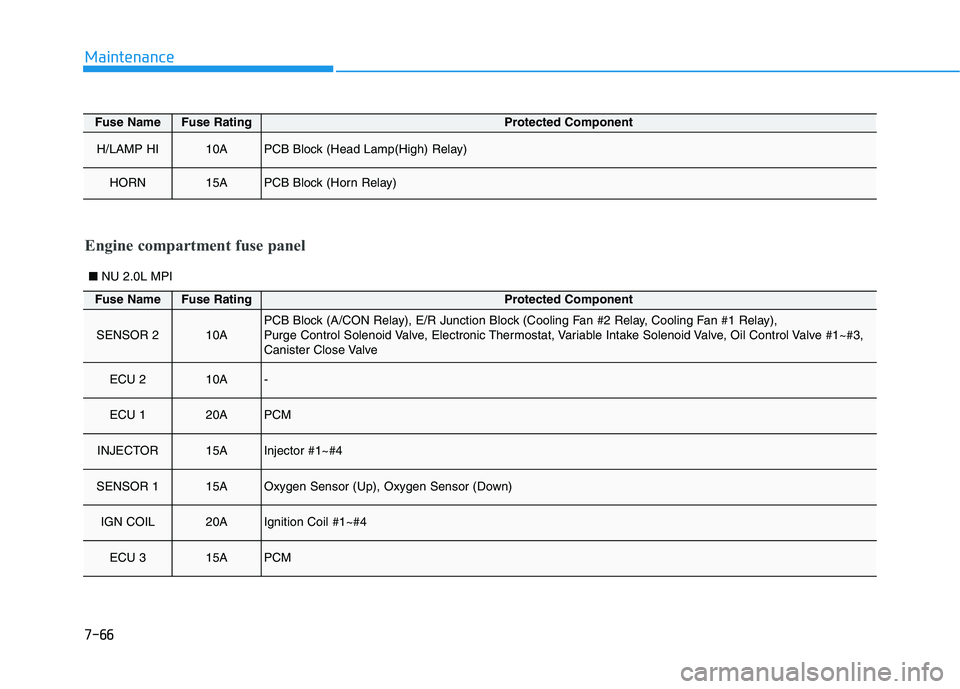
■NU 2.0L MPI
Engine compartment fuse panel
Fuse NameFuse RatingProtected Component
H/LAMP HI10APCB Block (Head Lamp(High) Relay)
HORN15APCB Block (Horn Relay)
Fuse NameFuse RatingProtected Component
SENSOR 210APCB Block (A/CON Relay), E/R Junction Block (Cooling Fan #2 Relay, Cooling Fan #1 Relay),
Purge Control Solenoid Valve, Electronic Thermostat, Variable Intake Solenoid Valve, Oil Control Valve #1~#3,
Canister Close Valve
ECU 210A-
ECU 120APCM
INJECTOR15AInjector #1~#4
SENSOR 115AOxygen Sensor (Up), Oxygen Sensor (Down)
IGN COIL20AIgnition Coil #1~#4
ECU 315APCM
Page 460 of 506
7-68
Maintenance
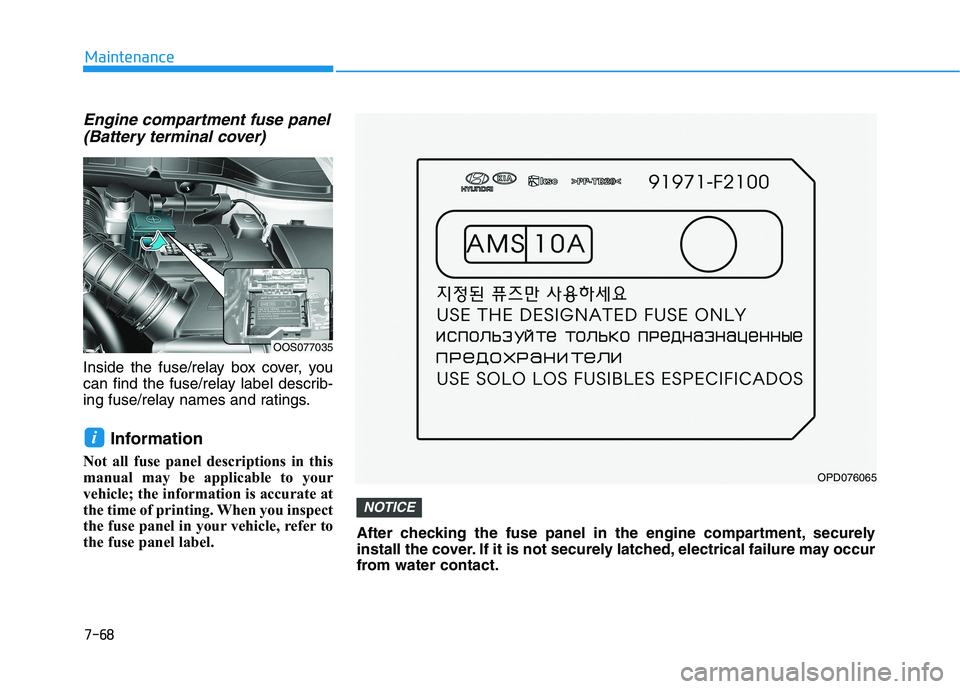
Engine compartment fuse panel
(Battery terminal cover)
Inside the fuse/relay box cover, you
can find the fuse/relay label describ-
ing fuse/relay names and ratings.
Information
Not all fuse panel descriptions in this
manual may be applicable to your
vehicle; the information is accurate at
the time of printing. When you inspect
the fuse panel in your vehicle, refer to
the fuse panel label.
i
OOS077035
OPD076065
After checking the fuse panel in the engine compartment, securely
install the cover. If it is not securely latched, electrical failure may occur
from water contact.
NOTICE
Page 468 of 506
7-76
Maintenance
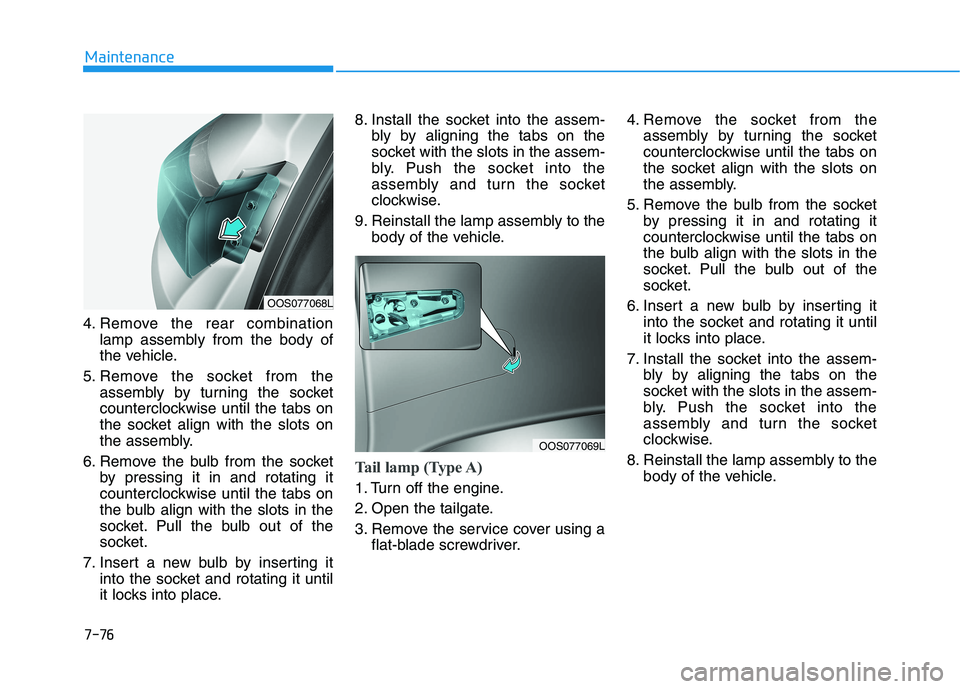
4. Remove the rear combination
lamp assembly from the body of
the vehicle.
5. Remove the socket from the
assembly by turning the socket
counterclockwise until the tabs on
the socket align with the slots on
the assembly.
6. Remove the bulb from the socket
by pressing it in and rotating it
counterclockwise until the tabs on
the bulb align with the slots in the
socket. Pull the bulb out of the
socket.
7. Insert a new bulb by inserting it
into the socket and rotating it until
it locks into place.8. Install the socket into the assem-
bly by aligning the tabs on the
socket with the slots in the assem-
bly. Push the socket into the
assembly and turn the socket
clockwise.
9. Reinstall the lamp assembly to the
body of the vehicle.
Tail lamp (Type A)
1. Turn off the engine.
2. Open the tailgate.
3. Remove the service cover using a
flat-blade screwdriver.4. Remove the socket from the
assembly by turning the socket
counterclockwise until the tabs on
the socket align with the slots on
the assembly.
5. Remove the bulb from the socket
by pressing it in and rotating it
counterclockwise until the tabs on
the bulb align with the slots in the
socket. Pull the bulb out of the
socket.
6. Insert a new bulb by inserting it
into the socket and rotating it until
it locks into place.
7. Install the socket into the assem-
bly by aligning the tabs on the
socket with the slots in the assem-
bly. Push the socket into the
assembly and turn the socket
clockwise.
8. Reinstall the lamp assembly to the
body of the vehicle.
OOS077068L
OOS077069L
Page 473 of 506
7-81
7
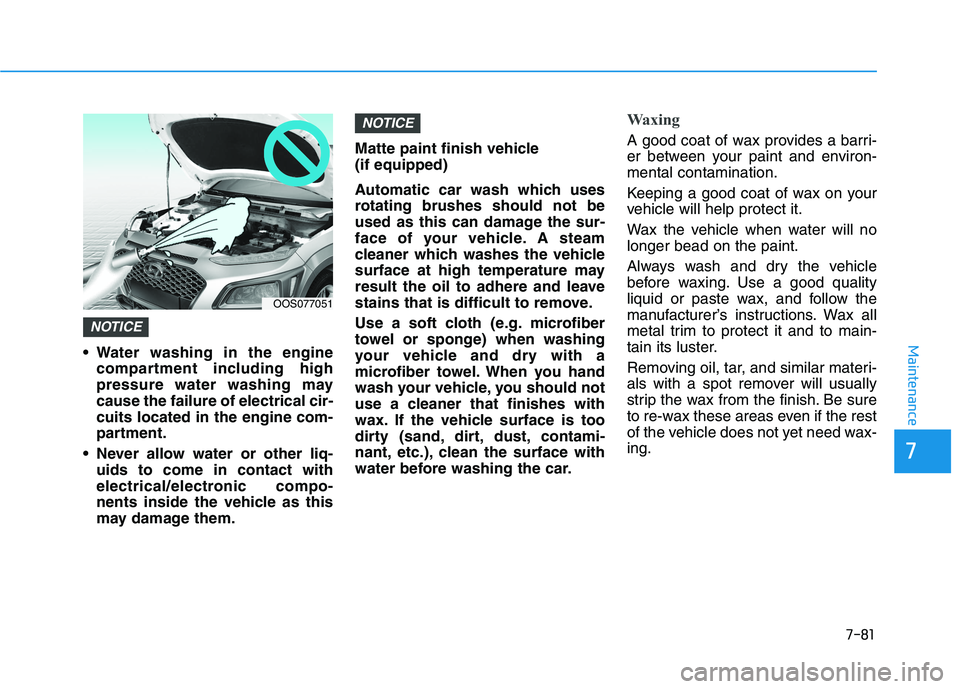
Maintenance Water washing in the engine
compartment including high
pressure water washing may
cause the failure of electrical cir-
cuits located in the engine com-
partment.
Never allow water or other liq-
uids to come in contact with
electrical/electronic compo-
nents inside the vehicle as this
may damage them.Matte paint finish vehicle
(if equipped)
Automatic car wash which uses
rotating brushes should not be
used as this can damage the sur-
face of your vehicle. A steam
cleaner which washes the vehicle
surface at high temperature may
result the oil to adhere and leave
stains that is difficult to remove.
Use a soft cloth (e.g. microfiber
towel or sponge) when washing
your vehicle and dry with a
microfiber towel. When you hand
wash your vehicle, you should not
use a cleaner that finishes with
wax. If the vehicle surface is too
dirty (sand, dirt, dust, contami-
nant, etc.), clean the surface with
water before washing the car.
Waxing
A good coat of wax provides a barri-
er between your paint and environ-
mental contamination.
Keeping a good coat of wax on your
vehicle will help protect it.
Wax the vehicle when water will no
longer bead on the paint.
Always wash and dry the vehicle
before waxing. Use a good quality
liquid or paste wax, and follow the
manufacturer’s instructions. Wax all
metal trim to protect it and to main-
tain its luster.
Removing oil, tar, and similar materi-
als with a spot remover will usually
strip the wax from the finish. Be sure
to re-wax these areas even if the rest
of the vehicle does not yet need wax-
ing.
NOTICE
NOTICE
OOS077051