check oil HYUNDAI KONA 2021 User Guide
[x] Cancel search | Manufacturer: HYUNDAI, Model Year: 2021, Model line: KONA, Model: HYUNDAI KONA 2021Pages: 506, PDF Size: 34.9 MB
Page 413 of 506
7-21
7
Maintenance
E EN
NG
GI
IN
NE
E
O
OI
IL
L
Checking the Engine Oil Level
1. Follow all of the oil manufacturer's
precautions.
2. Be sure the vehicle is on the level
ground in P (Park) with the park-
ing brake set. If possible, block the
wheels.
3. Turn the engine on and allow the
engine to reach normal operating
temperature.
4. Turn the engine off and wait about
five minutes for the oil to return to
the oil pan.
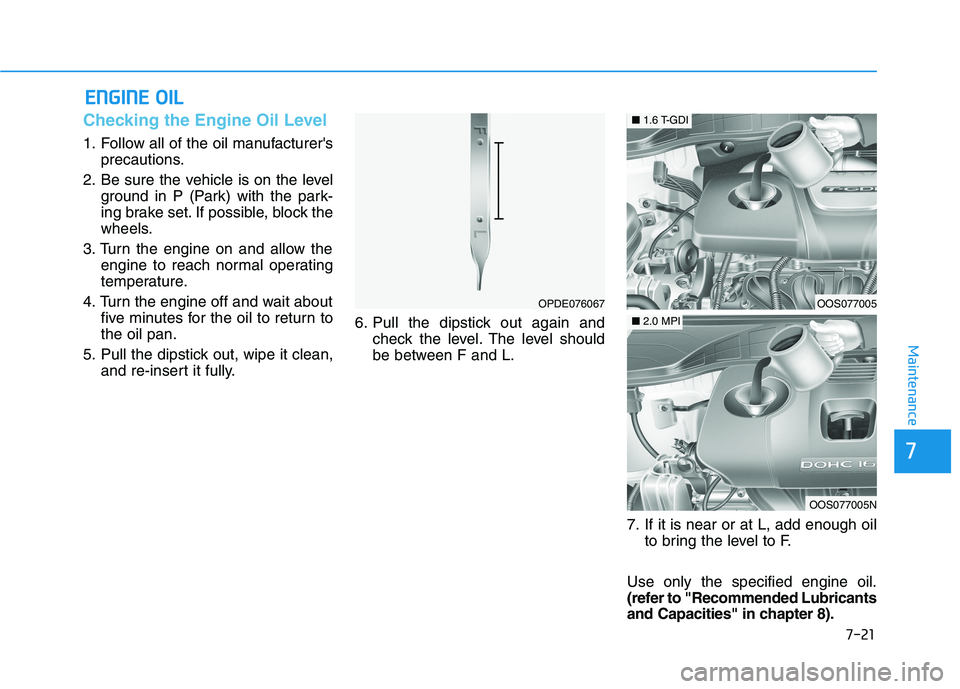
5. Pull the dipstick out, wipe it clean,
and re-insert it fully.6. Pull the dipstick out again and
check the level. The level should
be between F and L.
7. If it is near or at L, add enough oil
to bring the level to F.
Use only the specified engine oil.
(refer to "Recommended Lubricants
and Capacities" in chapter 8).
OPDE076067OOS077005
OOS077005N
■1.6 T-GDI
■2.0 MPI
Page 414 of 506
7-22
Maintenance
To prevent damage to your
engine:
Do not overfill with engine oil.
Add oil in small quantities and
recheck level to ensure engine
is not overfilled.
Do not spill engine oil when
adding or changing engine oil.
Use a funnel to help prevent oil
from being spilled on engine
components. Wipe off spilled oil
immediately.
Checking the Engine Oil and
Filter
Have engine oil and filter changed by
an authorized HYUNDAI dealer
according to the Maintenance
Schedule at the beginning of this
chapter.
NOTICE
CALIFORNIA PROPOSITION 65
WARNING
Engine oil contains chemicals
known to the State of California
to cause cancer, birth defects
and reproductive harm. Used
engine oil may cause irritation
or cancer of the skin if left in
contact with the skin for pro-
longed periods of time. Always
protect your skin by washing
your hands thoroughly with
soap and warm water as soon
as possible after handling used
oil.
WARNING
Page 419 of 506
7-27
7
Maintenance
B BR
RA
AK
KE
E
F
FL
LU
UI
ID
D
Checking the Brake Fluid
Level
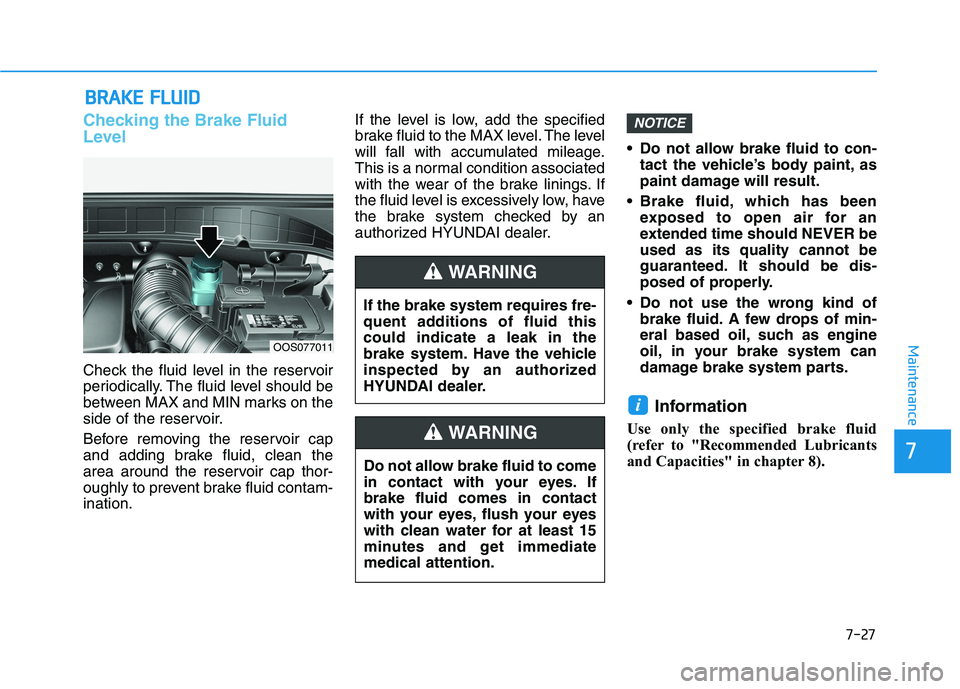
Check the fluid level in the reservoir
periodically. The fluid level should be
between MAX and MIN marks on the
side of the reservoir.
Before removing the reservoir cap
and adding brake fluid, clean the
area around the reservoir cap thor-
oughly to prevent brake fluid contam-
ination.If the level is low, add the specified
brake fluid to the MAX level. The level
will fall with accumulated mileage.
This is a normal condition associated
with the wear of the brake linings. If
the fluid level is excessively low, have
the brake system checked by an
authorized HYUNDAI dealer. Do not allow brake fluid to con-
tact the vehicle’s body paint, as
paint damage will result.
Brake fluid, which has been
exposed to open air for an
extended time should NEVER be
used as its quality cannot be
guaranteed. It should be dis-
posed of properly.
Do not use the wrong kind of
brake fluid. A few drops of min-
eral based oil, such as engine
oil, in your brake system can
damage brake system parts.
Information
Use only the specified brake fluid
(refer to "Recommended Lubricants
and Capacities" in chapter 8).
i
NOTICE
If the brake system requires fre-
quent additions of fluid this
could indicate a leak in the
brake system. Have the vehicle
inspected by an authorized
HYUNDAI dealer.
WARNING
Do not allow brake fluid to come
in contact with your eyes. If
brake fluid comes in contact
with your eyes, flush your eyes
with clean water for at least 15
minutes and get immediate
medical attention.
WARNING
OOS077011
Page 421 of 506
7-29
7
Maintenance
A AI
IR
R
C
CL
LE
EA
AN
NE
ER
R
Filter Replacement
The air cleaner filter can be cleaned
for inspection using compressed air.
Do not attempt to wash or to rinse it,
as water will damage the filter.
If soiled, the air cleaner filter must be
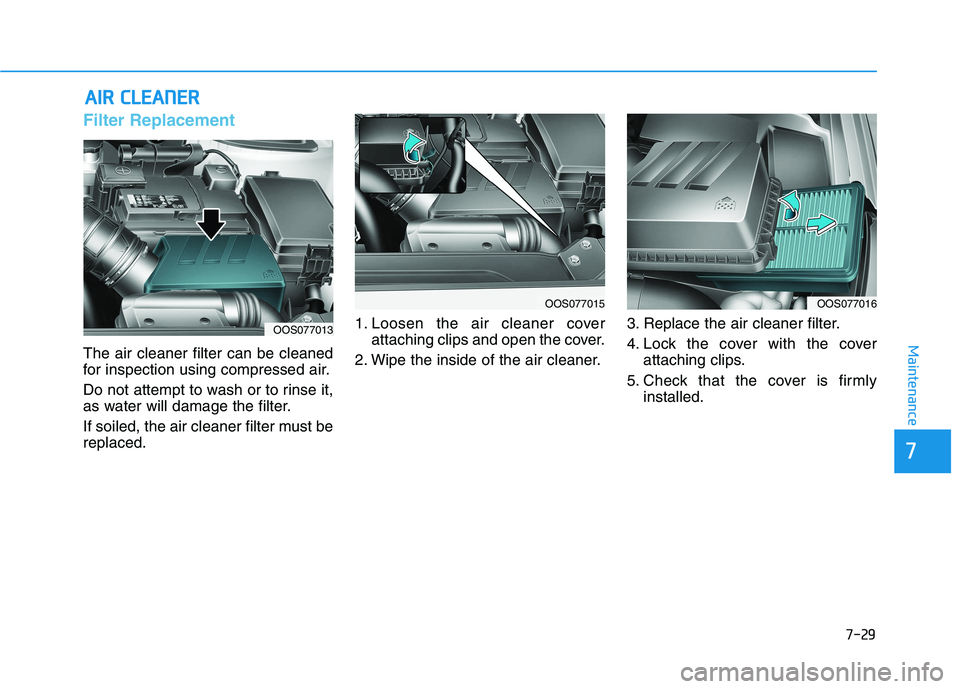
replaced.1. Loosen the air cleaner cover
attaching clips and open the cover.
2. Wipe the inside of the air cleaner.3. Replace the air cleaner filter.
4. Lock the cover with the cover
attaching clips.
5. Check that the cover is firmly
installed.
OOS077015OOS077016
OOS077013
Page 445 of 506
7-53
7
Maintenance
F FU
US
SE
ES
S
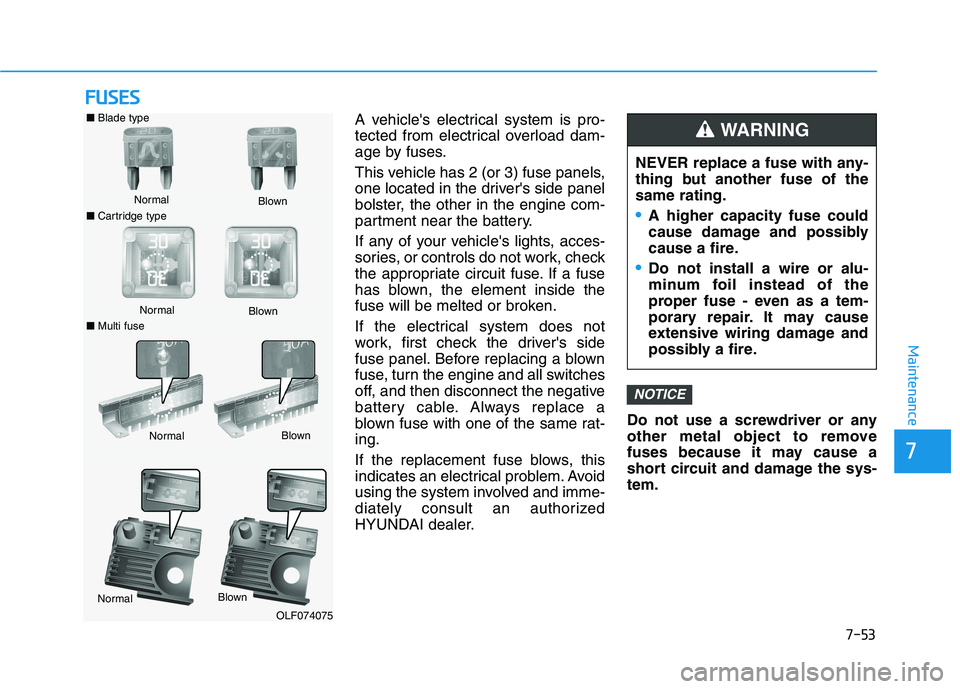
A vehicle's electrical system is pro-
tected from electrical overload dam-
age by fuses.
This vehicle has 2 (or 3) fuse panels,
one located in the driver's side panel
bolster, the other in the engine com-
partment near the battery.
If any of your vehicle's lights, acces-
sories, or controls do not work, check
the appropriate circuit fuse. If a fuse
has blown, the element inside the
fuse will be melted or broken.
If the electrical system does not
work, first check the driver's side
fuse panel. Before replacing a blown
fuse, turn the engine and all switches
off, and then disconnect the negative
battery cable. Always replace a
blown fuse with one of the same rat-
ing.
If the replacement fuse blows, this
indicates an electrical problem. Avoid
using the system involved and imme-
diately consult an authorized
HYUNDAI dealer.Do not use a screwdriver or any
other metal object to remove
fuses because it may cause a
short circuit and damage the sys-
tem.
NOTICE
NEVER replace a fuse with any-
thing but another fuse of the
same rating.
A higher capacity fuse could
cause damage and possibly
cause a fire.
Do not install a wire or alu-
minum foil instead of the
proper fuse - even as a tem-
porary repair. It may cause
extensive wiring damage and
possibly a fire.
WARNING ■Blade type
Normal
■Cartridge typeBlown
Normal
Blown
■Multi fuse
NormalBlown
NormalBlown
OLF074075
Page 457 of 506
7-65
7
Maintenance
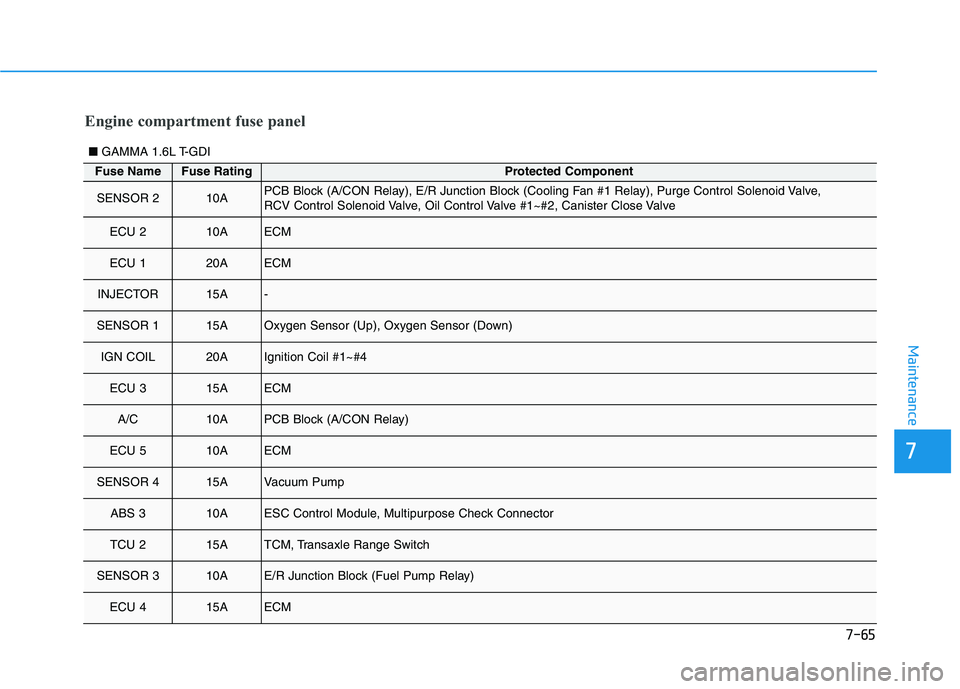
Fuse NameFuse RatingProtected Component
SENSOR 210APCB Block (A/CON Relay), E/R Junction Block (Cooling Fan #1 Relay), Purge Control Solenoid Valve,
RCV Control Solenoid Valve, Oil Control Valve #1~#2, Canister Close Valve
ECU 210AECM
ECU 120AECM
INJECTOR15A-
SENSOR 115AOxygen Sensor (Up), Oxygen Sensor (Down)
IGN COIL20AIgnition Coil #1~#4
ECU 315AECM
A/C10APCB Block (A/CON Relay)
ECU 510AECM
SENSOR 415AVacuum Pump
ABS 310AESC Control Module, Multipurpose Check Connector
TCU 215ATCM, Transaxle Range Switch
SENSOR 310AE/R Junction Block (Fuel Pump Relay)
ECU 415AECM
■ GAMMA 1.6L T-GDI
Engine compartment fuse panel
Page 464 of 506
7-72
Maintenance
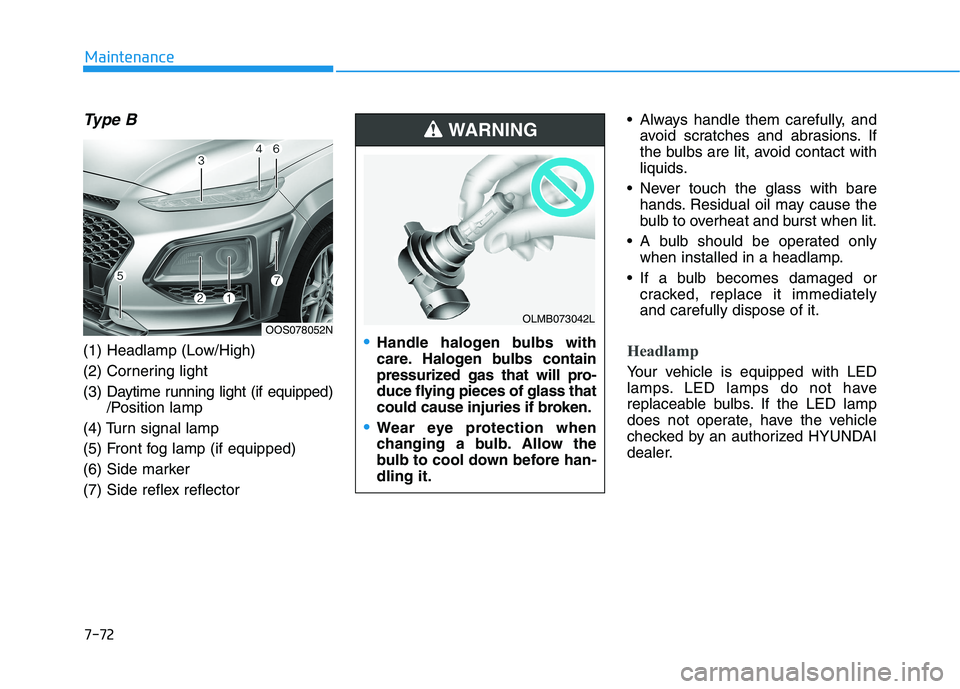
Type B
(1) Headlamp (Low/High)
(2) Cornering light
(3) Daytime running light (if equipped)
/Position lamp
(4) Turn signal lamp
(5) Front fog lamp (if equipped)
(6) Side marker
(7) Side reflex reflector Always handle them carefully, and
avoid scratches and abrasions. If
the bulbs are lit, avoid contact with
liquids.
Never touch the glass with bare
hands. Residual oil may cause the
bulb to overheat and burst when lit.
A bulb should be operated only
when installed in a headlamp.
If a bulb becomes damaged or
cracked, replace it immediately
and carefully dispose of it.Headlamp
Your vehicle is equipped with LED
lamps. LED lamps do not have
replaceable bulbs. If the LED lamp
does not operate, have the vehicle
checked by an authorized HYUNDAI
dealer.
OOS078052NHandle halogen bulbs with
care. Halogen bulbs contain
pressurized gas that will pro-
duce flying pieces of glass that
could cause injuries if broken.
Wear eye protection when
changing a bulb. Allow the
bulb to cool down before han-
dling it.
WARNING
OLMB073042L
Page 469 of 506
7-77
7
Maintenance
Tail / Stop lamp (Type B)
Your vehicle is equipped with LED
lamps. LED lamps do not have
replaceable bulbs. If the LED lamp
does not operate, have the vehicle
checked by an authorized HYUNDAi
dealer.
Turn signal lamp / Back up lamp
If the light bulb does not operate,
have the vehicle checked by an
authorized HYUNDAI dealer.
Side marker
Your vehicle is equipped with LED
lamps. LED lamps do not have
replaceable bulbs. If the LED lamp
does not operate, have the vehicle
checked by an authorized HYUNDAI
dealer.
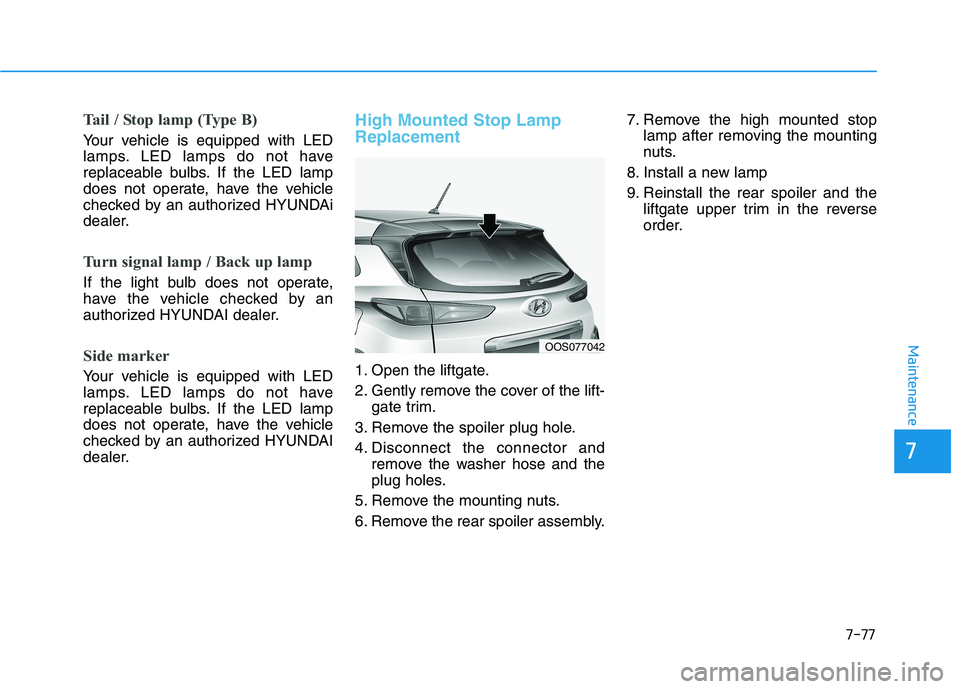
High Mounted Stop Lamp
Replacement
1. Open the liftgate.
2. Gently remove the cover of the lift-
gate trim.
3. Remove the spoiler plug hole.
4. Disconnect the connector and
remove the washer hose and the
plug holes.
5. Remove the mounting nuts.
6. Remove the rear spoiler assembly.7. Remove the high mounted stop
lamp after removing the mounting
nuts.
8. Install a new lamp
9. Reinstall the rear spoiler and the
liftgate upper trim in the reverse
order.
OOS077042
Page 493 of 506
8-9
88
Specifications, Consumer information and Reporting safety defects
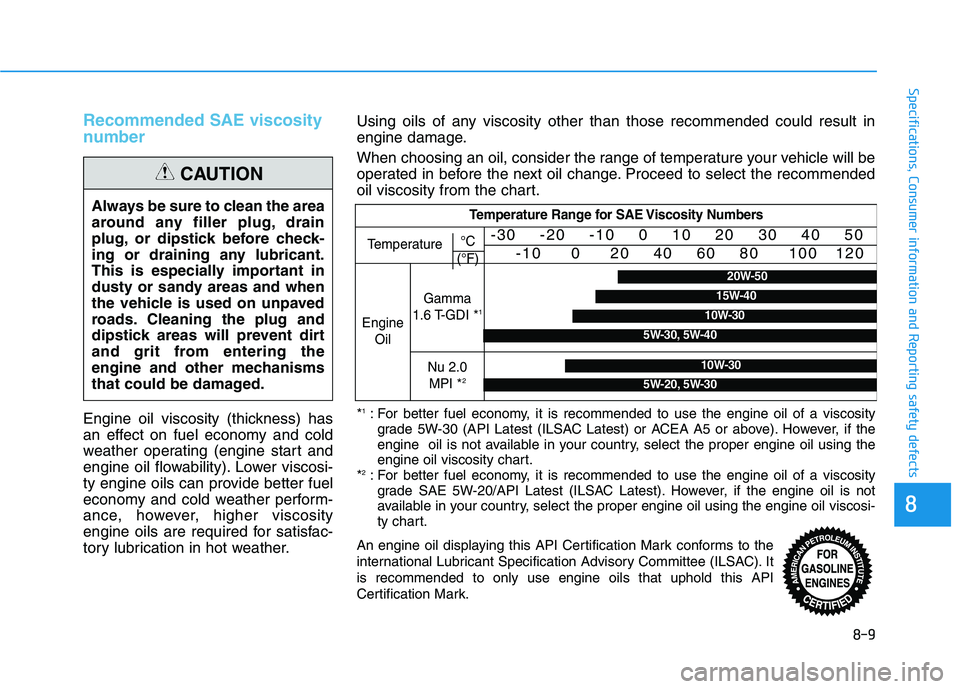
Recommended SAE viscosity
number
Engine oil viscosity (thickness) has
an effect on fuel economy and cold
weather operating (engine start and
engine oil flowability). Lower viscosi-
ty engine oils can provide better fuel
economy and cold weather perform-
ance, however, higher viscosity
engine oils are required for satisfac-
tory lubrication in hot weather.Always be sure to clean the area
around any filler plug, drain
plug, or dipstick before check-
ing or draining any lubricant.
This is especially important in
dusty or sandy areas and when
the vehicle is used on unpaved
roads. Cleaning the plug and
dipstick areas will prevent dirt
and grit from entering the
engine and other mechanisms
that could be damaged.
CAUTION
Temperature Range for SAE Viscosity Numbers
Temperature -30 -20 -10 0 10 20 30 40 50
-10 0 20 40 60 80 100 120
Engine
Oil
Gamma
1.6 T-GDI *1
Nu 2.0
MPI *2
°C
(°F)
*1: For better fuel economy, it is recommended to use the engine oil of a viscosity
grade 5W-30 (API Latest (ILSAC Latest) or ACEA A5 or above). However, if the
engine oil is not available in your country, select the proper engine oil using the
engine oil viscosity chart.
*
2: For better fuel economy, it is recommended to use the engine oil of a viscosity
grade SAE 5W-20/API Latest (ILSAC Latest). However, if the engine oil is not
available in your country, select the proper engine oil using the engine oil viscosi-
ty chart.
5W-30, 5W-40
10W-30
15W-40
20W-50
10W-30
5W-20, 5W-30
Using oils of any viscosity other than those recommended could result in
engine damage.
When choosing an oil, consider the range of temperature your vehicle will be
operated in before the next oil change. Proceed to select the recommended
oil viscosity from the chart.
An engine oil displaying this API Certification Mark conforms to the
international Lubricant Specification Advisory Committee (ILSAC). It
is recommended to only use engine oils that uphold this API
Certification Mark.
Page 501 of 506
I-4
Emission control system .................................................7-88
Crankcase Emission Control System .........................7-88
Evaporative Emission Control System Including
Onboard Refueling Vapor Recovery (ORVR) ........7-88
Exhaust Emission Control System .............................7-89
Engine ...............................................................................8-2
Engine Compartment.................................................1-6, 7-3
Engine coolant ................................................................7-23
Changing Engine Coolant ..........................................7-26
Checking the Engine Coolant Level ..........................7-23
Engine Number ...............................................................8-11
Engine oil ........................................................................7-21
Checking the Engine Oil and Filter ...........................7-22
Checking the Engine Oil Level ..................................7-21
Explanation of scheduled maintenance items.................7-18
Exterior Features .................................................3-43, 3-144
Fuel Filler Door ..........................................................3-46
Hood ...........................................................................3-43
Liftgate .......................................................................3-44
Roof Side Rails ........................................................3-144
Exterior Overview.............................................................1-2Forward Collision-avoidance Assist (FCA) system
- Camera type ..............................................................5-56
FCA Sensor ................................................................5-60
FCA Warning Message and System Control..............5-58
Limitations of the System ..........................................5-64
System Malfunction ...................................................5-62
System Setting and Activation ...................................5-56
Forward collision-avoidance assist (FCA) system
- sensor fusion type (Front radar + Front camera) ......5-69
System Setting and Activation ...................................5-69
FCA Sensor ................................................................5-73
FCA Warning Message and System Control..............5-71
Limitations of the System ..........................................5-76
System Malfunction ...................................................5-74
Fuses ...............................................................................7-53
Engine Compartment Panel Fuse Replacement .........7-55
Fuse/Relay Panel Description ....................................7-57
Instrument Panel Fuse Replacement ..........................7-54
Hazard warning flasher .....................................................6-2
Head Up Display (HUD) ................................................3-87
Index
EF
H