Engine HYUNDAI KONA 2022 Owners Manual
[x] Cancel search | Manufacturer: HYUNDAI, Model Year: 2022, Model line: KONA, Model: HYUNDAI KONA 2022Pages: 579, PDF Size: 35.31 MB
Page 459 of 579
08
8-9
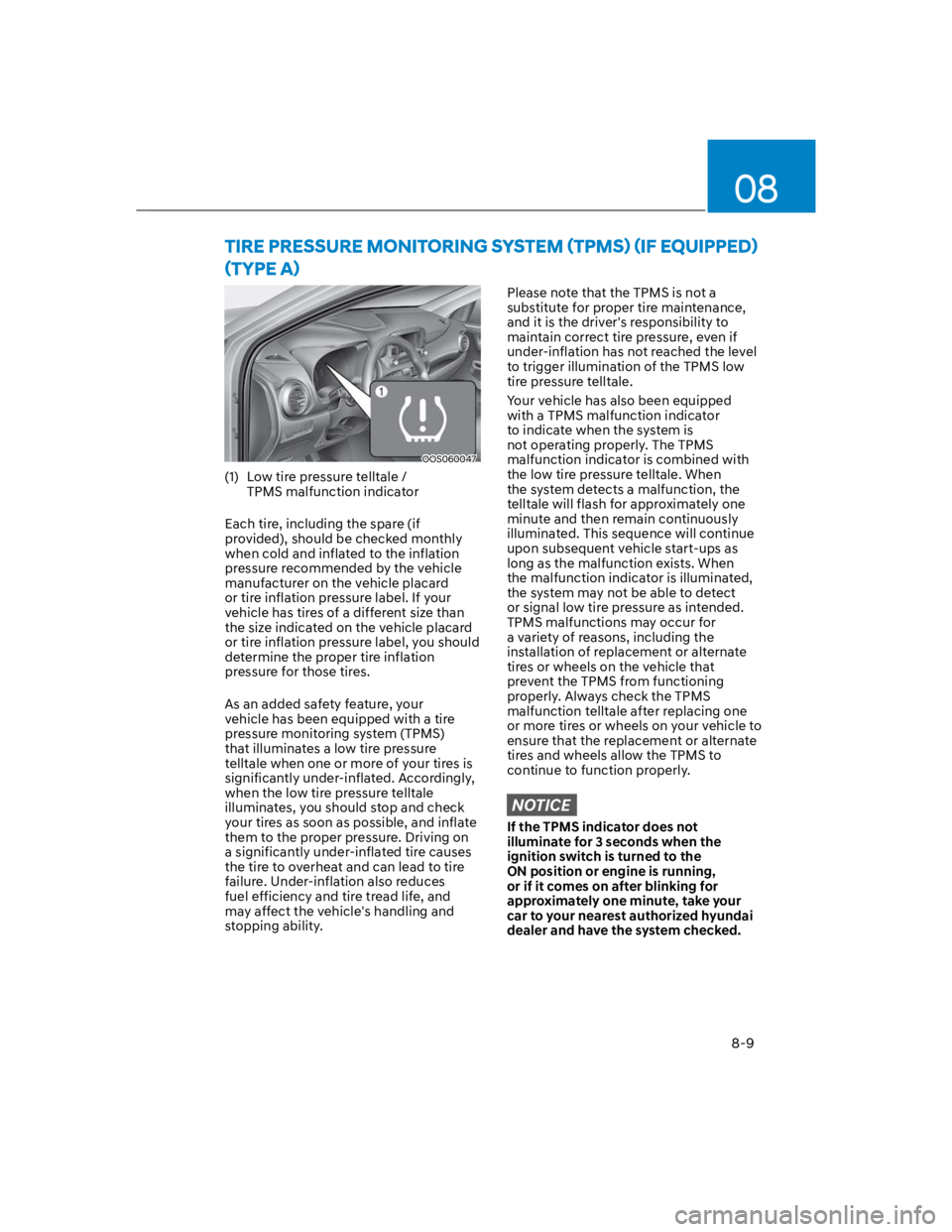
OOS060047
(1) Low tire pressure telltale /
TPMS malfunction indicator
Each tire, including the spare (if
provided), should be checked monthly
when cold and inflated to the inflation
pressure recommended by the vehicle
manufacturer on the vehicle placard
or tire inflation pressure label. If your
vehicle has tires of a different size than
the size indicated on the vehicle placard
or tire inflation pressure label, you should
determine the proper tire inflation
pressure for those tires.
As an added safety feature, your
vehicle has been equipped with a tire
pressure monitoring system (TPMS)
that illuminates a low tire pressure
telltale when one or more of your tires is
significantly under-inflated. Accordingly,
when the low tire pressure telltale
illuminates, you should stop and check
your tires as soon as possible, and inflate
them to the proper pressure. Driving on
a significantly under-inflated tire causes
the tire to overheat and can lead to tire
failure. Under-inflation also reduces
fuel efficiency and tire tread life, and
may affect the vehicle's handling and
stopping ability.
Please note that the TPMS is not a
substitute for proper tire maintenance,
and it is the driver's responsibility to
maintain correct tire pressure, even if
under-inflation has not reached the level
to trigger illumination of the TPMS low
tire pressure telltale.
Your vehicle has also been equipped
with a TPMS malfunction indicator
to indicate when the system is
not operating properly. The TPMS
malfunction indicator is combined with
the low tire pressure telltale. When
the system detects a malfunction, the
telltale will flash for approximately one
minute and then remain continuously
illuminated. This sequence will continue
upon subsequent vehicle start-ups as
long as the malfunction exists. When
the malfunction indicator is illuminated,
the system may not be able to detect
or signal low tire pressure as intended.
TPMS malfunctions may occur for
a variety of reasons, including the
installation of replacement or alternate
tires or wheels on the vehicle that
prevent the TPMS from functioning
properly. Always check the TPMS
malfunction telltale after replacing one
or more tires or wheels on your vehicle to
ensure that the replacement or alternate
tires and wheels allow the TPMS to
continue to function properly.
NOTICE
If the TPMS indicator does not
illuminate for 3 seconds when the
ignition switch is turned to the
ON position or engine is running,
or if it comes on after blinking for
approximately one minute, take your
car to your nearest authorized hyundai
dealer and have the system checked.
Page 463 of 579
08
8-13
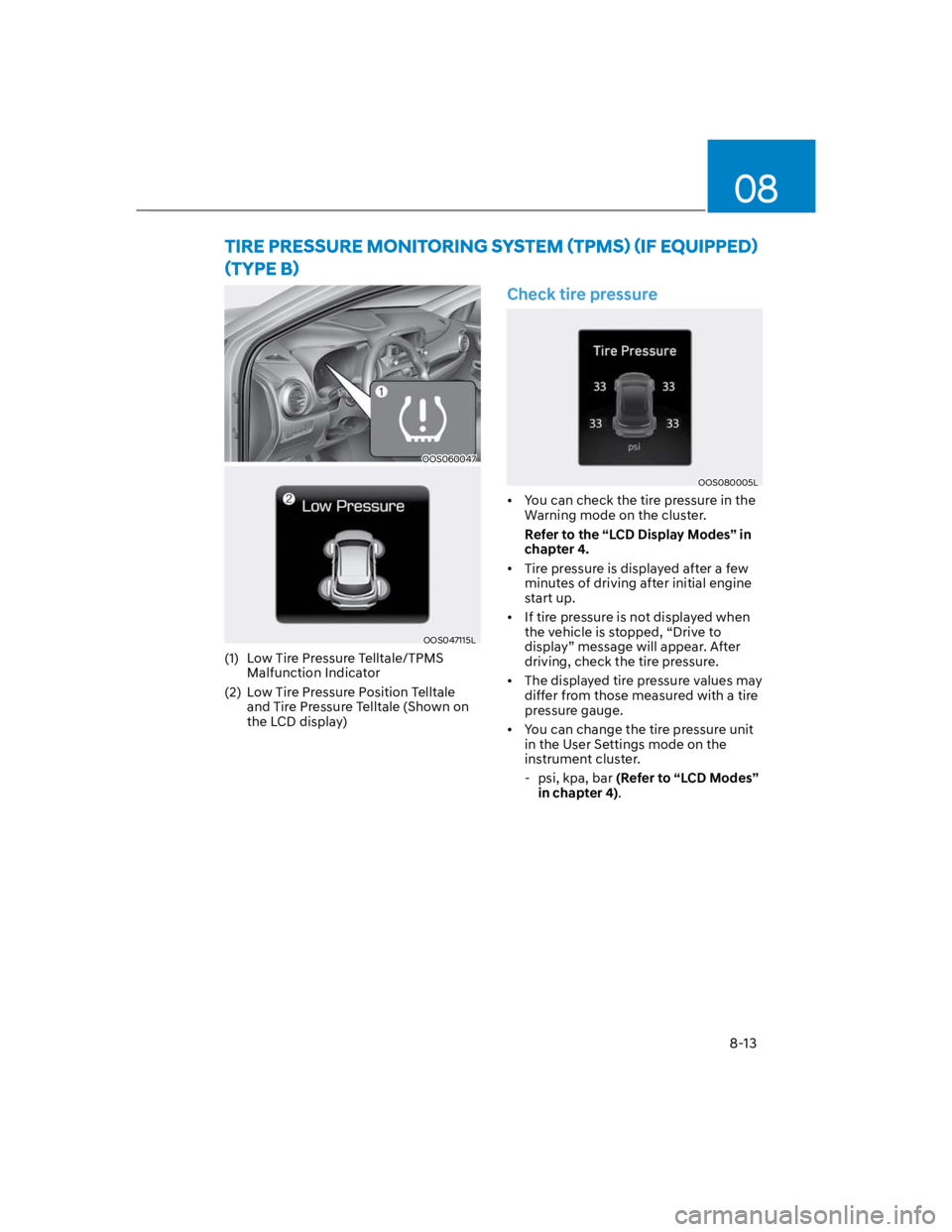
OOS060047
OOS047115L
(1) Low Tire Pressure Telltale/TPMS
Malfunction Indicator
(2) Low Tire Pressure Position Telltale
and Tire Pressure Telltale (Shown on
the LCD display)
Check tire pressure
OOS080005L
You can check the tire pressure in the
Warning mode on the cluster.
Refer to the “LCD Display Modes” in
chapter 4.
Tire pressure is displayed after a few
minutes of driving after initial engine
start up.
If tire pressure is not displayed when
the vehicle is stopped, “Drive to
display” message will appear. After
driving, check the tire pressure.
The displayed tire pressure values may
differ from those measured with a tire
pressure gauge.
You can change the tire pressure unit
in the User Settings mode on the
instrument cluster.
- psi, kpa, bar (Refer to “LCD Modes”
in chapter 4).
Page 464 of 579
Emergency situations
8-14
Tire pressure monitoring system
WARNING
Over-inflation or under-inflation can
reduce tire life, adversely affect vehicle
handling, and lead to sudden tire failure
that may cause loss of vehicle control
resulting in an accident.
Each tire, including the spare (if
provided), should be checked monthly
when cold and inflated to the inflation
pressure recommended by the vehicle
manufacturer on the vehicle placard
or tire inflation pressure label. (If your
vehicle has tires of a different size than
the size indicated on the vehicle placard
or tire inflation pressure label, you should
determine the proper tire inflation
pressure for those tires.)
As an added safety feature, your
vehicle has been equipped with a tire
pressure monitoring system (TPMS)
that illuminates a low tire pressure
telltale when one or more of your tires is
significantly under-inflated. Accordingly,
when the low tire pressure telltale
illuminates, you should stop and check
your tires as soon as possible, and inflate
them to the proper pressure. Driving on
a significantly under-inflated tire causes
the tire to overheat and can lead to tire
failure.
Under-inflation also reduces fuel
efficiency and tire tread life, and may
affect the vehicle’s handling and
stopping ability.
Please note that the TPMS is not a
substitute for proper tire maintenance,
and it is the driver’s responsibility to
maintain correct tire pressure, even if
under-inflation has not reached the level
to trigger illumination of the TPMS low
tire pressure telltale.
Your vehicle has also been equipped with
a TPMS malfunction indicator to indicate
when the system is not operating
properly. The TPMS malfunction
indicator is combined with the low
tire pressure telltale. When the system
detects a malfunction, the telltale will
flash for approximately one minute and
then remain continuously illuminated.
This sequence will continue upon
subsequent vehicle start-ups as long as
the malfunction exists.
When the malfunction indicator is
illuminated, the system may not be able
to detect or signal low tire pressure as
intended. TPMS malfunctions may occur
for a variety of reasons, including the
installation of replacement or alternate
tires or wheels on the vehicle that
prevent the TPMS from functioning
properly.
Always check the TPMS malfunction
telltale after replacing one or more tires
or wheels on your vehicle to ensure that
the replacement or alternate tires and
wheels allow the TPMS to continue to
function properly.
NOTICE
If any of the below happens, have
the system checked by an authorized
HYUNDAI dealer.
1. The Low Tire Pressure Telltale/ TPMS
Malfunction Indicator does not
illuminate for 3 seconds when the
Engine Start/Stop button is pressed
to the ON position or when the
engine is running.
2. The TPMS Malfunction Indicator
remains illuminated after blinking for
approximately 1 minute.
3. The Low Tire Pressure Position
Telltale remains illuminated.
Page 469 of 579
08
8-19
Changing tires
WARNING
A vehicle can slip or roll off of a jack
causing serious injury or death to you or
those nearby. Take the following safety
precautions:
Do not get under a vehicle that is
supported by a jack.
NEVER attempt to change a tire in
the lane of traffic. ALWAYS move the
vehicle completely off the road on
level, firm ground away from traffic
before trying to change a tire. If you
cannot find a level, firm place off
the road, call a towing service for
assistance.
Be sure to use the jack provided with
the vehicle.
ALWAYS place the jack on the
designated jacking positions on the
vehicle and NEVER on the bumpers
or any other part of the vehicle for
jacking support.
Do not start or run the engine while
the vehicle is on the jack.
Do not allow anyone to remain in the
vehicle while it is on the jack.
Keep children away from the road
and the vehicle.
Follow these steps to change your
vehicle’s tire:
1. Park on a level, firm surface.
2. Move the shift lever into P (Park),
apply the parking brake, and place
the ignition switch in the LOCK/OFF
position.
3. Press the hazard warning flasher
button.
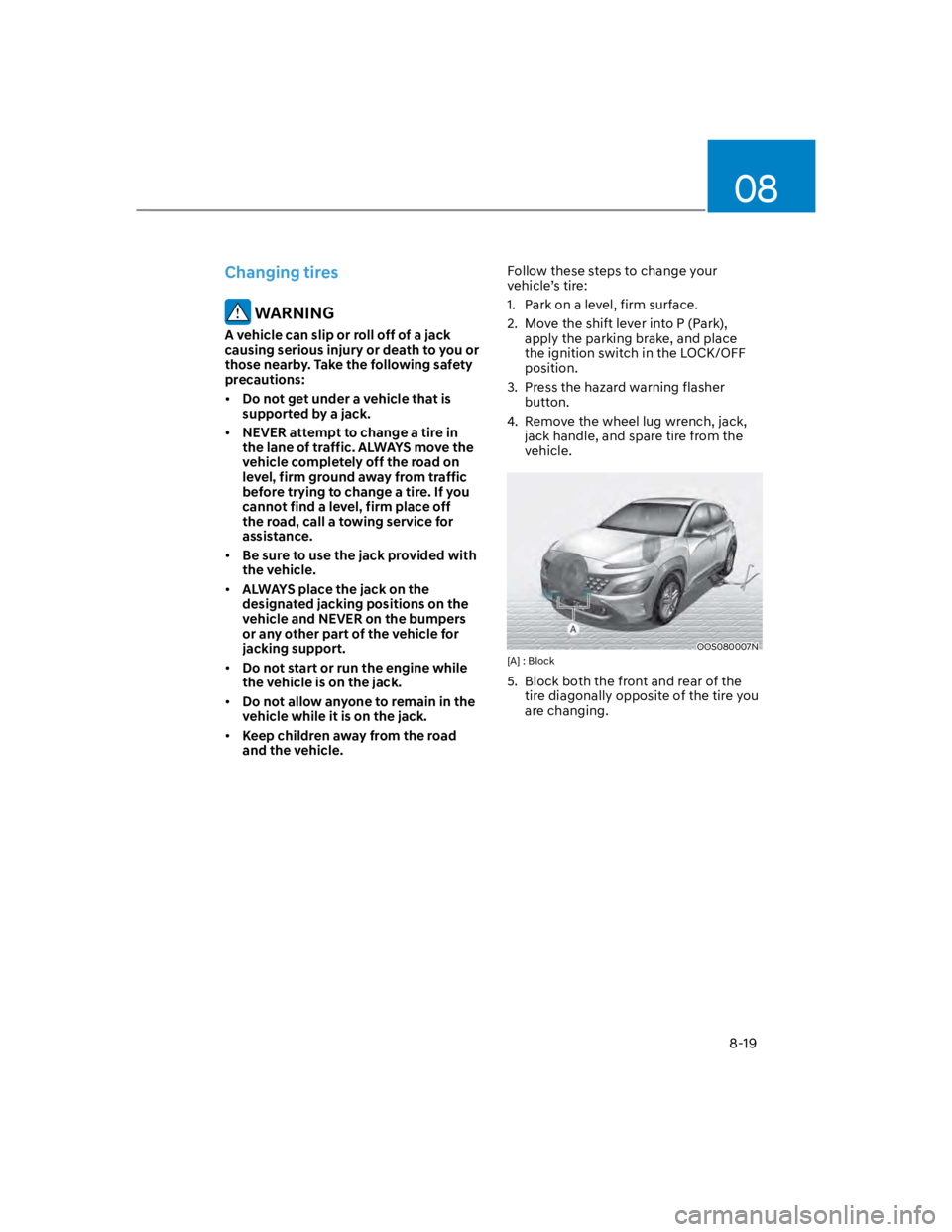
4. Remove the wheel lug wrench, jack,
jack handle, and spare tire from the
vehicle.
OOS080007N
[A] : Block
5. Block both the front and rear of the
tire diagonally opposite of the tire you
are changing.
Page 474 of 579
Emergency situations
8-24
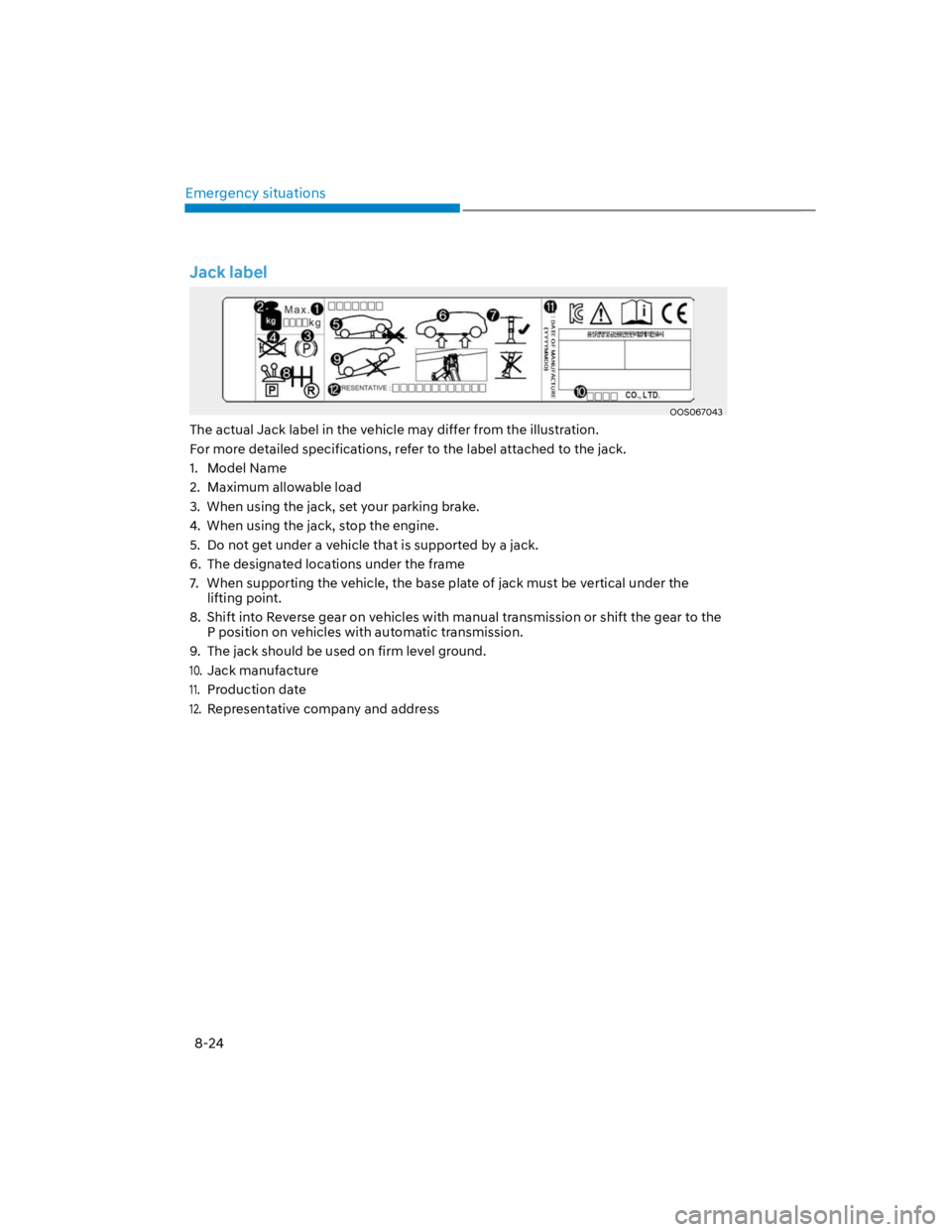
Jack label
OOS067043
The actual Jack label in the vehicle may differ from the illustration.
For more detailed specifications, refer to the label attached to the jack.
1. Model Name
2. Maximum allowable load
3. When using the jack, set your parking brake.
4. When using the jack, stop the engine.
5. Do not get under a vehicle that is supported by a jack.
6. The designated locations under the frame
7. When supporting the vehicle, the base plate of jack must be vertical under the
lifting point.
8. Shift into Reverse gear on vehicles with manual transmission or shift the gear to the
P position on vehicles with automatic transmission.
9. The jack should be used on firm level ground.
10.
Jack manufacture
11.
Production date
12.
Representative company and address
Page 482 of 579

Emergency situations
8-32
Notes on the safe use of the Tire
Mobility Kit
Park your car at the side of the road
so that you can work with the Tire
Mobility Kit away from moving traffic.
To be sure your vehicle will not move,
even when you’re on fairly level
ground, always set your parking brake.
Only use the Tire Mobility Kit for
sealing/inflation passenger car tires.
Only punctured areas located within
the tread region of the tire can be
sealed using the tire mobility kit.
Do not use on motorcycles, bicycles
or any other type of tires.
When the tire and wheel are
damaged, do not use Tire Mobility Kit
for your safety.
Use of the Tire Mobility Kit may not be
effective for tire damage larger than
approximately 16 inch (4 mm).
Please contact the nearest HYUNDAI
dealer if the tire cannot be made
roadworthy with the Tire Mobility Kit.
Do not use the Tire Mobility Kit if a tire
is severely damaged by driving run flat
or with insufficient air pressure.
Do not remove any foreign objects
such as nails or screws that have
penetrated the tire.
Provided the car is outdoors, leave the
engine running. Otherwise operating
the compressor may eventually drain
the car battery.
Never leave the Tire Mobility Kit
unattended while it is being used.
Do not leave the compressor running
for more than 10 minutes at a time or
it may overheat.
Do not use the Tire Mobility Kit if the
ambient temperature is below -22°F
(30°C).
In case of skin contact with the
sealant, wash the area thoroughly
with plenty of water. If the irritation
persists, seek medical attention.
In case of eye contact with the
sealant, flush your eyes for at least 15
minutes. If the irritation persists, seek
medical attention.
In case of swallowing the sealant,
rinse the mouth and drink plenty of
water. However, never give anything
to an unconscious person and seek
medical attention immediately.
Long time exposure to the sealant
may cause damage to bodily tissue
such as kidney, etc.
Page 487 of 579
9
9. Maintenance
Engine compartment ........................................................................................ 9-3
Maintenance services ....................................................................................... 9-4
Owner’s responsibility ................................................................................................ 9-4
Owner maintenance precautions............................................................................... 9-4
Owner maintenance ......................................................................................... 9-5
Owner maintenance schedule ................................................................................... 9-6
Scheduled maintenance services .....................................................................9-7
Normal Maintenance Schedule .................................................................................. 9-8
Maintenance Under Severe Usage Conditions ......................................................... 9-11
Explanation of scheduled maintenance items .............................................. 9-13
Fuel filter (for gasoline engine) ................................................................................. 9-13
Intelligent variable transmission fluid ...................................................................... 9-14
Parking brake .............................................................................................................. 9-14
Propeller shaft ............................................................................................................ 9-14
Engine oil .......................................................................................................... 9-15
Checking the engine oil level .................................................................................... 9-15
Checking the engine oil and filter ............................................................................. 9-16
Engine coolant .................................................................................................9-18
Checking the coolant level ........................................................................................ 9-18
Changing coolant ...................................................................................................... 9-20
Brake fluid ........................................................................................................ 9-21
Checking the brake fluid level ................................................................................... 9-21
Washer fluid .................................................................................................... 9-22
Checking the washer fluid level ................................................................................ 9-22
Parking brake .................................................................................................. 9-22
Checking the parking brake ...................................................................................... 9-22
Air cleaner ....................................................................................................... 9-23
Filter replacement ..................................................................................................... 9-23
Climate control air filter.................................................................................. 9-24
Filter Inspection..........................................................................................................9-24
Wiper blades ................................................................................................... 9-25
Blade inspection ......................................................................................................... 9-25
Blade replacement ..................................................................................................... 9-25
For best battery service ............................................................................................ 9-30
Battery capacity label ............................................................................................... 9-30
Battery recharging ..................................................................................................... 9-31
Reset items ................................................................................................................. 9-32
Page 488 of 579

9
Tires and wheels ............................................................................................. 9-33
Tire care ......................................................................................................................9-33
Recommended cold tire inflation pressures ............................................................9-33
Check tire inflation pressure .....................................................................................9-34
Tire rotation ................................................................................................................9-35
Wheel alignment and tire balance ............................................................................9-36
Tire replacement ........................................................................................................9-36
Wheel replacement .................................................................................................... 9-37
Tire traction ................................................................................................................ 9-37
Tire maintenance ....................................................................................................... 9-37
Tire sidewall labeling ................................................................................................. 9-38
Tire Terminology and Definitions ............................................................................. 9-41
All Season Tires .......................................................................................................... 9-43
Summer Tires ............................................................................................................ 9-43
Snow Tires.................................................................................................................. 9-43
Radial-Ply Tires .......................................................................................................... 9-44
Low aspect ratio tires ................................................................................................ 9-44
Fuses ................................................................................................................ 9-45
Instrument panel fuse replacement ........................................................................ 9-46
Engine compartment panel fuse replacement ........................................................9-47
Fuse/relay panel description .................................................................................... 9-49
Light bulbs ....................................................................................................... 9-58
Headlamp, position lamp, turn signal lamp, Daytime Running Light (DRL)
replacement .............................................................................................................. 9-59
Front fog lamp ........................................................................................................... 9-62
Side repeater lamp replacement ............................................................................. 9-63
Rear combination lamp bulb replacement ............................................................. 9-63
High mounted stop lamp replacement ................................................................... 9-65
License Plate Light Bulb Replacement ................................................................... 9-66
Interior Light Bulb Replacement .............................................................................. 9-66
Appearance care .............................................................................................9-68
Exterior care .............................................................................................................. 9-68
Interior care ................................................................................................................ 9-74
Emission control system..................................................................................9-77
Gasoline Particulate Filter (GPF) ............................................................................... 9-79
California perchlorate notice .........................................................................9-80
Page 489 of 579
9-3
09
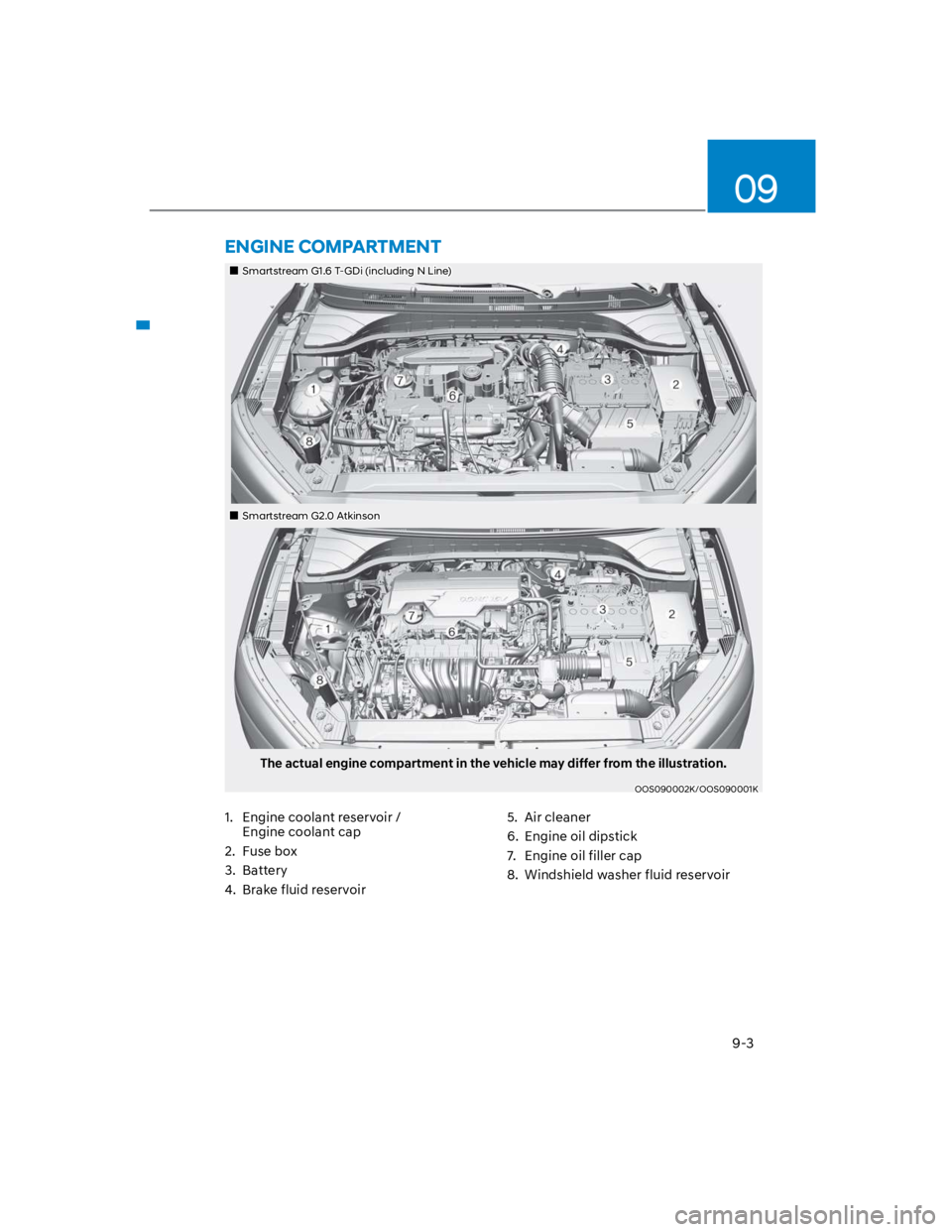
Smartstream G1.6 T-GDi (including N Line)
Smartstream G2.0 Atkinson
The actual engine compartment in the vehicle may differ from the illustration.
OOS090002K/OOS090001K
1. Engine coolant reservoir /
Engine coolant cap
2. Fuse box
3. Battery
4. Brake fluid reservoir
5. Air cleaner
6. Engine oil dipstick
7. Engine oil filler cap
8. Windshield washer fluid reservoir
ENGINE COMPARTMENT
Page 491 of 579

09
9-5
WARNING
Performing maintenance work on a
vehicle can be dangerous. If you lack
sufficient knowledge and experience or
the proper tools and equipment to do
the work, we recommend that having it
done by an authorized HYUNDAI dealer.
ALWAYS follow these precautions for
performing maintenance work:
Park your vehicle on level ground.
Shift the vehicle to P (Park), apply
the parking brake, and press the
Engine Start/Stop button to the OFF
position.
Block the tires (front and back) to
prevent the vehicle from moving.
Remove loose clothing or jewelry
that can become entangled in
moving parts.
If you must run the engine during
maintenance, do so out doors or in
an area with plenty of ventilation.
Keep flames, sparks, or smoking
materials away from the battery and
fuel-related parts.
WARNING
Touching metal parts
Do not touch metal parts (including
strut bars) while the engine is operating
or hot. Doing so could result in serious
personal injury. Turn the engine off and
wait until the metal parts cool down
to perform maintenance work on the
vehicle.
The following lists are vehicle checks and
inspections that should be performed
by the owner or an authorized HYUNDAI
dealer at the frequencies indicated to
help ensure safe, dependable operation
of your vehicle.
Any adverse conditions should be
brought to the attention of your dealer as
soon as possible.
These Owner Maintenance vehicle
checks are generally not covered by
warranties and you may be charged for
labor, parts and lubricants used.
OWNER MAINTENANCE