Engine HYUNDAI KONA 2022 Owners Manual
[x] Cancel search | Manufacturer: HYUNDAI, Model Year: 2022, Model line: KONA, Model: HYUNDAI KONA 2022Pages: 579, PDF Size: 35.31 MB
Page 532 of 579
Maintenance
9-46
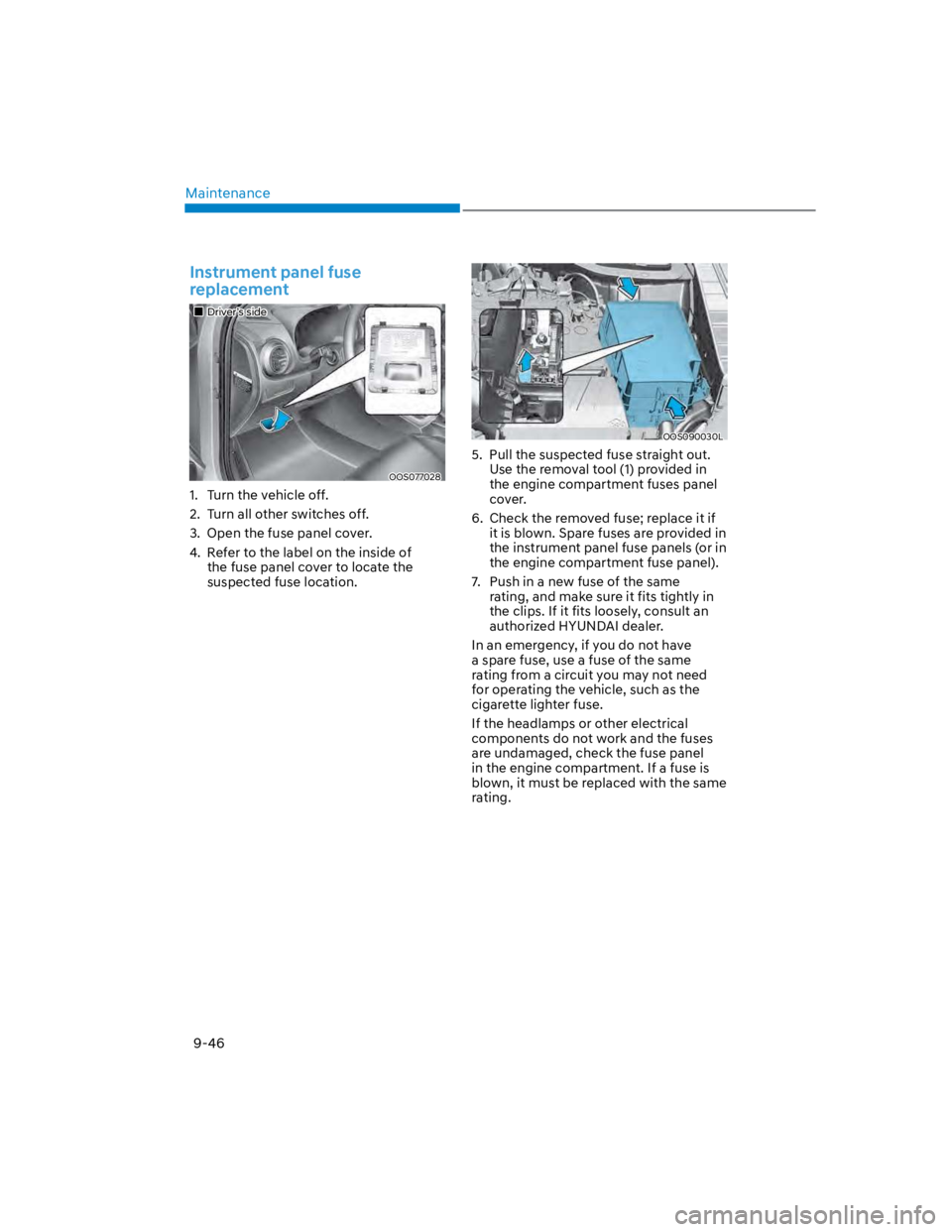
Instrument panel fuse
replacement
Driver’s side
OOS077028
1. Turn the vehicle off.
2. Turn all other switches off.
3. Open the fuse panel cover.
4. Refer to the label on the inside of
the fuse panel cover to locate the
suspected fuse location.
OOS090030L
5. Pull the suspected fuse straight out.
Use the removal tool (1) provided in
the engine compartment fuses panel
cover.
6. Check the removed fuse; replace it if
it is blown. Spare fuses are provided in
the instrument panel fuse panels (or in
the engine compartment fuse panel).
7. Push in a new fuse of the same
rating, and make sure it fits tightly in
the clips. If it fits loosely, consult an
authorized HYUNDAI dealer.
In an emergency, if you do not have
a spare fuse, use a fuse of the same
rating from a circuit you may not need
for operating the vehicle, such as the
cigarette lighter fuse.
If the headlamps or other electrical
components do not work and the fuses
are undamaged, check the fuse panel
in the engine compartment. If a fuse is
blown, it must be replaced with the same
rating.
Page 533 of 579
09
9-47
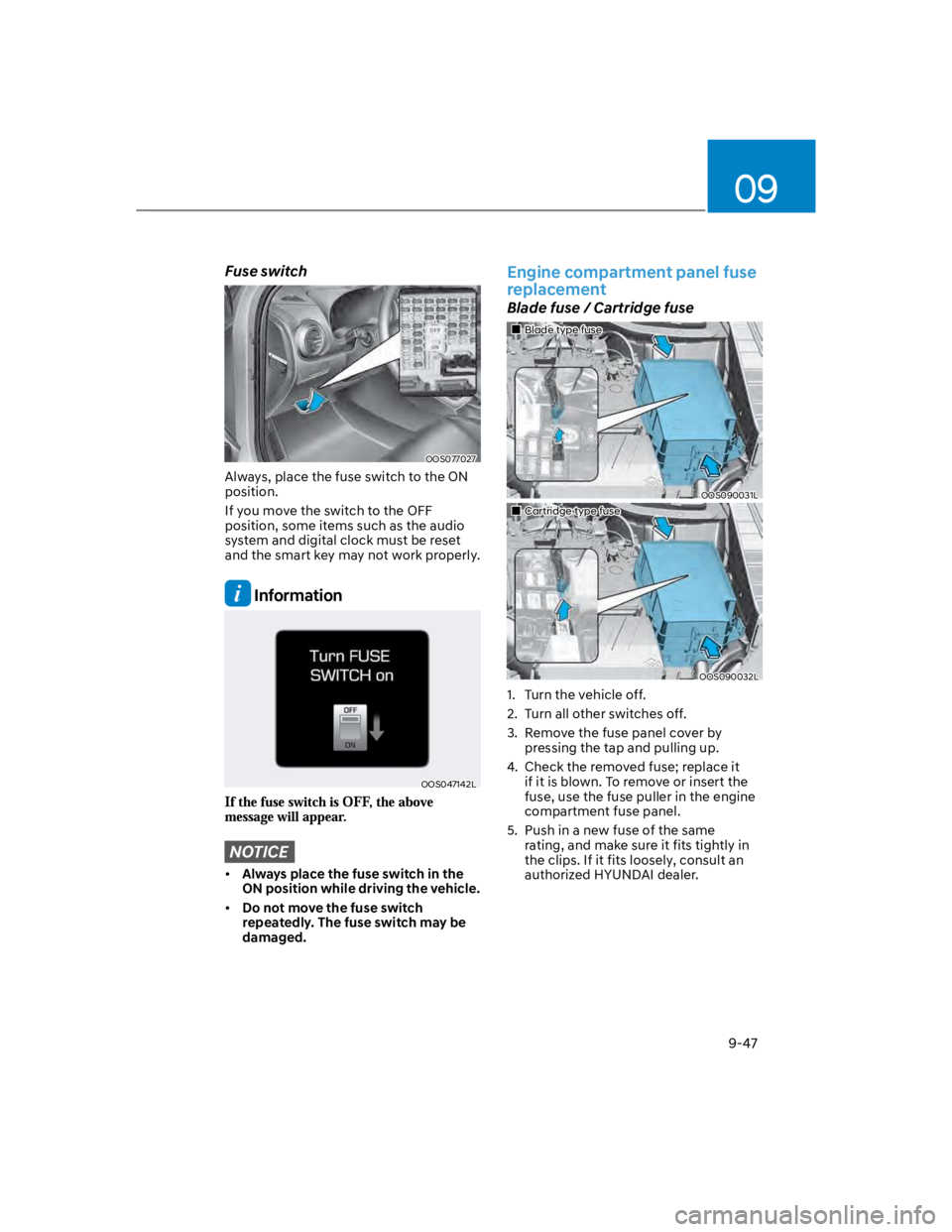
Fuse switch
OOS077027
Always, place the fuse switch to the ON
position.
If you move the switch to the OFF
position, some items such as the audio
system and digital clock must be reset
and the smart key may not work properly.
Information
OOS047142L
NOTICE
Always place the fuse switch in the
ON position while driving the vehicle.
Do not move the fuse switch
repeatedly. The fuse switch may be
damaged.
Engine compartment panel fuse
replacement
Blade fuse / Cartridge fuse
Blade type fuse
OOS090031L
Cartridge type fuse
OOS090032L
1. Turn the vehicle off.
2. Turn all other switches off.
3. Remove the fuse panel cover by
pressing the tap and pulling up.
4. Check the removed fuse; replace it
if it is blown. To remove or insert the
fuse, use the fuse puller in the engine
compartment fuse panel.
5. Push in a new fuse of the same
rating, and make sure it fits tightly in
the clips. If it fits loosely, consult an
authorized HYUNDAI dealer.
Page 534 of 579
Maintenance
9-48
NOTICE
After checking the fuse panel in the
engine compartment, securely install
the fuse panel cover. You may hear a
clicking sound if the cover is securely
latched. If it is not securely latched,
electrical failure may occur from water
contact.
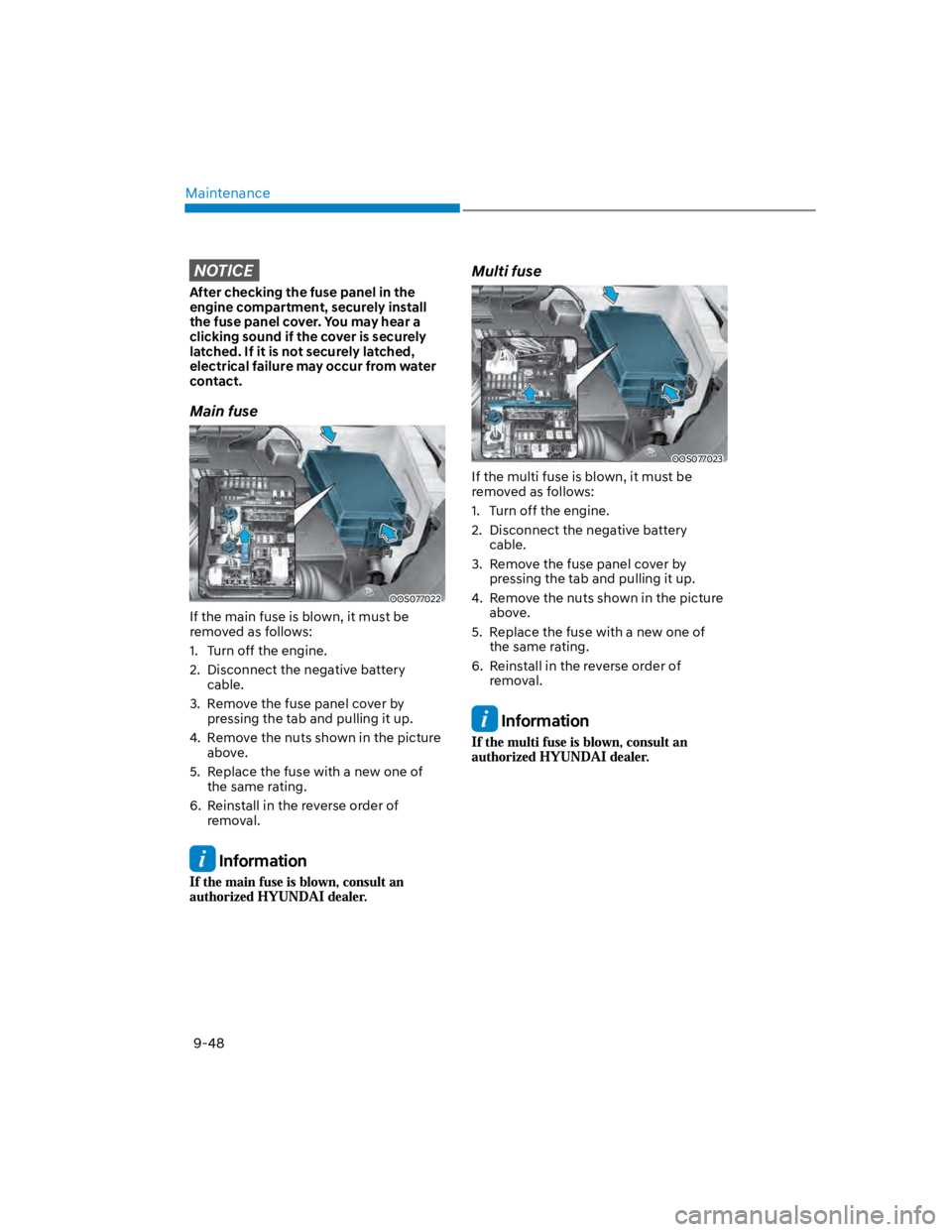
Main fuse
OOS077022
If the main fuse is blown, it must be
removed as follows:
1. Turn off the engine.
2. Disconnect the negative battery
cable.
3. Remove the fuse panel cover by
pressing the tab and pulling it up.
4. Remove the nuts shown in the picture
above.
5. Replace the fuse with a new one of
the same rating.
6. Reinstall in the reverse order of
removal.
Information
Multi fuse
OOS077023
If the multi fuse is blown, it must be
removed as follows:
1. Turn off the engine.
2. Disconnect the negative battery
cable.
3. Remove the fuse panel cover by
pressing the tab and pulling it up.
4. Remove the nuts shown in the picture
above.
5. Replace the fuse with a new one of
the same rating.
6. Reinstall in the reverse order of
removal.
Information
Page 538 of 579
Maintenance
9-52
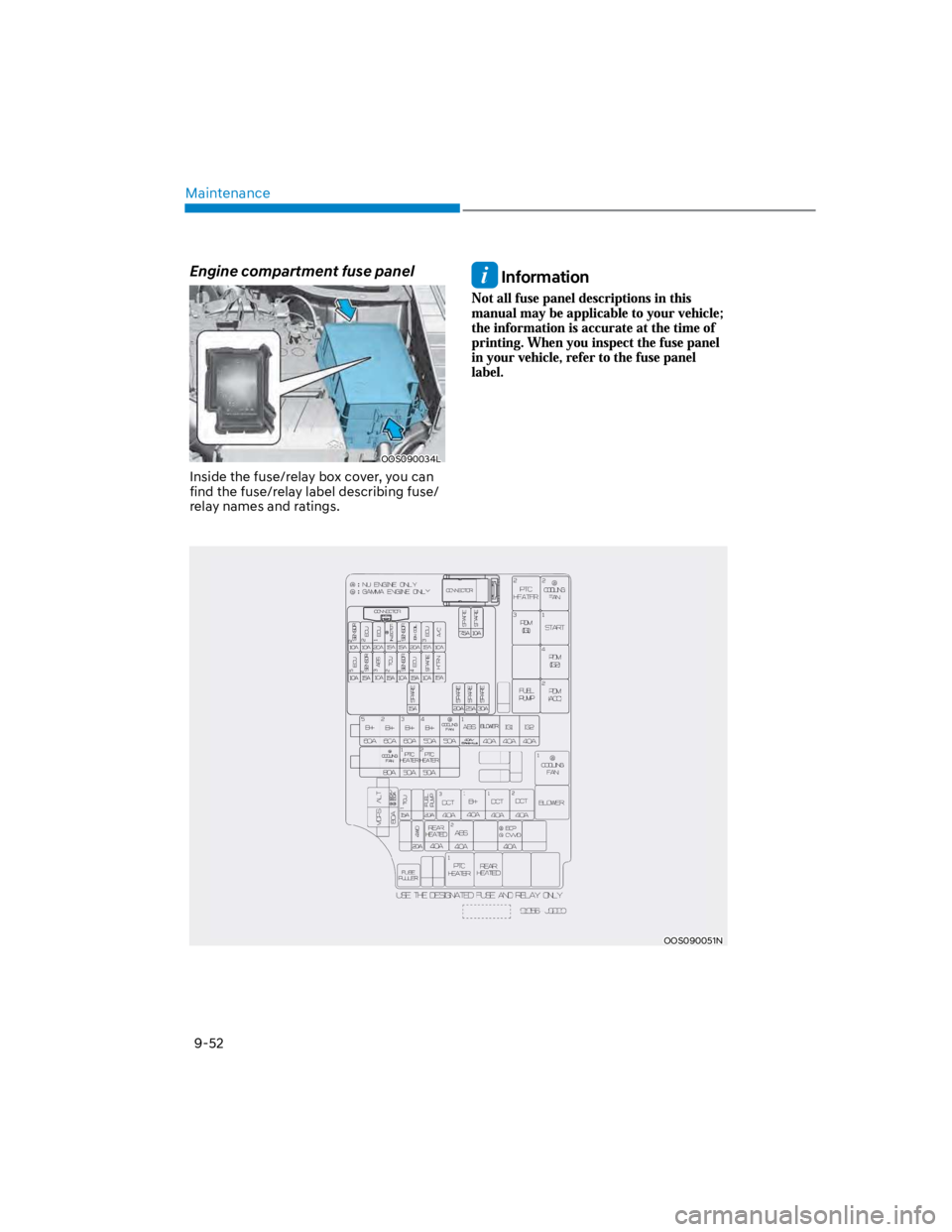
Engine compartment fuse panel
OOS090034L
Inside the fuse/relay box cover, you can
find the fuse/relay label describing fuse/
relay names and ratings.
Information
OOS090051N
Page 540 of 579
Maintenance
9-54
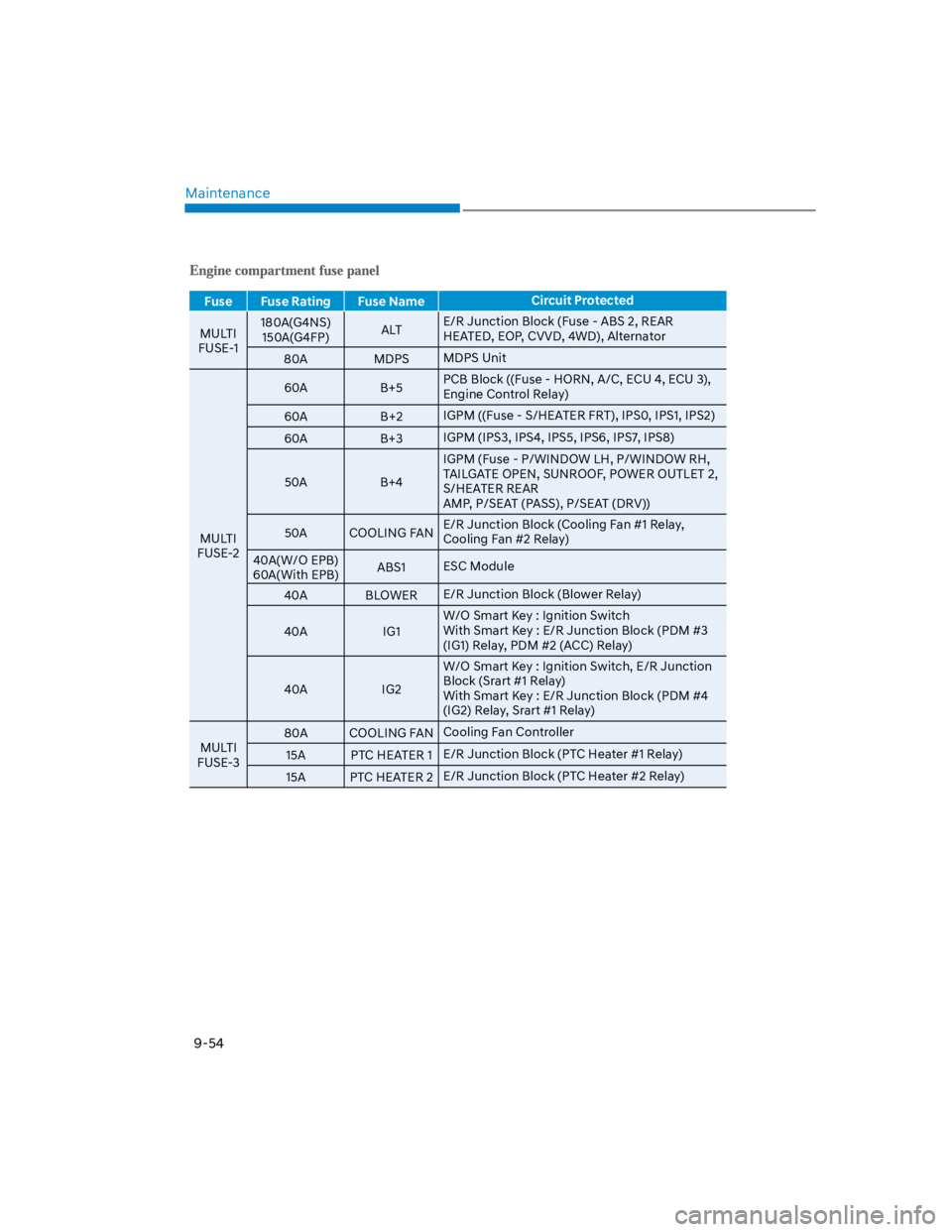
Fuse Fuse Rating Fuse NameCircuit Protected
MULTI
FUSE-1
180A(G4NS)
150A(G4FP)ALTE/R Junction Block (Fuse - ABS 2, REAR
HEATED, EOP, CVVD, 4WD), Alternator
80A MDPSMDPS Unit
MULTI
FUSE-2
60A B+5PCB Block ((Fuse - HORN, A/C, ECU 4, ECU 3),
Engine Control Relay)
60A B+2IGPM ((Fuse - S/HEATER FRT), IPS0, IPS1, IPS2)
60A B+3IGPM (IPS3, IPS4, IPS5, IPS6, IPS7, IPS8)
50A B+4
IGPM (Fuse - P/WINDOW LH, P/WINDOW RH,
TAILGATE OPEN, SUNROOF, POWER OUTLET 2,
S/HEATER REAR
AMP, P/SEAT (PASS), P/SEAT (DRV))
50A COOLING FANE/R Junction Block (Cooling Fan #1 Relay,
Cooling Fan #2 Relay)
40A(W/O EPB)
60A(With EPB)ABS1ESC Module
40A BLOWERE/R Junction Block (Blower Relay)
40A IG1
W/O Smart Key : Ignition Switch
With Smart Key : E/R Junction Block (PDM #3
(IG1) Relay, PDM #2 (ACC) Relay)
40A IG2
W/O Smart Key : Ignition Switch, E/R Junction
Block (Srart #1 Relay)
With Smart Key : E/R Junction Block (PDM #4
(IG2) Relay, Srart #1 Relay)
MULTI
FUSE-3
80A COOLING FANCooling Fan Controller
15A PTC HEATER 1E/R Junction Block (PTC Heater #1 Relay)
15A PTC HEATER 2E/R Junction Block (PTC Heater #2 Relay)
Page 544 of 579
Maintenance
9-58
We recommend that you consult an
authorized HYUNDAI dealer to replace
most vehicle light bulbs. It is difficult
to replace vehicle light bulbs because
other parts of the vehicle must be
removed before you can get to the bulb.
This is especially true for removing the
headlamp assembly to get to the bulb(s).
Removing/installing the headlamp
assembly can result in damage to the
vehicle.
WARNING
Prior to working on a light, depress
the foot brake, shift to P (Park), apply
the parking brake, press the Engine
Start/Stop button to the OFF position
and take the key with you when
leaving the vehicle to avoid sudden
movement of the vehicle and to
prevent possible electric shock.
Be aware the bulbs may be hot and
may burn your fingers.
NOTICE
Be sure to replace the burned-out bulb
with one of the same wattage rating.
Otherwise, it may cause damage to the
fuse or electrical wiring system.
NOTICE
To prevent damage, do not clean the
headlamp lens with chemical solvents
or strong detergents.
Information
LIGHT BULBS
Page 550 of 579
Maintenance
9-64
OOS077066L
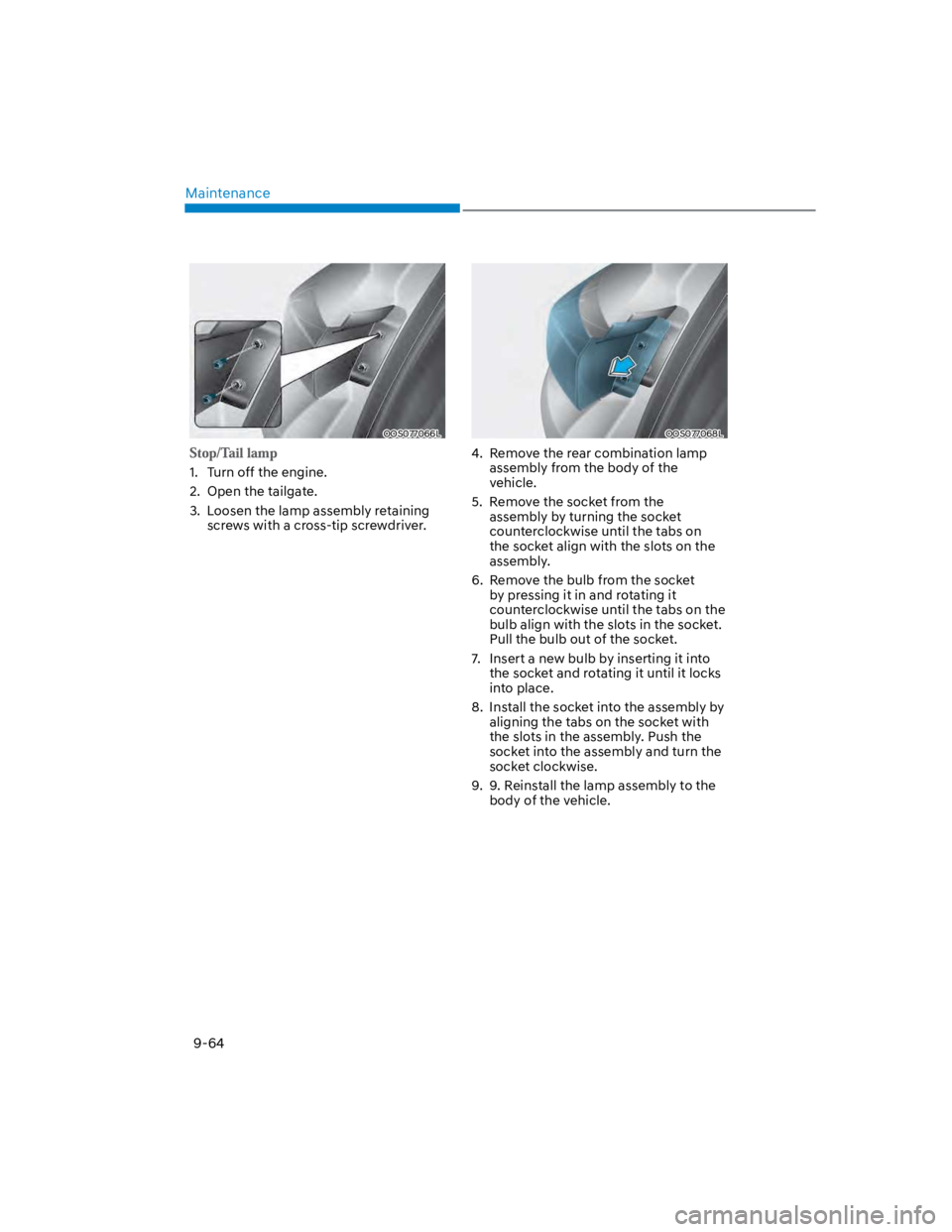
1. Turn off the engine.
2. Open the tailgate.
3. Loosen the lamp assembly retaining
screws with a cross-tip screwdriver.
OOS077068L
4. Remove the rear combination lamp
assembly from the body of the
vehicle.
5. Remove the socket from the
assembly by turning the socket
counterclockwise until the tabs on
the socket align with the slots on the
assembly.
6. Remove the bulb from the socket
by pressing it in and rotating it
counterclockwise until the tabs on the
bulb align with the slots in the socket.
Pull the bulb out of the socket.
7. Insert a new bulb by inserting it into
the socket and rotating it until it locks
into place.
8. Install the socket into the assembly by
aligning the tabs on the socket with
the slots in the assembly. Push the
socket into the assembly and turn the
socket clockwise.
9. 9. Reinstall the lamp assembly to the
body of the vehicle.
Page 551 of 579
09
9-65
OOS077069L
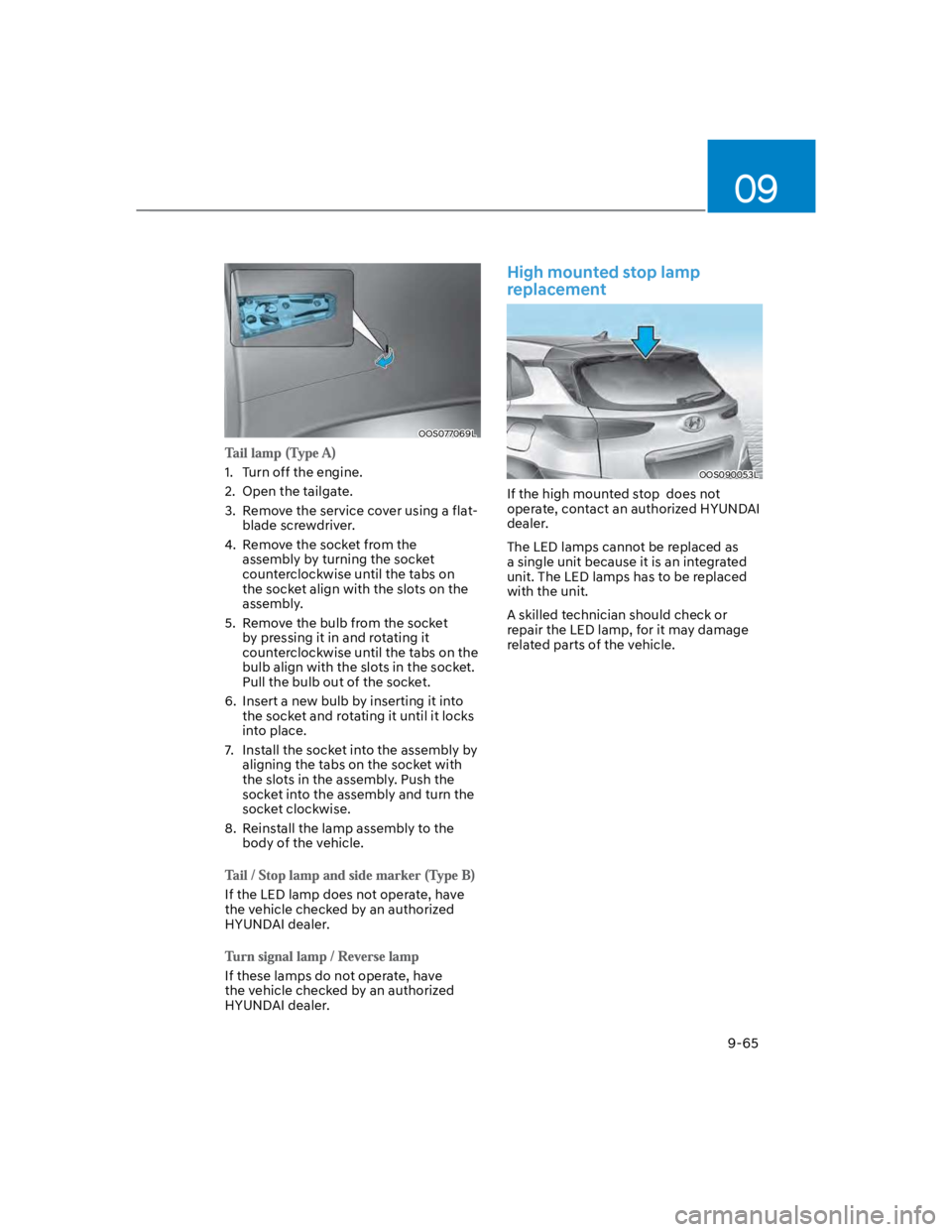
1. Turn off the engine.
2. Open the tailgate.
3. Remove the service cover using a flat-
blade screwdriver.
4. Remove the socket from the
assembly by turning the socket
counterclockwise until the tabs on
the socket align with the slots on the
assembly.
5. Remove the bulb from the socket
by pressing it in and rotating it
counterclockwise until the tabs on the
bulb align with the slots in the socket.
Pull the bulb out of the socket.
6. Insert a new bulb by inserting it into
the socket and rotating it until it locks
into place.
7. Install the socket into the assembly by
aligning the tabs on the socket with
the slots in the assembly. Push the
socket into the assembly and turn the
socket clockwise.
8. Reinstall the lamp assembly to the
body of the vehicle.
If the LED lamp does not operate, have
the vehicle checked by an authorized
HYUNDAI dealer.
If these lamps do not operate, have
the vehicle checked by an authorized
HYUNDAI dealer.
High mounted stop lamp
replacement
OOS090053L
If the high mounted stop does not
operate, contact an authorized HYUNDAI
dealer.
The LED lamps cannot be replaced as
a single unit because it is an integrated
unit. The LED lamps has to be replaced
with the unit.
A skilled technician should check or
repair the LED lamp, for it may damage
related parts of the vehicle.
Page 555 of 579
09
9-69
NOTICE
Do not use strong soap, chemical
detergents or hot water, and do not
wash the vehicle in direct sunlight
or when the body of the vehicle is
warm.
Be careful when washing the side
windows of your vehicle.
Especially, with high-pressure water,
water may leak through the windows
and wet the interior.
To prevent damage to the plastic
parts, do not clean with chemical
solvents or strong detergents.
NOTICE
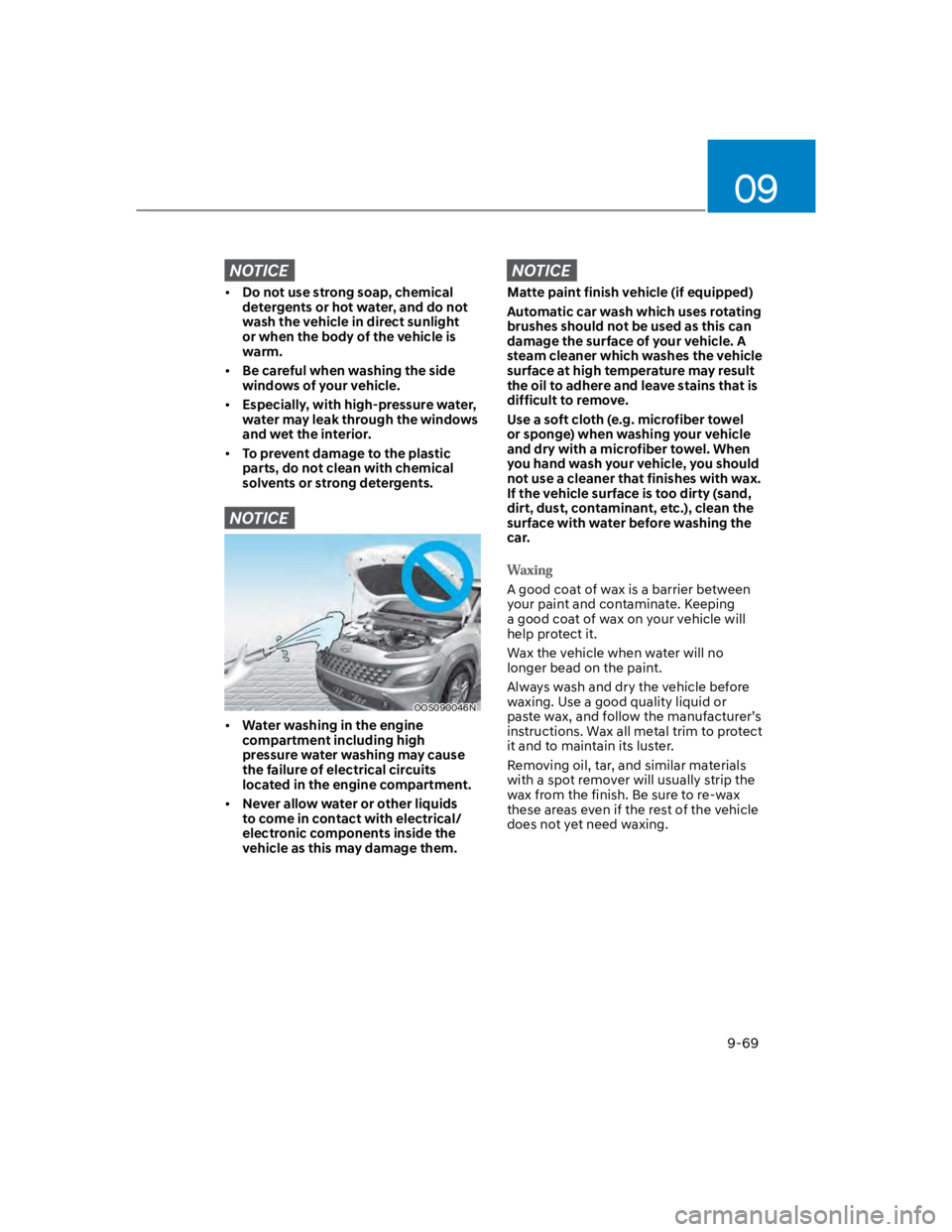
OOS090046N
Water washing in the engine
compartment including high
pressure water washing may cause
the failure of electrical circuits
located in the engine compartment.
Never allow water or other liquids
to come in contact with electrical/
electronic components inside the
vehicle as this may damage them.
NOTICE
Matte paint finish vehicle (if equipped)
Automatic car wash which uses rotating
brushes should not be used as this can
damage the surface of your vehicle. A
steam cleaner which washes the vehicle
surface at high temperature may result
the oil to adhere and leave stains that is
difficult to remove.
Use a soft cloth (e.g. microfiber towel
or sponge) when washing your vehicle
and dry with a microfiber towel. When
you hand wash your vehicle, you should
not use a cleaner that finishes with wax.
If the vehicle surface is too dirty (sand,
dirt, dust, contaminant, etc.), clean the
surface with water before washing the
car.
A good coat of wax is a barrier between
your paint and contaminate. Keeping
a good coat of wax on your vehicle will
help protect it.
Wax the vehicle when water will no
longer bead on the paint.
Always wash and dry the vehicle before
waxing. Use a good quality liquid or
paste wax, and follow the manufacturer’s
instructions. Wax all metal trim to protect
it and to maintain its luster.
Removing oil, tar, and similar materials
with a spot remover will usually strip the
wax from the finish. Be sure to re-wax
these areas even if the rest of the vehicle
does not yet need waxing.
Page 563 of 579
09
9-77
The emission control system of your
vehicle is covered by a written limited
warranty. Please see the warranty
information contained in the Service
Passport in your vehicle.
Your vehicle is equipped with an
emission control system to meet all
applicable emission regulations. There
are three emission control systems, as
follows.
(1) Crankcase emission control system
(2) Evaporative emission control system
(3) Exhaust emission control system
In order to ensure the proper function
of the emission control systems, it
is recommended that you have your
vehicle inspected and maintained
by an authorized HYUNDAI dealer in
accordance with the maintenance
schedule in this manual.
NOTICE
For the Inspection and Maintenance
Test (with Electronic Stability Control
(ESC) system)
To prevent the vehicle from misfiring
during dynamometer testing, turn
the Electronic Stability Control
(ESC) system off by pressing the ESC
switch (ESC OFF light illuminated).
After dynamometer testing is
completed, turn the ESC system back
on by pressing the ESC switch again.
1. Crankcase emission control
system
The positive crankcase ventilation system
is employed to prevent air pollution
caused by blow-by gases being emitted
from the crankcase. This system supplies
fresh filtered air to the crankcase through
the air intake hose. Inside the crankcase,
the fresh air mixes with blow-by gases,
which then pass through the PCV valve
into the induction system.
2. Evaporative emission control
system
The Evaporative Emission Control System
is designed to prevent fuel vapors from
escaping into the atmosphere.
Canister
Fuel vapors generated inside the fuel
tank are absorbed and stored in the
onboard canister. When the engine is
running, the fuel vapors absorbed in the
canister are drawn into the surge tank
through the purge control solenoid valve.
Purge Control Solenoid Valve (PCSV)
The purge control solenoid valve
is controlled by the Engine Control
Module (ECM); when the engine coolant
temperature is low during idling, the
PCSV closes so that evaporated fuel
is not taken into the engine. After the
engine warms-up during ordinary
driving, the PCSV opens to introduce
evaporated fuel to the engine.
EMISSION CONTROL SYSTEM