brake sensor HYUNDAI KONA 2022 User Guide
[x] Cancel search | Manufacturer: HYUNDAI, Model Year: 2022, Model line: KONA, Model: HYUNDAI KONA 2022Pages: 579, PDF Size: 35.31 MB
Page 410 of 579
![HYUNDAI KONA 2022 User Guide Driver assistance system
7-78
Changing lanes
OADAS030
[A] : Your vehicle, [B] : Lane changing vehicle
When a vehicle moves into your lane
from an adjacent lane, it cannot be
detected by the sensor](/img/35/41169/w960_41169-409.png "HYUNDAI KONA 2022 User Guide Driver assistance system
7-78
Changing lanes
OADAS030
[A] : Your vehicle, [B] : Lane changing vehicle
When a vehicle moves into your lane
from an adjacent lane, it cannot be
detected by the sensor")
Driver assistance system
7-78
Changing lanes
OADAS030
[A] : Your vehicle, [B] : Lane changing vehicle
When a vehicle moves into your lane
from an adjacent lane, it cannot be
detected by the sensor until it is in the
sensor's detection range. Smart Cruise
Control may not immediately detect
the vehicle when the vehicle changes
lanes abruptly. In this case, you must
maintain a safe braking distance, and
if necessary, depress the brake pedal
to reduce your driving speed in order
to maintain a safe distance.
Detecting vehicle
OJX1079181
In the following cases, some vehicles
in your lane cannot be detected by the
sensor:
- Vehicles offset to one side
- Slow-moving vehicles or sudden-
decelerating vehicles
- Oncoming vehicles
- Stopped vehicles
- Vehicles with small rear profile, such
as trailers
- Narrow vehicles, such as
motorcycles or bicycles
- Special vehicles
- Animals and pedestrians
Adjust your vehicle speed by
depressing the brake pedal according
to the road and driving conditions
ahead.
Page 411 of 579
07
7-79
OOS057022
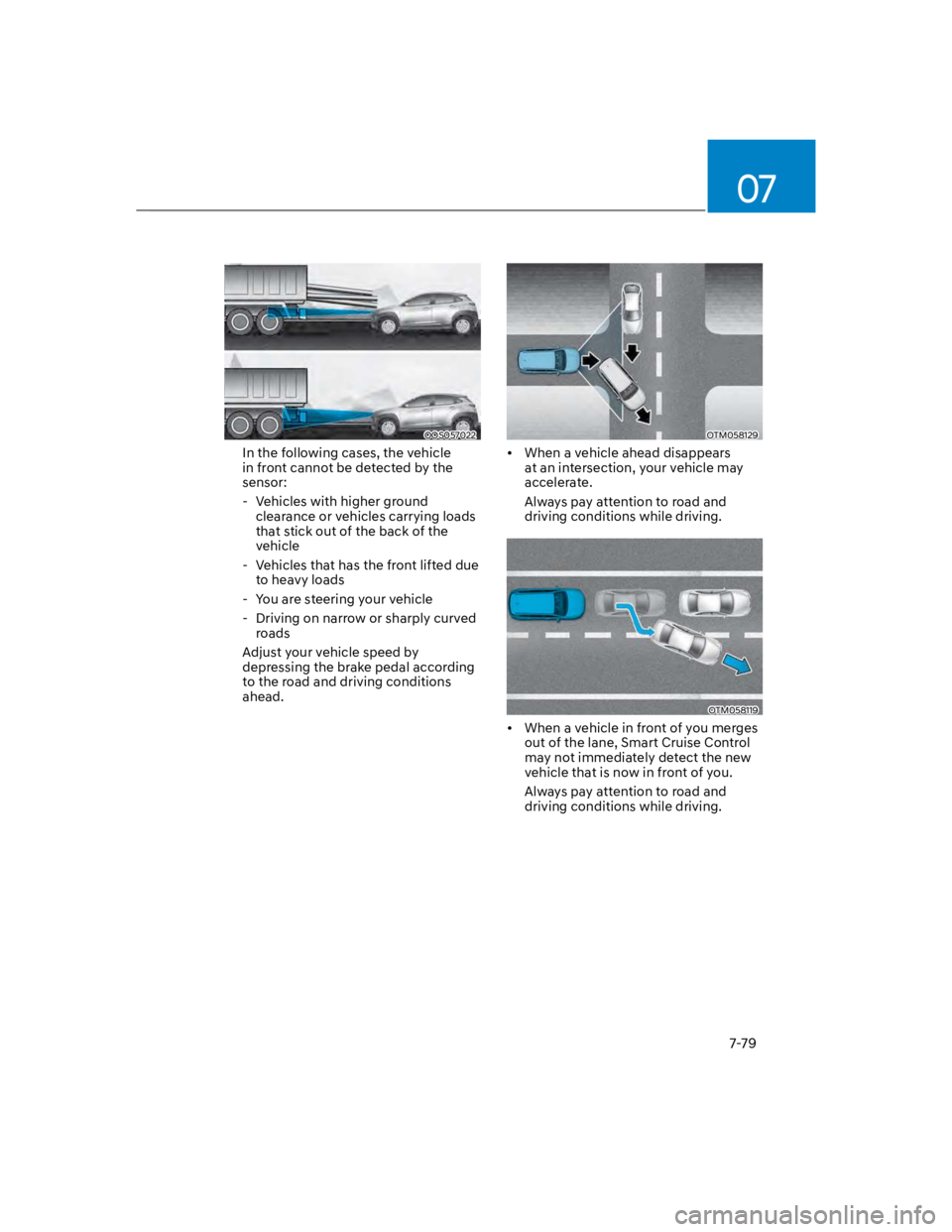
In the following cases, the vehicle
in front cannot be detected by the
sensor:
- Vehicles with higher ground
clearance or vehicles carrying loads
that stick out of the back of the
vehicle
- Vehicles that has the front lifted due
to heavy loads
- You are steering your vehicle
- Driving on narrow or sharply curved
roads
Adjust your vehicle speed by
depressing the brake pedal according
to the road and driving conditions
ahead.
OTM058129
When a vehicle ahead disappears
at an intersection, your vehicle may
accelerate.
Always pay attention to road and
driving conditions while driving.
OTM058119
When a vehicle in front of you merges
out of the lane, Smart Cruise Control
may not immediately detect the new
vehicle that is now in front of you.
Always pay attention to road and
driving conditions while driving.
Page 467 of 579

08
8-17
If the indicators do not extinguish after a
few minutes, please visit an authorized
HYUNDAI dealer.
Each wheel is equipped with a tire
pressure sensor mounted inside the tire
behind the valve stem (except for the
spare tire). You must use TPMS specific
wheels. It is recommended that you
always have your tires serviced by an
authorized HYUNDAI dealer.
You may not be able to identify a tire
with low pressure by simply looking at it.
Always use a good quality tire pressure
gauge to measure. Please note that a tire
that is hot (from being driven) will have a
higher pressure measurement than a tire
that is cold.
A cold tire means the vehicle has been
sitting for 3 hours and driven for less
than 1 mile (1.6 km) in that 3 hour period.
Allow the tire to cool before measuring
the inflation pressure. Always be sure
the tire is cold before inflating to the
recommended pressure.
WARNING
The TPMS cannot alert you to severe
and sudden tire damage caused by
external factors such as nails or road
debris.
If you feel any vehicle instability,
immediately take your foot off
the accelerator, apply the brakes
gradually with light force, and slowly
move to a safe position off the road.
WARNING
Tampering with, modifying, or disabling
the Tire Pressure Monitoring System
(TPMS) components may interfere
with the system’s ability to warn the
driver of low tire pressure conditions
and/or TPMS malfunctions. Tampering
with, modifying, or disabling the Tire
Pressure Monitoring System (TPMS)
components may void the warranty for
that portion of the vehicle.
Information
1.
2.
3.
Page 484 of 579
Emergency situations
8-34
WARNING
If your vehicle is equipped with a
rollover sensor, place the ignition
switch in the LOCK/OFF or ACC position
when the vehicle is being towed.
The side impact and curtain air bag
may deploy if the sensor detects the
situation as a rollover.
When towing your vehicle in an
emergency without wheel dollies:
1. Place the ignition switch in the ACC
position.
2. Place the shift lever in N (Neutral).
3. Release the parking brake.
CAUTION
Failure to place the shift lever in N
(Neutral) when being towed with the
front wheels on the ground can cause
internal damage to the transmission.
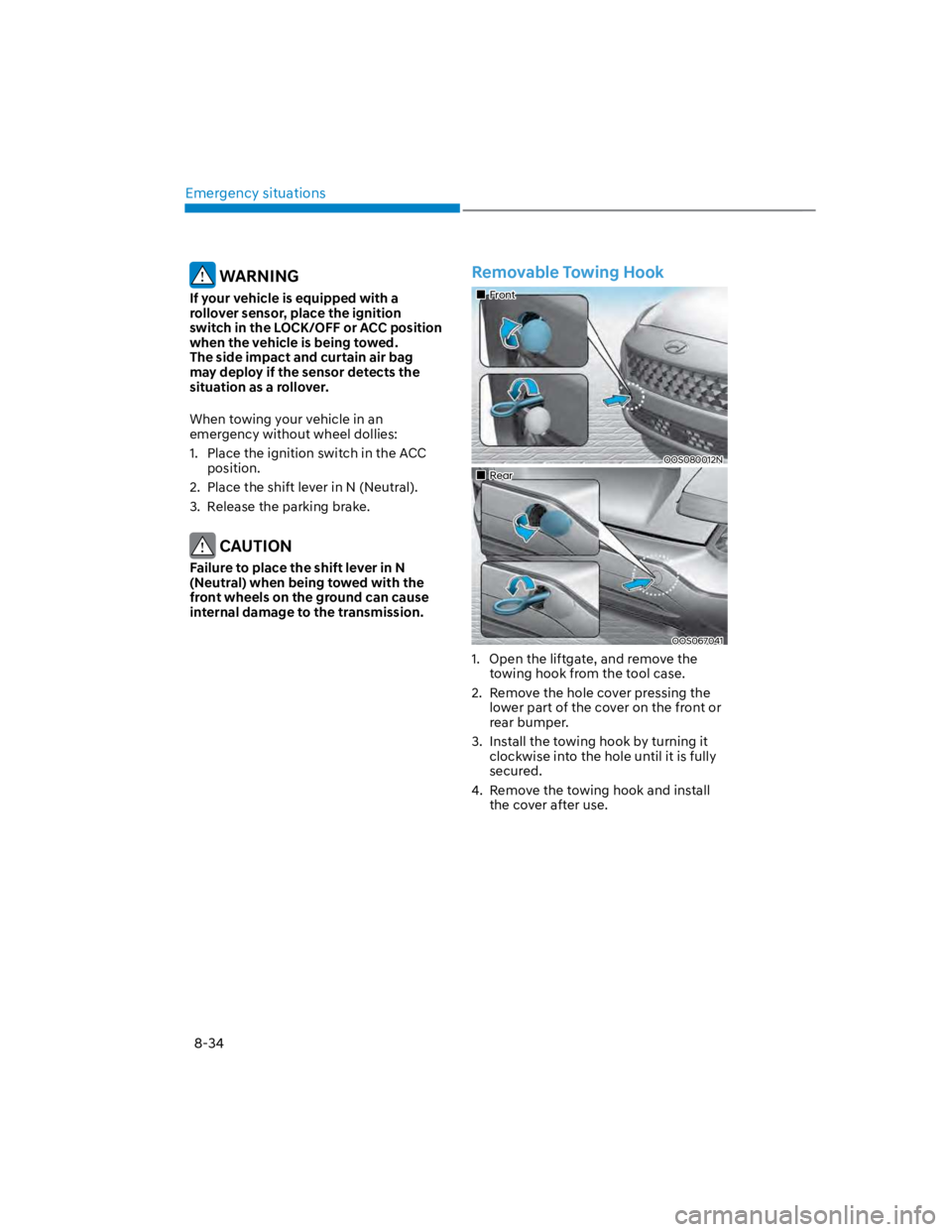
Removable Towing Hook
Front
OOS080012N
Rear
OOS067041
1. Open the liftgate, and remove the
towing hook from the tool case.
2. Remove the hole cover pressing the
lower part of the cover on the front or
rear bumper.
3. Install the towing hook by turning it
clockwise into the hole until it is fully
secured.
4. Remove the towing hook and install
the cover after use.
Page 537 of 579
09
9-51
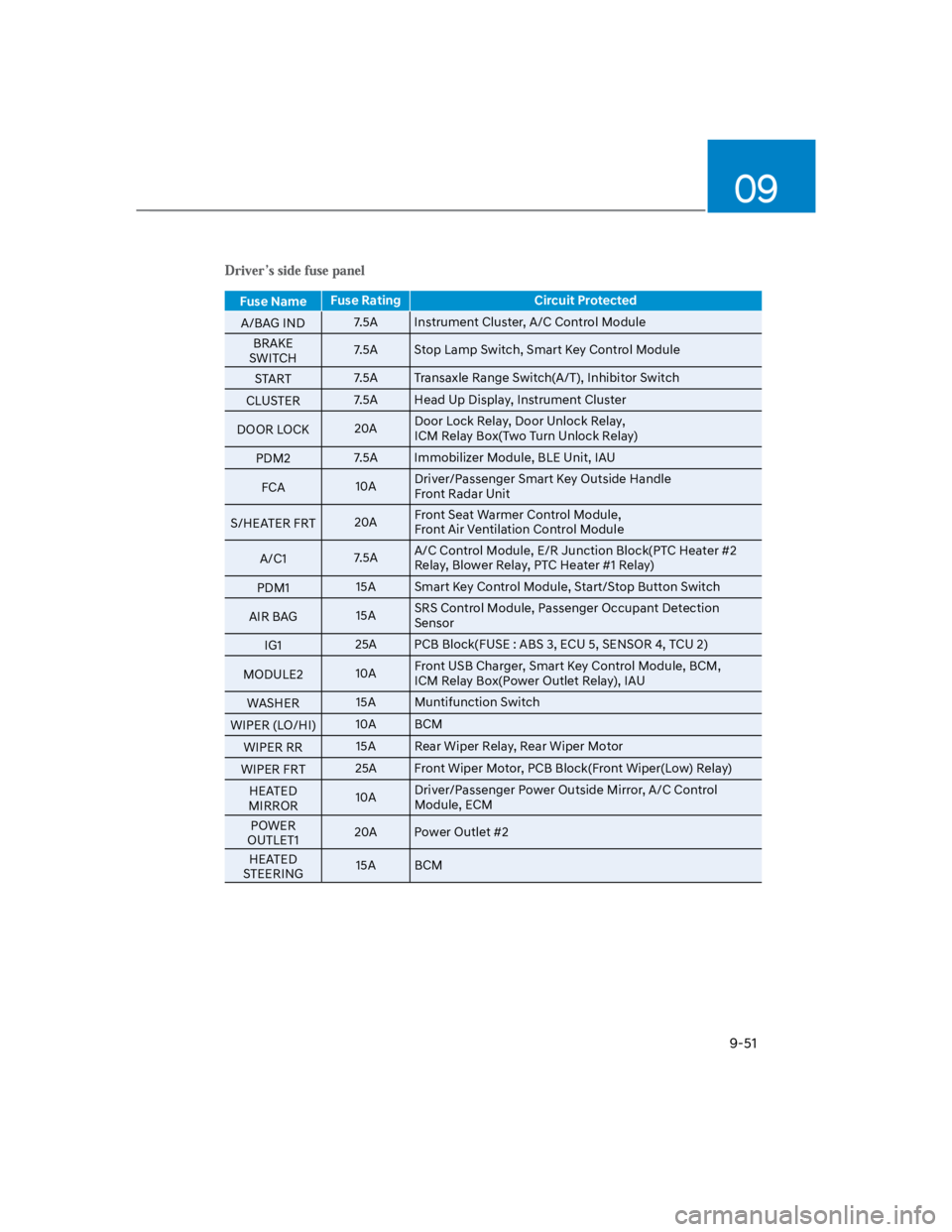
Fuse NameFuse Rating Circuit Protected
A/BAG IND7.5A Instrument Cluster, A/C Control Module
BRAKE
SWITCH7.5A Stop Lamp Switch, Smart Key Control Module
START7.5A Transaxle Range Switch(A/T), Inhibitor Switch
CLUSTER7.5A Head Up Display, Instrument Cluster
DOOR LOCK20ADoor Lock Relay, Door Unlock Relay,
ICM Relay Box(Two Turn Unlock Relay)
PDM27.5A Immobilizer Module, BLE Unit, IAU
FCA10ADriver/Passenger Smart Key Outside Handle
Front Radar Unit
S/HEATER FRT20AFront Seat Warmer Control Module,
Front Air Ventilation Control Module
A/C17.5AA/C Control Module, E/R Junction Block(PTC Heater #2
Relay, Blower Relay, PTC Heater #1 Relay)
PDM115A Smart Key Control Module, Start/Stop Button Switch
AIR BAG15ASRS Control Module, Passenger Occupant Detection
Sensor
IG125A PCB Block(FUSE : ABS 3, ECU 5, SENSOR 4, TCU 2)
MODULE210AFront USB Charger, Smart Key Control Module, BCM,
ICM Relay Box(Power Outlet Relay), IAU
WASHER15A Muntifunction Switch
WIPER (LO/HI)10A BCM
WIPER RR15A Rear Wiper Relay, Rear Wiper Motor
WIPER FRT25A Front Wiper Motor, PCB Block(Front Wiper(Low) Relay)
HEATED
MIRROR10ADriver/Passenger Power Outside Mirror, A/C Control
Module, ECM
POWER
OUTLET120A Power Outlet #2
HEATED
STEERING15A BCM
Page 554 of 579
Maintenance
9-68
NOTICE
If you park your vehicle near a stainless
steel sign or glass facade building, the
vehicle’s exterior plastic parts such
as a bumper, spoiler, garnish, lamp
or outside rearview mirror might be
damaged due to sunlight reflected from
the sign or building. To prevent damage
of the exterior plastic parts, you should
avoid parking in areas where light may
be reflected or use a car cover. (The
exterior plastic parts applied to your
vehicle may vary.)
Exterior care
Exterior general caution
It is very important to follow the label
directions when using any chemical
cleaner or polish. Read all warning and
caution statements that appear on the
label.
Finish maintenance
To help protect your vehicle’s finish from
rust and deterioration, wash it thoroughly
and frequently at least once a month
with lukewarm or cold water.
If you use your vehicle for off-road
driving, you should wash it after each
off-road trip. Pay special attention to the
removal of any accumulation of salt, dirt,
mud, and other foreign materials. Make
sure the drain holes in the lower edges
of the doors and rocker panels are kept
clear and clean.
Insects, tar, tree sap, bird droppings,
industrial pollution and similar deposits
can damage your vehicle’s finish if not
removed immediately.
Even prompt washing with plain water
may not completely remove all these
deposits. A mild soap, safe for use on
painted surfaces, should be used.
After washing, rinse the vehicle
thoroughly with lukewarm or cold water.
Do not allow soap to dry on the finish.
When using high-pressure washers,
make sure to maintain sufficient
distance from the vehicle.
Insufficient clearance or excessive
pressure can lead to component
damage or water penetration.
Do not spray the camera, sensors or
its surrounding area directly with a
high pressure washer. Shock applied
from high pressure water may cause
the device to not operate normally.
Do not bring the nozzle tip close to
boots (rubber or plastic covers) or
connectors as they may be damaged
if they come into contact with high
pressure water.
WARNING
After washing the vehicle, test the
brakes while driving slowly to see
if they have been affected by water
before getting on the road. If braking
performance is impaired, dry the
brakes by applying them lightly while
maintaining a slow forward speed.
APPEARANCE CARE
Page 571 of 579

I
I-5
Engine Start/Stop button........................................................................................ 6-8
Engine Stop/Start button positions ..................................................................... 6-9
Remote start...................................................................................................... 6-12
Starting the engine............................................................................................ 6-10
Turning off the engine ...................................................................................... 6-11
Explanation of scheduled maintenance items ...................................................... 9-13
Fuel filter (for gasoline engine)........................................................................ 9-13
Intelligent variable transmission fluid ............................................................. 9-14
Parking brake.................................................................................................... 9-14
Propeller shaft .................................................................................................. 9-14
Exterior features......................................................................................... 5-61,5-115
Fuel filler door.................................................................................................. 5-64
Hood ................................................................................................................. 5-61
Liftgate ............................................................................................................. 5-62
Roof side rails................................................................................................. 5-115
Exterior overview (I) ............................................................................................. 2-2
Exterior overview (II) ............................................................................................ 2-4
F
Foreword................................................................................................................ 1-2
Forward Collision–Avoidance Assist (FCA) (front view camera only) ................ 7-2
Forward Collision-Avoidance Assist malfunction and limitations .................... 7-7
Forward Collision-Avoidance Assist operation.................................................. 7-5
Forward Collision-Avoidance Assist settings..................................................... 7-3
Forward Collision–Avoidance Assist (FCA) (Sensor fusion) ............................ 7-14
Forward Collision-Avoidance Assist malfunction and limitations .................. 7-21
Forward Collision-Avoidance Assist operation................................................ 7-18
Forward Collision-Avoidance Assist settings................................................... 7-16
Four wheel drive (4WD)...................................................................................... 6-46
Emergency precautions .................................................................................... 6-51
Four Wheel Drive (4WD) operation ................................................................ 6-47
Reducing the risk of a rollover ......................................................................... 6-52
Fuel requirements .................................................................................................. 1-5
Gasoline engine .................................................................................................. 1-5
Fuses .................................................................................................................... 9-45
Engine compartment panel fuse replacement................................................... 9-47
Fuse/relay panel description............................................................................. 9-49
Instrument panel fuse replacement................................................................... 9-46