climate control HYUNDAI KONA 2022 User Guide
[x] Cancel search | Manufacturer: HYUNDAI, Model Year: 2022, Model line: KONA, Model: HYUNDAI KONA 2022Pages: 579, PDF Size: 35.31 MB
Page 232 of 579
Convenient features
5-98
WINDSHIELD DEFROSTING AND DEFOGGING
WARNING
Windshield heating
Do not use the position during
cooling operation in extremely humid
weather. The difference between the
temperature of the outside air and that
of the windshield could cause the outer
surface of the windshield to fog up,
causing loss of visibility could cause
an accident resulting in serious injury
or death. In this case, set the mode
selection button to the position
and fan speed control knob to a lower
speed.
For maximum defrost performance,
set the temperature control to the
highest temperature setting and
the fan speed control to the highest
setting.
If warm air to the floor is desired while
defrosting or defogging, set the mode
to the floor-defrost position.
Before driving, clear all snow and ice
from the windshield, rear window,
side view mirrors, and all side
windows.
Clear all snow and ice from the
hood and air inlet in the cowl grill
to improve heater and defroster
efficiency and to reduce the
probability of fogging up the inside of
the windshield.
NOTICE
If the engine temperature is still cold
after starting, then a brief engine warm
up period may be required for the
vented air flow to become warm or hot.
Manual climate control system
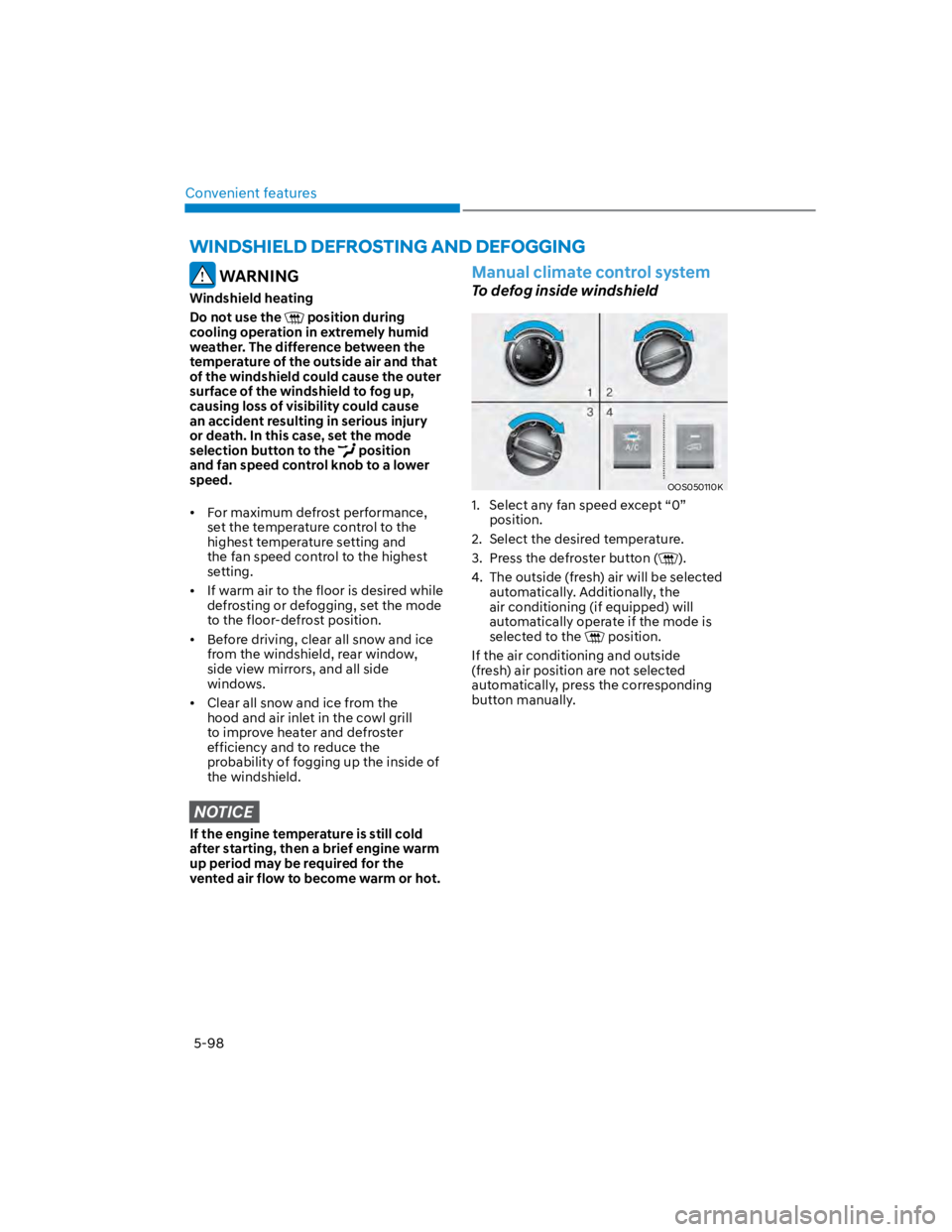
To defog inside windshield
OOS050110K
1. Select any fan speed except “0”
position.
2. Select the desired temperature.
3. Press the defroster button ().
4. The outside (fresh) air will be selected
automatically. Additionally, the
air conditioning (if equipped) will
automatically operate if the mode is
selected to the position.
If the air conditioning and outside
(fresh) air position are not selected
automatically, press the corresponding
button manually.
Page 233 of 579
05
5-99
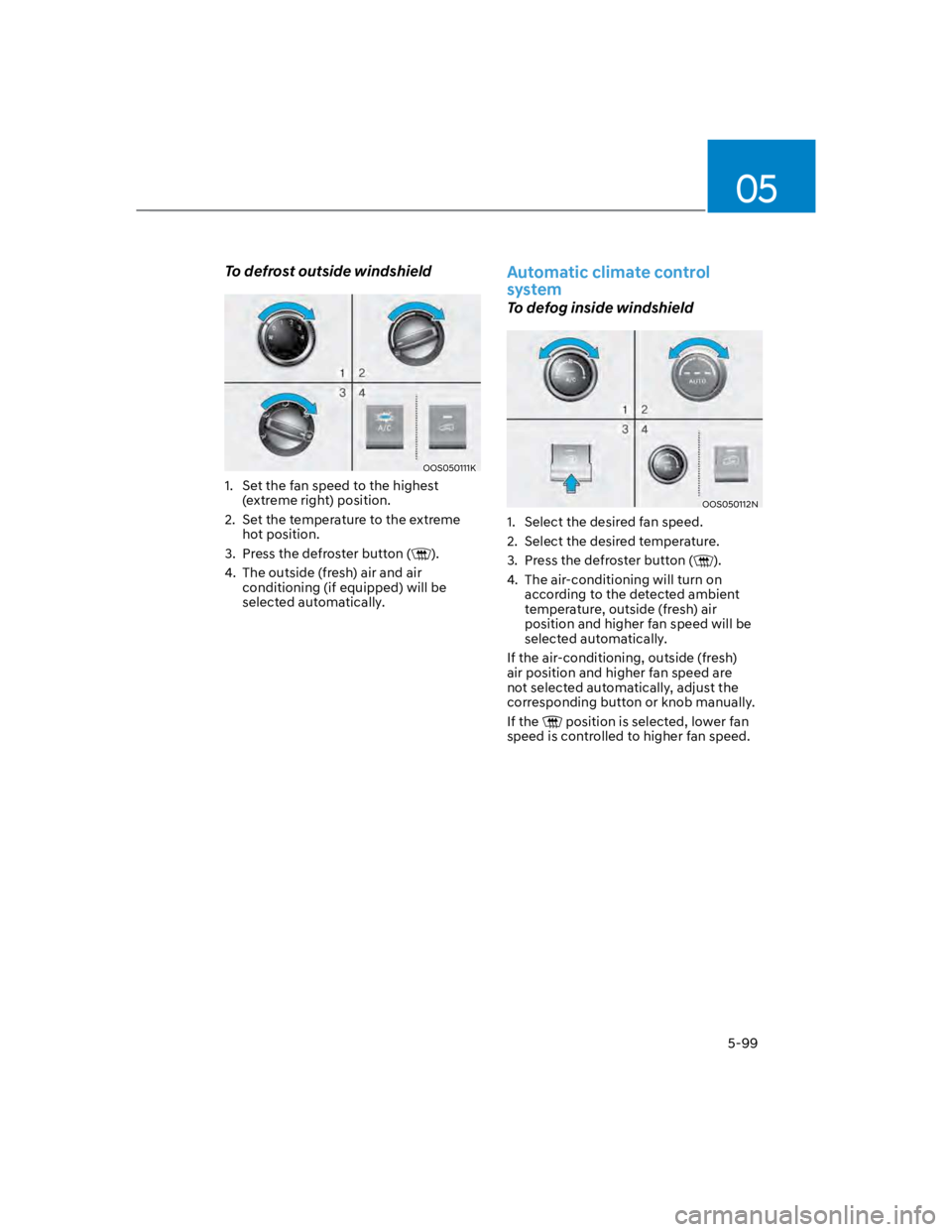
To defrost outside windshield
OOS050111K
1. Set the fan speed to the highest
(extreme right) position.
2. Set the temperature to the extreme
hot position.
3. Press the defroster button ().
4. The outside (fresh) air and air
conditioning (if equipped) will be
selected automatically.
Automatic climate control
system
To defog inside windshield
OOS050112N
1. Select the desired fan speed.
2. Select the desired temperature.
3. Press the defroster button ().
4. The air-conditioning will turn on
according to the detected ambient
temperature, outside (fresh) air
position and higher fan speed will be
selected automatically.
If the air-conditioning, outside (fresh)
air position and higher fan speed are
not selected automatically, adjust the
corresponding button or knob manually.
If the position is selected, lower fan
speed is controlled to higher fan speed.
Page 234 of 579
Convenient features
5-100
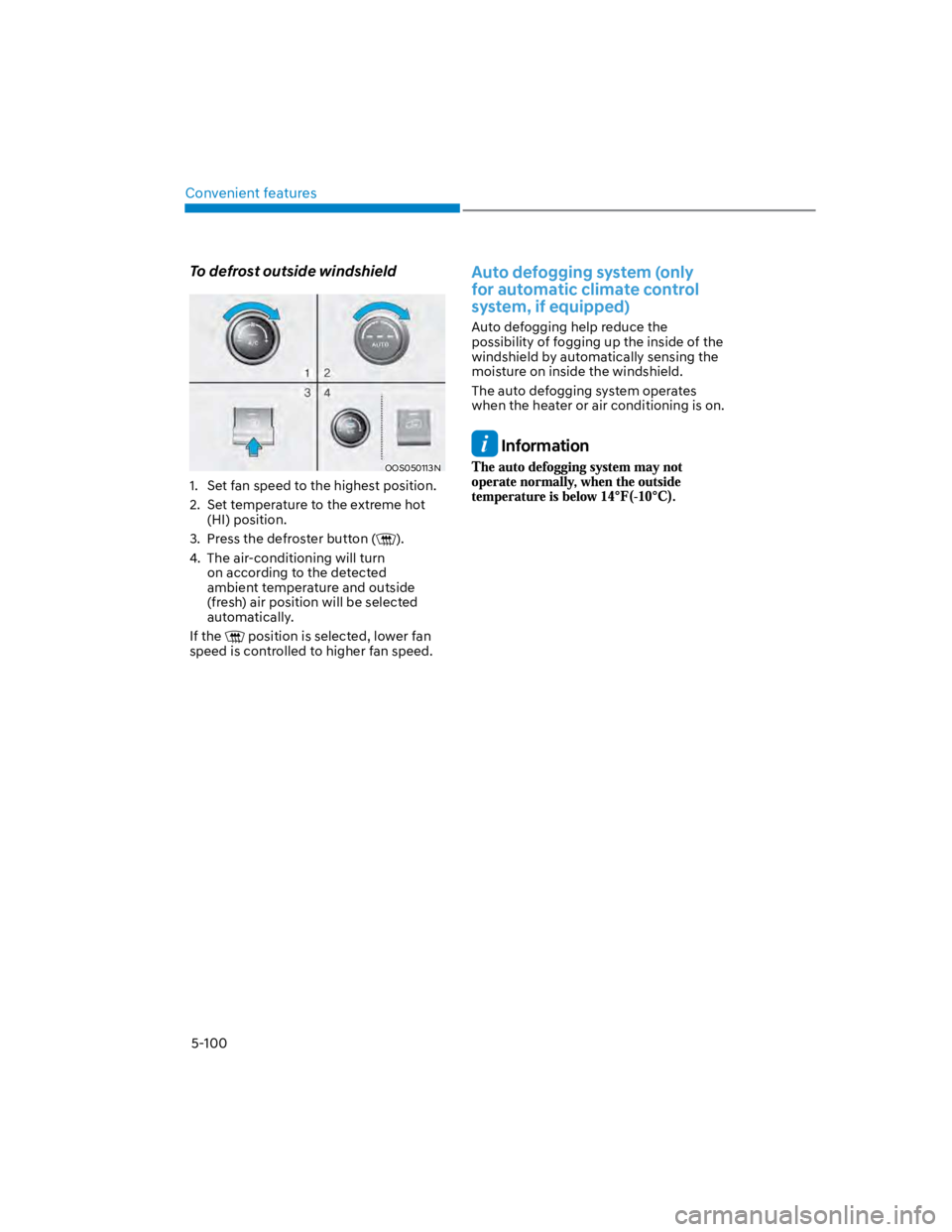
To defrost outside windshield
OOS050113N
1. Set fan speed to the highest position.
2. Set temperature to the extreme hot
(HI) position.
3. Press the defroster button ().
4. The air-conditioning will turn
on according to the detected
ambient temperature and outside
(fresh) air position will be selected
automatically.
If the position is selected, lower fan
speed is controlled to higher fan speed.
Auto defogging system (only
for automatic climate control
system, if equipped)
Auto defogging help reduce the
possibility of fogging up the inside of the
windshield by automatically sensing the
moisture on inside the windshield.
The auto defogging system operates
when the heater or air conditioning is on.
Information
Page 235 of 579
05
5-101
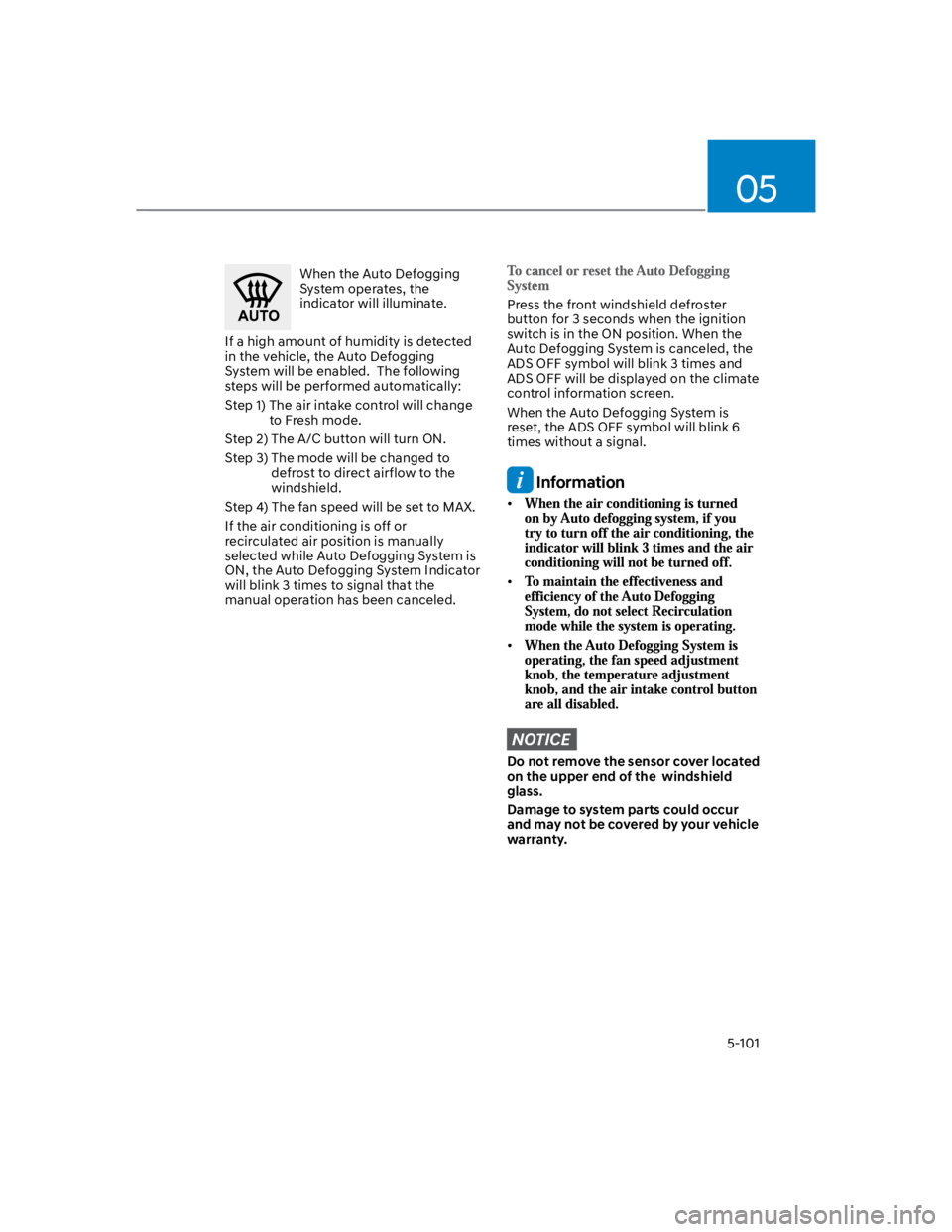
When the Auto Defogging
System operates, the
indicator will illuminate.
If a high amount of humidity is detected
in the vehicle, the Auto Defogging
System will be enabled. The following
steps will be performed automatically:
Step 1) The air intake control will change
to Fresh mode.
Step 2) The A/C button will turn ON.
Step 3) The mode will be changed to
defrost to direct airflow to the
windshield.
Step 4) The fan speed will be set to MAX.
If the air conditioning is off or
recirculated air position is manually
selected while Auto Defogging System is
ON, the Auto Defogging System Indicator
will blink 3 times to signal that the
manual operation has been canceled.
Press the front windshield defroster
button for 3 seconds when the ignition
switch is in the ON position. When the
Auto Defogging System is canceled, the
ADS OFF symbol will blink 3 times and
ADS OFF will be displayed on the climate
control information screen.
When the Auto Defogging System is
reset, the ADS OFF symbol will blink 6
times without a signal.
Information
NOTICE
Do not remove the sensor cover located
on the upper end of the windshield
glass.
Damage to system parts could occur
and may not be covered by your vehicle
warranty.
Page 236 of 579
Convenient features
5-102
Defroster
NOTICE
To prevent damage to the rear window
defroster conducting elements bonded
to the inside surface of the rear window,
never use sharp instruments or window
cleaners containing abrasives to clean
the window.
Information
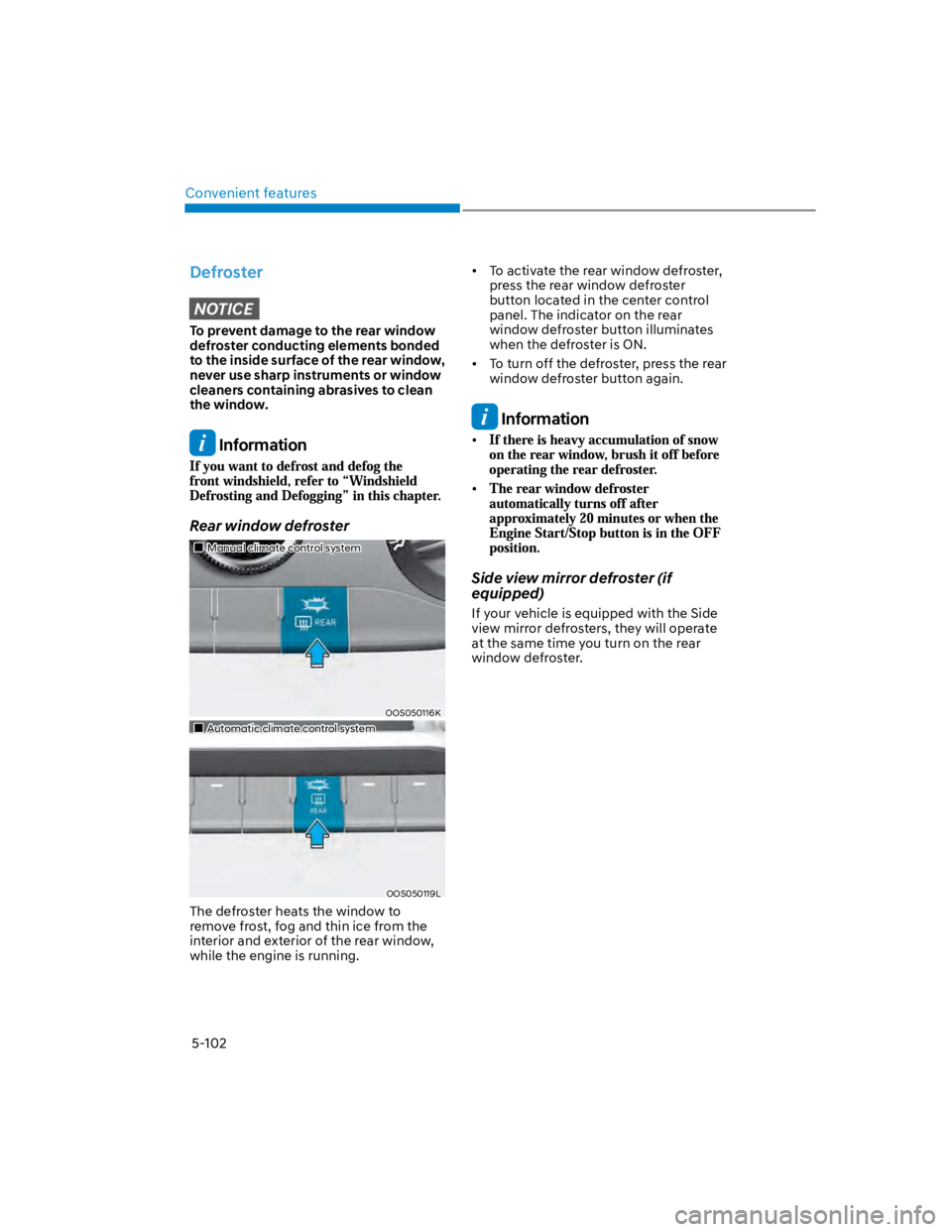
Rear window defroster
Manual climate control system
OOS050116K
Automatic climate control system
OOS050119L
The defroster heats the window to
remove frost, fog and thin ice from the
interior and exterior of the rear window,
while the engine is running.
To activate the rear window defroster,
press the rear window defroster
button located in the center control
panel. The indicator on the rear
window defroster button illuminates
when the defroster is ON.
To turn off the defroster, press the rear
window defroster button again.
Information
Side view mirror defroster (if
equipped)
If your vehicle is equipped with the Side
view mirror defrosters, they will operate
at the same time you turn on the rear
window defroster.
Page 237 of 579
05
5-103
Automatic Ventilation
When the ignition switch is in the ON
position or when the engine is running
and temperature is below 59°F (15°C)
with the recirculation mode selected
more than five minutes, the air intake
position will automatically change to
fresh mode.
When the air conditioning system is on,
press the mode selection button and
the recirculation mode button five times
within three seconds. (Automatic climate
control system)
When the air conditioning system is on,
press the recirculation mode button
for 3 seconds. (Manual climate control
system)
When the Automatic Ventilation feature
is enabled, the Recirculation button LED
indicator will blink 6 times.
When the Automatic Ventilation feature
is disabled, the Recirculation button LED
indicator will blink 3 times.
Sunroof Inside Air Recirculation
When the sunroof is opened, outside
(fresh) air will be automatically selected.
At this time, if you press the air intake
control button, recirculated air position
will be selected but will change back
to outside (fresh) air after 3 minutes.
When the sunroof is closed, the air
intake position will return to the original
position that was selected.
Inside air circulation while
operating the washer fluid
When the washer liquid is sprayed, it is
changed and maintained for a certain
period of time to prevent the smell of
washer liquid from entering the room.
However, in case of low outside
temperature, the outside (fresh) air mode
is maintained to prevent the cause of
window fogging.
Automatic heater and air
conditioner Function setting
1. Turn on the engine.
2. Set the mode to the () position.
3. When the air conditioning system
is on, press the recirculation mode
button more than 4 times within 2
seconds.
When the function is enabled, the
recirculation button LED indicator will
blink 6 times.
Function release
1. Turn on the engine.
2. Set the mode to the () position.
3. When the air conditioning system
is on, press the recirculation mode
button more than 4 times within 2
seconds.
When the function is disabled, the
recirculation button LED indicator will
blink 3 times.
Page 283 of 579
Driving your vehicle
6-26
Power-assist brakes
Your vehicle has power-assisted brakes
that adjust automatically through normal
usage.
If the engine is not running or is turned
off while driving, the power assist for
the brakes will not work. You can still
stop your vehicle by applying greater
force to the brake pedal than typical.
The stopping distance, however, will be
longer than with power brakes.
When the engine is not running, the
reserve brake power is partially depleted
each time the brake pedal is applied.
Do not pump the brake pedal when the
power assist has been interrupted.
WARNING
Take the following precautions:
Do not drive with your foot resting
on the brake pedal. This will create
abnormal high brake temperatures,
excessive brake lining and pad wear,
and increased stopping distances.
When descending down a long or
steep hill, use the paddle shifter
and manually downshift to a
lower gear in order to control your
speed without using the brake
pedal excessively. Applying the
brakes continuously will cause
the brakes to overheat and could
result in a temporary loss of braking
performance.
Wet brakes may impair the vehicle's
ability to safely slow down; the
vehicle may also pull to one side
when the brakes are applied.
Applying the brakes lightly will
indicate whether they have been
affected in this way. Always test your
brakes in this fashion after driving
through deep water. To dry the
brakes, lightly tap the brake pedal to
heat up the brakes while maintaining
a safe forward speed until brake
performance returns to normal.
Avoid driving at high speeds until the
brakes function correctly.
Disc brakes wear indicator
When your brake pads are worn and new
pads are required, you will hear a high
pitched warning sound from your front
or rear brakes. You may hear this sound
come and go or it may occur whenever
you depress the brake pedal.
Note that some driving conditions or
climates may cause a brake squeal
when you first apply (or lightly apply)
the brakes. This is normal and does not
indicate a problem with your brakes.
NOTICE
To avoid costly brake repairs, do not
continue to drive with worn brake pads.
Information
BRAKING SYSTEM
Page 313 of 579
Driving your vehicle
6-56
Condition of ISG system
operation
The driver’s seatbelt is fastened
The driver’s door and hood are closed
The brake vacuum pressure is
adequate
The battery sensor is activated and
the battery is sufficiently charged
Outside temperature is not too low or
too high
The vehicle is driven over a constant
speed and stops
The climate control system satisfies
the conditions
The vehicle is sufficiently warmed up
The vehicle is not on a steep road
grade
The steering wheel is not at a sharp
angle
The vehicle is not at a high elevation
The front windshield defroster is off
You have not selected Manual shift
mode
When sufficient time has elapsed after
shifting to R (Reverse) was released
The brake vacuum pressure is low.
You have exceeded the maximum
engine off time
The air conditioning is ON with the fan
speed set to the highest position.
Fogging of the windows could occur
and the air conditioning is on.
The battery is not within optimal
operating conditions.
The cooling and heating performance
of the climate control system is
unsatisfactory.
When you press the ISG OFF button
with the engine automatically stopped
Your vehicle is moving after standstill.
You press the accelerator and the
brake pedal at the same time.
The driver safety belt becomes
unfastened or the driver door is ajar
conditions.
The green AUTO STOP indicator ()
on the instrument cluster will blink for 5
seconds.
NOTICE
If the ISG system does not meet that
operation condition, the ISG system is
deactivated.
Page 487 of 579
9
9. Maintenance
Engine compartment ........................................................................................ 9-3
Maintenance services ....................................................................................... 9-4
Owner’s responsibility ................................................................................................ 9-4
Owner maintenance precautions............................................................................... 9-4
Owner maintenance ......................................................................................... 9-5
Owner maintenance schedule ................................................................................... 9-6
Scheduled maintenance services .....................................................................9-7
Normal Maintenance Schedule .................................................................................. 9-8
Maintenance Under Severe Usage Conditions ......................................................... 9-11
Explanation of scheduled maintenance items .............................................. 9-13
Fuel filter (for gasoline engine) ................................................................................. 9-13
Intelligent variable transmission fluid ...................................................................... 9-14
Parking brake .............................................................................................................. 9-14
Propeller shaft ............................................................................................................ 9-14
Engine oil .......................................................................................................... 9-15
Checking the engine oil level .................................................................................... 9-15
Checking the engine oil and filter ............................................................................. 9-16
Engine coolant .................................................................................................9-18
Checking the coolant level ........................................................................................ 9-18
Changing coolant ...................................................................................................... 9-20
Brake fluid ........................................................................................................ 9-21
Checking the brake fluid level ................................................................................... 9-21
Washer fluid .................................................................................................... 9-22
Checking the washer fluid level ................................................................................ 9-22
Parking brake .................................................................................................. 9-22
Checking the parking brake ...................................................................................... 9-22
Air cleaner ....................................................................................................... 9-23
Filter replacement ..................................................................................................... 9-23
Climate control air filter.................................................................................. 9-24
Filter Inspection..........................................................................................................9-24
Wiper blades ................................................................................................... 9-25
Blade inspection ......................................................................................................... 9-25
Blade replacement ..................................................................................................... 9-25
For best battery service ............................................................................................ 9-30
Battery capacity label ............................................................................................... 9-30
Battery recharging ..................................................................................................... 9-31
Reset items ................................................................................................................. 9-32
Page 508 of 579
Maintenance
9-22
PARKING BRAKEWASHER FLUID
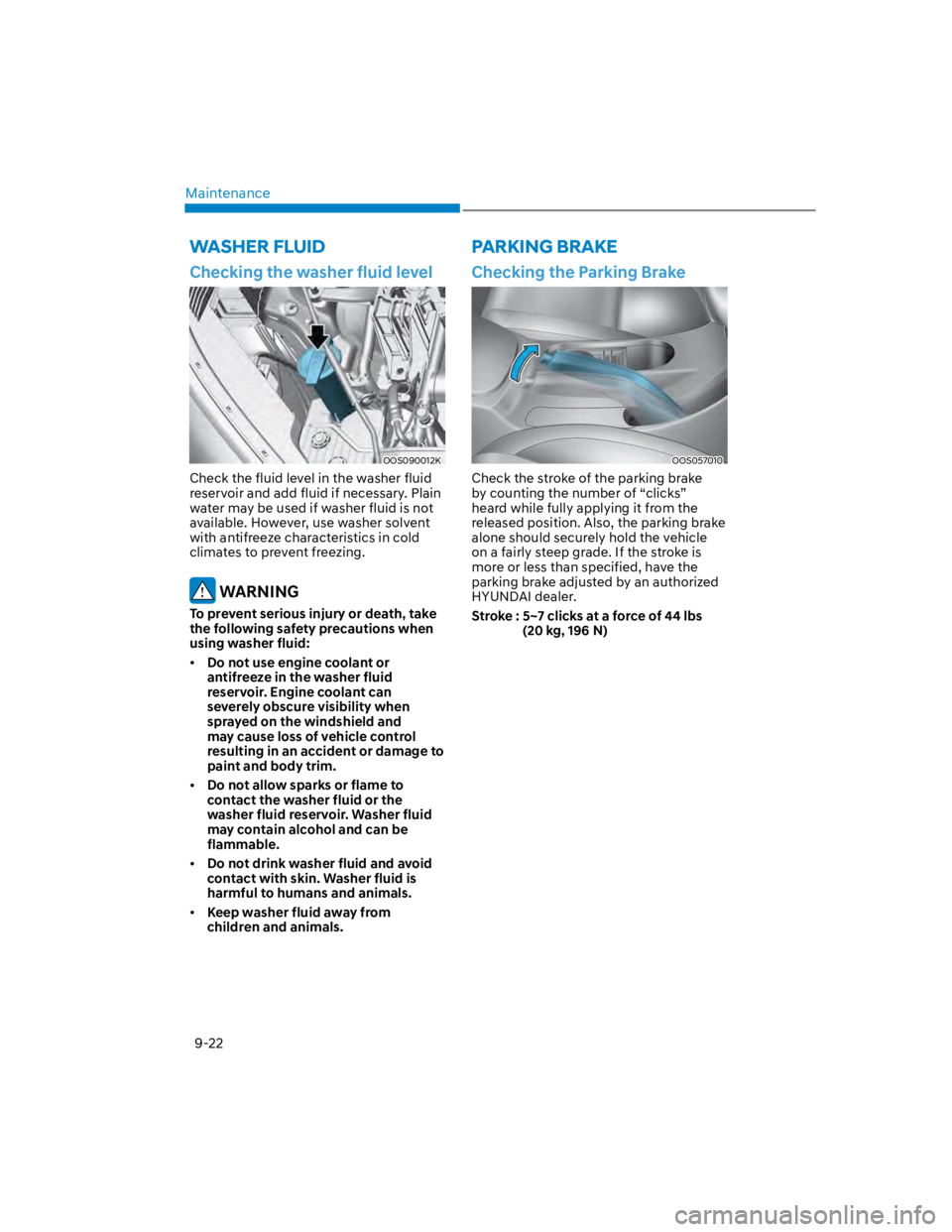
Checking the washer fluid level
OOS090012K
Check the fluid level in the washer fluid
reservoir and add fluid if necessary. Plain
water may be used if washer fluid is not
available. However, use washer solvent
with antifreeze characteristics in cold
climates to prevent freezing.
WARNING
To prevent serious injury or death, take
the following safety precautions when
using washer fluid:
Do not use engine coolant or
antifreeze in the washer fluid
reservoir. Engine coolant can
severely obscure visibility when
sprayed on the windshield and
may cause loss of vehicle control
resulting in an accident or damage to
paint and body trim.
Do not allow sparks or flame to
contact the washer fluid or the
washer fluid reservoir. Washer fluid
may contain alcohol and can be
flammable.
Do not drink washer fluid and avoid
contact with skin. Washer fluid is
harmful to humans and animals.
Keep washer fluid away from
children and animals.
Checking the Parking Brake
OOS057010
Check the stroke of the parking brake
by counting the number of “clicks”
heard while fully applying it from the
released position. Also, the parking brake
alone should securely hold the vehicle
on a fairly steep grade. If the stroke is
more or less than specified, have the
parking brake adjusted by an authorized
HYUNDAI dealer.
Stroke : 5~7 clicks at a force of 44 lbs
(20 kg, 196 N)