fuel pressure HYUNDAI KONA 2022 User Guide
[x] Cancel search | Manufacturer: HYUNDAI, Model Year: 2022, Model line: KONA, Model: HYUNDAI KONA 2022Pages: 579, PDF Size: 35.31 MB
Page 520 of 579

Maintenance
9-34
WARNING
Recommended pressures must be
maintained for the best ride, vehicle
handling, and minimum tire wear.
Over-inflation or under-inflation can
reduce tire life, adversely affect vehicle
handling, and lead to sudden tire failure
that could result in loss of vehicle
control resulting in an accident.
Severe under-inflation can lead to
severe heat build-up, causing blowouts,
tread separation and other tire failures
that can result in the loss of vehicle
control resulting in an accident. This
risk is much higher on hot days and
when driving for long periods at high
speeds.
CAUTION
Under-inflation results in excessive
wear, poor handling and reduced
fuel economy. Wheel deformation
is also possible. Keep your tire
pressures at the proper levels. If a
tire frequently needs refilling, we
recommend it be checked by an
authorized HYUNDAI dealer.
Over-inflation produces a harsh ride,
excessive wear at the center of the
tire tread, and a greater possibility of
damage from road hazards.
Check tire inflation pressure
Check your tires, including the spare tire,
once a month or more.
How to check
Use a good quality tire pressure gauge
to check tire pressure. You can not tell
if your tires are properly inflated simply
by looking at them. Radial tires may look
properly inflated when they are under-
inflated.
Remove the valve cap from the tire valve
stem. Press the tire gauge firmly onto the
valve to get a pressure measurement. If
the cold tire inflation pressure matches
the recommended pressure on the
tire and loading information label, no
further adjustment is necessary. If the
pressure is low, add air until you reach
the recommended pressure. Make sure
to put the valve caps back on the valve
stems. Without the valve cap, dirt or
moisture could get into the valve core
and cause air leakage. If a valve cap is
missing, install a new one as soon as
possible.
If you overfill the tire, release air by
pushing on the metal stem in the
center of the tire valve. Recheck the tire
pressure with the tire gauge. Be sure
to put the valve caps back on the valve
stems. Without the valve cap, dirt or
moisture could get into the valve core
and cause air leakage. If a valve cap is
missing, install a new one as soon as
possible.
Page 527 of 579

09
9-41
Tire Terminology and Definitions
Air Pressure
The amount of air inside the tire pressing
outward on the tire. Air pressure is
expressed in pounds per square inch
(psi) or kilopascal (kPa).
Accessory Weight
This means the combined weight of
optional accessories. Some examples
of optional accessories are automatic
transmission, power seats, and air
conditioning.
Aspect Ratio
The relationship of a tire’s height to its
width.
Belt
A rubber coated layer of cords that is
located between the plies and the tread.
Cords may be made from steel or other
reinforcing materials.
Bead
The tire bead contains steel wires
wrapped by steel cords that hold the tire
onto the rim.
Bias Ply Tire
A pneumatic tire in which the plies are
laid at alternate angles less than 90
degrees to the centerline of the tread.
Cold Tire Pressure
The amount of air pressure in a tire,
measured in pounds per square inch (psi)
or kilopascals (kPa) before a tire has built
up heat from driving.
Curb Weight
This means the weight of a motor vehicle
with standard and optional equipment
including the maximum capacity of fuel,
oil and coolant, but without passengers
and cargo.
DOT Markings
A code molded into the sidewall
of a tire signifying that the tire is in
compliance with the U.S. Department
of Transportation motor vehicle safety
standards. The DOT code includes the
Tire Identification Number (TIN), an
alphanumeric designator which can
also identify the tire manufacturer,
production plant, brand and date of
production.
GVWR
Gross Vehicle Weight Rating
GAWR FRT
Gross Axle Weight Rating for the Front
Axle.
GAWR RR
Gross Axle Weight Rating for the Rear
axle.
Intended Outboard Sidewall
The side of an asymmetrical tire,
that must always face outward when
mounted on a vehicle.
Kilopascal (kPa)
The metric unit for air pressure.
Light truck(LT) tire
A tire designated by its manufacturer as
primarily intended for use on lightweight
trucks or multipurpose passenger
vehicles.
Load ratings
The maximum load that a tire is rated to
carry for a given inflation pressure.
Load Index
An assigned number ranging from 1 to
279 that corresponds to the load carrying
capacity of a tire.
Page 543 of 579
09
9-57
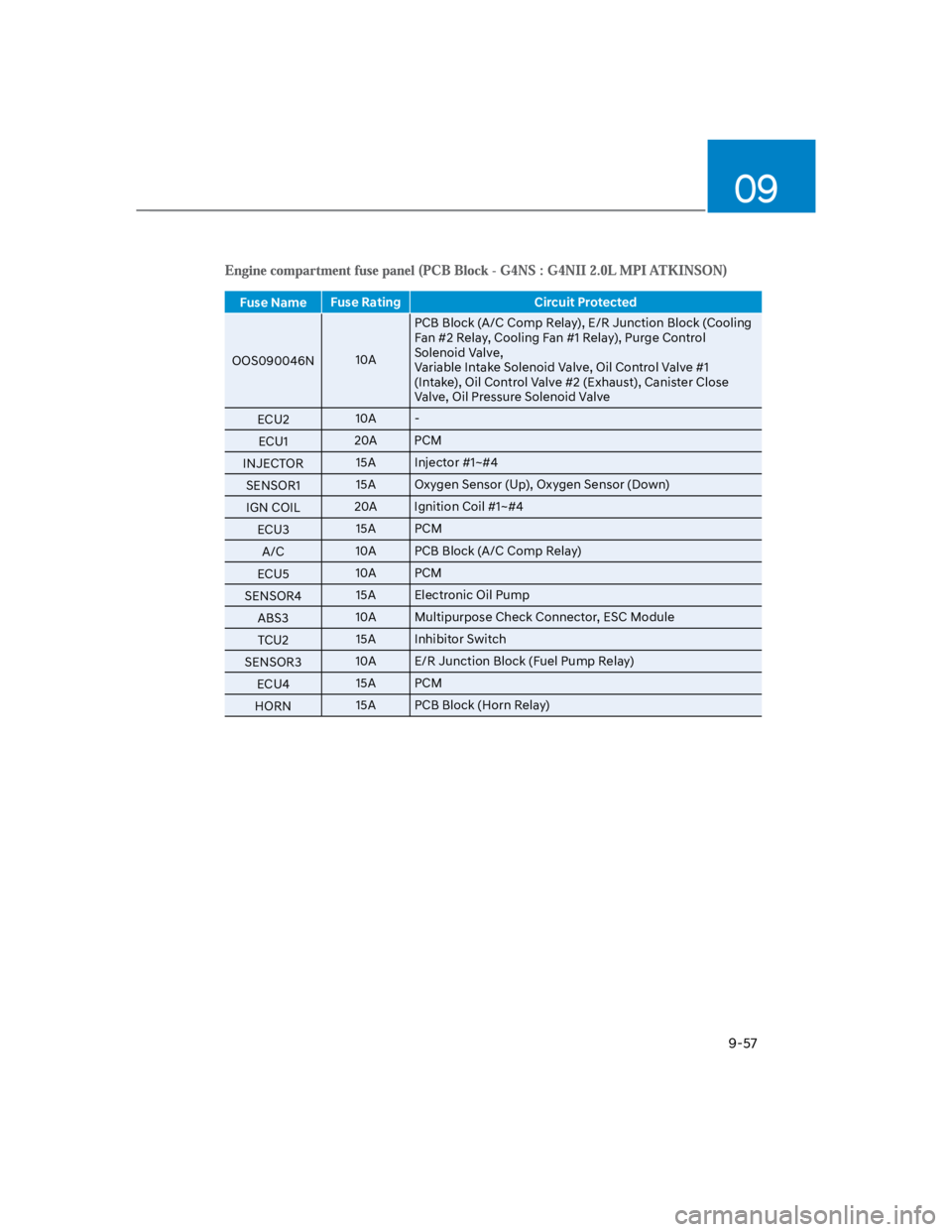
Fuse NameFuse Rating Circuit Protected
OOS090046N10A
PCB Block (A/C Comp Relay), E/R Junction Block (Cooling
Fan #2 Relay, Cooling Fan #1 Relay), Purge Control
Solenoid Valve,
Variable Intake Solenoid Valve, Oil Control Valve #1
(Intake), Oil Control Valve #2 (Exhaust), Canister Close
Valve, Oil Pressure Solenoid Valve
ECU210A -
ECU120A PCM
INJECTOR15A Injector #1~#4
SENSOR115A Oxygen Sensor (Up), Oxygen Sensor (Down)
IGN COIL20A Ignition Coil #1~#4
ECU315A PCM
A/C10A PCB Block (A/C Comp Relay)
ECU510A PCM
SENSOR415A Electronic Oil Pump
ABS310A Multipurpose Check Connector, ESC Module
TCU215A Inhibitor Switch
SENSOR310A E/R Junction Block (Fuel Pump Relay)
ECU415A PCM
HORN15A PCB Block (Horn Relay)