service HYUNDAI KONA 2022 Owner's Manual
[x] Cancel search | Manufacturer: HYUNDAI, Model Year: 2022, Model line: KONA, Model: HYUNDAI KONA 2022Pages: 579, PDF Size: 35.31 MB
Page 460 of 579

Emergency situations
8-10
Low tire pressure telltale
When the tire pressure monitoring
system warning indicator is illuminated
and warning message displayed on the
cluster LCD display, one or more of your
tires is significantly under-inflated.
If the telltale illuminates, immediately
reduce your speed, avoid hard cornering
and anticipate increased stopping
distances. You should stop and check
your tires as soon as possible. Inflate the
tires to the proper pressure as indicated
on the vehicle’s placard or tire inflation
pressure label located on the driver’s side
center pillar outer panel. If you cannot
reach a service station or if the tire
cannot hold the newly added air, replace
the low pressure tire with the spare tire.
Then the Low Tire Pressure telltale may
flash for approximately one minute and
then remain continuously illuminated
after restarting and about 10 minutes of
continuous driving before you have the
low pressure tire repaired and replaced
on the vehicle.
CAUTION
In winter or cold weather, the low tire
pressure telltale may be illuminated if
the tire pressure was adjusted to the
recommended tire inflation pressure
in warm weather. It does not mean
your TPMS is malfunctioning because
the decreased temperature leads to a
proportional lowering of tire pressure.
When you drive your vehicle from a
warm area to a cold area or from a cold
area to a warm area, or the outside
temperature is greatly higher or lower,
you should check the tire inflation
pressure and adjust the tires to the
recommended tire inflation pressure.
WARNING
Low pressure damage
Significantly low tire pressure makes
the vehicle unstable and can contribute
to loss of vehicle control and increased
braking distances.
Continued driving on low pressure tires
can cause the tires to overheat and fail.
TPMS (Tire Pressure
Monitoring System)
malfunction indicator
The TPMS malfunction indicator
will illuminate after it blinks for
approximately one minute when there
is a problem with the Tire Pressure
Monitoring System. If the system is able
to correctly detect an under inflation
warning at the same time as system
failure then it will illuminate the TPMS
malfunction indicator.
Have the system checked by an
authorized HYUNDAI dealer as soon as
possible to determine the cause of the
problem.
CAUTION
The TPMS malfunction indicator
may be illuminated if the vehicle is
moving around electric power supply
cables or radios transmitter such as
at police stations, government and
public offices, broadcasting stations,
military installations, airports, or
transmitting towers, etc. This can
interfere with normal operation of
the Tire Pressure Monitoring System
(TPMS).
The TPMS malfunction indicator may
illuminate if snow chains or some
separately purchased devices such
as notebook computers, mobile
charger, remote starter, navigation
etc. are used in the vehicle. This can
interfere with normal operation of
the Tire Pressure Monitoring System
(TPMS).
Page 461 of 579

08
8-11
Changing a tire with TPMS
If you have a flat tire, the Low Tire
Pressure will come on. Have the flat tire
repaired by an authorized HYUNDAI
dealer as soon as possible or replace the
flat tire with the spare tire.
CAUTION
Never use a puncture-repairing agent
not approved by HYUNDAI to repair
and/or inflate a low pressure tire. The
tire sealant not approved by HYUNDAI
may damage the tire pressure sensor.
The sealant on the tire pressure sensor
and wheel shall be eliminated when you
replace the tire with a new one.
Each wheel is equipped with a tire
pressure sensor mounted inside
the tire behind the valve stem. You
must use TPMS specific wheels. It is
recommended that you always have your
tires serviced by an authorized HYUNDAI
dealer.
Even if you replace the low pressure tire
with the spare tire, the Low Tire Pressure
Telltale will blink or remain on until the
low pressure tire is repaired and placed
on the vehicle.
After you replace the low pressure tire
with the spare tire, the Low Tire Pressure
Telltale may blink or illuminate after
driving about 20 minutes because the
TPMS sensor mounted on the spare
wheel is not initiated.
Once the low pressure tire is reinflated to
the recommended pressure and installed
on the vehicle or the TPMS sensor
mounted on the replaced spare wheel
is initiated by an authorized HYUNDAI
dealer, the TPMS malfunction indicator
and the low tire pressure telltale will
extinguish within a few minutes of
driving.
If the indicator is not extinguished after
a few minutes of driving, please visit an
authorized HYUNDAI dealer.
CAUTION
If original mounted tire is replaced
with the spare tire, the TPMS sensor
on the replaced spare wheel should
be initiated and the TPMS sensor on
the original mounted wheel should
be deactivated by a HYUNDAI dealer.
If the TPMS sensor on the original
mounted wheel located in the spare tire
carrier still activates, the tire pressure
monitoring system may not operate
properly. Have the tire with TPMS
serviced or replaced by an authorized
hyundai dealer.
You may not be able to identify a low tire
by simply looking at it. Always use a good
quality tire pressure gauge to measure
the tire's inflation pressure. Please note
that a tire that is hot (from being driven)
will have a higher pressure measurement
than a tire that is cold.
A cold tire means the vehicle has been
sitting for 3 hours and driven for less
than 1 mile (1.6 km) in that 3 hour period.
Allow the tire to cool before measuring
the inflation pressure. Always be sure
the tire is cold before inflating to the
recommended pressure.
CAUTION
Do not use any tire sealant except the
Tire Mobility Kit approved by HYUNDAI
if your vehicle is equipped with a Tire
Pressure Monitoring System. The liquid
sealant can damage the tire pressure
sensors.
Page 465 of 579
08
8-15
Low tire pressure
warning light
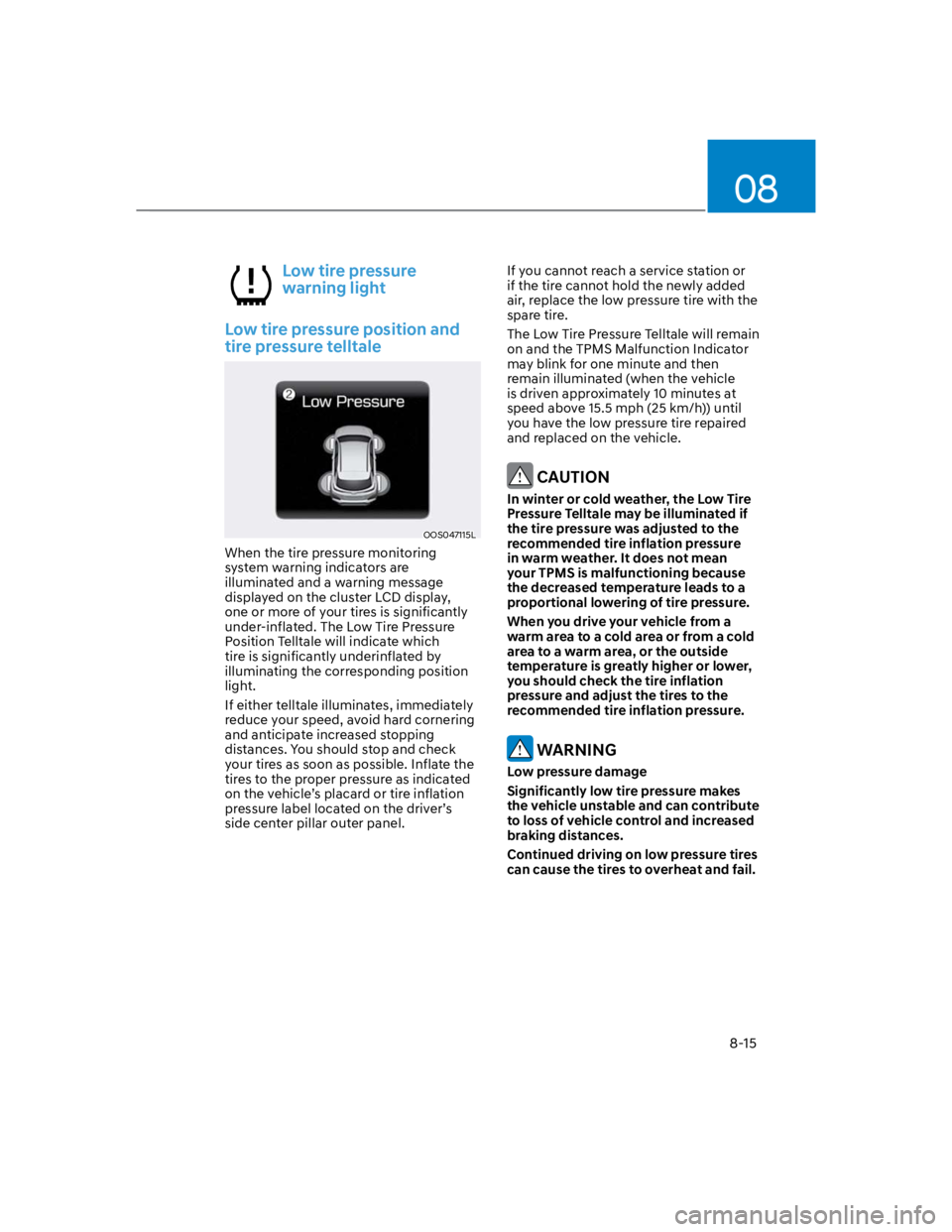
Low tire pressure position and
tire pressure telltale
OOS047115L
When the tire pressure monitoring
system warning indicators are
illuminated and a warning message
displayed on the cluster LCD display,
one or more of your tires is significantly
under-inflated. The Low Tire Pressure
Position Telltale will indicate which
tire is significantly underinflated by
illuminating the corresponding position
light.
If either telltale illuminates, immediately
reduce your speed, avoid hard cornering
and anticipate increased stopping
distances. You should stop and check
your tires as soon as possible. Inflate the
tires to the proper pressure as indicated
on the vehicle’s placard or tire inflation
pressure label located on the driver’s
side center pillar outer panel.
If you cannot reach a service station or
if the tire cannot hold the newly added
air, replace the low pressure tire with the
spare tire.
The Low Tire Pressure Telltale will remain
on and the TPMS Malfunction Indicator
may blink for one minute and then
remain illuminated (when the vehicle
is driven approximately 10 minutes at
speed above 15.5 mph (25 km/h)) until
you have the low pressure tire repaired
and replaced on the vehicle.
CAUTION
In winter or cold weather, the Low Tire
Pressure Telltale may be illuminated if
the tire pressure was adjusted to the
recommended tire inflation pressure
in warm weather. It does not mean
your TPMS is malfunctioning because
the decreased temperature leads to a
proportional lowering of tire pressure.
When you drive your vehicle from a
warm area to a cold area or from a cold
area to a warm area, or the outside
temperature is greatly higher or lower,
you should check the tire inflation
pressure and adjust the tires to the
recommended tire inflation pressure.
WARNING
Low pressure damage
Significantly low tire pressure makes
the vehicle unstable and can contribute
to loss of vehicle control and increased
braking distances.
Continued driving on low pressure tires
can cause the tires to overheat and fail.
Page 467 of 579

08
8-17
If the indicators do not extinguish after a
few minutes, please visit an authorized
HYUNDAI dealer.
Each wheel is equipped with a tire
pressure sensor mounted inside the tire
behind the valve stem (except for the
spare tire). You must use TPMS specific
wheels. It is recommended that you
always have your tires serviced by an
authorized HYUNDAI dealer.
You may not be able to identify a tire
with low pressure by simply looking at it.
Always use a good quality tire pressure
gauge to measure. Please note that a tire
that is hot (from being driven) will have a
higher pressure measurement than a tire
that is cold.
A cold tire means the vehicle has been
sitting for 3 hours and driven for less
than 1 mile (1.6 km) in that 3 hour period.
Allow the tire to cool before measuring
the inflation pressure. Always be sure
the tire is cold before inflating to the
recommended pressure.
WARNING
The TPMS cannot alert you to severe
and sudden tire damage caused by
external factors such as nails or road
debris.
If you feel any vehicle instability,
immediately take your foot off
the accelerator, apply the brakes
gradually with light force, and slowly
move to a safe position off the road.
WARNING
Tampering with, modifying, or disabling
the Tire Pressure Monitoring System
(TPMS) components may interfere
with the system’s ability to warn the
driver of low tire pressure conditions
and/or TPMS malfunctions. Tampering
with, modifying, or disabling the Tire
Pressure Monitoring System (TPMS)
components may void the warranty for
that portion of the vehicle.
Information
1.
2.
3.
Page 469 of 579
08
8-19
Changing tires
WARNING
A vehicle can slip or roll off of a jack
causing serious injury or death to you or
those nearby. Take the following safety
precautions:
Do not get under a vehicle that is
supported by a jack.
NEVER attempt to change a tire in
the lane of traffic. ALWAYS move the
vehicle completely off the road on
level, firm ground away from traffic
before trying to change a tire. If you
cannot find a level, firm place off
the road, call a towing service for
assistance.
Be sure to use the jack provided with
the vehicle.
ALWAYS place the jack on the
designated jacking positions on the
vehicle and NEVER on the bumpers
or any other part of the vehicle for
jacking support.
Do not start or run the engine while
the vehicle is on the jack.
Do not allow anyone to remain in the
vehicle while it is on the jack.
Keep children away from the road
and the vehicle.
Follow these steps to change your
vehicle’s tire:
1. Park on a level, firm surface.
2. Move the shift lever into P (Park),
apply the parking brake, and place
the ignition switch in the LOCK/OFF
position.
3. Press the hazard warning flasher
button.
4. Remove the wheel lug wrench, jack,
jack handle, and spare tire from the
vehicle.
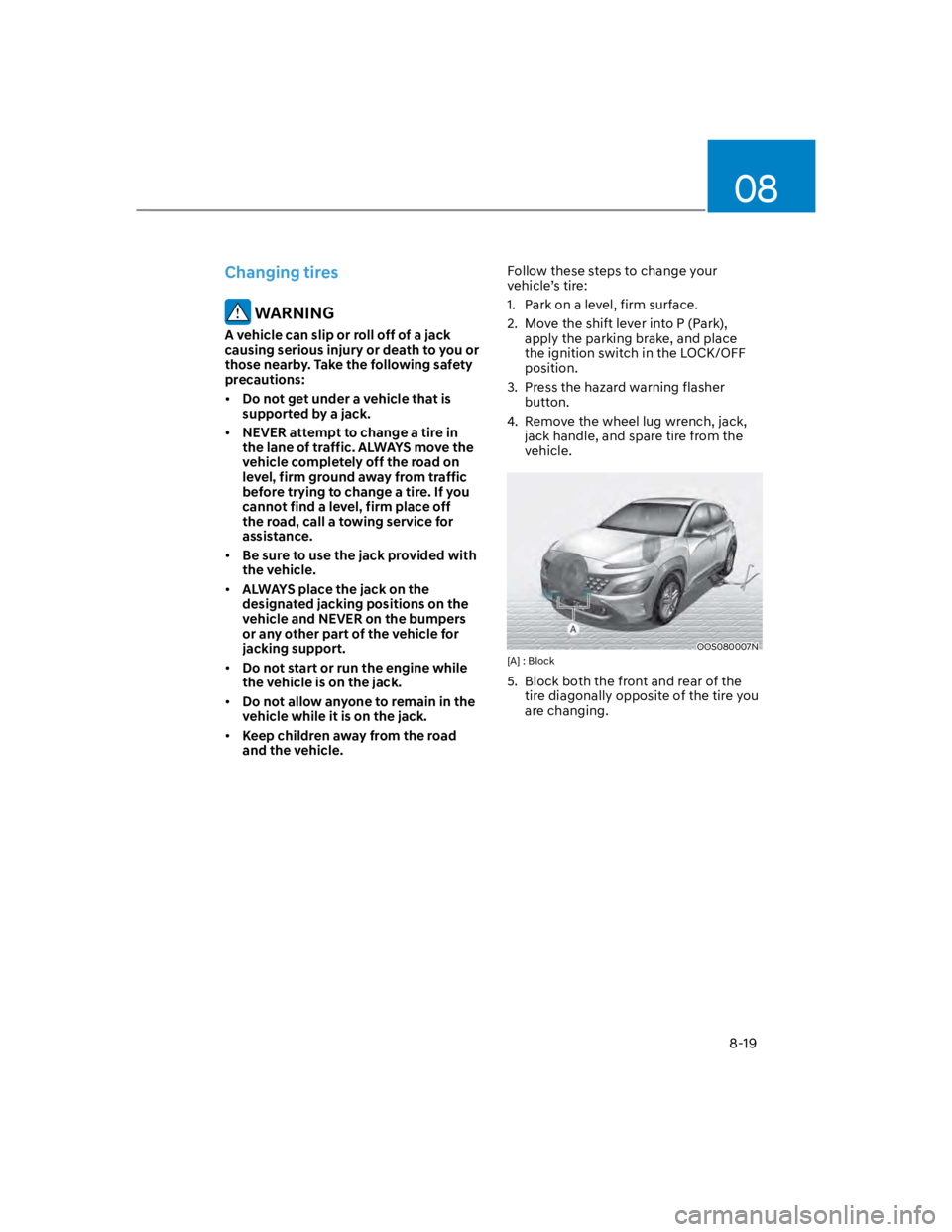
OOS080007N
[A] : Block
5. Block both the front and rear of the
tire diagonally opposite of the tire you
are changing.
Page 471 of 579
08
8-21
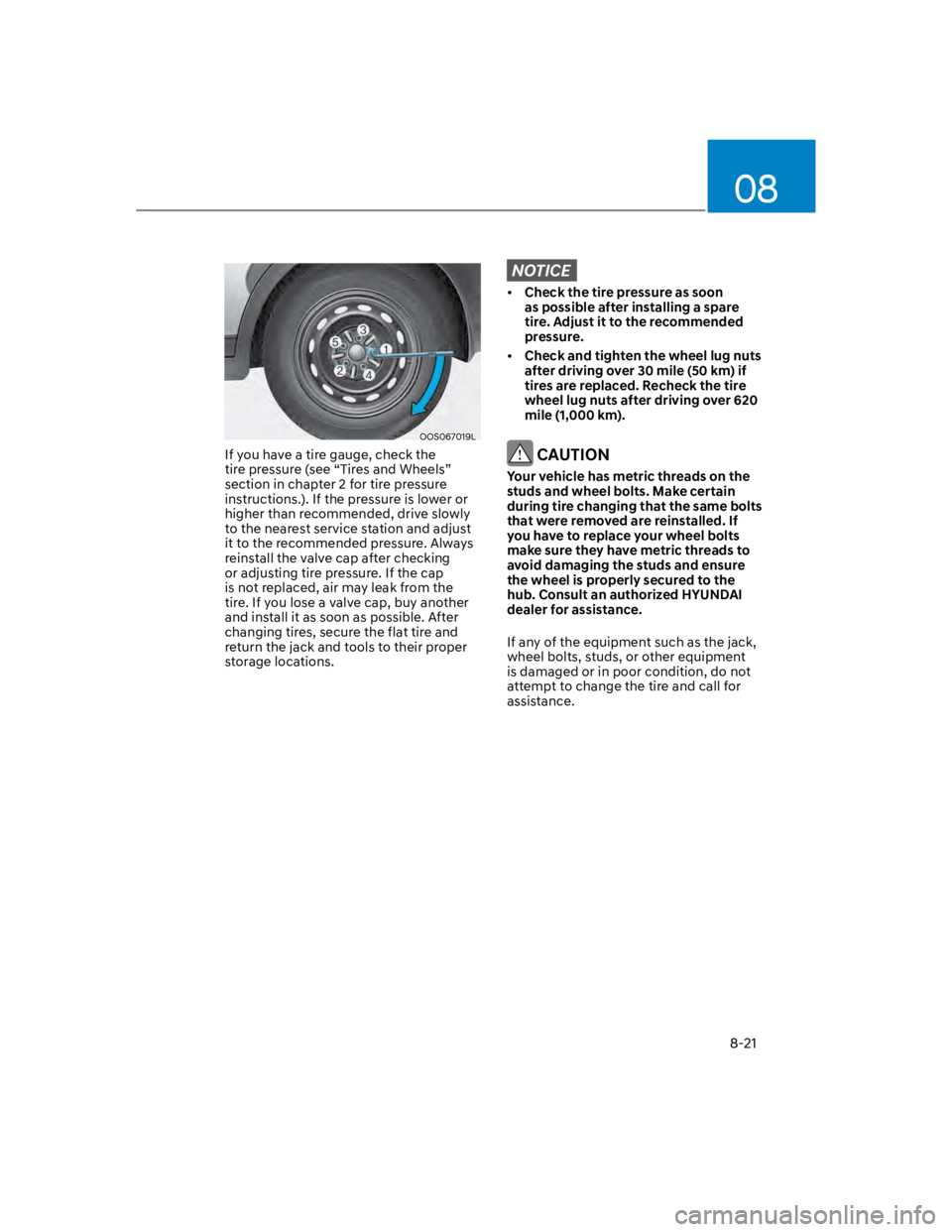
OOS067019L
If you have a tire gauge, check the
tire pressure (see “Tires and Wheels”
section in chapter 2 for tire pressure
instructions.). If the pressure is lower or
higher than recommended, drive slowly
to the nearest service station and adjust
it to the recommended pressure. Always
reinstall the valve cap after checking
or adjusting tire pressure. If the cap
is not replaced, air may leak from the
tire. If you lose a valve cap, buy another
and install it as soon as possible. After
changing tires, secure the flat tire and
return the jack and tools to their proper
storage locations.
NOTICE
Check the tire pressure as soon
as possible after installing a spare
tire. Adjust it to the recommended
pressure.
Check and tighten the wheel lug nuts
after driving over 30 mile (50 km) if
tires are replaced. Recheck the tire
wheel lug nuts after driving over 620
mile (1,000 km).
CAUTION
Your vehicle has metric threads on the
studs and wheel bolts. Make certain
during tire changing that the same bolts
that were removed are reinstalled. If
you have to replace your wheel bolts
make sure they have metric threads to
avoid damaging the studs and ensure
the wheel is properly secured to the
hub. Consult an authorized HYUNDAI
dealer for assistance.
If any of the equipment such as the jack,
wheel bolts, studs, or other equipment
is damaged or in poor condition, do not
attempt to change the tire and call for
assistance.
Page 475 of 579
08
8-25
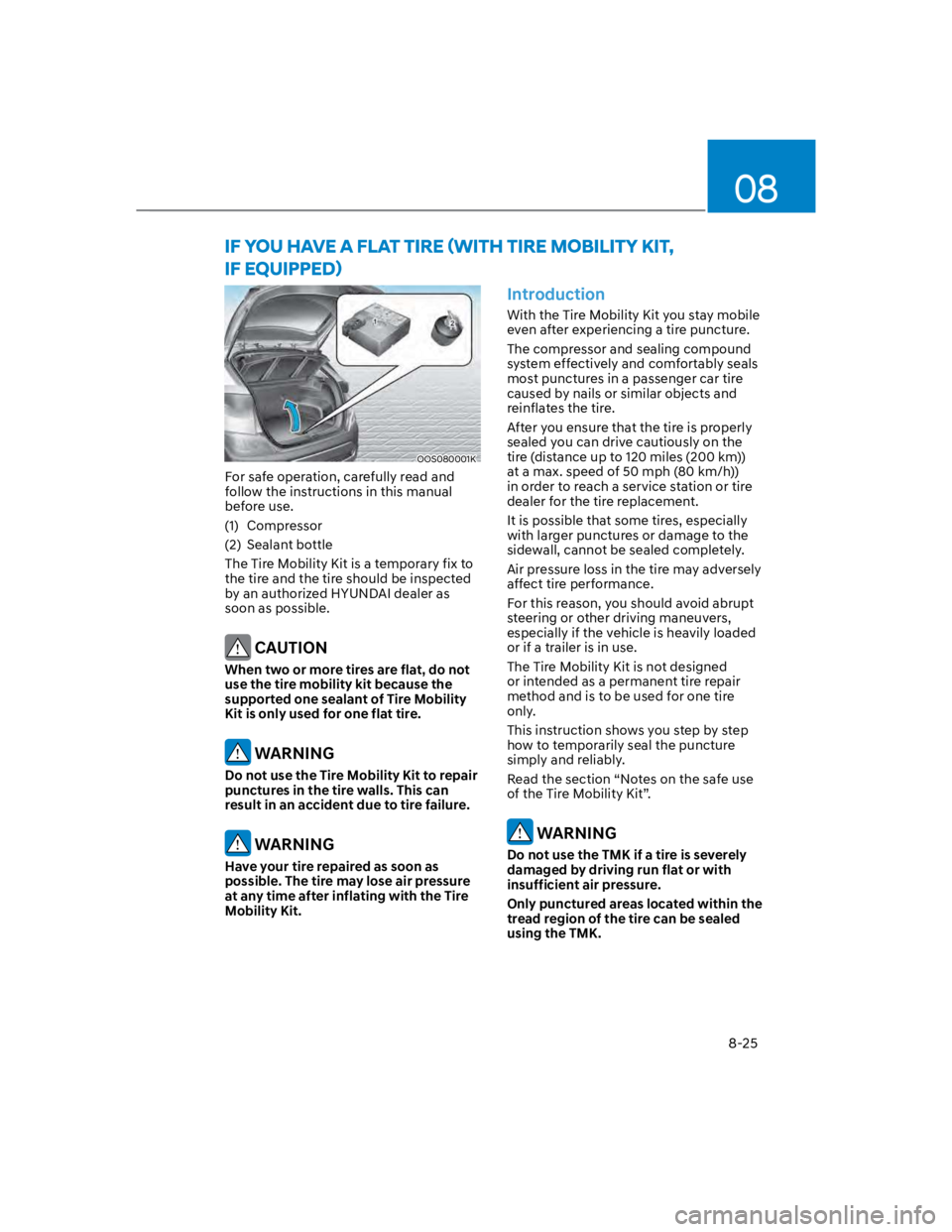
OOS080001K
For safe operation, carefully read and
follow the instructions in this manual
before use.
(1) Compressor
(2) Sealant bottle
The Tire Mobility Kit is a temporary fix to
the tire and the tire should be inspected
by an authorized HYUNDAI dealer as
soon as possible.
CAUTION
When two or more tires are flat, do not
use the tire mobility kit because the
supported one sealant of Tire Mobility
Kit is only used for one flat tire.
WARNING
Do not use the Tire Mobility Kit to repair
punctures in the tire walls. This can
result in an accident due to tire failure.
WARNING
Have your tire repaired as soon as
possible. The tire may lose air pressure
at any time after inflating with the Tire
Mobility Kit.
Introduction
With the Tire Mobility Kit you stay mobile
even after experiencing a tire puncture.
The compressor and sealing compound
system effectively and comfortably seals
most punctures in a passenger car tire
caused by nails or similar objects and
reinflates the tire.
After you ensure that the tire is properly
sealed you can drive cautiously on the
tire (distance up to 120 miles (200 km))
at a max. speed of 50 mph (80 km/h))
in order to reach a service station or tire
dealer for the tire replacement.
It is possible that some tires, especially
with larger punctures or damage to the
sidewall, cannot be sealed completely.
Air pressure loss in the tire may adversely
affect tire performance.
For this reason, you should avoid abrupt
steering or other driving maneuvers,
especially if the vehicle is heavily loaded
or if a trailer is in use.
The Tire Mobility Kit is not designed
or intended as a permanent tire repair
method and is to be used for one tire
only.
This instruction shows you step by step
how to temporarily seal the puncture
simply and reliably.
Read the section “Notes on the safe use
of the Tire Mobility Kit”.
WARNING
Do not use the TMK if a tire is severely
damaged by driving run flat or with
insufficient air pressure.
Only punctured areas located within the
tread region of the tire can be sealed
using the TMK.
Page 479 of 579
08
8-29
CAUTION
Do not attempt to drive your vehicle if
the tire pressure is below 200 kpa (29
psi). This could result in an accident due
to sudden tire failure.
8.
Switch off the compressor.
9.
Detach the hoses from the sealant
bottle connector and from the tire
valve.
Return the Tire Mobility Kit to its storage
location in the vehicle.
WARNING
Do not leave your vehicle running in
a poorly ventilated area for extended
periods of time. Carbon monoxide
poisoning and suffocation can occur.
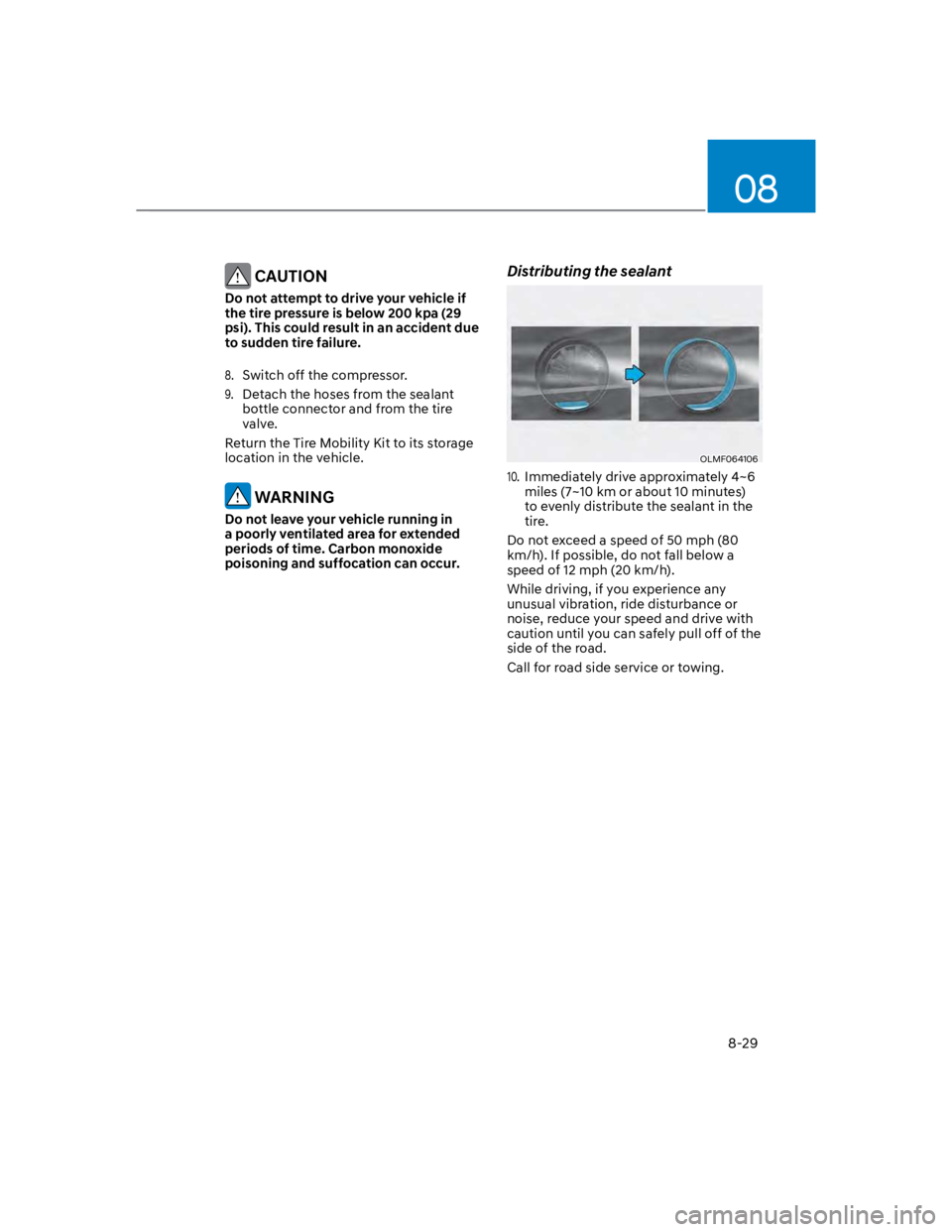
Distributing the sealant
OLMF064106
10.
Immediately drive approximately 4~6
miles (7~10 km or about 10 minutes)
to evenly distribute the sealant in the
tire.
Do not exceed a speed of 50 mph (80
km/h). If possible, do not fall below a
speed of 12 mph (20 km/h).
While driving, if you experience any
unusual vibration, ride disturbance or
noise, reduce your speed and drive with
caution until you can safely pull off of the
side of the road.
Call for road side service or towing.
Page 481 of 579

08
8-31
Information
CAUTION
If the inflation pressure is not
maintained, drive the vehicle a second
time, refer to Distributing the sealant.
Then repeat steps 1 to 4.
Use of the TMK may be ineffectual for
tire damage larger than approximately
0.16 inch (4 mm).
Contact an authorized HYUNDAI dealer
if the tire cannot be made roadworthy
with the Tire Mobility Kit.
WARNING
The tire inflation pressure must be
inflated to the proper pressure (Refer to
“Tire and Wheels” section in chapter 2).
If it is not, do not continue driving.
Call for road side service or towing.
CAUTION
Tire pressure sensor
The sealant on the tire pressure sensor
and wheel should be removed when
you replace the tire with a new one and
inspect the tire pressure sensors. We
recommend that you get this done at an
authorized dealer.
Information
Page 483 of 579
![HYUNDAI KONA 2022 Owners Manual 08
8-33
TOWING
Towing service
OOS067007L
[A] : Dollies
If emergency towing is necessary,
we recommend having it done by
an authorized HYUNDAI dealer or a
commercial tow-truck service.
Proper liftin](/img/35/41169/w960_41169-482.png "HYUNDAI KONA 2022 Owners Manual 08
8-33
TOWING
Towing service
OOS067007L
[A] : Dollies
If emergency towing is necessary,
we recommend having it done by
an authorized HYUNDAI dealer or a
commercial tow-truck service.
Proper liftin")
08
8-33
TOWING
Towing service
OOS067007L
[A] : Dollies
If emergency towing is necessary,
we recommend having it done by
an authorized HYUNDAI dealer or a
commercial tow-truck service.
Proper lifting and towing procedures
are necessary to prevent damage to
the vehicle. The use of wheel dollies or
flatbed is recommended.
For 2WD vehicles, it is acceptable to tow
the vehicle with the front wheels on the
ground (without dollies) and the rear
wheels off the ground.
If any of the loaded wheels or suspension
components are damaged or the vehicle
is being towed with the rear wheels on
the ground, use a towing dolly under the
rear wheels.
When being towed by a commercial tow
truck and wheel dollies are not used,
the rear of the vehicle should always be
lifted, not the front.
For 4WD vehicles, it must be towed
with a wheel lift and dollies or flatbed
equipment with all the wheels off the
ground.
NOTICE
Do not lift the vehicle by the tow fitting
or body and chassis parts. Otherwise
the vehicle may be damaged.
CAUTION
Do not tow the vehicle with the rear
wheels on the ground as this may
cause damage to the vehicle.
OOS067022
Do not tow with sling-type
equipment. Use wheel lift or flatbed
equipment.
OOS067021