Start car HYUNDAI KONA 2022 Service Manual
[x] Cancel search | Manufacturer: HYUNDAI, Model Year: 2022, Model line: KONA, Model: HYUNDAI KONA 2022Pages: 579, PDF Size: 35.31 MB
Page 486 of 579
Emergency situations
8-36
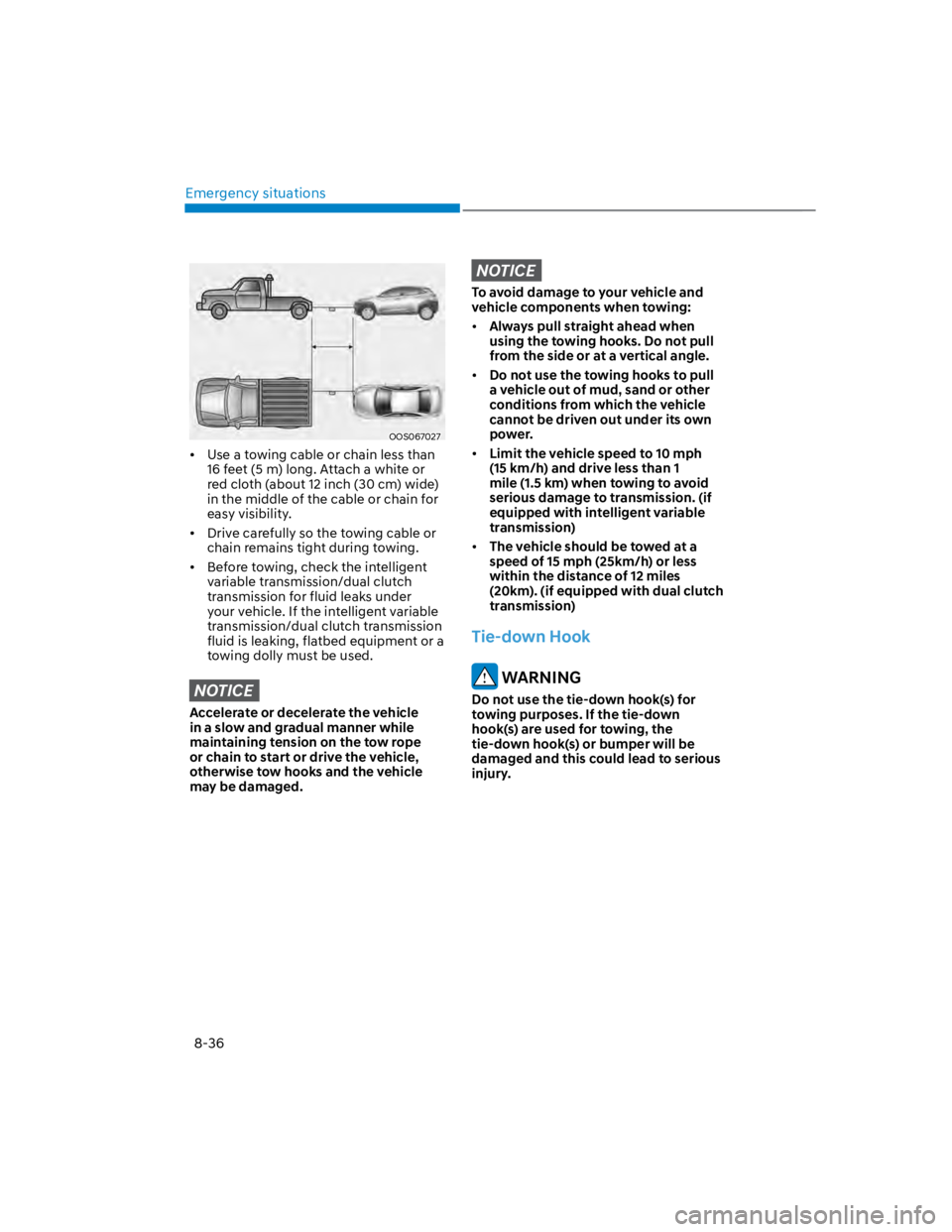
OOS067027
Use a towing cable or chain less than
16 feet (5 m) long. Attach a white or
red cloth (about 12 inch (30 cm) wide)
in the middle of the cable or chain for
easy visibility.
Drive carefully so the towing cable or
chain remains tight during towing.
Before towing, check the intelligent
variable transmission/dual clutch
transmission for fluid leaks under
your vehicle. If the intelligent variable
transmission/dual clutch transmission
fluid is leaking, flatbed equipment or a
towing dolly must be used.
NOTICE
Accelerate or decelerate the vehicle
in a slow and gradual manner while
maintaining tension on the tow rope
or chain to start or drive the vehicle,
otherwise tow hooks and the vehicle
may be damaged.
NOTICE
To avoid damage to your vehicle and
vehicle components when towing:
Always pull straight ahead when
using the towing hooks. Do not pull
from the side or at a vertical angle.
Do not use the towing hooks to pull
a vehicle out of mud, sand or other
conditions from which the vehicle
cannot be driven out under its own
power.
Limit the vehicle speed to 10 mph
(15 km/h) and drive less than 1
mile (1.5 km) when towing to avoid
serious damage to transmission. (if
equipped with intelligent variable
transmission)
The vehicle should be towed at a
speed of 15 mph (25km/h) or less
within the distance of 12 miles
(20km). (if equipped with dual clutch
transmission)
Tie-down Hook
WARNING
Do not use the tie-down hook(s) for
towing purposes. If the tie-down
hook(s) are used for towing, the
tie-down hook(s) or bumper will be
damaged and this could lead to serious
injury.
Page 505 of 579
09
9-19
Turn the vehicle off and wait until the
engine cools down. Use extreme care
when removing the engine coolant
cap and/or water-cooled intercooler
coolant cap. Wrap a thick towel around
it, and turn it counterclockwise slowly
to the first stop. Step back while the
pressure is released from the cooling
system. When you are sure all the
pressure has been released, press down
on the cap, using a thick towel, and
continue turning counterclockwise to
remove it.
Information
WARNING
The electric motor for the cooling fan
may continue to operate or start up
when the engine is not running and
can cause serious injury. Keep hands,
clothing and tools away from the
rotating fan blades of the cooling fan.
Always turn off the vehicle unless the
vehicle has to be inspected with the
engine on. Be cautious as the cooling
fan may operate if the negative (-)
battery terminal is not disconnected.
WARNING
Make sure the coolant cap is properly
closed after refilling coolant. Otherwise
the engine could be overheated while
driving.
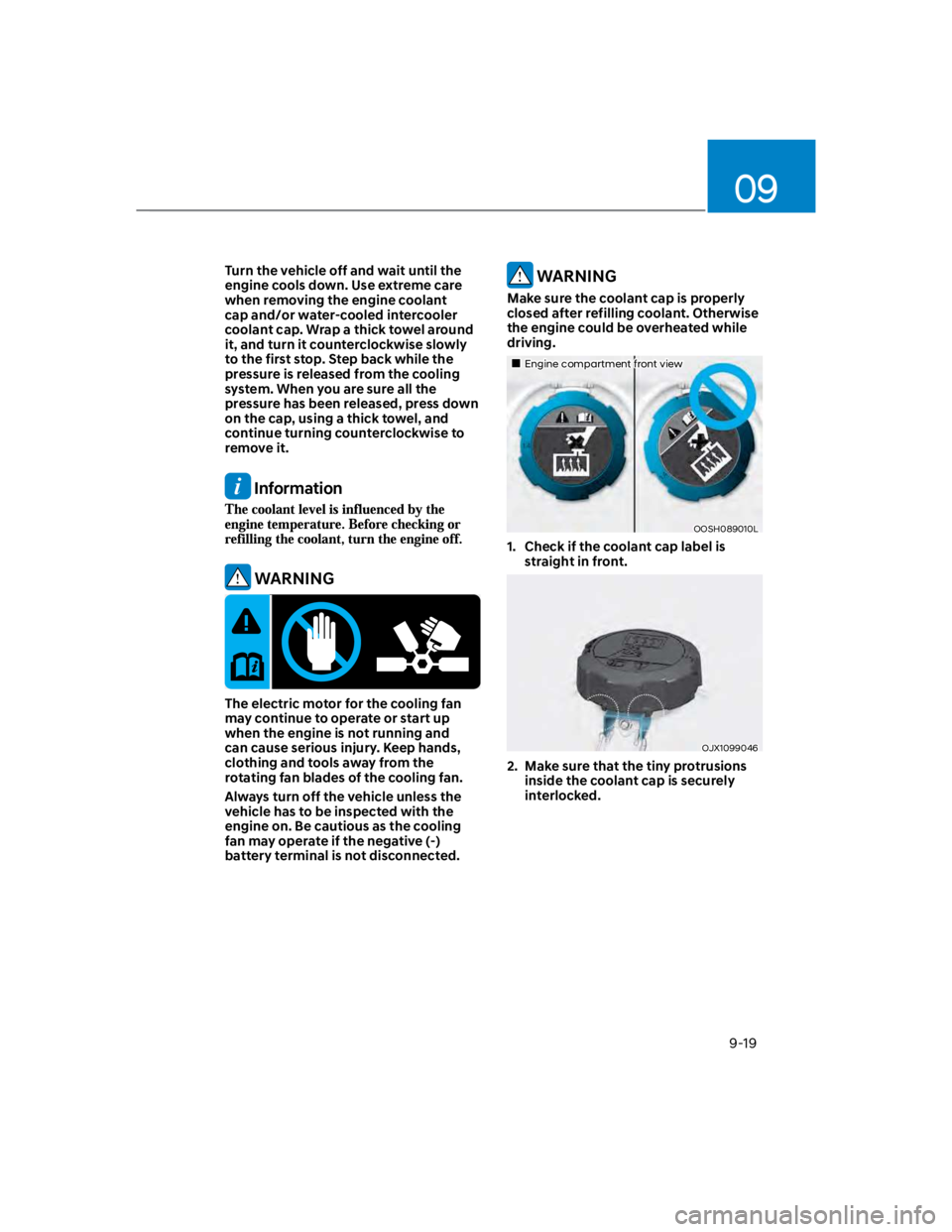
Engine compartment front view
OOSH089010L
1. Check if the coolant cap label is
straight in front.
OJX1099046
2. Make sure that the tiny protrusions
inside the coolant cap is securely
interlocked.
Page 515 of 579
09
9-29
BATTERY
WARNING
To prevent SERIOUS INJURY or DEATH
to you or bystanders, always follow
these precautions when working near
or handling the battery:
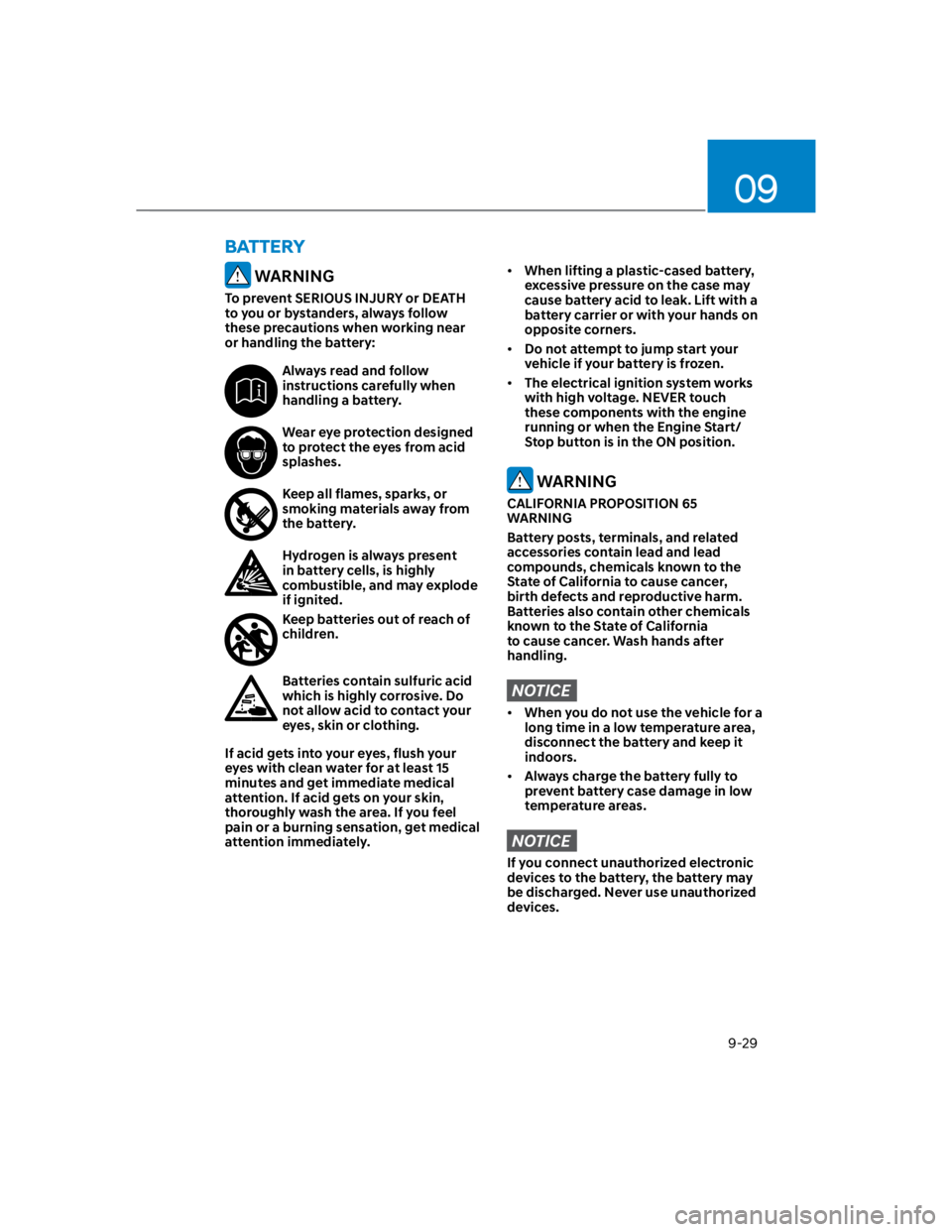
Always read and follow
instructions carefully when
handling a battery.
Wear eye protection designed
to protect the eyes from acid
splashes.
Keep all flames, sparks, or
smoking materials away from
the battery.
Hydrogen is always present
in battery cells, is highly
combustible, and may explode
if ignited.
Keep batteries out of reach of
children.
Batteries contain sulfuric acid
which is highly corrosive. Do
not allow acid to contact your
eyes, skin or clothing.
If acid gets into your eyes, flush your
eyes with clean water for at least 15
minutes and get immediate medical
attention. If acid gets on your skin,
thoroughly wash the area. If you feel
pain or a burning sensation, get medical
attention immediately.
When lifting a plastic-cased battery,
excessive pressure on the case may
cause battery acid to leak. Lift with a
battery carrier or with your hands on
opposite corners.
Do not attempt to jump start your
vehicle if your battery is frozen.
The electrical ignition system works
with high voltage. NEVER touch
these components with the engine
running or when the Engine Start/
Stop button is in the ON position.
WARNING
CALIFORNIA PROPOSITION 65
WARNING
Battery posts, terminals, and related
accessories contain lead and lead
compounds, chemicals known to the
State of California to cause cancer,
birth defects and reproductive harm.
Batteries also contain other chemicals
known to the State of California
to cause cancer. Wash hands after
handling.
NOTICE
When you do not use the vehicle for a
long time in a low temperature area,
disconnect the battery and keep it
indoors.
Always charge the battery fully to
prevent battery case damage in low
temperature areas.
NOTICE
If you connect unauthorized electronic
devices to the battery, the battery may
be discharged. Never use unauthorized
devices.
Page 564 of 579
Maintenance
9-78
3. Exhaust emission control
system
The Exhaust Emission Control System is
a highly effective system which controls
exhaust emissions while maintaining
good vehicle performance.
When the engine starts or fails to start,
excessive attempts to restart the engine
may cause damage to the emission
system.
Engine exhaust (carbon monoxide)
precautions
Carbon monoxide can be present
with other exhaust fumes. If you smell
exhaust fumes of any kind in your
vehicle, drive with all the windows
fully open. Have your vehicle checked
and repaired immediately.
WARNING
Engine exhaust gases contain carbon
monoxide (CO). Though colorless and
odorless, it is dangerous and could be
lethal if inhaled. Follow the instructions
on this page to avoid CO poisoning.
WARNING
CALIFORNIA PROPOSITION 65
WARNING
Engine exhaust and a wide variety of
automobile components and parts,
including components found in the
interior furnishings in a vehicle, contain
or emit chemicals known to the State
of California to cause cancer and
birth defects and reproductive harm.
In addition, certain fluids contained
in vehicles and certain products of
component wear contain or emit
chemicals known to the State of
California to cause cancer and birth
defects or other reproductive harm.
Do not operate the engine in confined
or closed areas (such as garages) any
more than what is necessary to move
the vehicle in or out of the area.
When the vehicle is stopped in an
open area for more than a short time
with the engine running, adjust the
ventilation system (as needed) to draw
outside air into the vehicle.
Never sit in a parked or stopped
vehicle for any extended time with the
engine running.
When the engine stalls or fails to
start, excessive attempts to restart
the engine may cause damage to the
emission control system.
Operating precautions for catalytic
converters (if equipped)
WARNING
The exhaust system and catalytic
converter are very hot during and
immediately after the engine has been
running. To avoid SERIOUS INJURY or
DEATH:
Do not park, idle, or drive the vehicle
over or near flammable objects, such
as grass, vegetation, paper, leaves,
etc. A hot exhaust system can ignite
flammable items under your vehicle.
Keep away from the exhaust system
and catalytic converter or you may
get burned.
Also, do not remove the heat sink
around the exhaust system, do not
seal the bottom of the vehicle, and
do not coat the vehicle for corrosion
control. It may present a fire risk
under certain conditions.
Page 568 of 579

Index
I-2
A
Accessing your vehicle .......................................................................................... 5-4
Hyundai Digital Key ........................................................................................ 5-15
Immobilizer system .......................................................................................... 5-14
Remote key......................................................................................................... 5-4
Smart key............................................................................................................ 5-7
Air bag - supplemental restraint system .............................................................. 3-41
Additional safety precautions ........................................................................... 3-62
Air bag warning labels ..................................................................................... 3-62
How does the air bags system operate?............................................................ 3-46
Occupant Classification System (OCS) ........................................................... 3-50
SRS care ........................................................................................................... 3-61
What to expect after an air bag inflates ............................................................ 3-49
Where are the air bags? .................................................................................... 3-43
Why didn’t my air bag go off in a collision? ................................................... 3-56
Air cleaner ........................................................................................................... 9-23
Filter replacement ............................................................................................ 9-23
Air conditioning system....................................................................................... 2-12
Appearance care................................................................................................... 9-68
Exterior care ..................................................................................................... 9-68
Interior care ...................................................................................................... 9-74
Automatic climate control system ....................................................................... 5-89
Automatic heating and air conditioning ........................................................... 5-90
Manual heating and air conditioning................................................................ 5-90
System maintenance ......................................................................................... 5-96
System operation .............................................................................................. 5-94
B
Before driving ........................................................................................................ 6-4
Before entering the vehicle ................................................................................ 6-4
Before starting .................................................................................................... 6-4
Blind-Spot Collision-Avoidance Assist (BCA) .................................................. 7-35
Blind- Spot Safety system malfunction and limitation .................................... 7-44
Blind- Spot Safety system operation ................................................................ 7-39
Blind- Spot Safety system settings ................................................................... 7-37
Page 574 of 579

Index
I-8
Interior features.................................................................................................. 5-107
Cargo Area Cover ........................................................................................... 5-114
Clock .............................................................................................................. 5-112
Clothes Hanger ............................................................................................... 5-112
Cup holder ...................................................................................................... 5-107
Floor mat anchor(s) ........................................................................................ 5-113
Luggage net holder......................................................................................... 5-114
Power outlet.................................................................................................... 5-108
Sunvisor.......................................................................................................... 5-108
USB charger ................................................................................................... 5-109
Wireless smart phone charging system .......................................................... 5-110
Interior overview (I) .............................................................................................. 2-6
Interior overview (II) ............................................................................................. 2-7
J
Jump starting.......................................................................................................... 8-4
L
Lane Following Assist (LFA) ............................................................................. 7-88
Lane Following Assist malfunction and limitation .......................................... 7-91
Lane Following Assist operation...................................................................... 7-89
Lane Following Assist settings......................................................................... 7-88
Lane Keeping Assist (LKA) ............................................................................... 7-29
Lane Keeping Assist malfunction and limitations............................................ 7-33
Lane Keeping Assist operation......................................................................... 7-31
Lane Keeping Assist settings ........................................................................... 7-29
LCD display......................................................................................................... 4-28
LCD display control ......................................................................................... 4-28
Trip computer (Type A).................................................................................... 4-38
Trip computer (Type B).................................................................................... 4-40
User settings mode ........................................................................................... 4-32
View modes ...................................................................................................... 4-29