sensor HYUNDAI KONA 2022 Repair Manual
[x] Cancel search | Manufacturer: HYUNDAI, Model Year: 2022, Model line: KONA, Model: HYUNDAI KONA 2022Pages: 579, PDF Size: 35.31 MB
Page 461 of 579

08
8-11
Changing a tire with TPMS
If you have a flat tire, the Low Tire
Pressure will come on. Have the flat tire
repaired by an authorized HYUNDAI
dealer as soon as possible or replace the
flat tire with the spare tire.
CAUTION
Never use a puncture-repairing agent
not approved by HYUNDAI to repair
and/or inflate a low pressure tire. The
tire sealant not approved by HYUNDAI
may damage the tire pressure sensor.
The sealant on the tire pressure sensor
and wheel shall be eliminated when you
replace the tire with a new one.
Each wheel is equipped with a tire
pressure sensor mounted inside
the tire behind the valve stem. You
must use TPMS specific wheels. It is
recommended that you always have your
tires serviced by an authorized HYUNDAI
dealer.
Even if you replace the low pressure tire
with the spare tire, the Low Tire Pressure
Telltale will blink or remain on until the
low pressure tire is repaired and placed
on the vehicle.
After you replace the low pressure tire
with the spare tire, the Low Tire Pressure
Telltale may blink or illuminate after
driving about 20 minutes because the
TPMS sensor mounted on the spare
wheel is not initiated.
Once the low pressure tire is reinflated to
the recommended pressure and installed
on the vehicle or the TPMS sensor
mounted on the replaced spare wheel
is initiated by an authorized HYUNDAI
dealer, the TPMS malfunction indicator
and the low tire pressure telltale will
extinguish within a few minutes of
driving.
If the indicator is not extinguished after
a few minutes of driving, please visit an
authorized HYUNDAI dealer.
CAUTION
If original mounted tire is replaced
with the spare tire, the TPMS sensor
on the replaced spare wheel should
be initiated and the TPMS sensor on
the original mounted wheel should
be deactivated by a HYUNDAI dealer.
If the TPMS sensor on the original
mounted wheel located in the spare tire
carrier still activates, the tire pressure
monitoring system may not operate
properly. Have the tire with TPMS
serviced or replaced by an authorized
hyundai dealer.
You may not be able to identify a low tire
by simply looking at it. Always use a good
quality tire pressure gauge to measure
the tire's inflation pressure. Please note
that a tire that is hot (from being driven)
will have a higher pressure measurement
than a tire that is cold.
A cold tire means the vehicle has been
sitting for 3 hours and driven for less
than 1 mile (1.6 km) in that 3 hour period.
Allow the tire to cool before measuring
the inflation pressure. Always be sure
the tire is cold before inflating to the
recommended pressure.
CAUTION
Do not use any tire sealant except the
Tire Mobility Kit approved by HYUNDAI
if your vehicle is equipped with a Tire
Pressure Monitoring System. The liquid
sealant can damage the tire pressure
sensors.
Page 466 of 579
Emergency situations
8-16
TPMS malfunction
indicator
The TPMS Malfunction Indicator
will illuminate after it blinks for
approximately one minute when there
is a problem with the Tire Pressure
Monitoring System.
Have the system checked by an
authorized HYUNDAI dealer as soon as
possible.
NOTICE
If there is a malfunction with the
TPMS, the individual tire pressures
in the cluster LCD display will not be
available. Have the system checked by
an authorized HYUNDAI dealer as soon
as possible.
NOTICE
The TPMS Malfunction Indicator may
illuminate after blinking for one minute
if the vehicle is near electric power
supply cables or radio transmitters
such as police stations, government
and public offices, broadcasting
stations, military installations, airports,
transmitting towers, etc.
Additionally, the TPMS Malfunction
Indicator may illuminate if snow chains
are used or electronic devices such as
computers, chargers, remote starters,
navigation, etc. This may interfere with
normal operation of the TPMS.
Changing a tire with TPMS
If you have a flat tire, the Low Tire
Pressure and Position telltales will come
on. Have the flat tire repaired by an
authorized HYUNDAI dealer as soon as
possible or replace the flat tire with the
spare tire.
NOTICE
It is recommended that you do not
use a puncture-repairing agent not
approved by HYUNDAI dealer or the
equivalent specified for your vehicle to
repair and/or inflate a low pressure tire.
Tire sealant not approved by HYUNDAI
dealer or the equivalent specified for
your vehicle may damage the tire
pressure sensor.
The spare tire (if equipped) does not
come with a tire pressure monitoring
sensor. When the low pressure tire or
the flat tire is replaced with the spare
tire, the Low Tire Pressure Telltale will
remain on. Also, the TPMS Malfunction
Indicator will illuminate after blinking
for one minute if the vehicle is driven
at speed above 15.5 mph (25 km/h) for
approximately 10 minutes.
Once the original wheel equipped with
a tire pressure monitoring sensor is
reinflated to the recommended pressure
and reinstalled on the vehicle, the
Low Tire Pressure Telltale and TPMS
Malfunction Indicator will go off within a
few minutes of driving.
Page 467 of 579

08
8-17
If the indicators do not extinguish after a
few minutes, please visit an authorized
HYUNDAI dealer.
Each wheel is equipped with a tire
pressure sensor mounted inside the tire
behind the valve stem (except for the
spare tire). You must use TPMS specific
wheels. It is recommended that you
always have your tires serviced by an
authorized HYUNDAI dealer.
You may not be able to identify a tire
with low pressure by simply looking at it.
Always use a good quality tire pressure
gauge to measure. Please note that a tire
that is hot (from being driven) will have a
higher pressure measurement than a tire
that is cold.
A cold tire means the vehicle has been
sitting for 3 hours and driven for less
than 1 mile (1.6 km) in that 3 hour period.
Allow the tire to cool before measuring
the inflation pressure. Always be sure
the tire is cold before inflating to the
recommended pressure.
WARNING
The TPMS cannot alert you to severe
and sudden tire damage caused by
external factors such as nails or road
debris.
If you feel any vehicle instability,
immediately take your foot off
the accelerator, apply the brakes
gradually with light force, and slowly
move to a safe position off the road.
WARNING
Tampering with, modifying, or disabling
the Tire Pressure Monitoring System
(TPMS) components may interfere
with the system’s ability to warn the
driver of low tire pressure conditions
and/or TPMS malfunctions. Tampering
with, modifying, or disabling the Tire
Pressure Monitoring System (TPMS)
components may void the warranty for
that portion of the vehicle.
Information
1.
2.
3.
Page 481 of 579

08
8-31
Information
CAUTION
If the inflation pressure is not
maintained, drive the vehicle a second
time, refer to Distributing the sealant.
Then repeat steps 1 to 4.
Use of the TMK may be ineffectual for
tire damage larger than approximately
0.16 inch (4 mm).
Contact an authorized HYUNDAI dealer
if the tire cannot be made roadworthy
with the Tire Mobility Kit.
WARNING
The tire inflation pressure must be
inflated to the proper pressure (Refer to
“Tire and Wheels” section in chapter 2).
If it is not, do not continue driving.
Call for road side service or towing.
CAUTION
Tire pressure sensor
The sealant on the tire pressure sensor
and wheel should be removed when
you replace the tire with a new one and
inspect the tire pressure sensors. We
recommend that you get this done at an
authorized dealer.
Information
Page 484 of 579
Emergency situations
8-34
WARNING
If your vehicle is equipped with a
rollover sensor, place the ignition
switch in the LOCK/OFF or ACC position
when the vehicle is being towed.
The side impact and curtain air bag
may deploy if the sensor detects the
situation as a rollover.
When towing your vehicle in an
emergency without wheel dollies:
1. Place the ignition switch in the ACC
position.
2. Place the shift lever in N (Neutral).
3. Release the parking brake.
CAUTION
Failure to place the shift lever in N
(Neutral) when being towed with the
front wheels on the ground can cause
internal damage to the transmission.
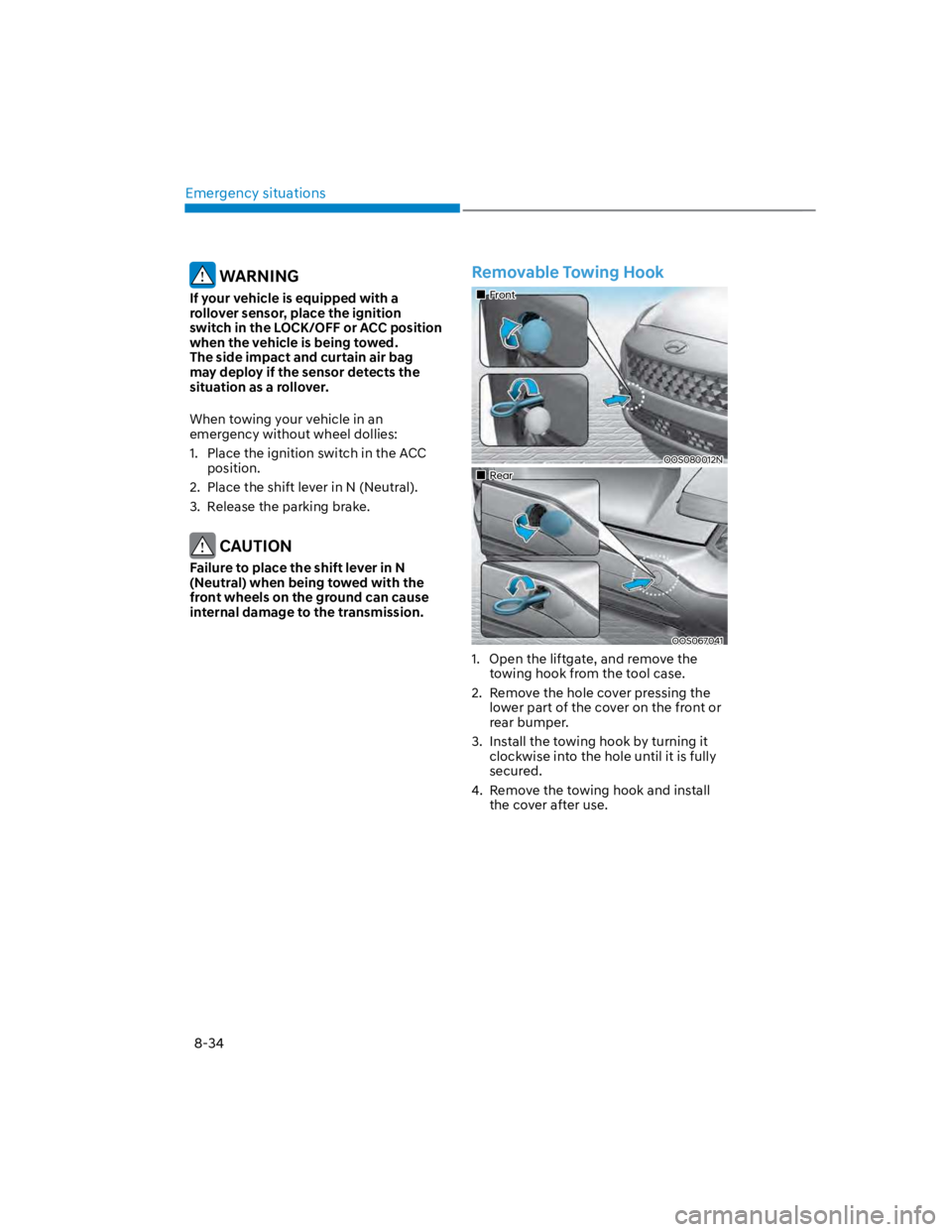
Removable Towing Hook
Front
OOS080012N
Rear
OOS067041
1. Open the liftgate, and remove the
towing hook from the tool case.
2. Remove the hole cover pressing the
lower part of the cover on the front or
rear bumper.
3. Install the towing hook by turning it
clockwise into the hole until it is fully
secured.
4. Remove the towing hook and install
the cover after use.
Page 509 of 579
09
9-23
Filter Replacement
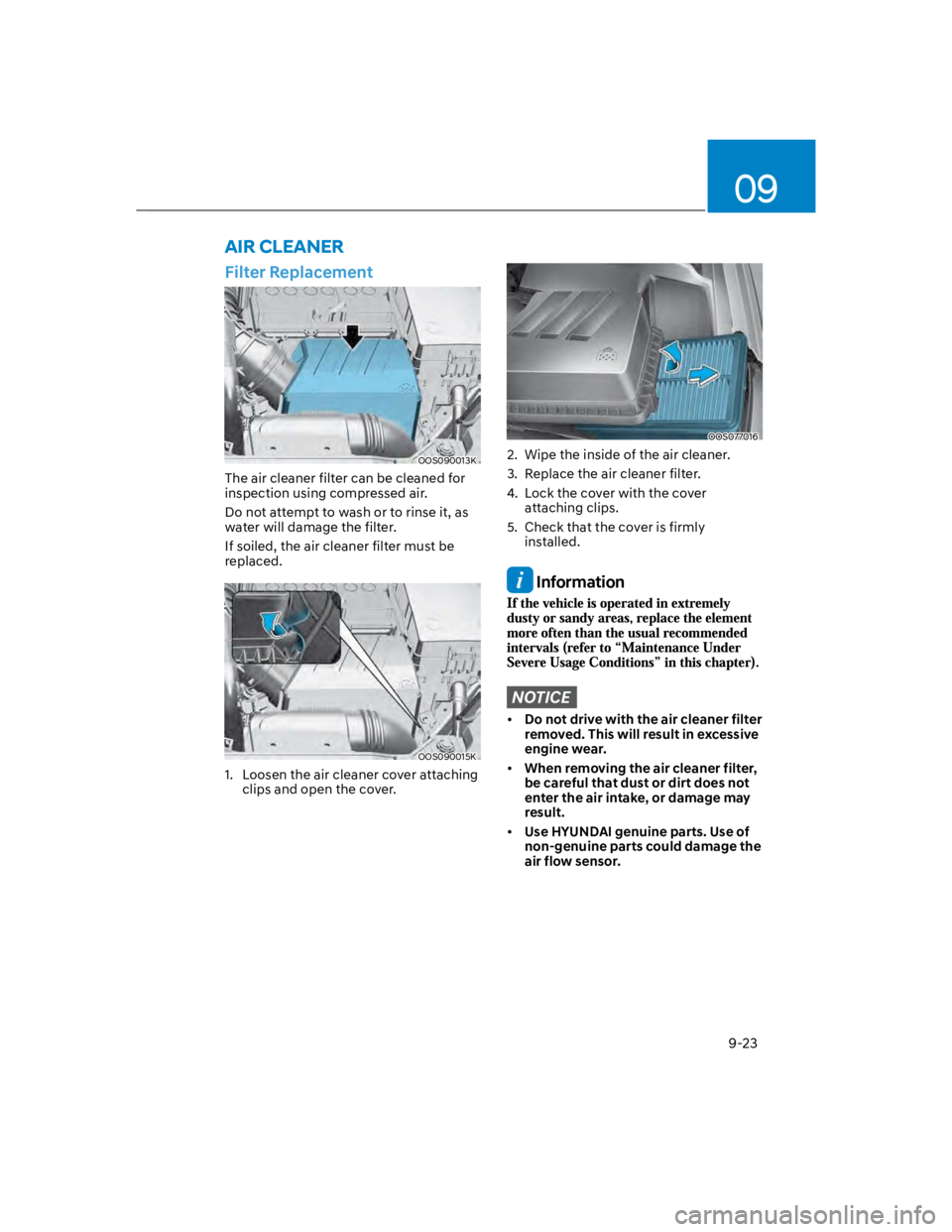
OOS090013K
The air cleaner filter can be cleaned for
inspection using compressed air.
Do not attempt to wash or to rinse it, as
water will damage the filter.
If soiled, the air cleaner filter must be
replaced.
OOS090015K
1. Loosen the air cleaner cover attaching
clips and open the cover.
OOS077016
2. Wipe the inside of the air cleaner.
3. Replace the air cleaner filter.
4. Lock the cover with the cover
attaching clips.
5. Check that the cover is firmly
installed.
Information
NOTICE
Do not drive with the air cleaner filter
removed. This will result in excessive
engine wear.
When removing the air cleaner filter,
be careful that dust or dirt does not
enter the air intake, or damage may
result.
Use HYUNDAI genuine parts. Use of
non-genuine parts could damage the
air flow sensor.
AIR CLEANER
Page 536 of 579
Maintenance
9-50
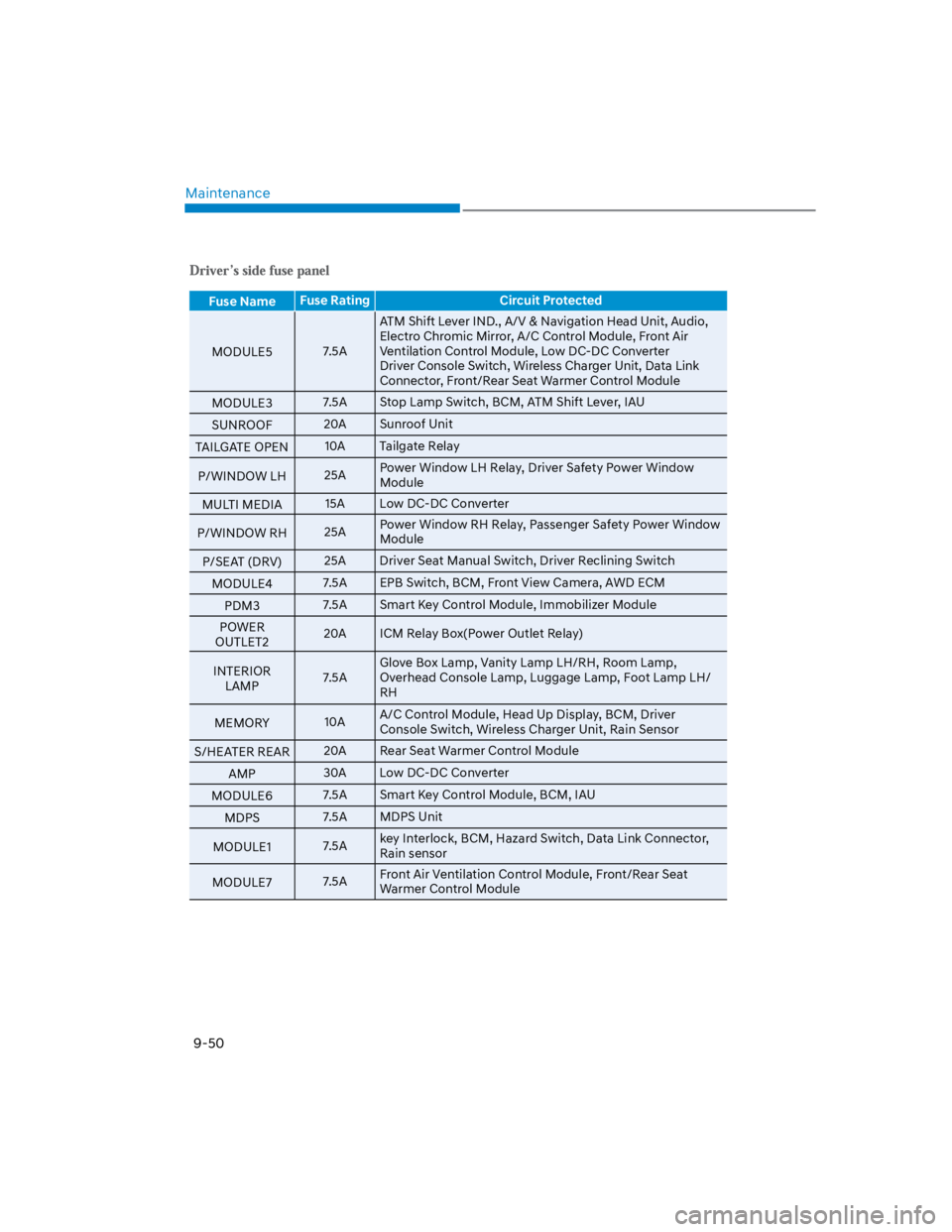
Fuse NameFuse Rating Circuit Protected
MODULE57.5A
ATM Shift Lever IND., A/V & Navigation Head Unit, Audio,
Electro Chromic Mirror, A/C Control Module, Front Air
Ventilation Control Module, Low DC-DC Converter
Driver Console Switch, Wireless Charger Unit, Data Link
Connector, Front/Rear Seat Warmer Control Module
MODULE37.5A Stop Lamp Switch, BCM, ATM Shift Lever, IAU
SUNROOF20A Sunroof Unit
TAILGATE OPEN10A Tailgate Relay
P/WINDOW LH25APower Window LH Relay, Driver Safety Power Window
Module
MULTI MEDIA15A Low DC-DC Converter
P/WINDOW RH25APower Window RH Relay, Passenger Safety Power Window
Module
P/SEAT (DRV)25A Driver Seat Manual Switch, Driver Reclining Switch
MODULE47.5A EPB Switch, BCM, Front View Camera, AWD ECM
PDM37.5A Smart Key Control Module, Immobilizer Module
POWER
OUTLET220A ICM Relay Box(Power Outlet Relay)
INTERIOR
LAMP7.5A
Glove Box Lamp, Vanity Lamp LH/RH, Room Lamp,
Overhead Console Lamp, Luggage Lamp, Foot Lamp LH/
RH
MEMORY10AA/C Control Module, Head Up Display, BCM, Driver
Console Switch, Wireless Charger Unit, Rain Sensor
S/HEATER REAR20A Rear Seat Warmer Control Module
AMP30A Low DC-DC Converter
MODULE67.5A Smart Key Control Module, BCM, IAU
MDPS7.5A MDPS Unit
MODULE17.5Akey Interlock, BCM, Hazard Switch, Data Link Connector,
Rain sensor
MODULE77.5AFront Air Ventilation Control Module, Front/Rear Seat
Warmer Control Module
Page 537 of 579
09
9-51
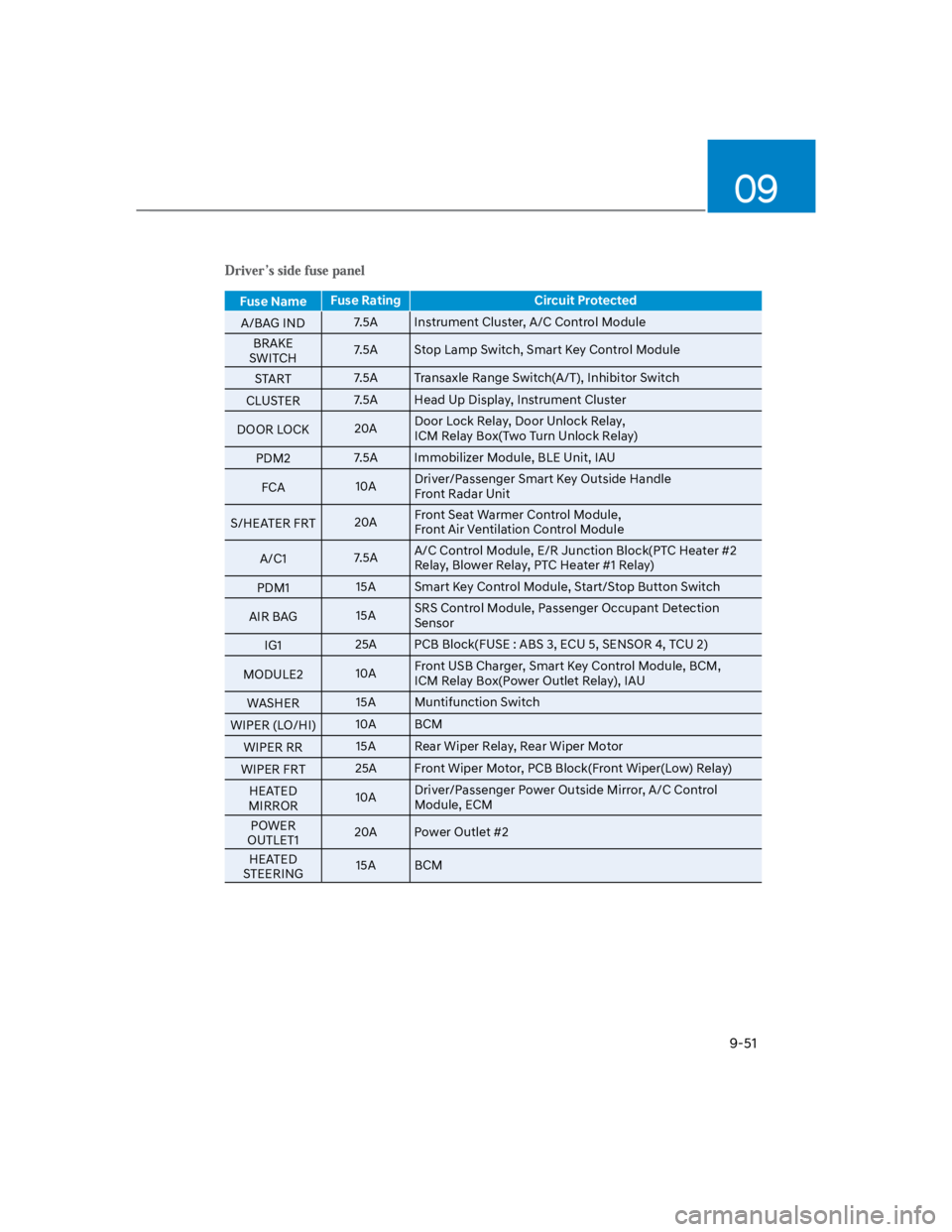
Fuse NameFuse Rating Circuit Protected
A/BAG IND7.5A Instrument Cluster, A/C Control Module
BRAKE
SWITCH7.5A Stop Lamp Switch, Smart Key Control Module
START7.5A Transaxle Range Switch(A/T), Inhibitor Switch
CLUSTER7.5A Head Up Display, Instrument Cluster
DOOR LOCK20ADoor Lock Relay, Door Unlock Relay,
ICM Relay Box(Two Turn Unlock Relay)
PDM27.5A Immobilizer Module, BLE Unit, IAU
FCA10ADriver/Passenger Smart Key Outside Handle
Front Radar Unit
S/HEATER FRT20AFront Seat Warmer Control Module,
Front Air Ventilation Control Module
A/C17.5AA/C Control Module, E/R Junction Block(PTC Heater #2
Relay, Blower Relay, PTC Heater #1 Relay)
PDM115A Smart Key Control Module, Start/Stop Button Switch
AIR BAG15ASRS Control Module, Passenger Occupant Detection
Sensor
IG125A PCB Block(FUSE : ABS 3, ECU 5, SENSOR 4, TCU 2)
MODULE210AFront USB Charger, Smart Key Control Module, BCM,
ICM Relay Box(Power Outlet Relay), IAU
WASHER15A Muntifunction Switch
WIPER (LO/HI)10A BCM
WIPER RR15A Rear Wiper Relay, Rear Wiper Motor
WIPER FRT25A Front Wiper Motor, PCB Block(Front Wiper(Low) Relay)
HEATED
MIRROR10ADriver/Passenger Power Outside Mirror, A/C Control
Module, ECM
POWER
OUTLET120A Power Outlet #2
HEATED
STEERING15A BCM
Page 542 of 579
Maintenance
9-56
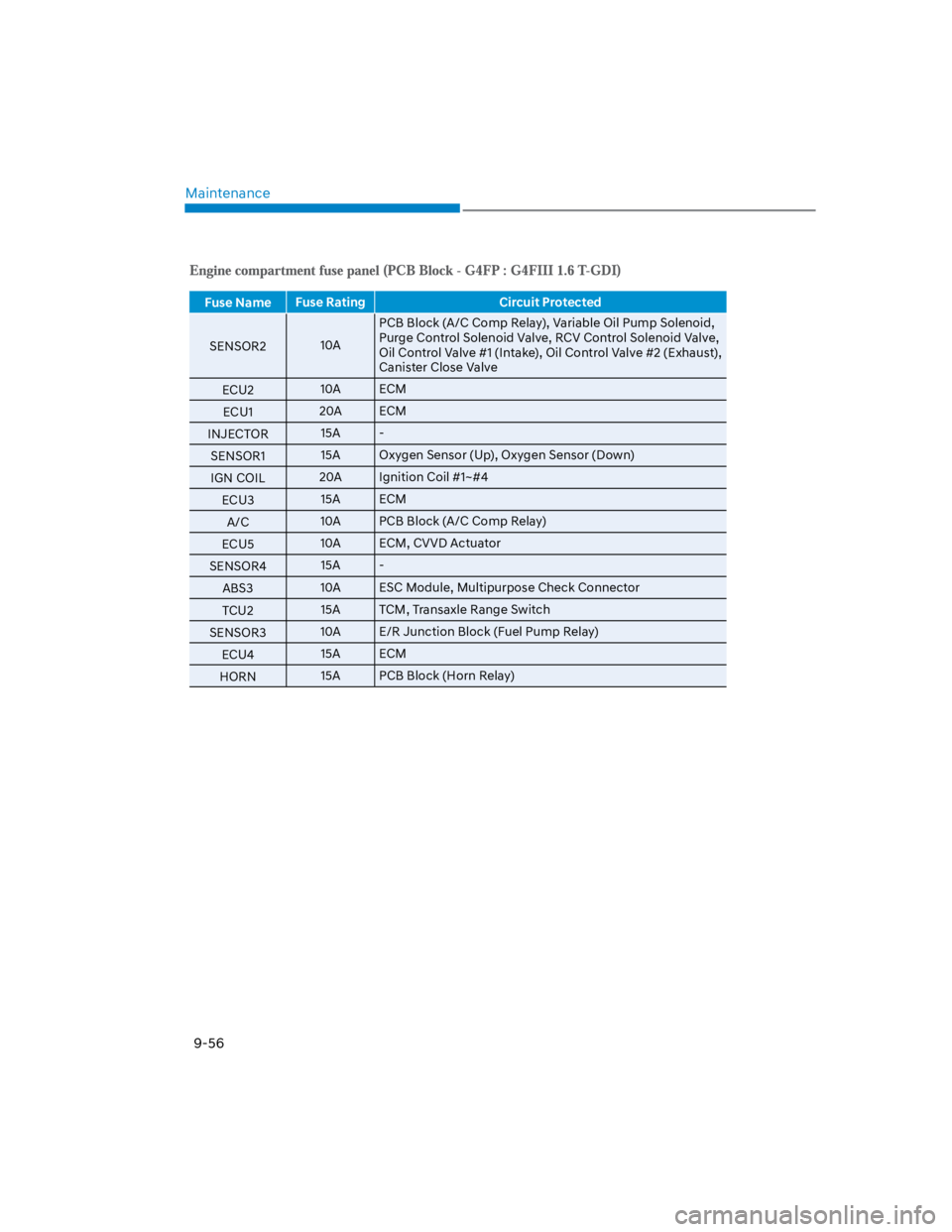
Fuse NameFuse Rating Circuit Protected
SENSOR210A
PCB Block (A/C Comp Relay), Variable Oil Pump Solenoid,
Purge Control Solenoid Valve, RCV Control Solenoid Valve,
Oil Control Valve #1 (Intake), Oil Control Valve #2 (Exhaust),
Canister Close Valve
ECU210A ECM
ECU120A ECM
INJECTOR15A -
SENSOR115A Oxygen Sensor (Up), Oxygen Sensor (Down)
IGN COIL20A Ignition Coil #1~#4
ECU315A ECM
A/C10A PCB Block (A/C Comp Relay)
ECU510A ECM, CVVD Actuator
SENSOR415A -
ABS310A ESC Module, Multipurpose Check Connector
TCU215A TCM, Transaxle Range Switch
SENSOR310A E/R Junction Block (Fuel Pump Relay)
ECU415A ECM
HORN15A PCB Block (Horn Relay)
Page 543 of 579
09
9-57
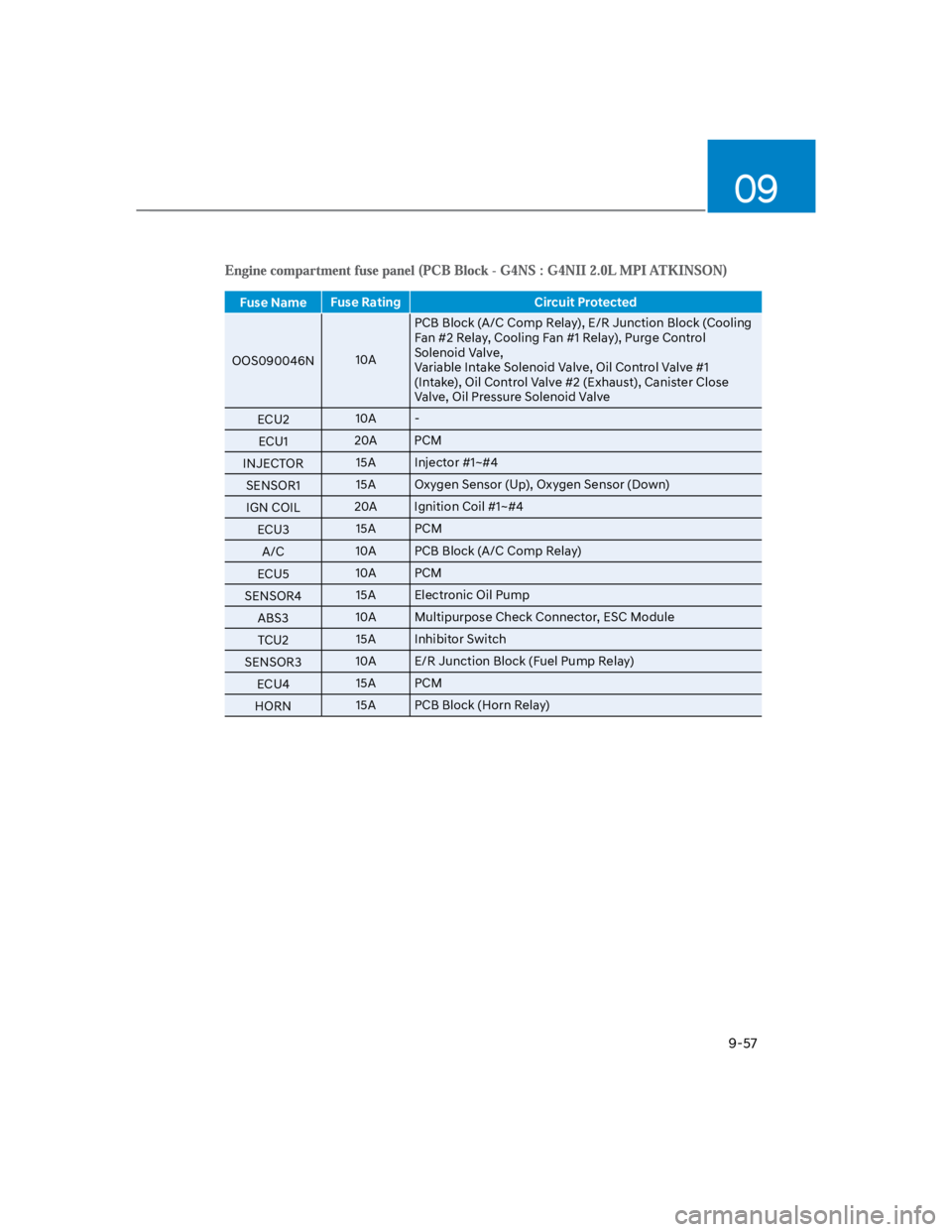
Fuse NameFuse Rating Circuit Protected
OOS090046N10A
PCB Block (A/C Comp Relay), E/R Junction Block (Cooling
Fan #2 Relay, Cooling Fan #1 Relay), Purge Control
Solenoid Valve,
Variable Intake Solenoid Valve, Oil Control Valve #1
(Intake), Oil Control Valve #2 (Exhaust), Canister Close
Valve, Oil Pressure Solenoid Valve
ECU210A -
ECU120A PCM
INJECTOR15A Injector #1~#4
SENSOR115A Oxygen Sensor (Up), Oxygen Sensor (Down)
IGN COIL20A Ignition Coil #1~#4
ECU315A PCM
A/C10A PCB Block (A/C Comp Relay)
ECU510A PCM
SENSOR415A Electronic Oil Pump
ABS310A Multipurpose Check Connector, ESC Module
TCU215A Inhibitor Switch
SENSOR310A E/R Junction Block (Fuel Pump Relay)
ECU415A PCM
HORN15A PCB Block (Horn Relay)