Windshield HYUNDAI KONA 2022 Owners Manual
[x] Cancel search | Manufacturer: HYUNDAI, Model Year: 2022, Model line: KONA, Model: HYUNDAI KONA 2022Pages: 579, PDF Size: 35.31 MB
Page 15 of 579
2-2
Vehicle Information, Consumer Information and Reporting Safety Defects
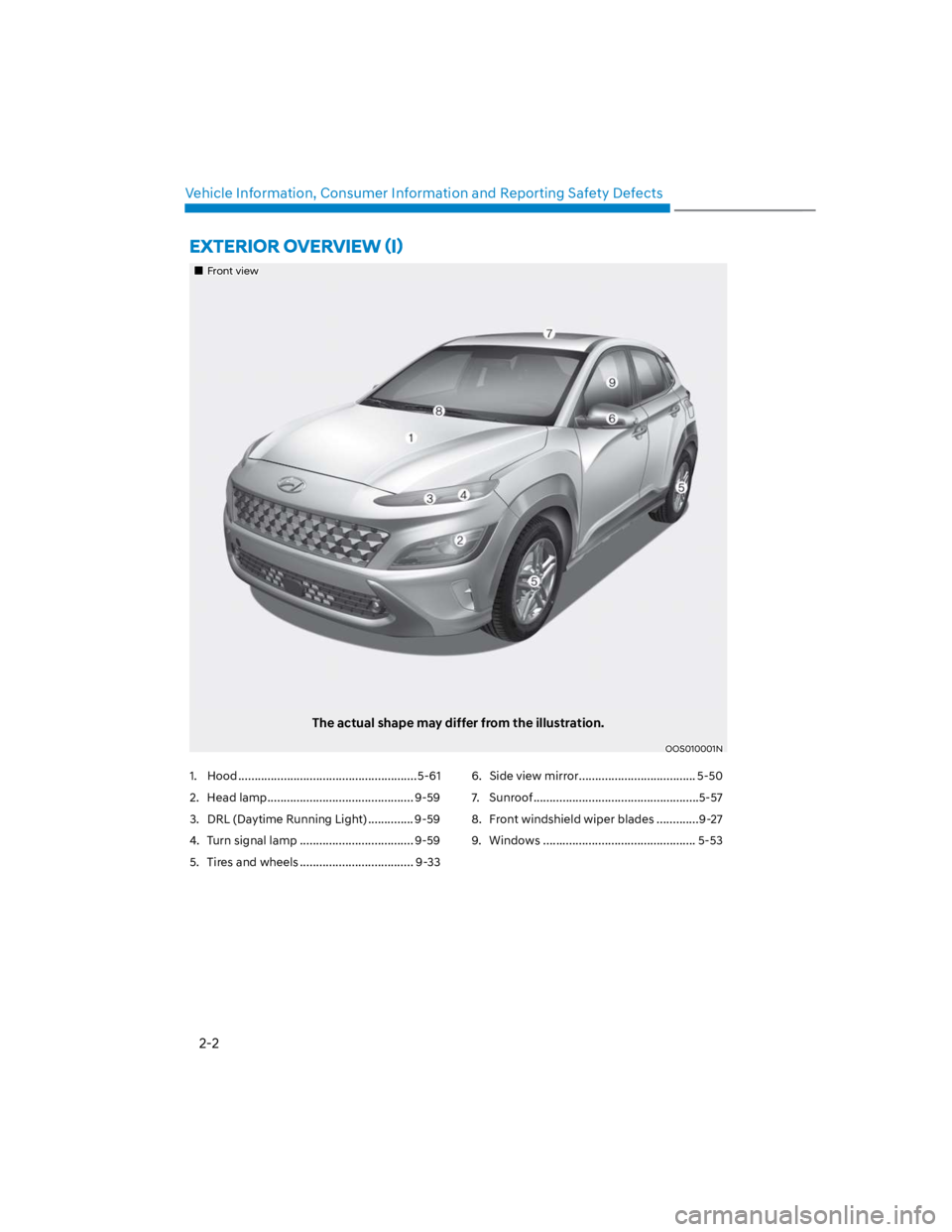
Front view
The actual shape may differ from the illustration.
OOS010001N
1. Hood ....................................................... 5-61
2. Head lamp ............................................. 9-59
3. DRL (Daytime Running Light) .............. 9-59
4. Turn signal lamp ................................... 9-59
5. Tires and wheels ................................... 9-33
6. Side view mirror .................................... 5-50
7. Sunroof ...................................................5-57
8. Front windshield wiper blades .............9-27
9. Windows ............................................... 5-53
Page 16 of 579
2-3
02
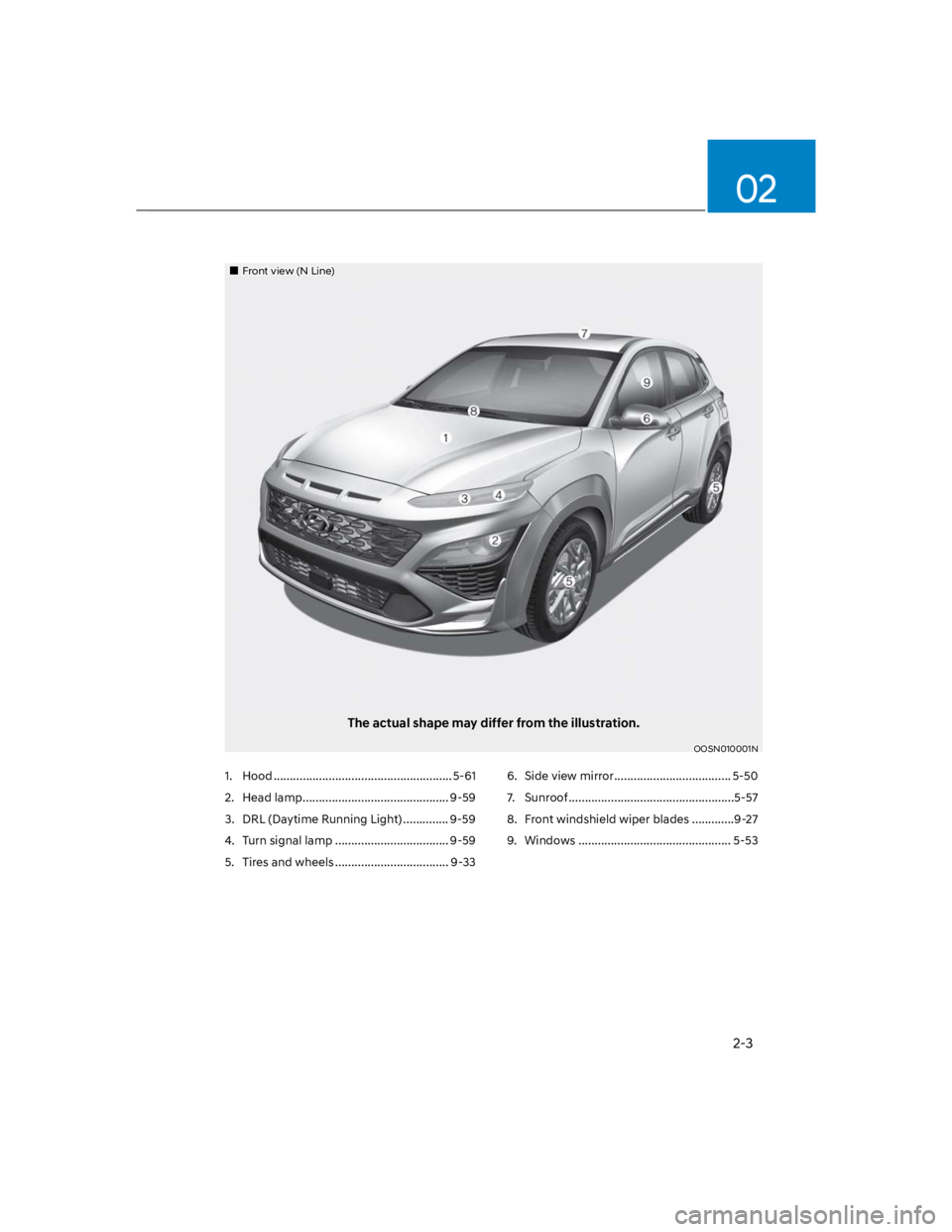
Front view (N Line)
The actual shape may differ from the illustration.
OOSN010001N
1. Hood ....................................................... 5-61
2. Head lamp ............................................. 9-59
3. DRL (Daytime Running Light) .............. 9-59
4. Turn signal lamp ................................... 9-59
5. Tires and wheels ................................... 9-33
6. Side view mirror .................................... 5-50
7. Sunroof ...................................................5-57
8. Front windshield wiper blades .............9-27
9. Windows ............................................... 5-53
Page 21 of 579
2-8
Vehicle Information, Consumer Information and Reporting Safety Defects
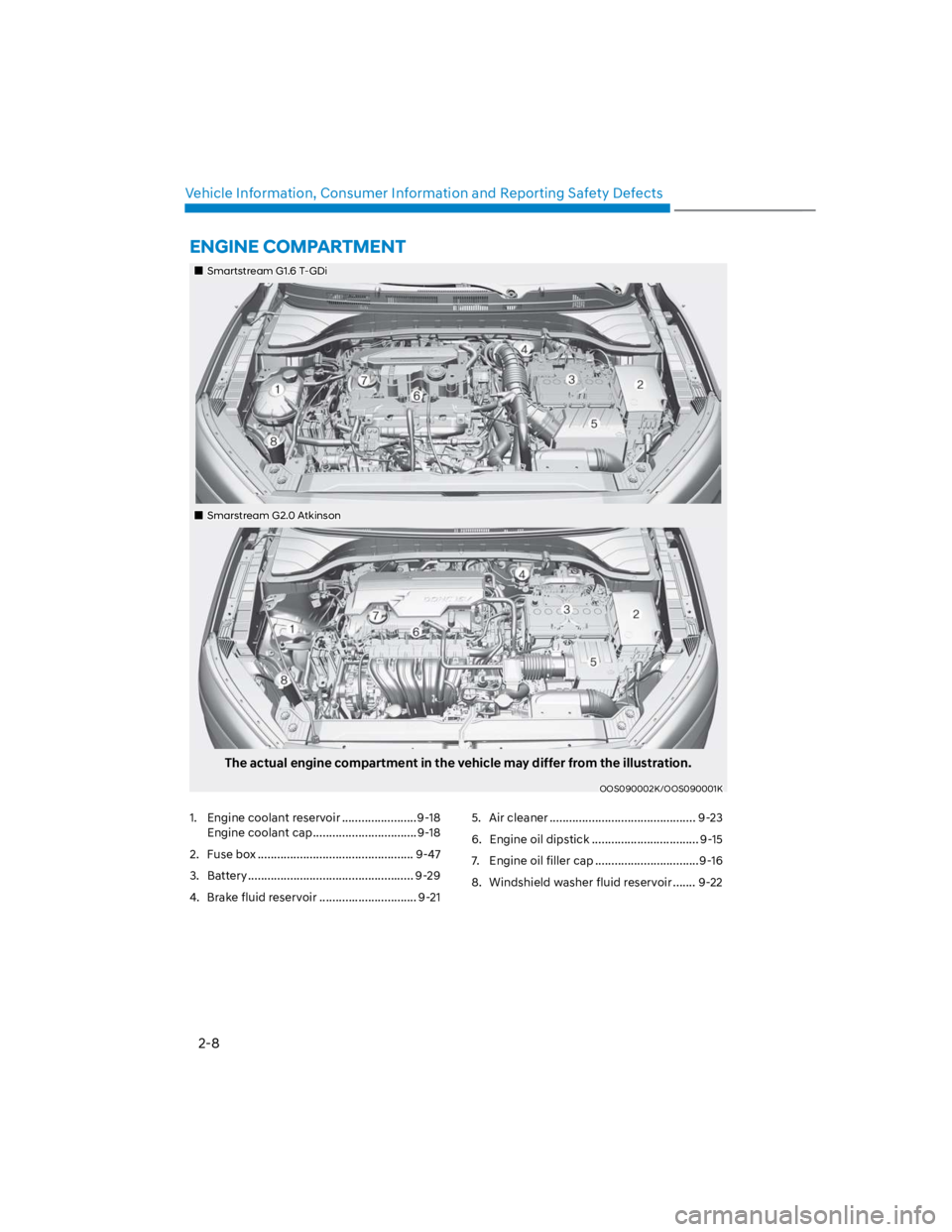
Smartstream G1.6 T-GDi
Smarstream G2.0 Atkinson
The actual engine compartment in the vehicle may differ from the illustration.
OOS090002K/OOS090001K
1. Engine coolant reservoir .......................9-18
Engine coolant cap ................................9-18
2. Fuse box ................................................ 9-47
3. Battery ................................................... 9-29
4. Brake fluid reservoir .............................. 9-21
5. Air cleaner ............................................. 9-23
6. Engine oil dipstick ................................. 9-15
7. Engine oil filler cap ................................9-16
8. Windshield washer fluid reservoir ....... 9-22
ENGINE COMPARTMENT
Page 28 of 579
02
2-15
VEHICLE IDENTIFICATION
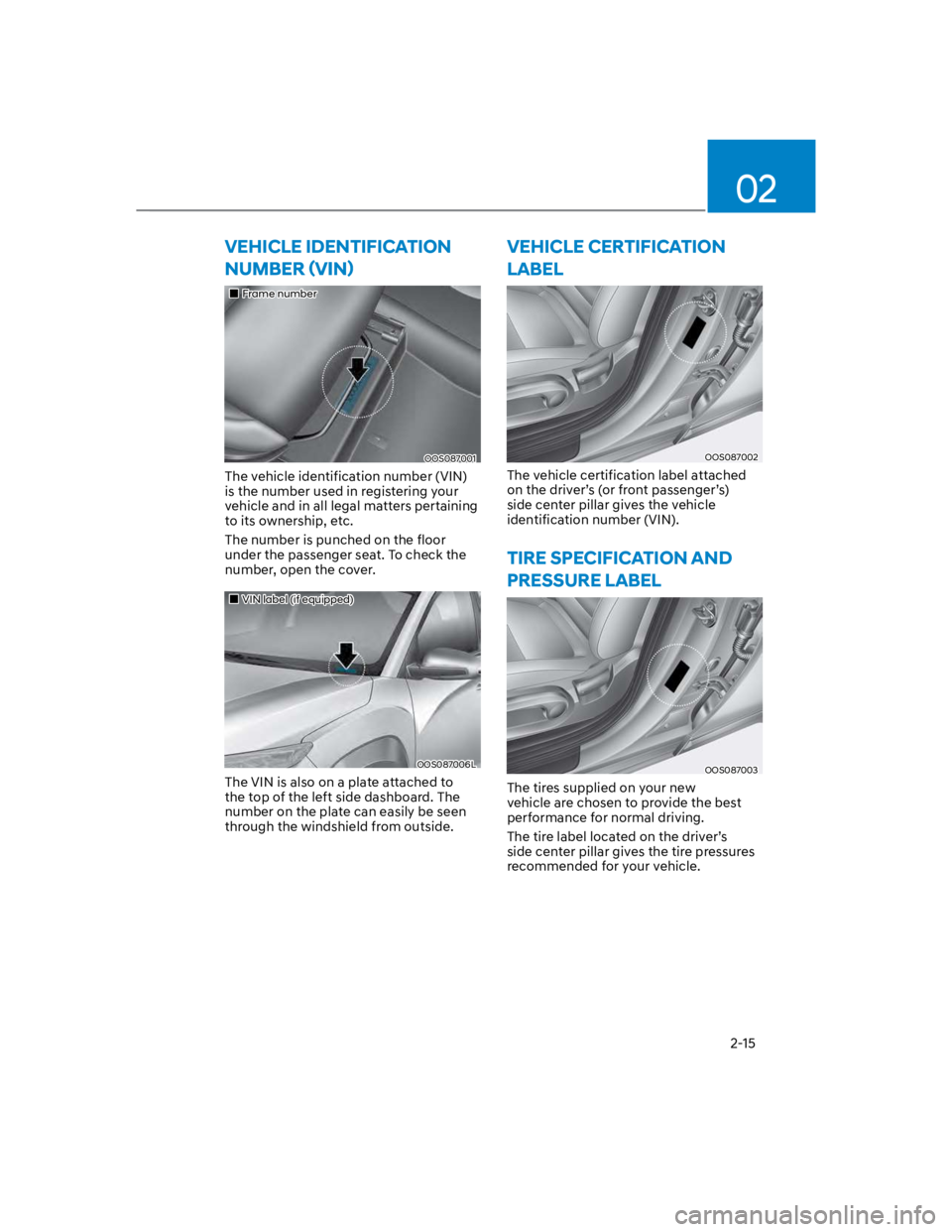
Frame number
OOS087001
The vehicle identification number (VIN)
is the number used in registering your
vehicle and in all legal matters pertaining
to its ownership, etc.
The number is punched on the floor
under the passenger seat. To check the
number, open the cover.
VIN label (if equipped)
OOS087006L
The VIN is also on a plate attached to
the top of the left side dashboard. The
number on the plate can easily be seen
through the windshield from outside.
VEHICLE CERTIFICATION
LABEL
OOS087002
The vehicle certification label attached
on the driver’s (or front passenger’s)
side center pillar gives the vehicle
identification number (VIN).
TIRE SPECIFICATION AND
PRESSURE LABEL
OOS087003
The tires supplied on your new
vehicle are chosen to provide the best
performance for normal driving.
The tire label located on the driver’s
side center pillar gives the tire pressures
recommended for your vehicle.
Page 74 of 579
03
3-43
Where are the air bags?
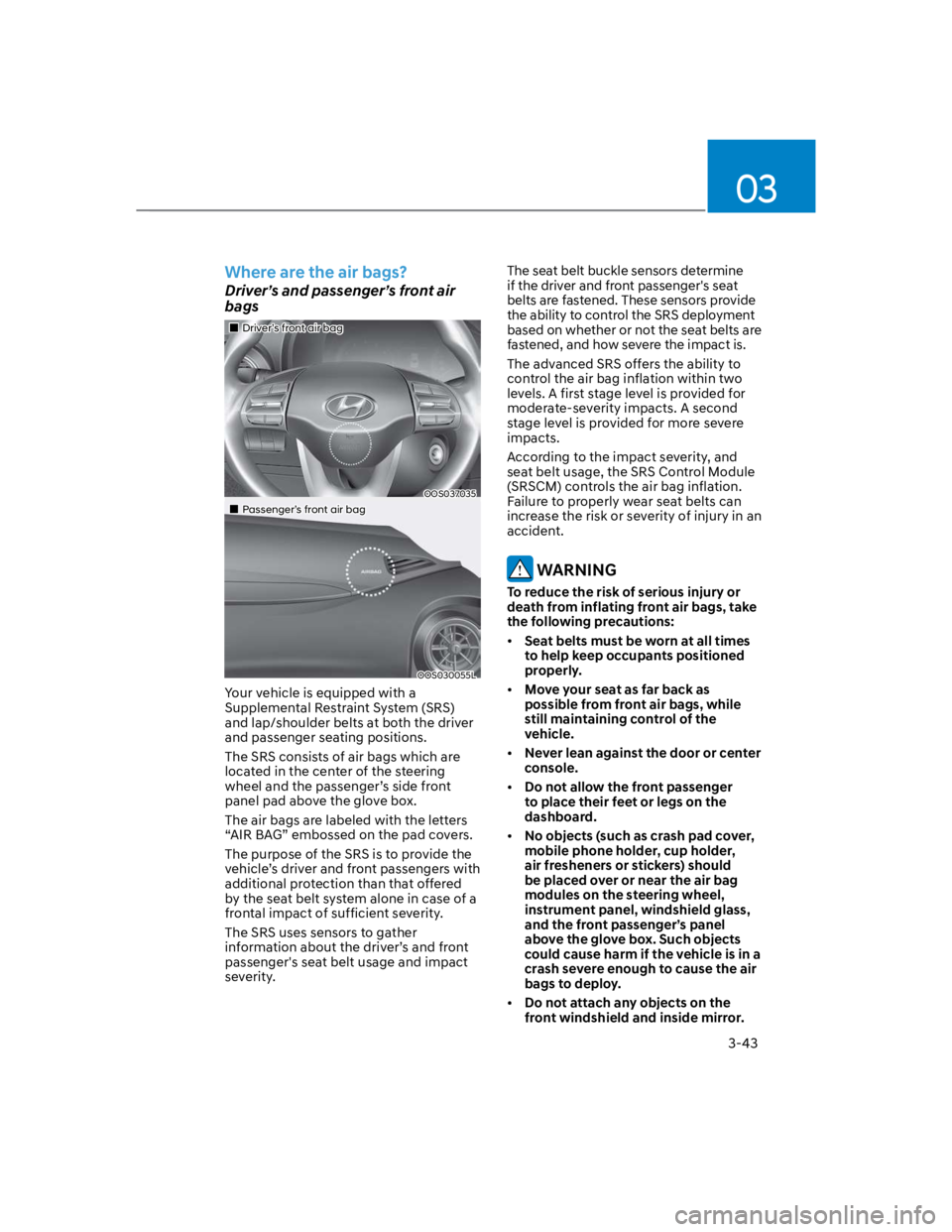
Driver’s and passenger’s front air
bags
Driver’s front air bag
OOS037035
Passenger’s front air bag
OOS030055L
Your vehicle is equipped with a
Supplemental Restraint System (SRS)
and lap/shoulder belts at both the driver
and passenger seating positions.
The SRS consists of air bags which are
located in the center of the steering
wheel and the passenger’s side front
panel pad above the glove box.
The air bags are labeled with the letters
“AIR BAG” embossed on the pad covers.
The purpose of the SRS is to provide the
vehicle’s driver and front passengers with
additional protection than that offered
by the seat belt system alone in case of a
frontal impact of sufficient severity.
The SRS uses sensors to gather
information about the driver’s and front
passenger's seat belt usage and impact
severity.
The seat belt buckle sensors determine
if the driver and front passenger's seat
belts are fastened. These sensors provide
the ability to control the SRS deployment
based on whether or not the seat belts are
fastened, and how severe the impact is.
The advanced SRS offers the ability to
control the air bag inflation within two
levels. A first stage level is provided for
moderate-severity impacts. A second
stage level is provided for more severe
impacts.
According to the impact severity, and
seat belt usage, the SRS Control Module
(SRSCM) controls the air bag inflation.
Failure to properly wear seat belts can
increase the risk or severity of injury in an
accident.
WARNING
To reduce the risk of serious injury or
death from inflating front air bags, take
the following precautions:
Seat belts must be worn at all times
to help keep occupants positioned
properly.
Move your seat as far back as
possible from front air bags, while
still maintaining control of the
vehicle.
Never lean against the door or center
console.
Do not allow the front passenger
to place their feet or legs on the
dashboard.
No objects (such as crash pad cover,
mobile phone holder, cup holder,
air fresheners or stickers) should
be placed over or near the air bag
modules on the steering wheel,
instrument panel, windshield glass,
and the front passenger’s panel
above the glove box. Such objects
could cause harm if the vehicle is in a
crash severe enough to cause the air
bags to deploy.
Do not attach any objects on the
front windshield and inside mirror.
Page 80 of 579
03
3-49
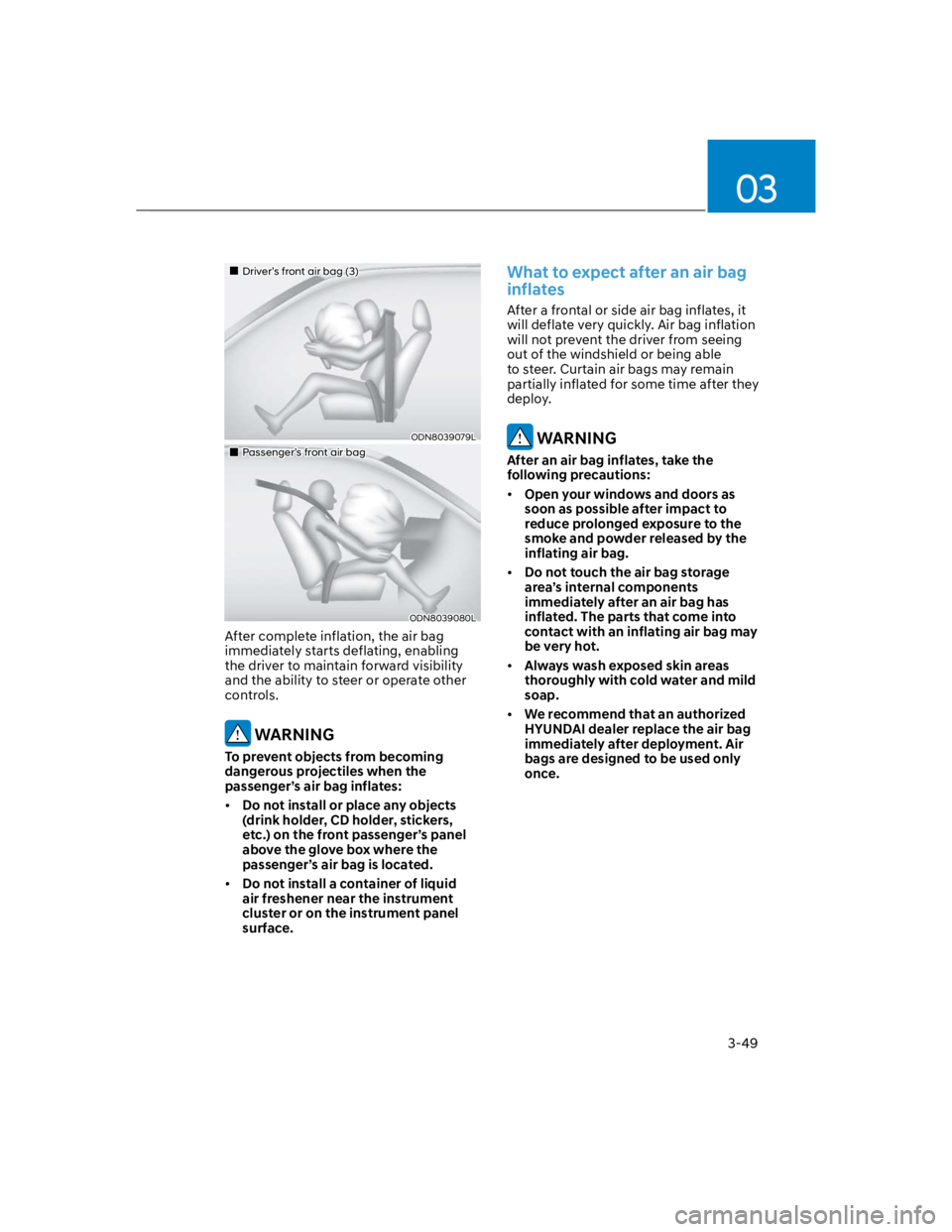
Driver’s front air bag (3)
ODN8039079L
Passenger’s front air bag
ODN8039080L
After complete inflation, the air bag
immediately starts deflating, enabling
the driver to maintain forward visibility
and the ability to steer or operate other
controls.
WARNING
To prevent objects from becoming
dangerous projectiles when the
passenger’s air bag inflates:
Do not install or place any objects
(drink holder, CD holder, stickers,
etc.) on the front passenger’s panel
above the glove box where the
passenger’s air bag is located.
Do not install a container of liquid
air freshener near the instrument
cluster or on the instrument panel
surface.
What to expect after an air bag
inflates
After a frontal or side air bag inflates, it
will deflate very quickly. Air bag inflation
will not prevent the driver from seeing
out of the windshield or being able
to steer. Curtain air bags may remain
partially inflated for some time after they
deploy.
WARNING
After an air bag inflates, take the
following precautions:
Open your windows and doors as
soon as possible after impact to
reduce prolonged exposure to the
smoke and powder released by the
inflating air bag.
Do not touch the air bag storage
area’s internal components
immediately after an air bag has
inflated. The parts that come into
contact with an inflating air bag may
be very hot.
Always wash exposed skin areas
thoroughly with cold water and mild
soap.
We recommend that an authorized
HYUNDAI dealer replace the air bag
immediately after deployment. Air
bags are designed to be used only
once.
Page 136 of 579

5
High Beam Assist (HBA) ..................................................................................5-74
High Beam Assist setting ........................................................................................... 5-74
Operating condition ................................................................................................... 5-75
High Beam Assist malfunction ................................................................................. 5-75
Wipers and washers ......................................................................................... 5-77
Windshield wipers ...................................................................................................... 5-77
Front windshield washers .......................................................................................... 5-79
Rear window wiper and washer ............................................................................... 5-80
Manual climate control system .......................................................................5-81
Heating and air conditioning .....................................................................................5-82
System operation .......................................................................................................5-85
System maintenance ................................................................................................. 5-87
Automatic climate control system ................................................................. 5-89
Automatic heating and air conditioning .................................................................. 5-90
Manual heating and air conditioning ....................................................................... 5-90
System operation ...................................................................................................... 5-94
System maintenance ................................................................................................ 5-96
Windshield defrosting and defogging ........................................................... 5-98
Manual climate control system ................................................................................ 5-98
Automatic climate control system ........................................................................... 5-99
Auto defogging system (only for automatic climate control system) .................. 5-100
Defroster ................................................................................................................... 5-102
Climate control additional features ..............................................................5-103
Automatic Ventilation .............................................................................................. 5-103
Sunroof Inside Air Recirculation .............................................................................. 5-103
Inside air circulation while operating the washer fluid ......................................... 5-103
Storage compartment ...................................................................................5-104
Center console storage ............................................................................................ 5-104
Glove box .................................................................................................................. 5-104
Sunglass Holder ....................................................................................................... 5-105
Multi Box ................................................................................................................... 5-105
Luggage tray ............................................................................................................. 5-106
Page 163 of 579
05
5-29
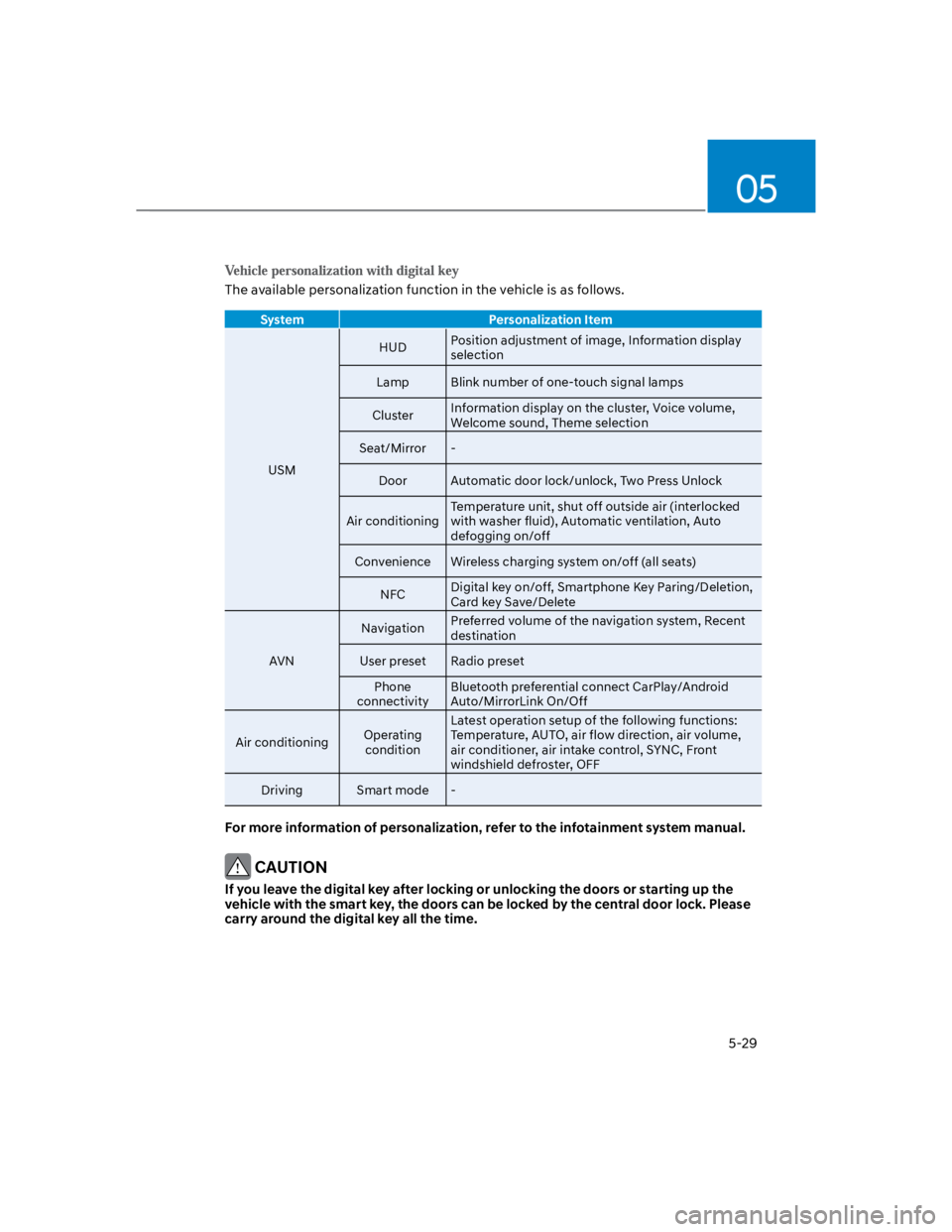
The available personalization function in the vehicle is as follows.
System Personalization Item
USM
HUDPosition adjustment of image, Information display
selection
Lamp Blink number of one-touch signal lamps
ClusterInformation display on the cluster, Voice volume,
Welcome sound, Theme selection
Seat/Mirror -
Door Automatic door lock/unlock, Two Press Unlock
Air conditioning
Temperature unit, shut off outside air (interlocked
with washer fluid), Automatic ventilation, Auto
defogging on/off
Convenience Wireless charging system on/off (all seats)
NFCDigital key on/off, Smartphone Key Paring/Deletion,
Card key Save/Delete
AVN
NavigationPreferred volume of the navigation system, Recent
destination
User preset Radio preset
Phone
connectivity
Bluetooth preferential connect CarPlay/Android
Auto/MirrorLink On/Off
Air conditioningOperating
condition
Latest operation setup of the following functions:
Temperature, AUTO, air flow direction, air volume,
air conditioner, air intake control, SYNC, Front
windshield defroster, OFF
Driving Smart mode -
For more information of personalization, refer to the infotainment system manual.
CAUTION
If you leave the digital key after locking or unlocking the doors or starting up the
vehicle with the smart key, the doors can be locked by the central door lock. Please
carry around the digital key all the time.
Page 201 of 579
05
5-67
Exterior lights
Lighting control
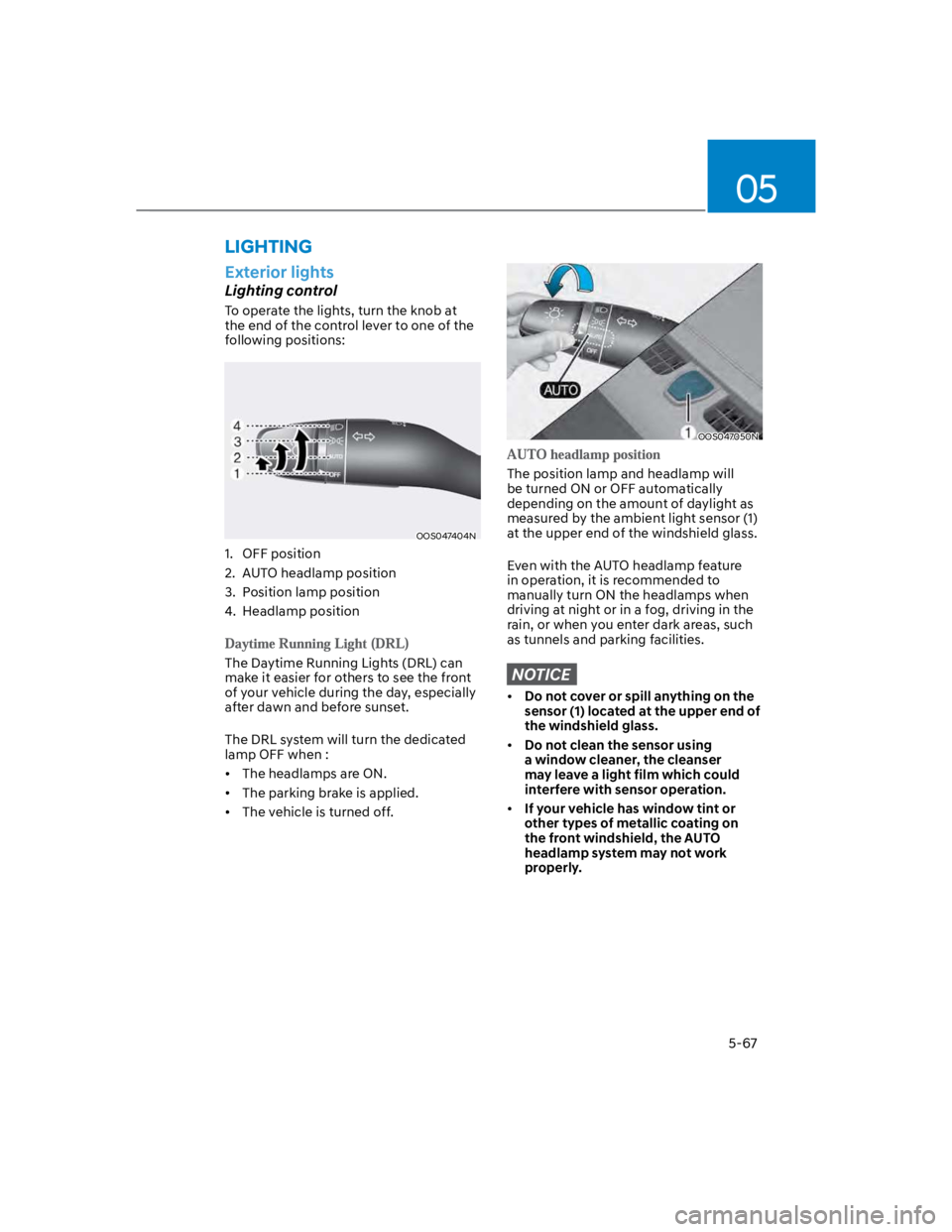
To operate the lights, turn the knob at
the end of the control lever to one of the
following positions:
OOS047404N
1. OFF position
2. AUTO headlamp position
3. Position lamp position
4. Headlamp position
The Daytime Running Lights (DRL) can
make it easier for others to see the front
of your vehicle during the day, especially
after dawn and before sunset.
The DRL system will turn the dedicated
lamp OFF when :
The headlamps are ON.
The parking brake is applied.
The vehicle is turned off.
OOS047050N
The position lamp and headlamp will
be turned ON or OFF automatically
depending on the amount of daylight as
measured by the ambient light sensor (1)
at the upper end of the windshield glass.
Even with the AUTO headlamp feature
in operation, it is recommended to
manually turn ON the headlamps when
driving at night or in a fog, driving in the
rain, or when you enter dark areas, such
as tunnels and parking facilities.
NOTICE
Do not cover or spill anything on the
sensor (1) located at the upper end of
the windshield glass.
Do not clean the sensor using
a window cleaner, the cleanser
may leave a light film which could
interfere with sensor operation.
If your vehicle has window tint or
other types of metallic coating on
the front windshield, the AUTO
headlamp system may not work
properly.
LIGHTING
Page 210 of 579

Convenient features
5-76
When it is affected by an external
condition
When there is a similar shaped lamp
with the vehicle front vehicle’s
lamps.
When the headlamp is not repaired
or replaced at an authorized dealer.
When headlamp aiming is not
properly adjusted.
When driving on a narrow winding
road or rough road.
When driving downhill or uphill.
When only part of the vehicle in
front is visible on a crossroad or on a
corner.
When there is a traffic light,
reflecting sign, flashing sign or
mirror.
When the road conditions are bad
such as being wet or covered with
snow.
When a vehicle suddenly appears
from around a corner.
When the vehicle is tilted from a flat
tire or being towed.
When the front visibility is poor
When the light from the on-coming
or vehicle in front is not detected
because of exhaust fume, smoke,
fog, snow, Heavy rain, dust, etc.
When the front window is covered
with foreign matter.
WARNING
Do not disassemble a front view
camera temporarily for tinted
window or attaching any types
of coatings and accessories. If
you disassemble the camera and
assemble it again, take your vehicle
to an authorized HYUNDAI dealer
and have the function checked to
need a calibration.
When you replace or reinstall the
windshield glass, front view camera,
we recommend that you take your
vehicle to an authorized HYUNDAI
dealer and have the function
checked.
Be careful that water doesn’t get into
High Beam Assist unit and do not
remove or damage related parts of
High Beam Assist.
Do not place objects on the crash
pad that reflect light such as mirrors,
white paper, etc. The function may
malfunction if sunlight is reflected.
At times, High Beam Assist may
not work properly. The function is
for your convenience only. It is the
responsibility of the driver for safe
driving practices and always check
the road conditions for your safety.
When the function does not operate
normally, change the lamp position
manually between the high beam
and low beam.