coolant HYUNDAI KONA EV 2022 User Guide
[x] Cancel search | Manufacturer: HYUNDAI, Model Year: 2022, Model line: KONA EV, Model: HYUNDAI KONA EV 2022Pages: 548, PDF Size: 49.14 MB
Page 483 of 548
09
9 -7
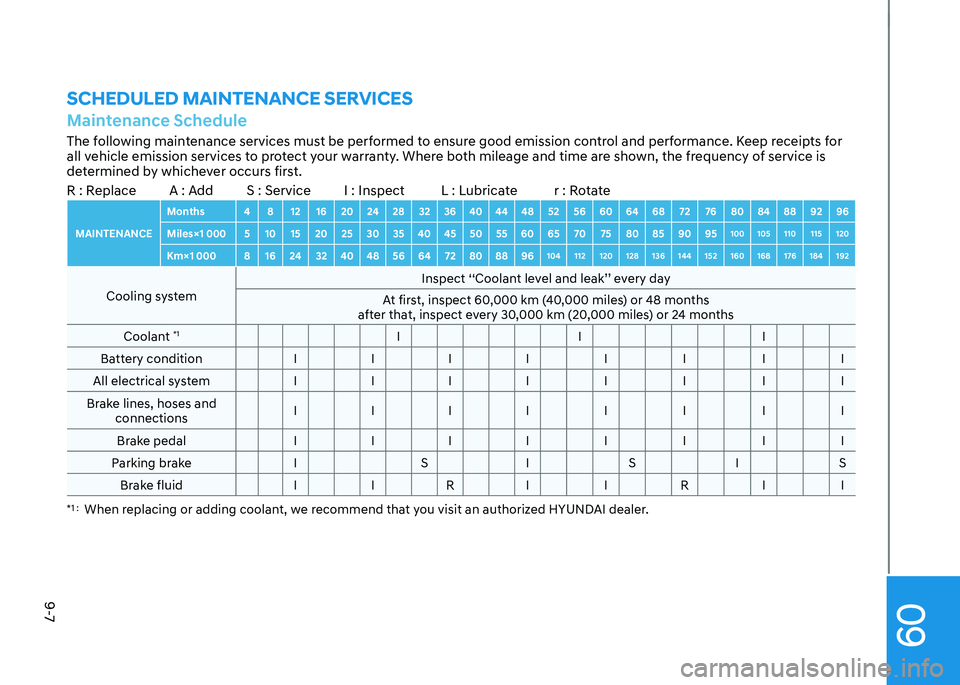
SCHEDULED MAINTENANCE SERVICESMaintenance ScheduleThe following maintenance services must be performed to ensure good emission control and performance. Keep receipts for
all vehicle emission services to protect your warranty. Where both mileage and time are shown, the frequency of service is
determined by whichever occurs first.
R : Replace A : Add S : Service I : Inspect L : Lubricate r : RotateMAINTENANCEMonths 4 8 12 16 20 24 28 32 36 40 44 48 52 56 60 64 68 72 76 80 84 88 92 96
Miles×1 000 5 10 15 20 25 30 35 40 45 50 55 60 65 70 75 80 85 90 95 100 105 110 115 120
Km×1 000 8 16 24 32 40 48 56 64 72 80 88 96 104 112 120 128 136 144 152 160 168 176 184 192
Cooling systemInspect ‘‘Coolant level and leak’’ every day
At first, inspect 60,000 km (40,000 miles) or 48 months
after that, inspect every 30,000 km (20,000 miles) or 24 months
Coolant *1
I I I
Battery condition I I I I I I I I
All electrical system I I I I I I I I
Brake lines, hoses and connections I I I I I I I I
Brake pedal I I I I I I I I
parking brake I S I S I S Brake fluid I I R I I R I I
*1 : When replacing or adding coolant, we recommend that you visit an authorized HYUNDAI dealer.
Page 485 of 548
09
9-9
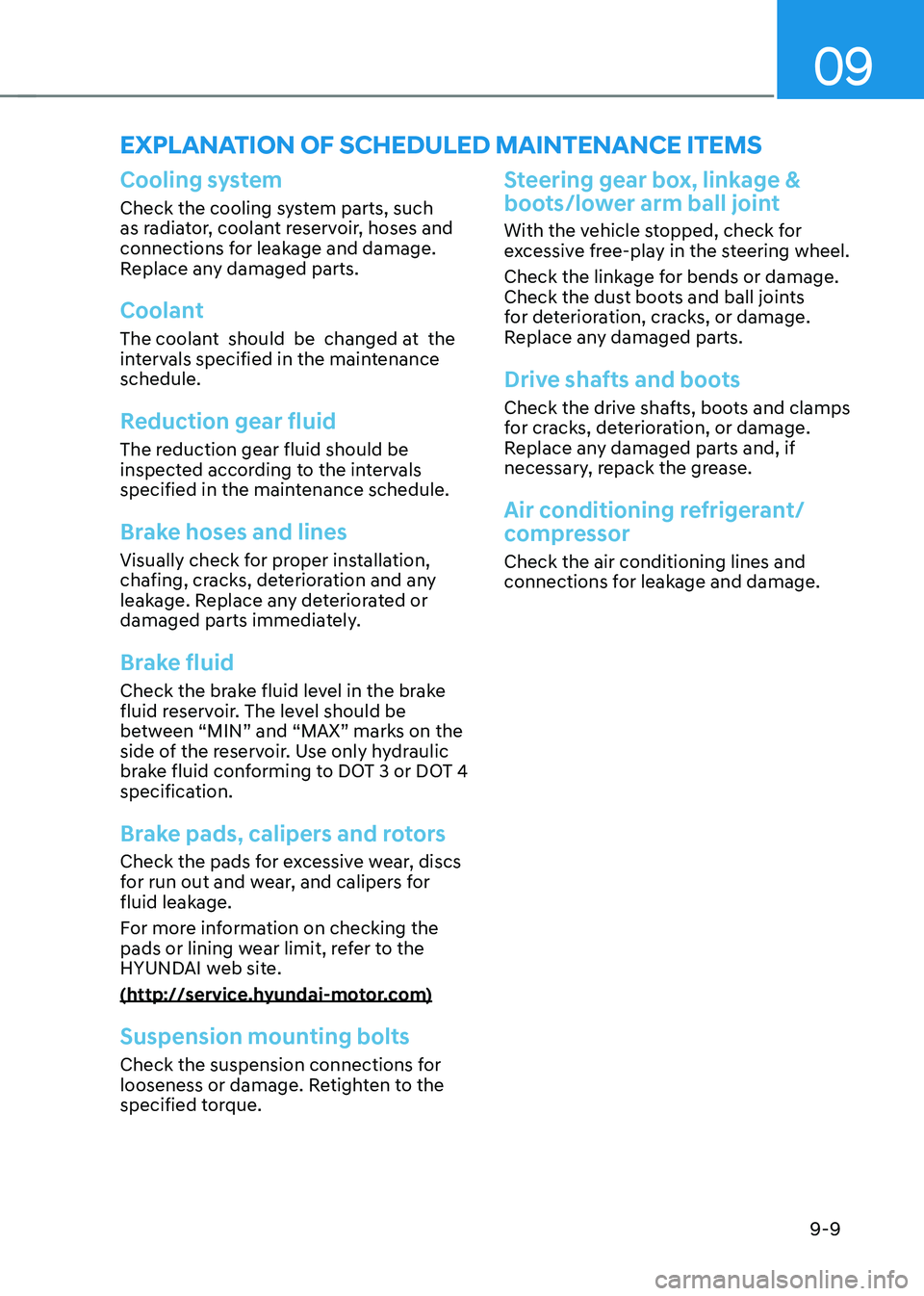
EXPLANATION OF SCHEDULED MAINTENANCE ITEMS
Cooling system
Check the cooling system parts, such
as radiator, coolant reservoir, hoses and
connections for leakage and damage.
Replace any damaged parts.
Coolant
The coolant should be changed at the
intervals specified in the maintenance schedule.
Reduction gear fluid
The reduction gear fluid should be
inspected according to the intervals
specified in the maintenance schedule.
Brake hoses and lines
Visually check for proper installation,
chafing, cracks, deterioration and any
leakage. Replace any deteriorated or
damaged parts immediately.
Brake fluid
Check the brake fluid level in the brake
fluid reservoir. The level should be
between “MIN” and “MAX” marks on the
side of the reservoir. Use only hydraulic
brake fluid conforming to DOT 3 or DOT 4
specification.
Brake pads, calipers and rotors
Check the pads for excessive wear, discs
for run out and wear, and calipers for
fluid leakage.
For more information on checking the
pads or lining wear limit, refer to the
HYUNDAI web site.
(http://service.hyundai-motor.com)
Suspension mounting bolts
Check the suspension connections for
looseness or damage. Retighten to the
specified torque.
Steering gear box, linkage &
boots/lower arm ball joint
With the vehicle stopped, check for
excessive free-play in the steering wheel.
Check the linkage for bends or damage.
Check the dust boots and ball joints
for deterioration, cracks, or damage.
Replace any damaged parts.
Drive shafts and boots
Check the drive shafts, boots and clamps
for cracks, deterioration, or damage.
Replace any damaged parts and, if
necessary, repack the grease.
Air conditioning refrigerant/
compressor
Check the air conditioning lines and
connections for leakage and damage.
Page 486 of 548
Maintenance
9-10
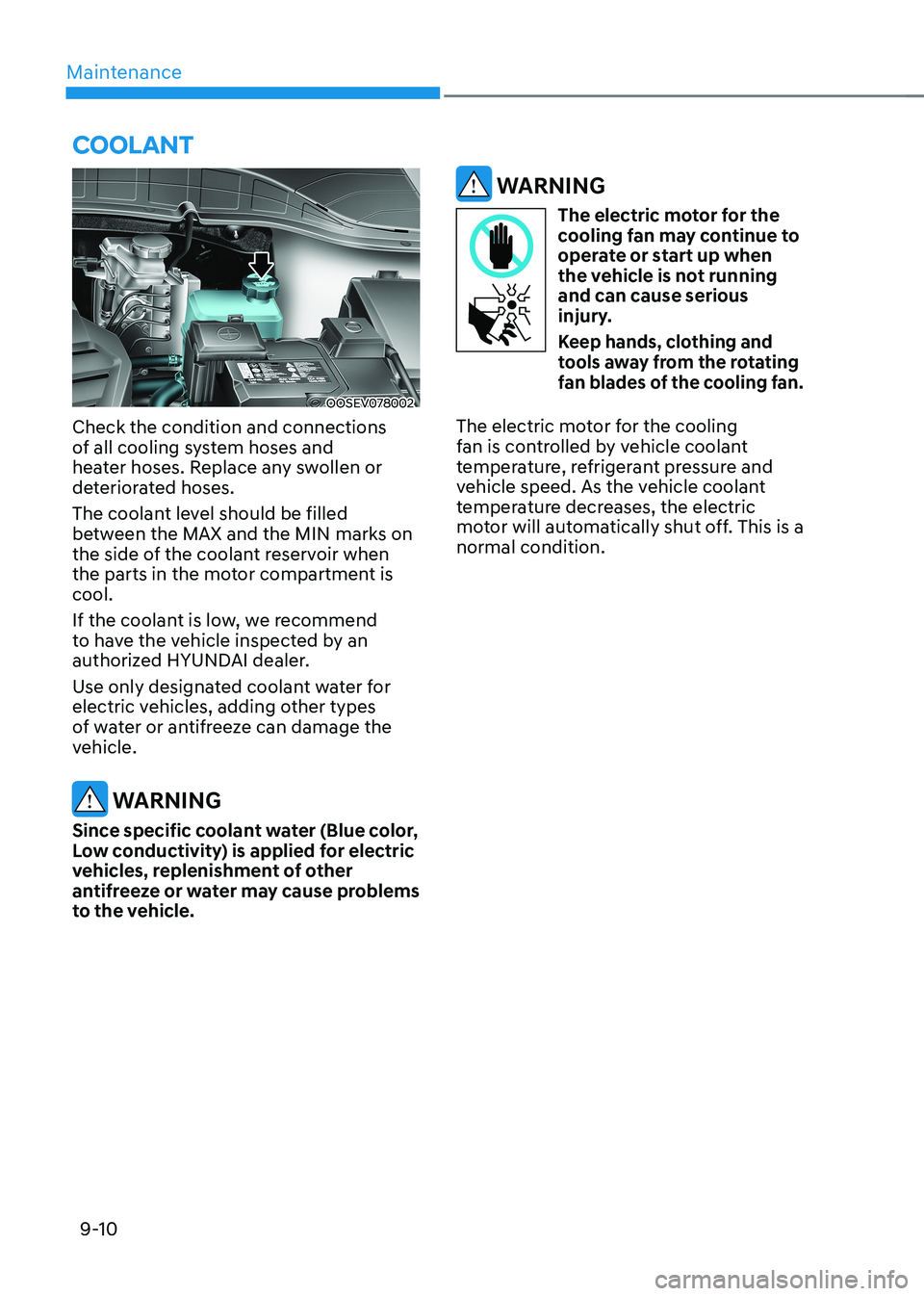
COOLANT
OOSEV078002
Check the condition and connections
of all cooling system hoses and
heater hoses. Replace any swollen or
deteriorated hoses.
The coolant level should be filled
between the MAX and the MIN marks on
the side of the coolant reservoir when
the parts in the motor compartment is cool.
If the coolant is low, we recommend
to have the vehicle inspected by an
authorized HYUNDAI dealer.
Use only designated coolant water for
electric vehicles, adding other types
of water or antifreeze can damage the
vehicle.
WARNING
Since specific coolant water (Blue color,
Low conductivity) is applied for electric
vehicles, replenishment of other
antifreeze or water may cause problems
to the vehicle.
WARNING
The electric motor for the
cooling fan may continue to
operate or start up when
the vehicle is not running and can cause serious
injury.
Keep hands, clothing and
tools away from the rotating
fan blades of the cooling fan.
The electric motor for the cooling
fan is controlled by vehicle coolant
temperature, refrigerant pressure and
vehicle speed. As the vehicle coolant
temperature decreases, the electric
motor will automatically shut off. This is a normal condition.
Page 488 of 548
Maintenance
9-12
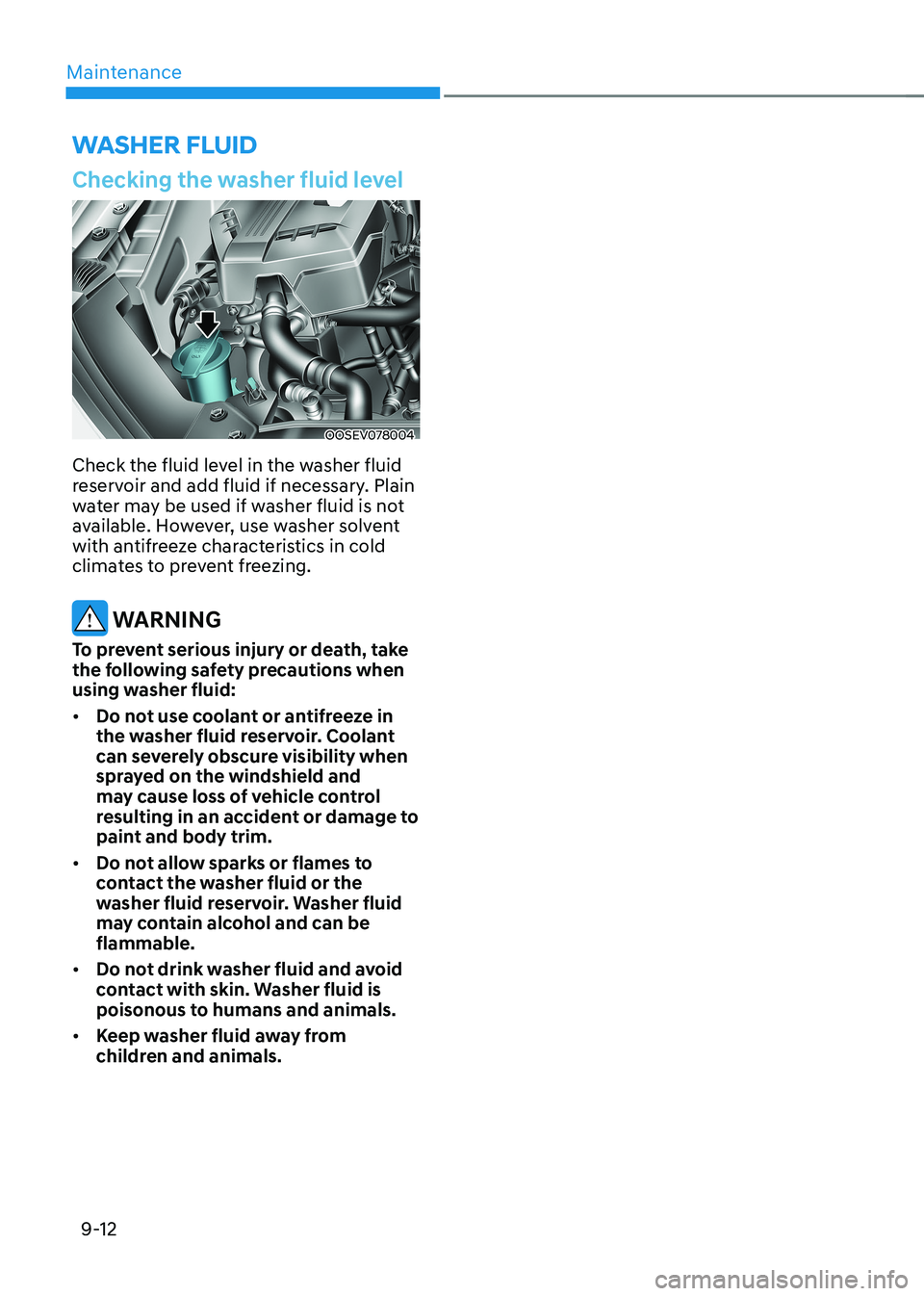
WASHER FLUID
Checking the washer fluid level
OOSEV078004
Check the fluid level in the washer fluid
reservoir and add fluid if necessary. plain
water may be used if washer fluid is not
available. However, use washer solvent
with antifreeze characteristics in cold
climates to prevent freezing.
WARNING
To prevent serious injury or death, take
the following safety precautions when
using washer fluid: • Do not use coolant or antifreeze in
the washer fluid reservoir. Coolant
can severely obscure visibility when
sprayed on the windshield and
may cause loss of vehicle control
resulting in an accident or damage to
paint and body trim.
• Do not allow sparks or flames to
contact the washer fluid or the
washer fluid reservoir. Washer fluid
may contain alcohol and can be flammable.
• Do not drink washer fluid and avoid
contact with skin. Washer fluid is
poisonous to humans and animals.
• Keep washer fluid away from
children and animals.
Page 504 of 548
Maintenance
9-28
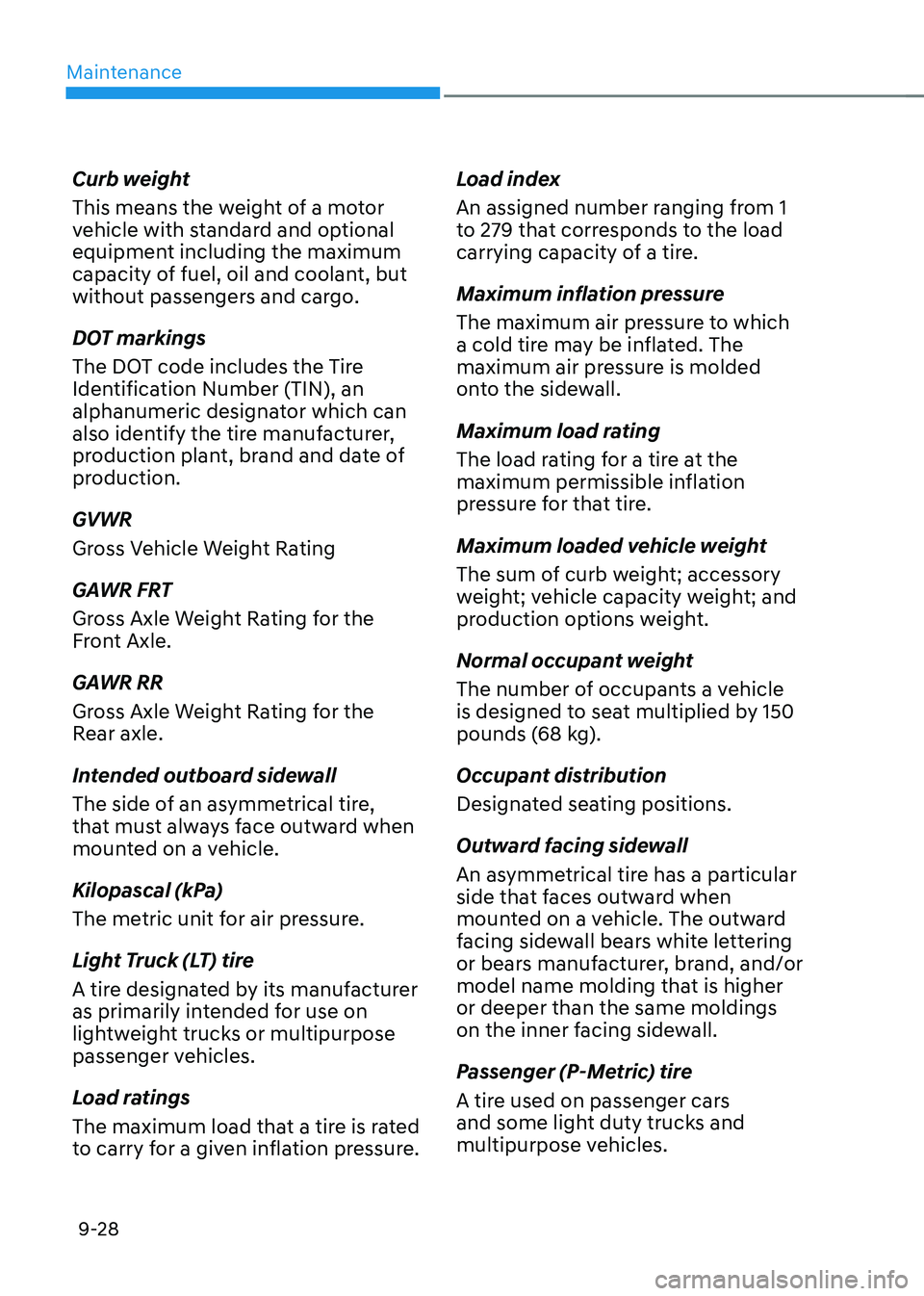
Curb weight
This means the weight of a motor
vehicle with standard and optional
equipment including the maximum
capacity of fuel, oil and coolant, but
without passengers and cargo.
DOT markings
The DOT code includes the Tire
Identification Number (TIN), an
alphanumeric designator which can
also identify the tire manufacturer,
production plant, brand and date of
production.
GVWR
Gross Vehicle Weight Rating
GAWR FRT
Gross Axle Weight Rating for the
Front Axle.
GAWR RR
Gross Axle Weight Rating for the
Rear axle.
Intended outboard sidewall
The side of an asymmetrical tire,
that must always face outward when
mounted on a vehicle.
Kilopascal (kPa)
The metric unit for air pressure.
Light Truck (LT) tire
A tire designated by its manufacturer
as primarily intended for use on
lightweight trucks or multipurpose
passenger vehicles.
Load ratings
The maximum load that a tire is rated
to carry for a given inflation pressure.
Load index
An assigned number ranging from 1
to 279 that corresponds to the load
carrying capacity of a tire.
Maximum inflation pressure
The maximum air pressure to which
a cold tire may be inflated. The
maximum air pressure is molded
onto the sidewall.
Maximum load rating
The load rating for a tire at the
maximum permissible inflation
pressure for that tire.
Maximum loaded vehicle weight
The sum of curb weight; accessory
weight; vehicle capacity weight; and
production options weight.
Normal occupant weight
The number of occupants a vehicle
is designed to seat multiplied by 150
pounds (68 kg).
Occupant distribution
Designated seating positions.
Outward facing sidewall
An asymmetrical tire has a particular
side that faces outward when
mounted on a vehicle. The outward
facing sidewall bears white lettering
or bears manufacturer, brand, and/or
model name molding that is higher or deeper than the same moldings
on the inner facing sidewall.
Passenger (P-Metric) tire
A tire used on passenger cars
and some light duty trucks and
multipurpose vehicles.
Page 538 of 548
I
I-3
Before driving ........................................................................................................ 6-3
Before entering the vehicle ............................................................................... 6-3
Before starting ................................................................................................... 6-3
Blind-Spot Collision-Avoidance Assist (BCA) ...................................................7-34
Blind-Spot Collision-Avoidance Assist malfunction and limitations............... 7-43
Blind-Spot Collision-Avoidance Assist operation ............................................7-38
Blind-Spot Collision-Avoidance Assist settings ..............................................7-36
Brake fluid .......................................................................................................... 9-11
Checking the brake fluid level ......................................................................... 9-11
Braking system .................................................................................................... 6-22
Anti-Lock Brake System (ABS) ...................................................................... 6-31
Auto Hold ......................................................................................................... 6-27
Disc brakes wear indicator ............................................................................... 6-22
Electronic Parking Brake (EPB) ...................................................................... 6-23
Electronic Stability Control (ESC) .................................................................. 6-32
Good braking practices .................................................................................... 6-37
Hill-Start Assist Control (FAC) ....................................................................... 6-36
Power brakes ................................................................................................... 6-22
Vehicle Stability Management (VSM) .............................................................6-35
Bulb wattage .......................................................................................................... 2-8
C Child Restraint System (CRS) ............................................................................. 3-31
Children always in the rear ............................................................................... 3-31
Installing a Child Restraint system (CRS) .......................................................3-34
Selecting a Child Restraint System (CRS) .......................................................3-32
Climate control additional features ...................................................................... 5-80
Automatic ventilation ....................................................................................... 5-80
Cluster ionizer .................................................................................................. 5-80
Climate control air filter ...................................................................................... 9-13
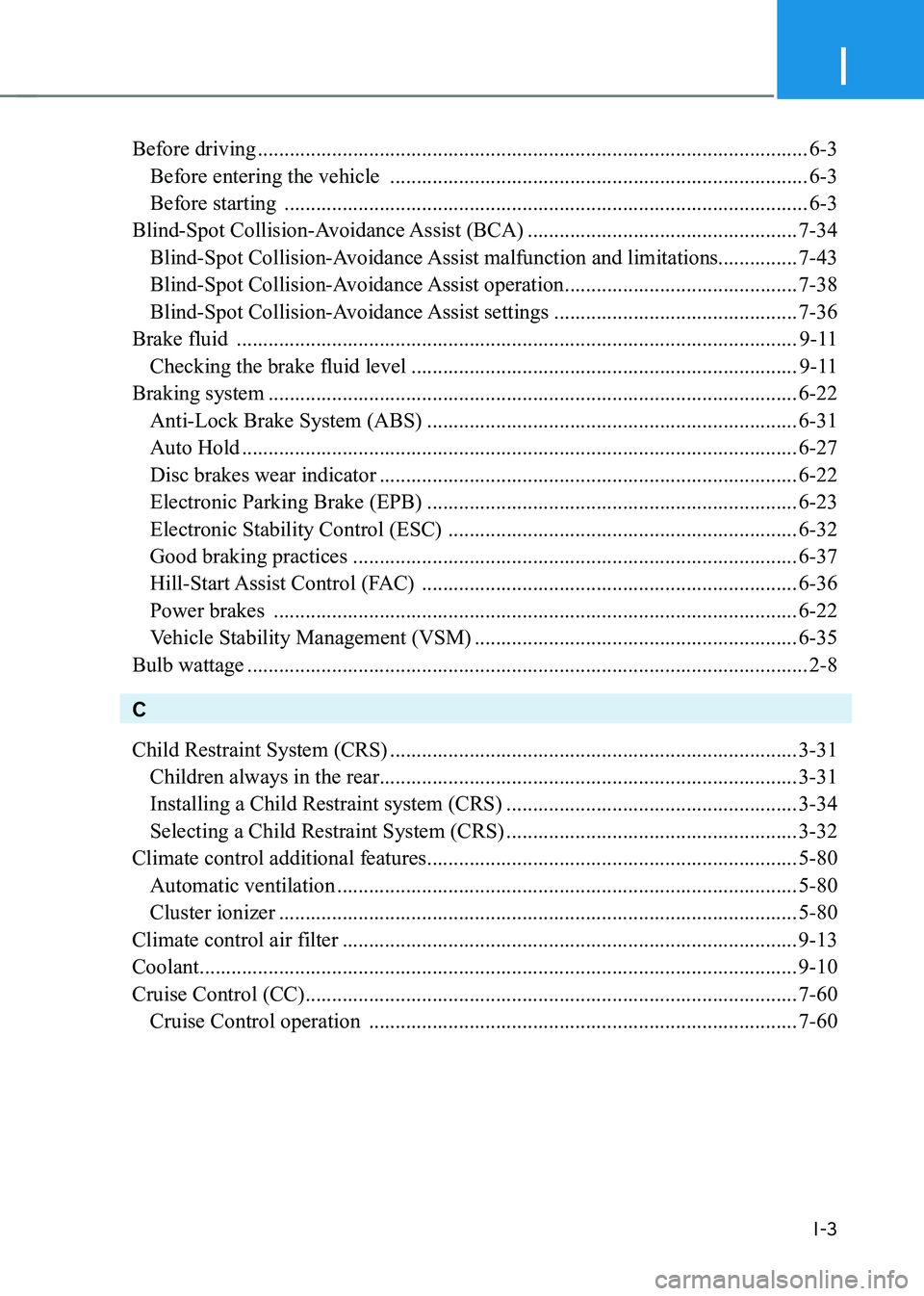
Coolant ................................................................................................................. 9-10
Cruise Control (CC) ............................................................................................. 7-60
Cruise Control operation ................................................................................. 7-60
Page 539 of 548
Index
I-4
D
Declaration of conformity......................................................................... 2-13/7-120
Front radar ...................................................................................................... 7-120
Rear corner radar ............................................................................................ 7-122
Dimensions ............................................................................................................ 2-7
Drive mode integrated control system ................................................................. 6-38
Initial setting for each drive mode .................................................................... 6-39
Driver Attention Warning (DAW) ....................................................................... 7-54
Driver Attention Warning malfunction and limitations ....................................7-57
Driver Attention Warning operation ................................................................. 7-55
Driver Attention Warning settings ................................................................... 7-54
E Electric vehicle specifications ............................................................................... 2-7
Explanation of scheduled maintenance items ........................................................9-9
Air conditioning refrigerant/compressor ............................................................9-9
Brake fluid ......................................................................................................... 9-9
Brake hoses and lines ......................................................................................... 9-9
Brake pads, calipers and rotors .......................................................................... 9-9
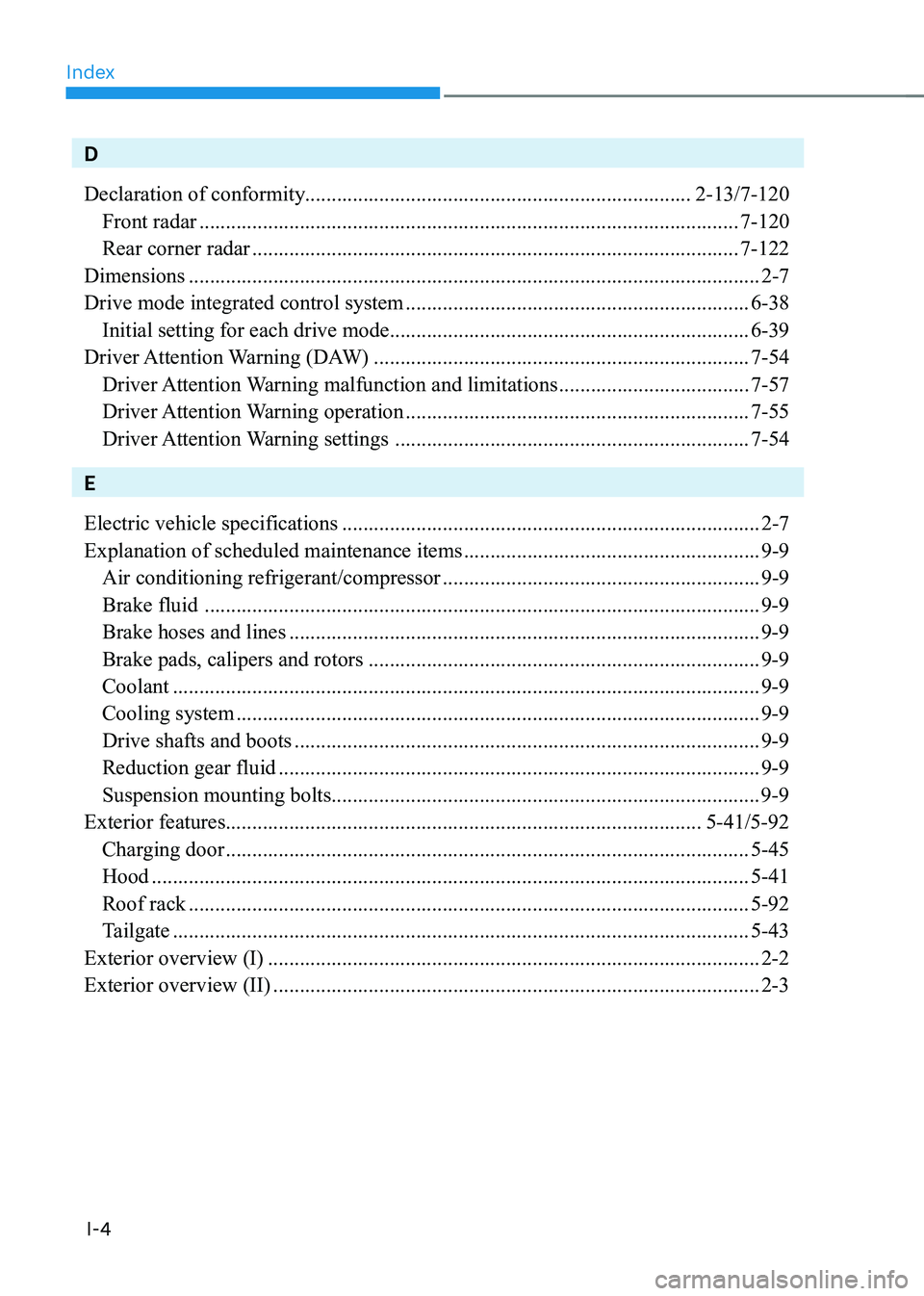
Coolant ............................................................................................................... 9-9
Cooling system ................................................................................................... 9-9
Drive shafts and boots ........................................................................................ 9-9
Reduction gear fluid ........................................................................................... 9-9
Suspension mounting bolts................................................................................. 9-9
Exterior features.......................................................................................... 5-41/5-92
Charging door ................................................................................................... 5-45
Hood ................................................................................................................. 5-41
Roof rack .......................................................................................................... 5-92
Tailgate ............................................................................................................. 5-43
Exterior overview (I) ............................................................................................. 2-2
Exterior overview (II) ............................................................................................ 2-3