service indicator HYUNDAI KONA EV 2022 User Guide
[x] Cancel search | Manufacturer: HYUNDAI, Model Year: 2022, Model line: KONA EV, Model: HYUNDAI KONA EV 2022Pages: 548, PDF Size: 49.14 MB
Page 470 of 548
08
8-15
OIGH067043
OOSEV060007L
10. After driving approximately 7~10 km (4~6 miles or about 10 min), stop at a
safety location.
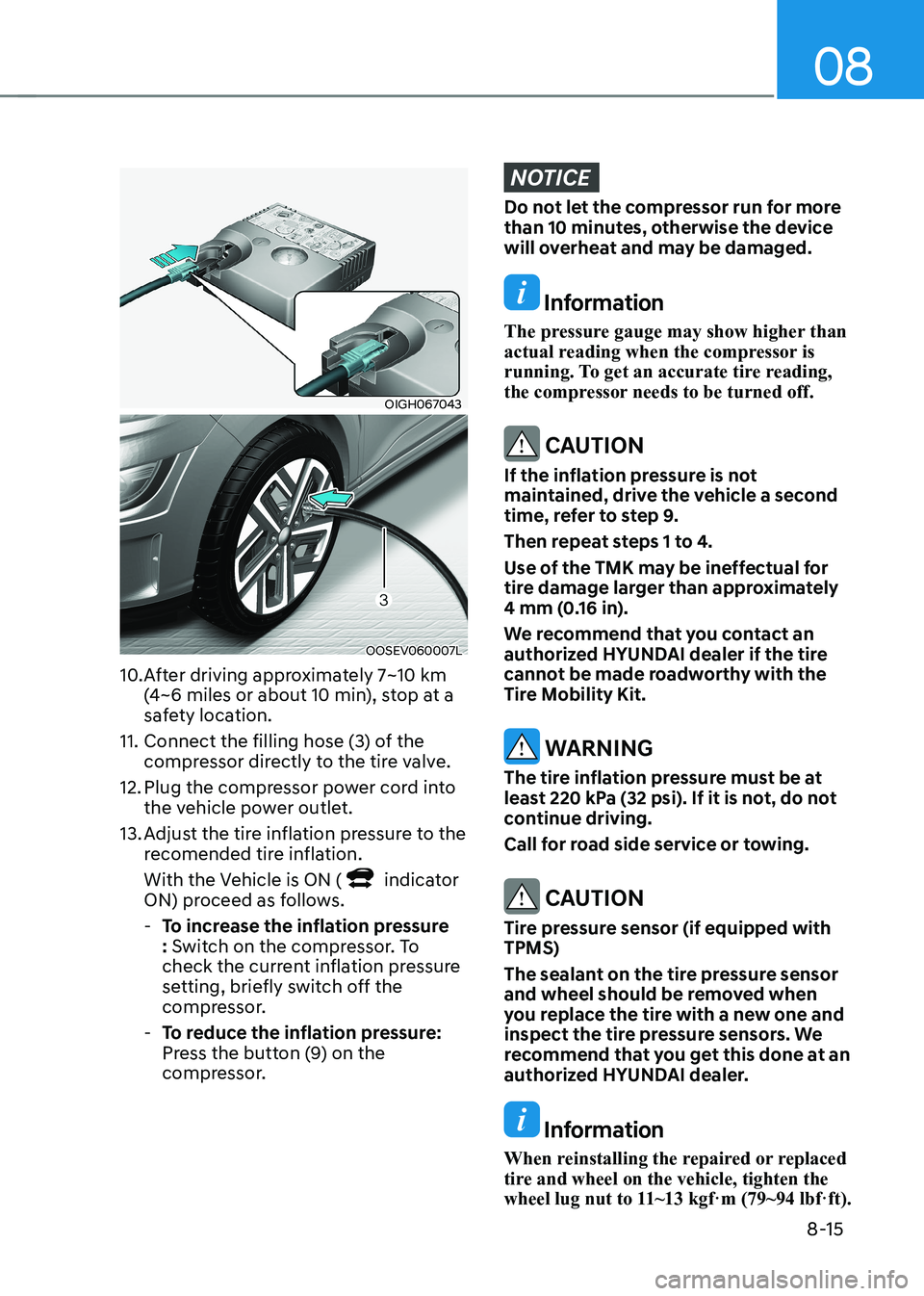
11. Connect the filling hose (3) of the compressor directly to the tire valve.
12. Plug the compressor power cord into the vehicle power outlet.
13. Adjust the tire inflation pressure to the recomended tire inflation.
With the Vehicle is ON (
indicator
ON) proceed as follows.
- To increase the inflation pressure : Switch on the compressor. To
check the current inflation pressure
setting, briefly switch off the
compressor.
- To reduce the inflation pressure:
Press the button (9) on the
compressor.
NOTICE
Do not let the compressor run for more
than 10 minutes, otherwise the device
will overheat and may be damaged.
Information
The pressure gauge may show higher than
actual reading when the compressor is
running. To get an accurate tire reading,
the compressor needs to be turned off.
CAUTION
If the inflation pressure is not
maintained, drive the vehicle a second
time, refer to step 9.
Then repeat steps 1 to 4.
Use of the TMK may be ineffectual for
tire damage larger than approximately
4 mm (0.16 in).
We recommend that you contact an
authorized HYUNDAI dealer if the tire
cannot be made roadworthy with the
Tire Mobility Kit.
WARNING
The tire inflation pressure must be at
least 220 kPa (32 psi). If it is not, do not
continue driving.
Call for road side service or towing.
CAUTION
Tire pressure sensor (if equipped with TPMS)
The sealant on the tire pressure sensor
and wheel should be removed when
you replace the tire with a new one and
inspect the tire pressure sensors. We
recommend that you get this done at an
authorized HYUNDAI dealer.
Information
When reinstalling the repaired or replaced
tire and wheel on the vehicle, tighten the
wheel lug nut to 11~13 kgf·m (79~94 lbf·ft).
Page 471 of 548
Emergency situations
8-16
How to adjust tire pressure
OIGH067043
OOSEV060007L
1. Park your vehicle in a safe location.
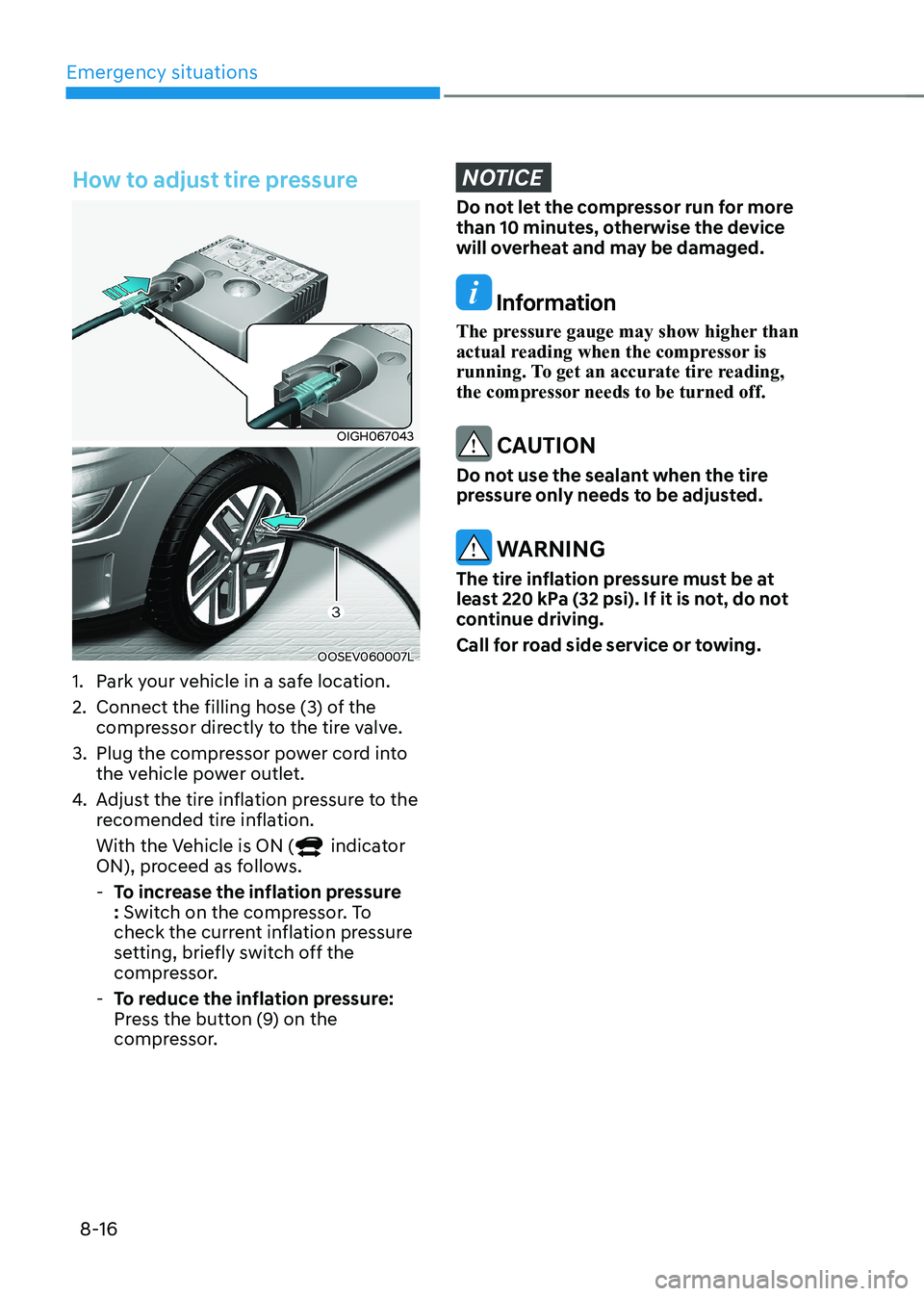
2. Connect the filling hose (3) of the compressor directly to the tire valve.
3. Plug the compressor power cord into the vehicle power outlet.
4. Adjust the tire inflation pressure to the
recomended tire inflation.
With the Vehicle is ON (
indicator
ON), proceed as follows.
- To increase the inflation pressure : Switch on the compressor. To
check the current inflation pressure
setting, briefly switch off the
compressor.
- To reduce the inflation pressure:
Press the button (9) on the
compressor.
NOTICE
Do not let the compressor run for more
than 10 minutes, otherwise the device
will overheat and may be damaged.
Information
The pressure gauge may show higher than
actual reading when the compressor is
running. To get an accurate tire reading,
the compressor needs to be turned off.
CAUTION
Do not use the sealant when the tire
pressure only needs to be adjusted.
WARNING
The tire inflation pressure must be at
least 220 kPa (32 psi). If it is not, do not
continue driving.
Call for road side service or towing.
Page 499 of 548
![HYUNDAI KONA EV 2022 User Guide 09
9-23
Tire replacement
OLMB073027
A
[A] : Tread wear indicator If the tire is worn evenly, a tread wear
indicator will appear as a solid band
across the tread. This shows there is less
than 1.6](/img/35/56171/w960_56171-498.png "HYUNDAI KONA EV 2022 User Guide 09
9-23
Tire replacement
OLMB073027
A
[A] : Tread wear indicator If the tire is worn evenly, a tread wear
indicator will appear as a solid band
across the tread. This shows there is less
than 1.6")
09
9-23
Tire replacement
OLMB073027
A
[A] : Tread wear indicator If the tire is worn evenly, a tread wear
indicator will appear as a solid band
across the tread. This shows there is less
than 1.6 mm (1/16 in.) of tread left on the
tire. Replace the tire when this happens.
Do not wait for the band to appear across
the entire tread before replacing the tire.
WARNING
To reduce the risk of DEATH or SERIOUS
INJURY: • Replace tires that are worn, show
uneven wear, or are damaged.
Worn tires can cause loss of braking
effectiveness, steering control, and
traction.
• Always replace tires with the same
size as each tire that was originally
supplied with this vehicle. Using
tires and wheels other than the
recommended sizes could cause
unusual handling characteristics,
poor vehicle control, or negatively
affect your vehicle’s Anti-Lock Brake
System (ABS) resulting in a serious
accident. •
When replacing tires (or wheels), it
is recommended to replace the two
front or two rear tires (or wheels)
as a pair. Replacing just one tire
can seriously affect your vehicle’s
handling. If only replacing one pair of
tires, it is recommended to install the
pair of new tires on the rear axle.
• Tires degrade over time, even when
they are not being used. Regardless
of the remaining tread, HYUNDAI
recommends that tires be replaced
after six (6) years of normal service.
• Heat caused by hot climates or
frequent high loading conditions can
accelerate the aging process. Failure
to follow this warning may cause
sudden tire failure, which could lead
to a loss of vehicle control resulting
in an accident.
Page 547 of 548
Index
I-12
Tire Pressure Monitoring System (TPMS) ............................................................8-6
Changing a tire with TPMS ................................................................................ 8-9
Check tire pressure ............................................................................................. 8-6
Low tire pressure position telltale and tire pressure telltale ...............................8-8
Low tire pressure telltale .................................................................................... 8-8
Tire pressure monitoring system ........................................................................ 8-7
TPMS (Tire Pressure Monitoring System) malfunction indicator .....................8-9
Tire specification and pressure label ................................................................... 2-13
Tires and wheels .................................................................................................... 2-9
Towing ................................................................................................................. 8-18
Emergency towing ............................................................................................ 8-20
Removable towing hook .................................................................................. 8-19
Towing service ................................................................................................. 8-18
Trailer towing ...................................................................................................... 6-53
Trip computer ...................................................................................................... 4-39
V
Vehicle certification label .................................................................................... 2-12
Vehicle identification number (VIN) ................................................................... 2-12
Vehicle load limit ................................................................................................. 6-48
Overloading ...................................................................................................... 6-48
The loading information label .......................................................................... 6-49
Volume and weight .............................................................................................. 2-10