warning light HYUNDAI KONA EV 2022 User Guide
[x] Cancel search | Manufacturer: HYUNDAI, Model Year: 2022, Model line: KONA EV, Model: HYUNDAI KONA EV 2022Pages: 548, PDF Size: 49.14 MB
Page 58 of 548
01
1-53
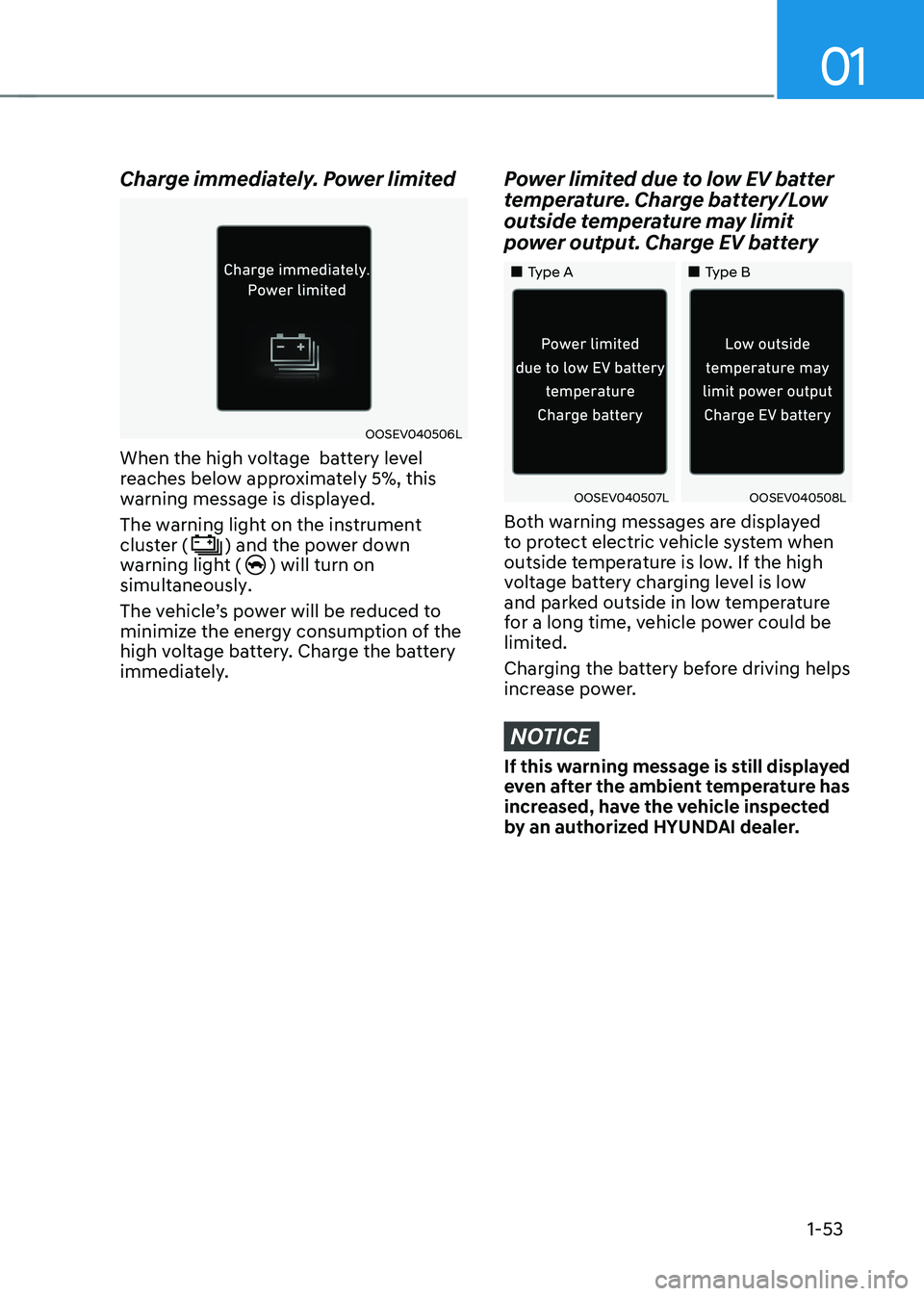
Charge immediately. Power limited
OOSEV040506L
When the high voltage battery level
reaches below approximately 5%, this
warning message is displayed. The warning light on the instrument cluster (
) and the power down
warning light () will turn on
simultaneously.
The vehicle’s power will be reduced to
minimize the energy consumption of the
high voltage battery. Charge the battery
immediately.
Power limited due to low EV batter
temperature. Charge battery/Low
outside temperature may limit
power output. Charge EV battery
„„Type A „„Type B
OOSEV040507LOOSEV040508L
Both warning messages are displayed
to protect electric vehicle system when
outside temperature is low. If the high
voltage battery charging level is low
and parked outside in low temperature
for a long time, vehicle power could be
limited.
Charging the battery before driving helps
increase power.
NOTICE
If this warning message is still displayed
even after the ambient temperature has
increased, have the vehicle inspected
by an authorized HYUNDAI dealer.
Page 59 of 548
Foreword / Electric Vehicle System Overview
1-54
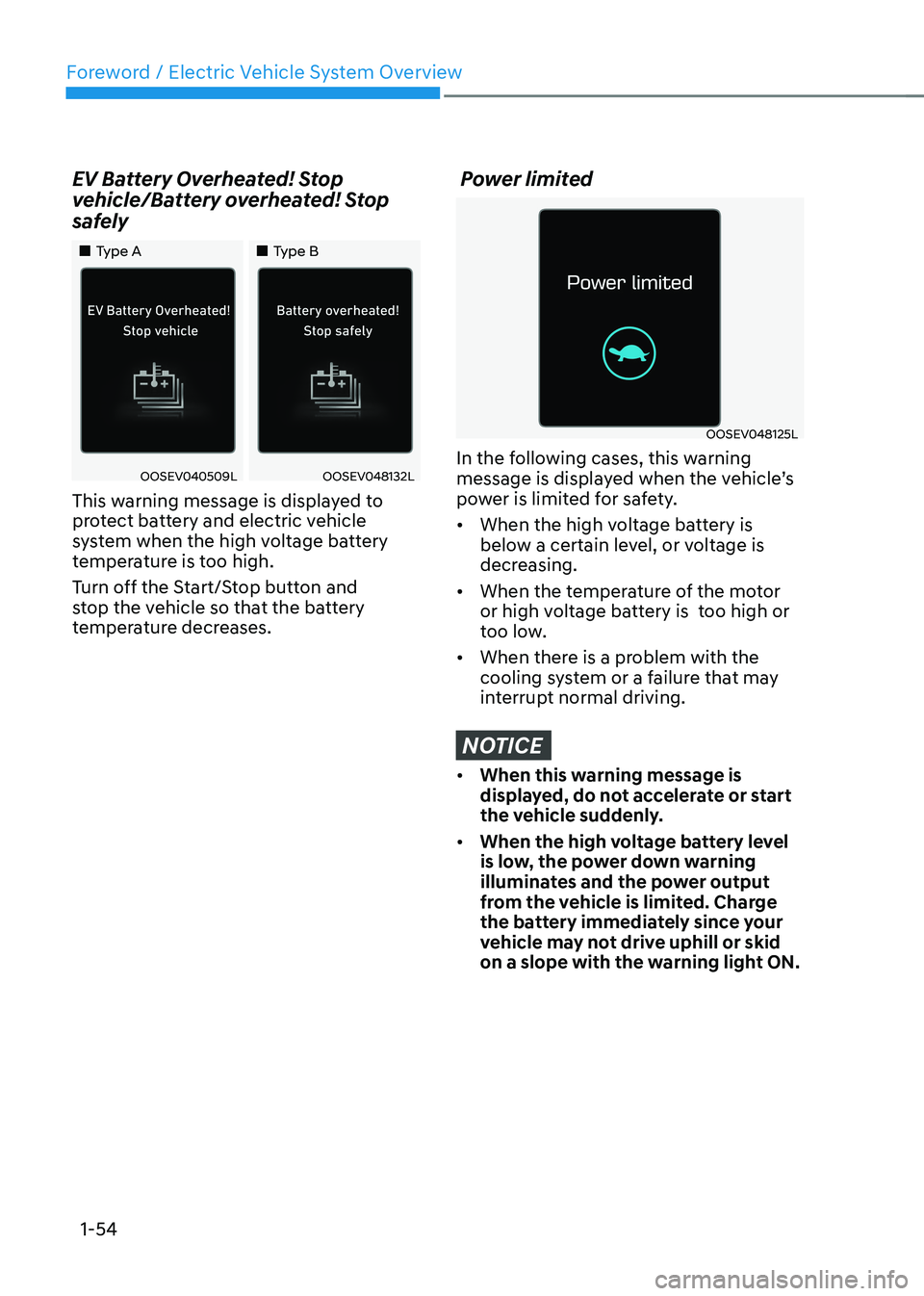
EV Battery Overheated! Stop
vehicle/Battery overheated! Stop
safely
„„Type A
„„Type B
OOSEV040509LOOSEV048132L
This warning message is displayed to
protect battery and electric vehicle
system when the high voltage battery
temperature is too high.
Turn off the Start/Stop button and
stop the vehicle so that the battery
temperature decreases.
Power limited
OOSEV048125L
In the following cases, this warning
message is displayed when the vehicle’s
power is limited for safety. • When the high voltage battery is
below a certain level, or voltage is
decreasing.
• When the temperature of the motor
or high voltage battery is too high or
too low.
• When there is a problem with the
cooling system or a failure that may
interrupt normal driving.
NOTICE
• When this warning message is
displayed, do not accelerate or start
the vehicle suddenly.
• When the high voltage battery level
is low, the power down warning
illuminates and the power output
from the vehicle is limited. Charge
the battery immediately since your
vehicle may not drive uphill or skid
on a slope with the warning light ON.
Page 70 of 548
2-5
02
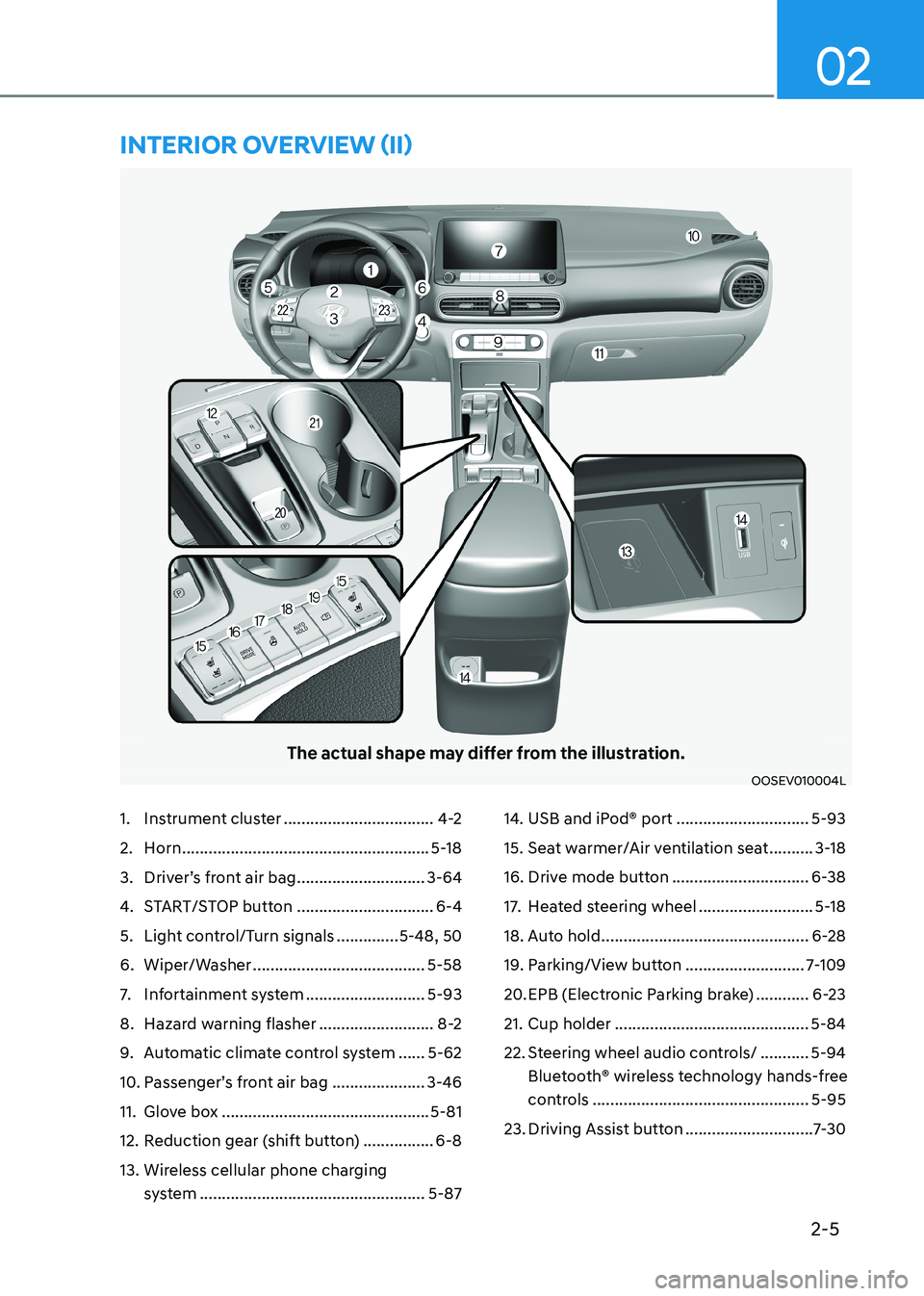
The actual shape may differ from the illustration.
OOSEV010004L
1. Instrument cluster ..................................4-2
2. Horn ........................................................ 5-18
3. Driver’s front air bag .............................3-64
4. START/STOP button ...............................6-4
5. Light control/Turn signals ..............5-48, 50
6. Wiper/Washer ....................................... 5-58
7. Infortainment system ...........................5-93
8. Hazard warning flasher ..........................8-2
9. Automatic climate control system ......5-62
10. Passenger’s front air bag ..................... 3-46
11. Glove box ............................................... 5-81
12. Reduction gear (shift button) ................6-8
13. Wireless cellular phone charging system ................................................... 5-8714. USB and iPod® port
..............................5-93
15. Seat warmer/Air ventilation seat ..........3-18
16. Drive mode button ...............................6-38
17. Heated steering wheel ..........................5-18
18. Auto hold ............................................... 6-28
19. Parking/View button ...........................7-109
20. EPB (Electronic Parking brake) ............6-23
21. Cup holder ............................................ 5-84
22. Steering wheel audio controls/ ...........5-94
Bluetooth® wireless technology hands-free
controls ................................................. 5-95
23. Driving Assist button .............................7-30
intErior ovErviEw (ii)
Page 80 of 548
3
3. Safety system
Important safety precautions ........................................................................... 3-2
Always wear your seat belt .......................................................................................... 3-2
Restrain all children ...................................................................................................... 3-2
Air bag hazards ............................................................................................................. 3-2
Driver distraction .......................................................................................................... 3-2
Control your speed ....................................................................................................... 3-2
Keep your vehicle in safe condition ............................................................................ 3-2
Seats .................................................................................................................. 3-3
Safety precautions ....................................................................................................... 3-4
Front seats .................................................................................................................... 3-5
Rear seats ................................................................................................................... 3-10
Headrest.......................................................................................................................3-13
Seat warmers and air ventilation seats ...................................................................... 3-17
Seat belts ......................................................................................................... 3-20
Seat belt safety precautions ...................................................................................... 3-20
Seat belt warning light ................................................................................................ 3-21
Seat belt restraint system .......................................................................................... 3-22
Additional seat belt safety precautions .................................................................... 3-28
Care of seat belts........................................................................................................3-30
Child Restraint System (CRS) .......................................................................... 3-31
Children always in the rear ......................................................................................... 3-31
Selecting a Child Restraint System (CRS) .................................................................3-32
Installing a Child Restraint system (CRS)..................................................................3-34
Air bag - supplemental restraint system .......................................................3-42
Where are the air bags? ............................................................................................ 3-44
How does the air bags system operate? ................................................................... 3-47
What to expect after an air bag inflates ................................................................... 3-51
Occupant Classification System (OCS) ..................................................................... 3-51
Why didn’t my air bag go off in a collision? ..............................................................3-57
Why didn’t my air bag go off in a collision? ..............................................................3-58
SRS care ...................................................................................................................... 3-63
Additional safety precautions................................................................................... 3-64
Air bag warning labels............................................................................................... 3-64
This chapter provides you with important information about how to protect yourself and your
passengers. It explains how to properly use your seats and seat belts, and how your air bags work.
Additionally, this chapter explains how to properly restrain infants and children in your vehicle.
Page 84 of 548
03
3-5
Seat belts
Always fasten your seat belt before
starting any trip. At all times, passengers
should sit upright and be properly
restrained. Infants and small children
must be restrained in appropriate Child
Restraint Systems. Children who have
outgrown a booster seat and adults must
be restrained using the seat belts.
WARNING
Take the following precautions when
adjusting your seat belt: • NEVER use one seat belt for more
than one occupant.
• Always position the seatback upright
with the lap portion of the seat belt
snug and low across the hips.
• NEVER allow children or small infants
to ride on a passenger’s lap.
• Do not route the seat belt across your
neck, across sharp edges, or reroute
the shoulder strap away from your
body.
• Do not allow the seat belt to become
caught or jammed.
Front seats
The front seat can be adjusted by using
the control lever (or knob) or switches
located on the outside of the seat
cushion. Before driving, adjust the seat
to the proper position so that you can
easily control the steering wheel, foot
pedals and controls on the instrument panel.
WARNING
Take the following precautions when
adjusting your seat: • NEVER attempt to adjust the seat
while the vehicle is moving. The seat
could respond with unexpected
movement and may cause loss
of vehicle control resulting in an
accident.
• Do not place anything under the
front seats. Loose objects in the
driver’s foot area could interfere
with the operation of the foot pedals,
causing an accident.
• Do not allow anything to interfere
with the normal position and proper
locking of the seatback.
• Do not place a cigarette lighter on
the floor or seat. When you operate
the seat, gas may exit out of the
lighter causing a fire.
• Use extreme caution when picking
up small objects trapped under the
seats or between the seat and the
center console. Your hands might be
cut or injured by the sharp edges of
the seat mechanism.
• If there are occupants in the rear
seats, be careful while adjusting the
front seat position.
• Make sure that the seat is locked in
place after the adjustment. If not,
the seat might move unexpectedly
resulting in an accident.
Page 100 of 548
03
3-21
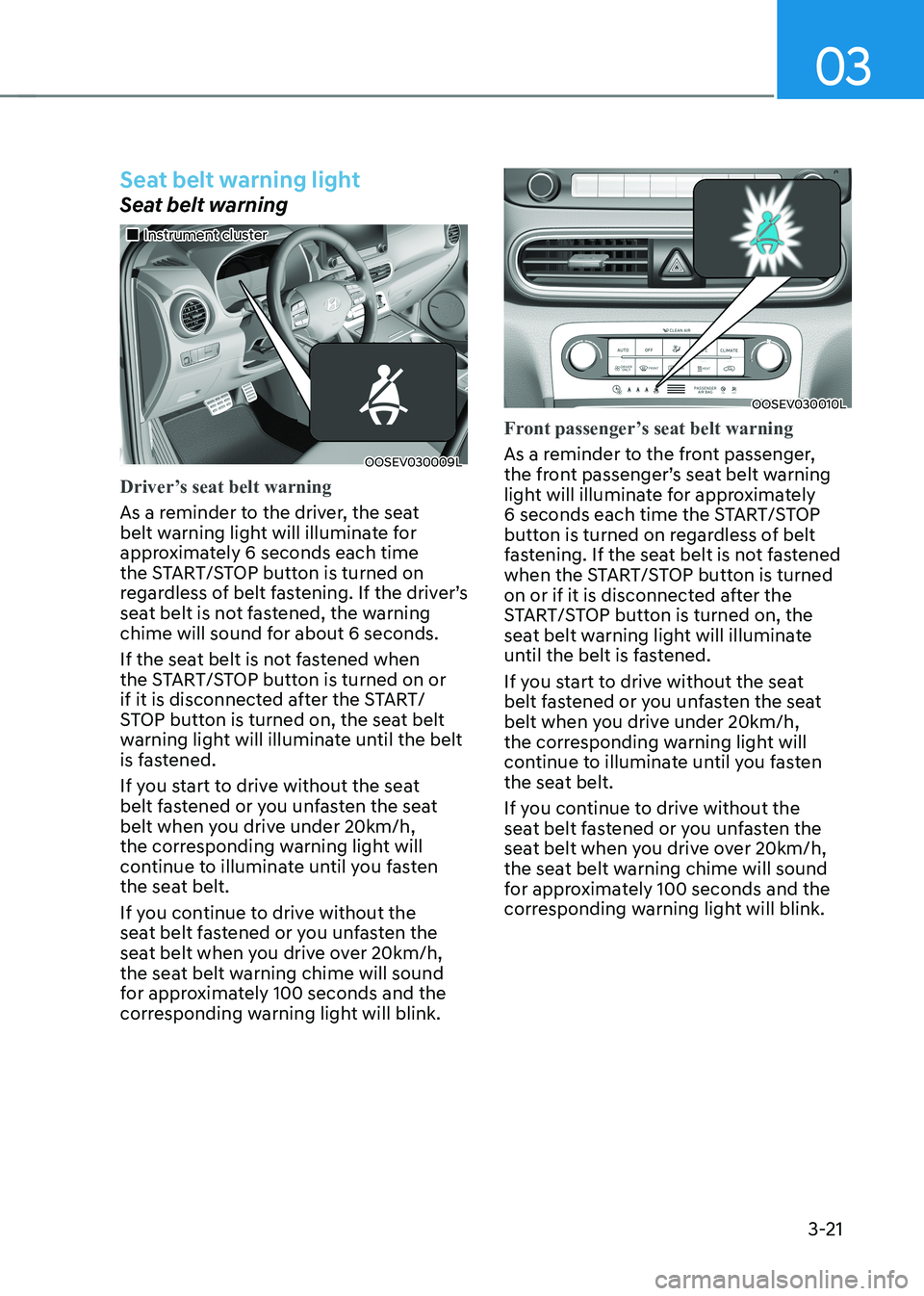
Seat belt warning light
Seat belt warning
„„Instrument cluster
OOSEV030009L
Driver’s seat belt warning
As a reminder to the driver, the seat
belt warning light will illuminate for
approximately 6 seconds each time
the START/STOP button is turned on
regardless of belt fastening. If the driver’s
seat belt is not fastened, the warning
chime will sound for about 6 seconds.
If the seat belt is not fastened when
the START/STOP button is turned on or
if it is disconnected after the START/
STOP button is turned on, the seat belt
warning light will illuminate until the belt
is fastened.
If you start to drive without the seat
belt fastened or you unfasten the seat
belt when you drive under 20km/h,
the corresponding warning light will
continue to illuminate until you fasten
the seat belt.
If you continue to drive without the
seat belt fastened or you unfasten the
seat belt when you drive over 20km/h,
the seat belt warning chime will sound
for approximately 100 seconds and the
corresponding warning light will blink.
OOSEV030010L
Front passenger’s seat belt warning
As a reminder to the front passenger,
the front passenger’s seat belt warning
light will illuminate for approximately
6 seconds each time the START/STOP
button is turned on regardless of belt
fastening. If the seat belt is not fastened
when the START/STOP button is turned
on or if it is disconnected after the
START/STOP button is turned on, the
seat belt warning light will illuminate
until the belt is fastened.
If you start to drive without the seat
belt fastened or you unfasten the seat
belt when you drive under 20km/h,
the corresponding warning light will
continue to illuminate until you fasten
the seat belt.
If you continue to drive without the
seat belt fastened or you unfasten the
seat belt when you drive over 20km/h,
the seat belt warning chime will sound
for approximately 100 seconds and the
corresponding warning light will blink.
Page 101 of 548
Safety system
3-22
WARNING
Riding in an improper position
adversely affects the front passenger’s
seat belt warning system. It is important
for the driver to instruct the passenger
to properly be seated as instructed in this manual.
Information
• You can find the front passenger’s seat
belt warning light on the center fascia panel.
• Although the front passenger seat is not occupied, the seat belt warning light
will blink or illuminate for 6 seconds.
• The front passenger’s seat belt warning may operate when luggage is placed on
the front passenger seat.
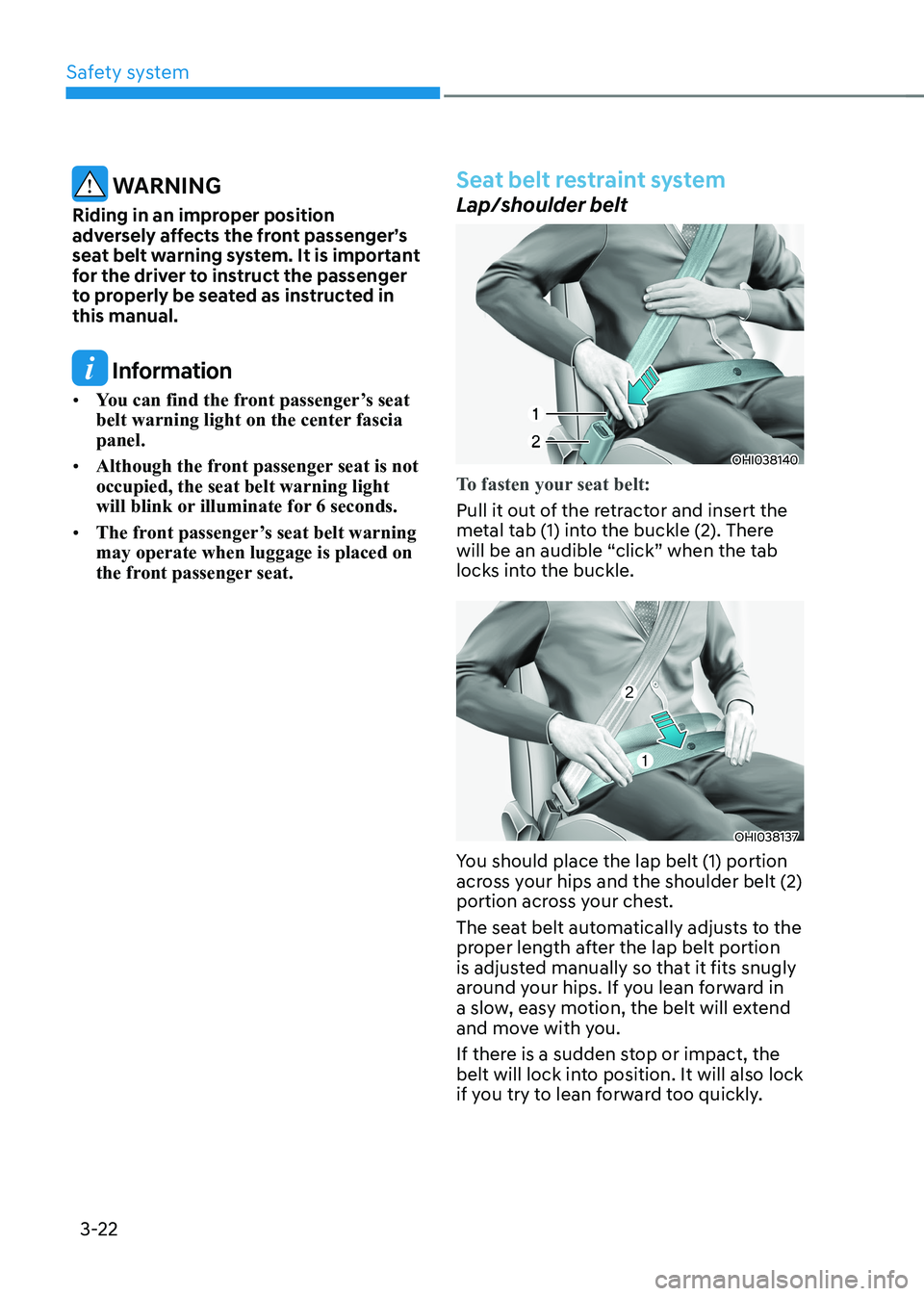
Seat belt restraint system
Lap/shoulder belt
OHI038140
To fasten your seat belt:
Pull it out of the retractor and insert the
metal tab (1) into the buckle (2). There
will be an audible “click” when the tab
locks into the buckle.
OHI038137
You should place the lap belt (1) portion
across your hips and the shoulder belt (2)
portion across your chest.
The seat belt automatically adjusts to the
proper length after the lap belt portion
is adjusted manually so that it fits snugly
around your hips. If you lean forward in
a slow, easy motion, the belt will extend
and move with you.
If there is a sudden stop or impact, the
belt will lock into position. It will also lock
if you try to lean forward too quickly.
Page 105 of 548
Safety system
3-26
WARNING
• Always wear your seat belt and sit
properly in your seat.
• Do not use the seat belt if it is loose
or twisted. A loose or twisted seat
belt will not protect you properly in
an accident.
• Do not place anything near the
buckle. This may adversely affect
the buckle and cause it to function
improperly.
• Always replace your pre-tensioners
after activation or an accident.
• Never inspect,service,repair or
replace the pre-tensioners yourself.
We recommend you to contact an
authorized HYUNDAI dealer.
• Do not hit the seat belt assemblies.
WARNING
Do not touch the pre-tensioner seat
belt assemblies for several minutes
after they have been activated. When
the pre-tensioner seat belt mechanism
deploys during a collision, the pre-
tensioner can become hot and can burn
you.
CAUTION
Body work on the front area of the
vehicle may damage the pre-tensioner
seat belt system. Therefore, we
recommend the system to be serviced
by an authorized HYUNDAI dealer.
OLMB033040
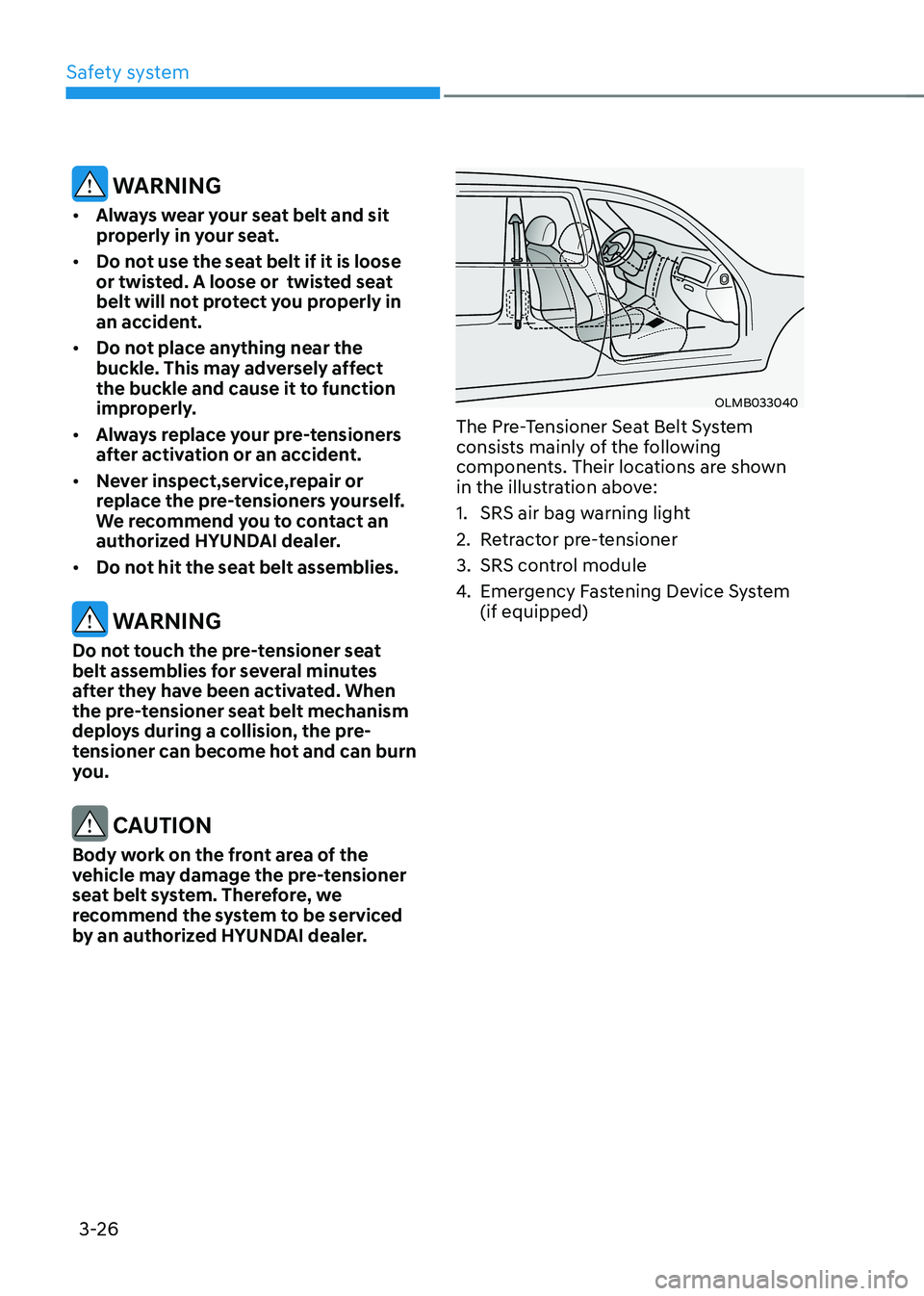
The Pre-Tensioner Seat Belt System
consists mainly of the following
components. Their locations are shown
in the illustration above:
1. SRS air bag warning light
2. Retractor pre-tensioner
3. SRS control module
4. Emergency Fastening Device System (if equipped)
Page 106 of 548
03
3-27
NOTICE
The sensor that activates the SRS
control module is connected with the
pre–tensioner seat belts. The SRS air
bag warning light on the instrument
cluster will illuminate for approximately
6 seconds after the START/STOP button
is placed in the ON position, and then it
should turn off.
If the pre-tensioner is not working
properly, the warning light will
illuminate even if the SRS air bag is not
malfunctioning. If the warning light
does not illuminate, stays illuminated
or illuminates when the vehicle is
being driven, we recommend the pre-
tensioner seat belts and/or SRS control
module be inspected by an authorized
HYUNDAI dealer as soon as possible. Information
• Both the driver’s and front passenger’s
pre-tensioner seat belts may be
activated in certain frontal or side collisions.
• The pre-tensioners will be activated
even if the seat belts are not worn at the time of the collision.
• When the pre-tensioner seat belts are activated, a loud noise may be heard
and fine dust, which may appear to be
smoke, may be visible in the passenger
compartment. These are normal
operating conditions and are not hazardous.
• Although it is non-toxic, the fine dust may cause skin irritation and should
not be inhaled for prolonged periods.
Wash all exposed skin areas thoroughly
after an accident in which the pre-
tensioner seat belts were activated.
WARNING
• Fasten your seat belt while sitting
properly in an upright position to
maximize the effectiveness of the
pre-tensioner seat belt system.
• A pre-tensioner seat belt system
is designed to activate only once.
Replace the pre-tensioner seat belt
system, if it was activated in an
accident.
Page 108 of 548
03
3-29
Larger children
Children under age 13 and who are
too large for a booster seat should
always occupy the rear seat and use the
available lap/shoulder belts. A seat belt
should lie across the upper thighs and
be snug across the shoulder and chest
to restrain the child safely. Check belt fit
periodically. A child’s squirming could
put the belt out of position. In the event
of an accident, children are afforded the
best safety restrained by a proper Child
Restraint System in the rear seats.
If a larger child over age 13 must be
seated in the front seat, the child must
be securely restrained by the available
lap/shoulder belt and the seat should be
placed in the rearmost position.
If the shoulder belt portion slightly
touches the child’s neck or face, try
placing the child closer to the center
of the vehicle. If the shoulder belt still
touches their face or neck, they need to
be returned to an appropriate booster
seat in the rear seat.
WARNING
• Always make sure larger children’s
seat belts are worn and properly
adjusted.
• NEVER allow the shoulder belt to
contact the child’s neck or face.
• Do not allow more than one child to
use a single seat belt. Seat belt use and injured people
A seat belt should be used when an
injured person is being transported.
Consult a physician for specific
recommendations. One person per belt
Two people (including children) should
never attempt to use a single seat belt.
This could increase the severity of
injuries in case of an accident.
Do not lie down
Sitting in a reclined position when the
vehicle is in motion can be dangerous.
Even when buckled up, the protections
of your restraint systems (seat belts
and/or air bags) are greatly reduced by
reclining your seatback.
Seat belts must be snug against your
hips and chest to work properly.
During an accident, you could be thrown
into the seat belt, causing neck or other injuries.
The more the seat back is reclined, the
greater the chance for the passenger’s
hips to slide under the lap belt or the
passenger’s neck to strike the shoulder belt.
WARNING
• NEVER ride with a reclined seatback
when the vehicle is moving.
• Riding with a reclined seatback
increases your chance of serious
or fatal injuries in the event of a
collision or sudden stop.
• Driver and passengers should always
sit well back in their seats, properly
belted, and with the seatbacks
upright.