climate control HYUNDAI KONA EV 2022 Owner's Manual
[x] Cancel search | Manufacturer: HYUNDAI, Model Year: 2022, Model line: KONA EV, Model: HYUNDAI KONA EV 2022Pages: 548, PDF Size: 49.14 MB
Page 262 of 548
Convenient features
5-78
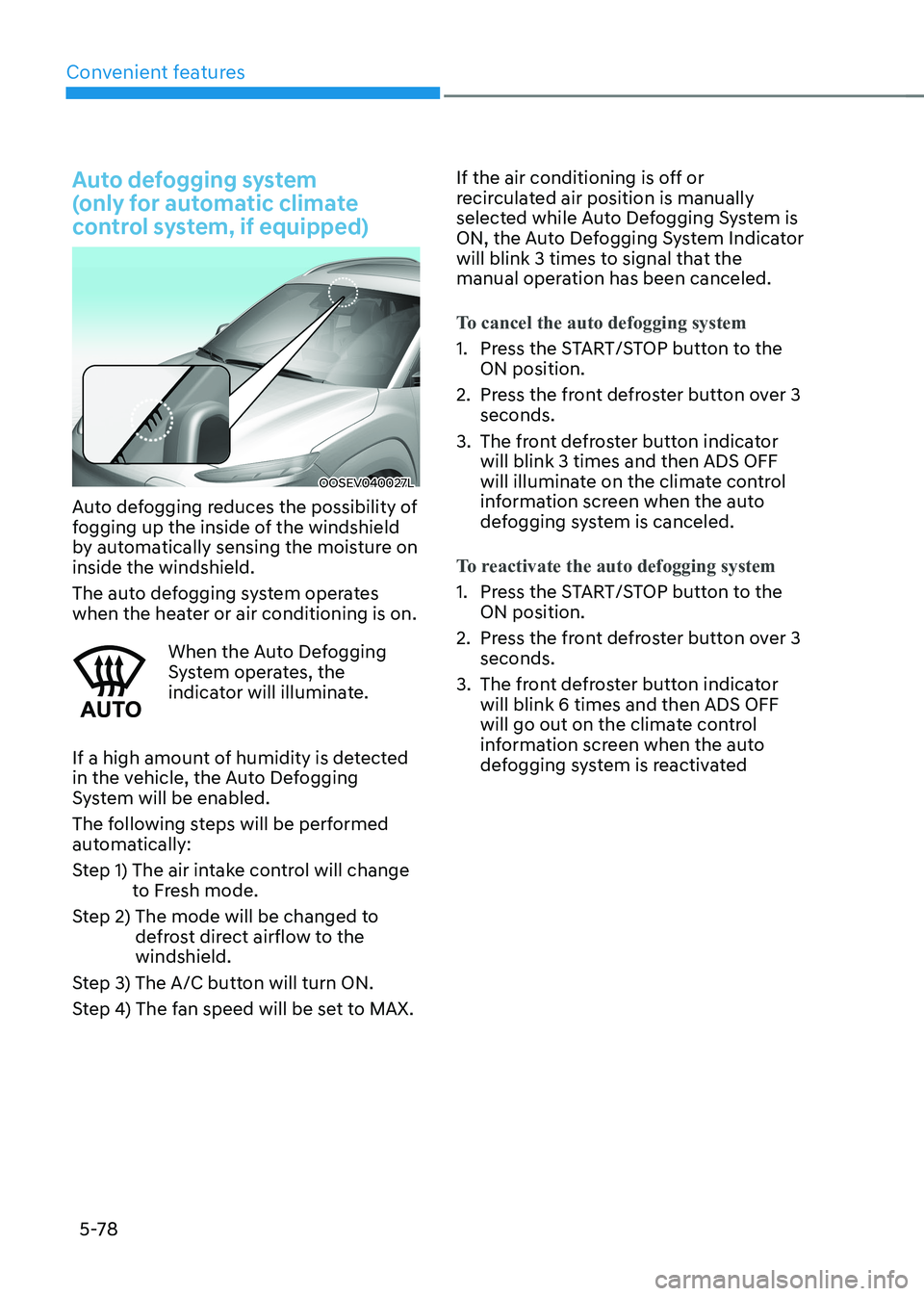
Auto defogging system
(only for automatic climate
control system, if equipped)
OOSEV040027L
Auto defogging reduces the possibility of
fogging up the inside of the windshield
by automatically sensing the moisture on inside the windshield.
The auto defogging system operates
when the heater or air conditioning is on.
When the Auto Defogging
System operates, the
indicator will illuminate.
If a high amount of humidity is detected
in the vehicle, the Auto Defogging
System will be enabled.
The following steps will be performed
automatically:
Step 1) The air intake control will change to Fresh mode.
Step 2) The mode will be changed to defrost direct airflow to the windshield.
Step 3) The A/C button will turn ON.
Step 4) The fan speed will be set to MAX. If the air conditioning is off or
recirculated air position is manually
selected while Auto Defogging System is
ON, the Auto Defogging System Indicator
will blink 3 times to signal that the
manual operation has been canceled.
To cancel the auto defogging system
1. Press the START/STOP button to the
ON position.
2. Press the front defroster button over 3 seconds.
3. The front defroster button indicator will blink 3 times and then ADS OFF
will illuminate on the climate control
information screen when the auto
defogging system is canceled.
To reactivate the auto defogging system
1. Press the START/STOP button to the ON position.
2. Press the front defroster button over 3 seconds.
3. The front defroster button indicator will blink 6 times and then ADS OFF
will go out on the climate control
information screen when the auto
defogging system is reactivated
Page 264 of 548
Convenient features
5-80
Cluster ionizer (if equipped)
When the START/STOP button is in the ON position, the clean air function turns
on automatically.
Also, the clean air function turns off
automatically, when the START/STOP
button is in the OFF position.
Automatic ventilation (if equipped)
To increase cabin air quality and reduce
windscreen misting, air recirculation
mode switches off automatically after
5 minutes, depending on outside
temperature, A/C state, air direction
mode, and the air intake will change to
outside (fresh) mode.
To cancel or reactivate the
Automatic Ventilation
When the air conditioning system is on,
select Face level mode (
) and set the
air intake control to the outside (fresh)
air position. Then, while pressing the
A/C button, press air recirculation mode
button five times within 3 seconds.
When the automatic ventilation is set,
the air recirculation indicator will blink 6
times. When canceled, the indicator will blink 3 times.
ClimaTe ConTrol addiTional feaTures
Page 477 of 548
9
9. Maintenance
Motor compartment ......................................................................................... 9-3
Maintenance services ....................................................................................... 9-4
Owner’s responsibility ................................................................................................ 9-4
Owner maintenance precautions............................................................................... 9-4
Owner maintenance ......................................................................................... 9-5
Owner maintenance schedule .................................................................................... 9-5
Scheduled maintenance services ..................................................................... 9 -7
Maintenance Schedule ................................................................................................ 9 -7
Explanation of scheduled maintenance items ...............................................9-9
Cooling system ............................................................................................................ 9-9
Coolant ......................................................................................................................... 9-9
Reduction gear fluid.................................................................................................... 9-9
Brake hoses and lines.................................................................................................. 9-9Brake fluid ................................................................................................................... 9-9
Brake pads, calipers and rotors .................................................................................. 9-9
Suspension mounting bolts ........................................................................................ 9-9
Drive shafts and boots ................................................................................................ 9-9
Air conditioning refrigerant/compressor................................................................... 9-9
Coolant ............................................................................................................. 9-10
Brake fluid ......................................................................................................... 9-11
Checking the brake fluid level .................................................................................... 9-11
Washer fluid ..................................................................................................... 9-12
Checking the washer fluid level ................................................................................ 9-12
Climate control air filter................................................................................... 9-13
Filter inspection ............................................................................................... 9-13
Filter replacement ...................................................................................................... 9-13
Wiper blades .................................................................................................... 9-14
Blade inspection ......................................................................................................... 9-14
Blade replacement ................................................................................................... 9-14
Battery (12 Volt) ................................................................................................ 9-17
Battery usage.............................................................................................................. 9-18 Battery capacity label ................................................................................................ 9-18
Battery recharging ..................................................................................................... 9-18
Reset items ................................................................................................................. 9-19
Page 484 of 548
Maintenance
9-8
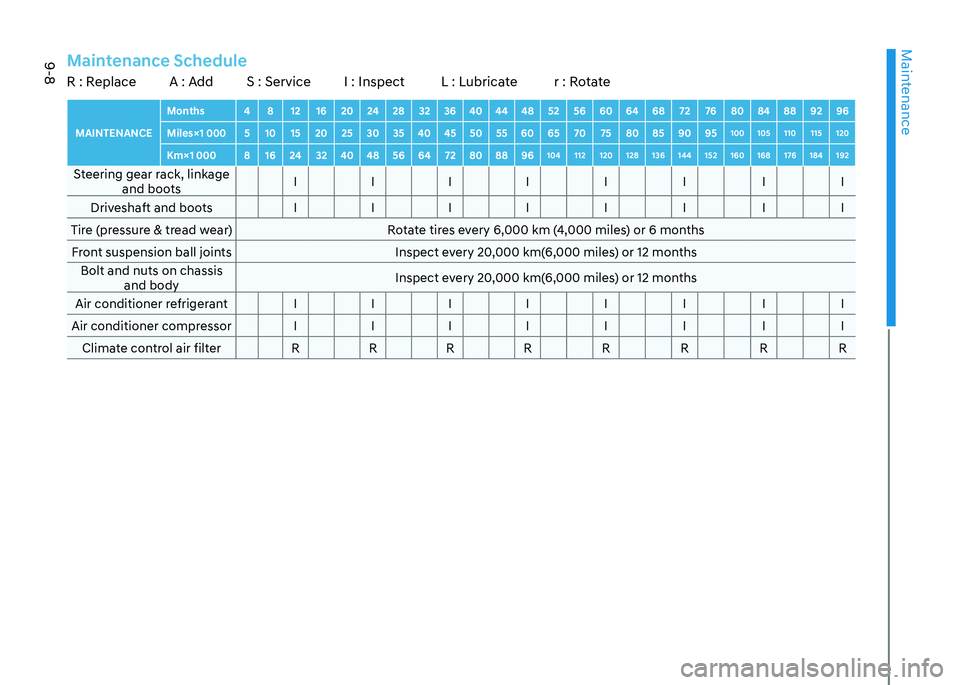
MAINTENANCEMonths 4 8 12 16 20 24 28 32 36 40 44 48 52 56 60 64 68 72 76 80 84 88 92 96
Miles×1 000 5 10 15 20 25 30 35 40 45 50 55 60 65 70 75 80 85 90 95 100 105 110 115 120
Km×1 000 8 16 24 32 40 48 56 64 72 80 88 96 104 112 120 128 136 144 152 160 168 176 184 192Steering gear rack, linkage
and boots I I I I I I I I
Driveshaft and boots I I I I I I I I
Tire (pressure & tread wear) Rotate tires every 6,000 km (4,000 miles) or 6 months Front suspension ball joints Inspect every 20,000 km(6,000 miles) or 12 months Bolt and nuts on chassis and body Inspect every 20,000 km(6,000 miles) or 12 months
Air conditioner refrigerant I I I I I I I I
Air conditioner compressor I I I I I I I I Climate control air filter R R R R R R R RMaintenance ScheduleR : Replace A : Add S : Service I : Inspect L : Lubricate r : Rotate
Page 488 of 548
Maintenance
9-12
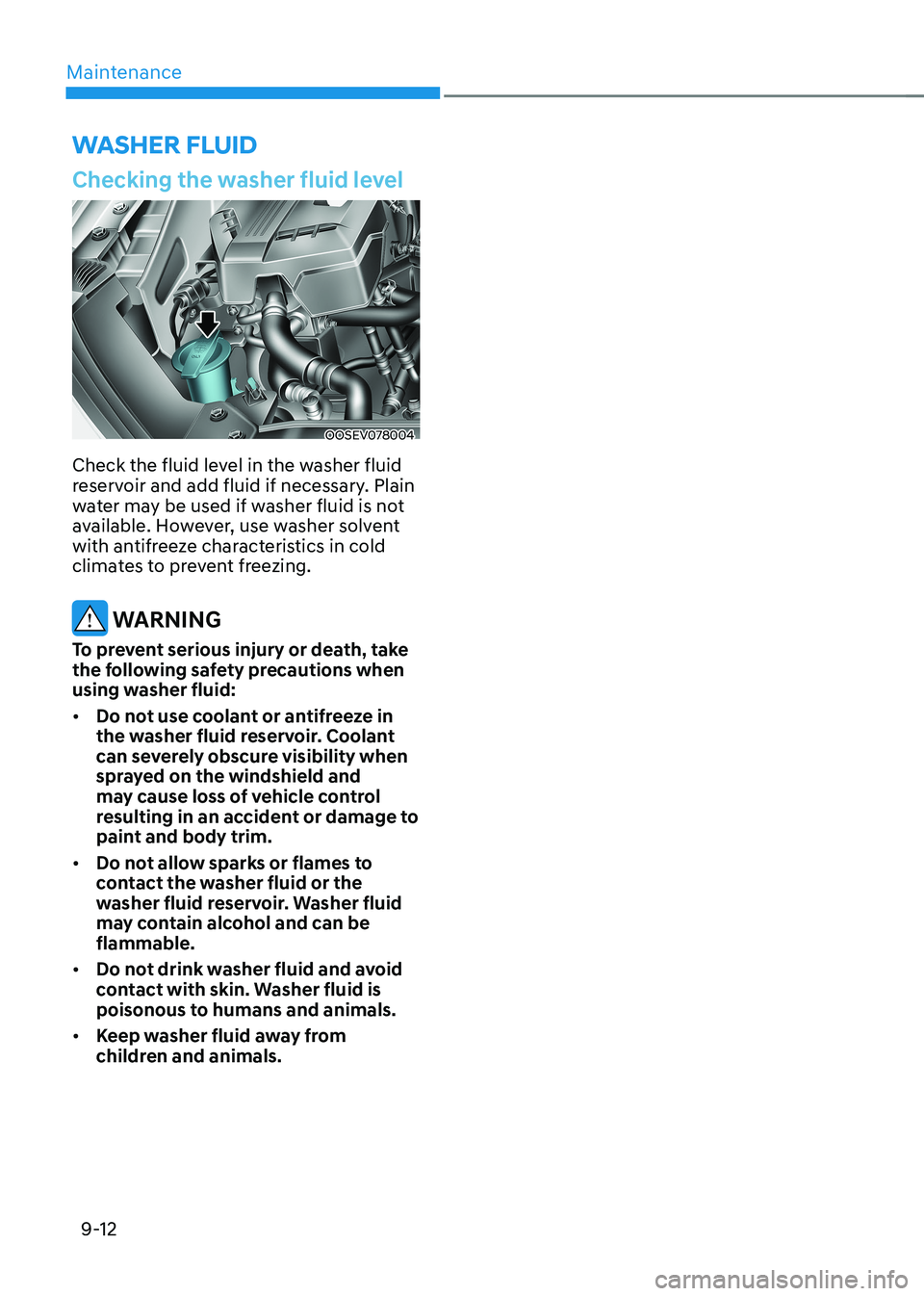
WASHER FLUID
Checking the washer fluid level
OOSEV078004
Check the fluid level in the washer fluid
reservoir and add fluid if necessary. plain
water may be used if washer fluid is not
available. However, use washer solvent
with antifreeze characteristics in cold
climates to prevent freezing.
WARNING
To prevent serious injury or death, take
the following safety precautions when
using washer fluid: • Do not use coolant or antifreeze in
the washer fluid reservoir. Coolant
can severely obscure visibility when
sprayed on the windshield and
may cause loss of vehicle control
resulting in an accident or damage to
paint and body trim.
• Do not allow sparks or flames to
contact the washer fluid or the
washer fluid reservoir. Washer fluid
may contain alcohol and can be flammable.
• Do not drink washer fluid and avoid
contact with skin. Washer fluid is
poisonous to humans and animals.
• Keep washer fluid away from
children and animals.
Page 489 of 548
09
9-13
CLIMATE CONTROL AIR FILTER
Filter inspection
Replace the filter according to the
Maintenance Schedule.
If the vehicle is operated in the severely
air-polluted cities or on dusty rough
roads for a long period, it should be
inspected more frequently and replaced
earlier. When you, the owner, replace
the climate control air filter, replace it
performing the following procedure,
and be careful to avoid damaging other
components.
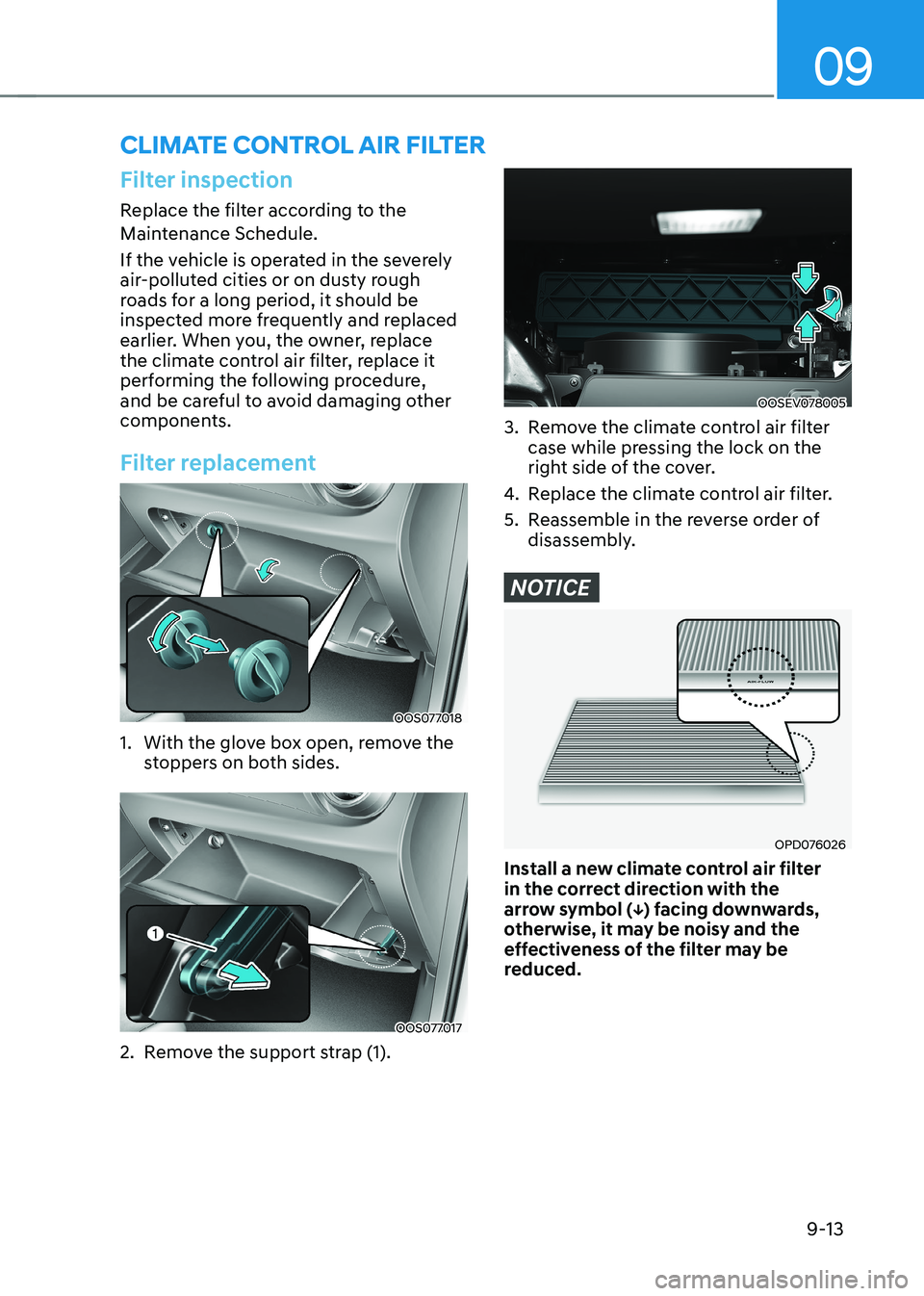
Filter replacement
OOS077018
1. With the glove box open, remove the stoppers on both sides.
OOS077017
2. Remove the support strap (1).
OOSEV078005
3. Remove the climate control air filter case while pressing the lock on the
right side of the cover.
4. Replace the climate control air filter.
5. Reassemble in the reverse order of disassembly.
NOTICE
OPD076026
Install a new climate control air filter
in the correct direction with the
arrow symbol (↓) facing downwards,
otherwise, it may be noisy and the
effectiveness of the filter may be
reduced.
Page 495 of 548
09
9-19
• Wear eye protection when checking
the battery during charging.
• The battery must be removed from
the vehicle and placed in a well
ventilated area.
• Watch the battery during charging,
and stop or reduce the charging
rate if the battery cells begin boiling
violently.
• The negative battery cable must
be removed first and installed last
when the battery is disconnected.
Disconnect the battery charger in the
following order:
(1) Turn off the battery charger main
switch.
(2) Unhook the negative clamp from the negative battery terminal.
(3) Unhook the positive clamp from the positive battery terminal.
• Always use a genuine HYUNDAI
approved battery or the equivalent
specified for your vehicle when you
replace the battery. By jump starting
After a jump start from a good battery,
drive the vehicle for 20-30 minutes
before it is shutoff. The vehicle may
not restart if you shut it off before the
battery had a chance to adequately
recharge. See “Jump Starting” in chapter
8 for more information on jump starting
procedures.
Information
An inappropriately disposed of battery can be harmful to the
environment and human health.
Dispose of the battery according to your
local law(s) or regulations.
Reset items
The following items may need to be reset
after the battery has been discharged or
the battery has been disconnected. • Auto up/down window
• Sunroof
• Trip computer
• Climate control system
• Clock
• Audio system
Page 499 of 548
![HYUNDAI KONA EV 2022 Owners Manual 09
9-23
Tire replacement
OLMB073027
A
[A] : Tread wear indicator If the tire is worn evenly, a tread wear
indicator will appear as a solid band
across the tread. This shows there is less
than 1.6](/img/35/56171/w960_56171-498.png "HYUNDAI KONA EV 2022 Owners Manual 09
9-23
Tire replacement
OLMB073027
A
[A] : Tread wear indicator If the tire is worn evenly, a tread wear
indicator will appear as a solid band
across the tread. This shows there is less
than 1.6")
09
9-23
Tire replacement
OLMB073027
A
[A] : Tread wear indicator If the tire is worn evenly, a tread wear
indicator will appear as a solid band
across the tread. This shows there is less
than 1.6 mm (1/16 in.) of tread left on the
tire. Replace the tire when this happens.
Do not wait for the band to appear across
the entire tread before replacing the tire.
WARNING
To reduce the risk of DEATH or SERIOUS
INJURY: • Replace tires that are worn, show
uneven wear, or are damaged.
Worn tires can cause loss of braking
effectiveness, steering control, and
traction.
• Always replace tires with the same
size as each tire that was originally
supplied with this vehicle. Using
tires and wheels other than the
recommended sizes could cause
unusual handling characteristics,
poor vehicle control, or negatively
affect your vehicle’s Anti-Lock Brake
System (ABS) resulting in a serious
accident. •
When replacing tires (or wheels), it
is recommended to replace the two
front or two rear tires (or wheels)
as a pair. Replacing just one tire
can seriously affect your vehicle’s
handling. If only replacing one pair of
tires, it is recommended to install the
pair of new tires on the rear axle.
• Tires degrade over time, even when
they are not being used. Regardless
of the remaining tread, HYUNDAI
recommends that tires be replaced
after six (6) years of normal service.
• Heat caused by hot climates or
frequent high loading conditions can
accelerate the aging process. Failure
to follow this warning may cause
sudden tire failure, which could lead
to a loss of vehicle control resulting
in an accident.
Page 502 of 548
Maintenance
9-26
5. Maximum permissible inflation
pressure
This number is the greatest amount
of air pressure that should be put in
the tire. Do not exceed the maximum
permissible inflation pressure. Refer to
the Tire and Loading Information label
for recommended inflation pressure.
6. Maximum load rating
This number indicates the maximum
load in kilograms and pounds that can be
carried by the tire. When replacing the
tires on the vehicle, always use a tire that
has the same load rating as the factory
installed tire.
7. Uniform tire quality grading
Quality grades can be found where
applicable on the tire sidewall between
tread shoulder and maximum section width.
For example: TREAD WEAR 200
TRACTION AA
TEMpERATURE A
Tread wear
The tread wear grade is a comparative
rating based on the wear rate of the tire
when tested under controlled conditions
on a specified government test course.
For example, a tire graded 150 would
wear one-and-a-half times (1½) as well
on the government course as a tire
graded 100.
The relative performance of tires depends upon the actual conditions
of their use, however, and may depart
significantly from the norm due to
variations in driving habits, service
practices and differences in road
characteristics and climate.
These grades are molded on the
sidewalls of passenger vehicle tires. The
tires available as standard or optional
equipment on your vehicle may vary with
respect to grade.
Traction - AA, A, B & C
The traction grades, from highest to
lowest, are AA, A, B and C. Those grades
represent the tire’s ability to stop on wet
pavement as measured under controlled
conditions on specified government
test surfaces of asphalt and concrete.
A tire marked C may have poor traction
performance.
WARNING
The traction grade assigned to this tire
is based on straight-ahead braking
traction tests, and does not include
acceleration, cornering, hydroplaning,
or peak traction characteristics.
Page 537 of 548
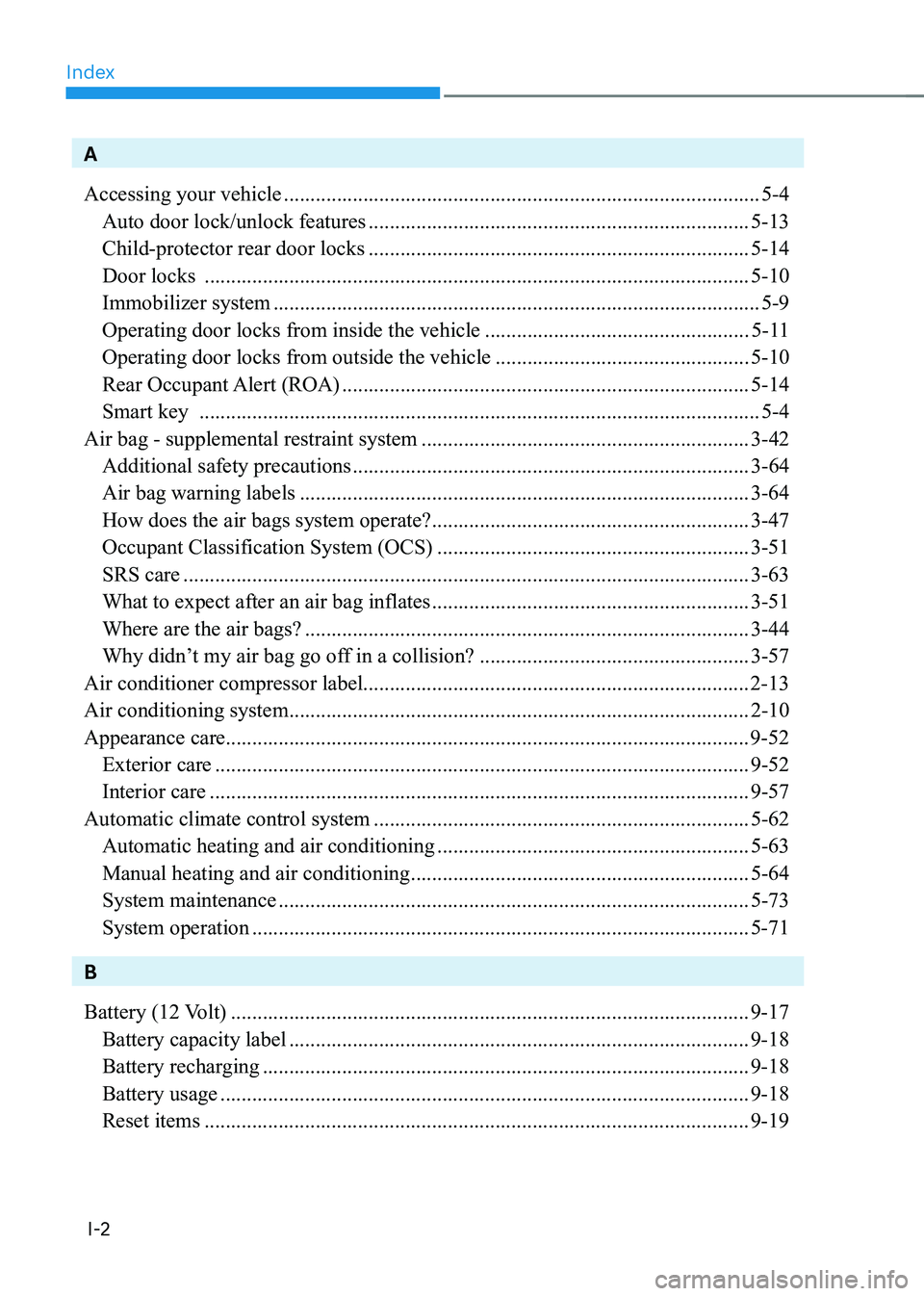
Index
I-2
A Accessing your vehicle .......................................................................................... 5-4
Auto door lock/unlock features ........................................................................ 5-13
Child-protector rear door locks ........................................................................ 5-14
Door locks ....................................................................................................... 5-10
Immobilizer system ............................................................................................ 5-9
Operating door locks from inside the vehicle ..................................................5-11
Operating door locks from outside the vehicle ................................................5-10
Rear Occupant Alert (ROA) ............................................................................. 5-14
Smart key .......................................................................................................... 5-4
Air bag - supplemental restraint system .............................................................. 3-42
Additional safety precautions ........................................................................... 3-64
Air bag warning labels ..................................................................................... 3-64
How does the air bags system operate? ............................................................3-47
Occupant Classification System (OCS) ...........................................................3-51
SRS care ........................................................................................................... 3-63
What to expect after an air bag inflates ............................................................3-51
Where are the air bags? .................................................................................... 3-44
Why didn’t my air bag go off in a collision? ...................................................3-57
Air conditioner compressor label......................................................................... 2-13 Air conditioning system ....................................................................................... 2-10
Appearance care................................................................................................... 9-52
Exterior care ..................................................................................................... 9-52
Interior care ...................................................................................................... 9-57
Automatic climate control system ....................................................................... 5-62
Automatic heating and air conditioning ...........................................................5-63
Manual heating and air conditioning ................................................................ 5-64
System maintenance ......................................................................................... 5-73
System operation .............................................................................................. 5-71
B
Battery (12 Volt) .................................................................................................. 9-17
Battery capacity label ....................................................................................... 9-18
Battery recharging ............................................................................................ 9-18
Battery usage .................................................................................................... 9-18
Reset items ....................................................................................................... 9-19