tow HYUNDAI KONA EV 2022 Owner's Manual
[x] Cancel search | Manufacturer: HYUNDAI, Model Year: 2022, Model line: KONA EV, Model: HYUNDAI KONA EV 2022Pages: 548, PDF Size: 49.14 MB
Page 250 of 548
Convenient features
5-66
OOSEV048303
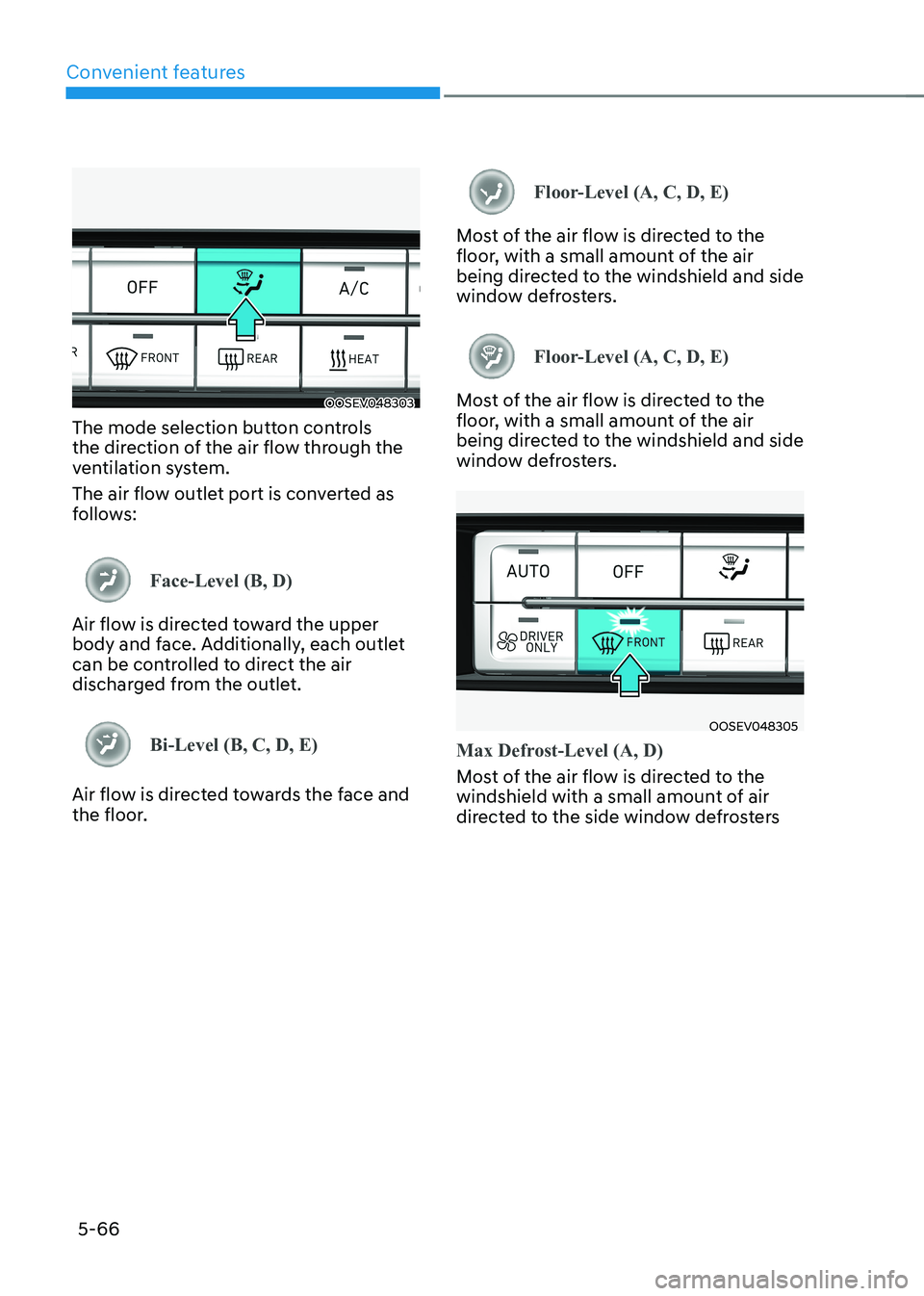
The mode selection button controls
the direction of the air flow through the
ventilation system.
The air flow outlet port is converted as
follows:
Face-Level (B, D)
Air flow is directed toward the upper
body and face. Additionally, each outlet
can be controlled to direct the air
discharged from the outlet.
Bi-Level (B, C, D, E)
Air flow is directed towards the face and
the floor.
Floor-Level (A, C, D, E)
Most of the air flow is directed to the
floor, with a small amount of the air
being directed to the windshield and side
window defrosters.
Floor-Level (A, C, D, E)
Most of the air flow is directed to the
floor, with a small amount of the air
being directed to the windshield and side
window defrosters.
OOSEV048305
Max Defrost-Level (A, D)
Most of the air flow is directed to the
windshield with a small amount of air
directed to the side window defrosters
Page 282 of 548
6
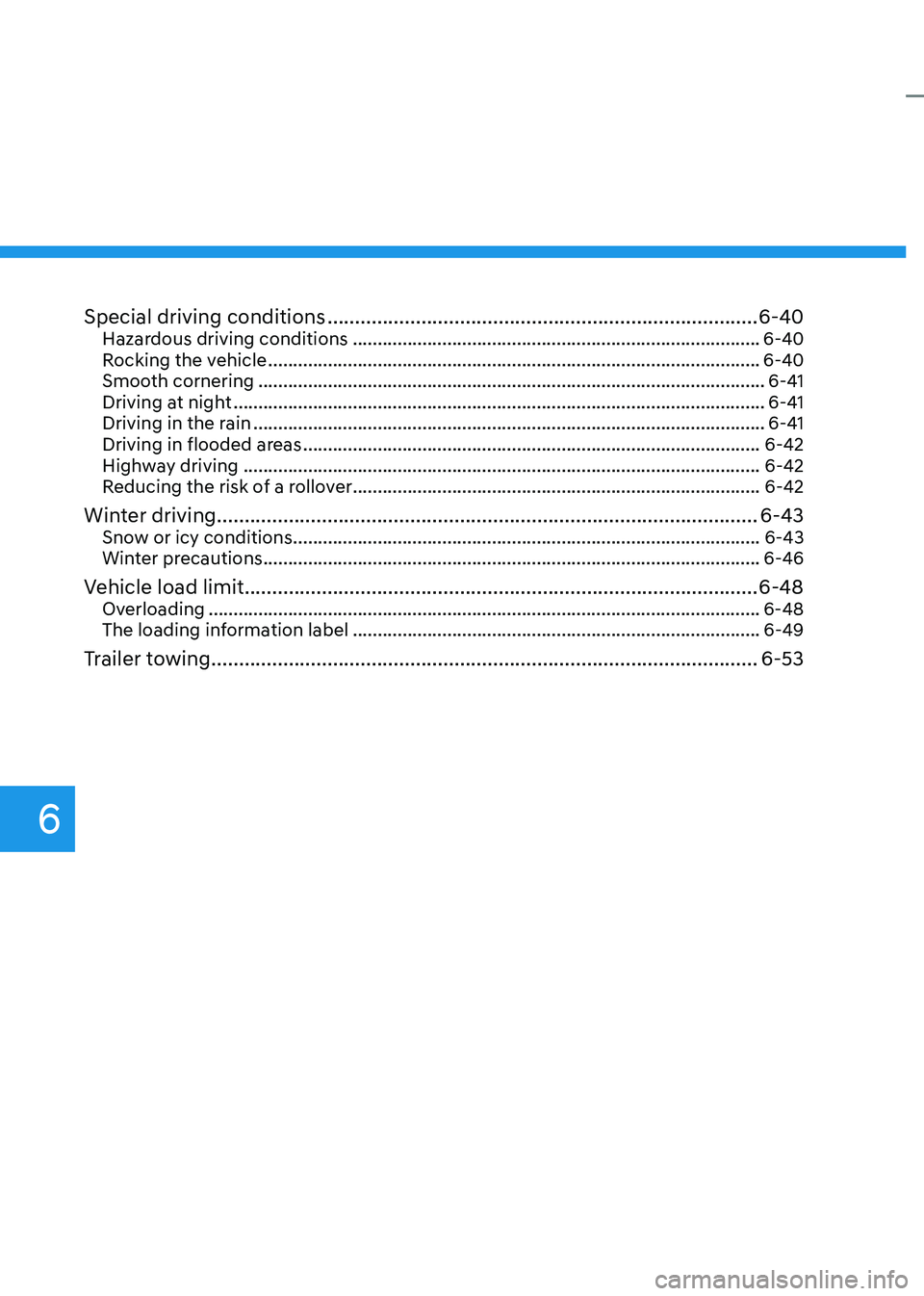
Special driving conditions .............................................................................. 6-40
Hazardous driving conditions .................................................................................. 6-40
Rocking the vehicle ................................................................................................... 6-40
Smooth cornering ...................................................................................................... 6-41
Driving at night ........................................................................................................... 6-41
Driving in the rain ....................................................................................................... 6-41
Driving in flooded areas ............................................................................................ 6-42
Highway driving ........................................................................................................ 6-42
Reducing the risk of a rollover .................................................................................. 6-42
Winter driving .................................................................................................. 6-43
Snow or icy conditions .............................................................................................. 6-43
Winter precautions .................................................................................................... 6-46
Vehicle load limit.............................................................................................6-48 Overloading ............................................................................................................... 6-48
The loading information label .................................................................................. 6-49
Trailer towing ................................................................................................... 6-53
Page 286 of 548
Driving your vehicle
6-6
Starting the vehicle
WARNING
• Always wear appropriate shoes when
operating your vehicle. Unsuitable
shoes, such as high heels, ski boots,
sandals, flip-flops, etc., may interfere
with your ability to use the brake,
accelerator and clutch pedals.
• Do not start the vehicle with the
accelerator pedal depressed. The
vehicle can move which can lead to
an accident.
Information
• The vehicle will start by pressing the
START/STOP button, only when the smart key is in the vehicle.
• Even if the smart key is in the vehicle,
and when it is far away from the driver, the vehicle may not start.
• When the START/STOP button is in
the ACC or ON position, any door is
open, the system checks for the smart
key. When the smart key is not in the vehicle, the "
" indicator will blink
and the warning "Key not in vehicle"
will come on. When all doors are
closed, the chime will also sound for about 5 seconds. Keep the smart key in
the vehicle when in the ACC position or
if the vehicle is in the ready (
) mode.
1. Always carry the smart key with you.
2. Make sure the parking brake is applied.
3. Make sure the gear is in P (Park).
4. Depress the brake pedal.
5. Press the START/STOP button. If the vehicle starts, the "
" indicator will
come on.
Information
• Always start the vehicle with your foot
on the brake pedal. Do not depress the
accelerator while starting the vehicle.
• If ambient temperature is low, the "
" indicator may remain illuminated
longer than the normal amount of time.
NOTICE
To prevent damage to the vehicle: • If the "
" indicator turns off while
you are in motion, do not attempt to
shift to the P (Park) position.
If traffic and road conditions permit,
you may shift to the N (Neutral)
position while the vehicle is still
moving and press the START/STOP
button in an attempt to restart the
vehicle.
• Do not push or tow your vehicle to
start the vehicle.
Page 307 of 548
06
6-27
Emergency braking
If there is a problem with the brake
pedal while driving, emergency braking
is possible by pulling up and holding
the EPB switch. Braking is possible only
while you are holding the EPB switch.
However, braking distance will be longer than normal.
WARNING
Do not operate the parking brake while
the vehicle is moving except in an
emergency situation. It could damage
the brake system and lead to a severe
accident.
Information
During emergency braking, the parking brake warning light will illuminate to indicate that the system is operating.
NOTICE
If you continuously notice a noise or
burning smell when the EPB is used for
emergency braking, we recommend
that you have the system checked by an
authorized HYUNDAI dealer.
When the EPB (Electronic Parking Brake)
does not release
If the EPB does not release normally,
we recommend that you contact an
authorized HYUNDAI dealer by loading
the vehicle on a flatbed tow truck and
have the system checked.
Auto Hold
The Auto Hold maintains the vehicle in a
standstill even though the brake pedal is
not depressed after the driver brings the
vehicle to a complete stop by depressing
the brake pedal.
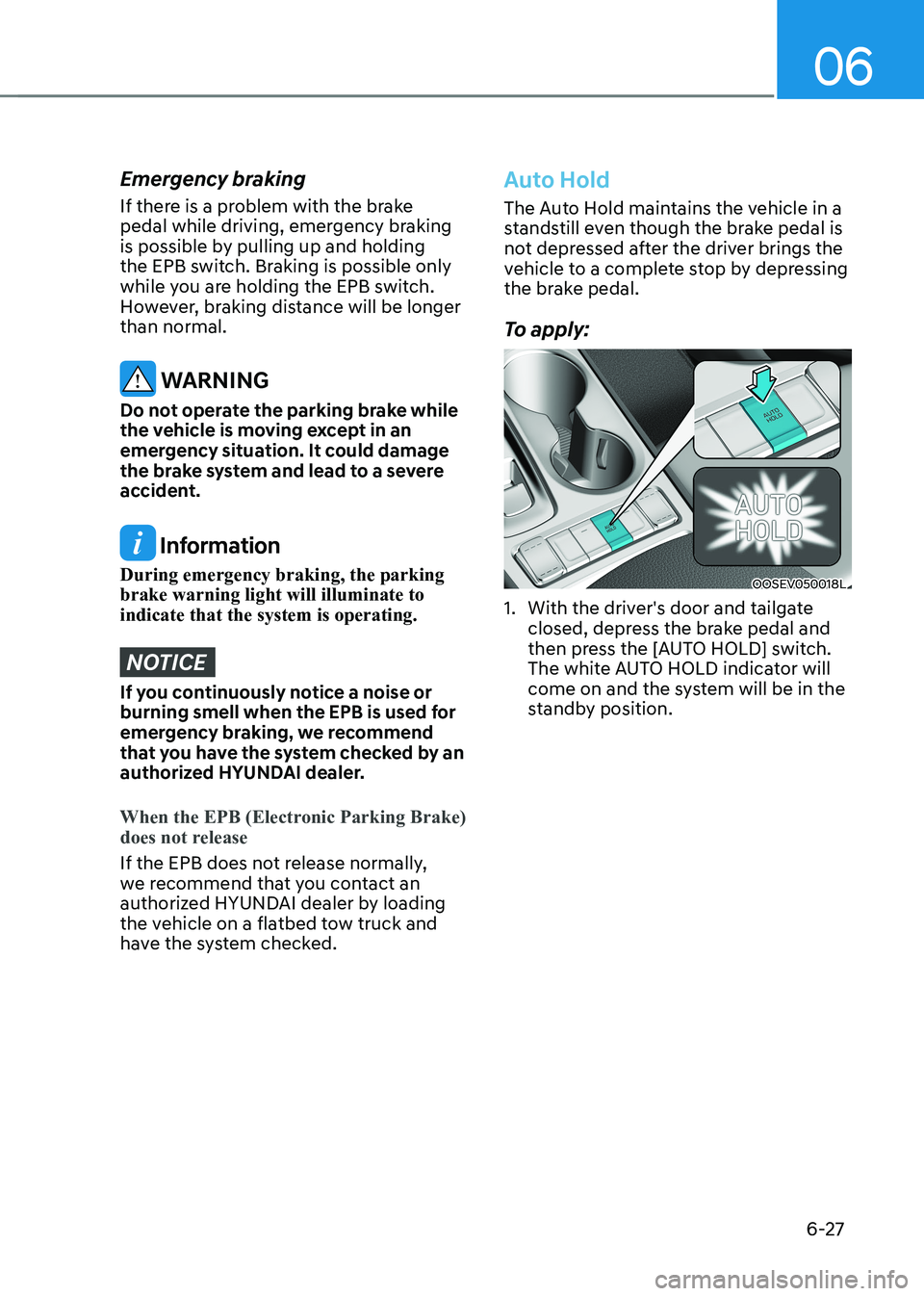
To apply:
OOSEV050018L
1. With the driver's door and tailgate closed, depress the brake pedal and
then press the [AUTO HOLD] switch.
The white AUTO HOLD indicator will
come on and the system will be in the
standby position.
Page 320 of 548
Driving your vehicle
6-40
SPECIAL DRIVING CONDITIONS
Hazardous driving conditions
When hazardous driving elements
are encountered such as water, snow,
ice, mud and sand, take the following
precautions: • Drive cautiously and maintain a longer
braking distance.
• Avoid abrupt braking or steering.
• When your vehicle is stuck in snow,
mud, or sand, accelerate slowly to
avoid unnecessary wheel spinning.
• Put sand, rock salt, tire chains or other
non-slip materials under the wheels
to provide additional traction while
being stuck in ice, snow, or mud.
Rocking the vehicle
If it is necessary to rock the vehicle to
free it from snow, sand, or mud, first turn
the steering wheel right and left to clear
the area around your front wheels. Then,
shift back and forth between R (Reverse)
and a forward gear.
Try to avoid spinning the wheels, and do
not race the vehicle.
To prevent reduction gear wear, wait
until the wheels stop spinning before
shifting gears. Release the accelerator
pedal while shifting, and press lightly on
the accelerator pedal while the reduction
gear wear is in gear. Slowly spinning the
wheels in forward and reverse directions
causes a rocking motion that may free
the vehicle.
WARNING
If the vehicle is stuck and excessive
wheel spin occurs, the temperature
in the tires can increase very quickly.
If the tires become damaged, a tire
blow out or tire explosion can occur.
This condition is dangerous - you and
others may be injured. Do not attempt
this procedure if people or objects are
anywhere near the vehicle.
If you attempt to free the vehicle, the
vehicle can overheat quickly, possibly
causing a motor compartment fire or
other damage. Try to avoid spinning the
wheels as much as possible to prevent
overheating of either the tires or the
vehicle. DO NOT allow the vehicle to
spin the wheels above 56 km/h (35
mph).
Information
The ESC system must be turned OFF
before rocking the vehicle.
NOTICE
If you are still stuck after rocking the
vehicle a few times, have the vehicle
pulled out by a tow vehicle to avoid
vehicle overheating, possible damage
to the reduction gear, and tire damage.
See “Towing” in chapter 8.
Page 323 of 548
06
6-43
The severe weather conditions of winter quickly wear out tires and cause other
problems. To minimize winter driving problems, you should take the following
suggestions:
Information
Information for Snow Tires and Tire Chains in the national language (Bulgarian,
Hungarian, Icelandic, Polish) is provided in the Appendix.
Snow or icy conditions
You need to keep sufficient distance between your vehicle and the vehicle in front of
you.
Apply the brakes gently. Speeding, rapid acceleration, sudden brake applications,
and sharp turns are potentially very hazardous practices. During deceleration, use the
paddle shifter (left side lever) to increase regenerative braking, but avoid adjusting it
to level 3 (steering may be difficult). Sudden brake applications on snowy or icy roads
may cause skids to occur.
To drive your vehicle in deep snow, it may be necessary to use snow tires or to install
tire chains on your tires.
Always carry emergency equipment. Some of the items you may want to carry include
tire chains, tow straps or chains, a flashlight, emergency flares, sand, a shovel, jumper
cables, a window scraper, gloves, ground cloth, coveralls, a blanket, etc.
wINTER dRIvINg
Page 327 of 548
06
6-47
Do not let your parking brake freeze
Under some conditions your parking
brake can freeze in the engaged position.
This is most likely to happen when there
is an accumulation of snow or ice around
or near the rear brakes or if the brakes
are wet. When there is the risk that your
parking brake may freeze, temporarily
apply it with the shift lever in P (Park).
Also, block the rear wheels in advance,
so the vehicle may not roll. Then, release
the parking brake.
Do not let ice and snow accumulate
underneath
Under some conditions, snow and ice
can build up under the fenders and
interfere with the steering. When driving
in such conditions during the severe
winter, you should check underneath
the vehicle on a regular basis, to ensure
that the front wheels and the steering
components is unblocked.
Carry emergency equipment
In accordance with weather conditions,
you should carry appropriate emergency
equipment, while driving. Some of the
items you may want to carry include tire
chains, tow straps or chains, flashlight,
emergency flares, sand, shovel, jumper
cables, window scraper, gloves, ground
cloth, coveralls, blanket, etc.
Do not place objects or materials in the
motor compartment
Putting objects or materials in the motor
compartment may cause an vehicle
failure or combustion, because they may
block cooling the parts in the motor
compartment. Such damage will not be
covered by the manufacturer’s warranty.
Page 329 of 548
06
6-49
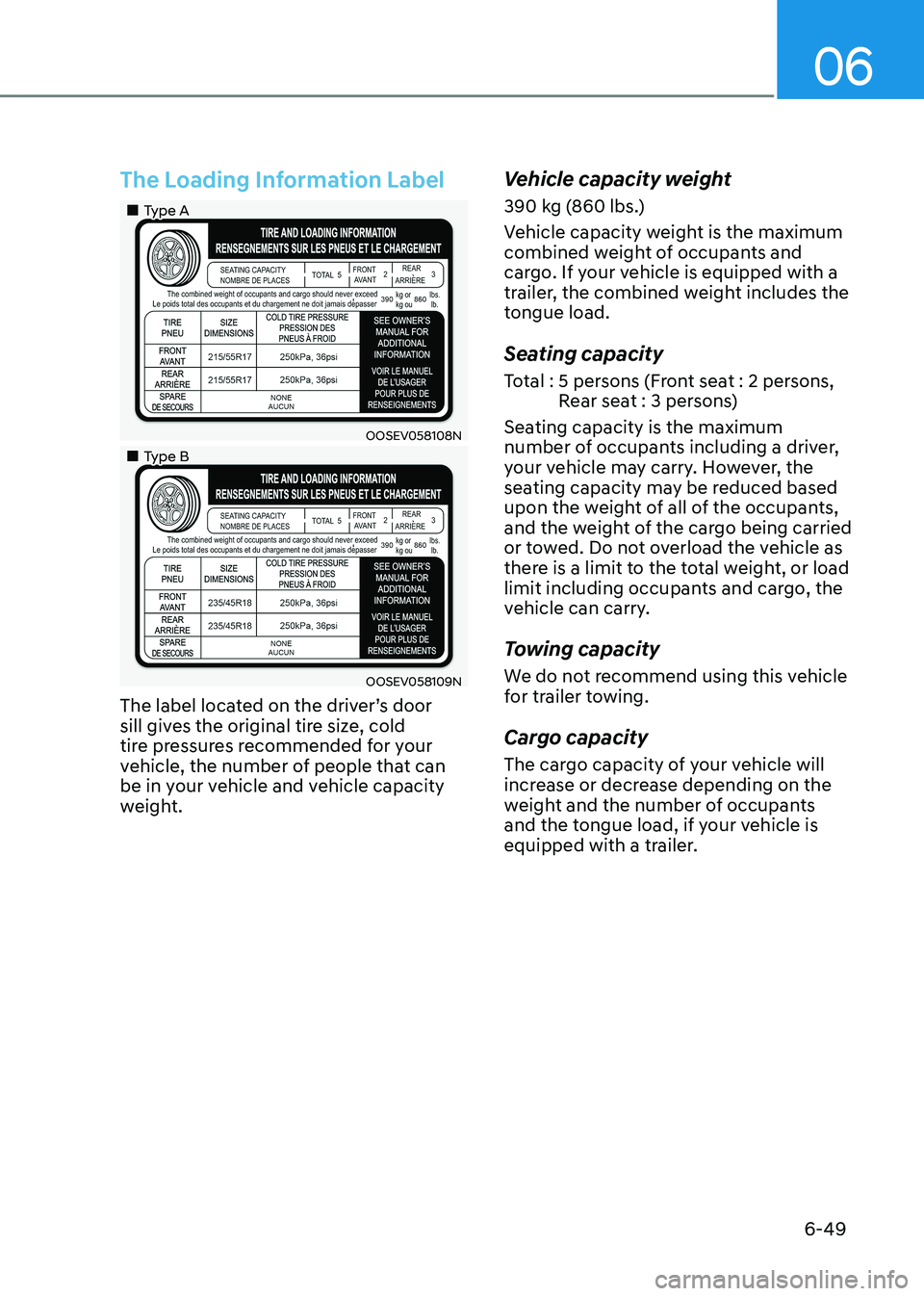
The Loading Information Label
„„Type A
OOSEV058108N
„„Type B
OOSEV058109N
The label located on the driver’s door
sill gives the original tire size, cold
tire pressures recommended for your
vehicle, the number of people that can
be in your vehicle and vehicle capacity
weight. Vehicle capacity weight
390 kg (860 lbs.)
Vehicle capacity weight is the maximum
combined weight of occupants and
cargo. If your vehicle is equipped with a
trailer, the combined weight includes the
tongue load.
Seating capacity
Total : 5 persons (Front seat : 2 persons,
Rear seat : 3 persons)
Seating capacity is the maximum
number of occupants including a driver,
your vehicle may carry. However, the
seating capacity may be reduced based
upon the weight of all of the occupants,
and the weight of the cargo being carried
or towed. Do not overload the vehicle as
there is a limit to the total weight, or load
limit including occupants and cargo, the
vehicle can carry.
Towing capacity
We do not recommend using this vehicle
for trailer towing.
Cargo capacity
The cargo capacity of your vehicle will
increase or decrease depending on the
weight and the number of occupants
and the tongue load, if your vehicle is
equipped with a trailer.
Page 330 of 548
Driving your vehicle
6-50
Steps for determining correct load limit
1. Locate the statement "The combined
weight of occupants and cargo should
never exceed XXX kg or XXX lbs." on
your vehicle's placard.
2. Determine the combined weight of the driver and passengers that will be
riding in your vehicle.
3. Subtract the combined weight of the driver and passengers from XXX kg or XXX lbs.
4. The resulting figure equals the
available amount of cargo and
luggage load capacity. For example,
if the "XXX" amount equals 1400
lbs. and there will be five 150 lb
passengers in your vehicle, the
amount of available cargo and luggage load capacity is 650 lbs.
(1400 - 750 (5 x 150) = 650 lbs.)
5. Determine the combined weight of luggage and cargo being loaded on
the vehicle. That weight may not
safely exceed the available cargo and
luggage load capacity calculated in
Step 4.
6. If your vehicle will be towing a trailer, load from your trailer will be
transferred to your vehicle. Consult
this manual to determine how this
reduces the available cargo and
luggage load capacity of your vehicle.
WARNING
Do not overload the vehicle as there
is a limit to the total weight, or load
limit, including occupants and cargo,
the vehicle can carry. Overloading can
shorten the life of the vehicle. If the
GVWR or the GAWR is exceeded, parts
on the vehicle can break, and it can
change the handling of your vehicle.
These could cause you to lose control
and result in an accident.
Page 333 of 548
06
6-53
TRAIlER TOwINg
We do not recommend using this vehicle for trailer towing.