warning HYUNDAI KONA EV 2022 Owner's Manual
[x] Cancel search | Manufacturer: HYUNDAI, Model Year: 2022, Model line: KONA EV, Model: HYUNDAI KONA EV 2022Pages: 548, PDF Size: 49.14 MB
Page 60 of 548
01
1-55
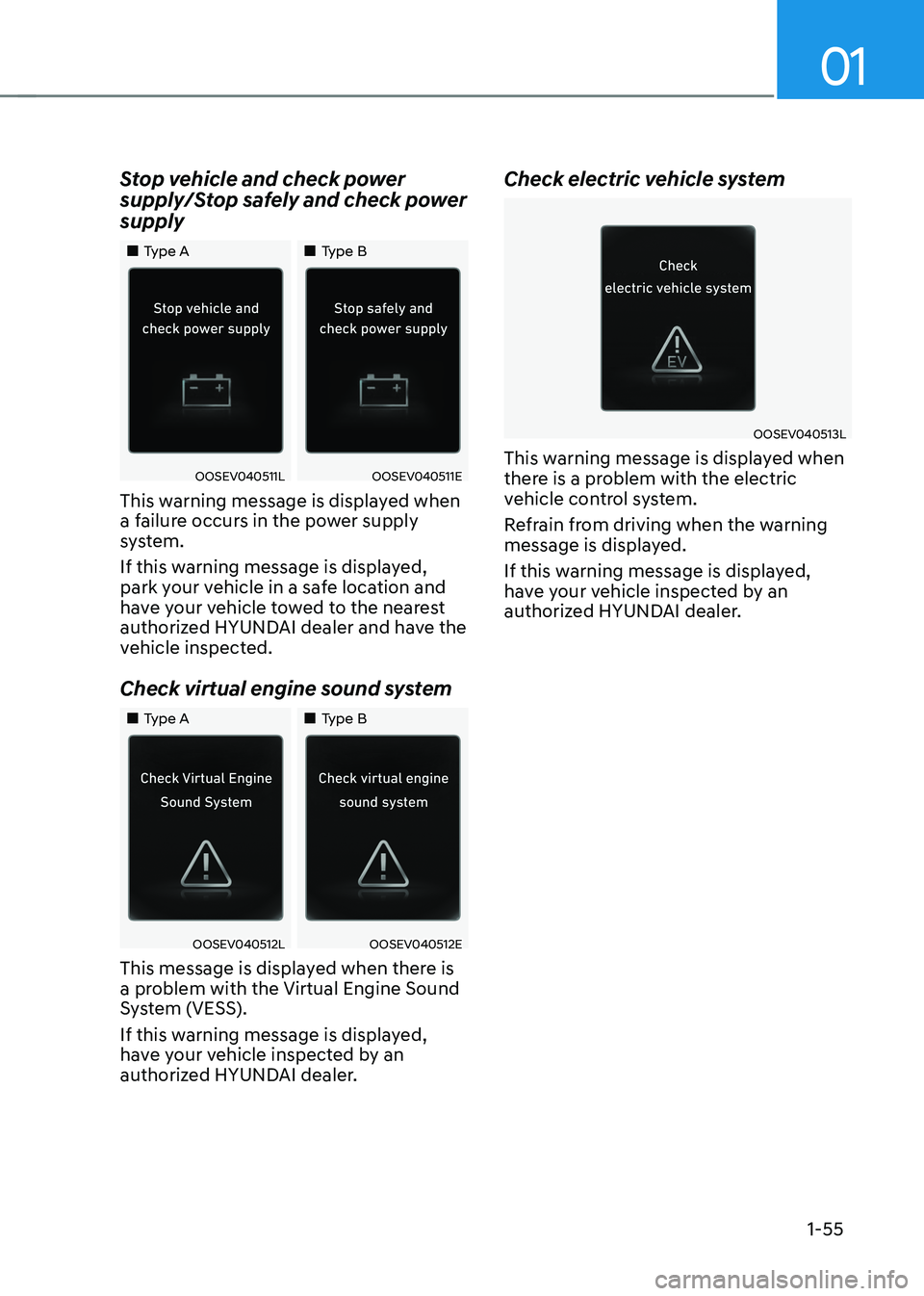
Stop vehicle and check power
supply/Stop safely and check power supply
„„Type A
„„Type B
OOSEV040511LOOSEV040511E
This warning message is displayed when
a failure occurs in the power supply
system.
If this warning message is displayed,
park your vehicle in a safe location and
have your vehicle towed to the nearest
authorized HYUNDAI dealer and have the
vehicle inspected.
Check virtual engine sound system
„„Type A „„Type B
OOSEV040512LOOSEV040512E
This message is displayed when there is
a problem with the Virtual Engine Sound
System (VESS).
If this warning message is displayed,
have your vehicle inspected by an
authorized HYUNDAI dealer. Check electric vehicle system
OOSEV040513L
This warning message is displayed when
there is a problem with the electric
vehicle control system.
Refrain from driving when the warning
message is displayed.
If this warning message is displayed,
have your vehicle inspected by an
authorized HYUNDAI dealer.
Page 62 of 548
01
1-57
Aux. Battery Saver+
The Aux. Battery Saver+ is a function that
monitors the charging status of the 12 V
auxiliary battery.
If the auxiliary battery level is low, the
main high voltage battery charges the
auxiliary battery.
Information
The Aux. Battery Saver+ function will
be ON when the vehicle is delivered. If the function is not needed, you may turn it off in the Users Settings mode on the
cluster. For more information, refer to the following page.
Mode • Cycle Mode :
When the Start/Stop button is in
the OFF position with all doors,
hood and tailgate closed, the Aux.
Battery Saver+ periodically activates
according to the auxiliary battery
status.
• Automatic Mode :
When the Start/Stop button is in
the ON position with the charging
connector plugged in, the function
activates according to the auxiliary
battery status to prevent over
discharge of the auxiliary battery.
Information
• The Aux. Battery Saver+ activates
for a maximum of 20 minutes. If the Aux Battery Saver+ function activates
for more than 10 times consecutively in automatic mode, the function will
be disabled. (Note: There may be
a problem with the 12V auxiliary
battery.) If the vehicle is driven normally and
12V battery is able to charge normally,
the Aux. Battery Saver+ function will be enabled again.
• The Aux. Battery Saver+ function
cannot prevent battery discharge if the auxiliary battery is damaged, worn out,
used as a power supply or unauthorized
electronic devices are used.
• If the Aux. Battery Saver+ function was activated, the high voltage battery level
may have decreased.
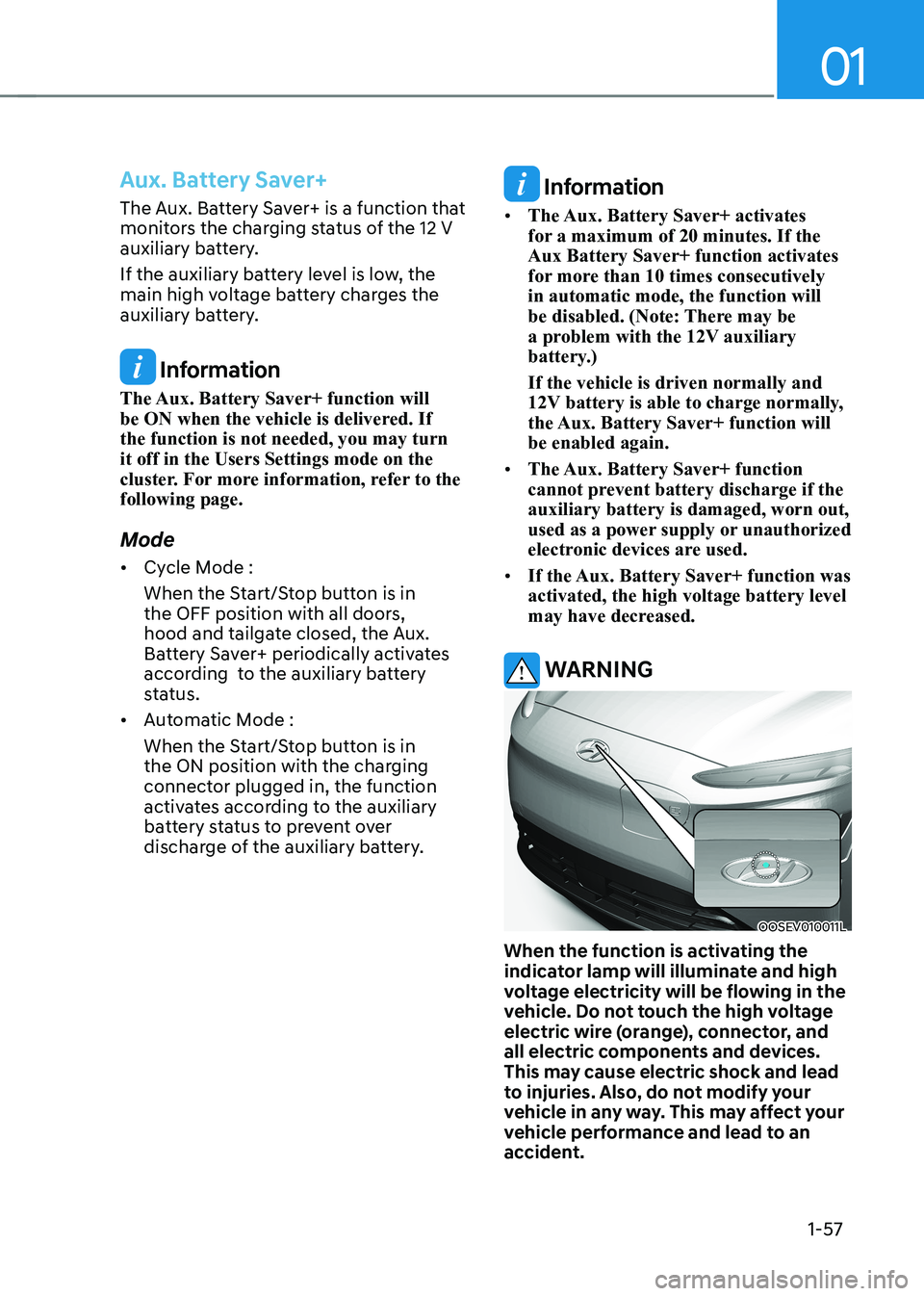
WARNING
OOSEV010011L
When the function is activating the
indicator lamp will illuminate and high
voltage electricity will be flowing in the
vehicle. Do not touch the high voltage
electric wire (orange), connector, and
all electric components and devices.
This may cause electric shock and lead
to injuries. Also, do not modify your
vehicle in any way. This may affect your
vehicle performance and lead to an
accident.
Page 63 of 548
Foreword / Electric Vehicle System Overview
1-58
If an accident occurs
WARNING
• When a vehicle accident occurs,
move the vehicle to a safe place,
turn OFF the vehicle and remove the
auxiliary battery (12 V) terminal to
prevent high voltage electricity from
flowing.
• If electric wires are exposed from
inside or outside the vehicle, do not
touch the wires.
Also, do not touch the high voltage
electric wire (orange), connector,
and all electric components and
devices. This may cause electric
shock and lead to injuries.
WARNING
• When a vehicle accident occurs and
the high voltage battery is damaged,
harmful gas and electrolytes may
leak. Be careful not to touch the
leaked liquid.
• When you suspect leakage of
inflammable gas and other harmful
gases, open the windows and
evacuate to a safe place. If any
leaked fluid comes in contact with
your eyes or skin, immediately clean
the affected area thoroughly with
tap water or saline solution and
have doctors inspect it as soon as possible.
WARNING
• If a small scale fire occurs, use a fire
extinguisher (ABC, BC) that is meant
for electrical fires. If it is impossible
to extinguish the fire in the early
stage, remain a safe distance from
the vehicle and immediately call the
fire department. Also, advise them
that an electric vehicle is involved.
• If the fire spreads to the high
voltage battery, large amount of
water is needed to put out the fire.
Using small amount of water or
fire extinguishers not meant for
electrical fires could cause serious
injury or death from electrical
shocks.
WARNING
If you cannot put out the fire
immediately, the high voltage battery
may explode. Evacuate to a safe place
and do not let other people approach
the site.
Contact the fire department and notify
them of an electric vehicle fire. • If the vehicle is flooded with water,
immediately turn off the vehicle and
evacuate to a safe place. Contact
the fire department or an authorized
HYUNDAI dealer.
saFeTy preCauTions For eleCTriC VeHiCle
Page 64 of 548
01
1-59
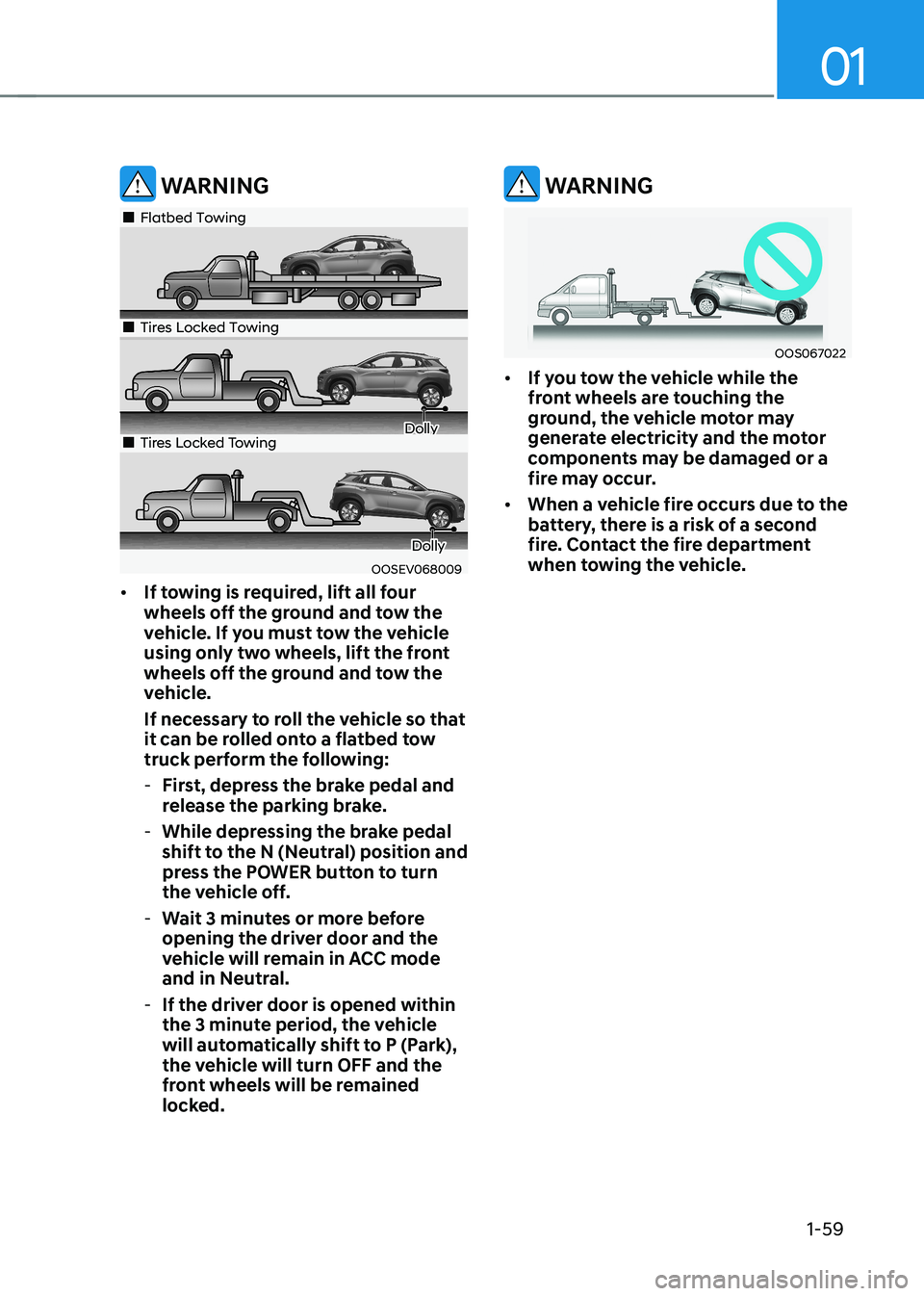
WARNING
OOSEV068009
„„Flatbed Towing
„„Tires Locked Towing
Dolly„„Tires Locked Towing
Dolly
• If towing is required, lift all four
wheels off the ground and tow the
vehicle. If you must tow the vehicle
using only two wheels, lift the front
wheels off the ground and tow the
vehicle.
If necessary to roll the vehicle so that
it can be rolled onto a flatbed tow
truck perform the following:
- First, depress the brake pedal and
release the parking brake.
- While depressing the brake pedal
shift to the N (Neutral) position and
press the POWER button to turn
the vehicle off.
- Wait 3 minutes or more before
opening the driver door and the
vehicle will remain in ACC mode
and in Neutral.
- If the driver door is opened within
the 3 minute period, the vehicle
will automatically shift to P (Park),
the vehicle will turn OFF and the
front wheels will be remained
locked.
WARNING
OOS067022
• If you tow the vehicle while the
front wheels are touching the
ground, the vehicle motor may
generate electricity and the motor
components may be damaged or a
fire may occur.
• When a vehicle fire occurs due to the
battery, there is a risk of a second
fire. Contact the fire department
when towing the vehicle.
Page 65 of 548
Foreword / Electric Vehicle System Overview
1-60
Additional Precautions
• When you paint or apply heat
treatment to the vehicle as a result of
an accident, the performance of the
high voltage battery can be reduced.
If heat treatment is required, contact
an authorized HYUNDAI dealer.
• When you clean the motor
compartment, do not use high
pressure water to wash. This may
cause an electric shock due to a
discharge in high voltage electricity,
or damage the vehicle’s electric
system.
• Do not use, remodel, or install non-
genuine parts. This may damage the
electric power system.
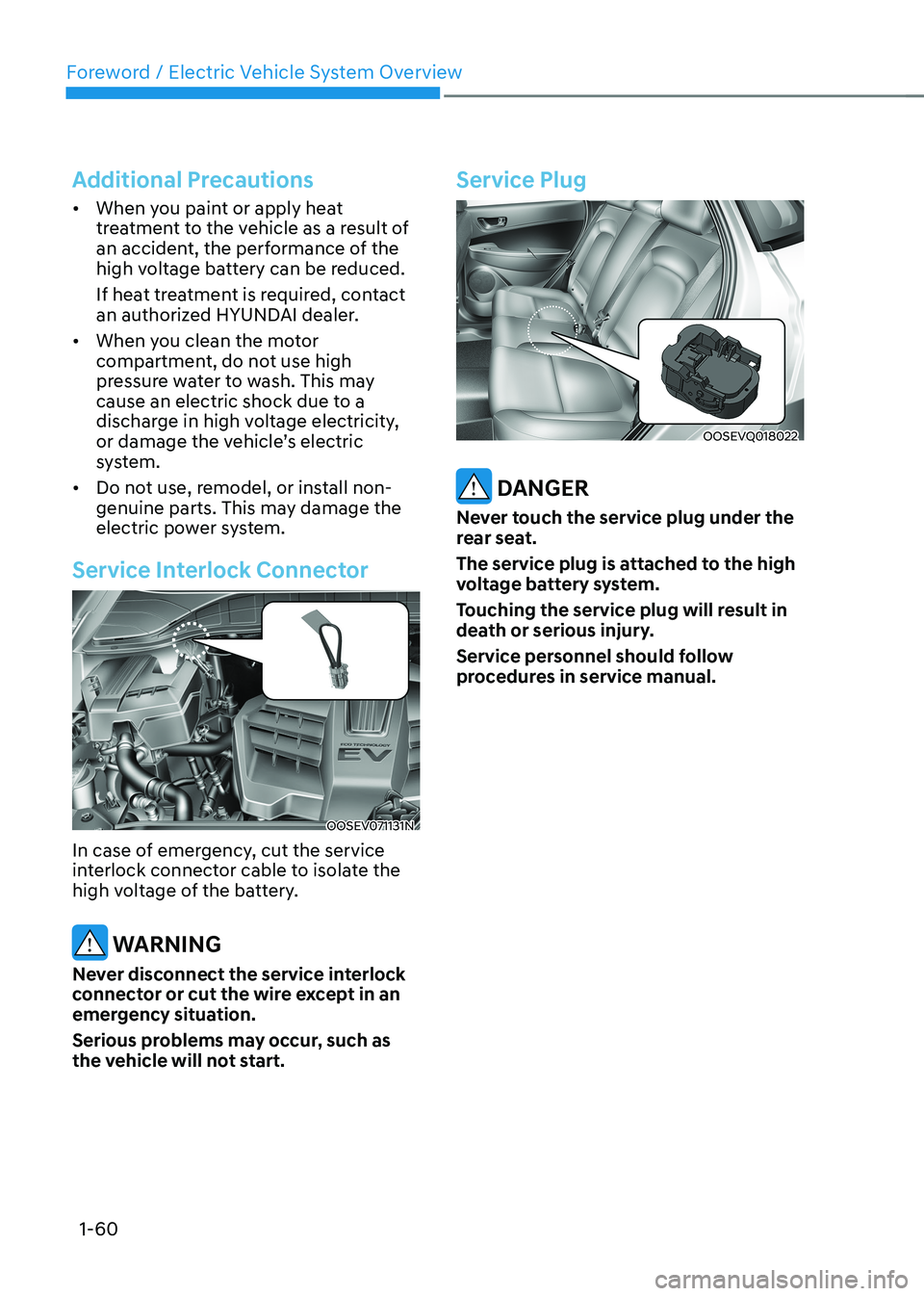
Service Interlock Connector
OOSEV071131N
In case of emergency, cut the service
interlock connector cable to isolate the
high voltage of the battery.
WARNING
Never disconnect the service interlock
connector or cut the wire except in an
emergency situation.
Serious problems may occur, such as
the vehicle will not start.
Service Plug
OOSEVQ018022
DANGER
Never touch the service plug under the
rear seat.
The service plug is attached to the high
voltage battery system.
Touching the service plug will result in
death or serious injury.
Service personnel should follow
procedures in service manual.
Page 70 of 548
2-5
02
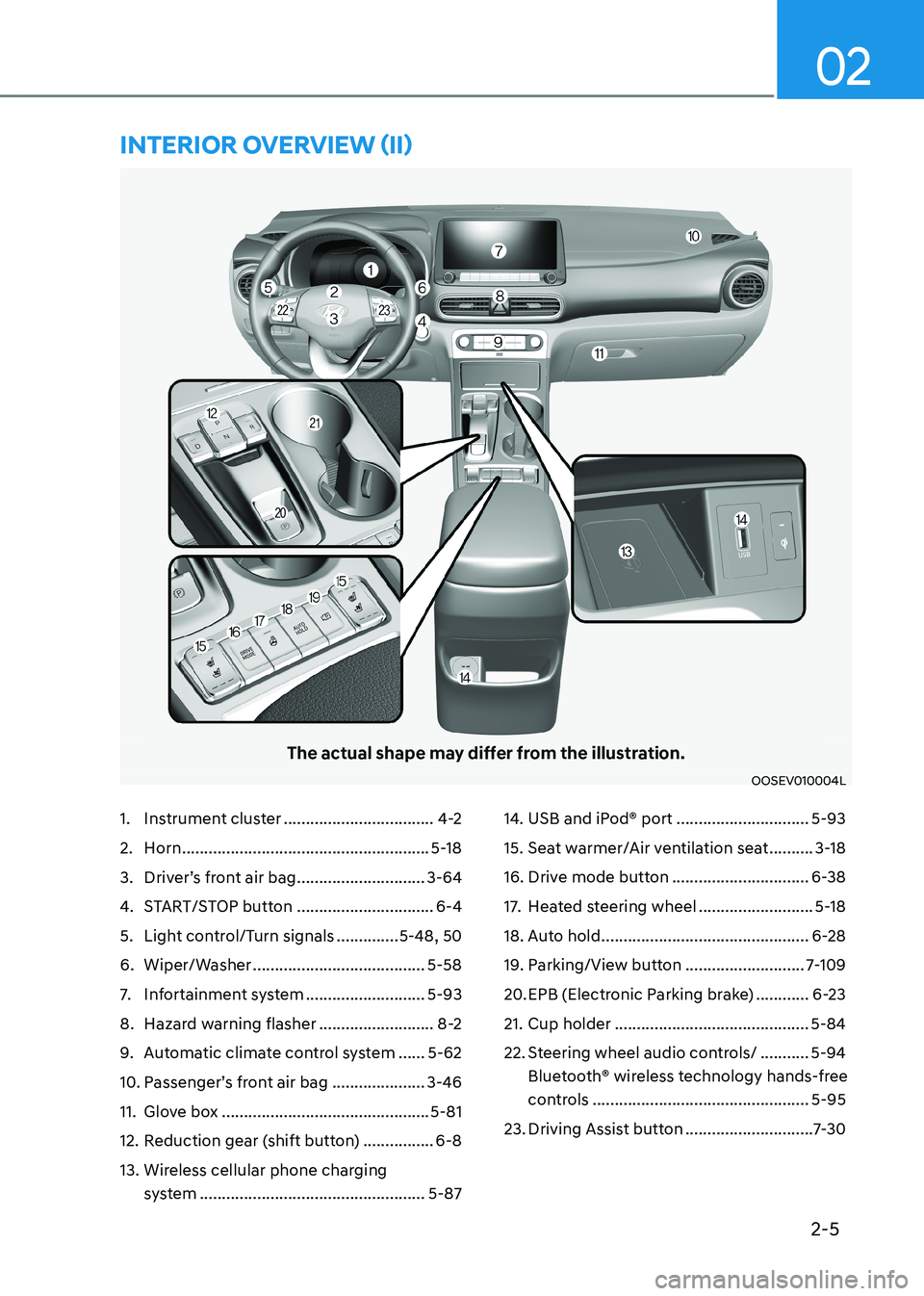
The actual shape may differ from the illustration.
OOSEV010004L
1. Instrument cluster ..................................4-2
2. Horn ........................................................ 5-18
3. Driver’s front air bag .............................3-64
4. START/STOP button ...............................6-4
5. Light control/Turn signals ..............5-48, 50
6. Wiper/Washer ....................................... 5-58
7. Infortainment system ...........................5-93
8. Hazard warning flasher ..........................8-2
9. Automatic climate control system ......5-62
10. Passenger’s front air bag ..................... 3-46
11. Glove box ............................................... 5-81
12. Reduction gear (shift button) ................6-8
13. Wireless cellular phone charging system ................................................... 5-8714. USB and iPod® port
..............................5-93
15. Seat warmer/Air ventilation seat ..........3-18
16. Drive mode button ...............................6-38
17. Heated steering wheel ..........................5-18
18. Auto hold ............................................... 6-28
19. Parking/View button ...........................7-109
20. EPB (Electronic Parking brake) ............6-23
21. Cup holder ............................................ 5-84
22. Steering wheel audio controls/ ...........5-94
Bluetooth® wireless technology hands-free
controls ................................................. 5-95
23. Driving Assist button .............................7-30
intErior ovErviEw (ii)
Page 80 of 548
3
3. Safety system
Important safety precautions ........................................................................... 3-2
Always wear your seat belt .......................................................................................... 3-2
Restrain all children ...................................................................................................... 3-2
Air bag hazards ............................................................................................................. 3-2
Driver distraction .......................................................................................................... 3-2
Control your speed ....................................................................................................... 3-2
Keep your vehicle in safe condition ............................................................................ 3-2
Seats .................................................................................................................. 3-3
Safety precautions ....................................................................................................... 3-4
Front seats .................................................................................................................... 3-5
Rear seats ................................................................................................................... 3-10
Headrest.......................................................................................................................3-13
Seat warmers and air ventilation seats ...................................................................... 3-17
Seat belts ......................................................................................................... 3-20
Seat belt safety precautions ...................................................................................... 3-20
Seat belt warning light ................................................................................................ 3-21
Seat belt restraint system .......................................................................................... 3-22
Additional seat belt safety precautions .................................................................... 3-28
Care of seat belts........................................................................................................3-30
Child Restraint System (CRS) .......................................................................... 3-31
Children always in the rear ......................................................................................... 3-31
Selecting a Child Restraint System (CRS) .................................................................3-32
Installing a Child Restraint system (CRS)..................................................................3-34
Air bag - supplemental restraint system .......................................................3-42
Where are the air bags? ............................................................................................ 3-44
How does the air bags system operate? ................................................................... 3-47
What to expect after an air bag inflates ................................................................... 3-51
Occupant Classification System (OCS) ..................................................................... 3-51
Why didn’t my air bag go off in a collision? ..............................................................3-57
Why didn’t my air bag go off in a collision? ..............................................................3-58
SRS care ...................................................................................................................... 3-63
Additional safety precautions................................................................................... 3-64
Air bag warning labels............................................................................................... 3-64
This chapter provides you with important information about how to protect yourself and your
passengers. It explains how to properly use your seats and seat belts, and how your air bags work.
Additionally, this chapter explains how to properly restrain infants and children in your vehicle.
Page 81 of 548
Safety system
3-2
You will find many safety precautions
and recommendations throughout this
section, and throughout this manual.
The safety precautions in this section are
among the most important.
Always wear your seat belt
A seat belt is your best protection in all
types of accidents. Air bags are designed
to supplement seat belts, not replace
them. So even though your vehicle is
equipped with air bags, ALWAYS make
sure you and your passengers wear your
seat belts, and wear them properly.
Restrain all children
All children under age 13 should ride
in your vehicle properly restrained in a
rear seat, not the front seat. Infants and
small children should be restrained in
an appropriate Child Restraint System.
Larger children should use a booster
seat with the lap/shoulder belt until they
can use the seat belt properly without a
booster seat.
Air bag hazards
While air bags can save lives, they can
also cause serious or fatal injuries to
occupants who sit too close to them, or
who are not properly restrained. Infants,
young children, and short adults are at
the greatest risk of being injured by an
inflating air bag. Follow all instructions
and warnings in this manual.
Driver distraction
Driver distraction presents a serious and
potentially deadly danger, especially for
inexperienced drivers. Safety should be
the first concern when behind the wheel
and drivers need to be aware of the wide
array of potential distractions, such as
drowsiness, reaching for objects, eating,
personal grooming, other passengers, and using cellular phones.
Drivers can become distracted when
they take their eyes and attention off
the road or their hands off the wheel to
focus on activities other than driving.
To reduce your risk of distraction and an
accident: •
ALWAYS set up your mobile devices
(i.e., MP3 players, phones, navigation
units, etc.) when your vehicle is
parked or safely stopped.
• ONLY use your mobile device when
allowed by laws and conditions permit
safe use. NEVER text or email while
driving. Most countries have laws
prohibiting drivers from texting. Some
countries and cities also prohibit
drivers from using handheld phones.
• NEVER let the use of a mobile device
distract you from driving. You have a
responsibility to your passengers and
others on the road to always drive
safely, with your hands on the wheel
as well as your eyes and attention on
the road.
Control your speed
Excessive speed is a major factor in crash
injuries and deaths. Generally, the higher
the speed, the greater the risk, but
serious injuries can also occur at lower
speeds. Never drive faster than is safe
for current conditions, regardless of the
maximum speed posted.
Keep your vehicle in safe
condition
Having a tire blowout or a mechanical
failure can be extremely hazardous. To
reduce the possibility of such problems,
check your tire pressures and condition
frequently, and perform all regularly
scheduled maintenance.
Important safety precautIons
Page 83 of 548
Safety system
3-4
Safety precautions
Adjusting the seats so that you are sitting
in a safe, comfortable position plays an
important role in driver and passenger
safety, together with seat belts and air
bags, in an accident.
WARNING
Do not use a cushion that reduces
friction between the seat and the
passenger. The passenger’s hips may
slide under the lap portion of the seat
belt during an accident or a sudden
stop.
Serious or fatal internal injuries could
result because the seat belt cannot
operate properly. Air bags
You can take steps to reduce the risk
of being injured by an inflating air bag.
Sitting too close to an air bag greatly
increases the risk of injury in the event
the air bag inflates. Move your seat as
far back as possible from front air bags,
while still maintaining control of the
vehicle.
WARNING
To reduce the risk of serious injury or
death from an inflating air bag, take the
following precautions: • Adjust the driver’s seat as far to the
rear as possible while maintaining
the ability to control the vehicle.
• Adjust the front passenger seat as far
to the rear as possible.
• Hold the steering wheel by the rim
with hands at the 9 o’clock and 3
o’clock positions to minimize the risk
of injuries to your hands and arms.
• NEVER place anything or anyone
between you and the air bag.
• Do not allow the front passenger to
place feet or legs on the dashboard
to minimize the risk of leg injuries.
Page 84 of 548
03
3-5
Seat belts
Always fasten your seat belt before
starting any trip. At all times, passengers
should sit upright and be properly
restrained. Infants and small children
must be restrained in appropriate Child
Restraint Systems. Children who have
outgrown a booster seat and adults must
be restrained using the seat belts.
WARNING
Take the following precautions when
adjusting your seat belt: • NEVER use one seat belt for more
than one occupant.
• Always position the seatback upright
with the lap portion of the seat belt
snug and low across the hips.
• NEVER allow children or small infants
to ride on a passenger’s lap.
• Do not route the seat belt across your
neck, across sharp edges, or reroute
the shoulder strap away from your
body.
• Do not allow the seat belt to become
caught or jammed.
Front seats
The front seat can be adjusted by using
the control lever (or knob) or switches
located on the outside of the seat
cushion. Before driving, adjust the seat
to the proper position so that you can
easily control the steering wheel, foot
pedals and controls on the instrument panel.
WARNING
Take the following precautions when
adjusting your seat: • NEVER attempt to adjust the seat
while the vehicle is moving. The seat
could respond with unexpected
movement and may cause loss
of vehicle control resulting in an
accident.
• Do not place anything under the
front seats. Loose objects in the
driver’s foot area could interfere
with the operation of the foot pedals,
causing an accident.
• Do not allow anything to interfere
with the normal position and proper
locking of the seatback.
• Do not place a cigarette lighter on
the floor or seat. When you operate
the seat, gas may exit out of the
lighter causing a fire.
• Use extreme caution when picking
up small objects trapped under the
seats or between the seat and the
center console. Your hands might be
cut or injured by the sharp edges of
the seat mechanism.
• If there are occupants in the rear
seats, be careful while adjusting the
front seat position.
• Make sure that the seat is locked in
place after the adjustment. If not,
the seat might move unexpectedly
resulting in an accident.