airbag Hyundai Matrix 2004 User Guide
[x] Cancel search | Manufacturer: HYUNDAI, Model Year: 2004, Model line: Matrix, Model: Hyundai Matrix 2004Pages: 317, PDF Size: 5.12 MB
Page 38 of 317
FEATURES OF YOUR HYUNDAI
1- 30
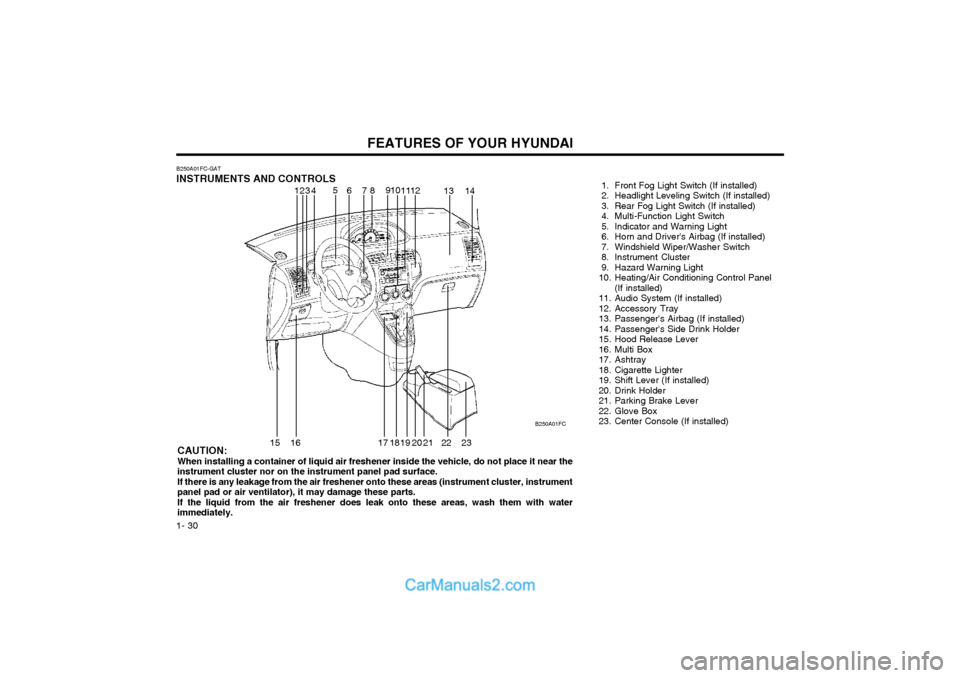
B250A01FC-GAT INSTRUMENTS AND CONTROLS
1. Front Fog Light Switch (If installed)
2. Headlight Leveling Switch (If installed)
3. Rear Fog Light Switch (If installed)
4. Multi-Function Light Switch
5. Indicator and Warning Light
6. Horn and Driver's Airbag (If installed)
7. Windshield Wiper/Washer Switch
8. Instrument Cluster
9. Hazard Warning Light
10. Heating/Air Conditioning Control Panel
(If installed)
11. Audio System (If installed)
12. Accessory Tray
13. Passenger's Airbag (If installed)
14. Passenger's Side Drink Holder
15. Hood Release Lever
16. Multi Box
17. Ashtray
18. Cigarette Lighter
19. Shift Lever (If installed)
20. Drink Holder
21. Parking Brake Lever
22. Glove Box
23. Center Console (If installed)
CAUTION:When installing a container of liquid air freshener inside the vehicle, do not place it near theinstrument cluster nor on the instrument panel pad surface.If there is any leakage from the air freshener onto these areas (instrument cluster, instrumentpanel pad or air ventilator), it may damage these parts.If the liquid from the air freshener does leak onto these areas, wash them with waterimmediately. B250A01FC
12
3
4 5
678 910
1112
13 14
15 16 17 1819 20 21 22 23
Page 39 of 317
FEATURES OF YOUR HYUNDAI 1- 31
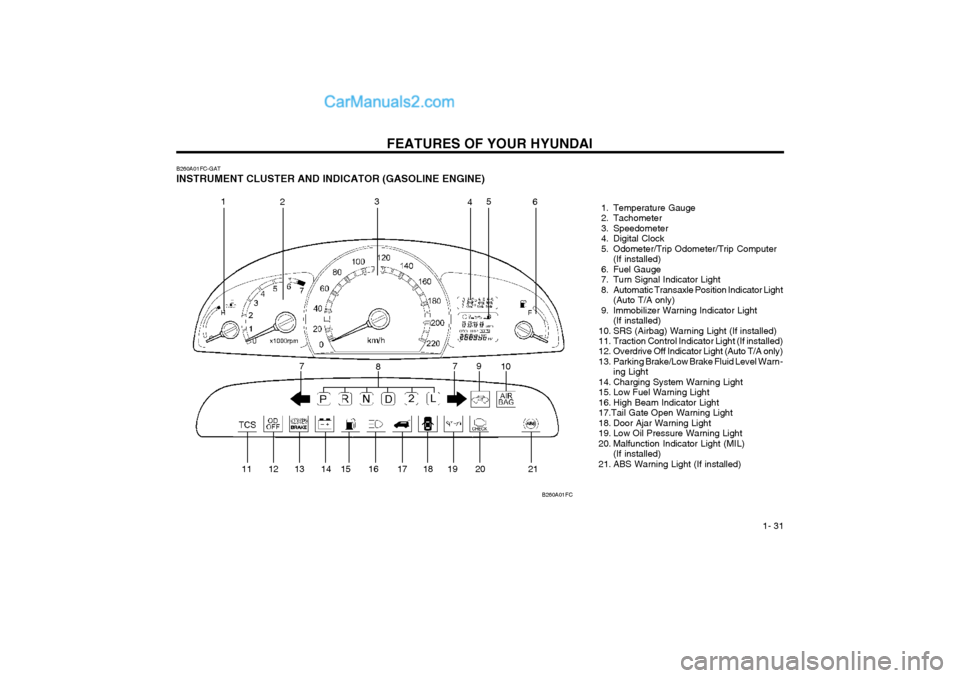
B260A01FC-GAT INSTRUMENT CLUSTER AND INDICATOR (GASOLINE ENGINE) 1. Temperature Gauge
2. Tachometer
3. Speedometer
4. Digital Clock
5. Odometer/Trip Odometer/Trip Computer(If installed)
6. Fuel Gauge
7. Turn Signal Indicator Light
8. Automatic Transaxle Position Indicator Light (Auto T/A only)
9. Immobilizer Warning Indicator Light (If installed)
10. SRS (Airbag) Warning Light (If installed)
11. Traction Control Indicator Light (If installed)
12. Overdrive Off Indicator Light (Auto T/A only)
13. Parking Brake/Low Brake Fluid Level Warn- ing Light
14. Charging System Warning Light
15. Low Fuel Warning Light
16. High Beam Indicator Light17.Tail Gate Open Warning Light
18. Door Ajar Warning Light
19. Low Oil Pressure Warning Light
20. Malfunction Indicator Light (MIL) (If installed)
21. ABS Warning Light (If installed)
B260A01FC
1
2 3
45
6
7 8 9
10
11 12 13 14 15 16 17 18 19 20 21 7
Page 40 of 317
FEATURES OF YOUR HYUNDAI
1- 32
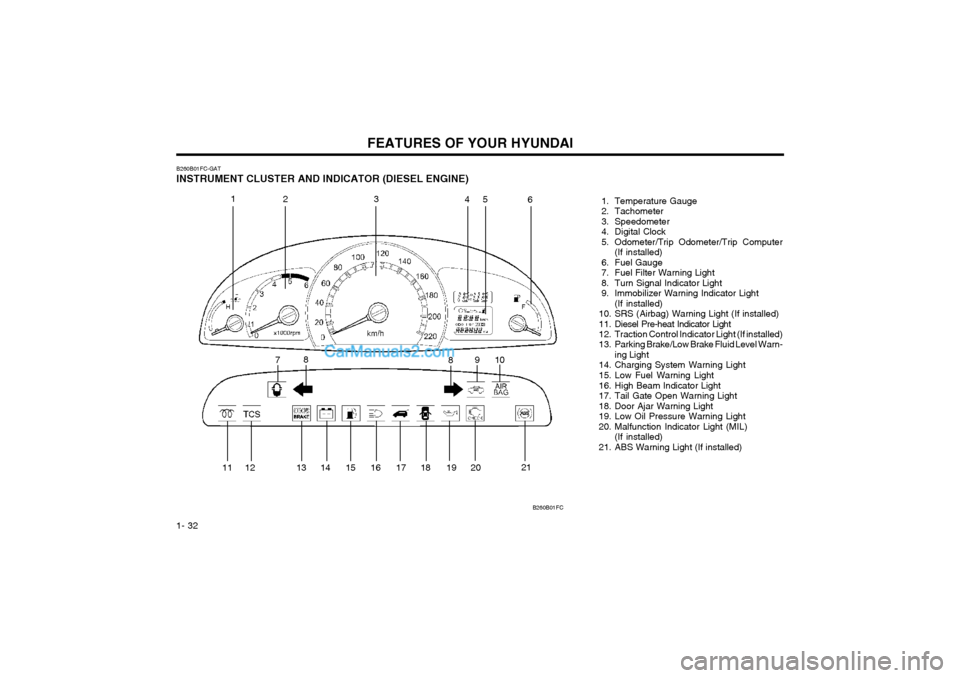
B260B01FC-GAT INSTRUMENT CLUSTER AND INDICATOR (DIESEL ENGINE)
1. Temperature Gauge
2. Tachometer
3. Speedometer
4. Digital Clock
5. Odometer/Trip Odometer/Trip Computer(If installed)
6. Fuel Gauge
7. Fuel Filter Warning Light
8. Turn Signal Indicator Light
9. Immobilizer Warning Indicator Light (If installed)
10. SRS (Airbag) Warning Light (If installed)
11. Diesel Pre-heat Indicator Light
12. Traction Control Indicator Light (If installed)
13. Parking Brake/Low Brake Fluid Level Warn- ing Light
14. Charging System Warning Light
15. Low Fuel Warning Light
16. High Beam Indicator Light
17. Tail Gate Open Warning Light
18. Door Ajar Warning Light
19. Low Oil Pressure Warning Light
20. Malfunction Indicator Light (MIL) (If installed)
21. ABS Warning Light (If installed)
B260B01FC
1 23 45
6
7 8
910
8
11 12 13 14 15 16 17 18 19 20 21
Page 41 of 317
FEATURES OF YOUR HYUNDAI 1- 33
B260B01S-GAT
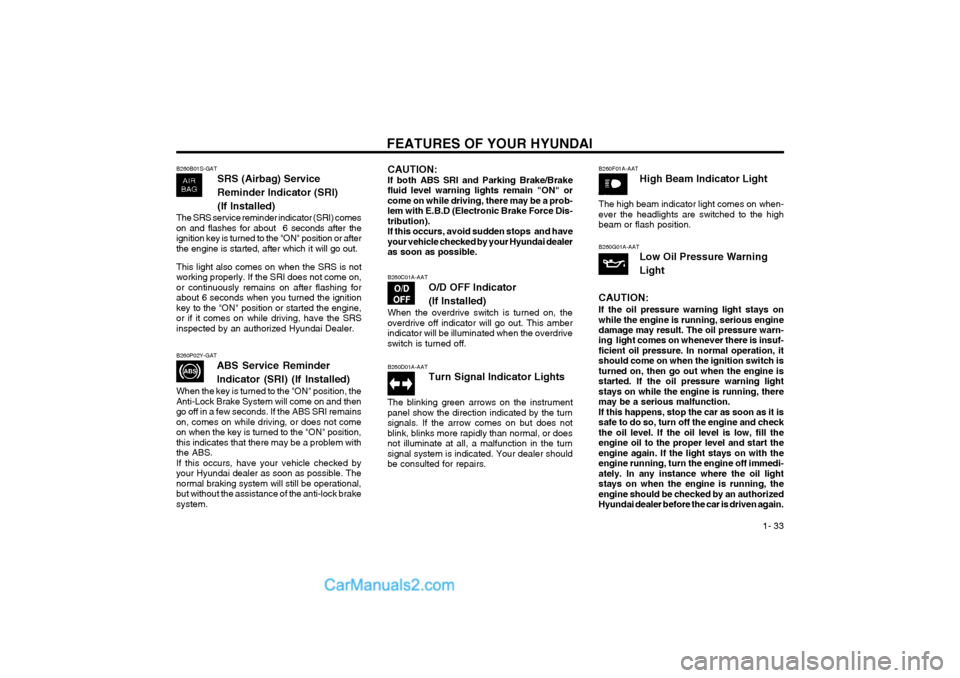
SRS (Airbag) Service Reminder Indicator (SRI)(If Installed)
The SRS service reminder indicator (SRI) comes on and flashes for about 6 seconds after theignition key is turned to the "ON" position or afterthe engine is started, after which it will go out. This light also comes on when the SRS is not working properly. If the SRI does not come on,or continuously remains on after flashing forabout 6 seconds when you turned the ignitionkey to the "ON" position or started the engine,or if it comes on while driving, have the SRSinspected by an authorized Hyundai Dealer. B260C01A-AAT
O/D OFF Indicator
(If Installed)
When the overdrive switch is turned on, the overdrive off indicator will go out. This amberindicator will be illuminated when the overdriveswitch is turned off.
B260P02Y-GAT
ABS Service Reminder
Indicator (SRI) (If Installed)
When the key is turned to the "ON" position, the Anti-Lock Brake System will come on and thengo off in a few seconds. If the ABS SRI remainson, comes on while driving, or does not comeon when the key is turned to the "ON" position,this indicates that there may be a problem withthe ABS.If this occurs, have your vehicle checked byyour Hyundai dealer as soon as possible. Thenormal braking system will still be operational,but without the assistance of the anti-lock brakesystem.
B260F01A-AAT High Beam Indicator Light
The high beam indicator light comes on when- ever the headlights are switched to the highbeam or flash position.
B260D01A-AAT Turn Signal Indicator Lights
The blinking green arrows on the instrument panel show the direction indicated by the turnsignals. If the arrow comes on but does notblink, blinks more rapidly than normal, or doesnot illuminate at all, a malfunction in the turnsignal system is indicated. Your dealer shouldbe consulted for repairs. B260G01A-AAT
Low Oil Pressure Warning Light
CAUTION: If the oil pressure warning light stays on while the engine is running, serious enginedamage may result. The oil pressure warn- ing light comes on whenever there is insuf- ficient oil pressure. In normal operation, itshould come on when the ignition switch isturned on, then go out when the engine isstarted. If the oil pressure warning lightstays on while the engine is running, theremay be a serious malfunction.If this happens, stop the car as soon as it issafe to do so, turn off the engine and checkthe oil level. If the oil level is low, fill theengine oil to the proper level and start theengine again. If the light stays on with theengine running, turn the engine off immedi-ately. In any instance where the oil lightstays on when the engine is running, theengine should be checked by an authorizedHyundai dealer before the car is driven again.
CAUTION: If both ABS SRI and Parking Brake/Brakefluid level warning lights remain "ON" orcome on while driving, there may be a prob-lem with E.B.D (Electronic Brake Force Dis-tribution).If this occurs, avoid sudden stops and haveyour vehicle checked by your Hyundai dealeras soon as possible.
Page 63 of 317
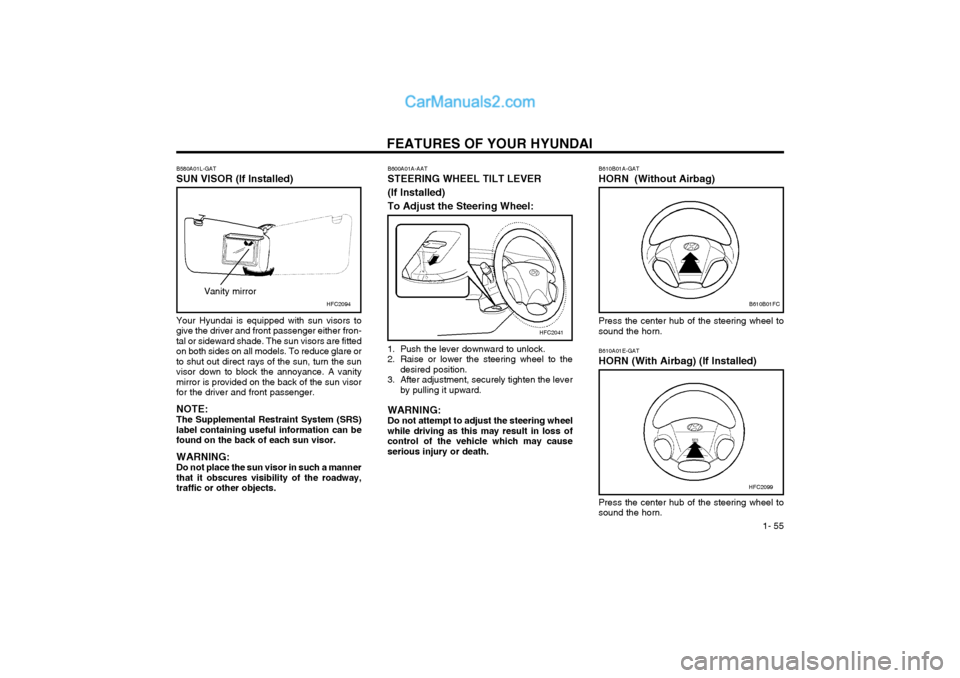
FEATURES OF YOUR HYUNDAI 1- 55
B610B01A-GAT HORN (Without Airbag)B610B01FC
Press the center hub of the steering wheel to sound the horn.
1. Push the lever downward to unlock.
2. Raise or lower the steering wheel to the desired position.
3. After adjustment, securely tighten the lever by pulling it upward.
WARNING:Do not attempt to adjust the steering wheelwhile driving as this may result in loss ofcontrol of the vehicle which may causeserious injury or death.
B600A01A-AAT STEERING WHEEL TILT LEVER (If Installed)To Adjust the Steering Wheel:
HFC2041
B610A01E-GAT HORN (With Airbag) (If Installed)
HFC2099
Press the center hub of the steering wheel to sound the horn.
B580A01L-GAT SUN VISOR (If Installed)
HFC2094
Your Hyundai is equipped with sun visors to give the driver and front passenger either fron-tal or sideward shade. The sun visors are fittedon both sides on all models. To reduce glare orto shut out direct rays of the sun, turn the sunvisor down to block the annoyance. A vanitymirror is provided on the back of the sun visorfor the driver and front passenger. NOTE: The Supplemental Restraint System (SRS)label containing useful information can befound on the back of each sun visor. WARNING: Do not place the sun visor in such a mannerthat it obscures visibility of the roadway,traffic or other objects.
Vanity mirror
Page 199 of 317
1- 17
CONTROLS AND EQUIPMENT
WARNING:
o A child restraint system must be placed in the rear seat. Never install a child orinfant seat on the front passenger's seat.Should an accident occur and cause the passenger side airbag to deploy, it could severely injure or kill an infant or child seated in an infant or child seat. Thus, only use a child restraint in the rear seat of your vehicle.
o Since a safety belt or child restraint system can become very hot if it is leftin a closed vehicle, be sure to check the seat cover and buckles before placing a child there.
o When the child restraint system is not in use, fasten it with a safety belt so thatit will not be thrown forward in the case of a sudden stop or an accident.
o Children who are too large to be in a
child restraint should still sit in the rear seat and be restrained with the avail- able lap/shoulder belts. Never allow children to ride in the front passenger seat.
o Always make sure that the shoulder belt portion of the outboard lap/shoulder beltis positioned midway over the shoul- der, never across the neck or behind the back. Moving the child closer to the center of the vehicle may help provide a good shoulder belt fit. The lap belt por- tion of the lap/shoulder belt or thecenter seat lap belt must always be positioned as low as possible on the child's hips and as snug as possible.
o If the seat belt will not properly fit the child, we recommend the use of anapproved booster seat in the rear seat in order to raise the child's seating height so that the seat belt will prop- erly fit the child.
o Never allow a child to stand up or kneel on the seat.
o Never use an infant carrier or child
safety seat that "hooks" over aseatback; it may not provide adequate security in an accident.
o Never allow a child to be held in a person's arms while they are in a mov-ing vehicle, as this could result in se- rious injury to the child in the event of an accident or a sudden stop. Holding a child in a moving vehicle does not provide the child with any means of protection during an accident, even if the person holding the child is wearing a seat belt.
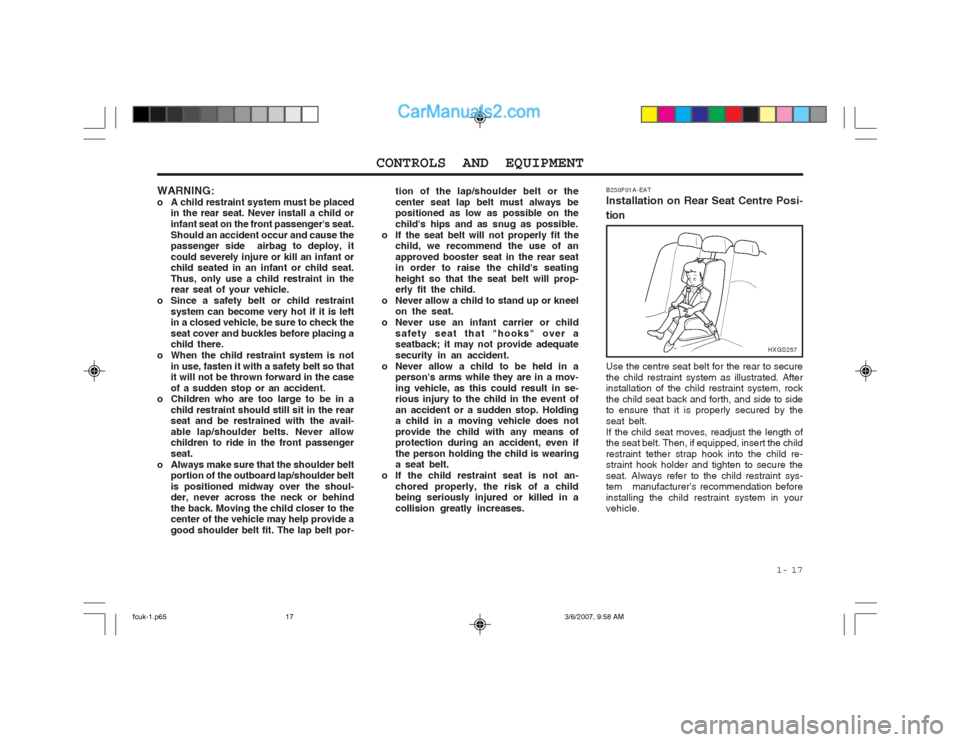
o If the child restraint seat is not an- chored properly, the risk of a childbeing seriously injured or killed in a collision greatly increases. B230F01A-EAT Installation on Rear Seat Centre Posi- tion Use the centre seat belt for the rear to secure the child restraint system as illustrated. After installation of the child restraint system, rock the child seat back and forth, and side to side to ensure that it is properly secured by the seat belt.If the child seat moves, readjust the length of the seat belt. Then, if equipped, insert the child restraint tether strap hook into the child re- straint hook holder and tighten to secure the seat. Always refer to the child restraint sys- tem manufacturer’s recommendation before installing the child restraint system in your vehicle.
HXGS257
fcuk-1.p65
3/6/2007, 9:58 AM
17
Page 200 of 317
CONTROLS AND EQUIPMENT
1- 18
B230G01A-GAT Installation on Outboard Rear Seats
NOTE:
o Before installing the child restraint
system, read the instructions suppliedby the child restraint system manufac- turer.
o If the seat belt does not operate as
described, have the system checkedimmediately by your authorized Hyundai dealer.
WARNING:Do not install any child restraint system inthe front passenger seat. Should an acci- dent occur and cause the passenger side airbag to deploy, it could severely injure or kill an infant or child seated in an infant or child seat. Therefore, only use a child restraint system in the rear seat of your vehicle.
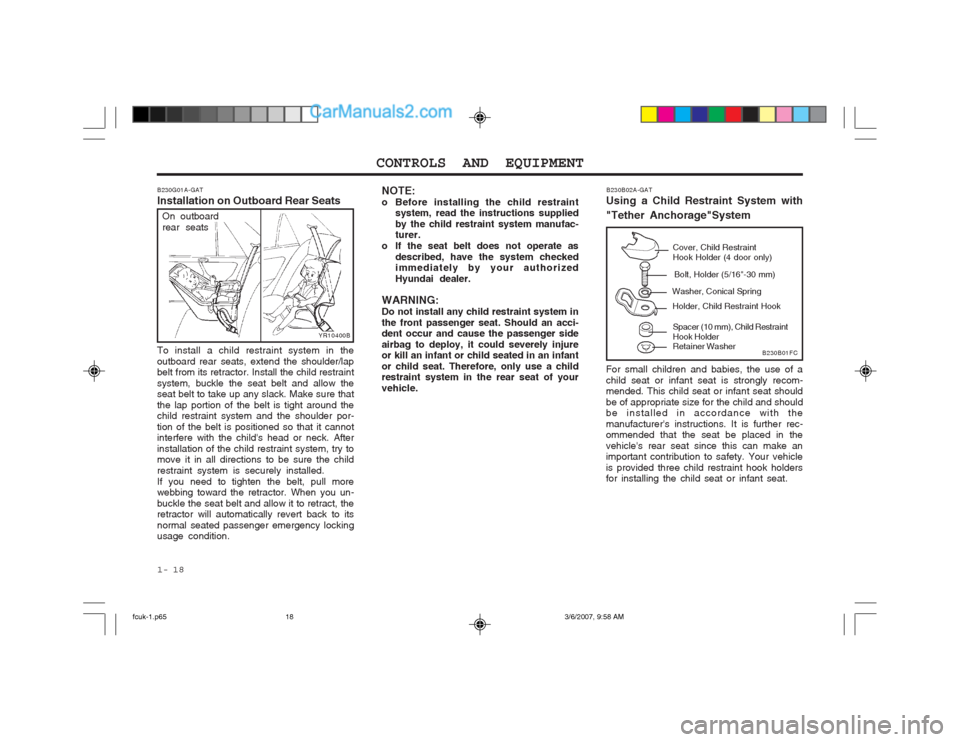
To install a child restraint system in theoutboard rear seats, extend the shoulder/lap belt from its retractor. Install the child restraint system, buckle the seat belt and allow the seat belt to take up any slack. Make sure that the lap portion of the belt is tight around the child restraint system and the shoulder por- tion of the belt is positioned so that it cannot interfere with the child's head or neck. After installation of the child restraint system, try to move it in all directions to be sure the child restraint system is securely installed.If you need to tighten the belt, pull more webbing toward the retractor. When you un- buckle the seat belt and allow it to retract, the retractor will automatically revert back to its normal seated passenger emergency locking usage condition.
YR10400B
On outboard rear seats
B230B02A-GAT
Using a Child Restraint System with "Tether Anchorage"System For small children and babies, the use of a child seat or infant seat is strongly recom- mended. This child seat or infant seat should be of appropriate size for the child and should be installed in accordance with the manufacturer's instructions. It is further rec- ommended that the seat be placed in the vehicle's rear seat since this can make an important contribution to safety. Your vehicle is provided three child restraint hook holders for installing the child seat or infant seat.
Cover, Child Restraint Hook Holder (4 door only)
Bolt, Holder (5/16"-30 mm)
Washer, Conical Spring Holder, Child Restraint Hook
Spacer (10 mm), Child RestraintHook Holder Retainer Washer
B230B01FC
fcuk-1.p65 3/6/2007, 9:58 AM
18
Page 202 of 317
CONTROLS AND EQUIPMENT
1- 20
Age Group Seating PositionFront
Passenger Rear
Outboard Rear
Centre
0 : Up to 10 kg (0 ~ 9 months) 0+ : Up to 13 kg (0 ~ 2 years)I : 9kg to 18kg(9 months ~4 years)II & III : 15kg to 36kg(4 ~ 12 years)XUX
XUX
X U, L1 U F XU FUF B180B01S-DAG
B180B01A-EAT Pre-Tensioner Seat BeltYour Hyundai vehicle is equipped with driver's and front passenger's pre-tensioner seat belts. The purpose of the pre-tensioner is to make sure that the seat belts fit tightly against the occupant's body in certain frontal collisions. The pre-tensioner seat belts can be activated with the airbags.
The pre-tensioner seat belt operates in the same way as an Emergency Locking Retrac- tor (ELR) type of seat belt. When the vehicle stops suddenly, or if the occupant tries to lean forward too quickly, the seat belt retractor will lock into position. However, in certain frontal collisions, the pre-tensioner will activate and pull the seat belt into tighter contact against the occupant's body.
B230H04A-GAT
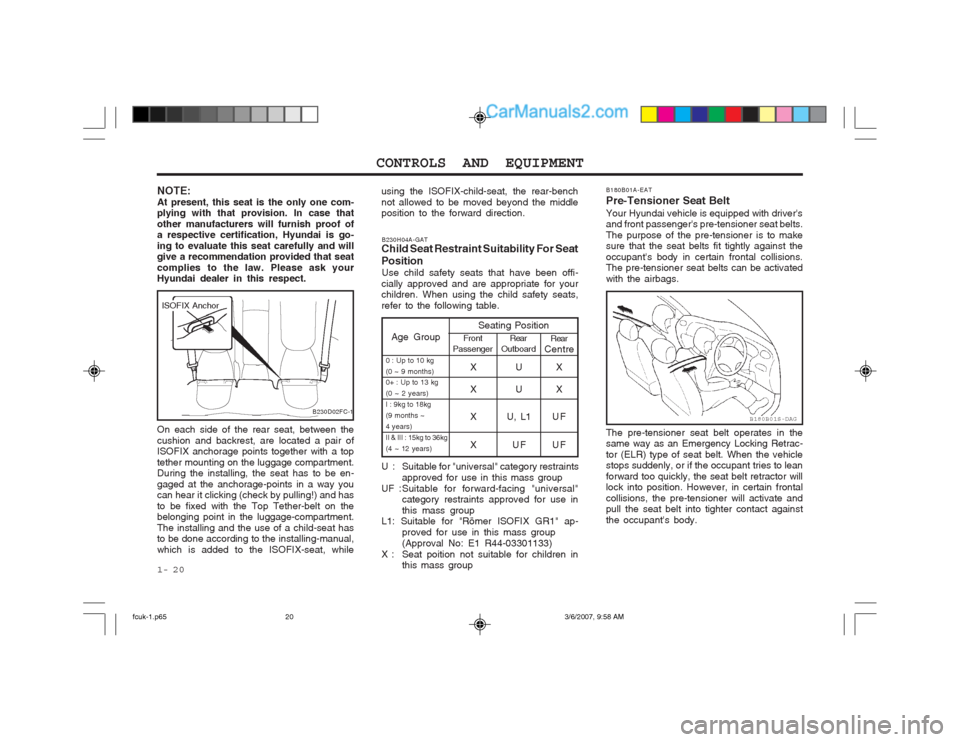
Child Seat Restraint Suitability For Seat Position
Use child safety seats that have been offi-
cially approved and are appropriate for your children. When using the child safety seats, refer to the following table.
U : Suitable for "universal" category restraints approved for use in this mass group
UF :Suitable for forward-facing "universal" category restraints approved for use in this mass group
L1: Suitable for "Römer ISOFIX GR1" ap-
proved for use in this mass group(Approval No: E1 R44-03301133)
X : Seat poition not suitable for children in this mass group
B230D02FC-1
ISOFIX Anchor
NOTE: At present, this seat is the only one com- plying with that provision. In case that other manufacturers will furnish proof of a respective certification, Hyundai is go- ing to evaluate this seat carefully and will give a recommendation provided that seat complies to the law. Please ask your Hyundai dealer in this respect. On each side of the rear seat, between the cushion and backrest, are located a pair of ISOFIX anchorage points together with a top tether mounting on the luggage compartment. During the installing, the seat has to be en- gaged at the anchorage-points in a way you can hear it clicking (check by pulling!) and has to be fixed with the Top Tether-belt on the belonging point in the luggage-compartment. The installing and the use of a child-seat has to be done according to the installing-manual, which is added to the ISOFIX-seat, while using the ISOFIX-child-seat, the rear-benchnot allowed to be moved beyond the middle position to the forward direction.
fcuk-1.p65
3/6/2007, 9:58 AM
20
Page 203 of 317
1- 21
CONTROLS AND EQUIPMENT
authorized Hyundai dealer inspect the pre-tensioner seat belt or SRS airbag system as soon as possible.
WARNING:
o Pre-tensioners are designed to operate only one time. After activation, pre- tensioner seat belts must be replaced. All seat belts, of any type, should al- ways be replaced after they have been worn during a collision.
o The pre-tensioner seat belt assembly mechanisms become hot during activa-tion. Do not touch the pre-tensioner seat belt assemblies for several min- utes after they have been activated.
o Do not attempt to inspect or replace the pre-tensioner seat belts yourself. Thismust be done by an authorized Hyundai dealer.
o Do not strike the pre-tensioner seat belt assemblies.
o Do not attempt to service or repair the pre-tensioner seat belt system in any manner.
o Improper handling of the pre-tensioner
seat belt assemblies, and failure to heed the warnings to not strike, modify, in- spect, replace, service or repair the pre- tensioner seat belt assemblies may lead to improper operation or inadvertent activation and serious injury.
o Always wear the seat belts when driving or travelling in a motor vehicle.
Driver's airbag conditions even if the seat belts are not being worn at the time of the collision.
o When the pre-tensioner seat belts are
activated, a loud noise may be heardand fine dust, which may appear to be smoke, may be visible in the passenger compartment. These are normal operat- ing conditions and are not hazardous.
o Although it is harmless, the fine dust
may cause skin irritation and should not be breathed for prolonged periods. Wash your hands and face thoroughly after an accident in which the pre- tensioner seat belts were activated.
CAUTION:
o Because the sensor that activates the SRS airbag is connected with the pre- tensioner seat belt, the SRS airbag warn- ing light on the instrument panel will blink for approximately 6 seconds after the ignition key has been turned to the "ON" position and then it should turn off.
o If the pre-tensioner seat belt is not work- ing properly, this warning light will illu-minate even if there is no malfunction of the SRS airbag system.If the SRS airbag warning light does not illuminate when the ignition key is turned to "ON", or if it remains illuminated after blinking for approximately 6 sec- onds, or if it illuminates while the ve- hicle is being driven, please have an
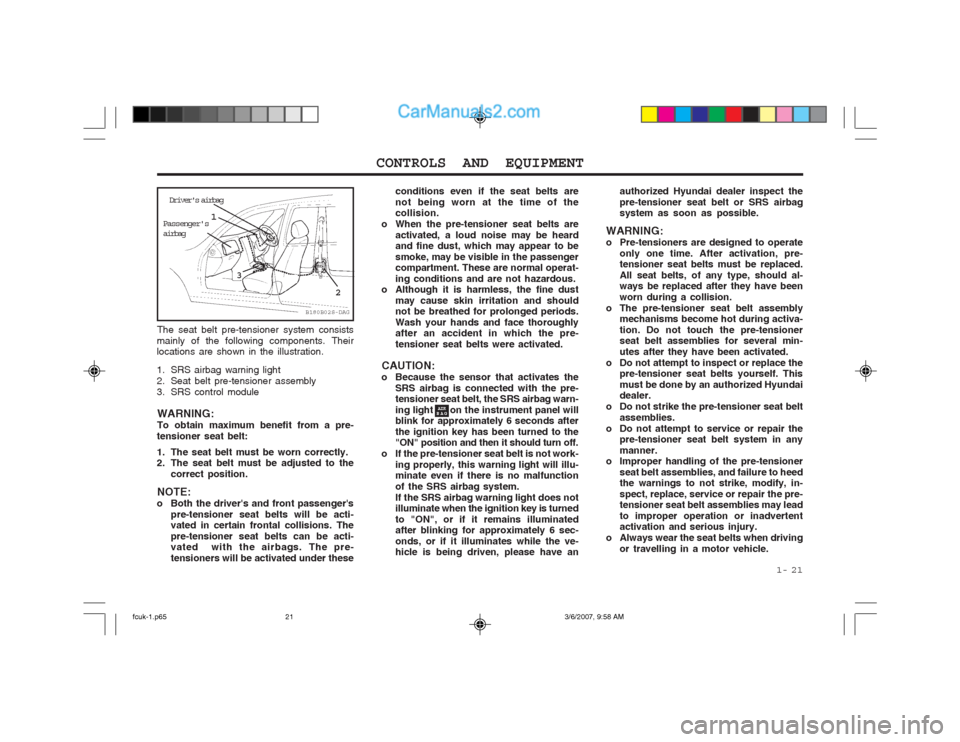
The seat belt pre-tensioner system consists
mainly of the following components. Theirlocations are shown in the illustration.
1. SRS airbag warning light
2. Seat belt pre-tensioner assembly
3. SRS control module
WARNING:To obtain maximum benefit from a pre-
tensioner seat belt:
1. The seat belt must be worn correctly.
2. The seat belt must be adjusted to the correct position.
NOTE:
o Both the driver's and front passenger's
pre-tensioner seat belts will be acti-vated in certain frontal collisions. The pre-tensioner seat belts can be acti- vated with the airbags. The pre- tensioners will be activated under these
1
2
3
B180B02S-DAG
Passenger's airbag
AIR
BAG
fcuk-1.p65 3/6/2007, 9:58 AM
21
Page 204 of 317
CONTROLS AND EQUIPMENT
1- 22
Your Hyundai is equipped with a Supplemen- tal Restraint (Airbag) System. The indications of the system's presence are the letters "SRS AIR BAG" embossed on the airbag pad cover in the steering wheel and the passenger's side front panel pad above the glove box. The Hyundai SRS consists of airbags in- stalled under the pad covers in the centre of the steering wheel and the passenger's side front panel above the glove box. The purpose of the SRS is to provide the vehicle's driver and/or the front passenger with additional protection than that offered by the seat belt system alone, in case of a frontal impact of sufficient severity. NOTE:Be sure to read information about the SRS
on the labels provided on the backside of the sun visor and in the glove box.
WARNING:
o As its name implies, the SRS is de- signed to work with, and be supplemen- tal to, the driver's and the passenger's three point seat belt systems and is not a substitute for them. Therefore your seat belts must be worn at all times while the vehicle is in motion. In addi- tion, the airbags deploy only in certain frontal impact conditions severe enough to likely cause significant injury to the vehicle occupants.
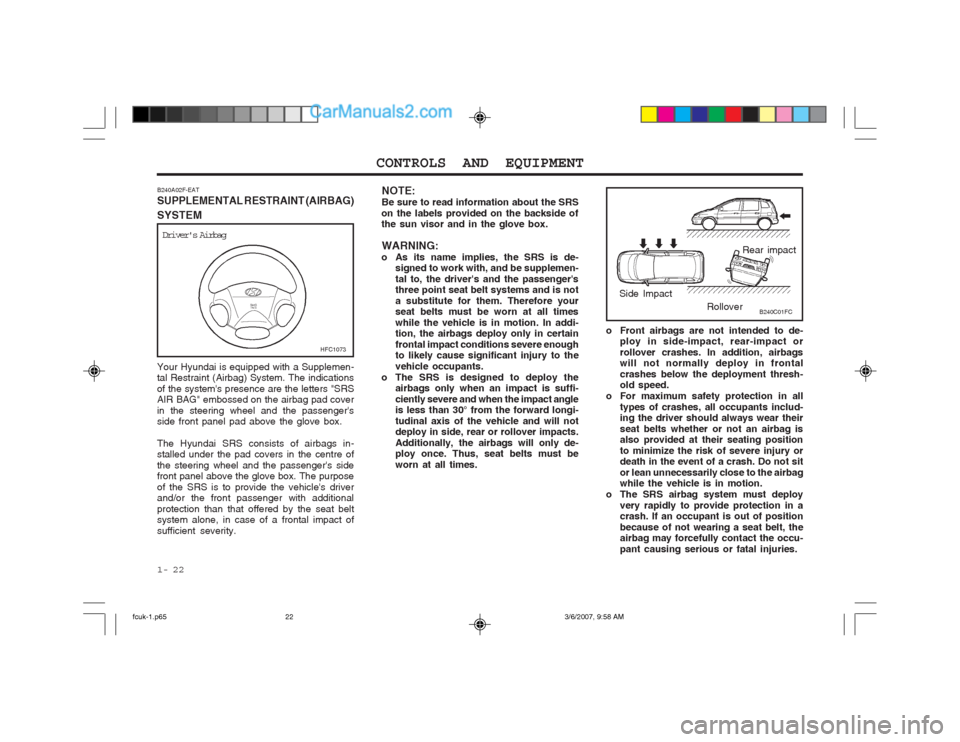
o The SRS is designed to deploy the airbags only when an impact is suffi-ciently severe and when the impact angle is less than 30° from the forward longi- tudinal axis of the vehicle and will not deploy in side, rear or rollover impacts. Additionally, the airbags will only de- ploy once. Thus, seat belts must be worn at all times.
Driver's Airbag
B240A02F-EAT
SUPPLEMENTAL RESTRAINT (AIRBAG)
SYSTEM
HFC1073
Rear impact
Side Impact RolloverB240C01FC
o Front airbags are not intended to de-
ploy in side-impact, rear-impact or rollover crashes. In addition, airbags will not normally deploy in frontal crashes below the deployment thresh- old speed.
o For maximum safety protection in all types of crashes, all occupants includ-ing the driver should always wear their seat belts whether or not an airbag is also provided at their seating position to minimize the risk of severe injury or death in the event of a crash. Do not sit or lean unnecessarily close to the airbag while the vehicle is in motion.
o The SRS airbag system must deploy very rapidly to provide protection in acrash. If an occupant is out of position because of not wearing a seat belt, the airbag may forcefully contact the occu- pant causing serious or fatal injuries.
fcuk-1.p65 3/6/2007, 9:58 AM
22