coolant level Hyundai Matrix 2004 User Guide
[x] Cancel search | Manufacturer: HYUNDAI, Model Year: 2004, Model line: Matrix, Model: Hyundai Matrix 2004Pages: 317, PDF Size: 5.12 MB
Page 142 of 317
DO-IT-YOURSELF MAINTENANCE
6-8
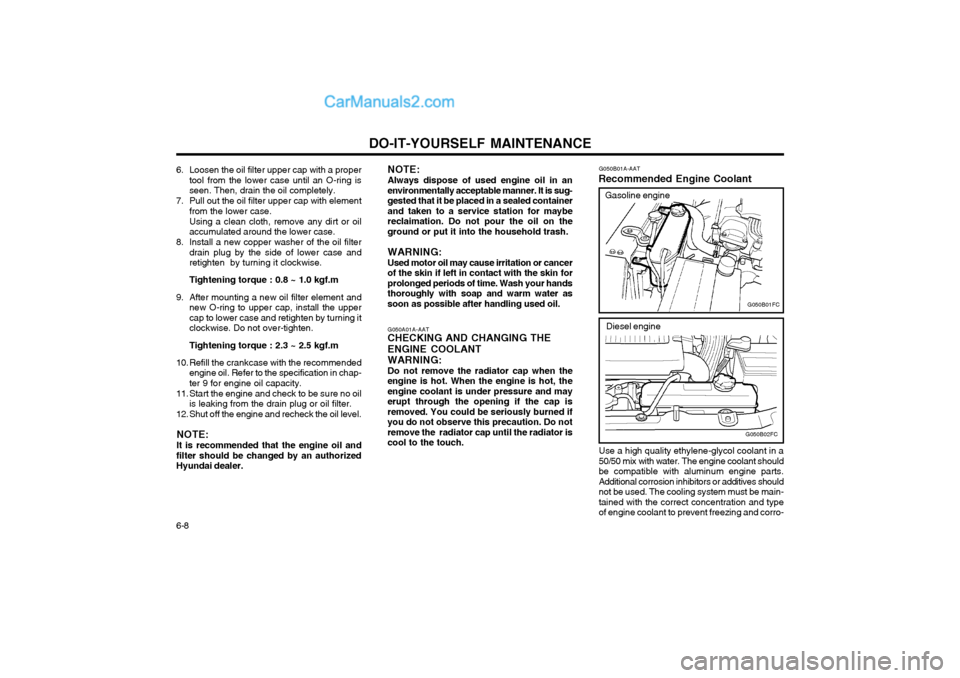
G050B01A-AAT
Recommended Engine Coolant
Use a high quality ethylene-glycol coolant in a 50/50 mix with water. The engine coolant shouldbe compatible with aluminum engine parts.Additional corrosion inhibitors or additives shouldnot be used. The cooling system must be main-tained with the correct concentration and typeof engine coolant to prevent freezing and corro-
G050B01FC
G050B02FC
Gasoline engine
Diesel engine
6. Loosen the oil filter upper cap with a proper tool from the lower case until an O-ring is seen. Then, drain the oil completely.
7. Pull out the oil filter upper cap with element from the lower case. Using a clean cloth, remove any dirt or oil accumulated around the lower case.
8. Install a new copper washer of the oil filter drain plug by the side of lower case andretighten by turning it clockwise.
Tightening torque : 0.8 ~ 1.0 kgf.m
9. After mounting a new oil filter element and new O-ring to upper cap, install the upper cap to lower case and retighten by turning itclockwise. Do not over-tighten.
Tightening torque : 2.3 ~ 2.5 kgf.m
10. Refill the crankcase with the recommended engine oil. Refer to the specification in chap- ter 9 for engine oil capacity.
11. Start the engine and check to be sure no oil is leaking from the drain plug or oil filter.
12. Shut off the engine and recheck the oil level.
NOTE: It is recommended that the engine oil and
filter should be changed by an authorized Hyundai dealer. G050A01A-AAT
CHECKING AND CHANGING THE ENGINE COOLANT
WARNING: Do not remove the radiator cap when the
engine is hot. When the engine is hot, the engine coolant is under pressure and mayerupt through the opening if the cap isremoved. You could be seriously burned ifyou do not observe this precaution. Do notremove the radiator cap until the radiator iscool to the touch. NOTE: Always dispose of used engine oil in an environmentally acceptable manner. It is sug-gested that it be placed in a sealed containerand taken to a service station for maybereclaimation. Do not pour the oil on theground or put it into the household trash. WARNING: Used motor oil may cause irritation or
cancer
of the skin if left in contact with the skin for prolonged periods of time. Wash your handsthoroughly with soap and warm water assoon as possible after handling used oil.
Page 143 of 317
DO-IT-YOURSELF MAINTENANCE 6-9
35% 65%
40% 60%
50% 50%
60% 40%
Ambient
temperature °C ( °F)-15 (5)
-25 (-13) -35 (-31)-45 (-49)
Antifreeze solution Water
Engine coolant concentration G050C01A-GAT
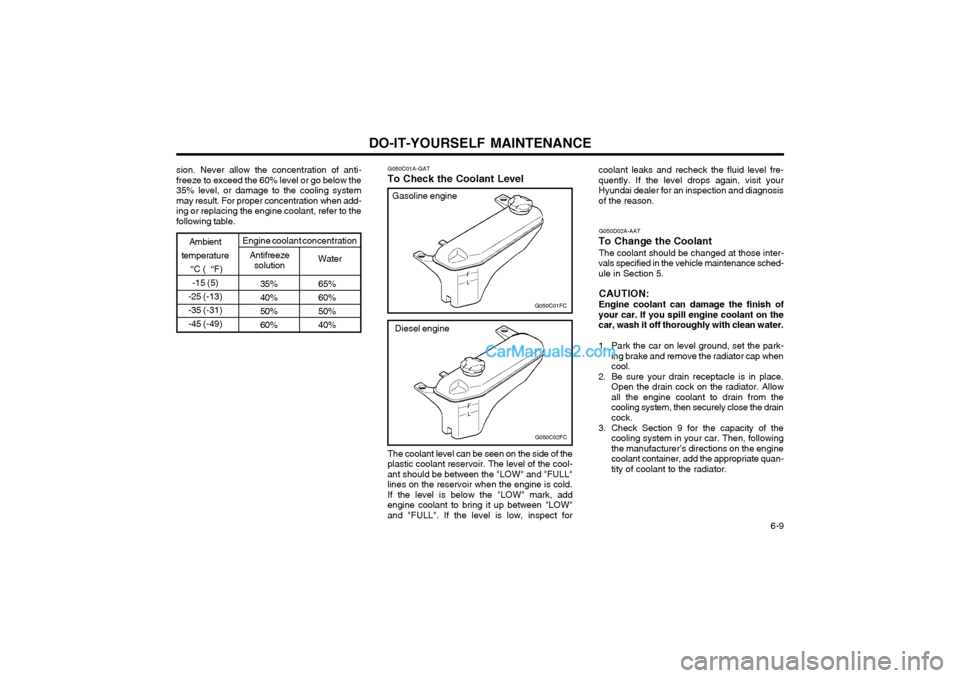
To Check the Coolant Level
G050C01FC
The coolant level can be seen on the side of the
plastic coolant reservoir. The level of the cool- ant should be between the "LOW" and "FULL"lines on the reservoir when the engine is cold.If the level is below the "LOW" mark, addengine coolant to bring it up between "LOW"and "FULL". If the level is low, inspect for G050D02A-AAT
To Change the Coolant The coolant should be changed at those inter-
vals specified in the vehicle maintenance sched-ule in Section 5.
CAUTION: Engine coolant can damage the finish of
your car. If you spill engine coolant on the car, wash it off thoroughly with clean water.
1. Park the car on level ground, set the park- ing brake and remove the radiator cap when cool.
2. Be sure your drain receptacle is in place. Open the drain cock on the radiator. Allowall the engine coolant to drain from thecooling system, then securely close the draincock.
3. Check Section 9 for the capacity of the cooling system in your car. Then, followingthe manufacturer’s directions on the enginecoolant container, add the appropriate quan-tity of coolant to the radiator.
G050C02FC
Diesel engine
Gasoline engine
sion. Never allow the concentration of anti- freeze to exceed the 60% level or go below the35% level, or damage to the cooling systemmay result. For proper concentration when add-ing or replacing the engine coolant, refer to thefollowing table.
coolant leaks and recheck the fluid level fre-quently. If the level drops again, visit yourHyundai dealer for an inspection and diagnosisof the reason.
Page 144 of 317
DO-IT-YOURSELF MAINTENANCE
6-10
CHAMPION NGK RC10YC BKR5ES
Unleaded
engine Leaded
engine
RC10YC4 BKR5ES-11
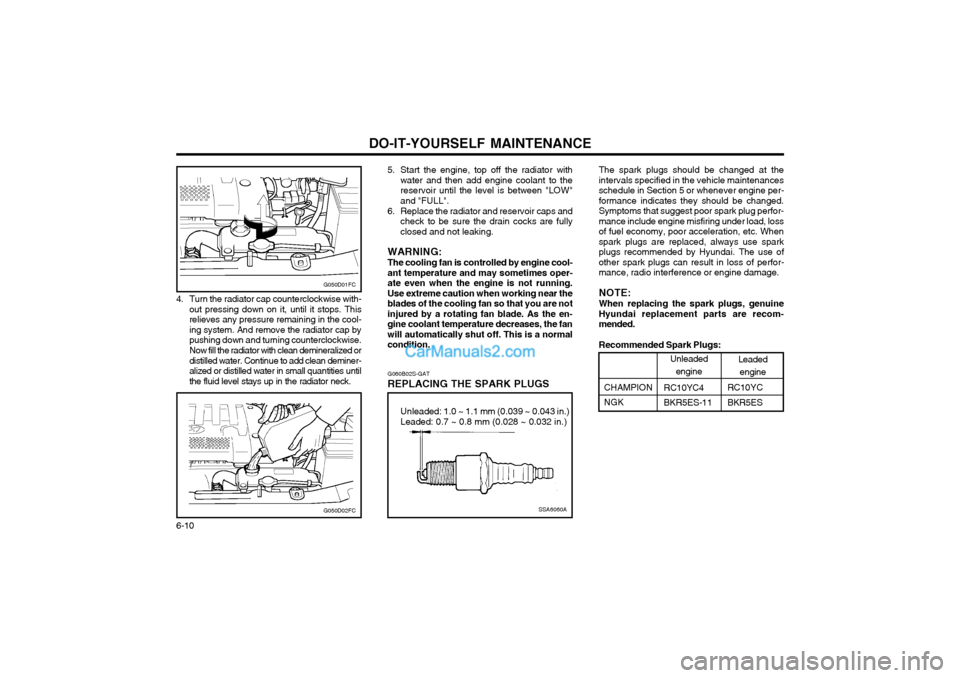
4. Turn the radiator cap counterclockwise with-
out pressing down on it, until it stops. This relieves any pressure remaining in the cool-ing system. And remove the radiator cap bypushing down and turning counterclockwise. Now fill the radiator with clean demineralized or distilled water. Continue to add clean deminer-alized or distilled water in small quantities untilthe fluid level stays up in the radiator neck. G060B02S-GAT
REPLACING THE SPARK PLUGS The spark plugs should be changed at theintervals specified in the vehicle maintenancesschedule in Section 5 or whenever engine per-formance indicates they should be changed.Symptoms that suggest poor spark plug perfor-mance include engine misfiring under load, lossof fuel economy, poor acceleration, etc. Whenspark plugs are replaced, always use sparkplugs recommended by Hyundai. The use ofother spark plugs can result in loss of perfor-mance, radio interference or engine damage. NOTE: When replacing the spark plugs, genuine Hyundai replacement parts are recom-mended. Recommended Spark Plugs:
SSA6060A
Unleaded: 1.0 ~ 1.1 mm (0.039 ~ 0.043 in.) Leaded: 0.7 ~ 0.8 mm (0.028 ~ 0.032 in.)
G050D01FC
5. Start the engine, top off the radiator with
water and then add engine coolant to the reservoir until the level is between "LOW"and "FULL".
6. Replace the radiator and reservoir caps and check to be sure the drain cocks are fullyclosed and not leaking.
WARNING: The cooling fan is controlled by engine cool- ant temperature and may sometimes oper-ate even when the engine is not running.Use extreme caution when working near theblades of the cooling fan so that you are notinjured by a rotating fan blade. As the en-gine coolant temperature decreases, the fanwill automatically shut off. This is a normalcondition.
G050D02FC
Page 147 of 317
DO-IT-YOURSELF MAINTENANCE 6-13
CAUTION:
o Radiator antifreeze (engine coolant) should not be used in the washer system because it will damage the car's finish.
o The washer lever should not be pulled and the washer should not be operated ifthe washer reservoir is empty. This candamage the washer fluid pump.
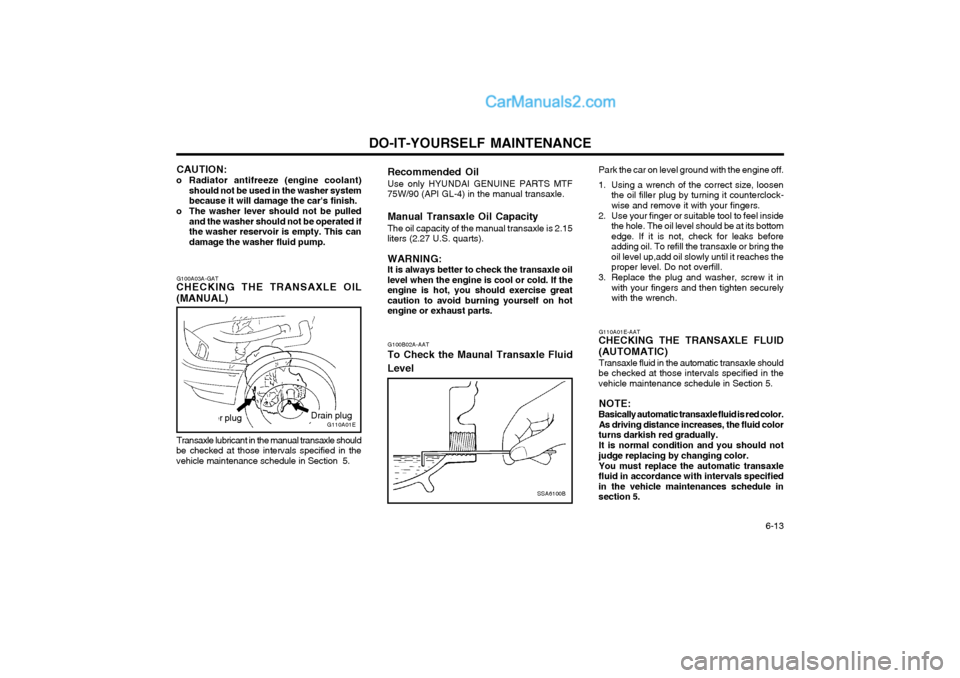
G100B02A-AAT
To Check the Maunal Transaxle Fluid Level
SSA6100B
Park the car on level ground with the engine off.
1. Using a wrench of the correct size, loosen the oil filler plug by turning it counterclock- wise and remove it with your fingers.
2. Use your finger or suitable tool to feel inside the hole. The oil level should be at its bottomedge. If it is not, check for leaks beforeadding oil. To refill the transaxle or bring theoil level up,add oil slowly until it reaches theproper level. Do not overfill.
3. Replace the plug and washer, screw it in with your fingers and then tighten securelywith the wrench.
Filler plugG110A01E
Transaxle lubricant in the manual transaxle should
be checked at those intervals specified in the vehicle maintenance schedule in Section 5. G100A03A-GAT
CHECKING THE TRANSAXLE OIL (MANUAL)Drain plug Recommended Oil
Use only HYUNDAI GENUINE PARTS MTF
75W/90 (API GL-4) in the manual transaxle. Manual Transaxle Oil Capacity
The oil capacity of the manual transaxle is 2.15
liters (2.27 U.S. quarts).
WARNING: It is always better to check the transaxle oil
level when the engine is cool or cold. If the engine is hot, you should exercise greatcaution to avoid burning yourself on hotengine or exhaust parts.
G110A01E-AAT
CHECKING THE TRANSAXLE FLUID (AUTOMATIC)
Transaxle fluid in the automatic transaxle should
be checked at those intervals specified in the vehicle maintenance schedule in Section 5.
NOTE:
Basically automatic transaxle fluid is red color. As driving distance increases, the fluid color
turns darkish red gradually.
It is normal condition and you should not
judge replacing by changing color.
You must replace the automatic transaxle
fluid in accordance with intervals specifiedin the vehicle maintenances schedule insection 5.
Page 149 of 317
DO-IT-YOURSELF MAINTENANCE 6-15
WARNING: The cooling fan is controlled by engine cool-
ant temperature and may sometimes oper- ate even when the engine is not running.Use extreme caution when working near theblades of the cooling fan, so that you are notinjured by a rotating fan blade. As the en-gine coolant temperature decreases, the fanwill automatically shut off. This is a normalcondition.
WARNING (Diesel only): Never work on injection system with engine
running or within 30 seconds after shutting off engine. High pressure pump, rail, injec-tors and high pressure pipes are subject tohigh pressure even after the engine stopped.The fuel jet produced by fuel leaks maycause serious injury, if it touch the body.People using pacemakers should not movethan 30cm closer to the ECU or wiring har-ness within the engine room while engine isrunning, since the high currents in the Com-mon Rail system produce considerable mag-netic fields.
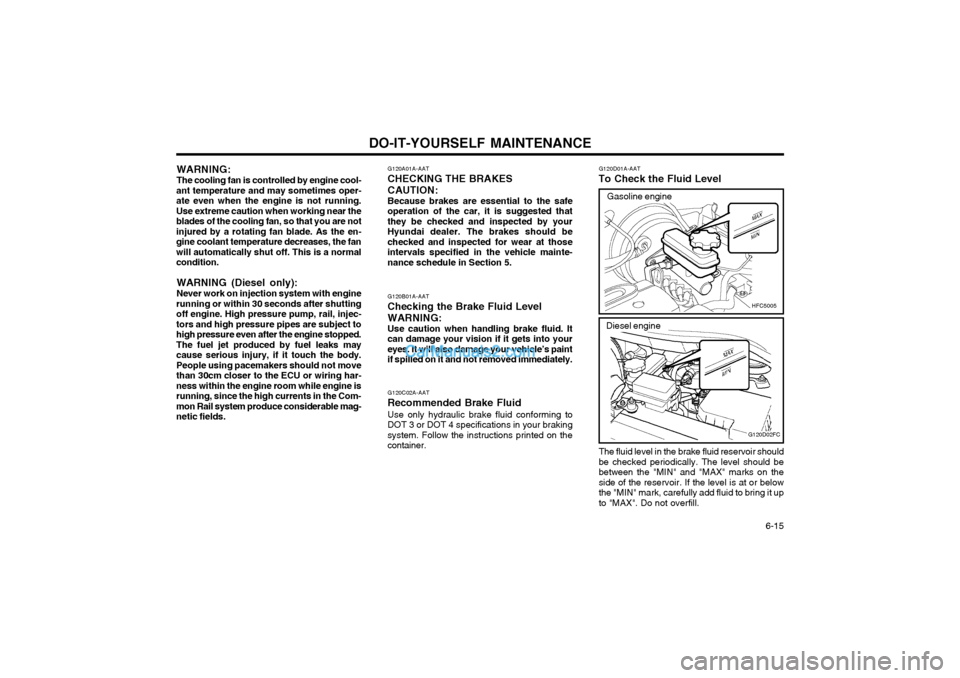
The fluid level in the brake fluid reservoir shouldbe checked periodically. The level should bebetween the "MIN" and "MAX" marks on theside of the reservoir. If the level is at or belowthe "MIN" mark, carefully add fluid to bring it upto "MAX". Do not overfill.
G120D01A-AAT
To Check the Fluid Level
G120C02A-AAT
Recommended Brake Fluid Use only hydraulic brake fluid conforming to
DOT 3 or DOT 4 specifications in your braking system. Follow the instructions printed on thecontainer. G120A01A-AAT
CHECKING THE BRAKES
CAUTION: Because brakes are essential to the safe
operation of the car, it is suggested that they be checked and inspected by yourHyundai dealer. The brakes should bechecked and inspected for wear at thoseintervals specified in the vehicle mainte-nance schedule in Section 5.
G120B01A-AAT
Checking the Brake Fluid Level WARNING: Use caution when handling brake fluid. It
can damage your vision if it gets into your eyes. It will also damage your vehicle’s paintif spilled on it and not removed immediately.
HFC5005
G120D02FC
Gasoline engine
Diesel engine
Page 158 of 317
DO-IT-YOURSELF MAINTENANCE
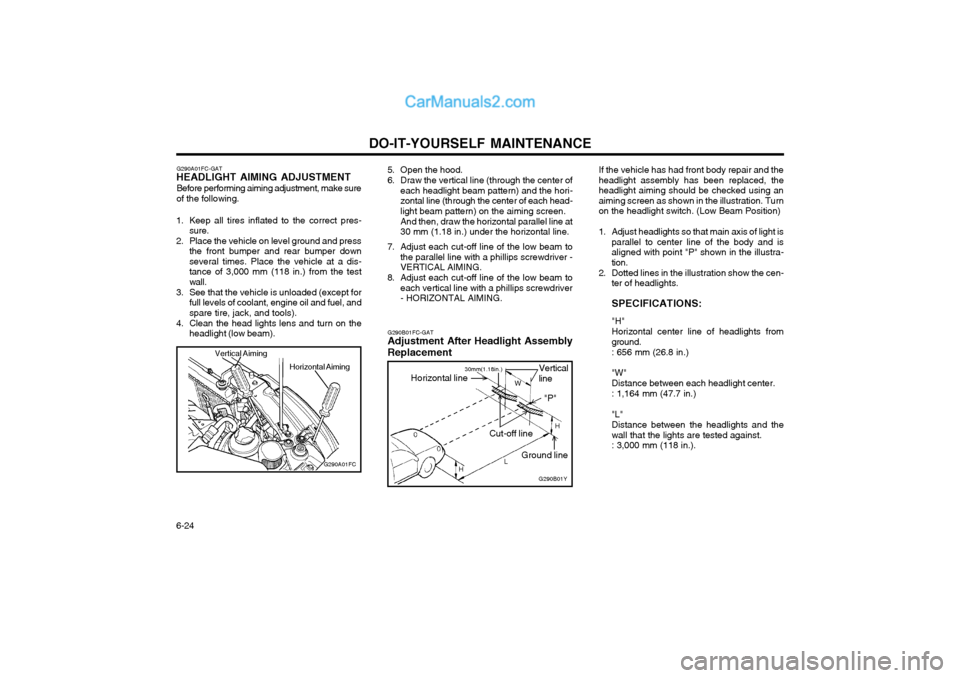
6-24 If the vehicle has had front body repair and the headlight assembly has been replaced, theheadlight aiming should be checked using anaiming screen as shown in the illustration. Turnon the headlight switch. (Low Beam Position)
1. Adjust headlights so that main axis of light is
parallel to center line of the body and is aligned with point "P" shown in the illustra-tion.
2. Dotted lines in the illustration show the cen- ter of headlights. SPECIFICATIONS: "H" Horizontal center line of headlights from ground. : 656 mm (26.8 in.) "W" Distance between each headlight center.: 1,164 mm (47.7 in.) "L" Distance between the headlights and the wall that the lights are tested against.: 3,000 mm (118 in.).
5. Open the hood.
6. Draw the vertical line (through the center of
each headlight beam pattern) and the hori- zontal line (through the center of each head-light beam pattern) on the aiming screen. And then, draw the horizontal parallel line at 30 mm (1.18 in.) under the horizontal line.
7. Adjust each cut-off line of the low beam to the parallel line with a phillips screwdriver -VERTICAL AIMING.
8. Adjust each cut-off line of the low beam to each vertical line with a phillips screwdriver- HORIZONTAL AIMING.
G290B01FC-GAT
Adjustment After Headlight Assembly Replacement
G290B01Y
Vertical line
Cut-off line Ground line
Horizontal line
LW
H
H "P"30mm(1.18in.)
G290A01FC-GAT
HEADLIGHT AIMING ADJUSTMENT
Before performing aiming adjustment, make sure of the following.
1. Keep all tires inflated to the correct pres- sure.
2. Place the vehicle on level ground and press the front bumper and rear bumper downseveral times. Place the vehicle at a dis-tance of 3,000 mm (118 in.) from the testwall.
3. See that the vehicle is unloaded (except for full levels of coolant, engine oil and fuel, andspare tire, jack, and tools).
4. Clean the head lights lens and turn on the headlight (low beam).
G290A01FC
Horizontal Aiming
Vertical Aiming
Page 172 of 317
INDEX
10-2 Driving
Economical dr iving ........................................................................ 2-10
Smooth cornering .......................................................................... 2-10
Winter driving ................................................................................ 2-10
E Emissions Control Systems ................................................................ 7-1
Engine Before starting the engine ............................................................... 2-2Compartment .......................................................................... 6-1 ~ 6-3
Coolant ................................................................................. 6-8 ~ 6-10
Coolant temperature gauge ........................................................... 1-36
If the engine overheats ................................................................... 3-2
Number ............................................................................................ 8-1
Oil ........................................................................................... 6-4 ~ 6-5Starting ............................................................................................ 2-3
Engine Exhaust Can Be Dangerous ................................................... 2-1
FFold-up Tray ...................................................................................... 1-50
Front Fog Light Sw itch ...................................................................... 1-42
Front Seats Adjustable front seats ..................................................................... 1-9
Lumbar support control ................................................................. 1-10
Seat cushion height adjustment .................................................... 1-10
Fuel Capacity .......................................................................................... 9-1
Gauge ............................................................................................ 1-36
Recommendations ........................................................................... 1-1
Fuel Filler Lid
Remote release ............................................................................. 1-52
Fuse Panel Description .......................................................... 6-26 ~ 6-28
Fuses ...................................................................................... 6-19 ~6-20 GGeneral Checks
.................................................................................. 6-4
Glove box .......................................................................................... 1-47
H Hazard Warning System ................................................................... 1-41
Headlight Aiming Adjustment ........................................................... 6-24
Headlight Bulb ................................................................................... 6-23
Headlight Leveling Device System ........................................ 1-44 ~ 1-45
Heating and Ventilation
Air flow control .............................................................................. 1-58
Air intake control ........................................................................... 1-57
Bi-level heating .............................................................................. 1-59
Fan speed control ......................................................................... 1-57
Heating controls ............................................................................ 1-59
Temperature control ...................................................................... 1-59
High-mounted Rear Stoplight ............................................................ 1-50
Hood Release ................................................................................... 1-51
Horn .................................................................................................. 1-55
IIgnition Switch ..................................................................................... 2-2
Immobilizer System ............................................................................. 1-3
Instrument Cluster and Indicator ............................................ 1-31 ~ 1-35
Instruments and Controls .................................................................. 1-30
Interior Light Interior light ................................................................................... 1-47
Map light ........................................................................................ 1-46
Intermittent Wiper .............................................................................. 1-41
JJump Starting ...................................................................................... 3-1
Page 215 of 317
1- 33
CONTROLS AND EQUIPMENT
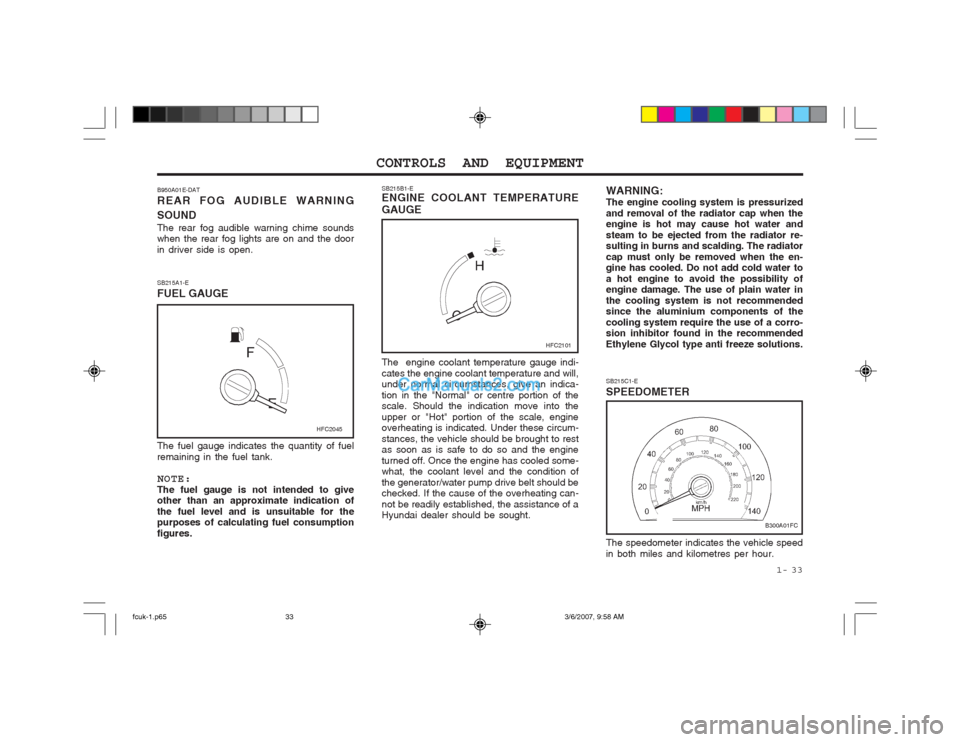
The fuel gauge indicates the quantity of fuel remaining in the fuel tank. NOTE: The fuel gauge is not intended to give other than an approximate indication of the fuel level and is unsuitable for the purposes of calculating fuel consumption figures. SB215B1-E ENGINE COOLANT TEMPERATURE GAUGE The engine coolant temperature gauge indi- cates the engine coolant temperature and will, under normal circumstances, give an indica- tion in the "Normal" or centre portion of the scale. Should the indication move into the upper or "Hot" portion of the scale, engine overheating is indicated. Under these circum- stances, the vehicle should be brought to rest as soon as is safe to do so and the engine turned off. Once the engine has cooled some- what, the coolant level and the condition of the generator/water pump drive belt should be checked. If the cause of the overheating can- not be readily established, the assistance of a Hyundai dealer should be sought.
SB215A1-E FUEL GAUGE
B950A01E-DATREAR FOG AUDIBLE WARNING SOUND The rear fog audible warning chime sounds when the rear fog lights are on and the door in driver side is open.
HFC2101
HFC2045
WARNING: The engine cooling system is pressurizedand removal of the radiator cap when the engine is hot may cause hot water and steam to be ejected from the radiator re- sulting in burns and scalding. The radiator cap must only be removed when the en- gine has cooled. Do not add cold water to a hot engine to avoid the possibility of engine damage. The use of plain water in the cooling system is not recommended since the aluminium components of the cooling system require the use of a corro- sion inhibitor found in the recommended Ethylene Glycol type anti freeze solutions.
B300A01FC
SB215C1-E SPEEDOMETER The speedometer indicates the vehicle speed in both miles and kilometres per hour.
fcuk-1.p65
3/6/2007, 9:58 AM
33
Page 262 of 317
3-3
IN CASE OF EMERGENCY
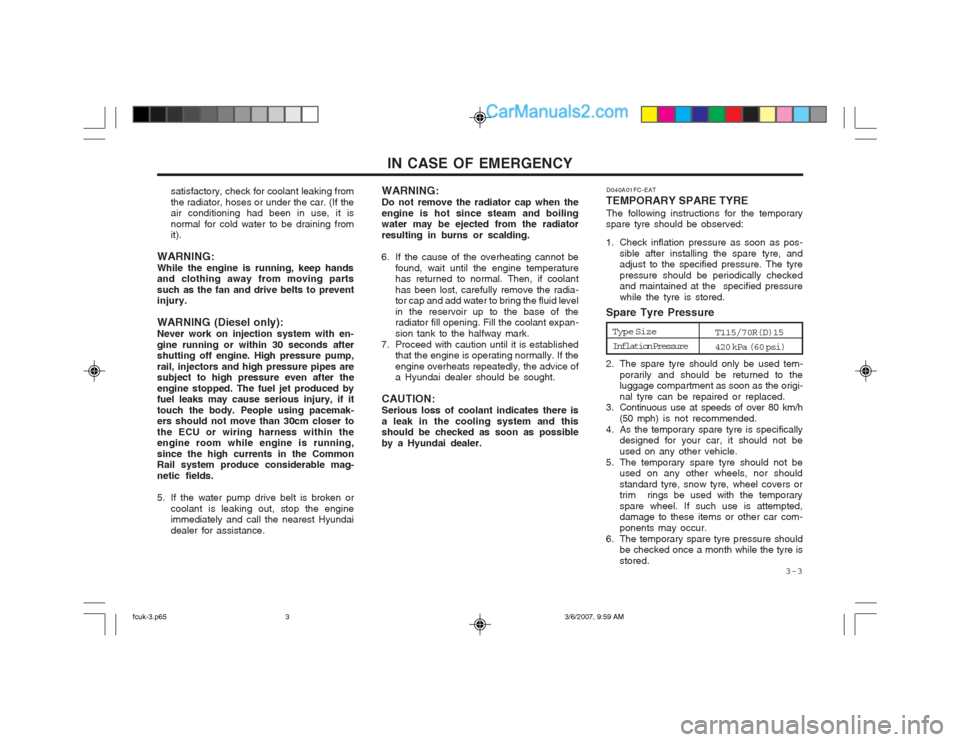
satisfactory, check for coolant leaking from the radiator, hoses or under the car. (If the air conditioning had been in use, it is normal for cold water to be draining from it).
WARNING: While the engine is running, keep hands and clothing away from moving parts such as the fan and drive belts to prevent injury. WARNING (Diesel only): Never work on injection system with en-gine running or within 30 seconds after shutting off engine. High pressure pump, rail, injectors and high pressure pipes are subject to high pressure even after the engine stopped. The fuel jet produced by fuel leaks may cause serious injury, if it touch the body. People using pacemak- ers should not move than 30cm closer to the ECU or wiring harness within the engine room while engine is running, since the high currents in the Common Rail system produce considerable mag- netic fields.
5. If the water pump drive belt is broken or coolant is leaking out, stop the engine immediately and call the nearest Hyundai dealer for assistance. WARNING:Do not remove the radiator cap when theengine is hot since steam and boiling water may be ejected from the radiator resulting in burns or scalding.
6. If the cause of the overheating cannot be found, wait until the engine temperature has returned to normal. Then, if coolant has been lost, carefully remove the radia- tor cap and add water to bring the fluid level in the reservoir up to the base of the radiator fill opening. Fill the coolant expan- sion tank to the halfway mark.
7. Proceed with caution until it is established that the engine is operating normally. If theengine overheats repeatedly, the advice of a Hyundai dealer should be sought.
CAUTION: Serious loss of coolant indicates there isa leak in the cooling system and this should be checked as soon as possible by a Hyundai dealer. D040A01FC-EAT
TEMPORARY SPARE TYRE The following instructions for the temporary
spare tyre should be observed:
1. Check inflation pressure as soon as pos-
sible after installing the spare tyre, and adjust to the specified pressure. The tyre pressure should be periodically checked and maintained at the specified pressure while the tyre is stored.
2. The spare tyre should only be used tem- porarily and should be returned to the luggage compartment as soon as the origi- nal tyre can be repaired or replaced.
3. Continuous use at speeds of over 80 km/h
(50 mph) is not recommended.
4. As the temporary spare tyre is specifically designed for your car, it should not beused on any other vehicle.
5. The temporary spare tyre should not be used on any other wheels, nor shouldstandard tyre, snow tyre, wheel covers or trim rings be used with the temporary spare wheel. If such use is attempted, damage to these items or other car com- ponents may occur.
6. The temporary spare tyre pressure should be checked once a month while the tyre isstored.
Spare Tyre Pressure
Type Size
Inflation Pressure T115/70R(D)15
420 kPa (60 psi)
fcuk-3.p65
3/6/2007, 9:59 AM
3
Page 277 of 317
VEHICLE MAINTENANCE REQUIREMENTS 5-7
6ZF070D1-A
o Manual Transaxle Oil Inspect the manual transaxle oil according to
the maintenance schedule. NOTE: If the oil level is low, check for possible
leaks before adding oil. Do not overfill.
6ZF070H1-A
o Rear Brake Drums And Linings/ Parking Brake
Check the rear brake drums and linings for
scoring, burning, leaking fluid, broken parts, and excessive wear. Inspect the parkingbrake system including the parking brakelever and cables. For detailed service proce-dures, refer to the Shop Manual.
6ZF070J1-A
o Brake Pads, Calipers and Rotors Check the pads for excessive wear, discs for
run out and wear, and calipers for fluid leak-age.
6ZF070K1-A
o Exhaust Pipe and Muffler Visually inspect the exhaust pipes, mufflerand hangers for cracks, deterioration, or dam-age. Start the engine and listen carefully forany exhaust gas leakage. Tighten connec-tions or replace parts as necessary.
F070E03A-AAT
o Automatic Transaxle Fluid The fluid level should be in the "HOT" range
of the dipstick, after engine and transaxle areat normal operating temperature. Check theAutomatic Transaxle Fluid level with the en-gine running and the transaxle in neutral, withthe parking brake properly applied. Use DIA-MOND ATF SP- III or SK ATF SP- III when
adding or changing fluid. 6ZF070F1-A
o Brake Hoses and Lines Visually check for proper installation, chafing, cracks, deterioration and any leakage. Replaceany deteriorated or damaged parts immediately.
6ZF060H1-A
o Air Cleaner Filter A Genuine Hyundai air cleaner filter is recom-
mended when filter is replaced.
6ZF060J1-A
o Spark Plugs Make sure to install new spark plugs of the
correct heat range.
6ZF070B1-A
o Cooling System Check the cooling system part, such asradiator, coolant reservoir, hoses and con-nections for leakage and damage. Replaceany damaged parts. 6ZF070G2-A
o Brake Fluid Check brake fluid level in the brake fluidreservoir. The level should be between "MIN"and "MAX" marks on the side of the reservoir.Use only hydraulic brake fluid conforming toDOT 3 or DOT 4.
6ZF070C1-A
o Engine Coolant The coolant should be changed at theintervals specified in the maintenance sched-ule.
F060N02E-AAT
o Valve Clearance Inspect excessive valve noise and/or enginevibration and adjust if necessary. A qualifiedtechnician should perform the operation.
fcuk-5.p65 3/6/2007, 10:01 AM
7