air condition Hyundai Matrix 2004 Owner's Guide
[x] Cancel search | Manufacturer: HYUNDAI, Model Year: 2004, Model line: Matrix, Model: Hyundai Matrix 2004Pages: 317, PDF Size: 5.12 MB
Page 212 of 317
CONTROLS AND EQUIPMENT
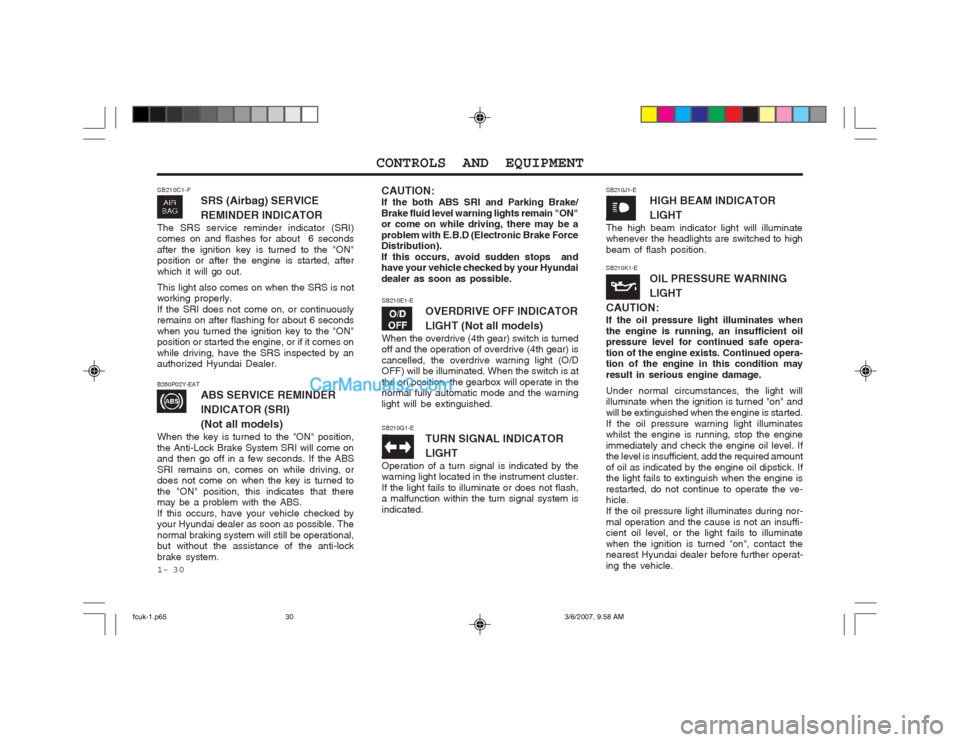
1- 30 SB210E1-E
OVERDRIVE OFF INDICATOR LIGHT (Not all models)
When the overdrive (4th gear) switch is turned off and the operation of overdrive (4th gear) is cancelled, the overdrive warning light (O/D OFF) will be illuminated. When the switch is at the on position, the gearbox will operate in the normal fully automatic mode and the warning light will be extinguished.
B260P02Y-EAT
ABS SERVICE REMINDER INDICATOR (SRI)(Not all models)
When the key is turned to the "ON" position, the Anti-Lock Brake System SRI will come on and then go off in a few seconds. If the ABS SRI remains on, comes on while driving, or does not come on when the key is turned to the "ON" position, this indicates that there may be a problem with the ABS. If this occurs, have your vehicle checked by your Hyundai dealer as soon as possible. The normal braking system will still be operational, but without the assistance of the anti-lock brake system.
CAUTION: If the both ABS SRI and Parking Brake/Brake fluid level warning lights remain "ON" or come on while driving, there may be a
problem with E.B.D (Electronic Brake Force Distribution). If this occurs, avoid sudden stops and have your vehicle checked by your Hyundai dealer as soon as possible. SB210K1-E
OIL PRESSURE WARNING LIGHT
CAUTION: If the oil pressure light illuminates when the engine is running, an insufficient oil pressure level for continued safe opera- tion of the engine exists. Continued opera- tion of the engine in this condition may result in serious engine damage. Under normal circumstances, the light will illuminate when the ignition is turned "on" and will be extinguished when the engine is started.If the oil pressure warning light illuminates whilst the engine is running, stop the engine immediately and check the engine oil level. If the level is insufficient, add the required amount of oil as indicated by the engine oil dipstick. If the light fails to extinguish when the engine is restarted, do not continue to operate the ve- hicle. If the oil pressure light illuminates during nor-mal operation and the cause is not an insuffi- cient oil level, or the light fails to illuminate when the ignition is turned "on", contact the nearest Hyundai dealer before further operat- ing the vehicle.
SB210G1-E TURN SIGNAL INDICATOR LIGHT
Operation of a turn signal is indicated by the warning light located in the instrument cluster. If the light fails to illuminate or does not flash, a malfunction within the turn signal system is indicated.
SB210J1-E HIGH BEAM INDICATOR LIGHT
The high beam indicator light will illuminate whenever the headlights are switched to high beam of flash position.
SB210C1-F
SRS (Airbag) SERVICE REMINDER INDICATOR
The SRS service reminder indicator (SRI) comes on and flashes for about 6 seconds after the ignition key is turned to the "ON" position or after the engine is started, after which it will go out. This light also comes on when the SRS is not working properly. If the SRI does not come on, or continuously remains on after flashing for about 6 seconds when you turned the ignition key to the "ON" position or started the engine, or if it comes on while driving, have the SRS inspected by an authorized Hyundai Dealer.
fcuk-1.p65 3/6/2007, 9:58 AM
30
Page 213 of 317
1- 31
CONTROLS AND EQUIPMENT
circuits becoming defective, approximately fifty per cent of the normal braking perfor- mance will be available. If failure of one of the circuits occurs, therequired amount of pedal effort, pedal travel and stopping distance will be increased. Use of the gearbox is recommended to assist in bringing the vehicle to rest. The vehicle must not be driven once brake failure has occurred until the system has been repaired and is functioning normally. The braking system employs a vacuum servo in order that the pedal efforts are reduced. Power for the servo is derived from the engine and therefore, in the event of the engine stopping or the vehicle being towed, pedal efforts will be substantially increased.
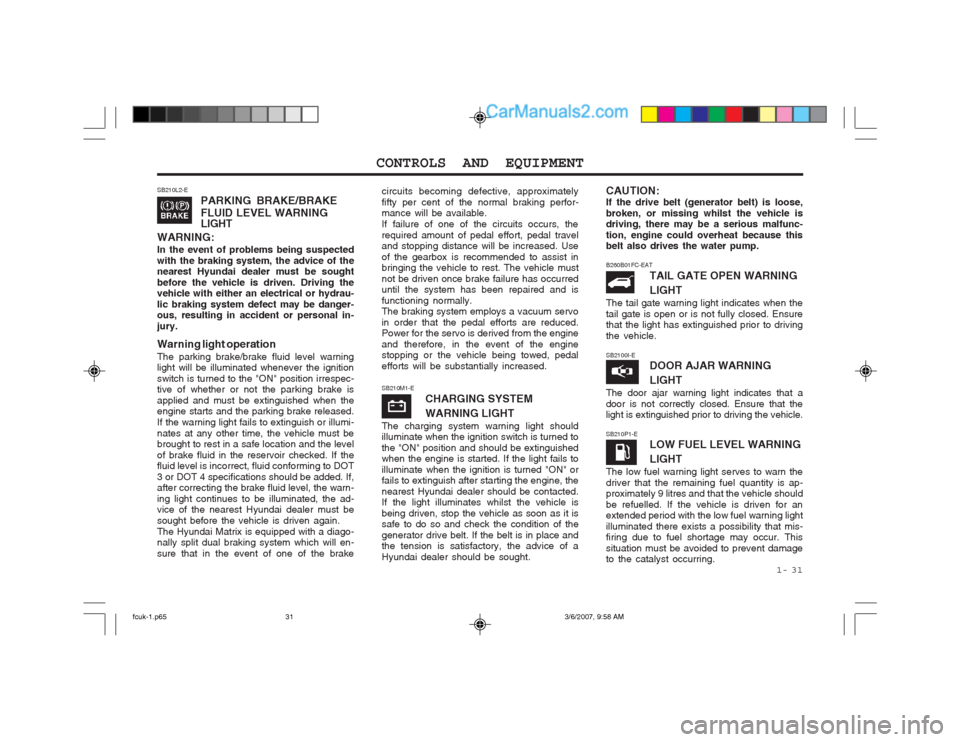
SB210L2-E
PARKING BRAKE/BRAKE FLUID LEVEL WARNING LIGHT
WARNING: In the event of problems being suspected with the braking system, the advice of the nearest Hyundai dealer must be sought before the vehicle is driven. Driving the vehicle with either an electrical or hydrau- lic braking system defect may be danger- ous, resulting in accident or personal in- jury. Warning light operation The parking brake/brake fluid level warning light will be illuminated whenever the ignition switch is turned to the "ON" position irrespec- tive of whether or not the parking brake is applied and must be extinguished when the engine starts and the parking brake released. If the warning light fails to extinguish or illumi-nates at any other time, the vehicle must be brought to rest in a safe location and the level of brake fluid in the reservoir checked. If the fluid level is incorrect, fluid conforming to DOT 3 or DOT 4 specifications should be added. If, after correcting the brake fluid level, the warn- ing light continues to be illuminated, the ad- vice of the nearest Hyundai dealer must be sought before the vehicle is driven again.The Hyundai Matrix is equipped with a diago- nally split dual braking system which will en- sure that in the event of one of the brake
CAUTION: If the drive belt (generator belt) is loose,broken, or missing whilst the vehicle is driving, there may be a serious malfunc- tion, engine could overheat because this belt also drives the water pump.
SB210M1-E CHARGING SYSTEM WARNING LIGHT
The charging system warning light should illuminate when the ignition switch is turned to the "ON" position and should be extinguished when the engine is started. If the light fails to illuminate when the ignition is turned "ON" or fails to extinguish after starting the engine, the nearest Hyundai dealer should be contacted. If the light illuminates whilst the vehicle is being driven, stop the vehicle as soon as it is safe to do so and check the condition of the generator drive belt. If the belt is in place and the tension is satisfactory, the advice of a Hyundai dealer should be sought.
B260B01FC-EAT TAIL GATE OPEN WARNING LIGHT
The tail gate warning light indicates when the tail gate is open or is not fully closed. Ensure that the light has extinguished prior to driving the vehicle. SB2100I-E DOOR AJAR WARNING LIGHT
The door ajar warning light indicates that a door is not correctly closed. Ensure that the light is extinguished prior to driving the vehicle.
SB210P1-E LOW FUEL LEVEL WARNING LIGHT
The low fuel warning light serves to warn the driver that the remaining fuel quantity is ap- proximately 9 litres and that the vehicle should be refuelled. If the vehicle is driven for an extended period with the low fuel warning light illuminated there exists a possibility that mis- firing due to fuel shortage may occur. This situation must be avoided to prevent damage to the catalyst occurring.
fcuk-1.p65 3/6/2007, 9:58 AM
31
Page 214 of 317
CONTROLS AND EQUIPMENT
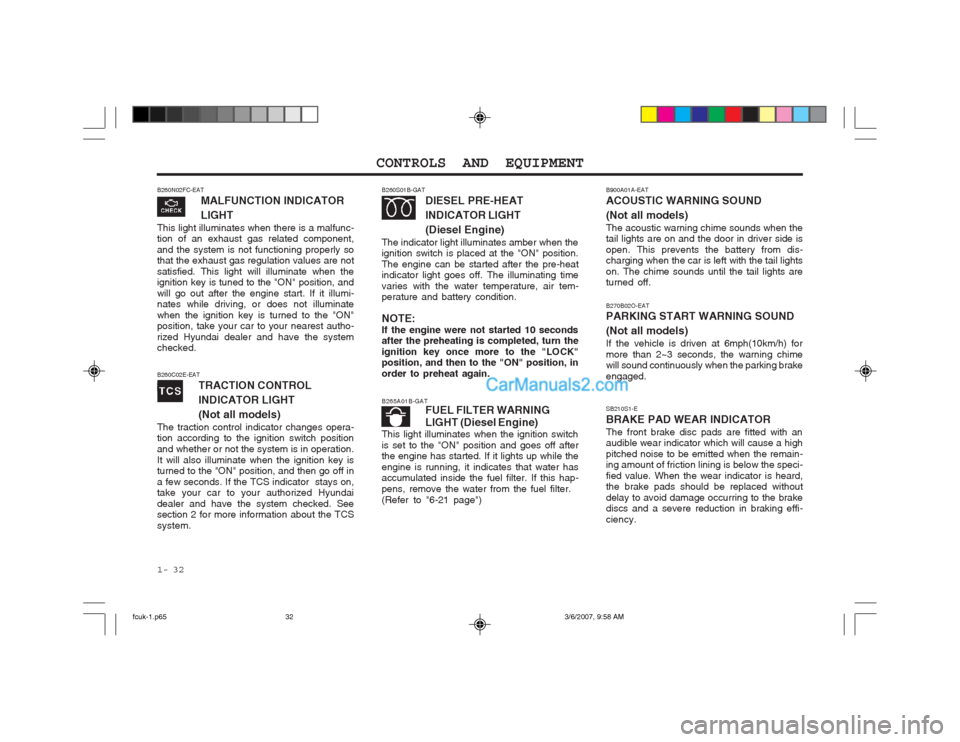
1- 32 SB210S1-E BRAKE PAD WEAR INDICATORThe front brake disc pads are fitted with an audible wear indicator which will cause a high pitched noise to be emitted when the remain- ing amount of friction lining is below the speci- fied value. When the wear indicator is heard, the brake pads should be replaced without delay to avoid damage occurring to the brake discs and a severe reduction in braking effi- ciency.
B260N02FC-EAT
MALFUNCTION INDICATOR LIGHT
This light illuminates when there is a malfunc- tion of an exhaust gas related component, and the system is not functioning properly so that the exhaust gas regulation values are not satisfied. This light will illuminate when the ignition key is tuned to the "ON" position, and will go out after the engine start. If it illumi- nates while driving, or does not illuminate when the ignition key is turned to the "ON" position, take your car to your nearest autho- rized Hyundai dealer and have the system checked.
B260S01B-GAT DIESEL PRE-HEAT INDICATOR LIGHT(Diesel Engine)
The indicator light illuminates amber when the ignition switch is placed at the "ON" position. The engine can be started after the pre-heat indicator light goes off. The illuminating time varies with the water temperature, air tem- perature and battery condition. NOTE: If the engine were not started 10 seconds after the preheating is completed, turn the ignition key once more to the "LOCK" position, and then to the "ON" position, in order to preheat again.
B265A01B-GAT FUEL FILTER WARNING LIGHT (Diesel Engine)
This light illuminates when the ignition switch is set to the "ON" position and goes off after the engine has started. If it lights up while the engine is running, it indicates that water has accumulated inside the fuel filter. If this hap- pens, remove the water from the fuel filter.(Refer to "6-21 page")
B260C02E-EAT
TRACTION CONTROL INDICATOR LIGHT(Not all models)
The traction control indicator changes opera- tion according to the ignition switch position and whether or not the system is in operation.It will also illuminate when the ignition key is turned to the "ON" position, and then go off in a few seconds. If the TCS indicator stays on, take your car to your authorized Hyundai dealer and have the system checked. See section 2 for more information about the TCS system.
B270B02O-EAT PARKING START WARNING SOUND (Not all models) If the vehicle is driven at 6mph(10km/h) for more than 2~3 seconds, the warning chime will sound continuously when the parking brake engaged.
B900A01A-EAT ACOUSTIC WARNING SOUND (Not all models) The acoustic warning chime sounds when the tail lights are on and the door in driver side is open. This prevents the battery from dis- charging when the car is left with the tail lights on. The chime sounds until the tail lights are turned off.
fcuk-1.p65
3/6/2007, 9:58 AM
32
Page 237 of 317
1- 55
CONTROLS AND EQUIPMENT
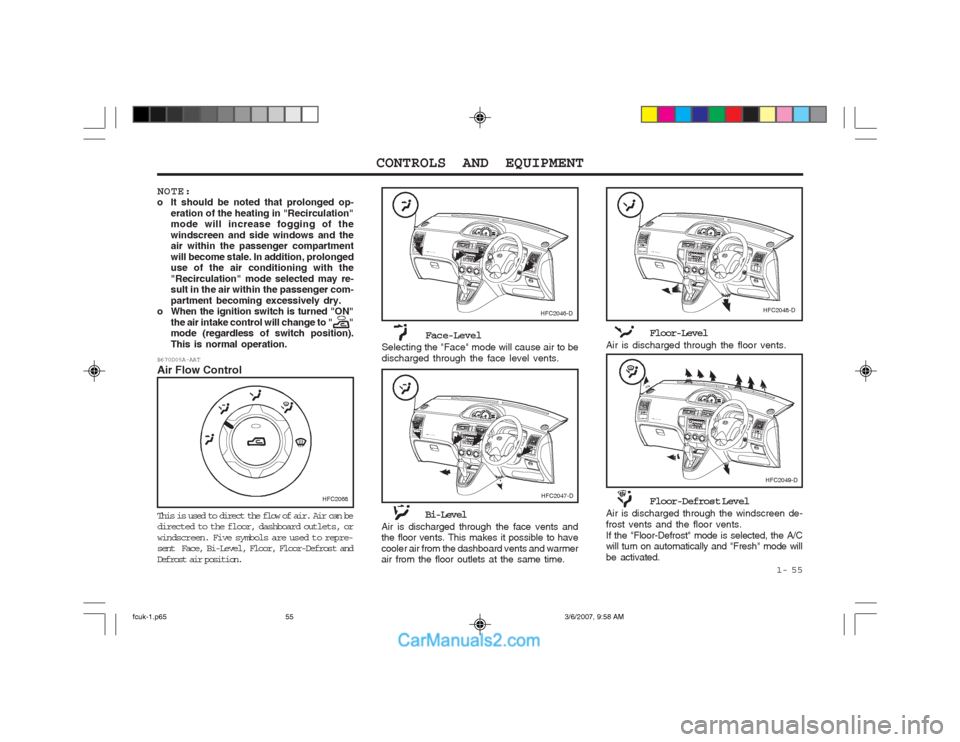
Face-Level
Selecting the "Face" mode will cause air to be discharged through the face level vents.
NOTE:
o It should be noted that prolonged op- eration of the heating in "Recirculation" mode will increase fogging of the windscreen and side windows and the air within the passenger compartment will become stale. In addition, prolonged use of the air conditioning with the "Recirculation" mode selected may re- sult in the air within the passenger com- partment becoming excessively dry.
o When the ignition switch is turned "ON"
the air intake control will change to "
"
mode (regardless of switch position). This is normal operation.
B670D05A-AAT Air Flow Control
HFC2068
This is used to direct the flow of air. Air can be
directed to the floor, dashboard outlets, or windscreen. Five symbols are used to repre- sent Face, Bi-Level, Floor, Floor-Defrost and
Defrost air position.
HFC2046-D
HFC2047-D
HFC2048-D
HFC2049-D
Bi-Level
Air is discharged through the face vents and the floor vents. This makes it possible to have cooler air from the dashboard vents and warmer air from the floor outlets at the same time. Floor-Level
Air is discharged through the floor vents.
Floor-Defrost Level
Air is discharged through the windscreen de- frost vents and the floor vents.If the "Floor-Defrost" mode is selected, the A/C
will turn on automatically and "Fresh" mode will be activated.
fcuk-1.p65 3/6/2007, 9:58 AM
55
Page 239 of 317
1- 57
CONTROLS AND EQUIPMENT
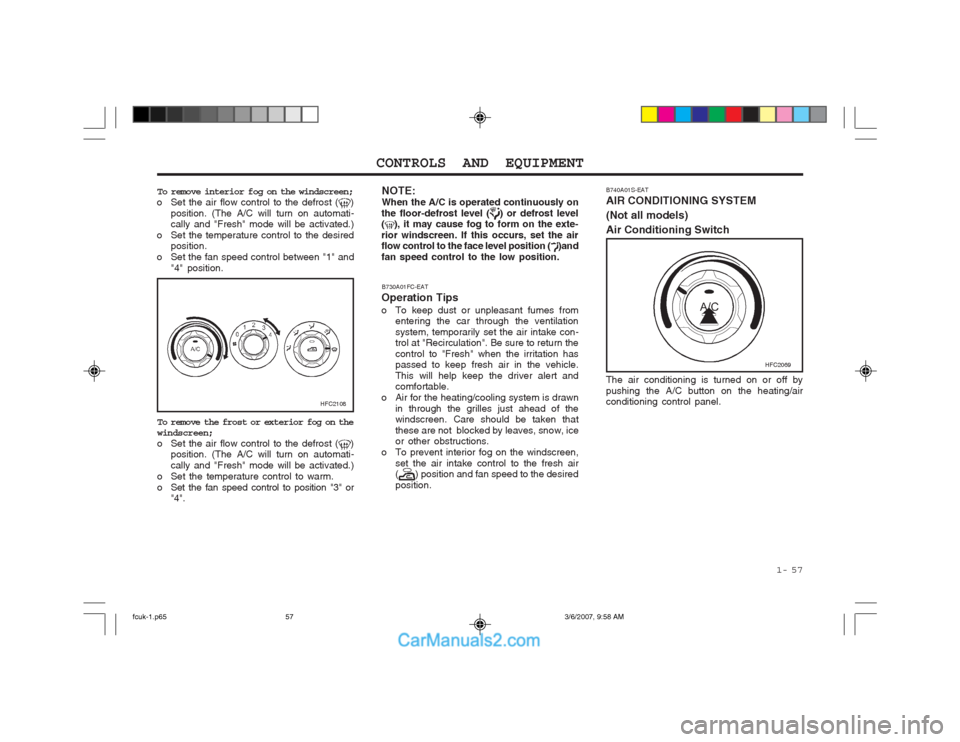
B740A01S-EAT AIR CONDITIONING SYSTEM (Not all models)Air Conditioning Switch
To remove interior fog on the windscreen;
o Set the air flow control to the defrost ()
position. (The A/C will turn on automati- cally and "Fresh" mode will be activated.)
o Set the temperature control to the desired position.
o Set the fan speed control between "1" and "4" position.
HFC2108
To remove the frost or exterior fog on the windscreen;
o Set the air flow control to the defrost (
)
position. (The A/C will turn on automati- cally and "Fresh" mode will be activated.)
o Set the temperature control to warm.
o Set the fan speed control to position "3" or "4". The air conditioning is turned on or off bypushing the A/C button on the heating/air conditioning control panel.
HFC2069
B730A01FC-EAT
Operation Tips
o To keep dust or unpleasant fumes from entering the car through the ventilation system, temporarily set the air intake con- trol at "Recirculation". Be sure to return the control to "Fresh" when the irritation has passed to keep fresh air in the vehicle. This will help keep the driver alert and comfortable.
o Air for the heating/cooling system is drawn in through the grilles just ahead of thewindscreen. Care should be taken that these are not blocked by leaves, snow, ice or other obstructions.
o To prevent interior fog on the windscreen, set the air intake control to the fresh air(
) position and fan speed to the desired
position.
NOTE: When the A/C is operated continuously on
the floor-defrost level (
) or defrost level
(), it may cause fog to form on the exte-
rior windscreen. If this occurs, set the air flow control to the face level position (
)and
fan speed control to the low position.
fcuk-1.p65 3/6/2007, 9:58 AM
57
Page 240 of 317

CONTROLS AND EQUIPMENT
1- 58 B740C01FC-GAT
Dehumidified Heating
B740C01FC
For dehumidified heating:
o Turn on the fan control switch.
o Turn on the air conditioning switch. The air conditioning indicator light should come onat the same time.
o Set the air intake control to "Fresh" mode (
).
o Set the air flow control to the desired position.
o Adjust the fan control to the desired speed.
o For more rapid action, set the fan at one of the higher speeds.
o Adjust the temperature control to provide
the desired amount of warmth. B740D01A-AAT Operation Tips
o If the interior of the car is hot when you first
get in, open the windows for a few minutes to expel the hot air.
o When you are using the air conditioning system, keep all windows closed to keephot air out.
o When moving slowly, as in heavy traffic, shift to a lower gear. This increases enginespeed, which in turn increases the speed of the air conditioning compressor.
o On steep grades, turn the air conditioning off to avoid the possibility of the engineover-heating.
o During winter months or in periods when the air conditioning is not used regularly,run the air conditioning once every month for a few minutes. This will help circulate the lubricants and keep your system in peak operating condition.
B740B01FC-GAT Air Conditioning Operation Cooling
B740B01FC
To use the air conditioning to cool the interior:
o Turn on the fan control switch.
o Turn on the air conditioning switch by pushing in on the switch. The air condition- ing indicator light should come on at the same time.
o Set the air intake control to "Fresh" mode
(
).
o Set the temperature control to "Cool".
("Cool" provides maximum cooling. The temperature may be moderated by moving the control toward "Warm".)
o Adjust the fan control to the desired speed. For greater cooling, turn the fan control toone of the higher speeds or temporarily select the "Recirculation" position on the air intake control.
fcuk-1.p65 3/6/2007, 9:58 AM
58
Page 241 of 317
1- 59
CONTROLS AND EQUIPMENT
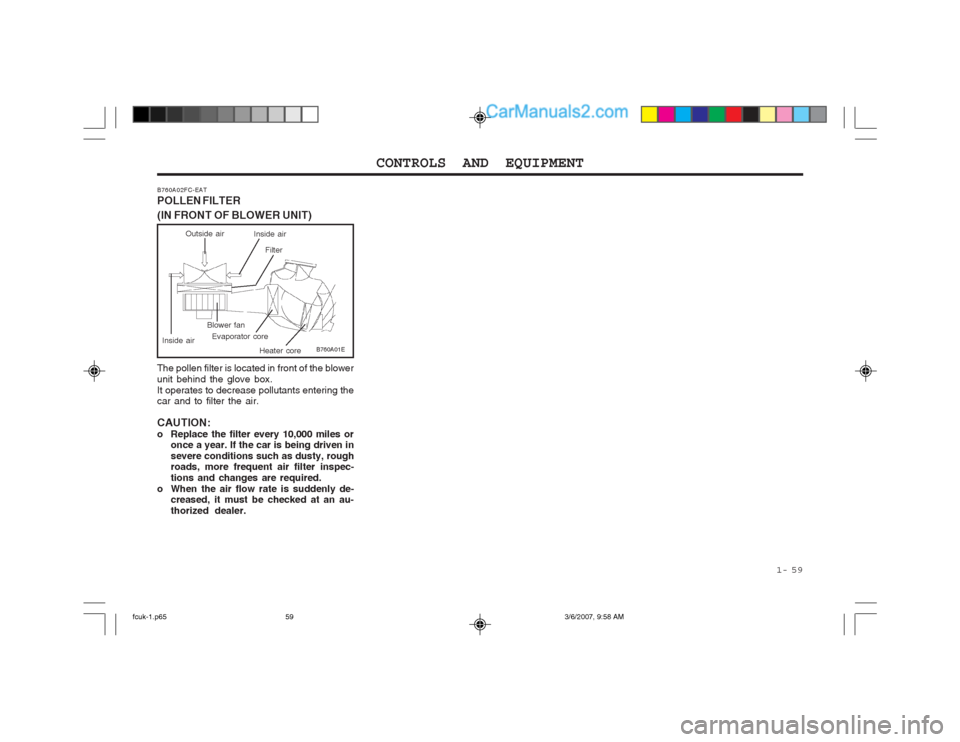
B760A01E
The pollen filter is located in front of the blower unit behind the glove box.It operates to decrease pollutants entering the car and to filter the air. CAUTION:
o Replace the filter every 10,000 miles or
once a year. If the car is being driven insevere conditions such as dusty, rough roads, more frequent air filter inspec- tions and changes are required.
o When the air flow rate is suddenly de- creased, it must be checked at an au-thorized dealer.
Evaporator coreBlower fan
Heater core
B760A02FC-EAT POLLEN FILTER (IN FRONT OF BLOWER UNIT)
Outside air
Filter
Inside air
Inside air
fcuk-1.p65 3/6/2007, 9:58 AM
59
Page 245 of 317
DRIVING YOUR HYUNDAI 2- 1
SC000A1-E 2
. DRIVING YOUR HYUNDAI
SC020A1-E
WARNING: ENGINE EXHAUST CAN BE DANGEROUS!
Engine exhaust gases are potentially lethal. If at any time engine exhaust gas is detected within the passenger
compartment, move the vehicle to an open area and open all windows.
o Never inhale exhaust gas.
Exhaust gases contain Carbon Monoxide which is colourless and odourless. Carbon Monoxide is poisonous and can
cause unconsciousness and death by asphyxiation. o Exhaust System Maintenance.
Ensure that the exhaust system is maintained in good condition and is free from excessive corrosion and damage
which may result in leakage. If the vehicle is driven over an object which strikes the exhaust system, ensure that theexhaust system is inspected at the first available opportunity to ensure that no leakage exists.
o Confined Areas.
Do not run the engine in confined spaces, allowing the engine to idle in a garage, even when the doors are open is dangerous practice. Only start the engine immediately prior to moving the vehicle out of the garage.
o Prolonged Idling.
If it is necessary to allow the vehicle to idle for prolonged periods, ensure that the heating system air intake control is set to the "Fresh" position, the blower is set to high speed operation and that the vehicle is standing in an open area.
o Load Carrying.
If it is necessary to carry long objects which do not permit the boot lid to be fully closed, the side windows must remain
closed and the heating air intake control set to the "Fresh" position with the blower running at the highest speed setting. To ensure correct operation of the heater system, the air intake grilles at the base of the windscreen must not beobstructed by snow leaves etc..
2
fcuk-2.p65 3/6/2007, 9:59 AM
1
Page 249 of 317
DRIVING YOUR HYUNDAI 2- 5
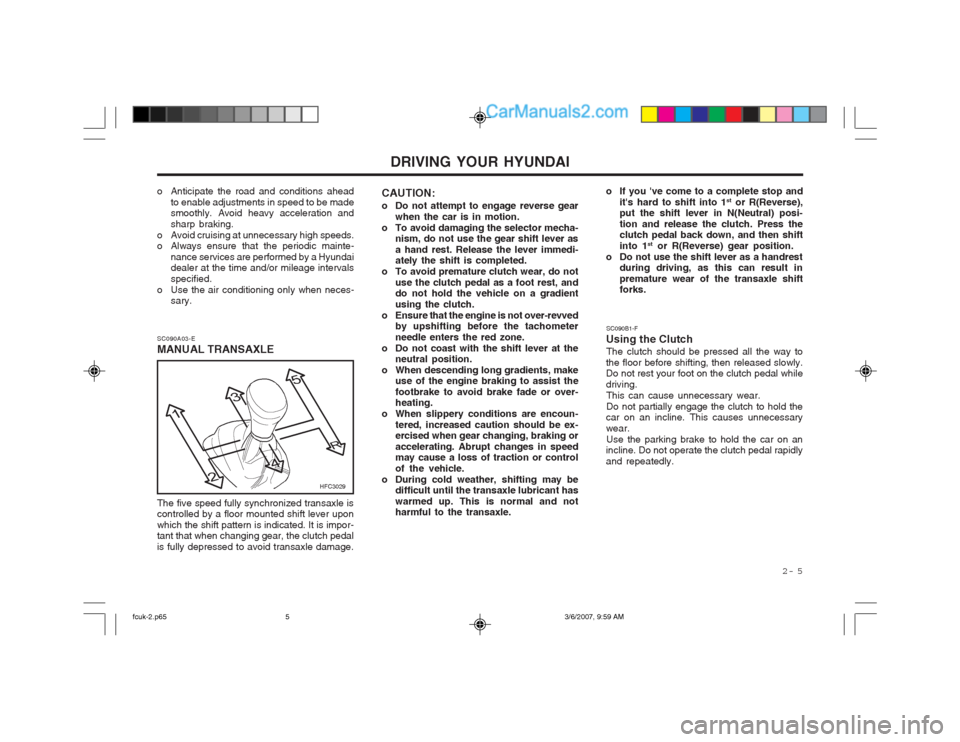
SC090A03-E MANUAL TRANSAXLE
HFC3029
The five speed fully synchronized transaxle is controlled by a floor mounted shift lever upon which the shift pattern is indicated. It is impor- tant that when changing gear, the clutch pedal is fully depressed to avoid transaxle damage. CAUTION:
o Do not attempt to engage reverse gear
when the car is in motion.
o To avoid damaging the selector mecha- nism, do not use the gear shift lever as a hand rest. Release the lever immedi- ately the shift is completed.
o To avoid premature clutch wear, do not use the clutch pedal as a foot rest, anddo not hold the vehicle on a gradient using the clutch.
o Ensure that the engine is not over-revved by upshifting before the tachometerneedle enters the red zone.
o Do not coast with the shift lever at the neutral position.
o When descending long gradients, make use of the engine braking to assist thefootbrake to avoid brake fade or over- heating.
o When slippery conditions are encoun- tered, increased caution should be ex-ercised when gear changing, braking or accelerating. Abrupt changes in speed may cause a loss of traction or control of the vehicle.
o During cold weather, shifting may be difficult until the transaxle lubricant haswarmed up. This is normal and not harmful to the transaxle. SC090B1-F
Using the Clutch The clutch should be pressed all the way to
the floor before shifting, then released slowly.Do not rest your foot on the clutch pedal while driving. This can cause unnecessary wear.Do not partially engage the clutch to hold the
car on an incline. This causes unnecessarywear.
Use the parking brake to hold the car on an
incline. Do not operate the clutch pedal rapidlyand repeatedly.
o Anticipate the road and conditions ahead
to enable adjustments in speed to be made smoothly. Avoid heavy acceleration and sharp braking.
o Avoid cruising at unnecessary high speeds.
o Always ensure that the periodic mainte- nance services are performed by a Hyundaidealer at the time and/or mileage intervals specified.
o Use the air conditioning only when neces- sary.
o If you 've come to a complete stop and
it's hard to shift into 1 st
or R(Reverse),
put the shift lever in N(Neutral) posi- tion and release the clutch. Press the clutch pedal back down, and then shift into 1 st
or R(Reverse) gear position.
o Do not use the shift lever as a handrest during driving, as this can result inpremature wear of the transaxle shift forks.
fcuk-2.p65 3/6/2007, 9:59 AM
5
Page 255 of 317
DRIVING YOUR HYUNDAI 2- 11
o Don't "lug" or "over-rev" the engine. Lug-
ging is driving too slowly in too high a gear resulting in the engine bucking. If this happens to you, shift to a lower gear.Over-revving is racing the engine beyond its safe limit. This can be avoided by shifting at the recommended speeds.
o Use your air conditioning sparingly. The air
conditioning system is operated by the engine power so your fuel economy is reduced when you use it.
SC150A1-F DRIVING FOR ECONOMYYou can save fuel and get more miles from your car if you follow these suggestions:
o Drive smoothly. Accelerate at a moderate
rate. Don't make "jack-rabbit" starts or full- throttle shifts and maintain a steady cruis- ing speed. Don't race between stoplights. Try to adjust your speed to that of the other traffic so you don't have to change speeds unnecessarily.Avoid heavy traffic whenever possible. Al- ways maintain a safe distance from other vehicles so you can avoid unnecessary braking. This also reduces brake wear.
o Drive at a moderate speed. The faster you drive, the more fuel your car uses. Drivingat a moderate speed, especially on the highway, is one of the most effective ways to reduce fuel consumption.
o Don't "ride" the brake or clutch pedal. This can increase fuel consumption and alsoincrease wear on these components. In addition, driving with your foot resting on the brake pedal may cause the brakes to overheat, which reduces their effective- ness and may lead to more serious con-
sequences.
o Take care of your tyres. Keep them inflated to the recommended pressure. Incorrectinfla-tion, either too much or too little, re- sults in unnecessary tyre wear. Check the tyre pres-sures at least once a month. o Be sure that the wheels are aligned cor-
rectly. Improper alignment can result from hitting curbs or driving too fast over irregu- lar surfaces. Poor alignment causes faster tyre wear and may also result in other problems as well as greater fuel consump- tion.
o Keep your car in good condition. For better fuel economy and reduced maintenancecosts, maintain your car in accordance with the maintenance schedule in Section 5. If you drive your car in severe condi- tions, more frequent maintenance is re- quired (see Section 5 for details).
o Keep your car clean. For maximum ser- vice, your car should be kept clean and free of corrosive materials. It is especially important that mud, dirt, ice, etc. not be allowed to accumulate on the underside of the car. This extra weight can result in increased fuel consumption and also con- tribute to corrosion.
o Travel lightly. Don't carry unnecessary
weight in your car. Weight is an enemy ofgood fuel economy.
o Don't let the engine idle longer than neces- sary. If you are waiting (and not in traffic),turn off your engine and restart only when you're ready to go.
o Remember, your car does not require extended warm-up. As soon as the engineis running smoothly, you can drive away. In very cold weather, however, give your engine a slightly longer warm-up period. SC160A1-F SMOOTH CORNERINGAvoid braking or gear changing in corners, especially when roads are wet. Ideally, cor- ners should always be taken under gentle acceleration. If you follow these suggestions, tyre wear will be held to a minimum. SC170A1-E WINTER MOTORINGThe onset of winter conditions subject motor vehicles to greater operating demands. There- fore, the following suggestions will assist in maintaining peak performance and reliability during these periods:
fcuk-2.p65
3/6/2007, 9:59 AM
11