air condition Hyundai Matrix 2004 Owner's Guide
[x] Cancel search | Manufacturer: HYUNDAI, Model Year: 2004, Model line: Matrix, Model: Hyundai Matrix 2004Pages: 317, PDF Size: 5.12 MB
Page 151 of 317

DO-IT-YOURSELF MAINTENANCE 6-17
G140B01A-AAT
Checking the Air Conditioning Operation
1. Start the engine and let it run at a fast idle for
several minutes with the air conditioning set at the maximum cold setting.
2. If the air coming out of the in-dash vents is not cold, have the air conditioning systeminspected by your Hyundai dealer.
CAUTION: Running the air conditioning system for extended periods of time with a low refriger-ant level may damage the compressor. G140C01A-AAT
Lubrication To lubricate the compressor and the seals in the system, the air conditioning should be runfor at least 10 minutes each week. This isparticularly important during cool weather whenthe air conditioning system is not otherwise inuse.
G150A01A-GAT
CHECKING STEERING WHEEL FREEPLAY
To check the steering wheel freeplay, stop the
car with the wheels pointed straight ahead and gently move the steering wheel back and forth.Use very light finger pressure and be sensitiveto changes in resistance that mark the limits ofthe freeplay. If the freeplay is greater thanspecified, have it inspected by your Hyundaidealer and adjusted or repaired if necessary.
G150A01FC
G140D01S-GAT
Checking the Compressor Drive Belt
When the air conditioning is being used regular- ly, the compressor drive belt tension should bechecked at least once a month. To check the drive belt tension, press down on the belt halfway between the engine crankshaftand compressor pulleys. Pressing with yourfinger, you should not be able to deflect this beltanymore than 8.0 mm. If you have the instru-ments to check it with a force of 98N (22 lb.),the deflection should be approx. 8.0 mm (0.315in.). If the belt is too loose, have it adjusted byyour Hyundai dealer.
G140D01A
A/C
CRANK PULLEY
TENSION PULLEY
30 mm (1.18 in.)
8mm(0.315 in.)
Page 155 of 317
DO-IT-YOURSELF MAINTENANCE 6-21
G210A01A-AAT
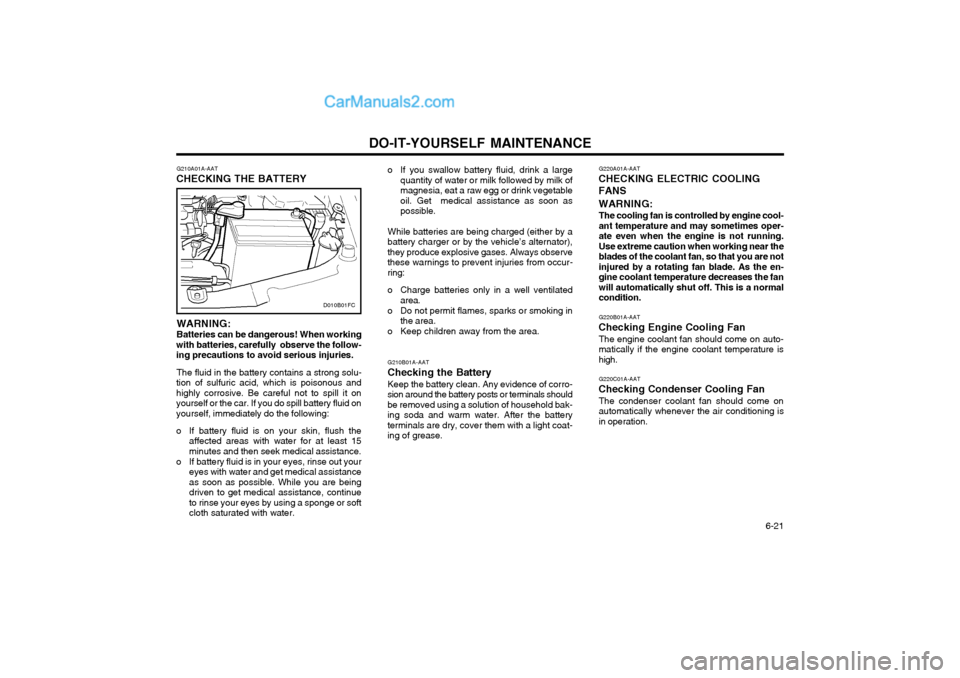
CHECKING THE BATTERY
WARNING: Batteries can be dangerous! When working
with batteries, carefully observe the follow- ing precautions to avoid serious injuries.
The fluid in the battery contains a strong solu-
tion of sulfuric acid, which is poisonous andhighly corrosive. Be careful not to spill it onyourself or the car. If you do spill battery fluid onyourself, immediately do the following:
o If battery fluid is on your skin, flush the affected areas with water for at least 15 minutes and then seek medical assistance.
o If battery fluid is in your eyes, rinse out your eyes with water and get medical assistanceas soon as possible. While you are beingdriven to get medical assistance, continueto rinse your eyes by using a sponge or softcloth saturated with water.
D010B01FC
G220A01A-AAT
CHECKING ELECTRIC COOLING FANS WARNING: The cooling fan is controlled by engine cool- ant temperature and may sometimes oper-ate even when the engine is not running.Use extreme caution when working near theblades of the coolant fan, so that you are notinjured by a rotating fan blade. As the en-gine coolant temperature decreases the fanwill automatically shut off. This is a normalcondition. G220B01A-AAT
Checking Engine Cooling Fan The engine coolant fan should come on auto- matically if the engine coolant temperature ishigh. G220C01A-AAT
Checking Condenser Cooling Fan The condenser coolant fan should come on automatically whenever the air conditioning isin operation.
G210B01A-AAT
Checking the Battery Keep the battery clean. Any evidence of corro-
sion around the battery posts or terminals shouldbe removed using a solution of household bak-ing soda and warm water. After the batteryterminals are dry, cover them with a light coat-ing of grease.
o If you swallow battery fluid, drink a large
quantity of water or milk followed by milk ofmagnesia, eat a raw egg or drink vegetableoil. Get medical assistance as soon aspossible.
While batteries are being charged (either by abattery charger or by the vehicle’s alternator),they produce explosive gases. Always observethese warnings to prevent injuries from occur-ring:
o Charge batteries only in a well ventilated area.
o Do not permit flames, sparks or smoking in the area.
o Keep children away from the area.
Page 171 of 317
INDEX10-1
Cargo Area
Cover ............................................................................. 1-53
Cassette Tape Player Operation (H220, H280).1-69 ~ 1-70, 1-81 ~ 1-82 Catalytic Converter .................................................................... 7-1 ~ 7-2
CD Auto Changer ............................................................................. 1-53
CD Auto Changer (H260, H280) ...................... 1-76 ~ 1-77, 1-85 ~ 1-86
Child-Protector Rear Door Lock ......................................................... 1-5
Child Restraint System .......................................................... 1-18 ~ 1-23
Cigarette Lighter ................................................................................ 1-43
Clock ................................................................................................ 1-43Clutch Checking fluid ............................................................................... 6-16
Pedal free play ............................................................................. 6-18
Combination Light Headlight flasher ........................................................................... 1-40
Headlight switch ............................................................................ 1-39
High-beam switch .......................................................................... 1-40
Lane change signal ....................................................................... 1-39
Turn signal operation .................................................................... 1-39
Compact Disc Player Operation (H260, H280) .1-72 ~ 1-75, 1-83 ~ 1-84Cooling Fans ..................................................................................... 6-21
Corrosion Protection
Cleaning the interior ........................................................................ 4-3
Protecting your Hyundai from corrosion ................ ......................... 4-1
Washing and waxing ....................................................................... 4-2
DDefrosting/Defogging ......................................................................... 1-60
Door Central door lock ............................................................................. 1-6
Door locks ....................................................................................... 1-4Locking and unlocking front doors with a key ....................... 1-4 ~ 1-5
Drink Holder ........................................................................... 1-43 ~ 1-44
Drive Belts ........................................................................................ 6-19
ZK000A1-G 10. INDEX
A Accessory Tray ................................................................................. 1-51
Air Bag ................................................................................... 1-25 ~ 1-29
Air Cleaner Filter ............................................................................... 6-12
Air Conditioning Care .............................................................................................. 6-16
Operation ....................................................................................... 6-17
Switch ............................................................................................ 1-61
Air Filter ............................................................................................ 1-62
Antenna ............................................................................................. 1-90
Ashtray .............................................................................................. 1-43
Auto Fuel Cut Switch ........................................................................ 1-54
BBattery ...................................................................................... 2-11, 6-20
Brake Anti-lock system ..................................................................... 2-8 ~ 2-9
Checking the brakes ..................................................................... 6-15
Fluid ............................................................................................... 6-15
Pedal clearance ............................................................................ 6-18
Pedal free play .............................................................................. 6-18
Practices ................................................................................ 2-7 ~ 2-8
Brake Pad Wear Warning Sound ..................................................... 1-35
Brake Traction Control System .......................................................... 2-9
Breaking-In your new Hyundai ........................................................... 1-2
Bulbs Wattage ................................................................................... 6-25
C Care of Cassette Tapes ........................................................ 1-88 ~ 1-89
Care of Disc ...................................................................................... 1-88
10
Page 177 of 317
SA020A1-EResponsibilty For Maintenance
It is the responsibility of the vehicle owner/driver to ensure that all routine mainte- nance services are undertaken in line with the recommendations specified in Section 5 of this manual. In addition, in order to ensure continued validity of the newvehicle warranty and safe operation of the vehicle, non scheduled maintenance/running repairs should be undertaken at the earliest available opportunity.Under severe operating conditions, more frequent maintenance is required.Details of the maintenance schedule for such conditions are also given in section 5. It is recommended that all maintenance operations and repairs are entrusted to afranchised Hyundai dealer to ensure that the latest repair methods, specializedtooling and genuine Hyundai parts are used to ensure the continued reliability andsafety of the vehicle.
fcuk-0.p65 3/6/2007, 9:55 AM
3
Page 183 of 317
1- 1
CONTROLS AND EQUIPMENT
from jerry cans or by means of a funnel that the fuel being used is unleaded.The use of leaded fuel in this vehicle will result in irreversible pollution of the catalyst ele- ment. Such pollution will prevent correct op- eration of the catalyst and give rise to in- creased operating temperatures leading to the catalyst element melting and restricting the exhaust flow along with an increase in exhaust emission levels. CAUTION: The vehicle warranty will not extend to damage arising from the use of incorrect fuels. Use Diesel Diesel fuel of 52 to 54 cetane is the correct rating to use in Hyundai vehicle. If two types of diesel fuel are available, use summer or winter fuel properly according to the following temperature conditions.
o Above 23°F (-5°C) ... Summer type diesel fuel.
o Below 23°F (-5°C) ... Winter type diesel fuel. Watch the fuel level in the tank very carefully: If the engine stops through fuel failure, thecircuits must be completely purged to permit restarting.
SB000A1-E 1
. CONTROLS AND
EQUIPMENT
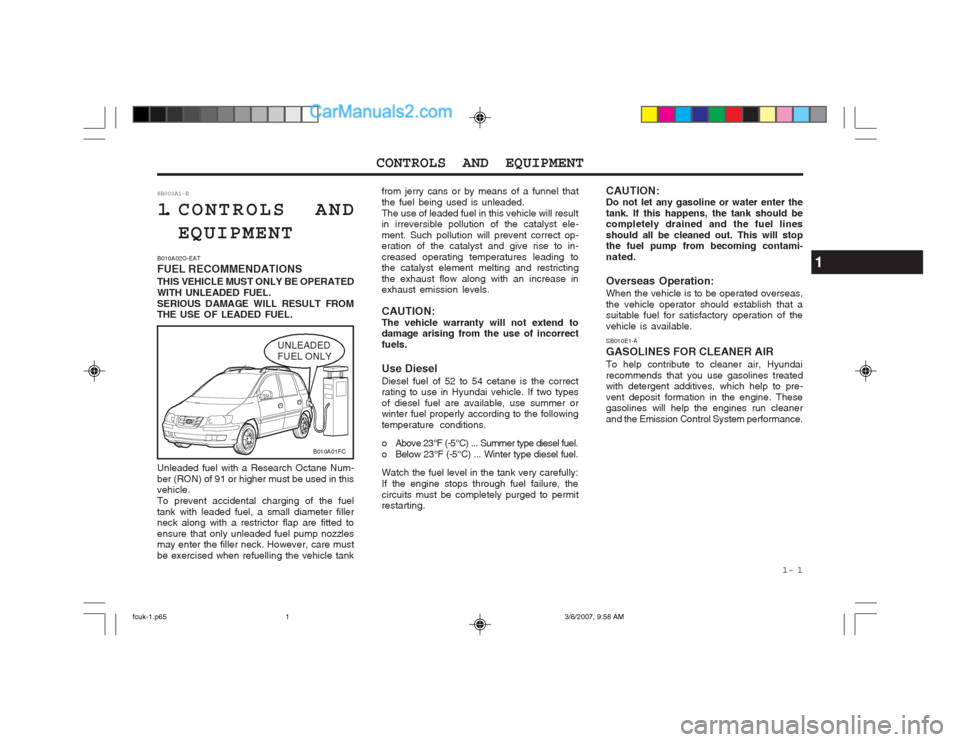
B010A02O-EAT FUEL RECOMMENDATIONSTHIS VEHICLE MUST ONLY BE OPERATED WITH UNLEADED FUEL.SERIOUS DAMAGE WILL RESULT FROM THE USE OF LEADED FUEL.
UNLEADED FUEL ONLY
Unleaded fuel with a Research Octane Num-ber (RON) of 91 or higher must be used in this vehicle. To prevent accidental charging of the fueltank with leaded fuel, a small diameter filler neck along with a restrictor flap are fitted to ensure that only unleaded fuel pump nozzles may enter the filler neck. However, care must be exercised when refuelling the vehicle tank SB010E1-A GASOLINES FOR CLEANER AIRTo help contribute to cleaner air, Hyundai recommends that you use gasolines treated with detergent additives, which help to pre- vent deposit formation in the engine. These gasolines will help the engines run cleaner and the Emission Control System performance.
CAUTION:Do not let any gasoline or water enter thetank. If this happens, the tank should be completely drained and the fuel lines should all be cleaned out. This will stop the fuel pump from becoming contami- nated. Overseas Operation: When the vehicle is to be operated overseas, the vehicle operator should establish that a suitable fuel for satisfactory operation of the vehicle is available.
1
B010A01FC
fcuk-1.p65
3/6/2007, 9:58 AM
1
Page 200 of 317
CONTROLS AND EQUIPMENT
1- 18
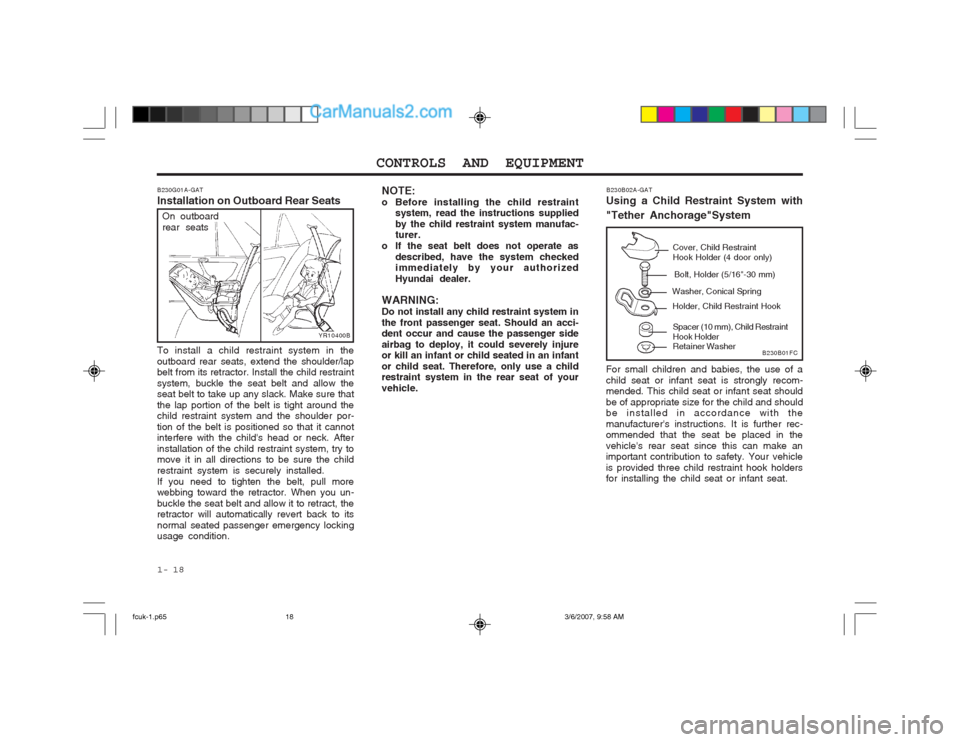
B230G01A-GAT Installation on Outboard Rear Seats
NOTE:
o Before installing the child restraint
system, read the instructions suppliedby the child restraint system manufac- turer.
o If the seat belt does not operate as
described, have the system checkedimmediately by your authorized Hyundai dealer.
WARNING:Do not install any child restraint system inthe front passenger seat. Should an acci- dent occur and cause the passenger side airbag to deploy, it could severely injure or kill an infant or child seated in an infant or child seat. Therefore, only use a child restraint system in the rear seat of your vehicle.
To install a child restraint system in theoutboard rear seats, extend the shoulder/lap belt from its retractor. Install the child restraint system, buckle the seat belt and allow the seat belt to take up any slack. Make sure that the lap portion of the belt is tight around the child restraint system and the shoulder por- tion of the belt is positioned so that it cannot interfere with the child's head or neck. After installation of the child restraint system, try to move it in all directions to be sure the child restraint system is securely installed.If you need to tighten the belt, pull more webbing toward the retractor. When you un- buckle the seat belt and allow it to retract, the retractor will automatically revert back to its normal seated passenger emergency locking usage condition.
YR10400B
On outboard rear seats
B230B02A-GAT
Using a Child Restraint System with "Tether Anchorage"System For small children and babies, the use of a child seat or infant seat is strongly recom- mended. This child seat or infant seat should be of appropriate size for the child and should be installed in accordance with the manufacturer's instructions. It is further rec- ommended that the seat be placed in the vehicle's rear seat since this can make an important contribution to safety. Your vehicle is provided three child restraint hook holders for installing the child seat or infant seat.
Cover, Child Restraint Hook Holder (4 door only)
Bolt, Holder (5/16"-30 mm)
Washer, Conical Spring Holder, Child Restraint Hook
Spacer (10 mm), Child RestraintHook Holder Retainer Washer
B230B01FC
fcuk-1.p65 3/6/2007, 9:58 AM
18
Page 203 of 317
1- 21
CONTROLS AND EQUIPMENT
authorized Hyundai dealer inspect the pre-tensioner seat belt or SRS airbag system as soon as possible.
WARNING:
o Pre-tensioners are designed to operate only one time. After activation, pre- tensioner seat belts must be replaced. All seat belts, of any type, should al- ways be replaced after they have been worn during a collision.
o The pre-tensioner seat belt assembly mechanisms become hot during activa-tion. Do not touch the pre-tensioner seat belt assemblies for several min- utes after they have been activated.
o Do not attempt to inspect or replace the pre-tensioner seat belts yourself. Thismust be done by an authorized Hyundai dealer.
o Do not strike the pre-tensioner seat belt assemblies.
o Do not attempt to service or repair the pre-tensioner seat belt system in any manner.
o Improper handling of the pre-tensioner
seat belt assemblies, and failure to heed the warnings to not strike, modify, in- spect, replace, service or repair the pre- tensioner seat belt assemblies may lead to improper operation or inadvertent activation and serious injury.
o Always wear the seat belts when driving or travelling in a motor vehicle.
Driver's airbag conditions even if the seat belts are not being worn at the time of the collision.
o When the pre-tensioner seat belts are
activated, a loud noise may be heardand fine dust, which may appear to be smoke, may be visible in the passenger compartment. These are normal operat- ing conditions and are not hazardous.
o Although it is harmless, the fine dust
may cause skin irritation and should not be breathed for prolonged periods. Wash your hands and face thoroughly after an accident in which the pre- tensioner seat belts were activated.
CAUTION:
o Because the sensor that activates the SRS airbag is connected with the pre- tensioner seat belt, the SRS airbag warn- ing light on the instrument panel will blink for approximately 6 seconds after the ignition key has been turned to the "ON" position and then it should turn off.
o If the pre-tensioner seat belt is not work- ing properly, this warning light will illu-minate even if there is no malfunction of the SRS airbag system.If the SRS airbag warning light does not illuminate when the ignition key is turned to "ON", or if it remains illuminated after blinking for approximately 6 sec- onds, or if it illuminates while the ve- hicle is being driven, please have an
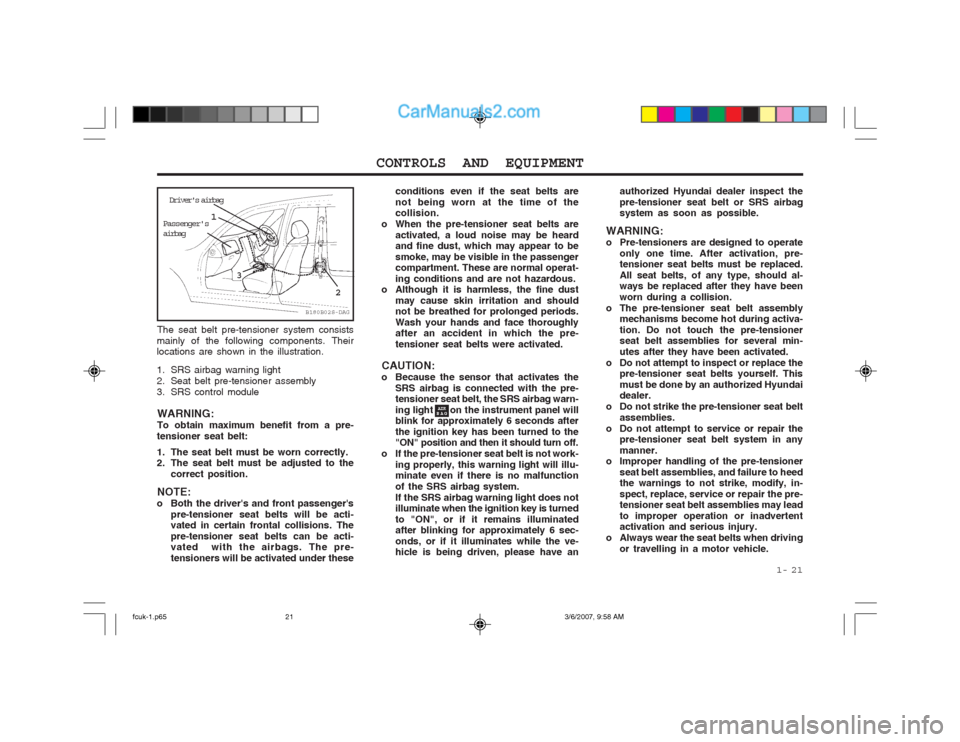
The seat belt pre-tensioner system consists
mainly of the following components. Theirlocations are shown in the illustration.
1. SRS airbag warning light
2. Seat belt pre-tensioner assembly
3. SRS control module
WARNING:To obtain maximum benefit from a pre-
tensioner seat belt:
1. The seat belt must be worn correctly.
2. The seat belt must be adjusted to the correct position.
NOTE:
o Both the driver's and front passenger's
pre-tensioner seat belts will be acti-vated in certain frontal collisions. The pre-tensioner seat belts can be acti- vated with the airbags. The pre- tensioners will be activated under these
1
2
3
B180B02S-DAG
Passenger's airbag
AIR
BAG
fcuk-1.p65 3/6/2007, 9:58 AM
21
Page 204 of 317
CONTROLS AND EQUIPMENT
1- 22
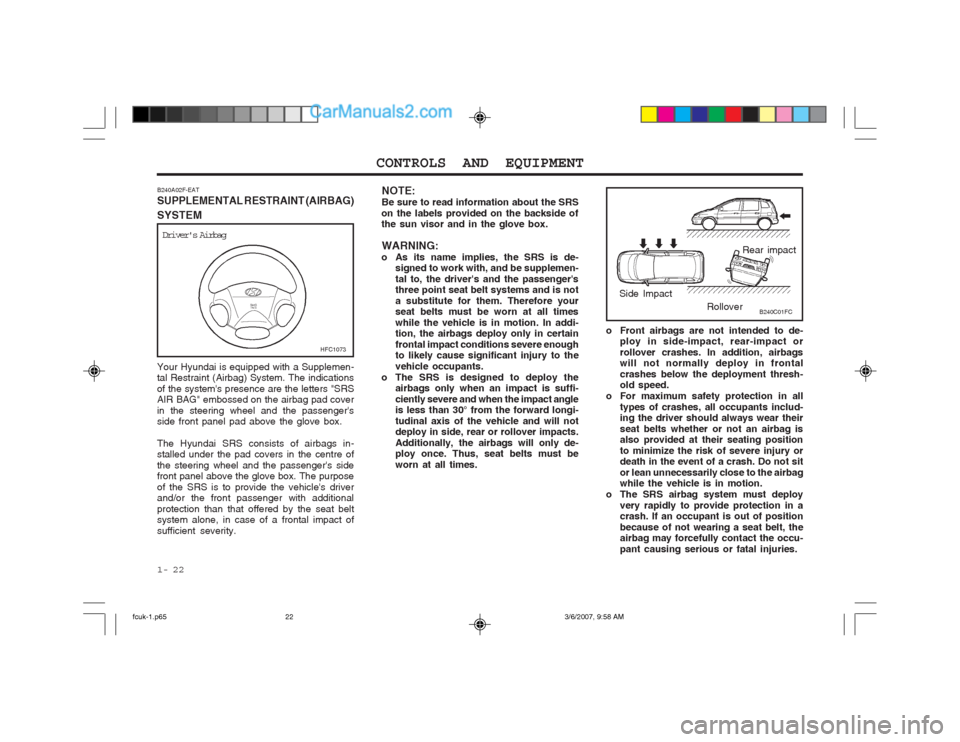
Your Hyundai is equipped with a Supplemen- tal Restraint (Airbag) System. The indications of the system's presence are the letters "SRS AIR BAG" embossed on the airbag pad cover in the steering wheel and the passenger's side front panel pad above the glove box. The Hyundai SRS consists of airbags in- stalled under the pad covers in the centre of the steering wheel and the passenger's side front panel above the glove box. The purpose of the SRS is to provide the vehicle's driver and/or the front passenger with additional protection than that offered by the seat belt system alone, in case of a frontal impact of sufficient severity. NOTE:Be sure to read information about the SRS
on the labels provided on the backside of the sun visor and in the glove box.
WARNING:
o As its name implies, the SRS is de- signed to work with, and be supplemen- tal to, the driver's and the passenger's three point seat belt systems and is not a substitute for them. Therefore your seat belts must be worn at all times while the vehicle is in motion. In addi- tion, the airbags deploy only in certain frontal impact conditions severe enough to likely cause significant injury to the vehicle occupants.
o The SRS is designed to deploy the airbags only when an impact is suffi-ciently severe and when the impact angle is less than 30° from the forward longi- tudinal axis of the vehicle and will not deploy in side, rear or rollover impacts. Additionally, the airbags will only de- ploy once. Thus, seat belts must be worn at all times.
Driver's Airbag
B240A02F-EAT
SUPPLEMENTAL RESTRAINT (AIRBAG)
SYSTEM
HFC1073
Rear impact
Side Impact RolloverB240C01FC
o Front airbags are not intended to de-
ploy in side-impact, rear-impact or rollover crashes. In addition, airbags will not normally deploy in frontal crashes below the deployment thresh- old speed.
o For maximum safety protection in all types of crashes, all occupants includ-ing the driver should always wear their seat belts whether or not an airbag is also provided at their seating position to minimize the risk of severe injury or death in the event of a crash. Do not sit or lean unnecessarily close to the airbag while the vehicle is in motion.
o The SRS airbag system must deploy very rapidly to provide protection in acrash. If an occupant is out of position because of not wearing a seat belt, the airbag may forcefully contact the occu- pant causing serious or fatal injuries.
fcuk-1.p65 3/6/2007, 9:58 AM
22
Page 206 of 317
CONTROLS AND EQUIPMENT
1- 24
WARNING:
o When the SRS is activated, there may be a loud noise and fine dust will be released throughout the vehicle. These conditions are normal and are not haz- ardous. However, the fine dust generat- ed during airbag deployment may cause skin irritation. Be sure to wash your hands and face thoroughly with luke- warm water and a mild soap after an accident in which the airbags were de- ployed.
o The SRS can function only when the ignition key is in the "ON" position. If the SRS SRI does not come on, or continuously remains on, after flashing for about 6 seconds when the ignition key is turned to the "ON" position, or after the engine is started, or comes on while driving, the SRS is not working properly. If this occurs, have your ve- hicle immediately inspected by your Hyundai dealer.
o Before you replace a fuse or disconnect a battery terminal, turn the ignition keyto the "LOCK" position or remove the ignition key. Never remove or replace the air bag related fuse(s) when the ignition key is in the "ON" position. Failure to heed this warning will cause the SRS SRI to illuminate.
Passenger's Airbag
After complete inflation, the airbag immedi- ately starts deflating, enabling the driver to maintain forward visibility. CAUTION: When installing a container of liquid airfreshener inside a vehicle, do not place it near the instrument cluster nor on the instrument panel pad surface. If there is any leakage from the air freshener onto these areas (instrument cluster, instrument panel pad or air ventilator), it may damage these parts. If the liquid from the air fresh- ener does leak onto these areas, wash them with water immediately. YR10353A
dangerous projectiles and cause injury ifthe passenger's side air bag inflates.
B990B04Y-EAT Side Impact Airbag
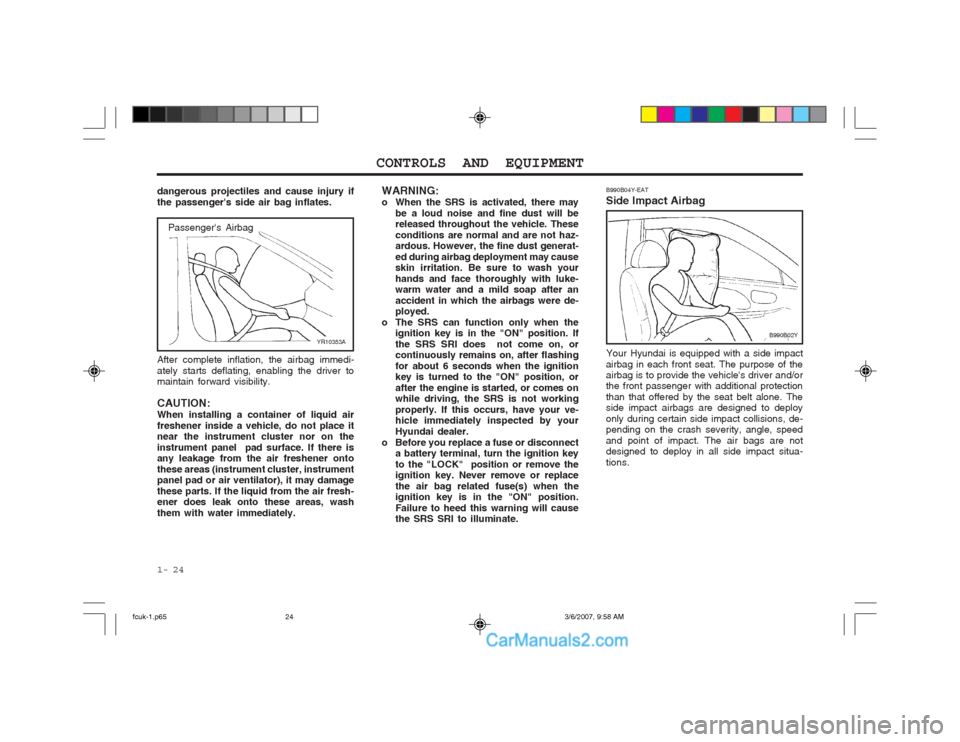
Your Hyundai is equipped with a side impact
airbag in each front seat. The purpose of the airbag is to provide the vehicle's driver and/orthe front passenger with additional protection than that offered by the seat belt alone. The side impact airbags are designed to deploy only during certain side impact collisions, de- pending on the crash severity, angle, speed and point of impact. The air bags are not designed to deploy in all side impact situa- tions. B990B02Y
fcuk-1.p65
3/6/2007, 9:58 AM
24
Page 209 of 317
1- 27
CONTROLS AND EQUIPMENT
HFC002-D
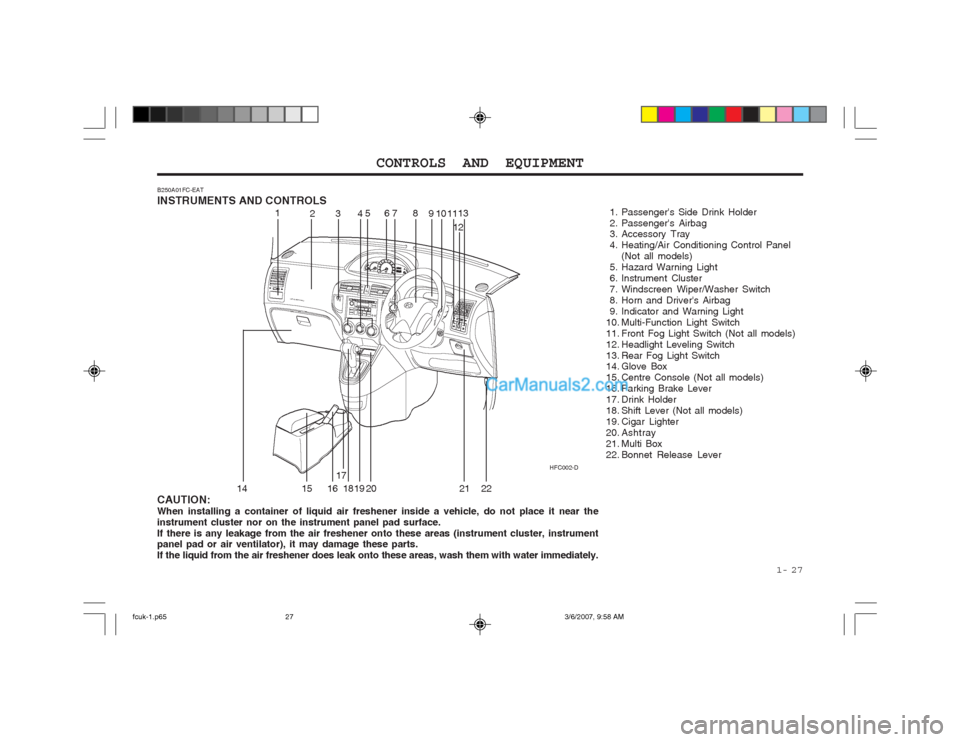
B250A01FC-EAT INSTRUMENTS AND CONTROLS
1. Passenger's Side Drink Holder
2. Passenger's Airbag
3. Accessory Tray
4. Heating/Air Conditioning Control Panel(Not all models)
5. Hazard Warning Light
6. Instrument Cluster
7. Windscreen Wiper/Washer Switch
8. Horn and Driver's Airbag
9. Indicator and Warning Light
10. Multi-Function Light Switch
11. Front Fog Light Switch (Not all models)
12. Headlight Leveling Switch
13. Rear Fog Light Switch
14. Glove Box
15. Centre Console (Not all models)
16. Parking Brake Lever
17. Drink Holder
18. Shift Lever (Not all models)
19. Cigar Lighter
20. Ashtray
21. Multi Box
22. Bonnet Release Lever
CAUTION:When installing a container of liquid air freshener inside a vehicle, do not place it near theinstrument cluster nor on the instrument panel pad surface.If there is any leakage from the air freshener onto these areas (instrument cluster, instrument panel pad or air ventilator), it may damage these parts. If the liquid from the air freshener does leak onto these areas, wash them with water immediately. 1
234
567 8
91011
1213
14 15 16 17
1819
20 2122
fcuk-1.p65 3/6/2007, 9:58 AM
27