wheel Hyundai Matrix 2004 Owner's Guide
[x] Cancel search | Manufacturer: HYUNDAI, Model Year: 2004, Model line: Matrix, Model: Hyundai Matrix 2004Pages: 317, PDF Size: 5.12 MB
Page 173 of 317
INDEX10-3
R
Rear Fog Audible Warning Sound
....................................................1-36
Rear Seat Adjustable headrests ..................................................................... 1-11
Adjusting seatback angle .............................................................. 1-11
Adjusting seat forward and rearward ............................................ 1-11
Arm Rest ....................................................................................... 1-44
Fold down ........................................................................... 1-12 ~ 1-13
Rear Window Defroster Switch ......................................................... 1-42
Recommended Shift Poi nts ................................................................ 2-5
Removal of water from the fuel fiter ...................................... 6-22 ~ 6-23
Replacing Light Bulbs ....................................................................... 6-23
Replacing The Spark Plugs .............................................................. 6-10
Roof R ack ......................................................................................... 1-54
SSeat Belts 2-Point Static Type ............................................................ 1-16 ~ 1-173-Point system ................................................................... 1-15 ~ 1-16
Adjustable height ........................................................................... 1-15
Adjusting your seat belt ................................................................ 1-16
Care of seat belts ......................................................................... 1-14
Precautions ................................................................................... 1-13
Seat Warmer ..................................................................................... 1-13
Spark Plugs ........................................................................... 6-10 ~ 6-11
Spectacle Case ................................................................................. 1-46
Speedometer ..................................................................................... 1-36
Starting Procedures ............................................................................ 2-3Steering Wheel Free play ....................................................................................... 6-17
Tilt lever ........................................................................................ 1-55
Stereo Radio Operation (H210, H220, H260, H280) ............................ 1-65 ~ 1-66, 1-67 ~ 1-68, 1-71 ~ 1-73, 1-78 ~ 1-80
Stereo Sound System ............................................................ 1-63 ~ 1-64
K
Keys .................................................................................................... 1-2
If you lose your keys .................................................................... 3-10
Positions .......................................................................................... 2-2
L
Lubrication Chart ................................................................................. 9-3
Luggaga Net ..................................................................................... 1-53
MMaintenance Intervals Explanation of scheduled maintenance items ........................ 5-7 ~ 5-8
Maintenance under severe usage conditions ................................. 5-6
Scheduled maintenance ......................................................... 5-3 ~ 5-5
Service requirements ...................................................................... 5-1
Mirros Day-night inside rearview .............................................................. 1-49
Outside rear view .......................................................................... 1-48
Multi Box ........................................................................................... 1-48
OOdometer .......................................................................................... 1-37
Outside Rearview Mirror Heater ....................................................... 1-49
PParking Brake ................................................................................... 1-50
Power Outlet ..................................................................................... 1-51
Power Steering Fluid Level .............................................................. 6-22
Pre-tensioner Seat Belt ..................................................................... 1-23
Page 204 of 317
CONTROLS AND EQUIPMENT
1- 22
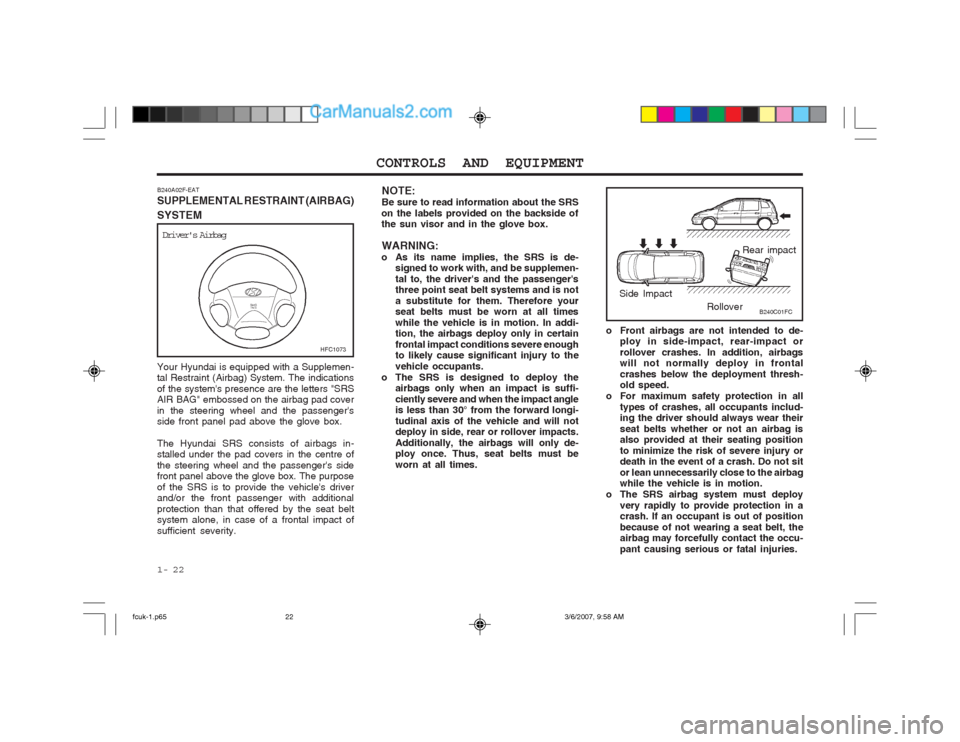
Your Hyundai is equipped with a Supplemen- tal Restraint (Airbag) System. The indications of the system's presence are the letters "SRS AIR BAG" embossed on the airbag pad cover in the steering wheel and the passenger's side front panel pad above the glove box. The Hyundai SRS consists of airbags in- stalled under the pad covers in the centre of the steering wheel and the passenger's side front panel above the glove box. The purpose of the SRS is to provide the vehicle's driver and/or the front passenger with additional protection than that offered by the seat belt system alone, in case of a frontal impact of sufficient severity. NOTE:Be sure to read information about the SRS
on the labels provided on the backside of the sun visor and in the glove box.
WARNING:
o As its name implies, the SRS is de- signed to work with, and be supplemen- tal to, the driver's and the passenger's three point seat belt systems and is not a substitute for them. Therefore your seat belts must be worn at all times while the vehicle is in motion. In addi- tion, the airbags deploy only in certain frontal impact conditions severe enough to likely cause significant injury to the vehicle occupants.
o The SRS is designed to deploy the airbags only when an impact is suffi-ciently severe and when the impact angle is less than 30° from the forward longi- tudinal axis of the vehicle and will not deploy in side, rear or rollover impacts. Additionally, the airbags will only de- ploy once. Thus, seat belts must be worn at all times.
Driver's Airbag
B240A02F-EAT
SUPPLEMENTAL RESTRAINT (AIRBAG)
SYSTEM
HFC1073
Rear impact
Side Impact RolloverB240C01FC
o Front airbags are not intended to de-
ploy in side-impact, rear-impact or rollover crashes. In addition, airbags will not normally deploy in frontal crashes below the deployment thresh- old speed.
o For maximum safety protection in all types of crashes, all occupants includ-ing the driver should always wear their seat belts whether or not an airbag is also provided at their seating position to minimize the risk of severe injury or death in the event of a crash. Do not sit or lean unnecessarily close to the airbag while the vehicle is in motion.
o The SRS airbag system must deploy very rapidly to provide protection in acrash. If an occupant is out of position because of not wearing a seat belt, the airbag may forcefully contact the occu- pant causing serious or fatal injuries.
fcuk-1.p65 3/6/2007, 9:58 AM
22
Page 205 of 317
1- 23
CONTROLS AND EQUIPMENT
Passenger's Airbag
B240B04FC-D
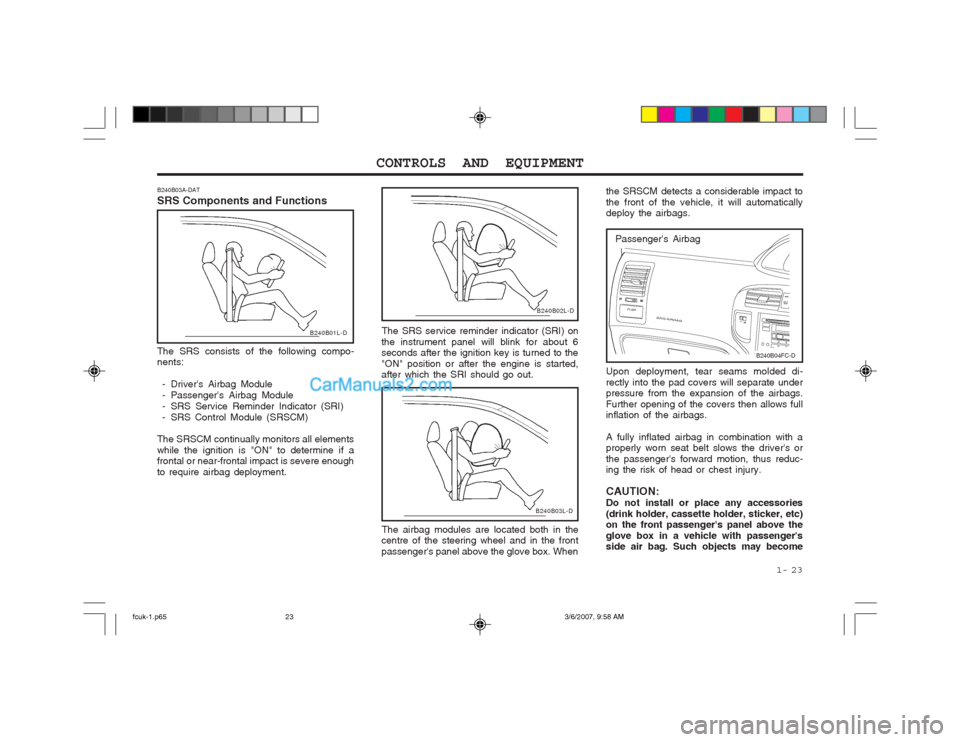
Upon deployment, tear seams molded di- rectly into the pad covers will separate under pressure from the expansion of the airbags. Further opening of the covers then allows full inflation of the airbags. A fully inflated airbag in combination with a properly worn seat belt slows the driver's or the passenger's forward motion, thus reduc- ing the risk of head or chest injury. CAUTION: Do not install or place any accessories(drink holder, cassette holder, sticker, etc) on the front passenger's panel above the glove box in a vehicle with passenger's side air bag. Such objects may become
the SRSCM detects a considerable impact to the front of the vehicle, it will automatically deploy the airbags.
B240B02L-D
The SRS service reminder indicator (SRI) on
the instrument panel will blink for about 6 seconds after the ignition key is turned to the "ON" position or after the engine is started, after which the SRI should go out.
B240B03L-D
The airbag modules are located both in the
centre of the steering wheel and in the front passenger's panel above the glove box. When
B240B03A-DAT SRS Components and Functions
B240B01L-D
The SRS consists of the following compo- nents:
- Driver's Airbag Module
- Passenger's Airbag Module
- SRS Service Reminder Indicator (SRI)
- SRS Control Module (SRSCM)
The SRSCM continually monitors all elementswhile the ignition is "ON" to determine if a frontal or near-frontal impact is severe enough to require airbag deployment.
fcuk-1.p65 3/6/2007, 9:58 AM
23
Page 207 of 317
1- 25
CONTROLS AND EQUIPMENT
YT10355A
WARNING:
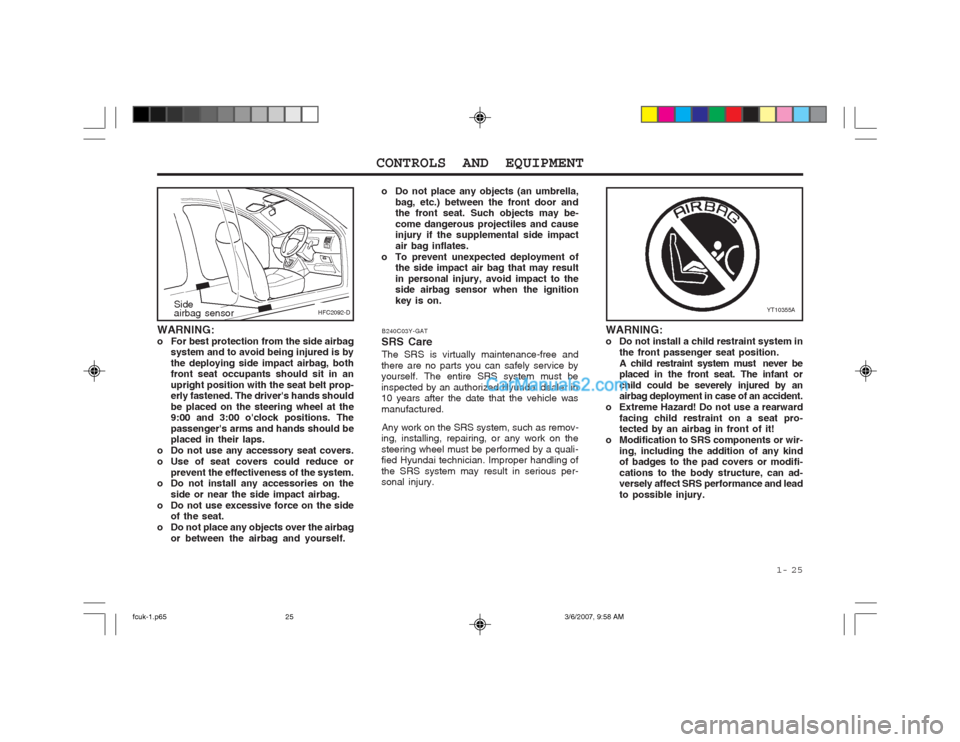
o Do not install a child restraint system in
the front passenger seat position.
A child restraint system must never be placed in the front seat. The infant or child could be severely injured by an airbag deployment in case of an accident.
o Extreme Hazard! Do not use a rearward facing child restraint on a seat pro-tected by an airbag in front of it!
o Modification to SRS components or wir- ing, including the addition of any kindof badges to the pad covers or modifi- cations to the body structure, can ad- versely affect SRS performance and lead to possible injury.
WARNING:
o For best protection from the side airbag
system and to avoid being injured is bythe deploying side impact airbag, both front seat occupants should sit in an upright position with the seat belt prop- erly fastened. The driver's hands should be placed on the steering wheel at the 9:00 and 3:00 o'clock positions. The passenger's arms and hands should be placed in their laps.
o Do not use any accessory seat covers.
o Use of seat covers could reduce or prevent the effectiveness of the system.
o Do not install any accessories on the
side or near the side impact airbag.
o Do not use excessive force on the side of the seat.
o Do not place any objects over the airbag or between the airbag and yourself. B240C03Y-GAT
SRS Care The SRS is virtually maintenance-free and
there are no parts you can safely service by yourself. The entire SRS system must be inspected by an authorized Hyundai dealer in 10 years after the date that the vehicle was manufactured.
Any work on the SRS system, such as remov-
ing, installing, repairing, or any work on thesteering wheel must be performed by a quali- fied Hyundai technician. Improper handling of the SRS system may result in serious per- sonal injury.
HFC2092-DSide airbag sensor o Do not place any objects (an umbrella,
bag, etc.) between the front door and the front seat. Such objects may be- come dangerous projectiles and cause injury if the supplemental side impact air bag inflates.
o To prevent unexpected deployment of the side impact air bag that may resultin personal injury, avoid impact to the side airbag sensor when the ignition key is on.
fcuk-1.p65 3/6/2007, 9:58 AM
25
Page 208 of 317
CONTROLS AND EQUIPMENT
1- 26
o For cleaning the airbag pad covers,
use only a soft, dry cloth or one which has been moistened with plain water. Solvents or cleaners could adversely affect the airbag covers and proper deployment of the system.
o No objects should be placed over or near the airbag modules on the steeringwheel, instrument panel, and the front passenger's panel above the glove box, because any such object could cause harm if the vehicle is in a crash severe enough to cause the airbags to inflate.
o If the airbags inflate, they must be re-
placed by an authorized Hyundai dealer.
o Do not tamper with or disconnect SRS wiring, or other components of the SRSsystem. Doing so could result in injury, due to accidental firing of the airbags or by rendering the SRS inoperative.
o If components of the airbag system must be discarded, or if the vehicle must bescrapped, certain safety precautions must be observed. Your Hyundai dealer knows these precautions and can give you the necessary information. Failure to follow these precautions and proce- dures could increase the risk of per- sonal injury. o If you sell your vehicle, be sure to
inform the new owner of these impor- tant points and make certain that this manual is transferred to the new owner.
o If your car was flooded and has soaked carpeting or water on flooring, youshouldn't try to start engine; have the car towed to authorized Hyundai dealer.
o Do not replace the bumper or the
bumper guard with the one other than the Hyundai genuine parts. Otherwise, it can adversely affect SRS performance and lead to unexpected injury.
fcuk-1.p65 3/6/2007, 9:58 AM
26
Page 218 of 317
CONTROLS AND EQUIPMENT
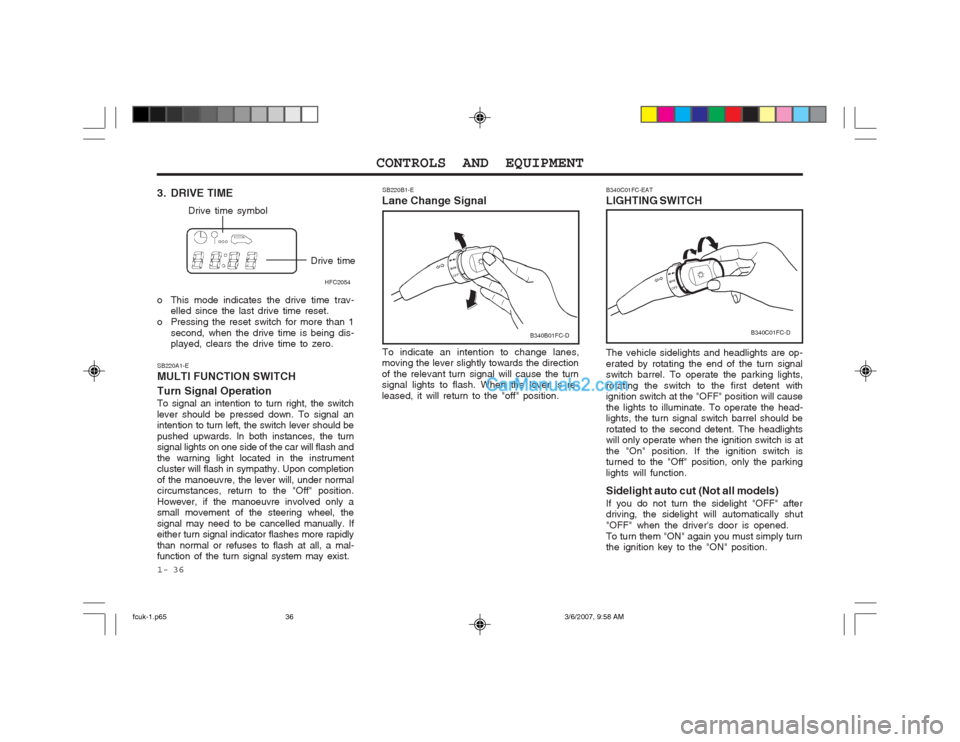
1- 36 The vehicle sidelights and headlights are op- erated by rotating the end of the turn signal switch barrel. To operate the parking lights, rotating the switch to the first detent with ignition switch at the "OFF" position will cause the lights to illuminate. To operate the head- lights, the turn signal switch barrel should be rotated to the second detent. The headlights will only operate when the ignition switch is at the "On" position. If the ignition switch is turned to the "Off" position, only the parking lights will function. Sidelight auto cut (Not all models) If you do not turn the sidelight "OFF" after driving, the sidelight will automatically shut "OFF" when the driver's door is opened.To turn them "ON" again you must simply turn the ignition key to the "ON" position.
B340C01FC-EAT LIGHTING SWITCH
SB220A1-EMULTI FUNCTION SWITCH Turn Signal Operation To signal an intention to turn right, the switch lever should be pressed down. To signal an intention to turn left, the switch lever should be pushed upwards. In both instances, the turn signal lights on one side of the car will flash and the warning light located in the instrument cluster will flash in sympathy. Upon completion of the manoeuvre, the lever will, under normal circumstances, return to the "Off" position. However, if the manoeuvre involved only a small movement of the steering wheel, the signal may need to be cancelled manually. If either turn signal indicator flashes more rapidly than normal or refuses to flash at all, a mal- function of the turn signal system may exist. SB220B1-E
Lane Change Signal
To indicate an intention to change lanes,
moving the lever slightly towards the direction of the relevant turn signal will cause the turn signal lights to flash. When the lever is re- leased, it will return to the "off" position.
3. DRIVE TIME
Drive time symbol
Drive timeHFC2054
o This mode indicates the drive time trav- elled since the last drive time reset.
o Pressing the reset switch for more than 1 second, when the drive time is being dis- played, clears the drive time to zero. B340C01FC-D
B340B01FC-D
fcuk-1.p65
3/6/2007, 9:58 AM
36
Page 219 of 317
1- 37
CONTROLS AND EQUIPMENT
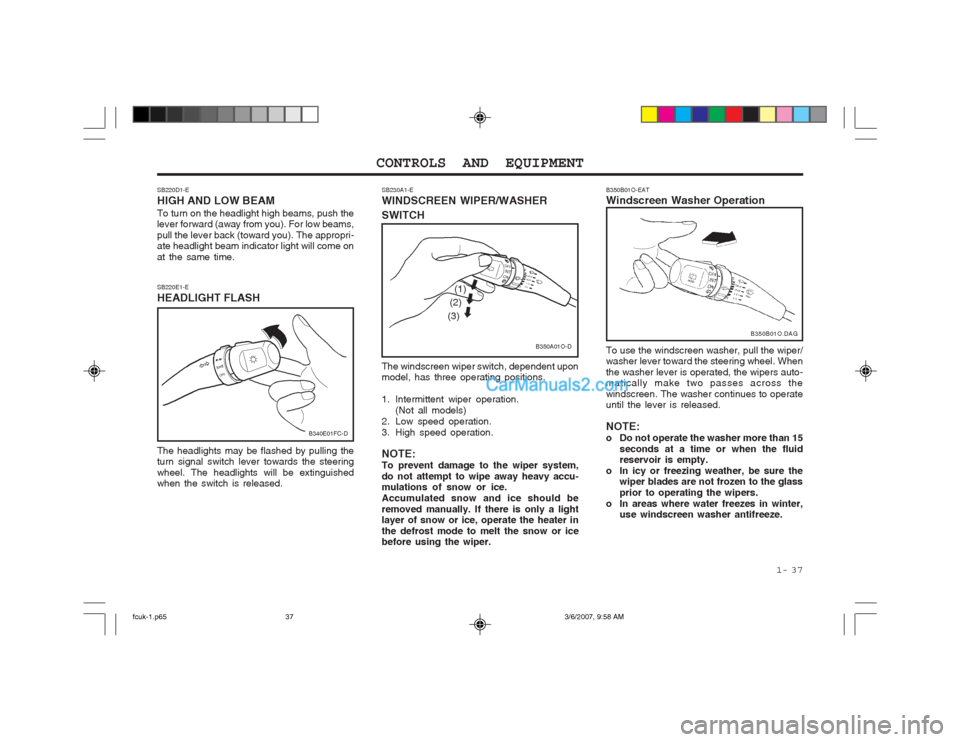
The windscreen wiper switch, dependent upon model, has three operating positions.
1. Intermittent wiper operation.
(Not all models)
2. Low speed operation.
3. High speed operation. NOTE: To prevent damage to the wiper system,do not attempt to wipe away heavy accu- mulations of snow or ice. Accumulated snow and ice should beremoved manually. If there is only a light layer of snow or ice, operate the heater in the defrost mode to melt the snow or ice before using the wiper.
SB230A1-E WINDSCREEN WIPER/WASHER SWITCH
SB220E1-E HEADLIGHT FLASH The headlights may be flashed by pulling the turn signal switch lever towards the steering wheel. The headlights will be extinguished when the switch is released.
SB220D1-E HIGH AND LOW BEAMTo turn on the headlight high beams, push the lever forward (away from you). For low beams, pull the lever back (toward you). The appropri- ate headlight beam indicator light will come on at the same time.
B340E01FC-D
B350A01O-D
(1)
(2)
(3)
B350B01O-EAT Windscreen Washer Operation To use the windscreen washer, pull the wiper/ washer lever toward the steering wheel. When the washer lever is operated, the wipers auto- matically make two passes across the windscreen. The washer continues to operate until the lever is released. NOTE:
o Do not operate the washer more than 15 seconds at a time or when the fluid reservoir is empty.
o In icy or freezing weather, be sure the wiper blades are not frozen to the glass prior to operating the wipers.
o In areas where water freezes in winter, use windscreen washer antifreeze. B350B01O.DAG
fcuk-1.p65
3/6/2007, 9:58 AM
37
Page 234 of 317
CONTROLS AND EQUIPMENT
1- 52 B610A01S-DAT
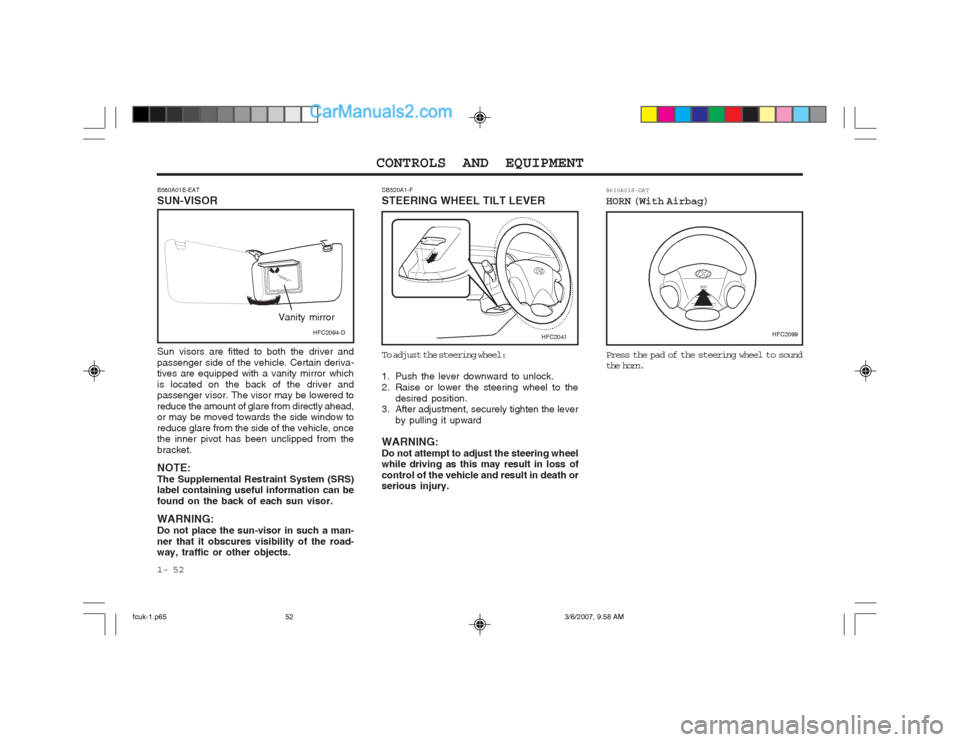
HORN (With Airbag) Press the pad of the steering wheel to sound
the horn.
B580A01E-EAT SUN-VISOR Sun visors are fitted to both the driver and passenger side of the vehicle. Certain deriva- tives are equipped with a vanity mirror which is located on the back of the driver and passenger visor. The visor may be lowered to reduce the amount of glare from directly ahead, or may be moved towards the side window to reduce glare from the side of the vehicle, once the inner pivot has been unclipped from the bracket. NOTE: The Supplemental Restraint System (SRS) label containing useful information can be found on the back of each sun visor. WARNING: Do not place the sun-visor in such a man-ner that it obscures visibility of the road- way, traffic or other objects. SB520A1-F STEERING WHEEL TILT LEVER
HFC2099HFC2041HFC2094-D
Vanity mirror
To adjust the steering wheel:
1. Push the lever downward to unlock.
2. Raise or lower the steering wheel to the
desired position.
3. After adjustment, securely tighten the lever
by pulling it upward
WARNING:Do not attempt to adjust the steering wheel while driving as this may result in loss of control of the vehicle and result in death or serious injury.
fcuk-1.p65 3/6/2007, 9:58 AM
52
Page 247 of 317
DRIVING YOUR HYUNDAI 2- 3
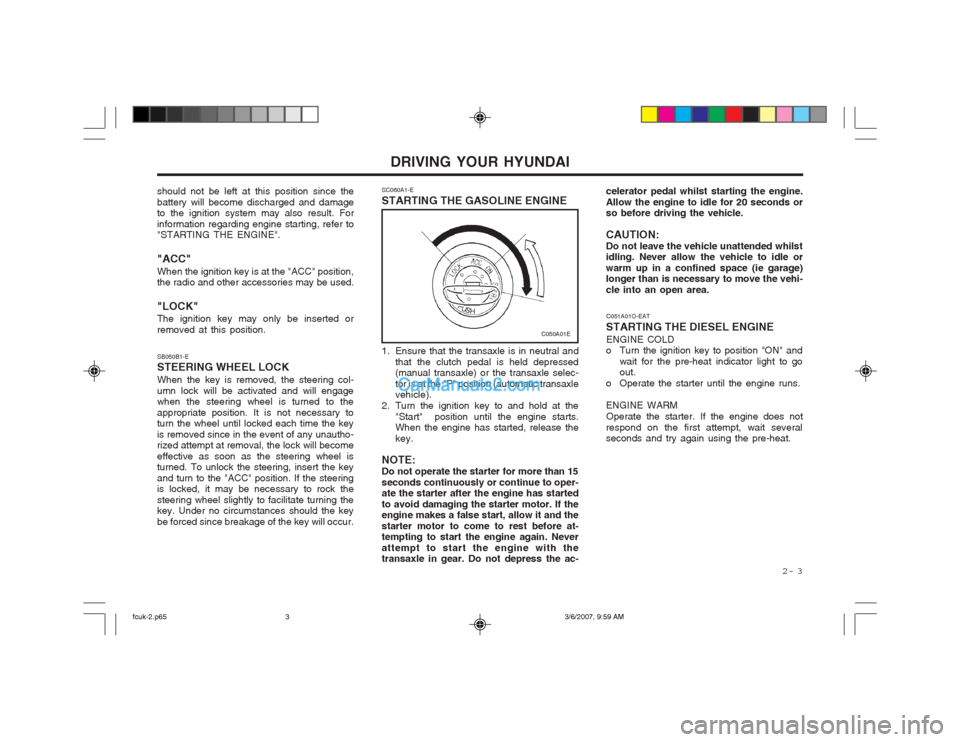
SB050B1-E STEERING WHEEL LOCK When the key is removed, the steering col- umn lock will be activated and will engage when the steering wheel is turned to the appropriate position. It is not necessary to turn the wheel until locked each time the key is removed since in the event of any unautho- rized attempt at removal, the lock will become effective as soon as the steering wheel is turned. To unlock the steering, insert the key and turn to the "ACC" position. If the steering is locked, it may be necessary to rock the steering wheel slightly to facilitate turning the key. Under no circumstances should the key be forced since breakage of the key will occur. SC060A1-E STARTING THE GASOLINE ENGINE
1. Ensure that the transaxle is in neutral and
that the clutch pedal is held depressed (manual transaxle) or the transaxle selec- tor is at the "P" position (automatic transaxle vehicle).
2. Turn the ignition key to and hold at the "Start" position until the engine starts.When the engine has started, release the key.
NOTE:Do not operate the starter for more than 15seconds continuously or continue to oper- ate the starter after the engine has started to avoid damaging the starter motor. If the engine makes a false start, allow it and the starter motor to come to rest before at- tempting to start the engine again. Never attempt to start the engine with the transaxle in gear. Do not depress the ac-
C050A01E
should not be left at this position since the battery will become discharged and damage to the ignition system may also result. For information regarding engine starting, refer to "STARTING THE ENGINE". "ACC" When the ignition key is at the "ACC" position, the radio and other accessories may be used. "LOCK" The ignition key may only be inserted or removed at this position. celerator pedal whilst starting the engine.Allow the engine to idle for 20 seconds or so before driving the vehicle. CAUTION: Do not leave the vehicle unattended whilst idling. Never allow the vehicle to idle or warm up in a confined space (ie garage) longer than is necessary to move the vehi- cle into an open area.
C051A01O-EAT
STARTING THE DIESEL ENGINE
ENGINE COLD
o Turn the ignition key to position "ON" and
wait for the pre-heat indicator light to go out.
o Operate the starter until the engine runs. ENGINE WARM Operate the starter. If the engine does not
respond on the first attempt, wait several seconds and try again using the pre-heat.
fcuk-2.p65 3/6/2007, 9:59 AM
3
Page 251 of 317
DRIVING YOUR HYUNDAI 2- 7
DC110C1-E o R (Reverse):With the selector in this position, reverse gear will be engaged. The engine may not be started with the selector in this position. CAUTION: The selector must NEVER be shifted to the"R" position whilst the vehicle is in mo- tion.
YC090A1-E SELECTOR POSITIONS o P (Park): With the selector in this position, no drive is transmitted from the engine and the transaxle output and therefore the front wheels locked. The engine may be started with the selector in this position. CAUTION: The selector must NEVER be shifted to the "P" position whilst the vehicle is in motion, otherwise serious transaxle dam- age will result.
DC110F1-E
o 2 (Second Gear):
With the selector in this position, first gear will be engaged from rest. The transmission will upshift to second gear depending upon the vehicle speed and throttle position. No upshift to third or fourth will occur. The engine may not be started with the selector in this position. CAUTION: Do not move the selector to the 2 position when the vehicle speed is in excess of 60 m.p.h. DC110G2-E o L (Low Gear):With the selector in this position, first gear will be engaged from rest. No upshift will occur regardless of vehicle speed and throttle open- ing. The engine may not be started with the selector in this position. CAUTION: Do not move the selector to the "L" posi- tion when the vehicle speed is in excess of 50 m.p.h.
DC110E1-E
o D (Drive): With the selector in this position, first gear willbe engaged from rest and the transmission will automatically upshift to second, third and fourth depending upon the vehicle speed, throttle position and the position of the over- drive switch. The engine may not be started with the selector in this position.
DC110D1-E
o N (Neutral): With the selector in this position, no gear isselected and no drive is transmitted from the engine. The engine may be started with the selector in this position. CAUTION: Do not coast with the selector at the "N"position.
C090H01A-EAT NOTE:
o The brake pedal should be depressedwhen shifting from NEUTRAL to a for- ward or reverse gear.
o The brake pedal fully depressed in or- der to move the shift lever from the "P"(Park) position to any of the other posi- tions.
o It is always possible to shift from "R", "N", "D", "2", "L" position.
For optimum fuel economy, accelerate grad-ually. The transaxle will automatically shift to the second, third and overdrive gears.
fcuk-2.p65
3/6/2007, 9:59 AM
7