tow Hyundai Matrix 2004 Workshop Manual
[x] Cancel search | Manufacturer: HYUNDAI, Model Year: 2004, Model line: Matrix, Model: Hyundai Matrix 2004Pages: 317, PDF Size: 5.12 MB
Page 267 of 317
IN CASE OF EMERGENCY
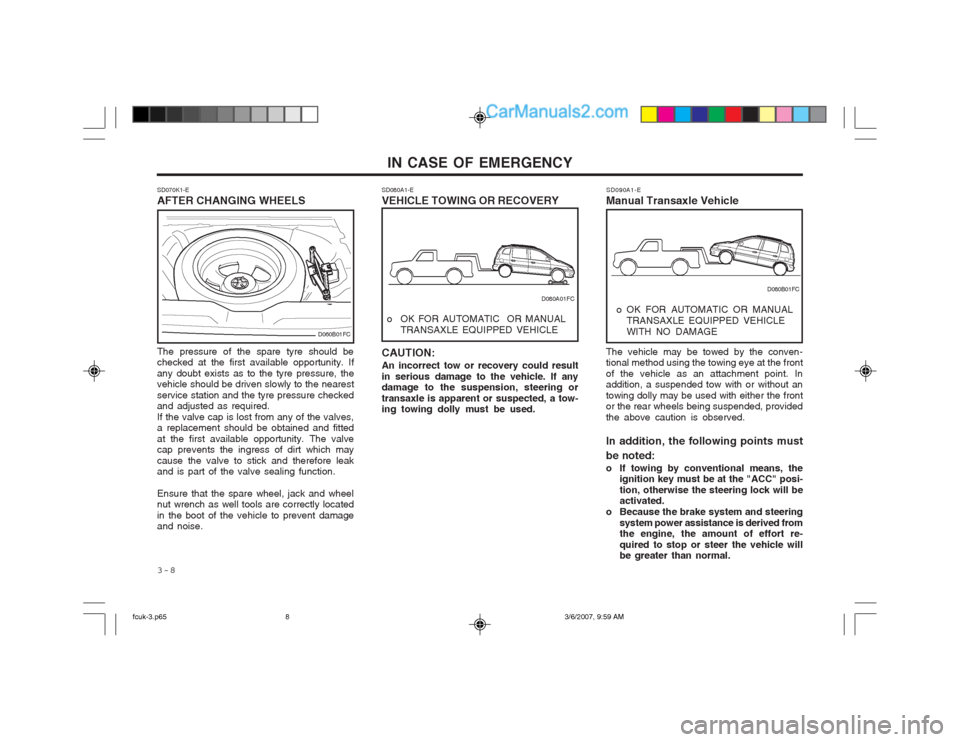
3-8 The vehicle may be towed by the conven- tional method using the towing eye at the front of the vehicle as an attachment point. In addition, a suspended tow with or without an towing dolly may be used with either the front or the rear wheels being suspended, provided the above caution is observed. In addition, the following points must be noted:
o If towing by conventional means, the
ignition key must be at the "ACC" posi- tion, otherwise the steering lock will be activated.
o Because the brake system and steering system power assistance is derived fromthe engine, the amount of effort re- quired to stop or steer the vehicle will be greater than normal.
SD090A1-E
Manual Transaxle Vehicle
o OK FOR AUTOMATIC OR MANUAL TRANSAXLE EQUIPPED VEHICLE WITH NO DAMAGE D080B01FC
SD070K1-E AFTER CHANGING WHEELS
SD080A1-EVEHICLE TOWING OR RECOVERY
The pressure of the spare tyre should be checked at the first available opportunity. If any doubt exists as to the tyre pressure, the vehicle should be driven slowly to the nearest service station and the tyre pressure checked and adjusted as required. If the valve cap is lost from any of the valves, a replacement should be obtained and fitted at the first available opportunity. The valve cap prevents the ingress of dirt which may cause the valve to stick and therefore leak and is part of the valve sealing function. Ensure that the spare wheel, jack and wheel nut wrench as well tools are correctly located in the boot of the vehicle to prevent damage and noise. CAUTION: An incorrect tow or recovery could result in serious damage to the vehicle. If any damage to the suspension, steering or transaxle is apparent or suspected, a tow- ing towing dolly must be used.
D060B01FC
o OK FOR AUTOMATIC OR MANUAL
TRANSAXLE EQUIPPED VEHICLE D080A01FC
fcuk-3.p65
3/6/2007, 9:59 AM
8
Page 268 of 317
3-9
IN CASE OF EMERGENCY
o If a suspended tow is being given to the rear, the ignition key must be at the "ACC" position since the steering lock is not designed to withstand the force required to hold the front wheels straight during the tow.
o The vehicle must not be towed with the front wheels on the ground for morethan thirty miles.
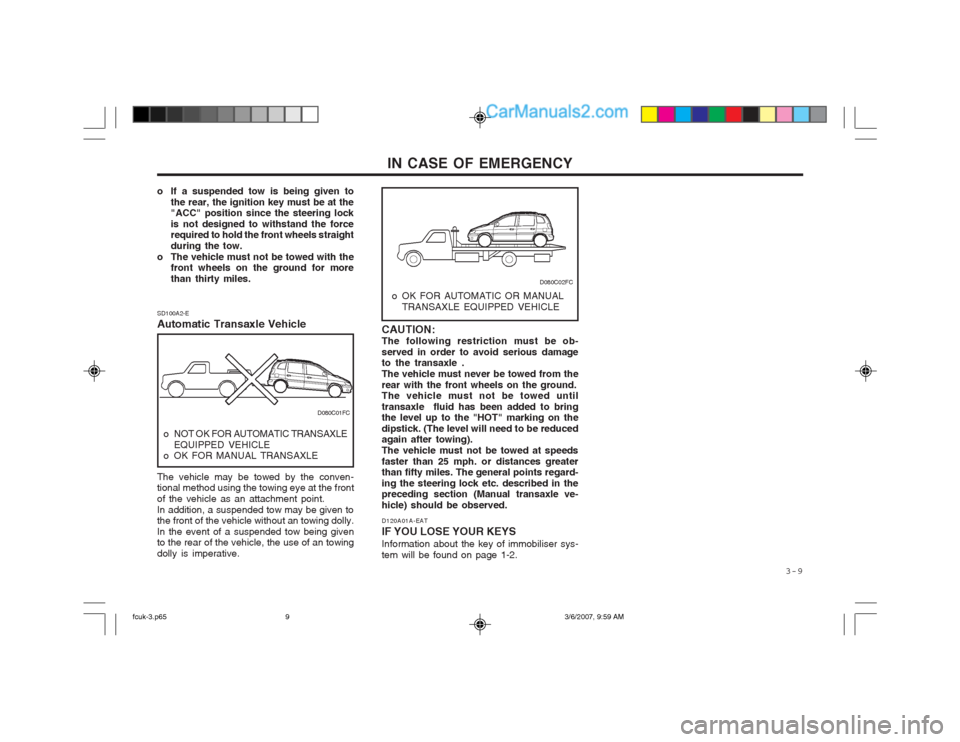
o OK FOR AUTOMATIC OR MANUAL
TRANSAXLE EQUIPPED VEHICLE
SD100A2-E Automatic Transaxle Vehicle
o NOT OK FOR AUTOMATIC TRANSAXLE
EQUIPPED VEHICLE
o OK FOR MANUAL TRANSAXLE
The vehicle may be towed by the conven- tional method using the towing eye at the front of the vehicle as an attachment point.In addition, a suspended tow may be given to the front of the vehicle without an towing dolly. In the event of a suspended tow being given to the rear of the vehicle, the use of an towing dolly is imperative. D120A01A-EAT IF YOU LOSE YOUR KEYS Information about the key of immobiliser sys- tem will be found on page 1-2.
CAUTION:The following restriction must be ob-served in order to avoid serious damage to the transaxle . The vehicle must never be towed from therear with the front wheels on the ground. The vehicle must not be towed until transaxle fluid has been added to bring the level up to the "HOT" marking on the dipstick. (The level will need to be reduced again after towing). The vehicle must not be towed at speedsfaster than 25 mph. or distances greater than fifty miles. The general points regard- ing the steering lock etc. described in the preceding section (Manual transaxle ve- hicle) should be observed.
D080C01FC
D080C02FC
fcuk-3.p65
3/6/2007, 9:59 AM
9
Page 275 of 317
VEHICLE MAINTENANCE REQUIREMENTS 5-5
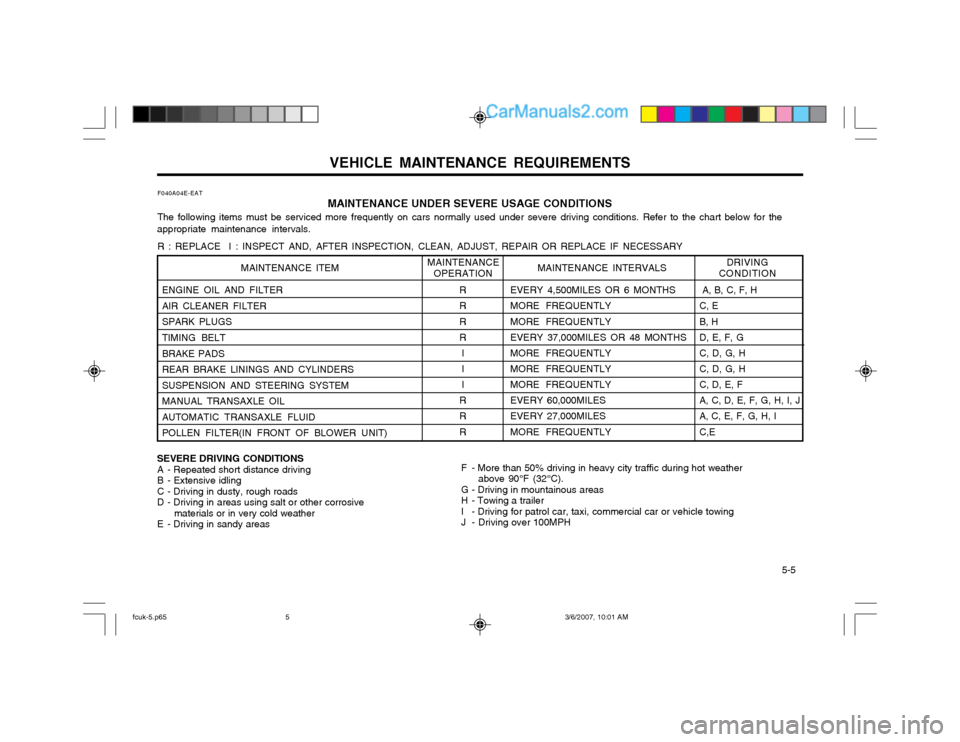
MAINTENANCE UNDER SEVERE USAGE CONDITIONS
The following items must be serviced more frequently on cars normally used under severe driving conditions. Refer to the chart below for the
appropriate maintenance intervals.
R : REPLACE I : INSPECT AND, AFTER INSPECTION, CLEAN, ADJUST, REPAIR OR REPLACE IF NECESSARY
F040A04E-EAT
SEVERE DRIVING CONDITIONS
A - Repeated short distance driving
B - Extensive idling
C - Driving in dusty, rough roads
D - Driving in areas using salt or other corrosive materials or in very cold weather
E - Driving in sandy areas ENGINE OIL AND FILTER AIR CLEANER FILTERSPARK PLUGSTIMING BELT BRAKE PADS REAR BRAKE LININGS AND CYLINDERSSUSPENSION AND STEERING SYSTEMMANUAL TRANSAXLE OILAUTOMATIC TRANSAXLE FLUIDPOLLEN FILTER(IN FRONT OF BLOWER UNIT)
EVERY 4,500MILES OR 6 MONTHS MORE FREQUENTLY MORE FREQUENTLY EVERY 37,000MILES OR 48 MONTHSMORE FREQUENTLYMORE FREQUENTLY MORE FREQUENTLY EVERY 60,000MILESEVERY 27,000MILES MORE FREQUENTLY
MAINTENANCE
OPERATIONMAINTENANCE ITEM
R R R RII I
R R R A, B, C, F, H C, E B, H D, E, F, GC, D, G, HC, D, G, H C, D, E, F A, C, D, E, F, G, H, I, JA, C, E, F, G, H, I C,E
MAINTENANCE INTERVALS
DRIVING
CONDITION
F - More than 50% driving in heavy city traffic during hot weather above 90°F (32°C).
G - Driving in mountainous areas
H - Towing a trailer
I - Driving for patrol car, taxi, commercial car or vehicle towing
J - Driving over 100MPH
fcuk-5.p65 3/6/2007, 10:01 AM
5
Page 288 of 317
OWNER MAINTENANCE
6-10
SSA6062A
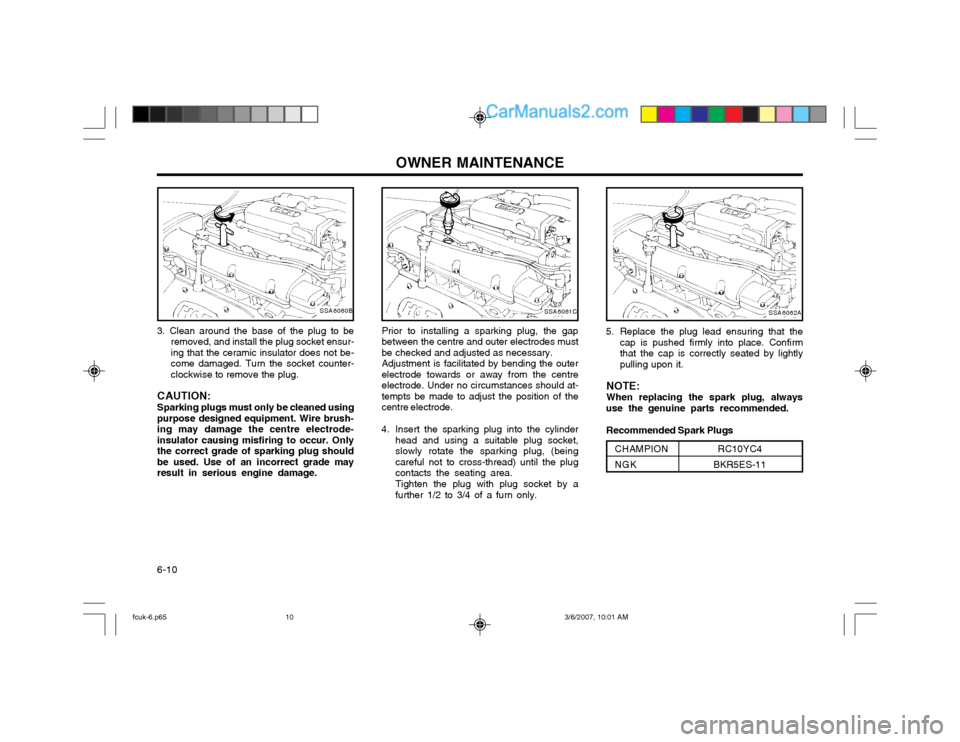
5. Replace the plug lead ensuring that the cap is pushed firmly into place. Confirm that the cap is correctly seated by lightlypulling upon it.
NOTE:When replacing the spark plug, always
use the genuine parts recommended.
Recommended Spark Plugs
RC10YC4
BKR5ES-11
NGK
CHAMPION
SSA6061CSSA6060B
Prior to installing a sparking plug, the gap between the centre and outer electrodes mustbe checked and adjusted as necessary.Adjustment is facilitated by bending the outerelectrode towards or away from the centreelectrode. Under no circumstances should at-tempts be made to adjust the position of thecentre electrode.
4. Insert the sparking plug into the cylinder head and using a suitable plug socket,slowly rotate the sparking plug, (beingcareful not to cross-thread) until the plugcontacts the seating area. Tighten the plug with plug socket by a further 1/2 to 3/4 of a furn only.
3. Clean around the base of the plug to be
removed, and install the plug socket ensur-ing that the ceramic insulator does not be-come damaged. Turn the socket counter-clockwise to remove the plug.
CAUTION: Sparking plugs must only be cleaned using
purpose designed equipment. Wire brush- ing may damage the centre electrode-insulator causing misfiring to occur. Onlythe correct grade of sparking plug shouldbe used. Use of an incorrect grade mayresult in serious engine damage.
fcuk-6.p65 3/6/2007, 10:01 AM
10
Page 307 of 317
EMISSION CONTROL SYSTEM
7-2
It is of the utmost importance that the following information is read and understood by thevehicle operator in order to prevent operationalproblems arising from damage to the catalyst.Damage to the catalyst will result if contamina-tion occurs through the use of leaded fuel.Whilst the vehicle is fitted with a reduced diam-eter filler neck to prevent charging of the fueltank with a leaded fuel pump nozzle, it ispossible that the use of funnels or jerry cans willpermit leaded fuel to be introduced into the fueltank.The catalyst is intolerant of unburnt fuel andtherefore if an engine misfire condition exists,damage to the catalyst will occur. It is impera-tive that if a misfire condition develops, thevehicle is immediately presented to a Hyundaidealer for rectification. Similarly, the practice ofcertain ignition system diagnosis procedureswhich involve inducing a misfire (cylinder powerbalance tests for example) may result in cata-lyst damage.For these reasons, it is advisable that theexhaust gas emission be tested at each routineservice with a gas analyzer having a Hydrocar-bon measuring facility to ensure continuedreliability of the catalyst.Push or tow starting of the vehicle is to beavoided since unburnt fuel may be enter thecatalyst and result in damage. (Note, it isimpossible to push or tow start a Hyundaimodel equipped with fuel injection since thefuel pump safety interlock will prevent the pumpfrom operating under these conditions).
Operation of the catalyst involves extremelyhigh temperatures being attained within thecatalytic convertor, and although the convertoris fitted with heat shields, it is important that thevehicle is not parked over combustible or vola-tile material which may result in fire.If the above precautions are not adhered to andthe catalyst becomes inoperative, the resultantincrease in core temperature will result in a"melt down" where the catalyst core will meltand subsequently may block the exhaust sys-tem.Due to the fragile nature of the catalyst ele-ment, it is important that damage does notoccur when the vehicle is raised by means of agarage jack. Care must also be exercised toavoid driving over road hazards or debris whichmay cause damage to the catalyst element. H020D01S-GAT ; For a diesel engineAll Hyundai vehicles are equipped with oxida- tion type catalytic converter to reduce the car-bon monoxide, hydrocarbons and particulatecontained in the exhaust gas.
H020C01S-GAT EGR SYSTEM ; For a diesel engine This system helps control oxides of nitrogen by recirculating a part of the exhaust gas into theengine.
fcuk-7.p65 3/6/2007, 10:02 AM
2
Page 309 of 317
CONSUMER INFORMATION
8-2 NOTE:
o Do not use the temporary spare tyre for tyre rotation.
o Aluminium wheels which are not sup- plied as Original Equipment should not be mixed on the same vehicle withthe original steel wheels. However, it isacceptable that the steel spare wheelbe used in conjunction with OriginalEquipment aluminium wheels since theoffset of both wheels is compatible.Radial and cross ply tyres should notbe mixed on the same vehicle.
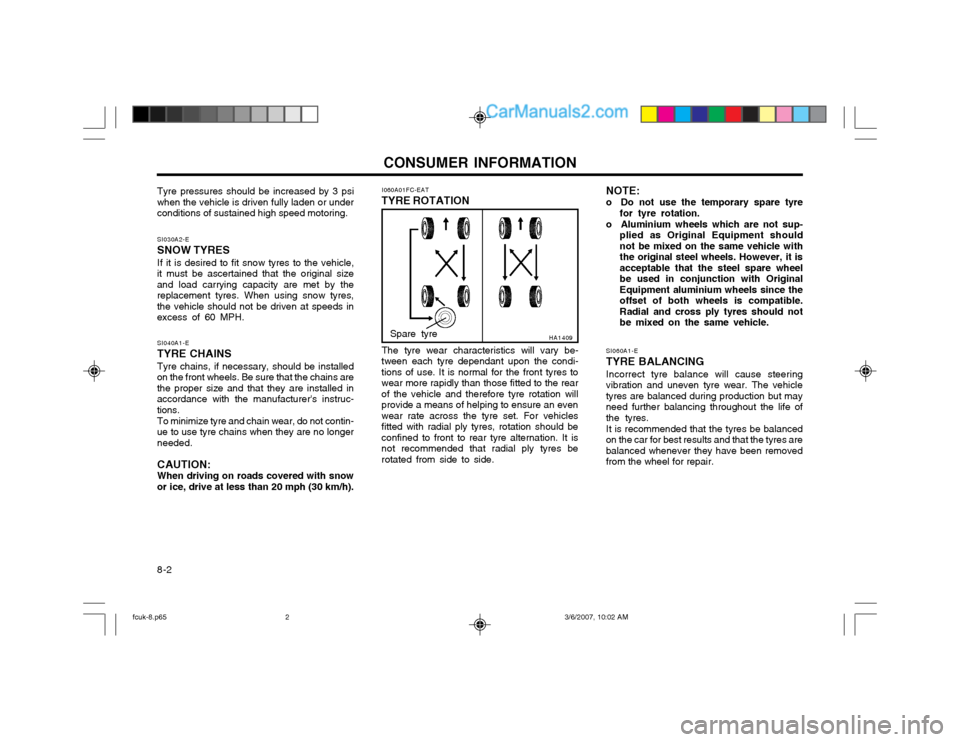
I060A01FC-EAT
TYRE ROTATION
The tyre wear characteristics will vary be-
tween each tyre dependant upon the condi-tions of use. It is normal for the front tyres towear more rapidly than those fitted to the rearof the vehicle and therefore tyre rotation willprovide a means of helping to ensure an evenwear rate across the tyre set. For vehiclesfitted with radial ply tyres, rotation should beconfined to front to rear tyre alternation. It isnot recommended that radial ply tyres berotated from side to side. SI060A1-E
TYRE BALANCING Incorrect tyre balance will cause steering
vibration and uneven tyre wear. The vehicletyres are balanced during production but mayneed further balancing throughout the life ofthe tyres.
It is recommended that the tyres be balanced
on the car for best results and that the tyres arebalanced whenever they have been removedfrom the wheel for repair.
SI030A2-E
SNOW TYRES If it is desired to fit snow tyres to the vehicle,
it must be ascertained that the original sizeand load carrying capacity are met by thereplacement tyres. When using snow tyres,the vehicle should not be driven at speeds inexcess of 60 MPH.
SI040A1-E
TYRE CHAINS
Tyre chains, if necessary, should be installed
on the front wheels. Be sure that the chains arethe proper size and that they are installed inaccordance with the manufacturer's instruc-tions.
To minimize tyre and chain wear, do not contin-
ue to use tyre chains when they are no longerneeded.
CAUTION:When driving on roads covered with snow
or ice, drive at less than 20 mph (30 km/h). Tyre pressures should be increased by 3 psi
when the vehicle is driven fully laden or underconditions of sustained high speed motoring.
HA1409Spare tyre
fcuk-8.p65 3/6/2007, 10:02 AM
2
Page 317 of 317
INDEX
10-4 S SCHEDULED MAINTENANCE
.......................................................... 5-2
SEAT ADJUSTMENT ... ......................................................... 1-8 ~ 1-12
SEAT BELT PRECAUTIONS .......................................................... 1-13
SEAT BELTS ....................................................................... 1-14 ~ 1-16
SEAT CUSHION HEIGHT ADJUSTMENT ..................................... 1-10
SEAT WARMER .............................................................................. 1-12
SERVICE HIS TORY .......................................................................... 5-1
SIDE VENTILATOR ......................................................................... 1-53
SMOOTH CORNERING .......... ........................................................ 2-11
SNOW TYRES ................................................................................... 8-1
SPARE WHEEL ................................................................................. 3-3
SPARKING PLUG REPLACEMENT ................................................. 6-9
SPECTACLE CASE ......................................................................... 1-44
SUPPLEMENTAL RESTRAINT (AIRBAG) SYSTEM ......... 1-22 ~ 1-26
STARTING THE ENGINE ................................................................. 2-3
STEERING WHEEL FREEPLAY .................................................... 6-16
STEERING WHEEL TILT LEVER ................................................... 1-52
STEREO SOUND SYSTEM ................................................ 1-60 ~ 1-61
SUN-VISOR ...................................................................................... 1-52
SUNROOF ............................................................................ 1-42 ~ 1-43TTAIL GATE
....................................................................................... 1-50
TOWING ATTACHMENTS .................................................. 2-13 ~ 2-15
TRAILER AND CARAVAN TOWING .............................................. 2-13
TRIP COMPUTER ........................................................................... 1-35
TYPE PRESSURES .......................................................................... 8-1
TYRE BALANCING ............................................................................ 8-2
TYRE CHAI NS ................................................................................... 8-2
TYRE REPLACEMENT ..................................................................... 8-3
TYRE ROTATION .............................................................................. 8-2
UUNDER TRAY .................................................................................. 1-10
VVEHICLE IDENTIFICATION NUMBER ............................................. 8-1
VEHICLE TOWING OR RECOVERY ............................................... 3-8
WWHEEL REPLACEMENT .................................................................. 8-3
WINDSHIELD WASHER OPERATION........................................... 1-37
WINDSCREEN WASHER RESERVOIR REPLENISHMENT ........................................................... 6-11 ~ 6-12
WINDSCREEN WIPER BLADES ........................................ 6-10 ~ 6-11
WINDSHIELD WIPER/WASHER SWITCH ..................................... 1-37
WINTER MOTORING ...................................................................... 2-11
fcuk-10.p65 3/6/2007, 10:03 AM
4