ABS Hyundai Matrix 2006 User Guide
[x] Cancel search | Manufacturer: HYUNDAI, Model Year: 2006, Model line: Matrix, Model: Hyundai Matrix 2006Pages: 490, PDF Size: 11.58 MB
Page 245 of 490

6
DO-IT-YOURSELF MAINTENANCE
39FUSE PANEL DESCRIPTION
G200C03FC-GAT
Engine Compartment (Gasoline Engine)
G200C03FC
NOTE: Not all fuse panel descriptions in this manual may be applicable to your vehicle. It is accurate at the time of printing. When you inspect the fuse box on your vehicle, refer to the fuse box label.
PROTECTED COMPONENTS
Generator (A/CON, RR HTD, STOP, D/LOCK, HAZARD) Fuse Generator, Engine control relay, ECM Radiator fan relay Start relay, Ignition switch Blower relay Power window relay Condenser fan relay #1 ABS control module, ABS bleeding connector, ESP ABS control module, ABS bleeding connector, ESP Fuel pump relay Injector, lgnition coil MAP sensor, Oxygen sensor, CP sensor, Knock sensor, Throttle position sensor Audio, Room lamp, Overhead console lamp, lnstrument cluster DRL control module Horn relay A/C relay Front fog lamp relay ECM, TCM Tail lamp relay Left rear combi lamp, Left position lamp, Left License lamp Right rear combi lamp, Right position lamp, Right License lamp Left head lamp Right head lamp, (H/LP IND) Fuse
FUSE RATING
120A
40A 30A 20A 40A 40A 30A 20A 40A 40A 10A 15A 10A10A 15A 10A 10A 15A 10A 20A 10A 10A 15A 15A
DESCRIPTION
ALTB+
ECU RAD IGN
BLR
P/WIN
COND
ABSABS
F/PUMP INJ
SNSR
ROOM LP DRL
HORN
A/CON
FR FOG ECU
LP
TAIL LH
TAIL RH H/LP LH
H/LP RH
Page 247 of 490

6
DO-IT-YOURSELF MAINTENANCE
41
ALT B+
ECU RAD
IGN
BLR
P/WIN
COND ABSABS
F/PUMP ECU ECU
SNSR
ROOM LP DRL
HORN
A/CON
FR FOG ECU
LP
TAIL LH
TAIL RH H/LP LH
H/LP RH
PTC HTR 1
GLOW
PTC HTR 2 FFHS
PTC HTR 3 PROTECTED COMPONENTS
Generator (A/CON, RR HTD, STOP, D/LOCK, HAZARD) Fuse, Deicer Generator, Engine control relay, ECM Radiator fan relayStart relay, Ignition switchBlower relayPower window relayCondenser fan relay #1 ABS control module, ABS bleeding connector, ESP ABS control module, ABS bleeding connector, ESPFuel pump relayECM No.5 (Batt+)ECM No.4 (Batt+), Stop lamp switch, PTC heater relay #1Glow plug relay, Assistor heater relay 1/2, Stop lamp switch, TDC sensor, EGR act, Throttle plate act, VGT vacuum Audio, Room lamp, Overhead console lamp, lnstrument cluster, ETACM, Luggage lampDRL control moduleHorn relayA/C relayFront fog lamp relay ECM, TCM Tail lamp relayLeft rear combi lamp, Left position lamp, Left License lampRight rear combi lamp, Right position lamp, Right License lampLeft head lampRight head lamp, (H/LP IND) Fuse PTC heater relay #1 GLOW relayPTC heater relay #2FFHS relayPTC heater relay #3
FUSE RATING
140A40A30A30A40A40A 30A 30A40A40A10A30A 10A 15A 10A 15A10A10A 15A 10A20A10A10A15A 15A 40A80A40A30A40A
FUSE
FUSIBLE LINK DESCRIPTION
Page 248 of 490

6 DO-IT-YOURSELF MAINTENANCE
42
G200D01FC-GAT Inner Panel
G200D01FC
DESCRIPTIONH/LP IND
HTD IND
A/CON
RR HTD STOP
D/LOCK
HAZARD AUDIO
C/LIGHT A/B
A/B IND
T/SIG
ECU
ETACS
RR WPR
START
FRT WPR S/HTD
P/OUTLET
IG2
O/S MRRPROTECTED COMPONENTS
Head lamp indicator Defogger relay, Left(Right) outside mirror motor,Rear window motorA/C SwitchDefogger relayStop lamp switch, Power window relay Door lock(unlock) relay, ETACM, Sunroof relay Burglar alarm relay, Hazard relayAudioCigarette lighterSRS control moduleSRS IND. Hazard switch, Seat belt timer, Instrument cluster, ABS control module, Pre-excitation resistor, Washer motorECM, Vehicle speed sensor, TCM, Ignition coilETACM, A/T Shift leverRear wiper motor, Rear wiper relayStart relay Wiper relay, Washer motor, Wiper & Defogger timer Left (Right) front seat warmer switchFront (Rear) power outletETACM, Power window relay, Defogger relay, Sunroof relayHead lamp relay, Blower relayOutside mirror switch, Rear fog lamp relay
FUSE RATING
10A 10A 10A 30A10A15A 10A 10A15A10A10A 10A 15A 10A10A 10A 20A15A25A 10A 10A
Page 250 of 490
7EMISSION CONTROL SYSTEMS
2EMISSION CONTROL SYSTEMS
H010A01A-GAT
(If Installed)
Your Hyundai is equipped with an
emission control system to meet all requirements of the Emission prohibi- tion rules of your province.
There are three emission control sys-
tems which are as follows.
(1) Crankcase emission control sys- tem
(2) Evaporative emission control sys- tem
(3) Exhaust emission control system
In order to assure the proper function
of the emission control systems, it is recommended that you have your carinspected and maintained by an au- thorized Hyundai dealer in accordance with the maintenance schedule in thismanual. H010B01A-AAT
1. Crankcase Emission Control
System
The positive crankcase ventilation
system is employed to prevent airpollution caused by blow-by gasesbeing emitted from the crankcase. This system supplies fresh filtered air to the crankcase through the air in-take hose. Inside the crankcase, the fresh air mixes with blow-by gases, then passes through the PCV valveinto the induction system.
H010C01E-GAT
2. Evaporative Emission Control
System
The Evaporative Emission Control
System is designed to prevent fuel vapors from escaping into the atmo- sphere. Canister
While the engine is inoperative, fuel
vapors generated inside the fuel tank are absorbed and stored in the canis- ter. When the engine is running, thefuel vapors absorbed in the canister are drawn into the induction system through the purge control solenoidvalve. Purge Control Solenoid Valve (PCSV)
The purge control solenoid valve is
controlled by the Engine Control Mod- ule (ECM); when the engine coolant temperature is low during idling, the PCSV closes so that evaporated fuelis not taken into the engine. After the engine warms-up during ordinary driv- ing, the PCSV opens so as to intro-duce evaporated fuel to the engine.
H010D01A-AAT
3. Exhaust Emission Control
System
The Exhaust Emission Control Sys-
tem is a highly effective system which controls exhaust emissions while maintaining good vehicle performance.
Page 280 of 490
YOUR VEHICLE AT A GLANCE
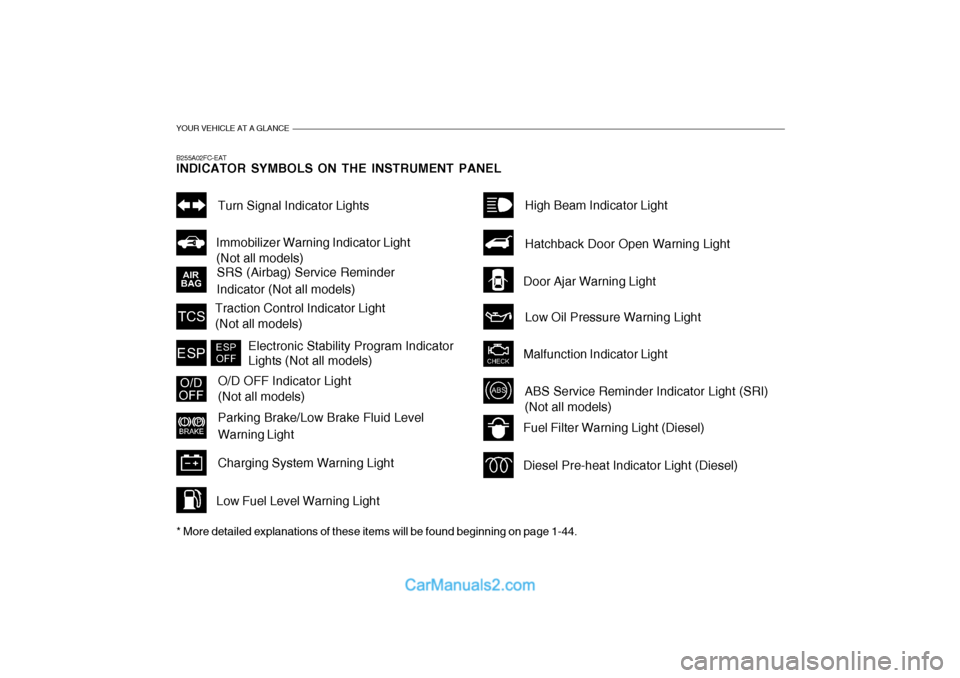
B255A02FC-EAT INDICATOR SYMBOLS ON THE INSTRUMENT PANEL * More detailed explanations of these items will be found beginning on page 1-44.
SRS (Airbag) Service Reminder
Indicator (Not all models)Turn Signal Indicator Lights
Malfunction Indicator Light
Traction Control Indicator Light (Not all models)
O/D OFF Indicator Light (Not all models)
Parking Brake/Low Brake Fluid Level Warning Light
Charging System Warning LightFuel Filter Warning Light (Diesel) Diesel Pre-heat Indicator Light (Diesel)
Immobilizer Warning Indicator Light (Not all models)
ABS Service Reminder Indicator Light (SRI) (Not all models) High Beam Indicator Light Low Oil Pressure Warning Light
Hatchback Door Open Warning Light
Door Ajar Warning Light
Low Fuel Level Warning Light
Electronic Stability Program Indicator Lights (Not all models)
Page 303 of 490

1
CONTROLS AND EQUIPMENT
23
There will be an audible "click" when the tab locks in the buckle. The seat beltautomatically adjusts to the proper length only after the lap belt is adjusted manu- ally so that it fits snugly around yourhips. If you lean forward in a slow, easy motion, the belt will extend and let you move around. If there is a sudden stopor impact, the belt will lock into position. It will also lock if you try to lean forward too quickly.
B220A02Y-D
!
!WARNING:
o When using the rear seat centre belt, you must lock all metal tabs and buckles. If any metal tab or buckle is not locked, it will in-crease the chance of injury in the event of collision.
o Never unlock the metal tab (a) and
the buckle (b) with the followingexceptions.
(1) In case of folding rear seatbacks
down.
(2) If transporting an object on the
rear seat may cause damage tothe rear seat centre belt.
o Lock the metal tab (a) and the
buckle (b) immediately after fold-ing rear seatbacks up. B220C01A-EAT To Release the Seat Belt
When you want to release the seat belt, press the button in the locking buckle.
WARNING:
The centre lap belt latching mecha-nism is different from those for the rear seat shoulder belts. When fas- tening the rear seat shoulder belts orthe centre lap belt, make sure they are inserted into the correct buckles to obtain maximum protection fromthe seat belt system and assure proper operation.
B220C02FC
Page 309 of 490

1
CONTROLS AND EQUIPMENT
29
NOTE: An ISOFIX-child-seat can only be installed if the seat has a vehicle- specific approval according to ECE-R44. Before using the ISOFIX-child- seat, which was bought for another car, ask your Hyundai authorisedrepairer whether this seat-type is ap- proved and recommended for your Hyundai. To secure the child restraint seat 1. To engage the child restraint seat to
the ISOFIX anchor, insert the child restraint seat latch into the ISOFIX anchor. Listen for the audible "click"sound. 2. Connect the tether strap hook to the
child restraint hook holder and tightento secure the seat. Refer to "Secur- ing a Child Restraint System with the Tether Anchorage System" on page1-27.
WARNING:
o Do not install a child restraint seat at the centre of the rear seat usingthe vehicle's ISOFIX anchors. TheISOFIX anchors are only provided for the left and right outboard rear seating positions. Do not misuse the ISOFIX anchors by attempting to attach a child restraint seat inthe middle of the rear seat to the ISOFIX anchors. In a crash, the child restraint seat ISOFIX attach-ments may not be strong enough to secure the child restraint seat properly in the centre of the rearseat and may break, causing seri- ous injury or death.
!
B230D03FC
o When using the vehicle’s “ISOFIX”
system to install a child restraint system in the rear seat, all unused vehicle rear seat belt metal latchplates or tabs must be latched securely in their seat belt buckles and the seat belt webbing must beretracted behind the child restraint to prevent the child from reaching and taking hold of unretracted seatbelts.
o Do not mount more than one child
restraint to a child restraint loweranchorage point. Over-loading may cause the anchorage points or tether anchor to break, causingserious injury or death.
o Attach the ISOFIX or ISOFIX-com-
patible child restraint seat only tothe appropriate locations shown in the illustration.
o Always follow the installation and use instructions provided by themanufacturer of the child restraint.
Page 321 of 490

1
CONTROLS AND EQUIPMENT
41
1. Temperature Gauge
2. Tachometer
3. Speedometer
4. Digital Clock
5. Odometer/Trip Odometer/Trip Computer (Not all models)
6. Fuel Gauge
7. Turn Signal Indicator Light
8. Automatic Transaxle Position Indicator Light (Auto T/A only)
9. Immobiliser Warning Indicator Light
10. SRS (Airbag) Warning Light
11. Electronic Stability Program (ESP) Indicator Light (Not all models)/Traction Control Indicator Light (Not all models) 12. Overdrive off Indicator Light (Not all models)
13. Parking Brake/Low Brake Fluid Level Warning Light
14. Charging System Warning Light
15. Low Fuel Warning Light
16. High Beam Indicator Light
17. Tail Gate Open Warning Light
18. Door Ajar Warning Light
19. Oil Pressure Warning Light
20. Malfunction Indicator Light (MIL)
21. ABS Warning Light (Not all models)
Page 323 of 490

1
CONTROLS AND EQUIPMENT
43
1. Temperature Gauge
2. Tachometer
3. Speedometer
4. Digital Clock
5. Odometer/Trip Odometer/Trip Computer (Not all models)
6. Fuel Gauge
7. Fuel Filter Warning Light
8. Turn Signal Indicator Light
9. Immobiliser Warning Indicator Light
10. SRS (Airbag) Warning Light
11. Diesel Pre-heat Indicator Light
12. Electronic Stability Program (ESP) Indicator Light (Not all models)/Traction Control Indicator Light (Not all models) 13. Parking Brake/Low Brake Fluid Level Warning Light
14. Charging System Warning Light
15. Low Fuel Warning Light
16. High Beam Indicator Light
17. Tail Gate Open Warning Light
18. Door Ajar Warning Light
19. Oil Pressure Warning Light
20. Malfunction Indicator Light (MIL)
21. ABS Warning Light (Not all models)
Page 327 of 490

1
CONTROLS AND EQUIPMENT
47
Under normal circumstances, the light will illuminate when the ignition is turned"on" and will be extinguished when the engine is started. If the oil pressure warning light illumi-nates whilst the engine is running, stop the engine immediately and check the engine oil level. If the level is insuffi-cient, add the required amount of oil as indicated by the engine oil dipstick. If the light fails to extinguish when theengine is restarted, do not continue to operate the vehicle. If the oil pressure light illuminates dur-ing normal operation and the cause is not an insufficient oil level, or the light fails to illuminate when the ignition isturned "on", contact the nearest Hyundai authorised repairer before further oper- ating the vehicle. B260N02FC-EAT
Malfunction Indicator
Light
This light illuminates when there is amalfunction of an exhaust gas relatedcomponent, and the system is not func- tioning properly so that the exhaust gas regulation values are not satisfied. Thislight will illuminate when the ignition key is tuned to the "ON" position, and then it will go out after the engine start. If itilluminates whilst driving, or does not illuminate when the ignition key is turned to the "ON" position, take your car toyour nearest Hyundai authorised re- pairer and have the system checked.
!
B260P02Y-EAT ABS Service Reminder Indicator (SRI)(Not all models)
When the key is turned to the "ON" position, the Anti-Lock Brake System SRI will come on and then go off in a few seconds. If the ABS SRI remains on, comes on whilst driving, or does not come on when the key is turned to the "ON" position, this indicates that there may be a problem with the ABS. If this occurs, have your vehicle checked by your Hyundai authorised repairer as soon as possible. The nor- mal braking system will still be opera- tional, but without the assistance of the anti-lock brake system.
CAUTION:
If the both ABS SRI and Parking Brake/ Brake fluid level warning lights re- main "ON" or come on whilst driving, there may be a problem with E.B.D.
(Electronic Brake Force Distribution). If this occurs, avoid sudden stops and have your vehicle checked byyour Hyundai authorised repairer as soon as possible.