change time Hyundai Matrix 2006 User Guide
[x] Cancel search | Manufacturer: HYUNDAI, Model Year: 2006, Model line: Matrix, Model: Hyundai Matrix 2006Pages: 490, PDF Size: 11.58 MB
Page 218 of 490
6 DO-IT-YOURSELF MAINTENANCE
12
!
!
CHECKING AND CHANGING THE ENGINE COOLANT
G050A01A-AAT
WARNING:
Do not remove the radiator cap
when the engine is hot. When the engine is hot, the engine coolant is under pressure and may eruptthrough the opening if the cap is removed. You could be seriously burned if you do not observe thisprecaution. Do not remove the radiator cap until the radiator is cool to the touch.
10. Start the engine and check to be
sure no oil is leaking from thedrain plug or oil filter.
11.Shut off the engine and recheck
the oil level.
NOTE:
o It is recommended that the en- gine oil and filter should be changed by an authorized Hyundai dealer.
o Always dispose of used engine oil in an environmentally accept-able manner. It is suggested that it be placed in a sealed container and taken to a service station formaybe reclaimation. Do not pour the oil on the ground or put it into the household trash.
WARNING:
Used motor oil may cause irrita- tion or cancer of the skin if left in contact with the skin for prolongedperiods of time. Wash your hands thoroughly with soap and warm water as soon as possible afterhandling used oil.
8. After mounting a new centerpipe O-
ring, new oil filter element and newO-ring to upper cap, install the up- per cap to oil filter housing and retighten by turning it clockwise.Do not over-tighten. Tightening torque : 2.5 kgf.m
CAUTION:
Don't use old oil filter upper cap O-ring and centerpipe O-ring
9. Refill the crankcase with the rec- ommended engine oil. Refer to the specification in chapter 9 for engine oil capacity.
CAUTION:
Slowly pour the recommended oilby into a funnel. Do not overfill not to damage the engine.
!
!
Page 221 of 490
6
DO-IT-YOURSELF MAINTENANCE
15
G050D02FC
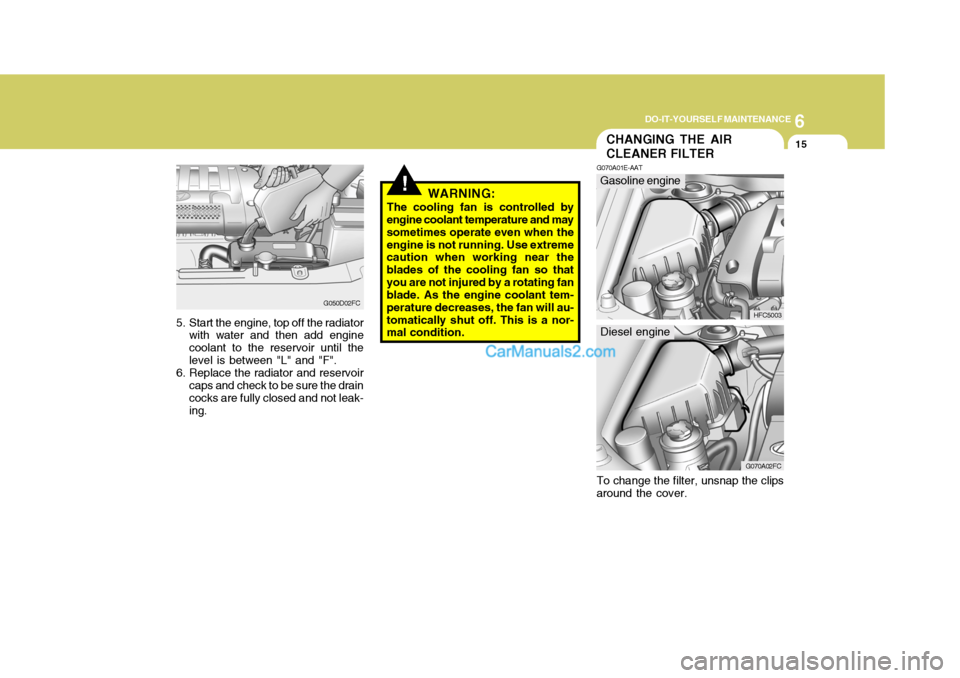
5. Start the engine, top off the radiator with water and then add engine coolant to the reservoir until the level is between "L" and "F".
6. Replace the radiator and reservoir caps and check to be sure the draincocks are fully closed and not leak- ing.
!WARNING:
The cooling fan is controlled by
engine coolant temperature and may sometimes operate even when theengine is not running. Use extreme caution when working near the blades of the cooling fan so thatyou are not injured by a rotating fan blade. As the engine coolant tem- perature decreases, the fan will au-tomatically shut off. This is a nor- mal condition.
CHANGING THE AIR CLEANER FILTER
G070A01E-AAT
HFC5003
Gasoline engine
G070A02FC
Diesel engine
To change the filter, unsnap the clips around the cover.
Page 233 of 490
6
DO-IT-YOURSELF MAINTENANCE
27
G170A01A-GAT
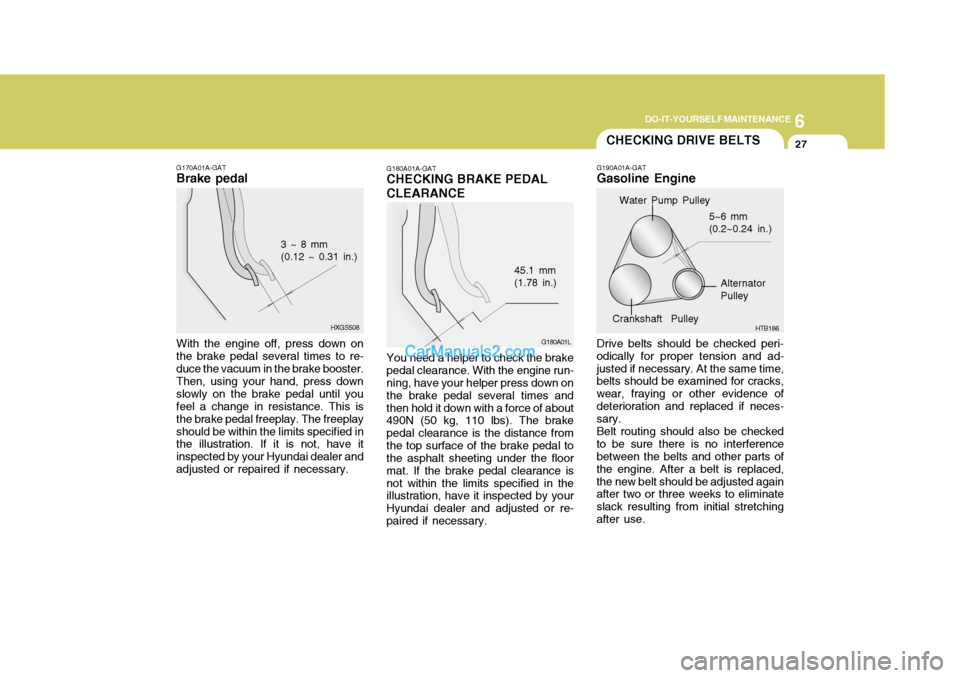
Brake pedal
HXGS508
3 ~ 8 mm (0.12 ~ 0.31 in.)
With the engine off, press down on the brake pedal several times to re-duce the vacuum in the brake booster.Then, using your hand, press downslowly on the brake pedal until you feel a change in resistance. This is the brake pedal freeplay. The freeplayshould be within the limits specified in the illustration. If it is not, have it inspected by your Hyundai dealer andadjusted or repaired if necessary.
Water Pump Pulley Alternator Pulley
Crankshaft Pulley 5~6 mm(0.2~0.24 in.)
HTB186
G190A01A-GAT Gasoline Engine Drive belts should be checked peri- odically for proper tension and ad-justed if necessary. At the same time, belts should be examined for cracks, wear, fraying or other evidence ofdeterioration and replaced if neces- sary. Belt routing should also be checked to be sure there is no interference between the belts and other parts of the engine. After a belt is replaced,the new belt should be adjusted again after two or three weeks to eliminate slack resulting from initial stretchingafter use.
G180A01A-GAT CHECKING BRAKE PEDAL CLEARANCE
G180A01L
45.1 mm (1.78 in.)
You need a helper to check the brake pedal clearance. With the engine run- ning, have your helper press down on the brake pedal several times andthen hold it down with a force of about 490N (50 kg, 110 lbs). The brake pedal clearance is the distance fromthe top surface of the brake pedal to the asphalt sheeting under the floor mat. If the brake pedal clearance isnot within the limits specified in the illustration, have it inspected by your Hyundai dealer and adjusted or re-paired if necessary. CHECKING DRIVE BELTS
Page 324 of 490

1CONTROLS AND EQUIPMENT
44WARNING AND INDICATOR LIGHTS
SB210C1-FSRS (Airbag) Service Reminder Indicator Light
The SRS service reminder indicator (SRI) comes on and flashes for about 6seconds after the ignition key is turned to the "ON" position or after the engine is started, after which it will go out. This light also comes on when the SRS is not working properly.If the SRI does not come on, or continu- ously remains on after flashing for about 6 seconds when you turned the ignitionkey to the "ON" position or started the engine, or if it comes on whilst driving, have the SRS inspected by an Hyundaiauthorised repairer.
B260U01TB-EAT Immobiliser Indicator Light
This indicator light comes on for some seconds after the ignition key is turnedto the "ON" position. At this time, you can start the engine. The light goes out after the engine is running. In case thislight goes out before you start the en- gine, you must turn to the "LOCK" position and restart the engine. In casethis light blinks for five seconds when the ignition key is turned to "ON" posi- tion, this indicates that the immobilisersystem is out of order.
SB210G1-E Turn Signal Indicator Light
Operation of a turn signal is indicated by the warning light located in the in-strument cluster. If the light fails to illuminate or does not flash, a malfunc- tion within the turn signal system isindicated.
B260C02E-EATTraction Control Indicator Light(Not all models)
The traction control indicator changes operation according to the ignition switch position and whether or not the system is in operation.
B265C01LZ-EAT Electronic Stability Program Indicator Lights(Not all models)
The electronic stability program indica- tors change operation according to theignition switch position and whether the system is in operation or not. They will illuminate when the ignitionkey is turned to the "ON" position, but should go out after three seconds. If the ESP or ESP-OFF indicator stays on,take your car to your Hyundai authorised repairer and have the system checked. See section 2 for more informationabout the ESP.
It will also illuminate when the ignition key is turned to the "ON" position, andthen go off in a few seconds. If the TCS indicator stays on, take your car to your Hyundai authorised repairer and havethe system checked. See section 2 for more information about the TCS sys- tem.
Page 332 of 490

1CONTROLS AND EQUIPMENT
52
2,3 Trip odometer Records the distance of 2 trips in miles. TRIP A: First distance you have traveled from your originationpoint to a first destination.
TRIP B: Second distance from thefirst destination to the finaldestination.
To shift from TRIP A to TRIP B, pressthe reset switch. When pressed for 1second, it will reset to 0.TRIP COMPUTER
B400B01FC-EAT (Not all models) The trip computer is the microcom- puter-controlled driver information gauge that displays information related to driv-ing, such as distance to empty, aver- age speed and drive time on the LCD. DISTANCE TO EMPTY
AVERAGE SPEED DRIVE TIME
B310B02FC Reset switch
o The reset switch is used to zero the
multi-functional display mode.
o Pushing in the reset switch changes the display as follows;
Reset switch
Page 339 of 490
1
CONTROLS AND EQUIPMENT
59
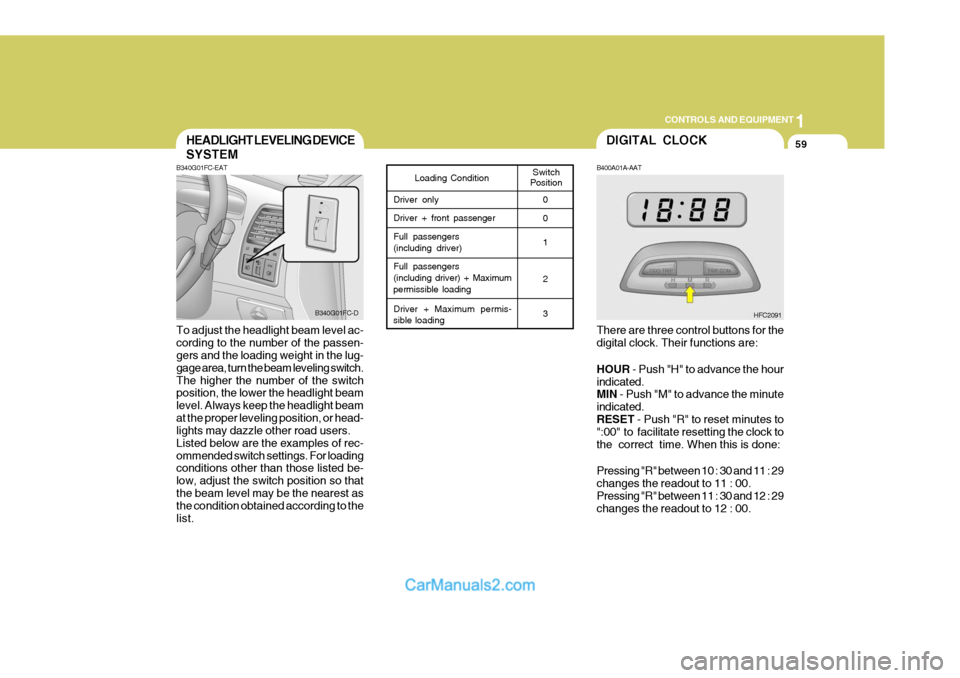
B340G01FC-EAT To adjust the headlight beam level ac- cording to the number of the passen- gers and the loading weight in the lug- gage area, turn the beam leveling switch.The higher the number of the switch position, the lower the headlight beam level. Always keep the headlight beamat the proper leveling position, or head- lights may dazzle other road users. Listed below are the examples of rec-ommended switch settings. For loading conditions other than those listed be- low, adjust the switch position so thatthe beam level may be the nearest as the condition obtained according to the list.
HEADLIGHT LEVELING DEVICE
SYSTEM
Switch
PositionLoading Condition
Driver only Driver + front passengerFull passengers (including driver) Full passengers (including driver) + Maximum
permissible loading
Driver + Maximum permis-
sible loading 0 0 1 2 3
B340G01FC-D
DIGITAL CLOCK
HFC2091
B400A01A-AAT There are three control buttons for the digital clock. Their functions are: HOUR
- Push "H" to advance the hour
indicated. MIN - Push "M" to advance the minute
indicated. RESET - Push "R" to reset minutes to
":00" to facilitate resetting the clock tothe correct time. When this is done: Pressing "R" between 10 : 30 and 11 : 29 changes the readout to 11 : 00.Pressing "R" between 11 : 30 and 12 : 29 changes the readout to 12 : 00.
Page 397 of 490
2 DRIVING YOUR HYUNDAI
22
SC200B3-E TOWING ATTACHMENTS It is strongly recommended that only an Hyundai Approved towing attachmentis used to ensure that the loads placed upon the body structure are correctly distributed. The use of a non approvedattachment will result in the invalidation of the vehicle warranty. Hyundai towing attachments are designed and con-structed to ensure maximum towing performance and ease of fitment. A range of accessories including electri-cal kits are available through the Hyundai authorised repairer network. It is of the utmost importance that those areas of the vehicle which are sub- jected to greater stress during towing are maintained in accordance with therecommendations given at the end of this book. In addition, the daily operat- ing checks relating to engine oil, trans-mission oil and tyres must be per- formed at each refuelling to ensure maximum reliability and safety.The use of a proprietary stabiliser will assist in achieving an inherently stable outfit but whilst the use of such equip-ment will improve the characteristics of a balanced outfit, it will not compensatefor a badly loaded and therefore un-stable outfit. The tyres and braking equipment fitted to the trailer or caravan must be main-tained in accordance with the recom- mendations of the manufacturer. Spe- cial attention should be paid to tyreswhich deteriorate through time and ex- posure rather than as a result of the distances towed. The inside walls ofthe tyres should be inspected along with the outside walls for cracking and damage. The trailer wheel nut torquemust be checked on a regular basis, preferably before each towing session. The trailer hitch and the safety catch mechanism must be maintained in good working order. The trailer break away cable or chain should be inspected fordamage and should be attached to the vehicle towing attachment each and every time the trailer is hitched to thevehicle. Whilst towing, the performance of the vehicle will be reduced in terms ofacceleration, braking and handling due
to the increased loads placed upon thevehicle. The driver should anticipatethe change in characteristics and ad- just the driving style in keeping with these changes. Care should be exer-cised when cornering and braking to prevent the outfit becoming uncontrol- lable by reducing cornering speeds andallowing increased braking distances. The driver should exercise care to en- sure that when pulling away from restparticularly on uphill gradients the clutch unit is not subjected to excessive slip- page which will reduce the useful life ofthis component. Use of the "Overdrive Off" "2" and "L" positions when driving vehicles with automatic transmissionwill assist with braking performance when long down hill gradients are en- countered. Improved acceleration per-formance will be available by selecting "Overdrive Off","2", or "1" depending upon road speed if it is found that thetransmission unit makes an undesir- able upshift whilst hill climbing or over- taking. The transmission unit should beoperated in "D" with the Overdrive "On" under normal circumstances to enhance fuel economy and reduce noise andengine wear.
Page 399 of 490

2 DRIVING YOUR HYUNDAI
24
YC200E2-E Trailer or Vehicle Towing Tips
1. Before towing, check towbar ball andsafety cable connections as well as proper operation of the trailer running lights, brake lights, and turn signals.
2. Always drive your vehicle at a mod- erate speed (Less than 60 MPH)
3. Trailer towing requires more fuel
than normal conditions.
4. To maintain engine braking effi- ciency and electrical charging per- formance, do not use fifth gear(manual transaxle) or overdrive (au- tomatic transaxle).
5. Always secure items in the trailer to prevent load shift whilst driving.
6. Check the condition and air pres-
sure of all tyres on the trailer and your vehicle. Low tyre pressure can seriously affect the handling. Also check the spare tyre. 7. The vehicle/trailer combination is
more affected by crosswind andbuffeting. When being passed by a large ve- hicle, keep a constant speed andsteer straight ahead. If there is too much wind buffeting slow down to get out of the other vehicle's airturbulence.
8. When parking your vehicle and
trailer, especially on a hill, be sure tofollow all the normal precautions. Turn your front wheels into the curb, set the parking brake firmly, and putthe transaxle in 1st or Reverse (manual) or Park (automatic). In ad- dition, place wheel chocks at eachof the trailer's tyres.
9. If the trailer has electric brakes,
start your vehicle and trailer mov-ing, and then apply the trailer brake controller by hand to be sure the brakes are working. This lets youcheck your electrical connection at the same time. 10. During your trip, check occasionally
to be sure that the load is secure, and that the lights and any trailer brakes are still working.
11. Avoid jerky starts, sudden acceler-
ation or sudden stops.
12. Avoid sharp turns and rapid lane
changes.
13. Avoid holding the brake pedal down too long or too frequently. This could cause the brakes to overheat, re-sulting in reduced braking efficien- cy.
14. When going down a hill, shift into a
lower gear and use the engine brak-ing effect. When ascending a long grade, down-shift the transaxle to a lower gear and reduce speed to reduce chances of engine overloading and/or over-heating.
Page 421 of 490
5VEHICLE MAINTENANCE REQUIREMENTS
2
SF030B1-E
SERVICE HISTORY
It is important that all scheduled main-
tenance services are recorded in the warranty and service passport to en- sure that proof of maintenance is avail-able when warranty service is required.
SF020C2-E
Specified Scheduled Procedures
The Specified scheduled procedures
are listed in the maintenance chartsbeginning at page 5-3. The operations specified must be performed at the time or mileage intervals shown irre-spective of whether the mileage inter- val has been reached before the speci- fied time interval.
Certain lubricants and components
degrade with both time and mileage(e.g. engine oil and brake fluid) andtherefore it is not permissable to base the maintenance schedule upon mile- age alone. It is strongly recommendedthat the maintenance operations are
SF020A1-E To ensure the continued reliability and safety of the vehicle, certain routine maintenance operations are requiredat specific mileage or time intervals.It is the responsibility of the vehicleowner to ensure that the maintenanceschedules shown in both this Owners Manual and the Warranty and Service Passport are adhered to.The new vehicle warranty may beinvalidated if the routine maintenanceoperations are not performed in line with the recommendations outlined and the safety and durability of the vehicleadversely affected.It is recommended that all mainte-nance operations with the exception ofthe daily operating checks are en- trusted to a Hyundai authorised re- pairer to ensure that the latest repairand maintenance procedures and specialised servicing tools are em- ployed.In addition, the use of genuine Hyundaireplacement parts will ensure that thevehicle safety and performance will not be compromised.
performed by the factory-trained or distributor-trained technicians at yourHyundai authorised repairer because of the need for specialised knowledge and tooling and to ensure that nopossibility of invalidating the manufac- turers warranty exists.
The maintenance schedules relate to
vehicles operated under normal condi-tions, vehicles which are operated under adverse conditions will requiremore frequent maintenance which is described at page 5-6. NOTE:
Service schedules may change de-
pending on individual country needs. Please ask your localHyundai authorised repairer for a copy of the service schedule that relates to that country.
MAINTENANCE AND SERVICING REQUIREMENTS
NOTE:The inspection and testing of cer-
tain electronic fuel injection/engine management and automatic trans- mission control systems requirespecialised electronic equipment specifically designed for Hyundai vehicles. The use of general pur-pose electrical test equipment may result in damage to the control unit microprocessors.
Page 438 of 490
6
OWNER MAINTENANCE
9ENGINE OIL AND FILTER REPLACEMENT
SSA6040A
1.6 DOHC
Oil filler cap
Drain plug
Oil filler
G040A03E
Oil filler cap
Drain plug
Oil filler
1.8 DOHC
SG040A2-E
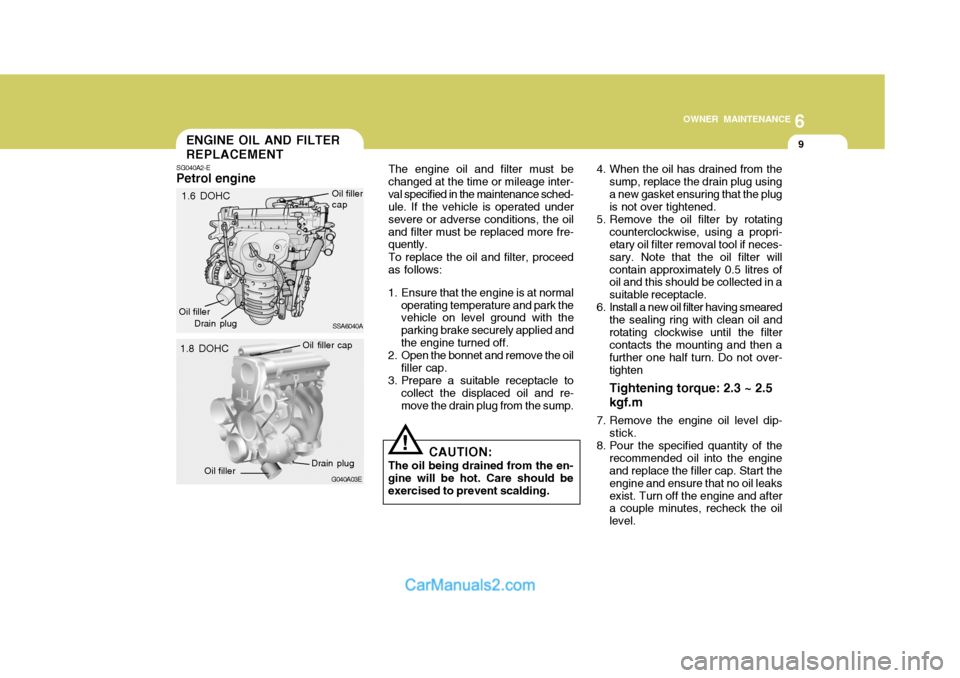
Petrol engine The engine oil and filter must be changed at the time or mileage inter-val specified in the maintenance sched- ule. If the vehicle is operated under severe or adverse conditions, the oiland filter must be replaced more fre- quently. To replace the oil and filter, proceed as follows:
1. Ensure that the engine is at normal operating temperature and park the vehicle on level ground with the parking brake securely applied andthe engine turned off.
2. Open the bonnet and remove the oil filler cap.
3. Prepare a suitable receptacle to collect the displaced oil and re-move the drain plug from the sump.
CAUTION:
The oil being drained from the en-gine will be hot. Care should beexercised to prevent scalding. 4. When the oil has drained from the
sump, replace the drain plug usinga new gasket ensuring that the plug is not over tightened.
5. Remove the oil filter by rotating counterclockwise, using a propri-etary oil filter removal tool if neces- sary. Note that the oil filter willcontain approximately 0.5 litres of oil and this should be collected in a suitable receptacle.
6. Install a new oil filter having smeared
the sealing ring with clean oil androtating clockwise until the filter contacts the mounting and then a further one half turn. Do not over-tighten Tightening torque: 2.3 ~ 2.5 kgf.m
7. Remove the engine oil level dip- stick.
8. Pour the specified quantity of the
recommended oil into the engine and replace the filler cap. Start the engine and ensure that no oil leaksexist. Turn off the engine and after a couple minutes, recheck the oil level.
!