towing Hyundai Matrix 2006 Owner's Guide
[x] Cancel search | Manufacturer: HYUNDAI, Model Year: 2006, Model line: Matrix, Model: Hyundai Matrix 2006Pages: 490, PDF Size: 11.58 MB
Page 400 of 490

2
DRIVING YOUR HYUNDAI
25
15. If you have to stop whilst going uphill, do not hold the vehicle in place by pressing on the accelera- tor. This can cause the automatic transaxle to overheat. Use the park-ing brake or footbrake.
NOTE: When towing check transaxle fluid more frequently.
! CAUTION:
If overheating should occur when towing, (temperature gauge readsnear the red zone), taking the follow- ing actions may reduce or eliminate the problem.
1. Turn off the air conditioner.
2. Reduce highway speed.
3. Select a lower gear when going uphill.
4. Whilst in stop and go traffic, place the gear selection in park or neu- tral and idle the engine at a higher speed.
Page 401 of 490

3
If the Engine Will not Start .......................................... 3-2
Jump Starting .............................................................. 3-3
If the Engine Overheats .............................................. 3-4
Spare Tyre ................................................................... 3-6
In the Event of a Puncture ........................................... 3-7
Changing A Flat Tyre ................................................... 3-7
If Your Vehicle Must Be Towed ..................................3-12
Emergency Towing ..................................................... 3-14
If You Lose Your K eys ................................................ 3-14
IN CASE OF EMERGENCY
3
Page 412 of 490

3 IN CASE OF EMERGENCY
12IF YOUR VEHICLE MUST BE TOWED
D080A01O-GAT If your vehicle has to be towed, it should be done by your Hyundai authorised repairer or a commercial tow truck ser- vice. This will help assure that yourvehicle is not damaged in towing. Also, professionals are generally aware of local laws governing towing. In anycase, rather than risk damage to your car, it is suggested that you show this information to the tow truck operator.Be sure that a safety chain system is used and that all local laws are ob- served.It is recommended that your vehicle be towed with a wheel lift and dollies or flatbed equipment with all the wheelsoff the ground.
! CAUTION:
o Your vehicle can be damaged if towed incorrectly!
o Be sure the transaxle is in neutral.
o When the engine will not start, be sure the steering is unlocked by placing the key in the "ACC" posi- tion. HFC005
1)
2)
3)
dolly
If the valve cap is lost from any of the valves, a replacement should be ob-tained and fitted at the first available opportunity. The valve cap prevents the ingress of dirt which may cause thevalve to stick and therefore leak and is part of the valve sealing function. Ensure that the spare wheel, jack and wheel nut wrench as well tools are correctly located in the boot of thevehicle to prevent damage and noise.
D080B01O-GAT Towing the Vehicle Your vehicle can be towed by wheel lift type truck (1), (2) or flatbed equipment (3).
Page 413 of 490

3
IN CASE OF EMERGENCY
13
HFC004!
CAUTION:
o When towing the vehicle, take care not to cause damage to the bumper or underbody of the vehicle.
!
o Do not tow with sling type truck as this may cause damage to the bumper or underbody of the ve- hicle.
1) If the vehicle is being towed with the rear wheels on the ground, be sure the parking brake is released. NOTE: Before towing, check the level of the automatic transaxle fluid. If it is be- low the "HOT" range on the dipstick,add fluid. If you cannot add fluid, a towing dolly must be used.
2) If any of the loaded wheels or sus-
pension components are damaged or the vehicle is being towed with thefront wheels on the ground, use a towing dolly under the front wheels.
o Manual Transaxle: If you do not use a towing dolly, placethe ignition key in the "ACC" position and put the transaxle in "N (Neutral)".
HFC006
CAUTION:
Do not tow with the key removed or in the "LOCK" position when towingfrom the rear without a towing dolly.
o Automatic Transaxle: Be sure to use a towing dolly under the front wheels.
! CAUTION:
A vehicle with an automatic transaxle should never be towed from the rear with the front wheels on the ground. This can cause serious damage tothe transaxle.
3) It is recommended that your vehicle be towed with all the wheels off the ground.
Page 414 of 490

3 IN CASE OF EMERGENCY
14IF YOU LOSE YOUR KEYS
NOTE: Before towing, check the level of the automatic transaxle fluid. If it is be- low the "HOT" range on the dipstick,add fluid. If you cannot add fluid, a towing dolly must be used. D120A01A-EAT Information about the key of immobiliser system will be found on page 1-4.
!
EMERGENCY TOWING
D080D04A-EAT For emergency towing when no com- mercial tow vehicle is available, attach a tow cable, chain or strap to one of thetowing hooks under the front/rear of your vehicle. Do not attempt to tow your vehicle in this manner on any unpavedsurface. This could result in serious damage to your vehicle. Nor should towing be attempted if thewheels, drive train, axles, steering or brakes are damaged. Before towing, be sure the transaxle is in neutral and thekey is in "ACC" (with the engine off) or in the "ON" position (with the engine running). A driver must be in the towedvehicle to steer it and operate the brakes. D080D04FC
Front
Rear CAUTION:
If the car is being towed with all four wheels on the ground, it can be towed only from the front. Be sure that the transaxle is in neutral. Do not tow at speeds greater than 30 mph(50 km/h) and for more than 15 miles (25 km). Be sure the steering is unlocked byplacing the key in the "ACC" posi- tion. A driver must be in the towed vehicle to operate the steering andbrakes
Page 425 of 490
5VEHICLE MAINTENANCE REQUIREMENTS
6
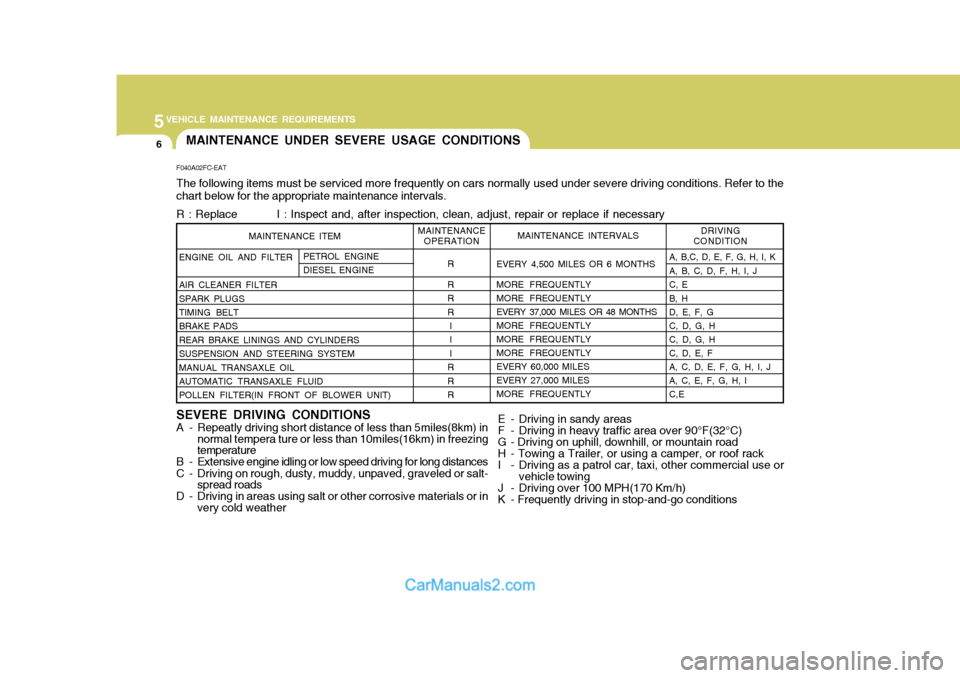
ENGINE OIL AND FILTER AIR CLEANER FILTER SPARK PLUGS TIMING BELT BRAKE PADSREAR BRAKE LININGS AND CYLINDERSSUSPENSION AND STEERING SYSTEMMANUAL TRANSAXLE OIL AUTOMATIC TRANSAXLE FLUID POLLEN FILTER(IN FRONT OF BLOWER UNIT) A, B,C, D, E, F, G, H, I, KA, B, C, D, F, H, I, JC, EB, HD, E, F, G C, D, G, HC, D, G, HC, D, E, FA, C, D, E, F, G, H, I, JA, C, E, F, G, H, IC,E
R R RR
I I I
RRR DRIVING
CONDITION
EVERY 4,500 MILES OR 6 MONTHS MORE FREQUENTLY MORE FREQUENTLY
EVERY 37,000 MILES OR 48 MONTHSMORE FREQUENTLYMORE FREQUENTLYMORE FREQUENTLYEVERY 60,000 MILESEVERY 27,000 MILESMORE FREQUENTLY MAINTENANCE INTERVALS
F040A02FC-EAT The following items must be serviced more frequently on cars normally used under severe driving conditions. Refer to the chart below for the appropriate maintenance intervals.
R : Replace I : Inspect and, after inspection, clean, adjust, repair or replace if necessary
SEVERE DRIVING CONDITIONS
A - Repeatly driving short distance of less than 5miles(8km) in
normal tempera ture or less than 10miles(16km) in freezing temperature
B - Extensive engine idling or low speed driving for long distances
C - Driving on rough, dusty, muddy, unpaved, graveled or salt- spread roads
D - Driving in areas using salt or other corrosive materials or in very cold weather
MAINTENANCEOPERATION
MAINTENANCE ITEM
E - Driving in sandy areas
F - Driving in heavy traffic area over 90°F(32°C)
G - Driving on uphill, downhill, or mountain road
H - Towing a Trailer, or using a camper, or roof rack
I - Driving as a patrol car, taxi, other commercial use orvehicle towing
J - Driving over 100 MPH(170 Km/h)
K - Frequently driving in stop-and-go conditions
MAINTENANCE UNDER SEVERE USAGE CONDITIONS
PETROL ENGINE DIESEL ENGINE
Page 487 of 490
10INDEX
2
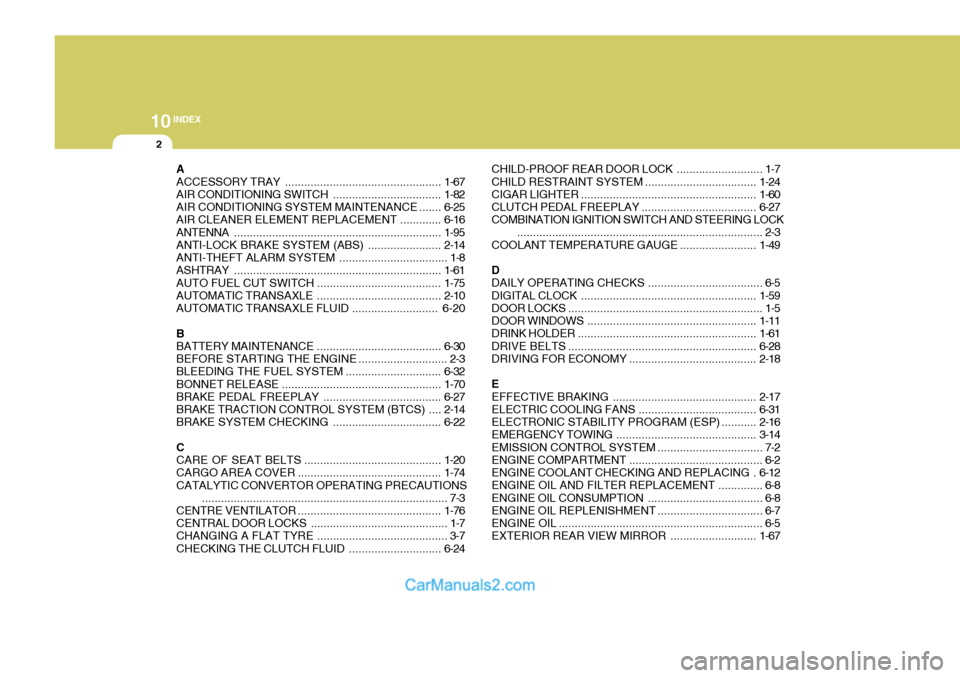
A ACCESSORY TRAY ................................................. 1-67
AIR CONDITIONING SWITCH.................................. 1-82
AIR CONDITIONING SYSTEM MAINTENANCE ....... 6-25
AIR CLEANER ELEMENT REPLACEMENT .............6-16
ANTENNA ................................................................. 1-95
ANTI-LOCK BRAKE SYSTEM (ABS) .......................2-14
ANTI-THEFT ALARM SYSTEM .................................. 1-8
ASHTRAY ................................................................. 1-61
AUTO FUEL CUT SWITCH ....................................... 1-75
AUTOMATIC TRANSAXLE .......................................2-10
AUTOMATIC TRANSAXLE FLUID ........................... 6-20
B BATTERY MAINTENANCE .......................................6-30
BEFORE STARTING THE ENGINE ............................ 2-3
BLEEDING THE FUEL SYSTEM .............................. 6-32
BONNET RELEASE .................................................. 1-70
BRAKE PEDAL FREEPLAY .....................................6-27
BRAKE TRACTION CONTROL SYSTEM (BTCS) .... 2-14
BRAKE SYSTEM CHECKING.................................. 6-22
C
CARE OF SEAT BELTS .... .......................................1-20
CARGO AREA COVER ............................................. 1-74
CATALYTIC CONVERTOR OPERATING PRECAUTIONS ............................................................................. 7-3
CENTRE VENTILATOR ............................................. 1-76
CENTRAL DOOR LOCKS ......... .................................. 1-7
CHANGING A FLAT TYRE ......................................... 3-7
CHECKING THE CLUTCH FLU ID .............................6-24CHILD-PROOF REAR DOOR LOCK
........................... 1-7
CHILD RESTRAINT SYSTEM ................................... 1-24
CIGAR LIGHTER ....................................................... 1-60
CLUTCH PEDAL FREEPLAY ....................................6-27
COMBINATION IGNITION SWITCH AND STEERING LOCK
............................................................................. 2-3
COOLANT TEMPERATURE GAUGE ........................1-49
D DAILY OPERATING CHECKS .................................... 6-5
DIGITAL CLOCK ....................................................... 1-59
DOOR LOCKS ............................................................. 1-5
DOOR WINDOWS ..................................................... 1-11
DRINK HOLDER ........................................................ 1-61
DRIVE BELTS ........................................................... 6-28
DRIVING FOR ECONOMY ....... .................................2-18
E EFFECTIVE BRAKING ............................................. 2-17
ELECTRIC COOLING FANS ..................................... 6-31
ELECTRONIC STABILITY PROGRAM (ESP) ...........2-16
EMERGENCY TOWING ............................................ 3-14
EMISSION CONTROL SYSTEM ................................. 7-2
ENGINE COMPARTMENT ....... ................................... 6-2
ENGINE COOLANT CHECKING AND REPLACING . 6-12
ENGINE OIL AND FILTER REPLACEMENT .............. 6-8
ENGINE OIL CONSUMPTION .................................... 6-8
ENGINE OIL REPLENISHMENT ................................. 6-7
ENGINE OIL ................................................................ 6-5 EXTERIOR REAR VIEW MIRROR ........................... 1-67
Page 490 of 490

10
INDEX
5
T
TOWING ATTACHMENTS . .......................................2-22
TRAILER AND CARAVAN TOWING .........................2-21
TRIP COMPUTER ..................................................... 1-52
TYPE PRESSURES .................................................... 8-3
TYRE BALANCING ..................................................... 8-4
TYRE CHAINS ............................................................ 8-3
TYRE REPLACEMENT ............................................... 8-5
TYRE ROTATION ....................................................... 8-4
UUNDER TRAY ........................................................... 1-15
V VEHICLE IDENTIFICATION NUMBER ........................ 8-2
W
WHEEL REPLACEMENT ............................................ 8-5
WINDSCREEN WASHER OPERATION ....................1-56
WINDSCREEN WASHER RESERVOIR REPLENISHMENT ................................................ 6-18
WINDSCREEN WIPER BLADES ............................. 6-16
WINDSCREEN WIPER/WASHER SWITCH ..............1-55
WINTER MOTORING ................................................ 2-19