heating Hyundai Matrix 2006 Workshop Manual
[x] Cancel search | Manufacturer: HYUNDAI, Model Year: 2006, Model line: Matrix, Model: Hyundai Matrix 2006Pages: 490, PDF Size: 11.58 MB
Page 400 of 490

2
DRIVING YOUR HYUNDAI
25
15. If you have to stop whilst going uphill, do not hold the vehicle in place by pressing on the accelera- tor. This can cause the automatic transaxle to overheat. Use the park-ing brake or footbrake.
NOTE: When towing check transaxle fluid more frequently.
! CAUTION:
If overheating should occur when towing, (temperature gauge readsnear the red zone), taking the follow- ing actions may reduce or eliminate the problem.
1. Turn off the air conditioner.
2. Reduce highway speed.
3. Select a lower gear when going uphill.
4. Whilst in stop and go traffic, place the gear selection in park or neu- tral and idle the engine at a higher speed.
Page 404 of 490
3 IN CASE OF EMERGENCY
4IF THE ENGINE OVERHEATS
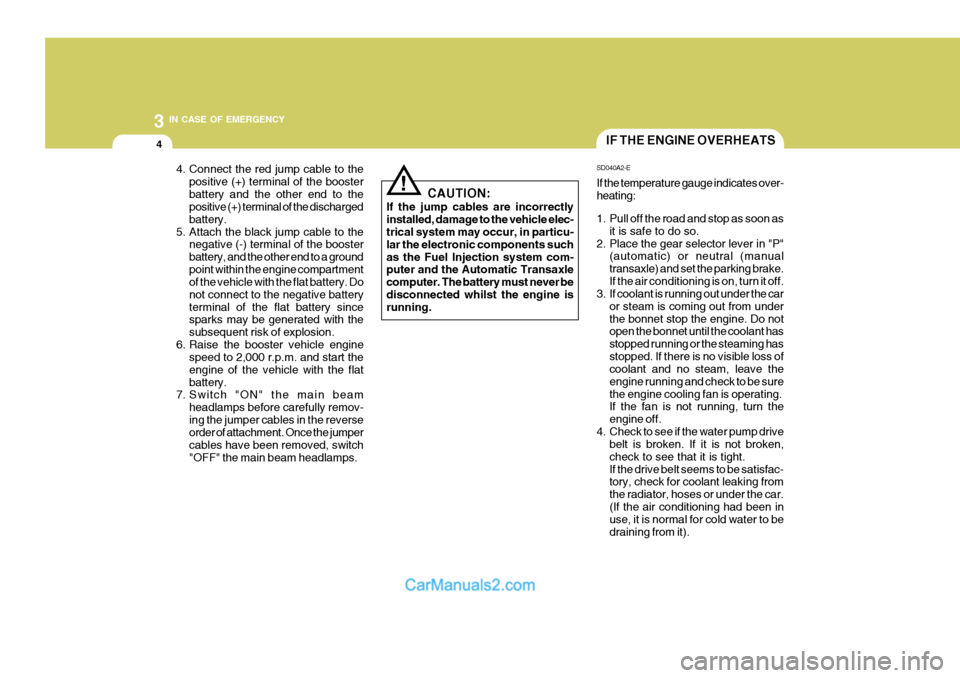
SD040A2-E If the temperature gauge indicates over- heating:
1. Pull off the road and stop as soon as it is safe to do so.
2. Place the gear selector lever in "P" (automatic) or neutral (manual transaxle) and set the parking brake.If the air conditioning is on, turn it off.
3. If coolant is running out under the car
or steam is coming out from underthe bonnet stop the engine. Do not open the bonnet until the coolant has stopped running or the steaming hasstopped. If there is no visible loss of coolant and no steam, leave the engine running and check to be surethe engine cooling fan is operating. If the fan is not running, turn the engine off.
4. Check to see if the water pump drive belt is broken. If it is not broken,check to see that it is tight.If the drive belt seems to be satisfac- tory, check for coolant leaking from the radiator, hoses or under the car.(If the air conditioning had been in use, it is normal for cold water to be draining from it).
4. Connect the red jump cable to the
positive (+) terminal of the boosterbattery and the other end to the positive (+) terminal of the discharged battery.
5. Attach the black jump cable to the negative (-) terminal of the boosterbattery, and the other end to a groundpoint within the engine compartment of the vehicle with the flat battery. Do not connect to the negative batteryterminal of the flat battery since sparks may be generated with the subsequent risk of explosion.
6. Raise the booster vehicle engine speed to 2,000 r.p.m. and start theengine of the vehicle with the flatbattery.
7. Switch "ON" the main beam
headlamps before carefully remov-ing the jumper cables in the reverse order of attachment. Once the jumper cables have been removed, switch"OFF" the main beam headlamps. CAUTION:
If the jump cables are incorrectlyinstalled, damage to the vehicle elec- trical system may occur, in particu- lar the electronic components suchas the Fuel Injection system com- puter and the Automatic Transaxle computer. The battery must never bedisconnected whilst the engine is running.
!
Page 405 of 490

3
IN CASE OF EMERGENCY
5
!
!
!WARNING:
Whilst the engine is running, keep hands and clothing away from mov- ing parts such as the fan and drive belts to prevent injury. 5. If the water pump drive belt is broken
or coolant is leaking out, stop theengine immediately and call the near- est Hyundai authorised repairer for assistance.
WARNING (Diesel only):
Never work on injection system with engine running or within 30 seconds after shutting off engine. High pres-sure pump, rail, injectors and high pressure pipes are subject to high pressure even after the enginestopped. The fuel jet produced by fuel leaks may cause serious injury, if it touch the body. People usingpacemakers should ensure that they keep a distance of 30cm from the ECU or wiring harness within theengine room whilst engine is run- ning, since the high currents in the Common Rail system produce con-siderable magnetic fields.!
WARNING:
Do not remove the radiator cap when the engine is hot since steam and boiling water may be ejected fromthe radiator resulting in burns or scalding.
6. If the cause of the overheating can- not be found, wait until the engine temperature has returned to normal. Then, if coolant has been lost, care-fully remove the radiator cap and add water to bring the fluid level in the reservoir up to the base of the radia-tor fill opening. Fill the coolant ex- pansion tank to the halfway mark.
7. Proceed with caution until it is estab- lished that the engine is operatingnormally. If the engine overheats repeatedly, the advice of a Hyundaiauthorised repairer should be sought. CAUTION:
Serious loss of coolant indicatesthere is a leak in the cooling system and this should be checked as soon as possible by a Hyundai authorisedrepairer.
Page 441 of 490

6 OWNER MAINTENANCE
12
!
ENGINE COOLANT CHECK- ING AND REPLACING
SG050B1-E Coolant recommended G050B01FC
SG050A1-E
WARNING:
Do not remove the radiator cap when the engine is hot, since the system is pressurised and coolant may be ejected from the radiator resultingin scalding.
G050B02FC
Petrol engine Diesel engine
Only ethylene glycol based coolantwith a corrosion inhibitor suited to alu- minium alloy engine components should be used in the cooling system. No further additives or inhibitors should be used. The coolant specific gravityshould be checked as prescribed in the maintenance schedule to ensure adequate frost and corrosion protec-tion. In addition, the engine coolant must be replaced at the specified in- terval since the corrosion inhibitor prop-erties deteriorate with time. It is important to note that whilst an
increase in the concentration of antifreeze gives an increase in the level of frost protection, a solution which is in excess of 65% anti freeze will result inreduced frost protection and engine overheating. Therefore the recom- mended concentration of 50% shouldnot be exceeded for general use. The use of methanol based anti freeze
compounds may result in engine over-heating and will invalidate the vehicle warranty.
NOTE: It is imperative that vehicles fitted
with an air conditioning system have a coolant concentration of the rec-ommended strength at all times. The use of the air conditioning sys- tem when the cooling system isfilled with water only will result in the heater matrix freezing and sub- sequently bursting.
Page 478 of 490

8
CONSUMER INFORMATION
3TYRE
I030A01FC-EAT
TYRE PRESSURES
SI030A2-E SNOW TYRES If it is desired to fit snow tyres to the vehicle, it must be ascertained thatthe original size and load carrying ca- pacity are met by the replacement tyres. When using snow tyres, thevehicle should not be driven at speeds in excess of 60 MPH.
In modern high-speed motoring, cor- rect tyre pressures are vitally impor- tant. Incorrect tyre pressures can af- fect vehicle safety by causing reducedadhesion, steering response and tyre failure through overheating. The tyre pressure must only be checked whenthe tyres are cold. The correct tyre pressures are indicated on the label affixed to the driver's side "C" pillerouter panel and below. 5.5Jx14 5.5Jx15 6.0Jx153.5Jx153.5Jx15
TYRE
SIZE
RIM
SIZE PRESSURE, kPa (PSI)
185/65R14 195/55R15 205/55R15
T115/70D15T115/70R15 REAR
210(30)210(30)210(30)420(60) 420(60) FRONT
250(36)250(36) 250(36)420(60)420(60)
UP TO 2
PERSONS UP TO
MAX. LOAD
REAR
250(36) 250(36) 250(36)420(60)420(60)
FRONT210(30)210(30) 210(30) 420(60)420(60)
Tyre pressures should be increased by 3 psi when the vehicle is driven fully laden or under conditions of sus- tained high speed motoring. SI040A1-E TYRE CHAINS Tyre chains, when included, should be installed on the front wheels. Be sure that the chains are the proper size and that they are installed in accordancewith the manufacturer's instructions.To minimise tyre and chain wear, donot continue to use tyre chains when they are no longer needed.
CAUTION:
When driving on roads covered withsnow or ice, drive at less than 20 mph (30 km/h).
!I030A02FC-D
Page 488 of 490
10
INDEX
3
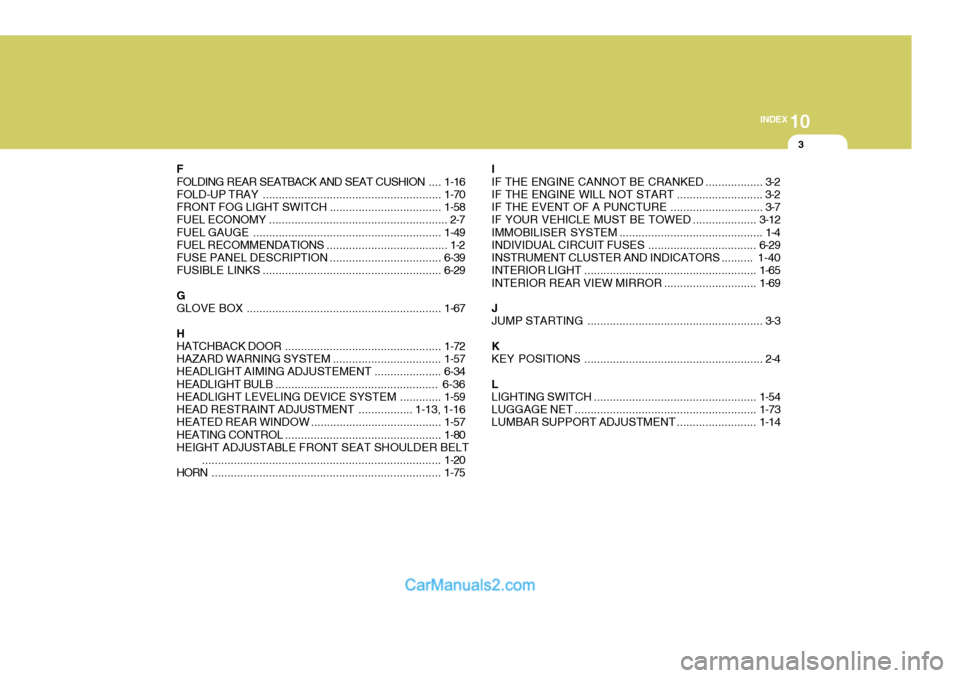
F FOLDING REAR SEATBACK AND SEAT CUSHION ....1-16
FOLD-UP TRAY ........................................................ 1-70
FRONT FOG LI GHT SWITCH ................................... 1-58
FUEL ECONOMY ........................................................ 2-7
FUEL GAUGE ........................................................... 1-49
FUEL RECOMMENDATIONS ...................................... 1-2
FUSE PANEL D ESCRIPTION................................... 6-39
FUSIBLE LINKS ........................................................ 6-29
GGLOVE BOX ............................................................. 1-67
H HATCHBACK DOOR ................................................. 1-72
HAZARD WARNING SYST EM ..................................1-57
HEADLIGHT AIMING ADJUSTEMENT ..................... 6-34
HEADLIGHT BULB ................................................... 6-36
HEADLIGHT LEVELING DEVICE SYSTEM ............. 1-59
HEAD RESTRAINT ADJUSTMENT .................1-13, 1-16
HEATED REAR WINDOW ......................................... 1-57
HEATING CONTROL ................................................. 1-80
HEIGHT ADJUSTABLE FRONT SEAT SHOULDER BELT
........................................................................... 1-20
HORN ........................................................................ 1-75I
IF THE ENGINE CANNOT BE CRANKED
.................. 3-2
IF THE ENGINE WILL NOT START ........................... 3-2
IF THE EVENT OF A PUNCTURE ............................. 3-7
IF YOUR VEHICLE MUST BE TOWED ....................3-12
IMMOBILISER SYSTEM ............................................. 1-4
INDIVIDUAL CIRCUIT FUSES .................................. 6-29
INSTRUMENT CLUSTER AND INDICATORS.......... 1-40
INTERIOR LIGHT ...................................................... 1-65
INTERIOR REAR VIEW MIRROR ............................. 1-69
J JUMP STAR TING ....................................................... 3-3
K KEY POSITIONS ........................................................ 2-4
L LIGHTING SWITCH ................................................... 1-54
LUGGAGE NET ......................................................... 1-73
LUMBAR SUPPORT ADJUSTMENT .........................1-14