warning Hyundai Matrix 2006 Repair Manual
[x] Cancel search | Manufacturer: HYUNDAI, Model Year: 2006, Model line: Matrix, Model: Hyundai Matrix 2006Pages: 490, PDF Size: 11.58 MB
Page 153 of 490

2
DRIVING YOUR HYUNDAI
5
!
STARTING
C050A01A-GAT Starting for the gasoline engine
C050A01E
WARNING:
Never run the engine in a closed or poorly ventilated area any longerthan is needed to move your car in or out of the area. The carbon mon- oxide gas emitted is odorless andcan cause serious injury or death. C050B02S-GAT NORMAL CONDITIONS The Starting Procedure:
1. Insert key, and fasten the seat belt.
2. Depress the clutch pedal fully and
place the gearshift lever (manual transaxle) in neutral or the selector lever (automatic transaxle) in "P" (park) position.
3. After turning the ignition key to the "ON" position, make certain all warn-ing lights and gauges are function-ing properly before starting the en- gine.
4. On vehicles equipped with the die- sel preheat indicator light, turn theignition key to the "ON" position. The diesel pre-heat indicator lightwill first illuminate in amber, and then after a short time, the amber illumination will goes off, indicatingthat preheating is completed.
C051A01O-GAT Starting for the diesel engine ENGINE COLD
o Turn the ignition key to position
"ON" and wait for the pre-heat indi- cator light to go out.
o Operate the starter until the engine runs.
ENGINE WARM Operate the starter. If the engine does not respond on the first attempt, wait several seconds and try again usingthe pre-heat.
Page 154 of 490

2 DRIVING YOUR HYUNDAI
6
!
!WARNING:
Be sure that the clutch is fully de- pressed when starting a manualtransaxle vehicle. Otherwise there is the potential to cause damage to the vehicle or injury to someoneinside or outside the vehicle as a result of the forward or backward movement of the vehicle that willoccur if the clutch is not depressed when the vehicle is started.
NOTE: If the engine was not started 10 seconds after the preheating is com- pleted, turn the ignition key oncemore to the "LOCK" position, and then to the "ON" position, in order to preheat again. C050B01HP
AMBER LAMP ON
AMBER LAMP OFF
5. Turn the ignition key to the "START"position and release it when the engine starts. C055B01B-GAT STARTING AND STOPPING THE ENGINE FOR TURBO CHARGERINTERCOOLER(DIESEL ENGINE)
(1) Do not race the engine or sudden
accelerate the engine immediately after start it. If the engine is cold,allow the engine to idle for several seconds before it is driven to en- sure sufficient lubrication of theturbo charger unit.
(2) After high speed or extended driv-
ing, requiring a heavy engine load,the engine should be allowed to idle about 1 minute before turning it off. This idle time will allow the turbocharger to cool prior to shutting the engine off.
WARNING:
Do not turn the engine off immedi-ately after it has been subjected to a heavy load. Doing so may causesevere damage to the engine or turbo charger unit.
Page 157 of 490

2
DRIVING YOUR HYUNDAI
9
!
o Exercise extreme caution when driv-
ing on a slippery surface. Be espe- cially careful when braking, acceler- ating or shifting gears. On a slippery surface, an abrupt change in ve-hicle speed can cause the drive wheels to lose traction and the ve- hicle to go out of control.
WARNING:
o Avoid high cornering speeds.
o Do not make quick steering wheel movements, such as sharp lanechanges or fast, sharp turns.
o Always wear your seat belts. In a collision, an unbelted personis significantly more likely to die than a person wearing a seat belt.
o The risk of rollover is greatly in- creased if you lose control of yourvehicle at highway speeds.
o Loss of control often occurs if two or more wheels drop off the road-way and the driver oversteers toreenter the roadway.o In the event your vehicle leavesthe roadway, do not steer sharply. Instead, slow down before pullingback into the travel lanes.
o Never exceed posted speed limits.
C090A01FC
The highly efficient Hyundai automatic transaxle has four forward speeds and one reverse speed. It has a conven-tional shift pattern as shown in the illustration. At night, with the first posi- tion of the multi-function switch, theappropriate symbol on the shift pattern indicator will be illuminated according to the range selected.
AUTOMATIC TRANSAXLE
C090A01A-GAT
Page 161 of 490

2
DRIVING YOUR HYUNDAI
13
!
o Exercise extreme caution when driv-
ing on a slippery surface. Be espe- cially careful when braking, acceler- ating or shifting gears. On a slippery surface, an abrupt change in ve-hicle speed can cause the drive wheels to lose traction and the ve- hicle to go out of control.
o Turn the overdrive switch on for good fuel economy and smooth driv-ing. If engine braking is needed inthe "D" range or if repeated upshift- ing and downshifting between 3rd and 4th gear is needed when climb-ing a gentle slope, it is recommended that the overdrive switch be turned off. Turn the overdrive switch backon immediately afterward.
o Optimum vehicle performance and
economy is obtained by smoothlydepressing and releasing the accel- erator pedal.
o Always wear your seat belts.In a collision, an unbelted person is significantly more likely to diethan a person wearing a seat belt.
o The risk of rollover is greatly in-
creased if you lose control of yourvehicle at highway speeds.
o Loss of control often occurs if two
or more wheels drop off the road-way and the driver oversteers to reenter the roadway.
o In the event your vehicle leaves the roadway, do not steer sharply.Instead, slow down before pulling back into the travel lanes.
o Never exceed posted speed limits.
o If your vehicle becomes stuck in snow, mud, sand, etc., then you may attempt to rock the vehicle free by moving it forward and back- ward. Do not attempt this proce-dure if people or objects are any- where near the vehicle. During the rocking operation the vehicle maysuddenly move forward of back- ward as it becomes unstuck, caus- ing injury or damage to nearbypeople or objects.
ANTI-LOCK BRAKE SYSTEM (ABS)
C120A01FC-AAT (If Installed) The Anti-Lock Brake System (ABS) is designed to prevent wheel lock-upduring sudden braking or on hazard- ous road surfaces. The ABS control module monitors the wheel speed andcontrols the pressure applied to each brake. Thus, in emergency situations or on slick roads, ABS will increasevehicle control during braking. NOTE:
o A click sound may be heard in the
engine compartment when the ve- hicle begins to move after the en- gine is started. These conditionsare normal and indicate that the anti-lock brake system (Electronic Stability Program) is functioningproperly.
o During ABS (ESP) operation, a
slight pulsation may be felt in thebrake pedal when the brakes are applied. Also, a noise may be heard in the engine compartment whilebraking. These conditions are normal and indicate that the anti- lock brake system is functioningproperly.
WARNING:
o Avoid high cornering speeds.
o Do not make quick steering wheel movements, such as sharp lane changes or fast, sharp turns.
Page 162 of 490

2 DRIVING YOUR HYUNDAI
14BRAKE TRACTION CONTROL SYSTEM (BTCS)
o Driving on rough, gravel or snow-
covered roads.
o Driving with tire chains installed.
o Driving on roads where the road surface is pitted or has differentsurface height.
During these conditions, the ve-hicle should be driven at reducedspeeds. The safety features of an ABS (ESP) equipped vehicle should not be tested by high speed driving or cornering. This could endanger the safety of yourself or others. C300A01O-GAT (If Installed) On slippery road surfaces, the traction control system (TCS) limits the drivewheels from spinning excessively, thus helping the car to accelerate. It also provides sufficient driving force andsteering performance as the car turns at accelerated speeds. SLIP Control Limits the drive wheels from spinning excessively during starting or whilemaking accelerated turns on slippery roads to avoid losing the driving force of the front wheels. Driving hints TCS does not actively apply brakes. Be sure to decelerate the car suffi-ciently before entering curves.!
WARNING:
ABS (ESP) will not prevent accidents due to improper or dangerous driv- ing maneuvers. Even though vehicle control is improved during emer-gency braking, always maintain a safe distance between you and ob- jects ahead. Vehicle speeds shouldalways be reduced during extreme road conditions. The braking distance for cars equipped with an anti-lock braking system may be longer than for thosewithout it in the following road con- ditions.
Page 163 of 490

2
DRIVING YOUR HYUNDAI
15
!
CAUTION:
When the TCS indicator blinks, SLIP control has been activated. It also means that the road is slippery or your car is accelerating excessively.In this situation, gently release foot pressure from the accelerator pedal and maintain moderate speed.
WARNING:
Traction control is only a driving aid; all normal precautions for driv- ing in inclement weather and onslippery driving surfaces should be observed.! C300D02O-GAT Indicator and Warning The TCS indicator should illuminate when the ignition key is turned to "ON"or "START", but should go out after three seconds. If the indicator does not illuminate,have it checked by an authorized Hyundai dealer. Should there be any unusual condi- tions in the device, TCS illuminates as a warning.If TCS illuminates, pull your car to a safe place and stop the engine. Then, start the engine again to checkif the TCS indicator goes out. If the indicator remains lit even after the engine has been started, haveyour car checked by an authorized Hyundai dealer. NOTE: When the TCS indicator illuminates, traction control is automatically de- activated for safety.
C300B01O-GAT TCS ON Mode In the TCS ON mode, the indicator in the instrument cluster will not be illumi-nated. NOTE:
1) Turn off the engine. Then restart
the engine, and the TCS mode will automatically turn "ON".
2) When the traction control is op-
erating properly, you can feel aslight pulsation in the vehicle. This is only the effect of brakecontrol and indicates nothing unusual.
3) When the engine starts, a click is heard from the engine compart-ment; however, this is only the sound of traction control beingchecked.
4) When moving out of the mud or
fresh snow, pressing the accel-erator pedal may not cause the engine speed to increase.
Page 164 of 490

2 DRIVING YOUR HYUNDAI
16
!
input can all affect whether ESP will be effective in preventing a loss of con-trol. It is still your responsibility to drive and corner at reasonable speeds and to leave a sufficient margin of safety.
CAUTION:
Driving with varying tire or wheelsize may cause the ESP system to malfunction. When replacing tires, make sure they are the same size asyour original tires.
WARNING:
Electronic stability program is onlya driving aid; all normal precau-tions for driving in inclement weather and on slippery road sur- faces should be observed.
!
ELECTRONIC STABILITY PROGRAM (ESP)
C310A01JM-AAT (If installed) The Electronic Stability Program (ESP) system is designed to stabilize thevehicle during cornering manuevers. ESP checks where you are steering and where the vehicle is actually go-ing. ESP applies the brakes at indi- vidual wheels and intervenes in the engine management system to stabi-lize the vehicle. The Electronic Stability Program (ESP) system is an electronic system de- signed to help the driver maintain ve- hicle control under adverse conditions.It is not a substitute for safe driving practices. Factors including speed, road conditions and driver steering C310A01FC
C310B01JM-AAT ESP ON/OFF Mode When the ESP is operating, the ESP indicator in the instrument cluster willblink. If you turn the system off by pressing the ESP switch, the ESP-OFF indica-tor will come on and stay on. In the ESP-OFF mode, the stability control will be deactivated. Adjust your drivingaccordingly. To turn the system back on, press the switch again. The ESP- OFF indicator should go off. NOTE: The ESP mode will automatically be turned ON after the engine isturned off and restarted.
Page 165 of 490

2
DRIVING YOUR HYUNDAI
17
!WARNING:
Nothing should be carried on top of the shelf panel behind the rear seat. If there were an accident or a sud- den stop, such objects could moveforward and cause damage to the vehicle or injure the occupants.
o After being parked, check to be sure the parking brake is not engaged and that the parking brake indicator light is out before driving away.
o Driving through water may get the brakes wet. They can also get wet when the car is washed. Wet brakescan be dangerous! Your car will not stop as quickly if the brakes are wet. Wet brakes may cause the car topull to one side. To dry the brakes, apply the brakes lightly until the braking action returns to normal,taking care to keep the car under control at all times. If the braking action does not return to normal,stop as soon as it is safe to do so and call your Hyundai dealer for assistance.
C310D01JM-AAT Indicators and Warning The indicators should illuminate when the ignition key is turned to ON orSTART but should go out after three seconds. If the indicators do not illuminate, orthe ESP or ESP-OFF indicator does not go out after 3 seconds, have the vehicle checked by an authorizeddealer. Should there be any unusual condi- tions in the device while driving, ESP- OFF indicator illuminates as a warn- ing.If ESP-OFF indicator illuminates, pull your car to a safe place and stop the engine.Then, start the engine again to check if the ESP-OFF indicator goes out. If the indicator remains lit even after the engine has been started, have your car checked by an authorizedHyundai dealer.
GOOD BRAKING PRACTICES
C130A01A-AAT o Don't coast down hills with the car
out of gear. This is extremely haz- ardous. Keep the car in gear at all times, use the brakes to slow down,then shift to a lower gear so that engine braking will help you main- tain a safe speed.
o Don't "ride" the brake pedal. Rest- ing your foot on the brake pedalwhile driving can be dangerous be-cause it can result in the brakes overheating and losing their effec- tiveness. It also increases the wearof the brake components.
o If a tire goes flat while you are
driving, apply the brakes gently and keep the car pointed straight ahead while you slow down. When you aremoving slowly enough for it to be safe to do so, pull off the road and stop in a safe place.
o If your car is equipped with an auto- matic transaxle, don't let your carcreep forward. To avoid creepingforward, keep your foot on the brake pedal when the car is stopped.
o Use caution when parking on a hill. Engage the parking brake and placethe gear selector lever in "P" (auto- matic transaxle) or in first or reversegear (manual transaxle).
Page 173 of 490
2
DRIVING YOUR HYUNDAI
25
!
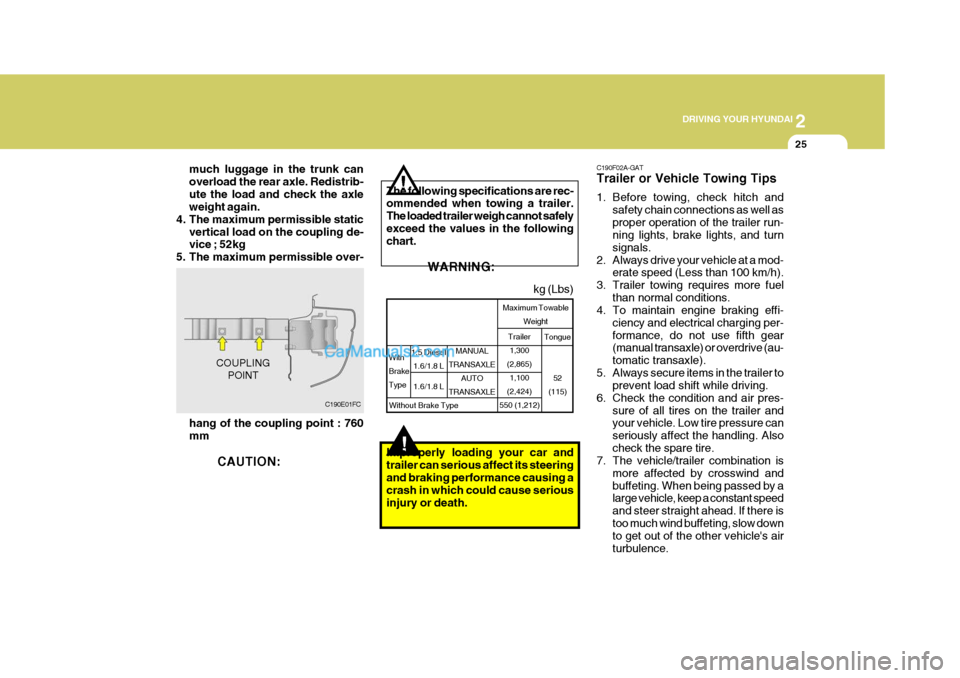
kg (Lbs)
!
COUPLING POINT
C190E01FC MANUAL
TRANSAXLE AUTO
TRANSAXLE Trailer
1,300
(2,865) 1,100
(2,424)
550 (1,212) Tongue
52
(115)
Maximum Towable Weight
With BrakeType
1.5 Diesel 1.6/1.8 L 1.6/1.8 L
Without Brake Type
much luggage in the trunk can overload the rear axle. Redistrib-ute the load and check the axle weight again.
4. The maximum permissible static
vertical load on the coupling de-vice ; 52kg
5. The maximum permissible over- The following specifications are rec-ommended when towing a trailer. The loaded trailer weigh cannot safelyexceed the values in the following chart.
WARNING:
hang of the coupling point : 760 mm CAUTION: Improperly loading your car andtrailer can serious affect its steering and braking performance causing a crash in which could cause seriousinjury or death. C190F02A-GAT Trailer or Vehicle Towing Tips
1. Before towing, check hitch and
safety chain connections as well as proper operation of the trailer run- ning lights, brake lights, and turn signals.
2. Always drive your vehicle at a mod- erate speed (Less than 100 km/h).
3. Trailer towing requires more fuel than normal conditions.
4. To maintain engine braking effi-
ciency and electrical charging per-formance, do not use fifth gear (manual transaxle) or overdrive (au- tomatic transaxle).
5. Always secure items in the trailer to prevent load shift while driving.
6. Check the condition and air pres- sure of all tires on the trailer and your vehicle. Low tire pressure can seriously affect the handling. Alsocheck the spare tire.
7. The vehicle/trailer combination is
more affected by crosswind andbuffeting. When being passed by a large vehicle, keep a constant speed and steer straight ahead. If there istoo much wind buffeting, slow down to get out of the other vehicle's air turbulence.
Page 176 of 490
3 WHAT TO DO IN AN EMERGENCY
2
!
IF THE ENGINE WILL NOT START
D010A01A-AAT D010B02A-AAT
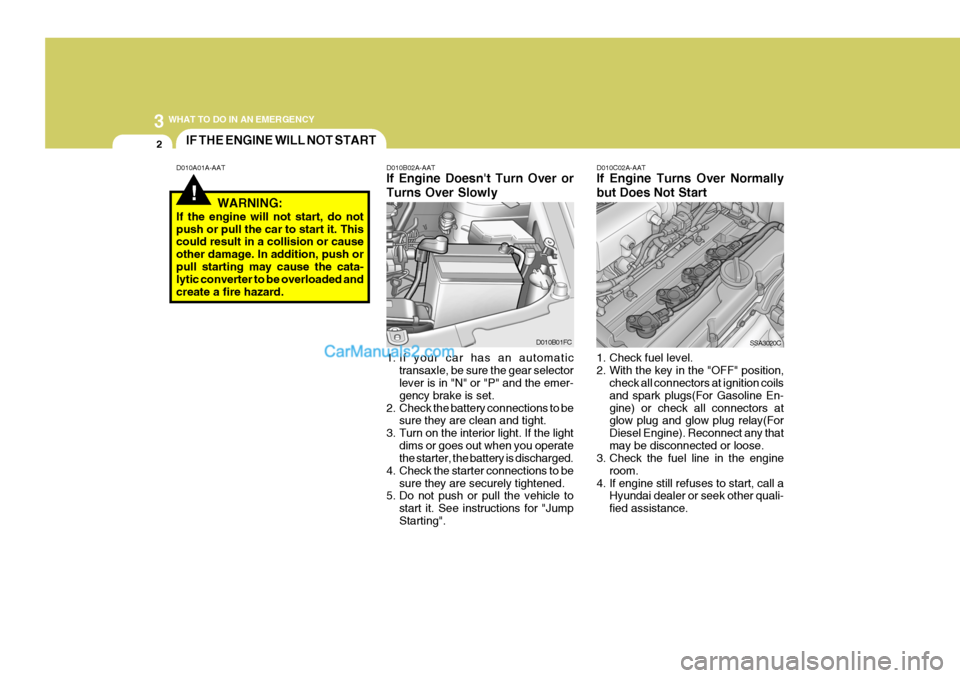
If Engine Doesn't Turn Over or Turns Over Slowly
1. If your car has an automatic
transaxle, be sure the gear selector lever is in "N" or "P" and the emer- gency brake is set.
2. Check the battery connections to be sure they are clean and tight.
3. Turn on the interior light. If the light dims or goes out when you operate the starter, the battery is discharged.
4. Check the starter connections to be sure they are securely tightened.
5. Do not push or pull the vehicle to
start it. See instructions for "Jump Starting". D010C02A-AAT If Engine Turns Over Normally but Does Not Start
D010B01FC
WARNING:
If the engine will not start, do not push or pull the car to start it. This could result in a collision or cause other damage. In addition, push orpull starting may cause the cata- lytic converter to be overloaded and create a fire hazard.
1. Check fuel level.2. With the key in the "OFF" position,check all connectors at ignition coilsand spark plugs(For Gasoline En-gine) or check all connectors at glow plug and glow plug relay(For Diesel Engine). Reconnect any thatmay be disconnected or loose.
3. Check the fuel line in the engine
room.
4. If engine still refuses to start, call a Hyundai dealer or seek other quali-fied assistance. SSA3020C