air condition Hyundai Matrix 2006 Manual PDF
[x] Cancel search | Manufacturer: HYUNDAI, Model Year: 2006, Model line: Matrix, Model: Hyundai Matrix 2006Pages: 490, PDF Size: 11.58 MB
Page 441 of 490

6 OWNER MAINTENANCE
12
!
ENGINE COOLANT CHECK- ING AND REPLACING
SG050B1-E Coolant recommended G050B01FC
SG050A1-E
WARNING:
Do not remove the radiator cap when the engine is hot, since the system is pressurised and coolant may be ejected from the radiator resultingin scalding.
G050B02FC
Petrol engine Diesel engine
Only ethylene glycol based coolantwith a corrosion inhibitor suited to alu- minium alloy engine components should be used in the cooling system. No further additives or inhibitors should be used. The coolant specific gravityshould be checked as prescribed in the maintenance schedule to ensure adequate frost and corrosion protec-tion. In addition, the engine coolant must be replaced at the specified in- terval since the corrosion inhibitor prop-erties deteriorate with time. It is important to note that whilst an
increase in the concentration of antifreeze gives an increase in the level of frost protection, a solution which is in excess of 65% anti freeze will result inreduced frost protection and engine overheating. Therefore the recom- mended concentration of 50% shouldnot be exceeded for general use. The use of methanol based anti freeze
compounds may result in engine over-heating and will invalidate the vehicle warranty.
NOTE: It is imperative that vehicles fitted
with an air conditioning system have a coolant concentration of the rec-ommended strength at all times. The use of the air conditioning sys- tem when the cooling system isfilled with water only will result in the heater matrix freezing and sub- sequently bursting.
Page 443 of 490

6 OWNER MAINTENANCE
14
!
SPARKING PLUG REPLACE- MENT
G060A01L
SG060A1-E
(Petrol Engine)
This operation should only be per-
formed when the engine is cold.
1. Remove the centre cover from the engine rocker cover.
2. Remove plug lead from the sparking
plug to be replaced, pulling the lead by the rubber cap. (Pulling the lead may damage the carbon conductor).
G050D02FC
6. Start the engine with the radiator cap still removed and continue to add coolant as the level decreases as air is expelled from the system.When the level remains constant, replace the radiator cap and replen- ish the coolant reservoir.
7. When the engine is hot, check to ensure that no coolant leaks arepresent. WARNING:
The cooling fan is controlled by
engine coolant temperature and maysometimes operate even when theengine is not running. Use extreme caution when working near the blades of the cooling fan so thatyou are not injured by a rotating fan blade. As the engine coolant tem- perature decreases, the fan will au-tomatically shut off. This is a nor- mal condition. 0.039~0.043 in. (1.0~1.0 mm)
Page 449 of 490

6 OWNER MAINTENANCE
20
G110A02E-EAT
AUTOMATIC TRANSAXLE FLUID The automatic transaxle fluid level should be checked and changed at those intervals prescribed in the main- tenance schedule. It is of paramountimportance that only the specified fluid is used when replenishing or changing the fluid. The use of other fluids mayirreparably damage the transaxle and invalidate the manufacturers warranty. In addition the ingress of dirt or lintmay prevent correct functioning of the transaxle and care must be exercised to prevent the ingress of such matter. NOTE: Automatic transaxle fluid is a red in color. As driving distance increases, the fluid color turns darkish red gradually. It is a normal conditionand you should not judge the need to replace based upon the changing color.You must replace the automatictransaxle fluid in accordance withintervals specified in the vehicle maintenance schedule in section 5. CAUTION:
The transaxle on fluid level must be
checked with the engine running and at normal operating tempera-ture and therefore care must be ex- ercised to prevent injury occurring through contact with rotating or hotparts of the engine.
!
G110B04A-AAT
Recommended Fluid
Your Hyundai automatic transaxle is specially designed to operate with HYUNDAI GENUINE ATF SP III, DIA- MOND ATF SP-III, SK ATF SP III orother brands approved by Hundai Mo- tor Co,. Damage caused by a nonspecified fluid is not covered byyour new vehicle limited warranty. CAUTION:
Use of aftermarket ATF additives
may cause damage to the automatictransaxle. Only use HYUNDAI GENU-INE ATF SP III, DIAMOND ATF SP III, SK ATF SP III or other brands approved by Hyundai Motor Co., Ifyou are having your vehicle ser- viced at a facility other than a Hyundai authorised repairer, verifythat the correct ATF is used for your vehicle. G110C01FC-EAT
Fluid Capacity
The total fluid capacity of the trans- mission unit is 6.1 litres (1.6 DOHC)/ 6.7 litres(1.8 DOHC).
! CAUTION:
The transaxle fluid level should be checked when the engine is at nor- mal operating temperature.
!
Page 451 of 490

6 OWNER MAINTENANCE
22
!
!
BRAKE SYSTEM CHECKING
Fluid level should be within this range
C090A03FC
WARNING:
The cooling fan is controlled by engine coolant temperature and may sometimes operate even when the engine is not running. Use extremecaution when working near the blades of the cooling fan so that you are not injured by a rotating fanblade. As the engine coolant tem- perature decreases, the fan will au- tomatically shut off. This is a nor-mal condition. WARNING (Diesel only):
Never work on injection system with
engine running or within 30 sec- onds after shutting off engine. Highpressure pump, rail, injectors and high pressure pipes are subject to high pressure even after the enginestopped. The fuel jet produced by fuel leaks may cause serious injury, if it contacts the body.
People using pacemakers should
ensure that they keep a distance of30cm from the ECU or wiring har- ness within the engine room whilst engine is running, since the highcurrents in the Common Rail sys- tem produce considerable magnetic fields. SG120A1-E
CAUTION:
Correct operation of the braking
system is essential to the safe op-eration of the vehicle and therefore, any maintenance operations other than those listed below should beentrusted to a Hyundai authorised repairer.
!
SG120C2-E
Brake Fluid Recommendations
Only brake fluid conforming to DOT 3
or DOT 4 specifications or higher may be used in the braking system. Care should be taken to observe the in- structions and precautions printed uponthe container.
Page 454 of 490

6
OWNER MAINTENANCE
25AIR CONDITIONING SYSTEM MAINTENANCE
SG140A1-E
Condenser
Ensure that the condenser is periodi- cally inspected and that accumula- tions of dirt, dead insects and leaves etc, are removed to ensure that theefficiency of the system is not im- paired. Care must be exercised to ensure that the condenser fins are notdamaged during cleaning.
SG140C2-E
Checking the Refrigerant
1. Start the engine and run at idle for
several minutes with the refrigera- tion system running at the coldest setting.
2. If the air coming out of the in-dash vents is not cold, have the air con-ditioning system inspected by yourHyundai authorised repairer.
CAUTION:
Running the air conditioning sys- tem with a low refrigerant level may damage the compressor.
! SG140D1-E
Off Season Maintenance
The air conditioning must be run for
ten minutes or so weekly during peri- ods when the system would not nor- mally be used to ensure that the com-pressor and seals are lubricated. If this precaution is not observed the compressor seals may become stuckto the compressor shaft and damaged when the system is next used result- ing in a loss of refrigerant and damageto the compressor.
SG140B1-E
Compressor Drive Belt The air conditioning compressor drive belt should be checked to ensure free- dom from damage or excessive wearand correct tension. The belt tension is correct when the belt deflects by about 0.3 inches (8 mm) when a forceof 98 N is applied to the belt halfway between the compressor and crank- shaft pulleys. Adjustment of the belt should be en- trusted to a Hyundai authorised re- pairer. CRANK PULLEY
G140D01A
A/C
TENSION PULLEY 0.315 in. (8mm)
Page 457 of 490
6 OWNER MAINTENANCE
28
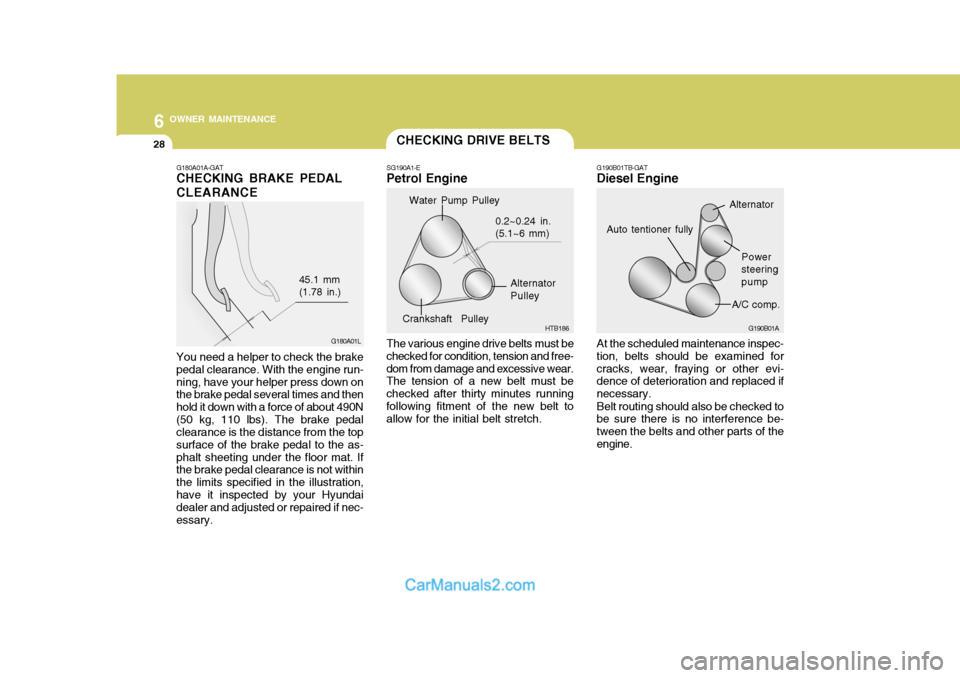
G190B01TB-GAT
Diesel Engine
At the scheduled maintenance inspec- tion, belts should be examined forcracks, wear, fraying or other evi- dence of deterioration and replaced if necessary. Belt routing should also be checked to be sure there is no interference be- tween the belts and other parts of theengine.
SG190A1-E
Petrol Engine
The various engine drive belts must be
checked for condition, tension and free- dom from damage and excessive wear. The tension of a new belt must be checked after thirty minutes runningfollowing fitment of the new belt to allow for the initial belt stretch. CHECKING DRIVE BELTS
Water Pump Pulley
Alternator Pulley
Crankshaft Pulley 0.2~0.24 in.(5.1~6 mm)
HTB186G190B01A
Power steeringpump
A/C comp.
Auto tentioner fully
Alternator
G180A01A-GAT
CHECKING BRAKE PEDAL CLEARANCE
45.1 mm (1.78 in.)G180A01L
You need a helper to check the brake pedal clearance. With the engine run-ning, have your helper press down on the brake pedal several times and then hold it down with a force of about 490N(50 kg, 110 lbs). The brake pedal clearance is the distance from the top surface of the brake pedal to the as-phalt sheeting under the floor mat. If the brake pedal clearance is not within the limits specified in the illustration,have it inspected by your Hyundai dealer and adjusted or repaired if nec- essary.
Page 458 of 490

6
OWNER MAINTENANCE
29
!
CHECKING AND REPLACING FUSES
SG200A1-E
Fusible Links
The fusible link prevents damage to the wiring harness in the event of anelectrical system malfunction. Failure of a fusiblelink is indicative of a seri- ous overload condition having occurredand therefore the electrical system should be checked by a Hyundai authorised repairer before a replace-ment link is fitted. G200B01E-EAT Individual Circuit Fuses The fuse box containing the individual circuit fuses will be found in the back- side of multi box located in the rightside of driver. The multi box is re- moved by pulling lightly and then re- leasing the lid. A fuse rating grid will befound on the reverse side of the cover. In the event of fuse failure, the fuse should be replaced with one of equiva-lent rating. A fuse removal tool is provided within the fuse box to facili- tate replacement.
WARNING:
Under no circumstances should a
fusible link be replaced with any-thing other than a new link of thesame rating. The use of higher rated links or other means of connecting the circuit will create a potential firehazard.
Good
Bad
G200A01FC
HFC4010
Page 460 of 490

6
OWNER MAINTENANCE
31
!!
SG220A1-E
o If battery electrolyte is spilled onto
skin or into eyes, the effected area must be flushed with copious amounts of water and medical as- sistance sought.
o If battery electrolyte is ingested, copious amounts of water or milkfollowed by an ant-acid (raw egg ormilk of magnesia) must be drunk. Vomiting should not be induced and medical assistance must be sought.
o Batteries must only be charged in
well ventilated areas from whichnaked lights or sources of sparks are excluded.
o Ensure that children, pets or other unauthorised persons are kept awayfrom batteries.
o Do not allow anything to bridge the positive (+) and negative (-) termi- nals of the battery.
o Never invert the battery.
The battery fitted during production isof the "Maintenance Free" type. ELECTRIC COOLING FANS
WARNING:
The cooling fan is controlled byengine coolant temperature and maysometimes operate even when the engine is not running. Use extreme caution when working near theblades of the cooling fan so that you are not injured by a rotating fan blade. As the engine coolant tem-perature decreases, the fan will au- tomatically shut off. This is a nor- mal condition. The engine cooling fan should operate before the temperature gauge reaches the upper portion of the scale and thecondenser fan should operate when- ever the air conditioning is in use.
WARNING:
The cooling fan is controlled by
engine coolant temperature and may sometimes operate even when theengine is not running. Do not touch the radiator fan until it is completely stopped.
As the coolant temperature de-
creases the fan will automaticallyshut off. This is a normal condition.
Page 461 of 490
6 OWNER MAINTENANCE
32
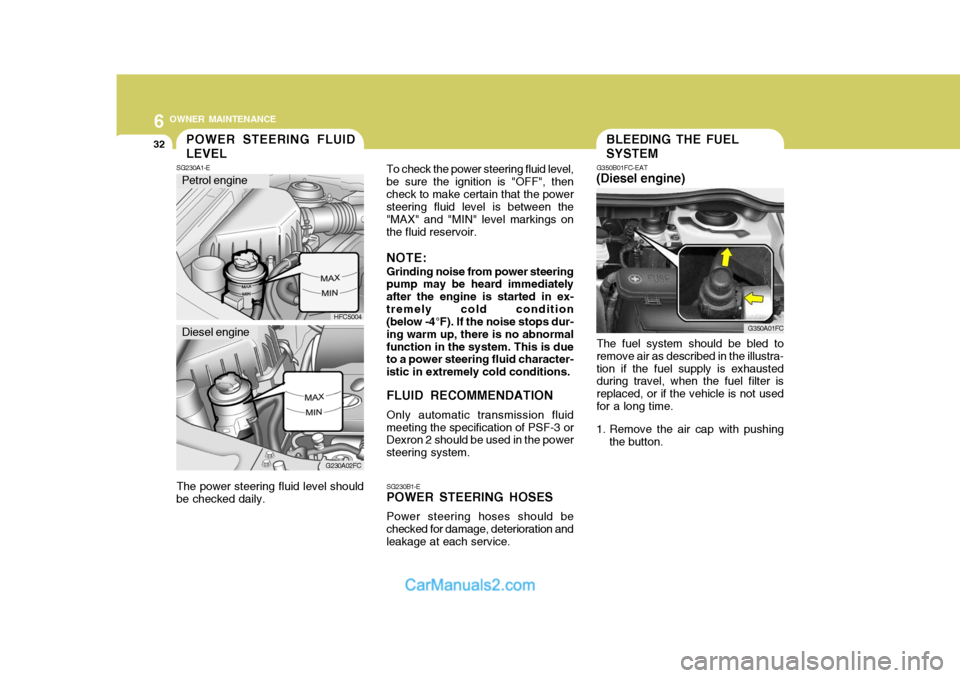
G350B01FC-EAT
(Diesel engine)
The fuel system should be bled to remove air as described in the illustra-tion if the fuel supply is exhausted during travel, when the fuel filter is replaced, or if the vehicle is not usedfor a long time.
1. Remove the air cap with pushing the button.
G350A01FC
BLEEDING THE FUEL SYSTEM
POWER STEERING FLUID LEVEL
SG230A1-E
HFC5004
G230A02FC
Petrol engine
Diesel engine
The power steering fluid level should
be checked daily. SG230B1-E
POWER STEERING HOSES
Power steering hoses should be
checked for damage, deterioration and leakage at each service. To check the power steering fluid level,
be sure the ignition is "OFF", thencheck to make certain that the power steering fluid level is between the "MAX" and "MIN" level markings onthe fluid reservoir.
NOTE: Grinding noise from power steering
pump may be heard immediately after the engine is started in ex-tremely cold condition (below -4°F). If the noise stops dur- ing warm up, there is no abnormalfunction in the system. This is due to a power steering fluid character- istic in extremely cold conditions. FLUID RECOMMENDATION
Only automatic transmission fluid
meeting the specification of PSF-3 or Dexron 2 should be used in the power steering system.
Page 473 of 490

7EMISSION CONTROL SYSTEMS
2EMISSION CONTROL SYSTEMS
SH010A1-E
(Not all models)
Depending upon the market for which
the vehicle is destined, the emission control system will comprise one or more of the following emission control devices.
(1) Crankcase emission control sys-
tem
(2) Evaporative emission control sys- tem
(3) Exhaust emission control system
In order that the proper functioning of
the emission control systems may be ensured, it is recommended that the vehicle is inspected and maintained by an Hyundai authorised repairer inaccordance with the maintenance schedule in this manual. SH010B1-E
1. Crankcase Emission Control
System
The positive crankcase ventilation
system is employed to prevent air pollution caused by blow-by gasesbeing emitted from the crankcase by introducing fresh air to the crankcase through the air cleaner where this mixeswith blow-by gases and then passes through the PCV valve into the intake manifold from where it subsequentlyenters the combustion chamber and is burned.
SH010C1-E
2. Evaporative Emission Control
System
The Evaporative Emission Control Sys-
tem is designed to prevent fuel vapours from escaping into the atmosphere through the fuel tank ventilation sys- tem. Whilst the engine is not running, fuel
vapours generated inside the fuel tankare absorbed and stored in a charcoal canister. When the engine is started, the vapours
stored in the canister are drawn intothe induction system through the purge control solenoid valve and are subse-quently burned. The purge control solenoid valve is
controlled by the ECU; when the en- gine coolant temperature is low or the engine is idling, the purge control valveis closed and fuel vapours remain stored in the canister. Under normal running conditions when the engine iswarm, the valve opens and the vapours are drawn into the inlet tract and sub- sequently burned in the combustionchamber.
SH010D1-E
3. Exhaust Emission Con Trol
System
The exhaust emission control system
is a highly effective system whichcontrols exhaust emission whilst main-taining good vehicle performance.