tire Hyundai Matrix 2006 Owner's Manual
[x] Cancel search | Manufacturer: HYUNDAI, Model Year: 2006, Model line: Matrix, Model: Hyundai Matrix 2006Pages: 490, PDF Size: 11.58 MB
Page 32 of 490

1FEATURES OF YOUR HYUNDAI
18
B090B01FC-GAT Folding Rear Seatback and Seat Cushion For greater convenience, the entire seatback and seat cushion may be folded down and up.
1. Move the rear seat to the rearmost
position.
2. Remove the headrests.
B090A02FC-GAT Adjustable Headrests (If installed) Headrests are designed to help reduce the risk of neck injuries. To raise the headrest, pull it up. To lower it, push it down while pressingthe lock knob.
Lock Knob
B090A01FC
!WARNING:
HFC2074
Seatback folding lever
o For maximum effectiveness in case
of an accident the headrest should be adjusted so the middle of the headrest is at the same height asthe top of the occupant's eyes. For this reason, the use of a cushion that holds the body away from theseatback should not be recom- mended.
o Do not operate vehicle with the headrests removed as injury tothe occupants may occur in the event of an accident. Headrestsmay provide protection against neck injuries when properly ad- justed.
B080D01JM
o Do not adjust the headrest hejght
while the vehicle is in motion.
Page 37 of 490
1
FEATURES OF YOUR HYUNDAI
23
B160B01A-AAT Periodic Inspection It is recommended that all seat belts be inspected periodically for wear ordamage of any kind. Parts of the sys- tem that are damaged should be re- placed as soon as possible.
B160A01A-AAT CARE OF SEAT BELTS Seat belt systems should never be disassembled or modified. In addition,care should be taken to assure that seat belts and belt hardware are not damaged by seat hinges, doors orother abuse.
!WARNING:
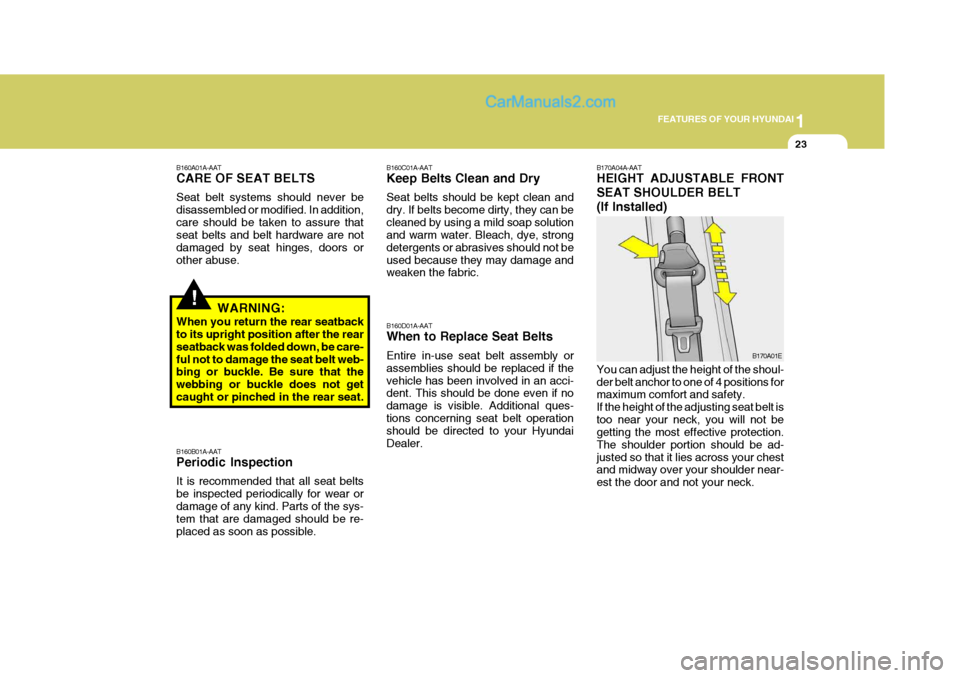
When you return the rear seatback to its upright position after the rear seatback was folded down, be care- ful not to damage the seat belt web- bing or buckle. Be sure that the webbing or buckle does not getcaught or pinched in the rear seat. You can adjust the height of the shoul-der belt anchor to one of 4 positions for maximum comfort and safety. If the height of the adjusting seat belt istoo near your neck, you will not be getting the most effective protection. The shoulder portion should be ad-justed so that it lies across your chest and midway over your shoulder near- est the door and not your neck.B170A01E
B170A04A-AAT HEIGHT ADJUSTABLE FRONT SEAT SHOULDER BELT(If Installed)
B160D01A-AAT When to Replace Seat Belts Entire in-use seat belt assembly or assemblies should be replaced if thevehicle has been involved in an acci- dent. This should be done even if no damage is visible. Additional ques-tions concerning seat belt operation should be directed to your Hyundai Dealer.
B160C01A-AAT Keep Belts Clean and Dry Seat belts should be kept clean and dry. If belts become dirty, they can becleaned by using a mild soap solution and warm water. Bleach, dye, strong detergents or abrasives should not beused because they may damage and weaken the fabric.
Page 56 of 490
1FEATURES OF YOUR HYUNDAI
42
B240C03Y-GAT SRS Care The SRS is virtually maintenance-free and there are no parts you can safelyservice by yourself. The entire SRS system must be inspected by an au- thorized Hyundai dealer 10 years afterthe date that the vehicle was manufac- tured. Any work on the SRS system, such as removing, installing, repairing, or any work on the steering wheel must beperformed by a qualified Hyundai tech- nician. Improper handling of the SRS system may result in serious personalinjury.
!WARNING:
o The side impact airbag is supple- mental to the driver's and the passenger's seat belt systems and is not a substitute for them. Your seat belts must be worn at alltimes while the vehicle is in mo- tion. The airbags deploy only in certain side impact conditionssevere enough to cause signifi- cant injury to the vehicle occu- pants.
o For best protection from the side
impact airbag system and toavoid being injured by the de- ploying side impact airbag, both front seat occupants should sitin an upright position with the seat belt properly fastened. The driver's hands should be placedon the steering wheel at the 9:00 and 3:00 o'clock positions. The passenger's arms and handsshould be placed on their laps.
o Do not use any accessory seat
covers. o Use of seat covers could reduce or
prevent the effectiveness of thesystem.
o Do not install any accessories on
the side or near the side impactairbag.
o Do not use excessive force on
the side of the seat.
o Do not place any objects over the airbag or between the airbag andyourself.
o Do not place any objects (an umbrella, bag, etc.) between thefront door and the front seat.Such objects may become dan- gerous projectiles and cause in- jury if the supplemental side im-pact air bag inflates.
o To prevent unexpected deploy-
ment of the side impact air bagthat may result in personal in- jury, avoid impact to the side airbag sensor when the ignitionkey is on.
Page 81 of 490

1
FEATURES OF YOUR HYUNDAI
67DRINK HOLDER
B450B02FC-GAT Rear drink holder (If Installed)
The rear drink holder is located on the rear main console for holding cups. The drink holder can be used by push- ing the knob on the rear main consoledownward and then releasing it. CAUTION:
Place the drink holder in its original position while not in use.
!
!
B450A02FC-GAT Front drink holder (If Installed) The front drink holder is used for hold- ing cups.To use the passenger's drink holder, push the drink holder and pull it en- tirely. HFC2097
Driver's Passenger's
WARNING:
o Use caution when using the drink holders. A spilled beverage that is very hot can injure you or your passengers. Spilled liquids candamage interior trim and electri- cal components.
o Do not place objects other than cups or cans in the drink holder. These objects can be thrown outin the event of a sudden stop or an accident, possibly injuring the pas- sengers in the vehicle.
HFC2098
Page 151 of 490
2
DRIVING YOUR HYUNDAI
3
!
TO START THE ENGINEBEFORE STARTING THE ENGINE
C020A01O-GAT Before you start the engine, you should always:
1. Look around the vehicle to be sure
there are no flat tires, puddles of oil, water or other indications of pos- sible trouble.
2. After entering the car, check to be sure the parking brake is engaged.
3. Check that all windows and lights are clean.
4. Check that the interior and exterior
mirrors are clean and in position.
5. Check your seat, seatback and headrest to be sure they are in theirproper positions.
6. Lock all the doors.
7. Fasten your seat belt and be sure
that all other occupants have fas- tened theirs.
8. Turn off all lights and accessories
that are not needed. C030A01A-GAT COMBINATION IGNITION SWITCH Before starting the engine:
o If your Hyundai is equipped with a
manual transaxle, place the shift lever in neutral and depress theclutch pedal fully.
o If your Hyundai has an automatic
transaxle, place the shift lever in "P"(park).
o To start the engine, insert the igni-
tion key and turn it to the "START"position. Release it as soon as the engine starts. Do not hold the key in the "START" position for more than15 seconds.
NOTE: For safety, the engine will not start if the shift lever is not in "P" or "N"Position (Automatic Transaxle).
WARNING: (DIESEL ENGINE)
To ensure that sufficient vacuum exists within the brake system dur- ing cold weather start-up condi-tions, it is necessary to run the engine at idle for several seconds after starting the engine.
9. When you turn the ignition switch to
"ON", check that all appropriatewarning lights are operating and that you have sufficient fuel.
10.Check the operation of warning lights and all bulbs when key is inthe "ON" position.
Page 162 of 490

2 DRIVING YOUR HYUNDAI
14BRAKE TRACTION CONTROL SYSTEM (BTCS)
o Driving on rough, gravel or snow-
covered roads.
o Driving with tire chains installed.
o Driving on roads where the road surface is pitted or has differentsurface height.
During these conditions, the ve-hicle should be driven at reducedspeeds. The safety features of an ABS (ESP) equipped vehicle should not be tested by high speed driving or cornering. This could endanger the safety of yourself or others. C300A01O-GAT (If Installed) On slippery road surfaces, the traction control system (TCS) limits the drivewheels from spinning excessively, thus helping the car to accelerate. It also provides sufficient driving force andsteering performance as the car turns at accelerated speeds. SLIP Control Limits the drive wheels from spinning excessively during starting or whilemaking accelerated turns on slippery roads to avoid losing the driving force of the front wheels. Driving hints TCS does not actively apply brakes. Be sure to decelerate the car suffi-ciently before entering curves.!
WARNING:
ABS (ESP) will not prevent accidents due to improper or dangerous driv- ing maneuvers. Even though vehicle control is improved during emer-gency braking, always maintain a safe distance between you and ob- jects ahead. Vehicle speeds shouldalways be reduced during extreme road conditions. The braking distance for cars equipped with an anti-lock braking system may be longer than for thosewithout it in the following road con- ditions.
Page 164 of 490

2 DRIVING YOUR HYUNDAI
16
!
input can all affect whether ESP will be effective in preventing a loss of con-trol. It is still your responsibility to drive and corner at reasonable speeds and to leave a sufficient margin of safety.
CAUTION:
Driving with varying tire or wheelsize may cause the ESP system to malfunction. When replacing tires, make sure they are the same size asyour original tires.
WARNING:
Electronic stability program is onlya driving aid; all normal precau-tions for driving in inclement weather and on slippery road sur- faces should be observed.
!
ELECTRONIC STABILITY PROGRAM (ESP)
C310A01JM-AAT (If installed) The Electronic Stability Program (ESP) system is designed to stabilize thevehicle during cornering manuevers. ESP checks where you are steering and where the vehicle is actually go-ing. ESP applies the brakes at indi- vidual wheels and intervenes in the engine management system to stabi-lize the vehicle. The Electronic Stability Program (ESP) system is an electronic system de- signed to help the driver maintain ve- hicle control under adverse conditions.It is not a substitute for safe driving practices. Factors including speed, road conditions and driver steering C310A01FC
C310B01JM-AAT ESP ON/OFF Mode When the ESP is operating, the ESP indicator in the instrument cluster willblink. If you turn the system off by pressing the ESP switch, the ESP-OFF indica-tor will come on and stay on. In the ESP-OFF mode, the stability control will be deactivated. Adjust your drivingaccordingly. To turn the system back on, press the switch again. The ESP- OFF indicator should go off. NOTE: The ESP mode will automatically be turned ON after the engine isturned off and restarted.
Page 165 of 490

2
DRIVING YOUR HYUNDAI
17
!WARNING:
Nothing should be carried on top of the shelf panel behind the rear seat. If there were an accident or a sud- den stop, such objects could moveforward and cause damage to the vehicle or injure the occupants.
o After being parked, check to be sure the parking brake is not engaged and that the parking brake indicator light is out before driving away.
o Driving through water may get the brakes wet. They can also get wet when the car is washed. Wet brakescan be dangerous! Your car will not stop as quickly if the brakes are wet. Wet brakes may cause the car topull to one side. To dry the brakes, apply the brakes lightly until the braking action returns to normal,taking care to keep the car under control at all times. If the braking action does not return to normal,stop as soon as it is safe to do so and call your Hyundai dealer for assistance.
C310D01JM-AAT Indicators and Warning The indicators should illuminate when the ignition key is turned to ON orSTART but should go out after three seconds. If the indicators do not illuminate, orthe ESP or ESP-OFF indicator does not go out after 3 seconds, have the vehicle checked by an authorizeddealer. Should there be any unusual condi- tions in the device while driving, ESP- OFF indicator illuminates as a warn- ing.If ESP-OFF indicator illuminates, pull your car to a safe place and stop the engine.Then, start the engine again to check if the ESP-OFF indicator goes out. If the indicator remains lit even after the engine has been started, have your car checked by an authorizedHyundai dealer.
GOOD BRAKING PRACTICES
C130A01A-AAT o Don't coast down hills with the car
out of gear. This is extremely haz- ardous. Keep the car in gear at all times, use the brakes to slow down,then shift to a lower gear so that engine braking will help you main- tain a safe speed.
o Don't "ride" the brake pedal. Rest- ing your foot on the brake pedalwhile driving can be dangerous be-cause it can result in the brakes overheating and losing their effec- tiveness. It also increases the wearof the brake components.
o If a tire goes flat while you are
driving, apply the brakes gently and keep the car pointed straight ahead while you slow down. When you aremoving slowly enough for it to be safe to do so, pull off the road and stop in a safe place.
o If your car is equipped with an auto- matic transaxle, don't let your carcreep forward. To avoid creepingforward, keep your foot on the brake pedal when the car is stopped.
o Use caution when parking on a hill. Engage the parking brake and placethe gear selector lever in "P" (auto- matic transaxle) or in first or reversegear (manual transaxle).
Page 166 of 490
2 DRIVING YOUR HYUNDAI
18
your foot resting on the brake pedal may cause the brakes to overheat,which reduces their effectiveness and may lead to more serious con- sequences.
o Take care of your tires. Keep them inflated to the recommended pres-sure. Incorrect inflation, either toomuch or too little, results in unnec- essary tire wear. Check the tire pres- sures at least once a month.
o Be sure that the wheels are aligned correctly. Improper alignment canresult from hitting curbs or drivingtoo fast over irregular surfaces. Poor alignment causes faster tire wear and may also result in other prob-lems as well as greater fuel con- sumption.
o Keep your car in good condition. For better fuel economy and reducedmaintenance costs, maintain your car in accordance with the mainte-nance schedule in Section 5. If you drive your car in severe conditions, more frequent maintenance is re-quired (see Section 5 for details).DRIVING FOR ECONOMY
C140A02A-AAT You can save fuel and get more kilo- meters from your car if you follow these suggestions:
o Drive smoothly. Accelerate at a moderate rate. Don't make "jack- rabbit" starts or full-throttle shiftsand maintain a steady cruising speed. Don't race between stop- lights. Try to adjust your speed tothat of the other traffic so you don't have to change speeds unneces- sarily. Avoid heavy traffic wheneverpossible. Always maintain a safe distance from other vehicles so you can avoidunnecessary braking. This also re- duces brake wear.
o Drive at a moderate speed. The faster you drive, the more fuel yourcar uses. Driving at a moderate speed, especially on the highway, isone of the most effective ways to reduce fuel consumption.
o Don't "ride" the brake or clutch pedal. This can increase fuel consumptionand also increase wear on these components. In addition, driving with
If your car is facing downhill, turn thefront wheels into the curb to helpkeep the car from rolling. If your car is facing uphill, turn the front wheels away from the curb to help keep thecar from rolling. If there is no curb or if it is required by other conditions to keep the car fromrolling, block the wheels.
o Under some conditions your park-
ing brake can freeze in the engagedposition. This is most likely to hap- pen when there is an accumulation of snow or ice around or near therear brakes or if the brakes are wet. If there is a risk that the parking brake may freeze, apply it only tem-porarily while you put the gear se- lector lever in "P" (automatic) or in first or reverse gear (manualtransaxle) and block the rear wheels so the car cannot roll. Then release the parking brake.
o Do not hold the vehicle on the up- grade with the accelerator pedal.This can cause the transmission tooverheat. Always use the brake pedal or parking brake.
Page 167 of 490

2
DRIVING YOUR HYUNDAI
19
o Keep your car clean. For maximum service, your Hyundai should be kept clean and free of corrosive materials. It is especially important that mud, dirt, ice, etc. not be al-lowed to accumulate on the under- side of the car. This extra weight can result in increased fuel con-sumption and also contribute to cor- rosion.
o Travel lightly. Don't carry unneces- sary weight in your car. Weight re-duces fuel economy.
o Don't let the engine idle longer than necessary. If you are waiting (andnot in traffic), turn off your engine and restart only when you're readyto go.
o Remember, your Hyundai does not
require extended warm-up. After theengine has started, allow the engine to run for 10 to 20 seconds prior to placing the vehicle in gear. In verycold weather, however, give your engine a slightly longer warm-up pe- riod. o Don't "lug" or "over-rev" the engine.
Lugging is driving too slowly in toohigh a gear resulting in the engine bucking. If this happens, shift to a lower gear. Over-revving is racingthe engine beyond its safe limit. This can be avoided by shifting at the recommended speeds.
o Use your air conditioning sparingly. The air conditioning system is oper-ated by engine power so your fueleconomy is reduced when you use it.SMOOTH CORNERING
C150A01A-AAT Avoid braking or gear changing in cor- ners, especially when roads are wet. Ideally, corners should always be taken under gentle acceleration. If you followthese suggestions, tire wear will be held to a minimum.