brakes Hyundai Matrix 2007 User Guide
[x] Cancel search | Manufacturer: HYUNDAI, Model Year: 2007, Model line: Matrix, Model: Hyundai Matrix 2007Pages: 490, PDF Size: 12.81 MB
Page 169 of 490

2
DRIVING YOUR HYUNDAI
23TRAILER OR VEHICLE TOWING
C190A02A-GAT If you are considering towing with your car, you should first check with your Province Department of Motor Vehicles to determine their legal requirements.Since laws vary from province to prov- ince, the requirements for towing trail- ers, cars, other types of vehicles, orapparatus may differ. Ask your Hyundai dealer for further details before towing.
CAUTION:
Do not do any towing with your car during its first 2,000 km (1,200 miles) in order to allow the engine to prop- erly break in. Failure to heed thiscaution may result in serious en- gine or transaxle damage.
! C190B01S-AAT Trailer Hitches Select the proper hitch and ball combi- nation, making sure that it's location iscompatible with that of the trailer or vehicle being towed. Use a quality non-equalizing hitch whichdistributes the tongue load uniformly throughout the chassis. The hitch should be bolted securely to the car and installed by a qualified technician. DO NOT USE A HITCHDESIGNED FOR TEMPORARY IN- STALLATION AND NEVER USE ONE THAT ATTACHES ONLY TO THEBUMPER. C190C04S-GAT Trailer Brakes If your trailer is equipped with a braking system, make sure it conforms to fed-eral and/or local regulations and that it is properly installed and operating cor- rectly. NOTE: If you tow a trailer or vehicle, your car will require more frequent main- tenance due to the additional load.See "Maintenance Under Severe Usage Conditions" on page 5-7.
CAUTION:
o Never connect a trailer brake sys- tem directly to the vehicle brakesystem.
o When towing a trailer on steep grades (in excess of 6%) pay close attention to the engine coolanttemperature gauge to ensure the engine does not overheat. If the needle of the coolant temperaturegauge moves across the dial to- wards "H" (HOT), pull over and stop as soon as it is safe to do so,and allow the engine to idle until it cools down. You may proceed once the engine has cooled suffi-ciently.
!
Page 172 of 490

2 DRIVING YOUR HYUNDAI
26
CAUTION:
If overheating should occur when towing, (temperature gauge reads near the red zone), taking the follow- ing actions may reduce or eliminatethe problem.
1. Turn off the air conditioner.
2. Reduce highway speed.
3. Select a lower gear when going uphill.
4. While in stop and go traffic, place the gear selection in park or neu- tral and idle the engine at a higherspeed.
!
8. When parking your vehicle and
trailer, especially on a hill, be sure to follow all the normal precautions. Turn your front wheel into the curb, set the parking brake firmly, and putthe transaxle in 1st or Reverse (manual) or Park (automatic). In addition, place wheel chocks ateach of the trailer's tires.
9. If the trailer has electric brakes,
start your vehicle and trailer mov-ing, and then apply the trailer brake controller by hand to be sure the brakes are working. This lets youcheck your electrical connection at the same time.
10.During your trip, check occasion- ally to be sure that the load issecure, and that the lights and any trailer brakes are still working.
11.Avoid jerky starts, sudden accel- eration or sudden stops.
12.Avoid sharp turns and rapid lane changes.
13.Avoid holding the brake pedal down
too long or too frequently. This couldcause the brakes to overheat, re- sulting in reduced braking efficiency. 14. When going down a hill, shift into a
lower gear and use the engine brak- ing effect. When ascending a long grade, downshift the transaxle to a lowergear and reduce speed to reduce chances of engine overloading and/ or overheating.
15.If you have to stop while going uphill, do not hold the vehicle inplace by pressing on the accelera-tor. This can cause the automatic transaxle to overheat. Use the park- ing brake or footbrake.
NOTE: When towing check transaxle fluid more frequently.
Page 179 of 490
3
WHAT TO DO IN AN EMERGENCY
7IF YOU HAVE A FLAT TIRE
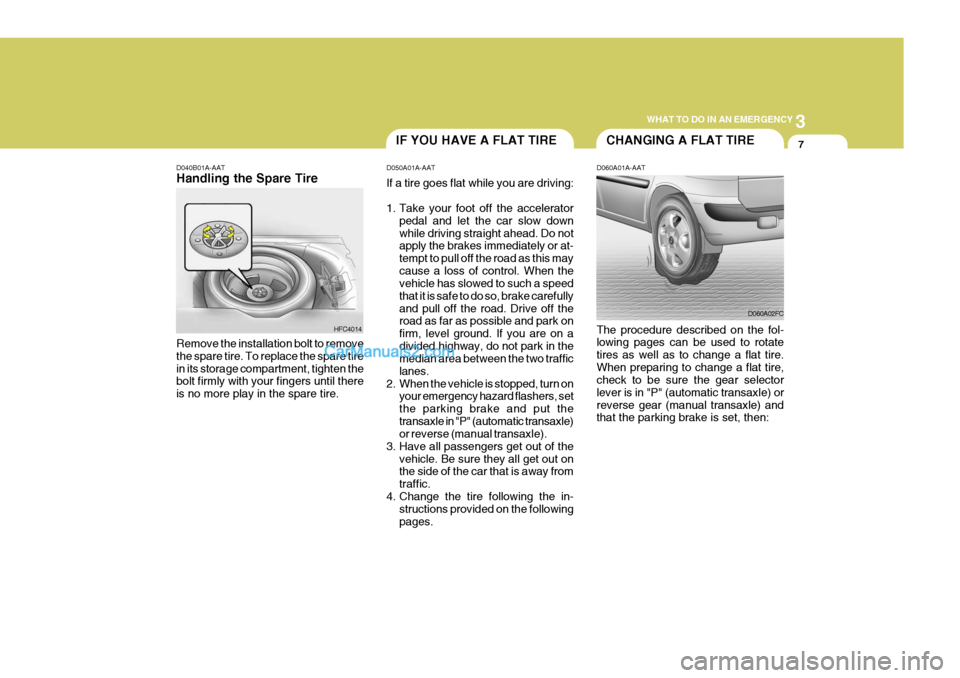
D040B01A-AAT Handling the Spare Tire
Remove the installation bolt to remove the spare tire. To replace the spare tirein its storage compartment, tighten the bolt firmly with your fingers until there is no more play in the spare tire. D050A01A-AAT If a tire goes flat while you are driving:
1. Take your foot off the accelerator
pedal and let the car slow down while driving straight ahead. Do not apply the brakes immediately or at- tempt to pull off the road as this maycause a loss of control. When the vehicle has slowed to such a speed that it is safe to do so, brake carefullyand pull off the road. Drive off the road as far as possible and park on firm, level ground. If you are on adivided highway, do not park in the median area between the two traffic lanes.
2. When the vehicle is stopped, turn on your emergency hazard flashers, setthe parking brake and put thetransaxle in "P" (automatic transaxle) or reverse (manual transaxle).
3. Have all passengers get out of the vehicle. Be sure they all get out onthe side of the car that is away from traffic.
4. Change the tire following the in- structions provided on the followingpages.
HFC4014CHANGING A FLAT TIRE
D060A01A-AAT The procedure described on the fol- lowing pages can be used to rotate tires as well as to change a flat tire.When preparing to change a flat tire, check to be sure the gear selector lever is in "P" (automatic transaxle) orreverse gear (manual transaxle) and that the parking brake is set, then: D060A02FC
Page 186 of 490

3 WHAT TO DO IN AN EMERGENCY
14
NOTE: Before towing, check the level of the automatic transaxle fluid. If it is be- low the "HOT" range on the dipstick,add fluid. If you cannot add fluid, a towing dolly must be used.
!
EMERGENCY TOWING
D080D04A-AAT
For emergency towing when no com- mercial tow vehicle is available, attach a tow cable, chain or strap to one of thetowing hooks under the front/rear of your vehicle. Do not attempt to tow your vehicle in this manner on any unpavedsurface. This could result in serious damage to your vehicle. Nor should towing be attempted if thewheels, drive train, axles, steering or brakes are damaged. Before towing, be sure the transaxle is in neutral andthe key is in "ACC" (with the engine off) or in the "ON" position (with the engine running). A driver must be in the towedvehicle to steer it and operate the brakes. D080D04FC
HFC006
!
o Automatic Transaxle:
Be sure to use a towing dolly under the front wheels.
CAUTION:
A vehicle with an automatic transaxleshould never be towed from the rearwith the front wheels on the ground. This can cause serious damage to the transaxle.
3) It is recommended that your vehicle be towed with all the wheels off the ground. Front
Rear CAUTION:
If the car is being towed with all fourwheels on the ground, it can be towed only from the front. Be sure that the transaxle is in neutral. Do not tow at speeds greater than 50km/h (30 mph) and for more than 25 km (15 miles). Be sure the steering is unlocked byplacing the key in the "ACC" posi- tion. A driver must be in the towed vehicle to operate the steering andbrakes.
Page 200 of 490
5
VEHICLE MAINTENANCE REQUIREMENTS
7
ENGINE AND FILTER (GASOLINE)
ENGINE OIL AND FILTER
(DIESEL)AIR CLEANER FILTER SPARK PLUGS TIMING BELTBRAKE PADS, CALIPERS AND ROTORSREAR BRAKE DRUMS/LININGS/PADS, PARKING BRAKESTEERING GEAR RACK, LINKAGE & BOOTS/LOWER ARM BALL JOINT DRIVESHAFTS & BOOTSMANUAL TRANSAXLE OILAUTOMATIC TRANSAXLEFLUIDAIR CONDITIONER FILTER (IN FRONT OF BLOWER UNIT) A, B, C, D, E, F, G, H, I, K A, B, C, F, H, I, J C, E B, H D, E, F, GC, D, G, HC, D, G, H C, D, E, F, G C, D, E, G A, C, D, E, F, G, H, I, J A, C, E, F, G, H, I C, E
R R R RR
II I I
RR R DRIVING
CONDITION
EVERY 7,500 KM OR 6 MONTHS EVERY 7,500 KM OR 6 MONTHSEVERY 5,000 KM OR 6 MONTHSMORE FREQUENTLYMORE FREQUENTLYEVERY 60,000 KM OR 48 MONTHS MORE FREQUENTLY MORE FREQUENTLY MORE FREQUENTLY EVERY 15,000 KM OR 12 MONTHS EVERY 100,000 KMEVERY 45,000 KMEVERY 40,000 KM MORE FREQUENTLY MAINTENANCE INTERVALS
European Community Only Except European Community
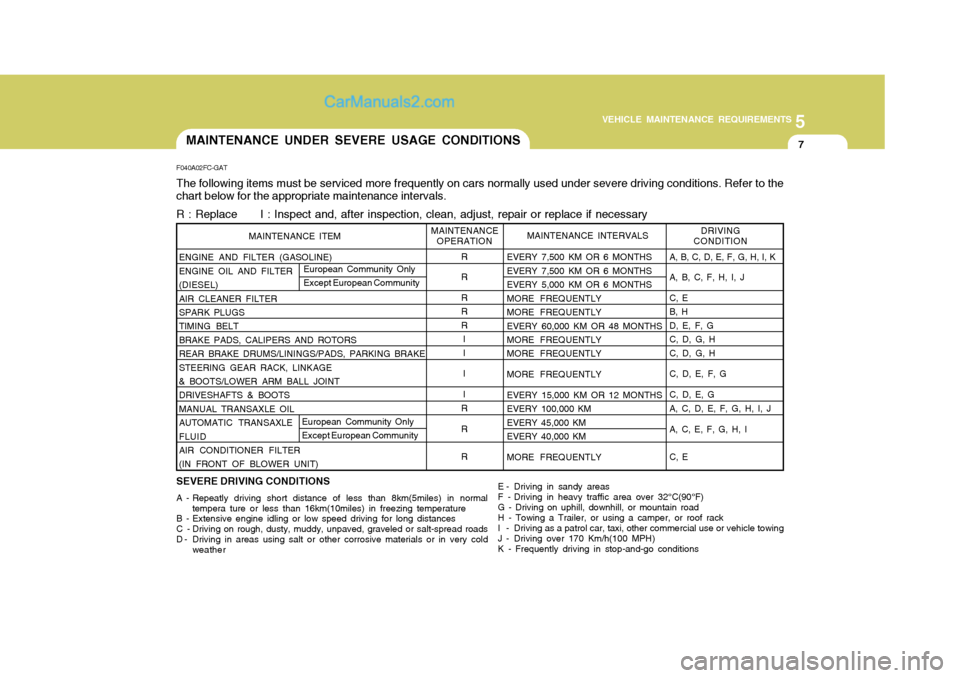
F040A02FC-GAT The following items must be serviced more frequently on cars normally used under severe driving conditions. Refer to the chart below for the appropriate maintenance intervals. R : Replace I : Inspect and, after inspection, clean, adjust, repair or replace if necessary
SEVERE DRIVING CONDITIONS
A - Repeatly driving short distance of less than 8km(5miles) in normal
tempera ture or less than 16km(10miles) in freezing temperature
B - Extensive engine idling or low speed driving for long distances
C - Driving on rough, dusty, muddy, unpaved, graveled or salt-spread roads
D - Driving in areas using salt or other corrosive materials or in very cold weather
MAINTENANCEOPERATION
MAINTENANCE ITEM
E - Driving in sandy areas
F - Driving in heavy traffic area over 32°C(90°F) G - Driving on uphill, downhill, or mountain road H - Towing a Trailer, or using a camper, or roof rack
I - Driving as a patrol car, taxi, other commercial use or vehicle towing
J - Driving over 170 Km/h(100 MPH)K - Frequently driving in stop-and-go conditions
MAINTENANCE UNDER SEVERE USAGE CONDITIONS
European Community Only Except European Community
Page 205 of 490
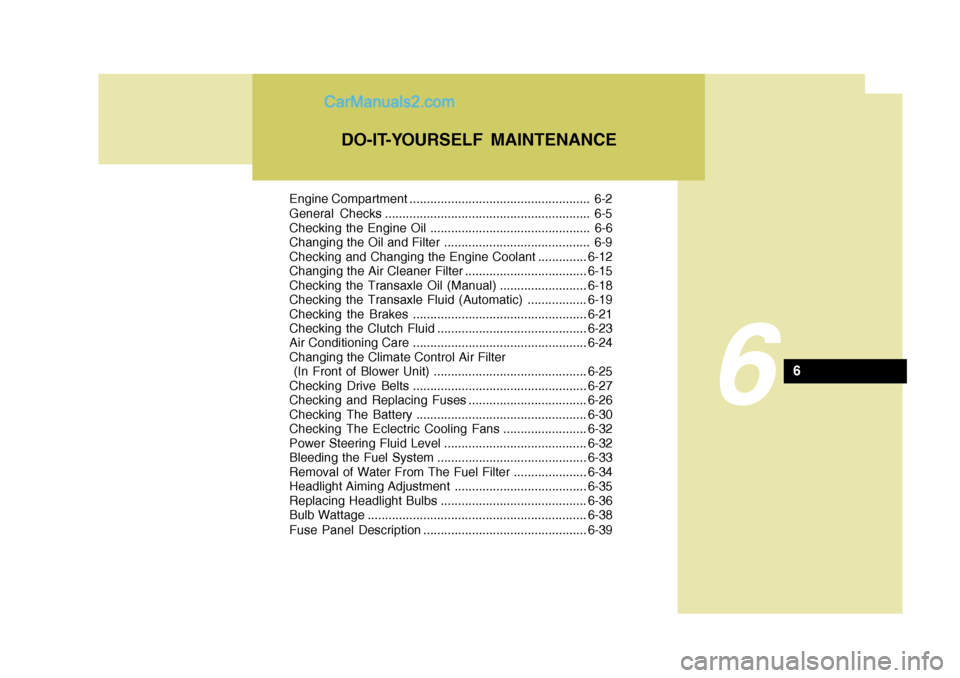
Engine Compartment .................................................... 6-2
General Checks ........................................................... 6-5
Checking the Engine Oil .............................................. 6-6
Changing the Oil and Filter .......................................... 6-9
Checking and Changing the Engine Coolant..............6-12
Changing the Air Cleaner Filte r ...................................6-15
Checking the Transaxle Oil (Manual) ......................... 6-18
Checking the Transaxle Fluid (Automatic) .................6-19
Checking the Brakes .................................................. 6-21
Checking the Clutch Fluid ........................................... 6-23
Air Conditioning Care .................................................. 6-24
Changing the Climate Control Air Filter
(In Front of Blower Unit) ............................................ 6-25
Checking Drive Belts .................................................. 6-27
Checking and Replacing Fuses ..................................6-26
Checking The Battery ................................................. 6-30
Checking The Eclectric Cooling Fans ........................6-32
Power Steering Fluid Level ......................................... 6-32
Bleeding the Fuel System ........................................... 6-33
Removal of Water From The Fuel F ilter..................... 6-34
Headlight Aiming Adjustment ...................................... 6-35
Replacing Headlight Bulbs .......................................... 6-36
Bulb Wattage ............................................................... 6-38
Fuse Panel Descripti on ............................................... 6-39
DO-IT-YOURSELF MAINTENANCE
6
6
Page 224 of 490

6 DO-IT-YOURSELF MAINTENANCE
20
C090A01FC
G110D03A-GAT
To Check the Transaxle Fluid Level
Park the car on level ground with the
parking brake engaged. When the transaxle fluid level is checked, the transaxle fluid should be at normaloperating temperature and the en- gine idling. While the engine is idling, apply the
brakes and move the gear selector lever from "P" to each of its other positions -- "R", "N", "D", "2", "L" -- and then return to "N" or "P". With theengine still idling:
1. Open the hood, being careful to keep hands, long hair and clothing clear of any moving parts.
2. Remove the transaxle dipstick, wipe it clean, reinsert the dipstick as faras it will go, then remove it again.Now check the fluid level on the dipstick. It should be in the "HOT" range on the dipstick. HFC5008
!
G110C01FC-GAT
Transaxle Fluid Capacity
The fluid capacity of the automatic
transaxle is 6.1 liters (1.6 DOHC)/6.7 liters (1.8 DOHC).
WARNING:
The transaxle fluid level should be
checked when the engine is at normal operating temperature. Thismeans that the engine, radiator, exhaust system etc., are very hot. Exercise great care not to burnyourself during this procedure.
Page 225 of 490

6
DO-IT-YOURSELF MAINTENANCE
21
!
!
CHECKING THE BRAKES
G120A01A-AAT
! CAUTION:
Because brakes are essential to the safe operation of the car, it issuggested that they be checked and inspected by your Hyundai dealer. The brakes should bechecked and inspected for wear at those intervals specified in the vehicle maintenance schedule inSection 5.
WARNING (Diesel only):
Never work on injection system
with engine running or within 30 seconds after shutting off engine. High pressure pump, rail, injec-tors and high pressure pipes are subject to high pressure even af- ter the engine stopped. The fuel jetproduced by fuel leaks may cause serious injury, if it touch the body. People using pacemakers shouldnot move than 30cm closer to the ECU or wiring harness within the engine room while engine is run-ning, since the high currents in the Common Rail system produce considerable magnetic fields.
WARNING:
The cooling fan is controlled byengine coolant temperature andmay sometimes operate even when the engine is not running. Use extreme caution when workingnear the blades of the cooling fan so that you are not injured by a rotating fan blade. As the enginecoolant temperature decreases, the fan will automatically shut off. This is a normal condition.Fluid level should be within this range
3. If the transaxle fluid level is low, use a funnel to add transaxle fluid through the dipstick tube until the level reaches the "HOT" range. Do not overfill. C090A03FC
Page 263 of 490

10INDEX
2
A Accessory Tray ......................................................... 1-72
Air Bag ...................................................................... 1-37
Air Cleaner Filter ........................................................ 6-15
Air Conditioning
Care ........................................................................ 6-24
Operation ................................................................ 6-24
Switch ..................................................................... 1-89
Air Conditioner Filter .................................................. 1-99
Antenna ................................................................... 1-133
Ashtray ...................................................................... 1-66
Audio System .......................................................... 1-102
Auto Fuel Cut Switch ................................................ 1-82
BBattery .............................................................. 2-21, 6-32
Bleeding The Fuel System ........................................ 6-33
Brake Anti-lock system ..................................................... 2-13
Brake traction control system ................................ 2-14
Checking the brakes ............................................... 6-21
Fluid ........................................................................ 6-22
Pedal clearance ...................................................... 6-27
Pedal free play ....................................................... 6-27
Practices ................................................................ 2-17
Brake Pad Wear Warning Sound ............................... 1-53
Brake Traction Control System ................................. 2-14
Breaking-In your new Hyundai ..................................... 1-3
Bulbs W attage ........................................................... 6-38C
Care of Cassette Tapes ..........................................
1-132
Care of Disc ............................................................ 1-131
Cargo Area Cover ...................................................... 1-81
Cassette Tape Player Operation (H220, H280) ................ .
.................................................................. 1-108, 1-122
Catalytic Converter ...................................................... 7-3
CD Auto changer ....................................................... 1-79
CD Auto Changer (H260, H280) ....................1-116, 1-127
Child-Protector Rear Door Lock ................................... 1-9
Child Restraint System ................................... 1-28 ~ 1-34
Cigarette Lighter ........................................................ 1-65
Clutch
Checking fluid ........................................................ 6-23
Pedal free play ...................................................... 6-26
Combination Light Headlight flasher ..................................................... 1-60
Headlight swi tch ..................................................... 1-59
High-beam switch ................................................... 1-60
Lane change si gnal ................................................. 1-59
Turn signal operation .............................................. 1-59
Compact Disc Player Operation (H260, H280) ................ .
.................................................................. 1-113, 1-124
Cooling Fans ............................................................. 6-32
Corrosion Protection
Cleaning the interior .................................................. 4-5
Protecting your Hyundai from corrosion ................... 4-2
Washing and waxing ................................................. 4-4
Page 349 of 490

1CONTROLS AND EQUIPMENT
70FOLD-UP TRAY
B570A01FC-EAT Pull the release lever inside the vehicle to unlatch the bonnet. At the front of the vehicle, push the safety catch lever sidewards as shown and raise the bon-net by hand. Support the bonnet by means of the bonnet prop. Before closing the bonnet, ensure thatthe prop is correctly stowed. Lower the bonnet by hand to a position of approxi- mately 30cm from the closed positionand allow the bonnet to drop. Do not attempt to close the bonnet by lowering the panel to the closed position andpressing upon the panel work since this may result in damage to the panel.BONNET RELEASE
HIGH-MOUNTED REAR STOP LIGHT
B550A01S-EAT In addition to the lower-mounted rear stoplights on either side of the car, the high mounted rear stoplight in the cen- tre of the rear window or inserted in therear spoiler also lights when the brakes are applied. B550A02FC
B810A01FC-GAT
For your convenience, it may be used as a table holding a book, cup or can.
!WARNING:
To avoid the possibility of injury in case of an accident or a sudden stop,the fold-up tray should be place its original position whilst the vehicle is moving. HFC2070
HFC2018-D
fcuk-1.p65
12/27/2006, 10:12 AM
70