trailer Hyundai Matrix 2007 User Guide
[x] Cancel search | Manufacturer: HYUNDAI, Model Year: 2007, Model line: Matrix, Model: Hyundai Matrix 2007Pages: 490, PDF Size: 12.81 MB
Page 375 of 490

2
Before Starting the Engine ........................................... 2-3
Key Positions ................................................................ 2-4Starting......................................................................... 2-5
Manual Transaxle ......................................................... 2-8Automatic Transaxle .................................................... 2-10
Anti-Lock Brake System (ABS) ................................... 2-14
Brake Traction Control System (BTCS) ...................... 2-14
Electronic Stability Program (ESP) ..............................2-16
Driving for Economy .................................................... 2-18
Smooth Cornering ........................................................ 2-19
Winter Motoring ............................................................ 2-19
Trailer and Caravan Towing .......... ..............................2-21
DRIVING YOUR HYUNDAI
2
fcuk-2.p65
12/27/2006, 10:14 AM
1
Page 391 of 490

2
DRIVING YOUR HYUNDAI
17
C310D01JM-EAT Indicators and Warning The indicators should illuminate when the ignition key is turned to ON orSTART but should go out after approxi- mately 3 seconds. If the indicators do not illuminate, or theESP or ESP-OFF indicator does not go out after approximately 3 seconds, have the vehicle checked by Hyundaiauthorised repairer. Should there be any unusual conditions in the device whilst driving, ESP-OFF indicator illuminates as a warning. If ESP-OFF indicator illuminates, pullyour car to a safe place and stop the engine. Then, start the engine again to check ifthe ESP-OFF indicator goes out. If the indicator remains lit even after the engine has been started, have your car checked by Hyundai authorised repairer.EFFECTIVE BRAKING
SC140A2-E Braking system performance and fric- tion material life are greatly affected by the driving style adopted. The following suggestions are made to assist inachieving the best results from the braking system.
o Anticipate the road and conditions ahead in order that heavy braking may be avoided.
o When descending long gradients, use the engine to assist in retarding thevehicle to minimize the possibility of brake fade occurring.
o When trailer towing, ensure that the trailer brakes function correctly anduse engine braking to assist thevehicle braking system.
o Use only genuine Hyundai replace-
ment brake pads and shoes to en-sure consistent friction characteris- tics and wear rates.
o After driving through deep water (e.g. fording), the brakes may become wetand performance reduced. Always check brake efficiency after emerg-ing from the water and dry the brakes by lightly depressing the brake pedal several times whilst driving slowly. o Apply the parking brake only when
the vehicle is at rest.
o Since the power assistance provided by the brake servo is derived fromthe engine, coasting with the engineturned off or towing of the vehicle with the engine turned off will result in greatly increased pedal pressuresbeing required to stop the vehicle.
o Do not hold the vehicle on an incline
with the accelerator pedal. This cancause the transmission to overheat. Always use the brake pedal or park- ing brake.
o Use caution when parking on a hill. Engage the parking brake and placethe gear selector lever in "P" (auto-matic transaxle) or in first or reverse gear (manual transaxle). If your car is facing downhill, turn the frontwheels into the curb to help keep the car from rolling. If your car is facing uphill, turn the front wheels awayfrom the curb to help keep the car from rolling. If there is no curb or if it is required by other conditions tokeep the car from rolling, block the wheels.
fcuk-2.p65 12/27/2006, 10:14 AM
17
Page 395 of 490

2
DRIVING YOUR HYUNDAI
21
o When driving in extreme conditions,
the windscreen wiper blades may fail to clear the screen properly due to the formation of ice upon the bladeedge. It will therefore be necessary to periodically remove such ice to restore their efficiency.
o If the power operated door mirrors become frozen, attempts to adjust
TRAILER AND CARAVAN TOWING
!
C190E01FC-EAT
WARNING:
It is not recommended that the ve- hicle be used for towing until the first 1,000 miles of Running in has beencompleted. All Hyundai MATRIX models are suited to towing trailers and caravans up to the limits indi-cated on page 2-23. MATRIX models fitted with automatic transaxle have a transaxle oil cooler and furthertransaxle cooling should not be re- quired. Nose weight
C190E01L
Total trailer weight
these may damage the mechanism.
o The formation of snow or ice built up
inside the wheel arches may inter-fere with the road wheels or steering mechanism. In such instances, un-usual noises or an increase in steer- ing effort may result. Therefore, en- sure that the wheel arches arechecked periodically and any accu- mulated snow or ice removed.
o It is advisable to carry emergency equipment including, torch, shovel,tow rope, blankets etc., if a journey is to be undertaken into areas of severeroad conditions.
fcuk-2.p65 12/27/2006, 10:14 AM
21
Page 396 of 490

2 DRIVING YOUR HYUNDAI
22
SC200B3-E TOWING ATTACHMENTS It is strongly recommended that only an Hyundai Approved towing attachmentis used to ensure that the loads placed upon the body structure are correctly distributed. The use of a non approvedattachment will result in the invalidation of the vehicle warranty. Hyundai towing attachments are designed and con-structed to ensure maximum towing performance and ease of fitment. A range of accessories including electri-cal kits are available through the Hyundai authorised repairer network. It is of the utmost importance that those areas of the vehicle which are sub- jected to greater stress during towing are maintained in accordance with therecommendations given at the end of this book. In addition, the daily operat- ing checks relating to engine oil, trans-mission oil and tyres must be per- formed at each refuelling to ensure maximum reliability and safety.The use of a proprietary stabiliser will assist in achieving an inherently stable outfit but whilst the use of such equip-ment will improve the characteristics of a balanced outfit, it will not compensatefor a badly loaded and therefore un-stable outfit. The tyres and braking equipment fitted to the trailer or caravan must be main-tained in accordance with the recom- mendations of the manufacturer. Spe- cial attention should be paid to tyreswhich deteriorate through time and ex- posure rather than as a result of the distances towed. The inside walls ofthe tyres should be inspected along with the outside walls for cracking and damage. The trailer wheel nut torquemust be checked on a regular basis, preferably before each towing session. The trailer hitch and the safety catch mechanism must be maintained in good working order. The trailer break away cable or chain should be inspected fordamage and should be attached to the vehicle towing attachment each and every time the trailer is hitched to thevehicle. Whilst towing, the performance of the vehicle will be reduced in terms ofacceleration, braking and handling due
to the increased loads placed upon thevehicle. The driver should anticipatethe change in characteristics and ad- just the driving style in keeping with these changes. Care should be exer-cised when cornering and braking to prevent the outfit becoming uncontrol- lable by reducing cornering speeds andallowing increased braking distances. The driver should exercise care to en- sure that when pulling away from restparticularly on uphill gradients the clutch unit is not subjected to excessive slip- page which will reduce the useful life ofthis component. Use of the "Overdrive Off" "2" and "L" positions when driving vehicles with automatic transmissionwill assist with braking performance when long down hill gradients are en- countered. Improved acceleration per-formance will be available by selecting "Overdrive Off","2", or "1" depending upon road speed if it is found that thetransmission unit makes an undesir- able upshift whilst hill climbing or over- taking. The transmission unit should beoperated in "D" with the Overdrive "On" under normal circumstances to enhance fuel economy and reduce noise andengine wear.
fcuk-2.p65
12/27/2006, 10:14 AM
22
Page 397 of 490

2
DRIVING YOUR HYUNDAI
23
!
NOTE:
o The total gross vehicle weight with trailer must not exceed the Gross Vehicle Weight Rating (GVWR)shown on the vehicle identifica- tion plate (see page 8-2). The total gross vehicle weight is the com-bined weight of the vehicle, driver, all passengers and their luggage, cargo, hitch, trailer nose weightand other optional equipment. o The front or rear axle weight must
not exceed the Gross Axle WeightRating (GAWR) shown on the ve- hicle identification plate (see page 8-2). It is possible that your towingpackage does not exceed the GVWR but exceeds the GAWR. Improper trailer loading and/or toomuch luggage in the boot can overload the rear axle. Redistrib- ute the load and check the axleweight again.
o The maximum permissible static
vertical load on the coupling de-vice : 52kg
Gross Axle Weight
C190E02L
Gross Vehicle Weight o The maximum permissible over-
hang of the coupling point : 760 mm.
Towing Bracket Attachment Location C190E01FC
Manual
transaxle
Auto
transaxle Trailer
Weight
1,300 1,100 550 Nose
weight
52
kg
Maximum Towable Weight
With BrakeType
1.5Diesel 1.6/1.8L
1.6/1.8L
Without Brake Type
CAUTION:
The use of a badly loaded or over- loaded trailer may result in instability. This following specifications are rec- ommended when towing a trailer.The loaded trailer weight or the Gross Train Weight must not exceed the values in the following chart .
fcuk-2.p65 12/27/2006, 10:14 AM
23
Page 398 of 490

2 DRIVING YOUR HYUNDAI
24
YC200E2-E Trailer or Vehicle Towing Tips
1. Before towing, check towbar ball andsafety cable connections as well as proper operation of the trailer running lights, brake lights, and turn signals.
2. Always drive your vehicle at a mod- erate speed (Less than 60 MPH)
3. Trailer towing requires more fuel
than normal conditions.
4. To maintain engine braking effi- ciency and electrical charging per- formance, do not use fifth gear(manual transaxle) or overdrive (au- tomatic transaxle).
5. Always secure items in the trailer to prevent load shift whilst driving.
6. Check the condition and air pres-
sure of all tyres on the trailer and your vehicle. Low tyre pressure can seriously affect the handling. Also check the spare tyre. 7. The vehicle/trailer combination is
more affected by crosswind andbuffeting. When being passed by a large ve- hicle, keep a constant speed andsteer straight ahead. If there is too much wind buffeting slow down to get out of the other vehicle's airturbulence.
8. When parking your vehicle and
trailer, especially on a hill, be sure tofollow all the normal precautions. Turn your front wheels into the curb, set the parking brake firmly, and putthe transaxle in 1st or Reverse (manual) or Park (automatic). In ad- dition, we advise the use of wheelchocks at each of the trailer's tyres.
9. If the trailer has electric brakes,
start your vehicle and trailer mov-ing, and then apply the trailer brake controller by hand to be sure the brakes are working. This lets youcheck your electrical connection at the same time. 10. During your trip, check occasionally
to be sure that the load is secure, and that the lights and any trailer brakes are still working.
11. Avoid jerky starts, sudden acceler-
ation or sudden stops.
12. Avoid sharp turns and rapid lane
changes.
13. Avoid holding the brake pedal down too long or too frequently. This could cause the brakes to overheat, re-sulting in reduced braking efficien- cy.
14. When going down a hill, shift into a
lower gear and use the engine brak-ing effect. When climbing a long grade, down-shift the transaxle to a lower gear and reduce speed to reduce chances of engine overloading and/or over-heating.
fcuk-2.p65 12/27/2006, 10:14 AM
24
Page 424 of 490
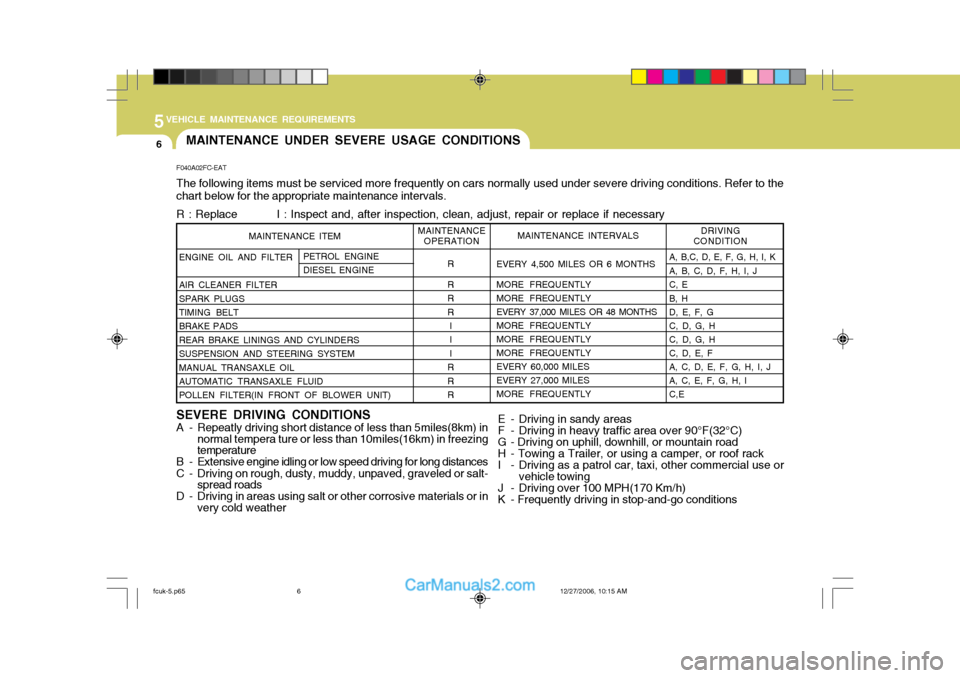
5VEHICLE MAINTENANCE REQUIREMENTS
6
ENGINE OIL AND FILTER AIR CLEANER FILTER SPARK PLUGS TIMING BELT BRAKE PADSREAR BRAKE LININGS AND CYLINDERSSUSPENSION AND STEERING SYSTEMMANUAL TRANSAXLE OIL AUTOMATIC TRANSAXLE FLUID POLLEN FILTER(IN FRONT OF BLOWER UNIT) A, B,C, D, E, F, G, H, I, KA, B, C, D, F, H, I, JC, EB, HD, E, F, G C, D, G, HC, D, G, HC, D, E, FA, C, D, E, F, G, H, I, JA, C, E, F, G, H, IC,E
R R RR
I I I
RRR DRIVING
CONDITION
EVERY 4,500 MILES OR 6 MONTHS MORE FREQUENTLY MORE FREQUENTLY
EVERY 37,000 MILES OR 48 MONTHSMORE FREQUENTLYMORE FREQUENTLYMORE FREQUENTLYEVERY 60,000 MILESEVERY 27,000 MILESMORE FREQUENTLY MAINTENANCE INTERVALS
F040A02FC-EAT The following items must be serviced more frequently on cars normally used under severe driving conditions. Refer to the chart below for the appropriate maintenance intervals.
R : Replace I : Inspect and, after inspection, clean, adjust, repair or replace if necessary
SEVERE DRIVING CONDITIONS
A - Repeatly driving short distance of less than 5miles(8km) in
normal tempera ture or less than 10miles(16km) in freezing temperature
B - Extensive engine idling or low speed driving for long distances
C - Driving on rough, dusty, muddy, unpaved, graveled or salt- spread roads
D - Driving in areas using salt or other corrosive materials or in very cold weather
MAINTENANCEOPERATION
MAINTENANCE ITEM
E - Driving in sandy areas
F - Driving in heavy traffic area over 90°F(32°C)
G - Driving on uphill, downhill, or mountain road
H - Towing a Trailer, or using a camper, or roof rack
I - Driving as a patrol car, taxi, other commercial use orvehicle towing
J - Driving over 100 MPH(170 Km/h)
K - Frequently driving in stop-and-go conditions
MAINTENANCE UNDER SEVERE USAGE CONDITIONS
PETROL ENGINE DIESEL ENGINE
fcuk-5.p65
12/27/2006, 10:15 AM
6
Page 488 of 490

10
INDEX
5
T
TOWING ATTACHMENTS . .......................................2-22
TRAILER AND CARAVAN TOWING .........................2-21
TRIP COMPUTER ..................................................... 1-52
TYPE PRESSURES .................................................... 8-3
TYRE BALANCING ..................................................... 8-4
TYRE CHAINS ............................................................ 8-3
TYRE REPLACEMENT ............................................... 8-5
TYRE ROTATION ....................................................... 8-4
UUNDER TRAY ........................................................... 1-15
V VEHICLE IDENTIFICATION NUMBER ........................ 8-2
W
WHEEL REPLACEMENT ............................................ 8-5
WINDSCREEN WASHER OPERATION ....................1-56
WINDSCREEN WASHER RESERVOIR REPLENISHMENT ................................................ 6-17
WINDSCREEN WIPER BLADES ............................. 6-15
WINDSCREEN WIPER/WASHER SWITCH ..............1-55
WINTER MOTORING ................................................ 2-19
fcuk-10.p65 12/27/2006, 10:14 AM
5