clutch Hyundai Matrix 2007 Owner's Guide
[x] Cancel search | Manufacturer: HYUNDAI, Model Year: 2007, Model line: Matrix, Model: Hyundai Matrix 2007Pages: 490, PDF Size: 12.81 MB
Page 396 of 490

2 DRIVING YOUR HYUNDAI
22
SC200B3-E TOWING ATTACHMENTS It is strongly recommended that only an Hyundai Approved towing attachmentis used to ensure that the loads placed upon the body structure are correctly distributed. The use of a non approvedattachment will result in the invalidation of the vehicle warranty. Hyundai towing attachments are designed and con-structed to ensure maximum towing performance and ease of fitment. A range of accessories including electri-cal kits are available through the Hyundai authorised repairer network. It is of the utmost importance that those areas of the vehicle which are sub- jected to greater stress during towing are maintained in accordance with therecommendations given at the end of this book. In addition, the daily operat- ing checks relating to engine oil, trans-mission oil and tyres must be per- formed at each refuelling to ensure maximum reliability and safety.The use of a proprietary stabiliser will assist in achieving an inherently stable outfit but whilst the use of such equip-ment will improve the characteristics of a balanced outfit, it will not compensatefor a badly loaded and therefore un-stable outfit. The tyres and braking equipment fitted to the trailer or caravan must be main-tained in accordance with the recom- mendations of the manufacturer. Spe- cial attention should be paid to tyreswhich deteriorate through time and ex- posure rather than as a result of the distances towed. The inside walls ofthe tyres should be inspected along with the outside walls for cracking and damage. The trailer wheel nut torquemust be checked on a regular basis, preferably before each towing session. The trailer hitch and the safety catch mechanism must be maintained in good working order. The trailer break away cable or chain should be inspected fordamage and should be attached to the vehicle towing attachment each and every time the trailer is hitched to thevehicle. Whilst towing, the performance of the vehicle will be reduced in terms ofacceleration, braking and handling due
to the increased loads placed upon thevehicle. The driver should anticipatethe change in characteristics and ad- just the driving style in keeping with these changes. Care should be exer-cised when cornering and braking to prevent the outfit becoming uncontrol- lable by reducing cornering speeds andallowing increased braking distances. The driver should exercise care to en- sure that when pulling away from restparticularly on uphill gradients the clutch unit is not subjected to excessive slip- page which will reduce the useful life ofthis component. Use of the "Overdrive Off" "2" and "L" positions when driving vehicles with automatic transmissionwill assist with braking performance when long down hill gradients are en- countered. Improved acceleration per-formance will be available by selecting "Overdrive Off","2", or "1" depending upon road speed if it is found that thetransmission unit makes an undesir- able upshift whilst hill climbing or over- taking. The transmission unit should beoperated in "D" with the Overdrive "On" under normal circumstances to enhance fuel economy and reduce noise andengine wear.
fcuk-2.p65
12/27/2006, 10:14 AM
22
Page 401 of 490

3 IN CASE OF EMERGENCY
2IF THE ENGINE WILL NOT START
SD020B1-E If the Engine Cannot be Cranked
1. If the vehicle is fitted with manualtransaxle, ensure that the clutch pedal is depressed whilst cranking the engine. If the vehicle is fitted with automatic transaxle, ensure that the transaxle
selector is at the "P" or "N" position.
2. Check the battery terminals and con-
nections to ensure that these areclean and also tight.
3. If the ignition warning lights dim when
the engine is cranked and the batteryterminals have been checked, a dis- charged battery is indicated.
4. Do not attempt to push or tow start
the vehicle, refer to "Jump Starting"for information regarding engine start- ing when the battery is discharged. D010C02A-EAT If Engine Turns Over Normally but Does Not Start
D010B01FC 1. Check fuel level.
2. With the key in the "OFF" position,check all connectors at ignition coilsand spark plugs(For Petrol Engine)or check all connectors at glow plug and glow plug relay(For Diesel En- gine). Reconnect any that may bedisconnected or loose.
3. Check fuel line in the engine com-
partment.
4. If engine still refuses to start, call a Hyundai authorised repairer or seekother qualified assistance. SSA3020C
!
SD020A1-E Seek assistance from the nearest Hyundai authorised repairer with regardto the method of ignition and fuel sys- tem diagnosis.
CAUTION:
If the engine refuses to start, noattempt should be made to push or tow start the vehicle. Vehicles withautomatic transaxle or fuel injection will not be able to be started in this manner since no drive is transmittedthrough the automatic transaxle whilst the engine is not running, and in the case of fuel injected deriva-tives, the fuel pump will not operate under tow start conditions. In addi- tion, if the vehicle is equipped withan exhaust catalyst, damage to the catalyst may result if the vehicle is tow started.
fcuk-3.p65 12/27/2006, 10:15 AM
2
Page 423 of 490

5
VEHICLE MAINTENANCE REQUIREMENTS
5
F030C02FC-EAT R : Replace I : Inspect and, after inspection, clean, adjust, repair or replace if necessary
DESCRIPTION
GENERAL MAINTENANCE COOLING SYSTEMCOOLANTENGINE COOLANT SPECIFIC GRAVITYMANUAL TRANSAXLE OILAUTOMATIC TRANSAXLE FLUIDBRAKE PIPES, HOSES, AND CONNECTIONSBRAKE FLUIDCLUTCH FLUIDREAR BRAKE LININGS AND CYLINDERSBRAKE PADSSUSPENSION AND STEERING SYSTEMFRONT SUSPENSION BALL JOINTSPOLLEN FILTER (IN FRONT OF BLOWER UNIT)REAR WHEEL BEARINGSTYRE CONDITION AND PRESSURE (incl. Spare)LUBRICATE LOCKS AND HINGESCHECK ALL ELECTRICAL SYSTEMSROAD TESTCHECK ALL SYSTEMS WITH HI-SCAN
NO.
123456789
10111213141516171819
60 72
I I I
R I
RR IIII
R IIIIII
5060
I I IIIII I II
R IIIIII
4048
I I II
RR IIII
R IIIIII
3036
I I IIIII I II
R IIIIII
2024
I I III
RR IIII
R IIIIII
1012
I I IIIII I II
R IIIIII
MILES X 1,000 MONTHS
See Note (1)
Note :(1) FOR THE FIRST TIME, REPLACE THE COOLANT AT 60,000 MILES OR 60 MONTHS. AFTER THAT, REPLACE IT EVERY 30,000 MILES OR 24 MONTHS.
fcuk-5.p65 12/27/2006, 10:15 AM
5
Page 429 of 490
Engine Compartment .................................................... 6-2
Daily Operating Checks ............................................... 6-5
Engine Oil ..................................................................... 6-5
Engine Oil and Filter Replacement .............................. 6-9 Engine Coolant Checking and Replacing................... 6-12
Air Cleaner Element Replacement .............................. 6-14
Checking the Transaxle Oil (Manual) ......................... 6-18
Checking the Transaxle Fluid (Automatic) .................6-19
Brake System Checking ............................................. 6-22
Checking the Clutch Fluid ........................................... 6-23
Air Conditioning System Maintenance ........................ 6-24
Changing the Pollen Filter (In Front of Blower Unit) ... 6-25
Checking Drive Belts .................................................. 6-27
Checking and Replacing Fuses ..................................6-28
Battery Mai ntenance ................................................... 6-30
Eclectric Cooling Fans ................................................ 6-31
Power Steering Fluid Level ......................................... 6-31
Headlight Aiming Adjustment ...................................... 6-34
Replacing Light Bulbs ................................................. 6-36
Bulb Wattage ............................................................... 6-37
Fuse Panel D escription ............................................... 6-38
OWNER MAINTENANCE
6
6
fcuk-6.p65
12/27/2006, 10:16 AM
1
Page 430 of 490
6 OWNER MAINTENANCE
2
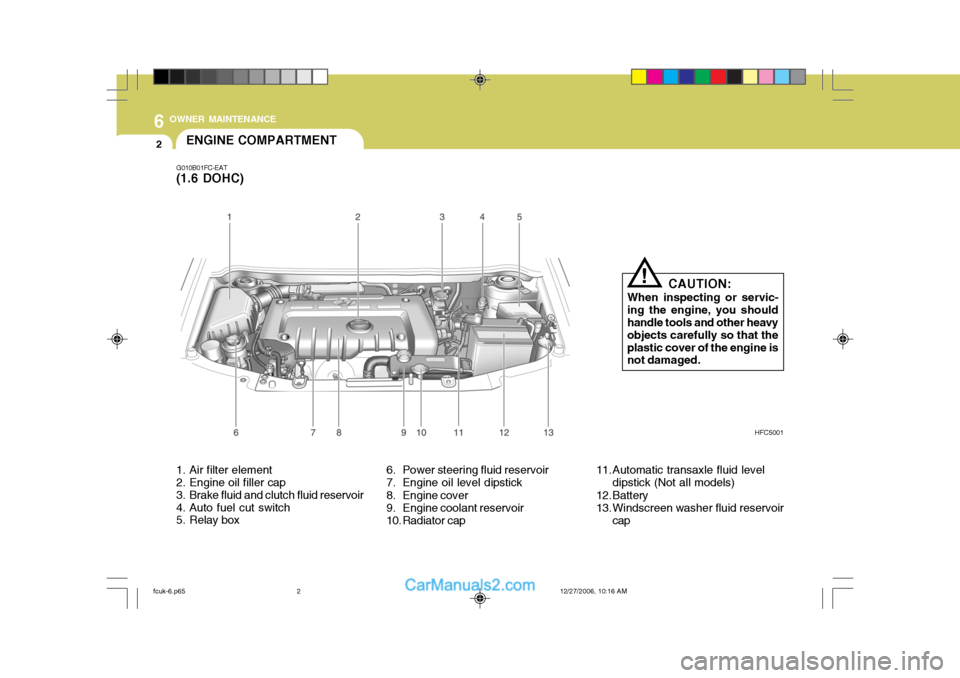
1. Air filter element
2. Engine oil filler cap
3. Brake fluid and clutch fluid reservoir
4. Auto fuel cut switch
5. Relay box 6. Power steering fluid reservoir
7. Engine oil level dipstick
8. Engine cover
9. Engine coolant reservoir
10. Radiator cap11. Automatic transaxle fluid level
dipstick (Not all models)
12. Battery
13. Windscreen washer fluid reservoir cap HFC5001
G010B01FC-EAT (1.6 DOHC)
CAUTION:
When inspecting or servic-
ing the engine, you should handle tools and other heavy objects carefully so that theplastic cover of the engine is not damaged.
!
ENGINE COMPARTMENT
fcuk-6.p65
12/27/2006, 10:16 AM
2
Page 431 of 490
6
OWNER MAINTENANCE
3
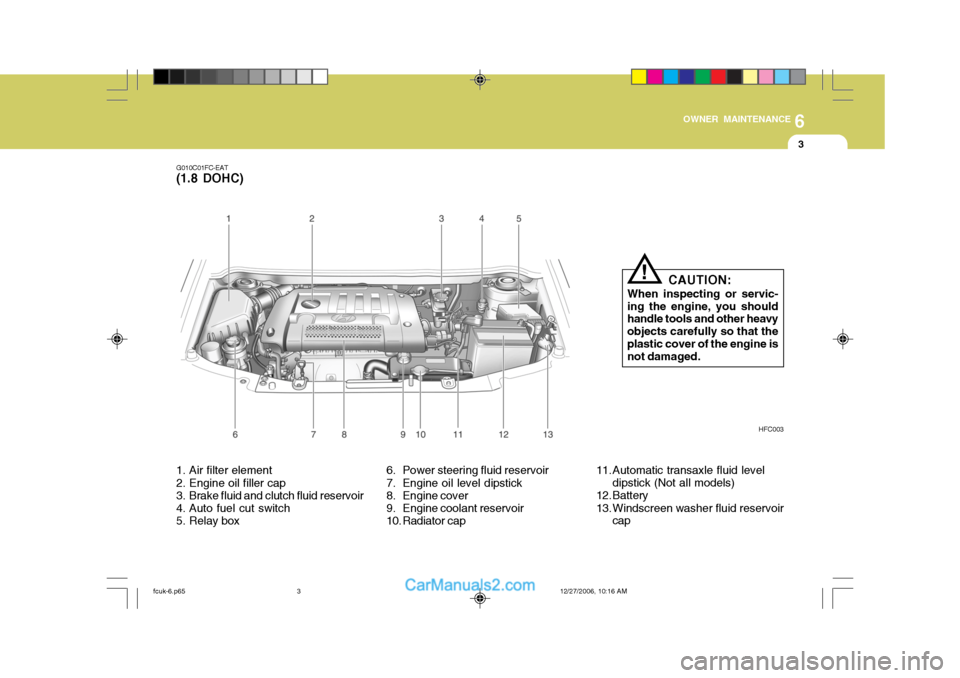
G010C01FC-EAT
(1.8 DOHC)
HFC003
1. Air filter element
2. Engine oil filler cap
3. Brake fluid and clutch fluid reservoir
4. Auto fuel cut switch
5. Relay box 6. Power steering fluid reservoir
7. Engine oil level dipstick
8. Engine cover
9. Engine coolant reservoir
10. Radiator cap11. Automatic transaxle fluid level
dipstick (Not all models)
12. Battery
13. Windscreen washer fluid reservoir cap CAUTION:
When inspecting or servic- ing the engine, you should handle tools and other heavy objects carefully so that the plastic cover of the engine is not damaged.
!
fcuk-6.p65 12/27/2006, 10:16 AM
3
Page 432 of 490

6 OWNER MAINTENANCE
4
1. Air filter element
2. Engine oil filler cap
3. Brake fluid and clutch fluid reservoir
4. Fuel filter 5. Relay box
6. Power steering fluid reservoir
7. Engine oil level dipstick
8. Engine coolant reservoir G010E02FC
G010E02FC-EAT
Diesel (1.5 CRDi)
CAUTION:
When inspecting or servic-
ing the engine, you should handle tools and other heavyobjects carefully so that the plastic cover of the engine is not damaged.
!
9. Radiator cap
10. Battery
11. Windscreen washer fluid reservoir
cap
fcuk-6.p65 12/27/2006, 10:16 AM
4
Page 451 of 490

6
OWNER MAINTENANCE
23
!WARNING:
Brake fluid is hygroscopic and should never be stored in an un- sealed container. The presence ofwater in the braking system will cause vapour locks and increase the possibility of brake fade alongwith promoting corrosion within the braking system. The brake fluid must be changed at the specifiedtime or mileage interval to ensure continued safe operation of the sys- tem. Brake fluid will cause rapidand serious damage to paintwork. If accidental spillage occurs, the af- fected area must be rinsed withwater immediately. Do not allow brake fluid to come into contact with the eyes or to be ingested andensure that fluid is safely stored away form the reach of children.
CHECKING THE CLUTCH FLUID
The system should be checked for leakage at the same time.Ensure that the clutch fluid level is
always between the "MAX" and "MIN"level markings on the fluid reservoir.Fill as required. Fluid loss indicates a leak in the clutch system which should be inspected and repaired immediately.
SG130A1-C To Check the Clutch Fluid
Petol engine
Diesel engine HFC5005
G120D02FC
The clutch fluid level in the master
cylinder should be checked when per- forming other under bonnet checks.
fcuk-6.p65 12/27/2006, 10:16 AM
23
Page 454 of 490

6 OWNER MAINTENANCE
26CHECKING THE FREEPLAY
SG160A1-E
Clutch Pedal
G160A01E
0.24 ~ 0.51 in. (6 ~ 13 mm)
The clutch pedal freeplay should bechecked against the specified value. If the freeplay is not correct, the clutchshould be adjusted by a Hyundai authorised repairer.
SG150A1-E
Steering Wheel
G150A01FC
Steering wheel freeplay should be
checked to ensure that the specified value is not exceeded. 1.18 in. (30 mm)
3. Replace the pollen filter with a new
one.
4. Installation is the reverse order of disassembly.
CAUTION:
Be sure to install the pollen filter in the direction of the arrow sign.
! KQNA020B
fcuk-6.p65
12/27/2006, 10:16 AM
26
Page 485 of 490

10INDEX
2
A ACCESSORY TRAY ................................................. 1-67
AIR CONDITIONING SWITCH.................................. 1-82
AIR CONDITIONING SYSTEM MAINTENANCE ....... 6-24
AIR CLEANER ELEMENT REPLACEMENT .............6-14
ANTENNA ................................................................. 1-95
ANTI-LOCK BRAKE SYSTEM (ABS) .......................2-14
ANTI-THEFT ALARM SYSTEM .................................. 1-8
ASHTRAY ................................................................. 1-61
AUTO FUEL CUT SWITCH ....................................... 1-75
AUTOMATIC TRANSAXLE .......................................2-10
AUTOMATIC TRANSAXLE FLUID ........................... 6-19
B BATTERY MAINTENANCE .......................................6-30
BEFORE STARTING THE ENGINE ............................ 2-3
BLEEDING THE FUEL SYSTEM .............................. 6-32
BONNET RELEASE .................................................. 1-70
BRAKE PEDAL FREEPLAY .....................................6-27
BRAKE TRACTION CONTROL SYSTEM (BTCS) .... 2-14
BRAKE SYSTEM CHECKING.................................. 6-22
C
CARE OF SEAT BELTS .... .......................................1-20
CARGO AREA COVER ............................................. 1-74
CATALYTIC CONVERTOR OPERATING PRECAUTIONS ............................................................................. 7-3
CENTRE VENTILATOR ............................................. 1-76
CENTRAL DOOR LOCKS ......... .................................. 1-7
CHANGING A FLAT TYRE ......................................... 3-7
CHECKING THE CLUTCH FLU ID .............................6-23CHILD-PROOF REAR DOOR LOCK
........................... 1-7
CHILD RESTRAINT SYSTEM ................................... 1-24
CIGAR LIGHTER ....................................................... 1-60
CLUTCH PEDAL FREEPLAY ....................................6-26
COMBINATION IGNITION SWITCH ANDSTEERING LOCK ....................................................... 2-3
COOLANT TEMPERATURE GAUGE ........................1-49
DDAILY OPERATING CHECKS .................................... 6-5
DIGITAL CLOCK ....................................................... 1-59
DOOR LOCKS ............................................................. 1-5
DOOR WINDOWS ..................................................... 1-11
DRINK HOLDER ........................................................ 1-61
DRIVE BELTS ........................................................... 6-27
DRIVING FOR ECONOMY ....... .................................2-18
E EFFECTIVE BRAKING ............................................. 2-17
ELECTRIC COOLING FANS ..................................... 6-31
ELECTRONIC STABILITY PROGRAM (ESP) ...........2-16
EMERGENCY TOWING ............................................ 3-14
EMISSION CONTROL SYSTEM ................................. 7-2
ENGINE COMPARTMENT ....... ................................... 6-2
ENGINE COOLANT CHECKING AND REPLACING . 6-12
ENGINE OIL AND FILTER REPLACEMENT .............. 6-8
ENGINE OIL CONSUMPTION .................................... 6-8
ENGINE OIL REPLENISHMENT ................................. 6-7
ENGINE OIL ................................................................ 6-5 EXTERIOR REAR VIEW MIRROR ........................... 1-67
fcuk-10.p65 12/27/2006, 10:14 AM
2