parking brake Hyundai Matrix 2007 Service Manual
[x] Cancel search | Manufacturer: HYUNDAI, Model Year: 2007, Model line: Matrix, Model: Hyundai Matrix 2007Pages: 490, PDF Size: 12.81 MB
Page 383 of 490
2
DRIVING YOUR HYUNDAI
9
!WARNING:
o Avoid high cornering speeds.
o Do not make quick steering wheel movements, such as sharp lane changes or fast, sharp turns.
o Always wear your seat belts.
In a collision, an unbelted personis significantly more likely to die than a person wearing a seat belt.
o The risk of rollover is greatly in- creased if you lose control of yourvehicle at highway speeds.
o Loss of control often occurs if two or more wheels drop off the road-way and the driver oversteers to reenter the roadway.
o In the event your vehicle leaves the roadway, do not steer sharply.Instead, slow down before pullingback into the travel lanes.
o Never exceed posted speed limits. SC090B1-F Using the Clutch The clutch should be pressed all the way to the floor before shifting, thenreleased slowly. Do not rest your foot on the clutch pedal whilst driving. This can cause unnecessary wear.Do not partially engage the clutch to hold the car on an incline. This causes unnecessary wear.Use the parking brake to hold the car on an incline. Do not operate the clutch pedal rapidly and repeatedly.
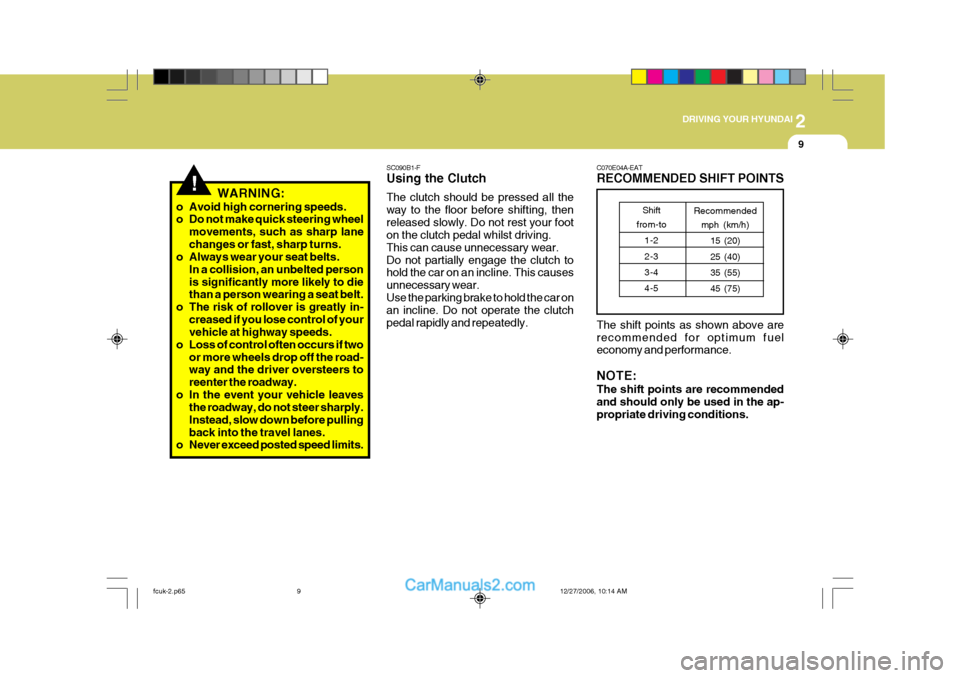
C070E04A-EAT RECOMMENDED SHIFT POINTS The shift points as shown above are recommended for optimum fuel economy and performance. NOTE: The shift points are recommended and should only be used in the ap- propriate driving conditions.Shift
from-to
1-2 2-3 3-4 4-5 Recommended
mph (km/h)
15 (20)25 (40)35 (55) 45 (75)
fcuk-2.p65 12/27/2006, 10:14 AM
9
Page 385 of 490

2
DRIVING YOUR HYUNDAI
11
DC110G2-E o L (Low Gear): With the selector in this position, first gear will be engaged from rest. Noupshift will occur regardless of vehicle speed and throttle opening. The engine may not be started with the selector inthis position. C090I02A-EAT
CAUTION:
o Shift into "R" and "P" only when the vehicle has completelystopped.
o Do not accelerate the engine in reverse or any of the forward
positions with the brakes applied.
o Always apply the footbrake when shifting from "P" or "N", to "R","D", "2" or "L" position.
o Do not use the "P" (Park) position in place of the parking brake. Al-ways set the parking brake, shiftthe transaxle into "P" (Park) and turn off the ignition when you leave the vehicle, even momentarily.Never leave the vehicle unattend- ed whilst the engine is running.
o Check the automatic transaxle fluid level regularly, and add fluid asnecessary. See the maintenance schedule forthe proper fluid recommendation.
!
DC110E1-E o D (Drive): With the selector in this position, first gear will be engaged from rest and thetransmission will automatically upshift to second, third and fourth depending upon the vehicle speed, throttle posi-tion and the position of the overdrive switch. The engine may not be started with the selector in this position. DC110F1-E o 2 (Second Gear): With the selector in this position, first gear will be engaged from rest. Thetransmission will upshift to second gear depending upon the vehicle speed and throttle position. No upshift to third orfourth will occur. The engine may not be started with the selector in this position.
!
CAUTION:
Do not move the selector to the 2 position when the vehicle speed is in excess of 60 m.p.h.
! CAUTION:
Do not move the selector to the "L" position when the vehicle speed is inexcess of 50 m.p.h. C090H01A-EAT NOTE:
o The brake pedal should be de- pressed when shifting from NEU- TRAL to a forward or reverse gear.
o The brake pedal fully depressed in order to move the shift lever fromthe "P" (Park) position to any of the other posi-tions.
o It is always possible to shift from "R", "N", "D", "2", "L" position.
fcuk-2.p65 12/27/2006, 10:14 AM
11
Page 386 of 490
2 DRIVING YOUR HYUNDAI
12
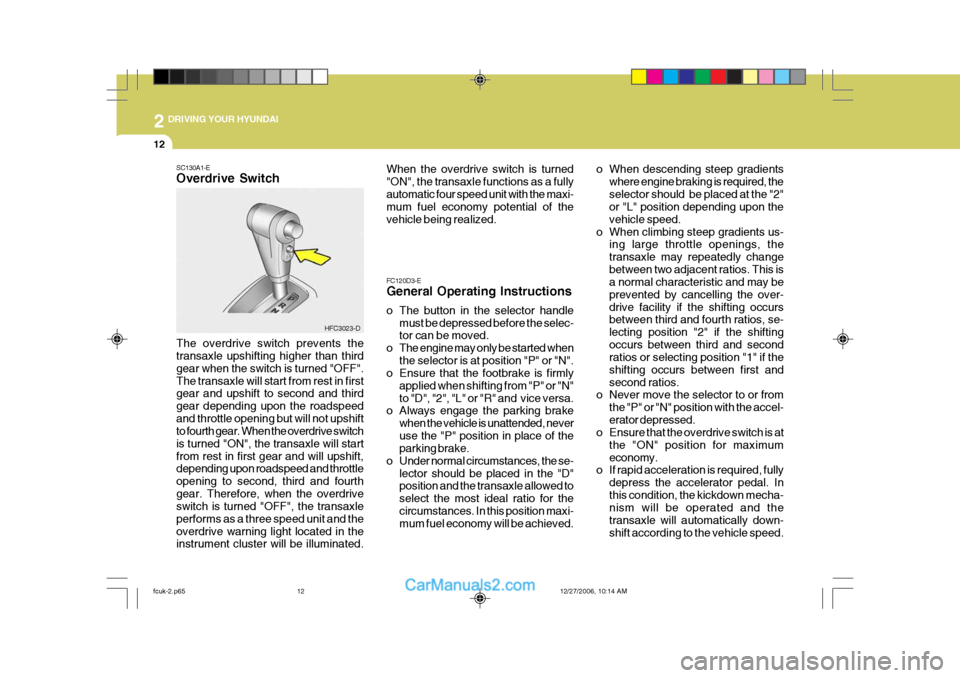
SC130A1-E Overdrive Switch The overdrive switch prevents the transaxle upshifting higher than third gear when the switch is turned "OFF".The transaxle will start from rest in first gear and upshift to second and third gear depending upon the roadspeedand throttle opening but will not upshift to fourth gear. When the overdrive switch is turned "ON", the transaxle will startfrom rest in first gear and will upshift, depending upon roadspeed and throttle opening to second, third and fourthgear. Therefore, when the overdrive switch is turned "OFF", the transaxle performs as a three speed unit and theoverdrive warning light located in the instrument cluster will be illuminated. HFC3023-D
When the overdrive switch is turned "ON", the transaxle functions as a fullyautomatic four speed unit with the maxi- mum fuel economy potential of the vehicle being realized. FC120D3-E General Operating Instructions
o The button in the selector handle
must be depressed before the selec- tor can be moved.
o The engine may only be started when the selector is at position "P" or "N".
o Ensure that the footbrake is firmly
applied when shifting from "P" or "N" to "D", "2", "L" or "R" and vice versa.
o Always engage the parking brake
when the vehicle is unattended, neveruse the "P" position in place of the parking brake.
o Under normal circumstances, the se- lector should be placed in the "D"position and the transaxle allowed to select the most ideal ratio for thecircumstances. In this position maxi- mum fuel economy will be achieved. o When descending steep gradients
where engine braking is required, the selector should be placed at the "2" or "L" position depending upon the vehicle speed.
o When climbing steep gradients us- ing large throttle openings, thetransaxle may repeatedly changebetween two adjacent ratios. This is a normal characteristic and may be prevented by cancelling the over-drive facility if the shifting occurs between third and fourth ratios, se- lecting position "2" if the shiftingoccurs between third and second ratios or selecting position "1" if the shifting occurs between first andsecond ratios.
o Never move the selector to or from
the "P" or "N" position with the accel-erator depressed.
o Ensure that the overdrive switch is at
the "ON" position for maximumeconomy.
o If rapid acceleration is required, fully
depress the accelerator pedal. Inthis condition, the kickdown mecha- nism will be operated and the transaxle will automatically down-shift according to the vehicle speed.
fcuk-2.p65 12/27/2006, 10:14 AM
12
Page 391 of 490

2
DRIVING YOUR HYUNDAI
17
C310D01JM-EAT Indicators and Warning The indicators should illuminate when the ignition key is turned to ON orSTART but should go out after approxi- mately 3 seconds. If the indicators do not illuminate, or theESP or ESP-OFF indicator does not go out after approximately 3 seconds, have the vehicle checked by Hyundaiauthorised repairer. Should there be any unusual conditions in the device whilst driving, ESP-OFF indicator illuminates as a warning. If ESP-OFF indicator illuminates, pullyour car to a safe place and stop the engine. Then, start the engine again to check ifthe ESP-OFF indicator goes out. If the indicator remains lit even after the engine has been started, have your car checked by Hyundai authorised repairer.EFFECTIVE BRAKING
SC140A2-E Braking system performance and fric- tion material life are greatly affected by the driving style adopted. The following suggestions are made to assist inachieving the best results from the braking system.
o Anticipate the road and conditions ahead in order that heavy braking may be avoided.
o When descending long gradients, use the engine to assist in retarding thevehicle to minimize the possibility of brake fade occurring.
o When trailer towing, ensure that the trailer brakes function correctly anduse engine braking to assist thevehicle braking system.
o Use only genuine Hyundai replace-
ment brake pads and shoes to en-sure consistent friction characteris- tics and wear rates.
o After driving through deep water (e.g. fording), the brakes may become wetand performance reduced. Always check brake efficiency after emerg-ing from the water and dry the brakes by lightly depressing the brake pedal several times whilst driving slowly. o Apply the parking brake only when
the vehicle is at rest.
o Since the power assistance provided by the brake servo is derived fromthe engine, coasting with the engineturned off or towing of the vehicle with the engine turned off will result in greatly increased pedal pressuresbeing required to stop the vehicle.
o Do not hold the vehicle on an incline
with the accelerator pedal. This cancause the transmission to overheat. Always use the brake pedal or park- ing brake.
o Use caution when parking on a hill. Engage the parking brake and placethe gear selector lever in "P" (auto-matic transaxle) or in first or reverse gear (manual transaxle). If your car is facing downhill, turn the frontwheels into the curb to help keep the car from rolling. If your car is facing uphill, turn the front wheels awayfrom the curb to help keep the car from rolling. If there is no curb or if it is required by other conditions tokeep the car from rolling, block the wheels.
fcuk-2.p65 12/27/2006, 10:14 AM
17
Page 398 of 490

2 DRIVING YOUR HYUNDAI
24
YC200E2-E Trailer or Vehicle Towing Tips
1. Before towing, check towbar ball andsafety cable connections as well as proper operation of the trailer running lights, brake lights, and turn signals.
2. Always drive your vehicle at a mod- erate speed (Less than 60 MPH)
3. Trailer towing requires more fuel
than normal conditions.
4. To maintain engine braking effi- ciency and electrical charging per- formance, do not use fifth gear(manual transaxle) or overdrive (au- tomatic transaxle).
5. Always secure items in the trailer to prevent load shift whilst driving.
6. Check the condition and air pres-
sure of all tyres on the trailer and your vehicle. Low tyre pressure can seriously affect the handling. Also check the spare tyre. 7. The vehicle/trailer combination is
more affected by crosswind andbuffeting. When being passed by a large ve- hicle, keep a constant speed andsteer straight ahead. If there is too much wind buffeting slow down to get out of the other vehicle's airturbulence.
8. When parking your vehicle and
trailer, especially on a hill, be sure tofollow all the normal precautions. Turn your front wheels into the curb, set the parking brake firmly, and putthe transaxle in 1st or Reverse (manual) or Park (automatic). In ad- dition, we advise the use of wheelchocks at each of the trailer's tyres.
9. If the trailer has electric brakes,
start your vehicle and trailer mov-ing, and then apply the trailer brake controller by hand to be sure the brakes are working. This lets youcheck your electrical connection at the same time. 10. During your trip, check occasionally
to be sure that the load is secure, and that the lights and any trailer brakes are still working.
11. Avoid jerky starts, sudden acceler-
ation or sudden stops.
12. Avoid sharp turns and rapid lane
changes.
13. Avoid holding the brake pedal down too long or too frequently. This could cause the brakes to overheat, re-sulting in reduced braking efficien- cy.
14. When going down a hill, shift into a
lower gear and use the engine brak-ing effect. When climbing a long grade, down-shift the transaxle to a lower gear and reduce speed to reduce chances of engine overloading and/or over-heating.
fcuk-2.p65 12/27/2006, 10:14 AM
24
Page 403 of 490

3 IN CASE OF EMERGENCY
4IF THE ENGINE OVERHEATS
D030A02TB-EAT If the temperature gauge indicates over- heating:
1. Pull off the road and stop as soon as it is safe to do so.
2. Place the gear selector lever in "P" (automatic) or neutral (manual transaxle) and set the parking brake.If the air conditioning is on, turn it off.
3. If coolant is running out under the car
or steam is coming out from underthe bonnet stop the engine. Do not open the bonnet until the coolant has stopped running or the steaming hasstopped. If there is no visible loss of coolant and no steam, leave the engine running and check to be surethe engine cooling fan is operating. If the fan is not running, turn the engine off.
4. Check to see if the water pump drive belt is broken. If it is not broken,check to see that it is tight.If the drive belt seems to be satisfac- tory, check for coolant leaking from the radiator, hoses or under the car.(If the air conditioning had been in use, it is normal for cold water to be draining from it).
4. Connect the red jump cable to the
positive (+) terminal of the boosterbattery and the other end to the positive (+) terminal of the discharged battery.
5. Attach the black jump cable to the negative (-) terminal of the boosterbattery, and the other end to a groundpoint within the engine compartment of the vehicle with the flat battery. Do not connect to the negative batteryterminal of the flat battery since sparks may be generated with the subsequent risk of explosion.
6. Raise the booster vehicle engine speed to 2,000 r.p.m. and start theengine of the vehicle with the flatbattery.
7. Switch "ON" the main beam
headlamps before carefully remov-ing the jumper cables in the reverse order of attachment. Once the jumper cables have been removed, switch"OFF" the main beam headlamps. CAUTION:
If the jump cables are incorrectlyinstalled, damage to the vehicle elec- trical system may occur, in particu- lar the electronic components suchas the Fuel Injection system com- puter and the Automatic Transaxle computer. The battery must never bedisconnected whilst the engine is running.
!
fcuk-3.p65 12/27/2006, 10:15 AM
4
Page 406 of 490
3
IN CASE OF EMERGENCY
7CHANGING A FLAT TYRE
SD070A1-E
It is of the utmost importance that care is exercised when changing road wheels. Ensure that the parking brakeis set and that the gear shift lever is in reverse (P, if the vehicle has automatic transaxle). D060A02FCIN THE EVENT OF A PUNCTURE
SD060A1-E If a puncture occurs whilst driving the vehicle:
1. Bring the car to rest as soon as it is
safe to do so and with the minimum amount of braking required which will assist in maintaining the maximum amount of control. The vehicle shouldbe parked wherever possible upon firm level ground to facilitate wheel changing.
2. If the vehicle is creating a hazard and the road conditions do not permit thewheel to be changed safely, assis-tance should be sought.
3. Passengers must not be allowed to
remain inside the vehicle during wheelchanging. If a puncture occurs whilst the vehicle is on a motorway, the passengers should take refuge onthe motorway embankment to avoid the possibility of injury occurring should the vehicle be struck by othermotorway traffic.
4. Wheel changing should be performed
according to the following instruc-tions.
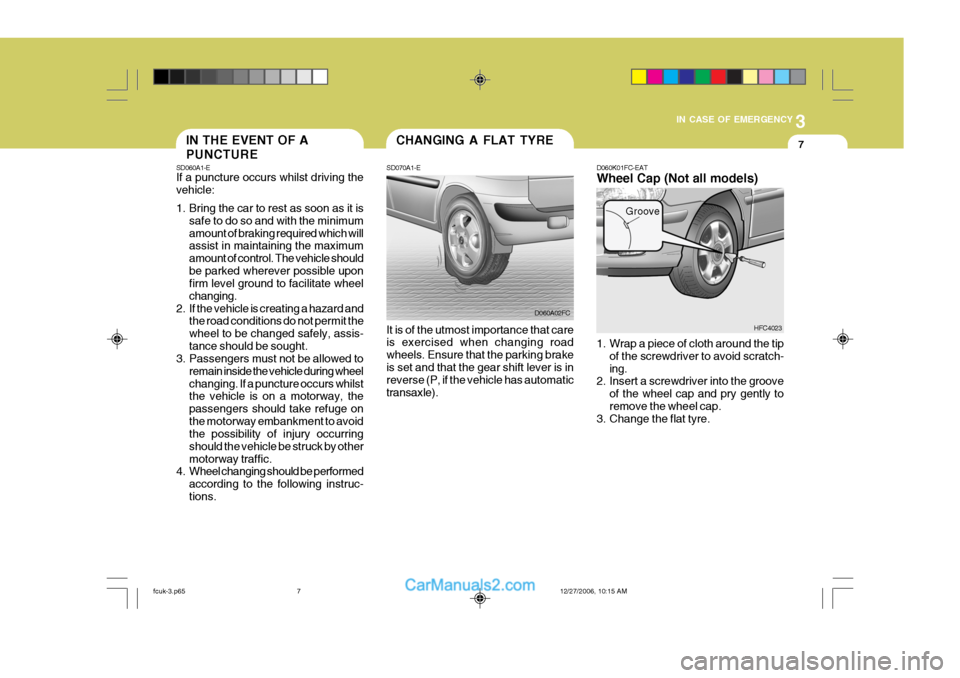
1. Wrap a piece of cloth around the tipof the screwdriver to avoid scratch- ing.
2. Insert a screwdriver into the groove
of the wheel cap and pry gently toremove the wheel cap.
3. Change the flat tyre.
D060K01FC-EAT Wheel Cap (Not all models)
HFC4023
Groove
fcuk-3.p65
12/27/2006, 10:15 AM
7
Page 412 of 490

3
IN CASE OF EMERGENCY
13
HFC004!
CAUTION:
o When towing the vehicle, take care not to cause damage to the bumper or underbody of the vehicle.
!
o Do not tow with sling type truck as this may cause damage to the bumper or underbody of the ve- hicle.
1) If the vehicle is being towed with the rear wheels on the ground, be sure the parking brake is released. NOTE: Before towing, check the level of the automatic transaxle fluid. If it is be- low the "HOT" range on the dipstick,add fluid. If you cannot add fluid, a towing dolly must be used.
2) If any of the loaded wheels or sus-
pension components are damaged or the vehicle is being towed with thefront wheels on the ground, use a towing dolly under the front wheels.
o Manual Transaxle: If you do not use a towing dolly, placethe ignition key in the "ACC" position and put the transaxle in "N (Neutral)".
HFC006
CAUTION:
Do not tow with the key removed or in the "LOCK" position when towingfrom the rear without a towing dolly.
o Automatic Transaxle: Be sure to use a towing dolly under the front wheels.
! CAUTION:
A vehicle with an automatic transaxle should never be towed from the rear with the front wheels on the ground. This can cause serious damage tothe transaxle.
3) It is recommended that your vehicle be towed with all the wheels off the ground.
fcuk-3.p65 12/27/2006, 10:15 AM
13
Page 427 of 490
5
VEHICLE MAINTENANCE REQUIREMENTS
9
6ZF070F1-A
o Brake Hoses and Lines Visually check for proper installation, chafing, cracks, deterioration and any leakage. Replace any deteriorated or damaged parts immediately. 6ZF070G2-A
o Brake Fluid Check brake fluid level in the brake fluid reservoir. The level should be between "MIN" and "MAX" marks on the side of the reservoir. Use onlyhydraulic brake fluid conforming to DOT 3 or DOT 4.
6ZF070H1-A
o Rear Brake Drums And
Linings/Parking Brake
Check the rear brake drums and lin-
ings for scoring, burning, leaking fluid, broken parts, and excessive wear. In- spect the parking brake system in- cluding the parking brake lever andcables. For detailed service proce- dures, refer to the Shop Manual.
6ZF070D1-A
o Manual Transaxle Oil
Inspect the manual transaxle oil ac-
cording to the maintenance schedule. NOTE:
If the oil level is low, check for
possible leaks before adding oil. Do not overfill. F070E05A-AAT
o Automatic Transaxle Fluid The fluid level should be in the "HOT" range of the dipstick, after the engine and transaxle are at normal operating temperature. Check the automatictransaxle fluid level with the engine running and the transaxle in neutral, with the parking brake properly ap-plied. Use Hyundai Genuine ATF SP- III, DIAMOND ATF SP-III, SK ATF SP-III or other brands approved byHyundai Motor Co., when adding or changing fluid.
6ZF070C1-A
o Engine Coolant
The coolant should be changed at
the intervals specified in the mainte-nance schedule.
fcuk-5.p65 12/27/2006, 10:15 AM
9
Page 437 of 490

6
OWNER MAINTENANCE
9ENGINE OIL AND FILTER REPLACEMENT
SSA6040A
1.6 DOHC
Oil filler cap
Drain plug
Oil filler
G040A03E
Oil filler cap
Drain plug
Oil filler
1.8 DOHC
SG040A2-E
Petrol engine The engine oil and filter must be changed at the time or mileage inter-val specified in the maintenance sched- ule. If the vehicle is operated under severe or adverse conditions, the oiland filter must be replaced more fre- quently. To replace the oil and filter, proceed as follows:
1. Ensure that the engine is at normal operating temperature and park the vehicle on level ground with the parking brake securely applied andthe engine turned off.
2. Open the bonnet and remove the oil filler cap.
3. Prepare a suitable receptacle to collect the displaced oil and re-move the drain plug from the sump.
CAUTION:
The oil being drained from the en-gine will be hot. Care should beexercised to prevent scalding. 4. When the oil has drained from the
sump, replace the drain plug usinga new gasket ensuring that the plug is not over tightened.
5. Remove the oil filter by rotating counterclockwise, using a propri-etary oil filter removal tool if neces- sary. Note that the oil filter willcontain approximately 0.5 litres of oil and this should be collected in a suitable receptacle.
6. Install a new oil filter having smeared
the sealing ring with clean oil androtating clockwise until the filter contacts the mounting and then a further one half turn. Do not over-tighten Tightening torque: 2.3 ~ 2.5 kgf.m
7. Remove the engine oil level dip- stick.
8. Pour the specified quantity of the
recommended oil into the engine and replace the filler cap. Start the engine and ensure that no oil leaksexist. Turn off the engine and after a couple minutes, recheck the oil level.
!
fcuk-6.p65 12/27/2006, 10:16 AM
9