brake Hyundai Matrix 2007 Manual Online
[x] Cancel search | Manufacturer: HYUNDAI, Model Year: 2007, Model line: Matrix, Model: Hyundai Matrix 2007Pages: 490, PDF Size: 12.81 MB
Page 391 of 490

2
DRIVING YOUR HYUNDAI
17
C310D01JM-EAT Indicators and Warning The indicators should illuminate when the ignition key is turned to ON orSTART but should go out after approxi- mately 3 seconds. If the indicators do not illuminate, or theESP or ESP-OFF indicator does not go out after approximately 3 seconds, have the vehicle checked by Hyundaiauthorised repairer. Should there be any unusual conditions in the device whilst driving, ESP-OFF indicator illuminates as a warning. If ESP-OFF indicator illuminates, pullyour car to a safe place and stop the engine. Then, start the engine again to check ifthe ESP-OFF indicator goes out. If the indicator remains lit even after the engine has been started, have your car checked by Hyundai authorised repairer.EFFECTIVE BRAKING
SC140A2-E Braking system performance and fric- tion material life are greatly affected by the driving style adopted. The following suggestions are made to assist inachieving the best results from the braking system.
o Anticipate the road and conditions ahead in order that heavy braking may be avoided.
o When descending long gradients, use the engine to assist in retarding thevehicle to minimize the possibility of brake fade occurring.
o When trailer towing, ensure that the trailer brakes function correctly anduse engine braking to assist thevehicle braking system.
o Use only genuine Hyundai replace-
ment brake pads and shoes to en-sure consistent friction characteris- tics and wear rates.
o After driving through deep water (e.g. fording), the brakes may become wetand performance reduced. Always check brake efficiency after emerg-ing from the water and dry the brakes by lightly depressing the brake pedal several times whilst driving slowly. o Apply the parking brake only when
the vehicle is at rest.
o Since the power assistance provided by the brake servo is derived fromthe engine, coasting with the engineturned off or towing of the vehicle with the engine turned off will result in greatly increased pedal pressuresbeing required to stop the vehicle.
o Do not hold the vehicle on an incline
with the accelerator pedal. This cancause the transmission to overheat. Always use the brake pedal or park- ing brake.
o Use caution when parking on a hill. Engage the parking brake and placethe gear selector lever in "P" (auto-matic transaxle) or in first or reverse gear (manual transaxle). If your car is facing downhill, turn the frontwheels into the curb to help keep the car from rolling. If your car is facing uphill, turn the front wheels awayfrom the curb to help keep the car from rolling. If there is no curb or if it is required by other conditions tokeep the car from rolling, block the wheels.
fcuk-2.p65 12/27/2006, 10:14 AM
17
Page 392 of 490

2 DRIVING YOUR HYUNDAI
18
o Keep your car in good condition. For
better fuel economy and reduced maintenance costs, maintain your car in accordance with the mainte- nance schedule in Section 5. If youdrive your car in severe conditions, more frequent maintenance is re- quired (see Section 5 for details).
o Keep your car clean. For maximum service, your car should be keptclean and free of corrosive materi-als. It is especially important that mud, dirt, ice, etc. not be allowed to accumulate on the underside of thecar. This extra weight can result in increased fuel consumption and also contribute to corrosion.
o Travel lightly. Don't carry unneces- sary weight in your car. Weight is anenemy of good fuel economy.
o Don't let the engine idle longer than necessary. If you are waiting (andnot in traffic), turn off your engine andrestart only when you're ready to go.
SC150A1-F You can save fuel and get more miles from your car if you follow these sug-gestions:
o Drive smoothly. Accelerate at a
moderate rate. Don't make "jack- rabbit" starts or full-throttle shifts and maintain a steady cruising speed. Don't race between stoplights. Try toadjust your speed to that of the other traffic so you don't have to change speeds unnecessarily.Avoid heavy traffic whenever pos- sible. Always maintain a safe dis- tance from other vehicles so you canavoid unnecessary braking. This also reduces brake wear.
o Drive at a moderate speed. The faster you drive, the more fuel your caruses. Driving at a moderate speed, especially on the highway, is one ofthe most effective ways to reduce fuel consumption.
DRIVING FOR ECONOMY
o Don't "ride" the brake or clutch pedal.This can increase fuel consumption and also increase wear on these components. In addition, driving with your foot resting on the brake pedalmay cause the brakes to overheat, which reduces their effectiveness and may lead to more serious con-
sequences.
o Take care of your tyres. Keep them
inflated to the recommended pres-sure. Incorrect infla-tion, either too much or too little, results in unneces- sary tyre wear. Check the tyre pres-sures at least once a month.
o Be sure that the wheels are aligned
correctly. Improper alignment canresult from hitting curbs or driving too fast over irregular surfaces. Poor alignment causes faster tyre wearand may also result in other prob- lems as well as greater fuel con- sumption.
fcuk-2.p65 12/27/2006, 10:14 AM
18
Page 397 of 490

2
DRIVING YOUR HYUNDAI
23
!
NOTE:
o The total gross vehicle weight with trailer must not exceed the Gross Vehicle Weight Rating (GVWR)shown on the vehicle identifica- tion plate (see page 8-2). The total gross vehicle weight is the com-bined weight of the vehicle, driver, all passengers and their luggage, cargo, hitch, trailer nose weightand other optional equipment. o The front or rear axle weight must
not exceed the Gross Axle WeightRating (GAWR) shown on the ve- hicle identification plate (see page 8-2). It is possible that your towingpackage does not exceed the GVWR but exceeds the GAWR. Improper trailer loading and/or toomuch luggage in the boot can overload the rear axle. Redistrib- ute the load and check the axleweight again.
o The maximum permissible static
vertical load on the coupling de-vice : 52kg
Gross Axle Weight
C190E02L
Gross Vehicle Weight o The maximum permissible over-
hang of the coupling point : 760 mm.
Towing Bracket Attachment Location C190E01FC
Manual
transaxle
Auto
transaxle Trailer
Weight
1,300 1,100 550 Nose
weight
52
kg
Maximum Towable Weight
With BrakeType
1.5Diesel 1.6/1.8L
1.6/1.8L
Without Brake Type
CAUTION:
The use of a badly loaded or over- loaded trailer may result in instability. This following specifications are rec- ommended when towing a trailer.The loaded trailer weight or the Gross Train Weight must not exceed the values in the following chart .
fcuk-2.p65 12/27/2006, 10:14 AM
23
Page 398 of 490

2 DRIVING YOUR HYUNDAI
24
YC200E2-E Trailer or Vehicle Towing Tips
1. Before towing, check towbar ball andsafety cable connections as well as proper operation of the trailer running lights, brake lights, and turn signals.
2. Always drive your vehicle at a mod- erate speed (Less than 60 MPH)
3. Trailer towing requires more fuel
than normal conditions.
4. To maintain engine braking effi- ciency and electrical charging per- formance, do not use fifth gear(manual transaxle) or overdrive (au- tomatic transaxle).
5. Always secure items in the trailer to prevent load shift whilst driving.
6. Check the condition and air pres-
sure of all tyres on the trailer and your vehicle. Low tyre pressure can seriously affect the handling. Also check the spare tyre. 7. The vehicle/trailer combination is
more affected by crosswind andbuffeting. When being passed by a large ve- hicle, keep a constant speed andsteer straight ahead. If there is too much wind buffeting slow down to get out of the other vehicle's airturbulence.
8. When parking your vehicle and
trailer, especially on a hill, be sure tofollow all the normal precautions. Turn your front wheels into the curb, set the parking brake firmly, and putthe transaxle in 1st or Reverse (manual) or Park (automatic). In ad- dition, we advise the use of wheelchocks at each of the trailer's tyres.
9. If the trailer has electric brakes,
start your vehicle and trailer mov-ing, and then apply the trailer brake controller by hand to be sure the brakes are working. This lets youcheck your electrical connection at the same time. 10. During your trip, check occasionally
to be sure that the load is secure, and that the lights and any trailer brakes are still working.
11. Avoid jerky starts, sudden acceler-
ation or sudden stops.
12. Avoid sharp turns and rapid lane
changes.
13. Avoid holding the brake pedal down too long or too frequently. This could cause the brakes to overheat, re-sulting in reduced braking efficien- cy.
14. When going down a hill, shift into a
lower gear and use the engine brak-ing effect. When climbing a long grade, down-shift the transaxle to a lower gear and reduce speed to reduce chances of engine overloading and/or over-heating.
fcuk-2.p65 12/27/2006, 10:14 AM
24
Page 399 of 490

2
DRIVING YOUR HYUNDAI
25
15. If you have to stop whilst going uphill, do not hold the vehicle in place by pressing on the accelera- tor. This can cause the automatic transaxle to overheat. Use the park-ing brake or footbrake.
NOTE: When towing check transaxle fluid more frequently.
! CAUTION:
If overheating should occur when towing, (temperature gauge readsnear the red zone), taking the follow- ing actions may reduce or eliminate the problem.
1. Turn off the air conditioner.
2. Reduce highway speed.
3. Select a lower gear when going uphill.
4. Whilst in stop and go traffic, place the gear selection in park or neu- tral and idle the engine at a higher speed.
fcuk-2.p65 12/27/2006, 10:14 AM
25
Page 403 of 490

3 IN CASE OF EMERGENCY
4IF THE ENGINE OVERHEATS
D030A02TB-EAT If the temperature gauge indicates over- heating:
1. Pull off the road and stop as soon as it is safe to do so.
2. Place the gear selector lever in "P" (automatic) or neutral (manual transaxle) and set the parking brake.If the air conditioning is on, turn it off.
3. If coolant is running out under the car
or steam is coming out from underthe bonnet stop the engine. Do not open the bonnet until the coolant has stopped running or the steaming hasstopped. If there is no visible loss of coolant and no steam, leave the engine running and check to be surethe engine cooling fan is operating. If the fan is not running, turn the engine off.
4. Check to see if the water pump drive belt is broken. If it is not broken,check to see that it is tight.If the drive belt seems to be satisfac- tory, check for coolant leaking from the radiator, hoses or under the car.(If the air conditioning had been in use, it is normal for cold water to be draining from it).
4. Connect the red jump cable to the
positive (+) terminal of the boosterbattery and the other end to the positive (+) terminal of the discharged battery.
5. Attach the black jump cable to the negative (-) terminal of the boosterbattery, and the other end to a groundpoint within the engine compartment of the vehicle with the flat battery. Do not connect to the negative batteryterminal of the flat battery since sparks may be generated with the subsequent risk of explosion.
6. Raise the booster vehicle engine speed to 2,000 r.p.m. and start theengine of the vehicle with the flatbattery.
7. Switch "ON" the main beam
headlamps before carefully remov-ing the jumper cables in the reverse order of attachment. Once the jumper cables have been removed, switch"OFF" the main beam headlamps. CAUTION:
If the jump cables are incorrectlyinstalled, damage to the vehicle elec- trical system may occur, in particu- lar the electronic components suchas the Fuel Injection system com- puter and the Automatic Transaxle computer. The battery must never bedisconnected whilst the engine is running.
!
fcuk-3.p65 12/27/2006, 10:15 AM
4
Page 406 of 490
3
IN CASE OF EMERGENCY
7CHANGING A FLAT TYRE
SD070A1-E
It is of the utmost importance that care is exercised when changing road wheels. Ensure that the parking brakeis set and that the gear shift lever is in reverse (P, if the vehicle has automatic transaxle). D060A02FCIN THE EVENT OF A PUNCTURE
SD060A1-E If a puncture occurs whilst driving the vehicle:
1. Bring the car to rest as soon as it is
safe to do so and with the minimum amount of braking required which will assist in maintaining the maximum amount of control. The vehicle shouldbe parked wherever possible upon firm level ground to facilitate wheel changing.
2. If the vehicle is creating a hazard and the road conditions do not permit thewheel to be changed safely, assis-tance should be sought.
3. Passengers must not be allowed to
remain inside the vehicle during wheelchanging. If a puncture occurs whilst the vehicle is on a motorway, the passengers should take refuge onthe motorway embankment to avoid the possibility of injury occurring should the vehicle be struck by othermotorway traffic.
4. Wheel changing should be performed
according to the following instruc-tions.
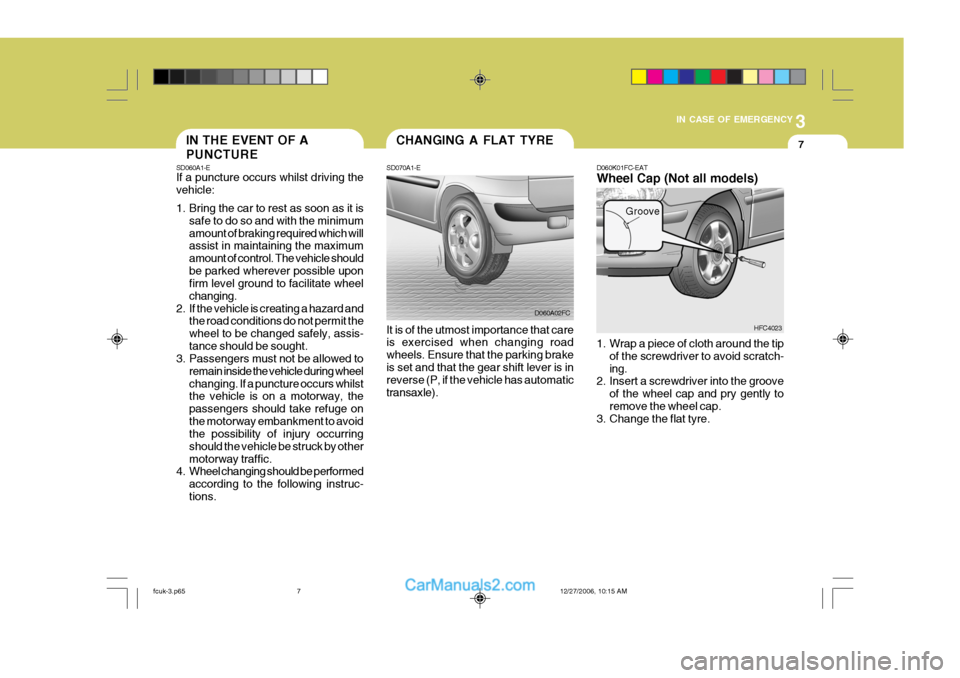
1. Wrap a piece of cloth around the tipof the screwdriver to avoid scratch- ing.
2. Insert a screwdriver into the groove
of the wheel cap and pry gently toremove the wheel cap.
3. Change the flat tyre.
D060K01FC-EAT Wheel Cap (Not all models)
HFC4023
Groove
fcuk-3.p65
12/27/2006, 10:15 AM
7
Page 412 of 490

3
IN CASE OF EMERGENCY
13
HFC004!
CAUTION:
o When towing the vehicle, take care not to cause damage to the bumper or underbody of the vehicle.
!
o Do not tow with sling type truck as this may cause damage to the bumper or underbody of the ve- hicle.
1) If the vehicle is being towed with the rear wheels on the ground, be sure the parking brake is released. NOTE: Before towing, check the level of the automatic transaxle fluid. If it is be- low the "HOT" range on the dipstick,add fluid. If you cannot add fluid, a towing dolly must be used.
2) If any of the loaded wheels or sus-
pension components are damaged or the vehicle is being towed with thefront wheels on the ground, use a towing dolly under the front wheels.
o Manual Transaxle: If you do not use a towing dolly, placethe ignition key in the "ACC" position and put the transaxle in "N (Neutral)".
HFC006
CAUTION:
Do not tow with the key removed or in the "LOCK" position when towingfrom the rear without a towing dolly.
o Automatic Transaxle: Be sure to use a towing dolly under the front wheels.
! CAUTION:
A vehicle with an automatic transaxle should never be towed from the rear with the front wheels on the ground. This can cause serious damage tothe transaxle.
3) It is recommended that your vehicle be towed with all the wheels off the ground.
fcuk-3.p65 12/27/2006, 10:15 AM
13
Page 413 of 490
3 IN CASE OF EMERGENCY
14IF YOU LOSE YOUR KEYS
NOTE: Before towing, check the level of the automatic transaxle fluid. If it is be- low the "HOT" range on the dipstick,add fluid. If you cannot add fluid, a towing dolly must be used. D120A01A-EAT Information about the key of immobiliser system will be found on page 1-4.
!
EMERGENCY TOWING
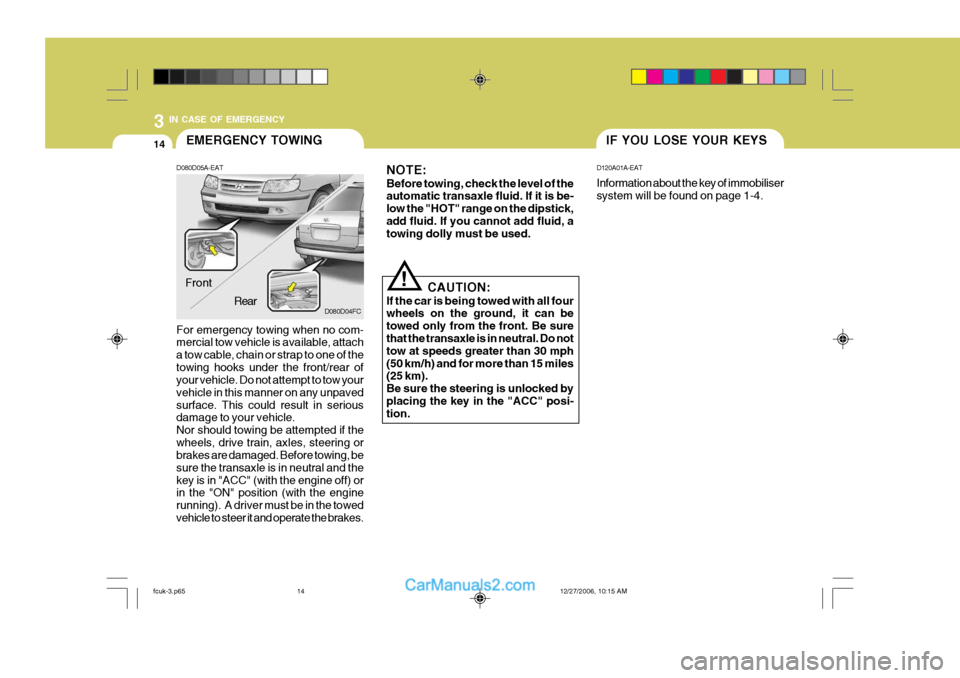
D080D05A-EAT For emergency towing when no com- mercial tow vehicle is available, attach a tow cable, chain or strap to one of thetowing hooks under the front/rear of your vehicle. Do not attempt to tow your vehicle in this manner on any unpavedsurface. This could result in serious damage to your vehicle. Nor should towing be attempted if thewheels, drive train, axles, steering or brakes are damaged. Before towing, be sure the transaxle is in neutral and thekey is in "ACC" (with the engine off) or in the "ON" position (with the engine running). A driver must be in the towedvehicle to steer it and operate the brakes. D080D04FC
Front
Rear CAUTION:
If the car is being towed with all four wheels on the ground, it can be towed only from the front. Be sure that the transaxle is in neutral. Do not tow at speeds greater than 30 mph(50 km/h) and for more than 15 miles (25 km). Be sure the steering is unlocked byplacing the key in the "ACC" posi- tion.
fcuk-3.p65 12/27/2006, 10:15 AM
14
Page 417 of 490

44APPEARANCE CARE
4BUMPER MAINTENANCE
SE040F1-E In the event of the body work sustaining damage, the following points should be noted prior to repairs being undertaken. If body panels are replaced or repaired,anti corrosion treatment must be ap- plied to the repair area. The product used must be compatible with thoseused in manufacture. It is recommended that repairs are entrusted to a Hyundai authorised repairer to ensure that re-placement parts used are of the same high quality as those used in manufac- ture of the vehicle and that the correctrepair methods and materials will en- sure adequate levels of corrosion pro- tection and the continued validity of theAnti Perforation Warranty.
SE040E1-E The special material from which the bumpers are manufactured warrants special attention to preserve the ap- pearance of the bumpers. Avoid con-tact with battery electrolyte or brake fluid and ensure that accidental spill- ages are immediately flushed with wa-ter. Do not use abrasive cleaning materials which may damage the bumpers.Avoid subjecting the bumpers to high temperatures E.g encountered in high bake paint ovens.
BODY WORK REPAIRS
SE040C1-E Polishing The exterior paint work should be pol- ished with a proprietary wax polish when water no longer collects in bead form onthe paint work. The instructions of the product manufacturer should be ad- hered to.
SE040B1-E Stain/Spot Removal Should tree sap, dead insects or tar prove to be difficult to remove from thepaint film, turpentine or a proprietary paint cutting compound may be used. Ensure that the area to be cleaned isnot rubbed intensively to prevent break- ing through the colour coat and expos- ing the under coat.
fcuk-4.p65
12/27/2006, 10:15 AM
4