ECO mode Hyundai Nexo 2019 Service Manual
[x] Cancel search | Manufacturer: HYUNDAI, Model Year: 2019, Model line: Nexo, Model: Hyundai Nexo 2019Pages: 560, PDF Size: 24.2 MB
Page 404 of 560
6-7
What to do in an emergency
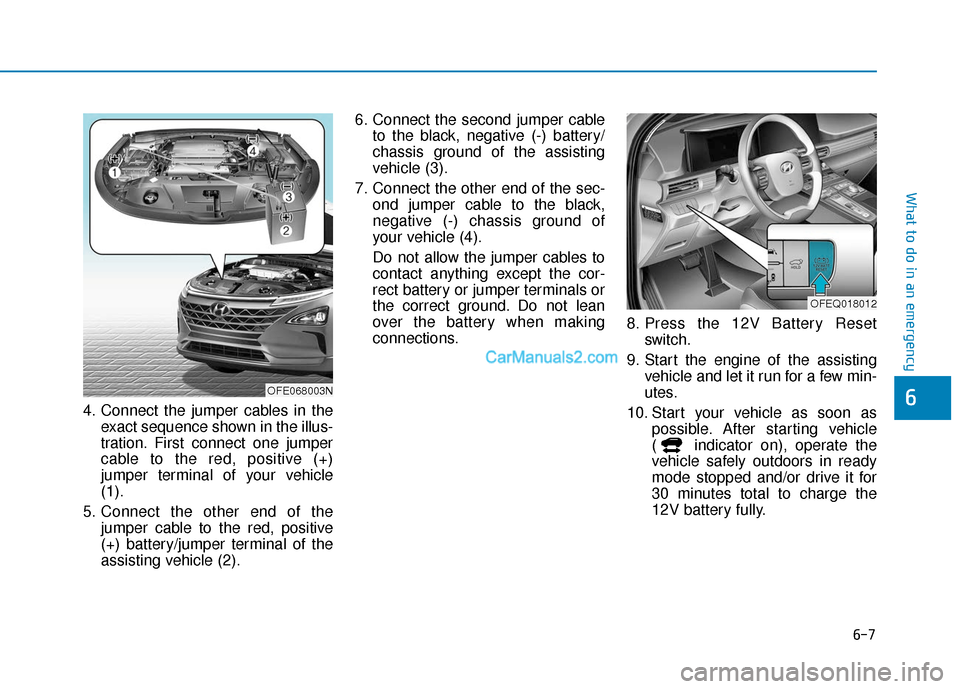
64. Connect the jumper cables in theexact sequence shown in the illus-
tration. First connect one jumper
cable to the red, positive (+)
jumper terminal of your vehicle
(1).
5. Connect the other end of the jumper cable to the red, positive
(+) battery/jumper terminal of the
assisting vehicle (2). 6. Connect the second jumper cable
to the black, negative (-) battery/
chassis ground of the assisting
vehicle (3).
7. Connect the other end of the sec- ond jumper cable to the black,
negative (-) chassis ground of
your vehicle (4).
Do not allow the jumper cables to
contact anything except the cor-
rect battery or jumper terminals or
the correct ground. Do not lean
over the battery when making
connections. 8. Press the 12V Battery Reset
switch.
9. Start the engine of the assisting vehicle and let it run for a few min-
utes.
10. Start your vehicle as soon as possible. After starting vehicle
( indicator on), operate the
vehicle safely outdoors in ready
mode stopped and/or drive it for
30 minutes total to charge the
12V battery fully.
OFE068003N
OFEQ018012
Page 464 of 560
7-40
Maintenance
Maximum Inflation Pressure
The maximum air pressure to which
a cold tire may be inflated. The max-
imum air pressure is molded onto the
sidewall.
Maximum Load Rating
The load rating for a tire at the maxi-
mum permissible inflation pressure
for that tire.
Maximum Loaded VehicleWeight
The sum of curb weight; accessory
weight; vehicle capacity weight; and
production options weight.
Normal Occupant Weight
The number of occupants a vehicle
is designed to seat multiplied by 150
pounds (68 kg).
Occupant Distribution
Designated seating positions.
Outward Facing Sidewall
An asymmetrical tire has a particular
side that faces outward when mount-
ed on a vehicle. The outward facing
sidewall bears white lettering or
bears manufacturer, brand, and/or
model name molding that is higher or
deeper than the same moldings on
the inner facing sidewall.
Passenger (P-Metric) tire
A tire used on passenger cars and
some light duty trucks and multipur-
pose vehicles.
Ply
A layer of rubber-coated parallel
cords.
Pneumatic tire
A mechanical device made of rubber,
chemicals, fabric and steel or other
materials, that, when mounted on an
automotive wheel provides the trac-
tion and contains the gas or fluid that
sustains the load.
Pneumatic options weight
The combined weight of installed
regular production options weighing
over 5 lb. (2.3 kg) in excess of the
standard items which they replace,
not previously considered in curb
weight or accessory weight, includ-
ing heavy duty breaks, ride levelers,
roof rack, heavy duty battery, and
special trim.
Recommended InflationPressure
Vehicle manufacturer's recommend-
ed tire inflation pressure as shown
on the tire placard.
Page 466 of 560
7-42
Maintenance
All Season Tires
HYUNDAI specifies all season tires
on some models to provide good
performance for use all year round,
including snowy and icy road condi-
tions. All season tires are identified
by ALL SEASON and/or M+S (Mud
and Snow) on the tire sidewall. Snow
tires have better snow traction than
all season tires and may be more
appropriate in some areas.
Summer Tires
HYUNDAI specifies summer tires on
some models to provide superior
performance on dry roads. Summer
tire performance is substantially
reduced in snow and ice. Summer
tires do not have the tire traction rat-
ing M+S (Mud and Snow) on the tire
side wall. If you plan to operate your
vehicle in snowy or icy conditions,
HYUNDAI recommends the use of
snow tires or all season tires on all
four wheels.
Snow Tires
If you equip your car with snow tires,
they should be the same size and
have the same load capacity as the
original tires. Snow tires should be
installed on all four wheels; other-
wise, poor handling may result. Snow
tires should carry 4 psi (28 kPa)
more air pressure than the pressure
recommended for the standard tires
on the tire label on the driver’s side of
the center pillar, or up to the maxi-
mum pressure shown on the tire
sidewall, whichever is less. Do not
drive faster than 75 mph (120 km/h)
when your vehicle is equipped with
snow tires.
Radial-Ply Tires
Radial-ply tires provide improved
tread life, road hazard resistance and
smoother high speed ride. The radi-
al-ply tires used on this vehicle are of
belted construction, and are selected
to complement the ride and handling
characteristics of your vehicle.
Radial-ply tires have the same load
carrying capacity, as bias-ply or bias
belted tires of the same size, and use
the same recommended inflation
pressure. Mixing of radial-ply tires
with bias-ply or bias belted tires is
not recommended. Any combina-
tions of radial-ply and bias-ply or bias
belted tires when used on the same
vehicle will seriously deteriorate
vehicle handling. The best rule to fol-
low is: Identical pairs of radial-ply
tires should always be used as a set
for the front tires and a set for the
rear tires.
Page 510 of 560
H6
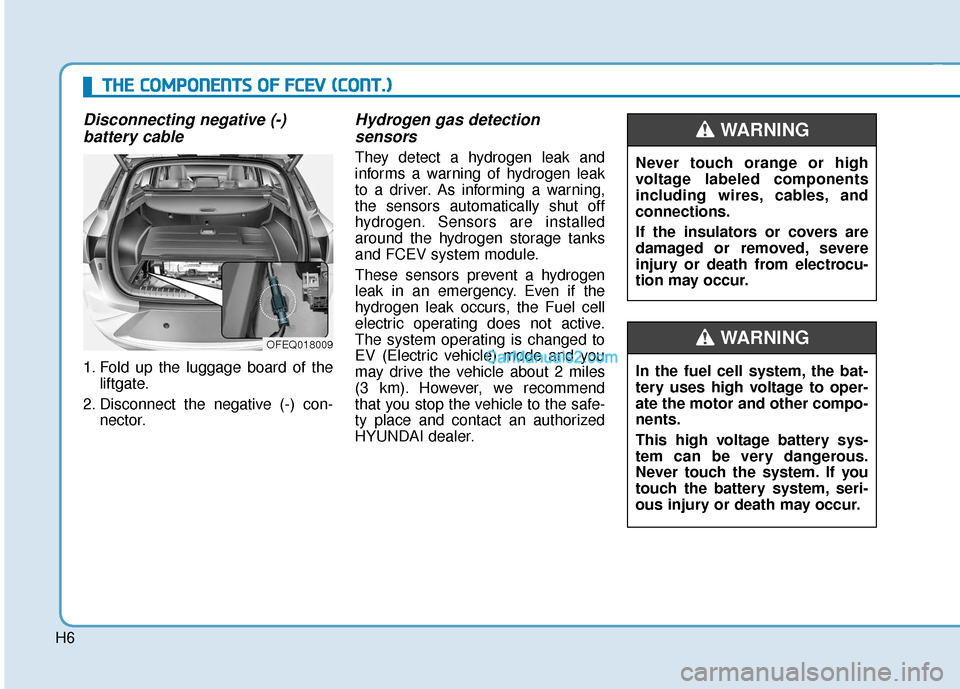
Disconnecting negative (-) battery cable
1. Fold up the luggage board of the
liftgate.
2. Disconnect the negative (-) con- nector.
Hydrogen gas detection sensors
They detect a hydrogen leak and
informs a warning of hydrogen leak
to a driver. As informing a warning,
the sensors automatically shut off
hydrogen. Sensors are installed
around the hydrogen storage tanks
and FCEV system module.
These sensors prevent a hydrogen
leak in an emergency. Even if the
hydrogen leak occurs, the Fuel cell
electric operating does not active.
The system operating is changed to
EV (Electric vehicle) mode and you
may drive the vehicle about 2 miles
(3 km). However, we recommend
that you stop the vehicle to the safe-
ty place and contact an authorized
HYUNDAI dealer.
OFEQ018009
T
T H
H E
E
C
C O
O M
M P
PO
O N
NE
EN
N T
TS
S
O
O F
F
F
F C
C E
E V
V
(
( C
C O
O N
NT
T.
.)
)
Never touch orange or high
voltage labeled components
including wires, cables, and
connections.
If the insulators or covers are
damaged or removed, severe
injury or death from electrocu-
tion may occur.
WARNING
In the fuel cell system, the bat-
tery uses high voltage to oper-
ate the motor and other compo-
nents.
This high voltage battery sys-
tem can be very dangerous.
Never touch the system. If you
touch the battery system, seri-
ous injury or death may occur.
WARNING
Page 525 of 560
H21
FCEV mode
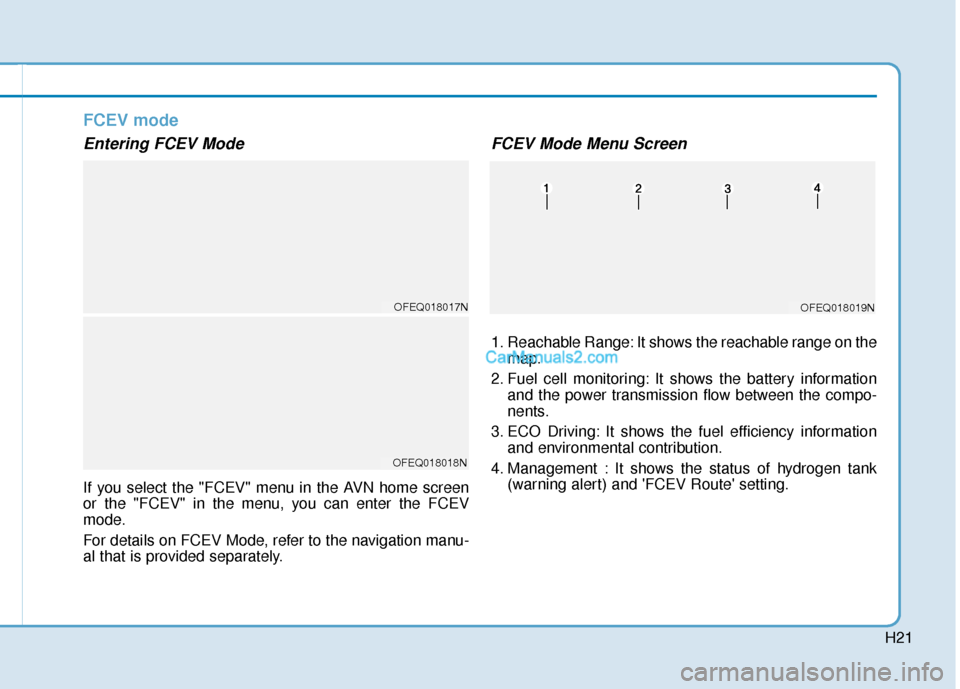
Entering FCEV Mode
If you select the "FCEV" menu in the AVN home screen
or the "FCEV" in the menu, you can enter the FCEV
mode.
For details on FCEV Mode, refer to the navigation manu-
al that is provided separately.
FCEV Mode Menu Screen
1. Reachable Range: It shows the reachable range on themap.
2. Fuel cell monitoring: It shows the battery information and the power transmission flow between the compo-
nents.
3. ECO Driving: It shows the fuel efficiency information and environmental contribution.
4. Management : It shows the status of hydrogen tank (warning alert) and 'FCEV Route' setting.
OFEQ018017NOFEQ018019N
OFEQ018018N
Page 529 of 560
H25
When the high voltage battery
is weak
When the high voltage battery is
weak due to driving on a hill for a
long time or accelerating and decel-
erating the vehicle repeatedly, the
acceleration performance may be
lower than usual. In this case, be
cautious not to overtake other vehi-
cles.
If the 12 volt battery is dis-
charged
This vehicle does not have a regular
12V battery that needs periodic
replacement. It is lithium ion polymer
type integrated into the high voltage
battery. The vehicle has a 12V bat-
tery protection system that cuts 12V
battery from vehicle draw to prevent
full discharge.
If the 12V battery is discharged, you
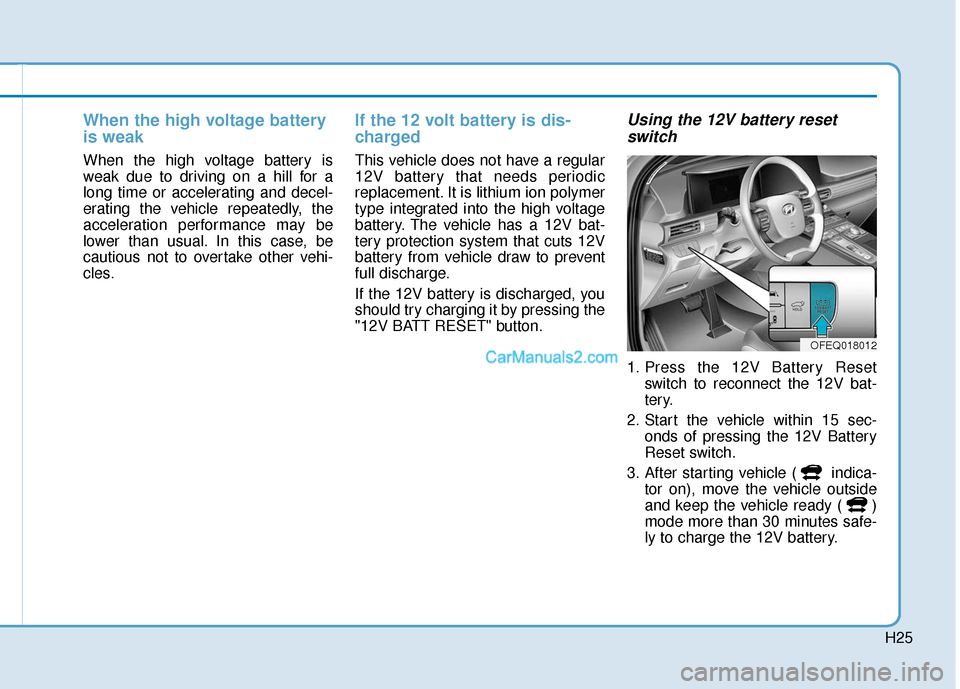
should try charging it by pressing the
"12V BATT RESET" button.
Using the 12V battery resetswitch
1. Press the 12V Battery Reset
switch to reconnect the 12V bat-
tery.
2. Start the vehicle within 15 sec- onds of pressing the 12V Battery
Reset switch.
3. After starting vehicle ( indica- tor on), move the vehicle outside
and keep the vehicle ready ( )
mode more than 30 minutes safe-
ly to charge the 12V battery.
OFEQ018012
Page 552 of 560
I-3
Blind-Spot View Monitor System ..................................5-77Operating conditions ..................................................5-77
Blind-Spot View Monitor system warning ................5-78
Brake fluid ......................................................................7-\
19 Checking the Brake Fluid Level ................................7-19
Braking System ...............................................................5-18 Power Brakes..............................................................5-18
Disc Brake Wear Indicator .........................................5-19
Electronic Parking Brake (EPB) ................................5-19
Auto Hold ...................................................................5-25
Anti-lock Brake System (ABS)..................................5-29
Electronic Stability Control (ESC).............................5-31
Vehicle Stability Management (VSM) .......................5-34
Hill-Start Assist Control (HAC) .................................5-36
Good Braking Practices..............................................5-36
Bulb Wattage .....................................................................8-3\
California perchlorate notice ..........................................7-70
Cargo Security Screen ..................................................3-173
Center Console Storage ................................................3-162
Child Restraint System (CRS) ........................................2-36 Children Always in the Rear ......................................2-36
Selecting a Child Restraint System (CRS).................2-37
Installing a Child Restraint System (CRS) ................2-39
Child-Protector Rear Door Locks ...................................3-18 Climate Control Additional Features ............................3-161
Automatic Ventilation...............................................3-161
Sunroof Inside Air Recirculation .............................3-161
Climate control air filter .................................................7-22 Filter Inspection..........................................................7-22
Clock ........................................................................\
.....3-170
Coat Hook .....................................................................3-1\
71
Consumer Information ......................................................8-9
Cup Holder....................................................................3-16\
3
Customer Q&A Guide (FCEV) .......................................H30
Device cooling coolant ...................................................7-13 Checking the Coolant Level .......................................7-13
Changing Coolant.......................................................7-15
Dimensions .......................................................................8\
-2
Disc Brake Wear Indicator..............................................5-19
Door Locks......................................................................3-\
11 Door unlocking from outside the vehicle...................3-11
Door locking from outside the vehicle.......................3-14
Operating Door Locks from Inside the Vehicle .........3-14
Automatic Door Lock and Unlock Features ..............3-17
Child-Protector Rear Door Locks ..............................3-18
Drive Mode Integrated Control System .........................5-37 Drive mode change alert ............................................5-38
ECO mode climate control .........................................5-38
I
Index
C
D
Page 557 of 560

I-8
Rear Seats .......................................................................2\
-10
Rear View Monitor .......................................................3-108
Rear Window Wiper and Washer..................................3-103
Recommended Lubricants and Capacities ........................8-6
Reducing the Risk of a Rollover ..................................5-121
Reduction Gear ...............................................................5-11Reduction Gear Operation ..........................................5-11
Parking........................................................................\
5-13
LCD Display Messages ..............................................5-13
Good Driving Practices ..............................................5-16
Refrigerant Label ..............................................................8-8
Remote Smart Parking Assist (RSPA) ..........................3-112 Operating Condition .................................................3-113
Non-operating Condition ..........................................3-114
Limitations of the System ........................................3-115
How the System Works (Smart Parking) .................3-119
How the System Works (Remote Smart Parking)....3-126
How the System Works (Smart Exit) .......................3-130
How the System Works (Remote Moving Forward/Backward) ..................3-137
Additional Instructions (Messages)..........................3-142
Turn signal Showing Vehicle Status while System in Activation ..........................................................3-143
Smart Key Showing Vehicle Status while System in Activation ..........................................................3-144
Link with other Systems ..........................................3-145
Reporting Safety Defects ................................................8-10
Roof Side Rails .............................................................3-175 Scheduled maintenance services.......................................7-7
Normal Maintenance Schedule ....................................7-8
Maintenance Under Severe Usage Conditions...........7-10
Seat Belt Restraint System .............................................2-24
Seat Belt Warning Light .................................................2-22
Seat Belts ........................................................................\
2-21 Seat Belt Safety Precautions ......................................2-21
Seat Belt Warning Light .............................................2-22
Seat Belt Restraint System .........................................2-24
Additional Seat Belt Safety Precautions ....................2-32
Care of Seat Belts .......................................................2-35
Seat Warmers and Air Ventilation Seats .........................2-17
Seats ........................................................................\
..........2-4 Safety Precautions ........................................................2-5
Front Seats ....................................................................2-6
Rear Seats ...................................................................2-10
Head Restraints ..........................................................2-13
Seat Warmers and Air Ventilation Seats.....................2-17
Side View Mirrors...........................................................3-31
Smart Cruise Control With Stop & Go System ..............5-98 Smart Cruise Control Switch .....................................5-99
To Adjust the Sensitivity of Smart Cruise Control ..5-100
To Convert to Cruise Control Mode ........................5-100
Smart Cruise Control Speed .....................................5-101
Index
S