valve Hyundai Nexo 2019 Owner's Manual
[x] Cancel search | Manufacturer: HYUNDAI, Model Year: 2019, Model line: Nexo, Model: Hyundai Nexo 2019Pages: 560, PDF Size: 24.2 MB
Page 400 of 560
6-3
What to do in an emergency
If a fire occurs
1. Stop the vehicle, shift gear to theP(Park) position, engage the park-
ing brake, and turn the vehicle off.
The flow of hydrogen into the fuel cell stack will be shut off to prevent
the electricity from being generat-
ed.
2. If the fire is small, which can be extinguished with fire extinguisher,
use carbon dioxide extinguisher.
You can also extinguish the fire with water when the vehicle power
is turned off. If the fire is too big to be extin-
guished with the fire extinguisher,
evacuate from the vehicle, call the
fire department, and let them know
the vehicle is a Fuel Cell Electric
Vehicle. Do not come close to the
vehicle until the fire is totally extin-
guished.
Emergency venting of hydro-
gen gas
If the temperature near the safety
valve located at the rear under vehi-
cle is over 230°F (110°C) caused by
a fire or other reasons, the safety
valve will open to vent hydrogen gas.
Venting the hydrogen gas makes a
loud noise because the venting
speed is very fast. Stay well away
from the vehicle. The discharge of
hydrogen gas from the vehicle is
flammable and could cause a fire.
If a submersion in water
occurs
If your vehicle was flooded and has
soaked carpeting or water on the
flooring, you should not try to start
the vehicle by pressing the POWER
button.
Contact an authorized HYUNDAI
dealer immediately.
If the vehicle stalls at a cross-
road or crossing
If the vehicle stalls at a crossroad or
crossing, set the gear in the N
(Neutral) position and then push the
vehicle to a safe place.
6
Do not use water to extinguish a
fire when the vehicle power is
turned on. Serious electric
shock may result.
WARNING
Page 412 of 560
6-15
What to do in an emergency
6
The TPMS Malfunction Indicator
may illuminate after blinking for
one minute if the vehicle is near
electric power supply cables or
radio transmitters such as police
stations, government and public
offices, broadcasting stations,
military installations, airports,
transmitting towers, etc.
Additionally, the TPMS Malfunction
Indicator may illuminate if snow
chains are used or electronic
devices such as computers, charg-
ers, remote starters, navigation,
etc. This may interfere with normal
operation of the TPMS.
Changing a Tire with TPMS
If you have a flat tire, the Low Tire
Pressure and LCD position indicator
will come on. Have the flat tire
repaired by an authorized HYUNDAI
dealer as soon as possible.
Once the original tire equipped with
a tire pressure monitoring sensor is
reinflated to the recommended pres-
sure and reinstalled on the vehicle,
the Low Tire Pressure LCD position
indicator and TPMS Malfunction
Indicator will go off within a few min-
utes of driving.If the indicators do not disappear
after a few minutes, please visit an
authorized HYUNDAI dealer.
Each wheel is equipped with a tire
pressure sensor mounted inside the
tire behind the valve stem. You must
use TPMS specific wheels. It is rec-
ommended that you always have
your tires serviced by an authorized
HYUNDAI dealer.
NOTICE
Never use a puncture-repairing
agent not approved by HYUNDAI
dealer to repair and/or inflate a
low pressure tire. Tire sealant
not approved by HYUNDAI deal-
er may damage the tire pressure
sensor.
CAUTION
Page 418 of 560
6-21
What to do in an emergency
6
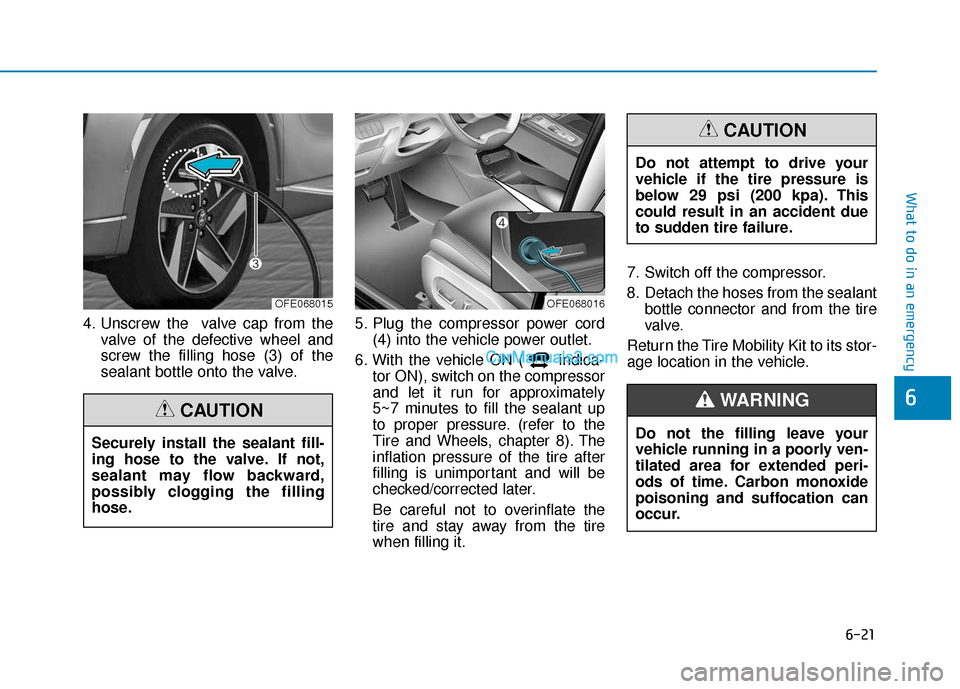
4. Unscrew the valve cap from thevalve of the defective wheel and
screw the filling hose (3) of the
sealant bottle onto the valve. 5. Plug the compressor power cord
(4) into the vehicle power outlet.
6. With the vehicle ON ( indica- tor ON), switch on the compressor
and let it run for approximately
5~7 minutes to fill the sealant up
to proper pressure. (refer to the
Tire and Wheels, chapter 8). The
inflation pressure of the tire after
filling is unimportant and will be
checked/corrected later.
Be careful not to overinflate the
tire and stay away from the tire
when filling it. 7. Switch off the compressor.
8. Detach the hoses from the sealant
bottle connector and from the tire
valve.
Return the Tire Mobility Kit to its stor-
age location in the vehicle.
OFE068015OFE068016
Securely install the sealant fill-
ing hose to the valve. If not,
sealant may flow backward,
possibly clogging the filling
hose.
CAUTION
Do not attempt to drive your
vehicle if the tire pressure is
below 29 psi (200 kpa). This
could result in an accident due
to sudden tire failure.
CAUTION
Do not the filling leave your
vehicle running in a poorly ven-
tilated area for extended peri-
ods of time. Carbon monoxide
poisoning and suffocation can
occur.
WARNING
Page 419 of 560
6-22
What to do in an emergency
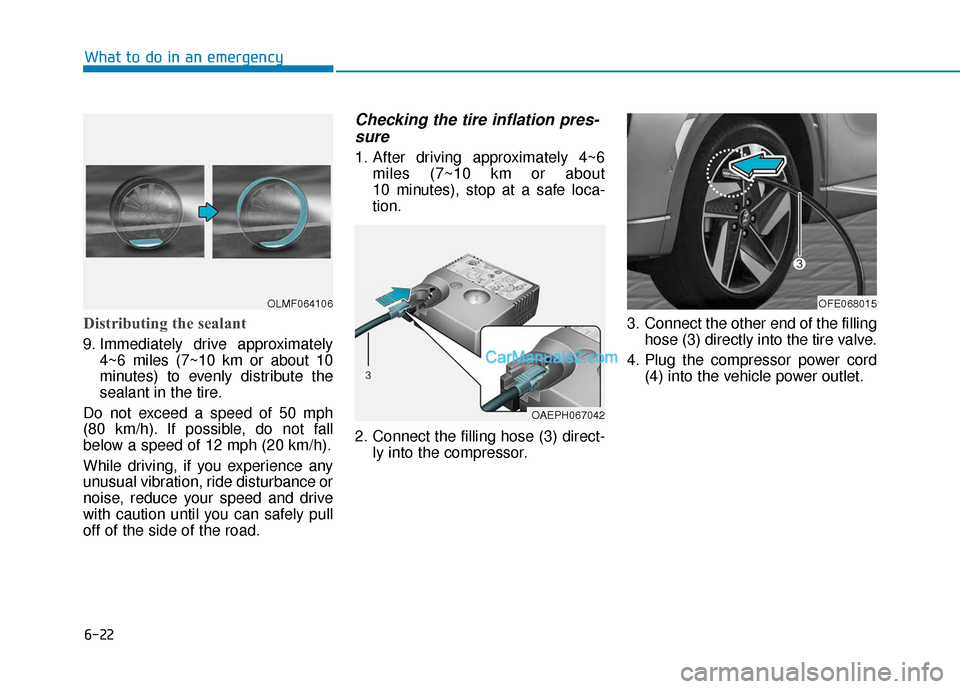
Distributing the sealant
9. Immediately drive approximately4~6 miles (7~10 km or about 10
minutes) to evenly distribute the
sealant in the tire.
Do not exceed a speed of 50 mph
(80 km/h). If possible, do not fall
below a speed of 12 mph (20 km/h).
While driving, if you experience any
unusual vibration, ride disturbance or
noise, reduce your speed and drive
with caution until you can safely pull
off of the side of the road.
Checking the tire inflation pres- sure
1. After driving approximately 4~6
miles (7~10 km or about
10 minutes), stop at a safe loca-
tion.
2. Connect the filling hose (3) direct- ly into the compressor. 3. Connect the other end of the filling
hose (3) directly into the tire valve.
4. Plug the compressor power cord (4) into the vehicle power outlet.
OLMF064106
OAEPH067042
OFE068015
Page 455 of 560
7-31
7
Maintenance
Check Tire Inflation Pressure
Check your tires once a month or
more.
How to check
Use a good quality tire pressure
gauge to check tire pressure. You
can not tell if your tires are properly
inflated simply by looking at them.
Radial tires may look properly inflat-
ed when they are under-inflated.
Remove the valve cap from the tire
valve stem. Press the tire gauge firm-
ly onto the valve to get a pressure
measurement. If the cold tire inflation
pressure matches the recommended
pressure on the tire and loading
information label, no further adjust-
ment is necessary. If the pressure is
low, add air until you reach the rec-
ommended pressure. Make sure to
put the valve caps back on the valve
stems. Without the valve cap, dirt or
moisture could get into the valve
core and cause air leakage. If a valve
cap is missing, install a new one as
soon as possible.If you overfill the tire, release air by
pushing on the metal stem in the
center of the tire valve. Recheck the
tire pressure with the tire gauge. Be
sure to put the valve caps back on
the valve stems. Without the valve
cap, dirt or moisture could get into
the valve core and cause air leakage.
If a valve cap is missing, install a new
one as soon as possible.
Under-inflation results in
excessive wear, poor handling
and reduced fuel economy.
Wheel deformation is also
possible. Keep your tire pres-
sures at the proper levels. If a
tire frequently needs refilling,
have it checked by an author-
ized HYUNDAI dealer.
Over-inflation produces a
harsh ride, excessive wear at
the center of the tire tread,
and a greater possibility of
damage from road hazards.
CAUTION
Page 509 of 560
H5
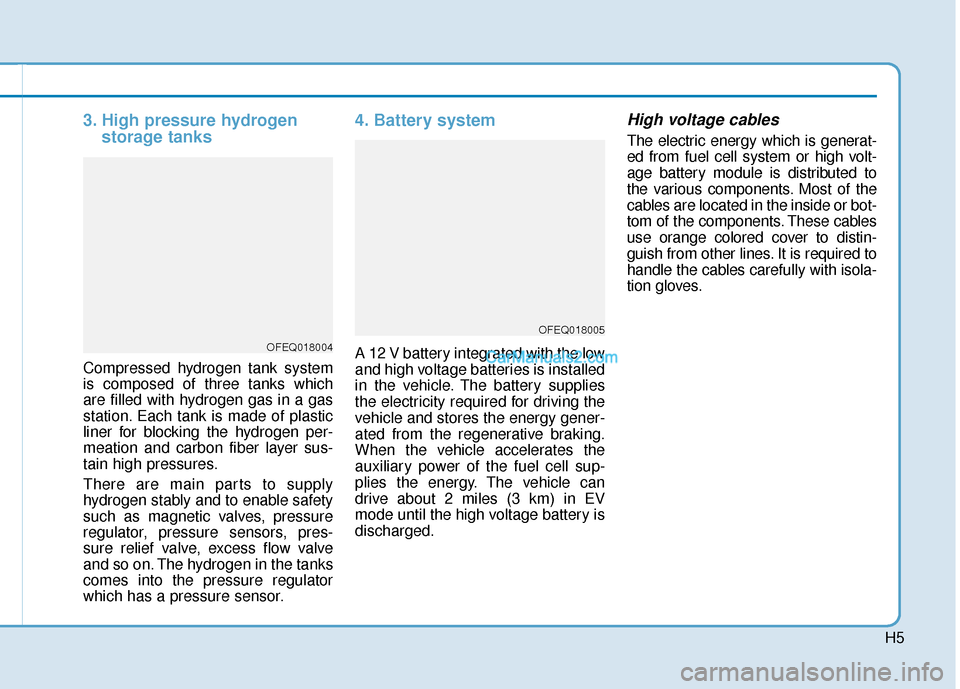
3. High pressure hydrogenstorage tanks
Compressed hydrogen tank system
is composed of three tanks which
are filled with hydrogen gas in a gas
station. Each tank is made of plastic
liner for blocking the hydrogen per-
meation and carbon fiber layer sus-
tain high pressures.
There are main parts to supply
hydrogen stably and to enable safety
such as magnetic valves, pressure
regulator, pressure sensors, pres-
sure relief valve, excess flow valve
and so on. The hydrogen in the tanks
comes into the pressure regulator
which has a pressure sensor.
4. Battery system
A 12 V battery integrated with the low
and high voltage batteries is installed
in the vehicle. The battery supplies
the electricity required for driving the
vehicle and stores the energy gener-
ated from the regenerative braking.
When the vehicle accelerates the
auxiliary power of the fuel cell sup-
plies the energy. The vehicle can
drive about 2 miles (3 km) in EV
mode until the high voltage battery is
discharged.
High voltage cables
The electric energy which is generat-
ed from fuel cell system or high volt-
age battery module is distributed to
the various components. Most of the
cables are located in the inside or bot-
tom of the components. These cables
use orange colored cover to distin-
guish from other lines. It is required to
handle the cables carefully with isola-
tion gloves.
OFEQ018004
OFEQ018005
Page 531 of 560
H27
If a fire occurs
1. Stop the vehicle, put the gear intothe P(Park) position, set the park-
ing brake, and turn the vehicle off
to prevent the hydrogen and cur-
rent from leaking.
The flow of hydrogen into the fuel cell stack will be shut off to prevent
the current from being generated.
2. If the fire is small, which can be extinguished with fire extinguisher,
use carbon dioxide extinguisher.
You can also extinguish the fire
with water when the vehicle power
is turned off. If the fire is too big to be extinguished
with the fire extinguisher, evacuate
from the vehicle, call the fire depart-
ment, and let them know the vehicle
is a Fuel Cell Electric Vehicle. Do not
come close to the vehicle until the
fire is totally extinguished.
Emergency venting of hydrogen
gas
If the temperature near the safety
valve located at the rear under vehi-
cle is over 110°C caused by a fire or
other reasons, the safety valve will
open to vent hydrogen gas. Venting
the hydrogen gas makes a loud
noise because the venting speed is
very fast. Stay well away from the
vehicle. This jet stream of hydrogen
gas could ignite.
If a submersion in water occurs
If your vehicle was flooded and has
soaked carpeting or water on the
flooring, you should not try to start
the vehicle by pressing the POWER
button.
Call an authorized HYUNDAI dealer.
Do not use water to extinguish a
fire when the vehicle power is
turned on. Serious electric
shock may result.
WARNING
Page 549 of 560
H45
CategoryQuestionsAnswers
Explosion or
Fire (5 items)
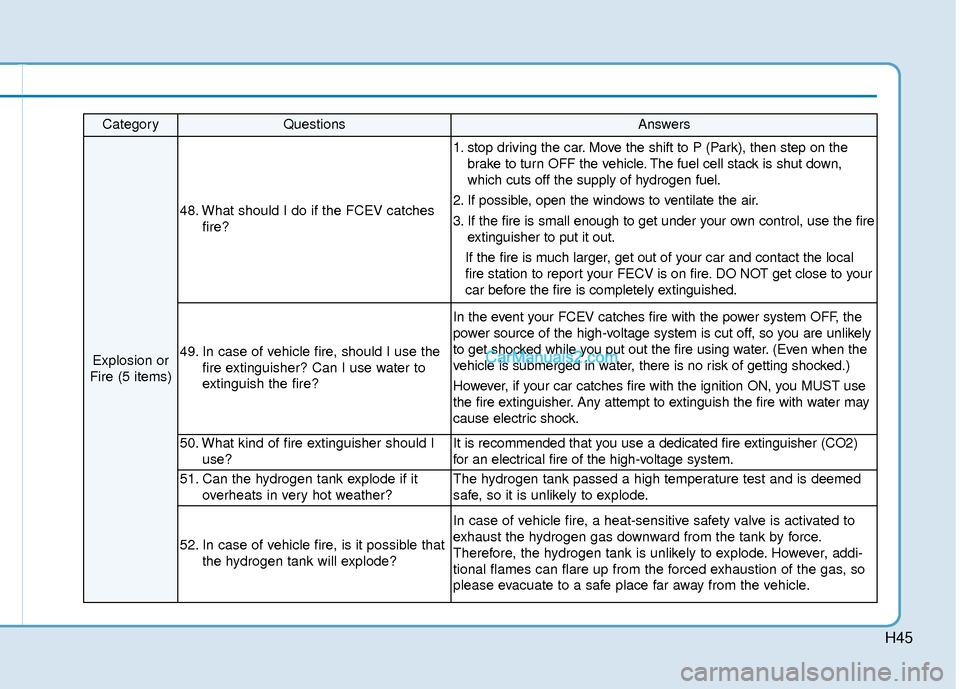
48. What should I do if the FCEV catches fire?
1. stop driving the car. Move the shift to P (Park), then step on thebrake to turn OFF the vehicle. The fuel cell stack is shut down,
which cuts off the supply of hydrogen fuel.
2. If possible, open the windows to ventilate the air.
3. If the fire is small enough to get under your own control, use the fire extinguisher to put it out.
If the fire is much larger, get out of your car and contact the local
fire station to report your FECV is on fire. DO NOT get close to your
car before the fire is completely extinguished.
49. In case of vehicle fire, should I use the fire extinguisher? Can I use water to
extinguish the fire?
In the event your FCEV catches fire with the power system OFF, the
power source of the high-voltage system is cut off, so you are unlikely
to get shocked while you put out the fire using water. (Even when the
vehicle is submerged in water, there is no risk of getting shocked.)
However, if your car catches fire with the ignition ON, you MUST use
the fire extinguisher. Any attempt to extinguish the fire with water may
cause electric shock.
50. What kind of fire extinguisher should Iuse?It is recommended that you use a dedicated fire extinguisher (CO2)
for an electrical fire of the high-voltage system.
51. Can the hydrogen tank explode if itoverheats in very hot weather?The hydrogen tank passed a high temperature test and is deemed
safe, so it is unlikely to explode.
52. In case of vehicle fire, is it possible thatthe hydrogen tank will explode?
In case of vehicle fire, a heat-sensitive safety valve is activated to
exhaust the hydrogen gas downward from the tank by force.
Therefore, the hydrogen tank is unlikely to explode. However, addi-
tional flames can flare up from the forced exhaustion of the gas, so
please evacuate to a safe place far away from the vehicle.