hydrogen HYUNDAI NEXO 2019 User Guide
[x] Cancel search | Manufacturer: HYUNDAI, Model Year: 2019, Model line: Nexo, Model: Hyundai Nexo 2019Pages: 561, PDF Size: 48.42 MB
Page 506 of 561
Introduction of FCEV .........................................................H2
The components of FCEV..................................................H3
Fuel cell stack ...................................................................................H4
FCEV system module .......................................................................H4
High pressure hydrogen storage tanks ......................................H5
Battery system..................................................................................H5
Features of FCEV .............................................................H10
How to Start the Vehicle ..............................................................H10
How to Stop the Vehicle ..............................................................H11
Virtual Engine Sound System......................................................H11
Fuel filler door ................................................................................H12
Warning and indicator lights .......................................................H15
LCD Display Messages ..................................................................H16
FCEV mode.......................................................................................H21
When the high voltage battery is weak ...................................H25
If the 12 volt battery is discharged...........................................H25
Emergency while driving ..............................................................H26
Customer Q&A Guide .......................................................H30
F FC
CE
EV
V
V
Ve
eh
hi
ic
cl
le
e
S
Sy
ys
st
te
em
m
O
Ov
ve
er
rv
vi
ie
ew
w
FCEV : Fuel Cell Electric Vehicle
Page 507 of 561
H2
An FCEV is an electric vehicle which is driven using the electricity generated from the fuel cell.
The power system of the FCEV is composed of the following:
- The fuel cell stack which generates the electricity
- The device which controls the heat generated after supplying the hydrogen and air for chemical reaction of the stack
- The inverter which converts the DC created from the stack to AC
- The traction motor which generates propelling power using the supplied AC
- Air processing system
- Fuel processing system
The hydrogen tanks that stores the hydrogen supplied to the fuel cell can be fueled at 70 MPa.
❈FCEV is Fuel Cell Electric Vehicle
I
IN
NT
TR
RO
OD
DU
UC
CT
TI
IO
ON
N
O
OF
F
F
FC
CE
EV
V
Page 508 of 561
H3
T TH
HE
E
C
CO
OM
MP
PO
ON
NE
EN
NT
TS
S
O
OF
F
F
FC
CE
EV
V
OFEQ018001N/OFEQ018002/OFEQ018003/OFEQ018004/OFEQ018005
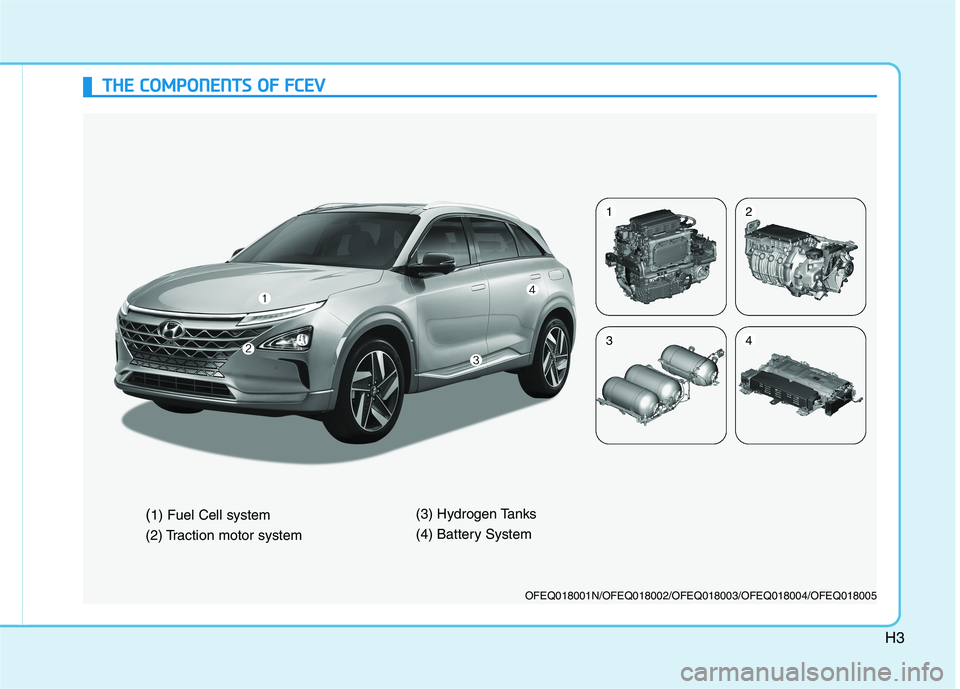
(1) Fuel Cell system
(2) Traction motor system(3) Hydrogen Tanks
(4) Battery System
12
34
Page 509 of 561
H4
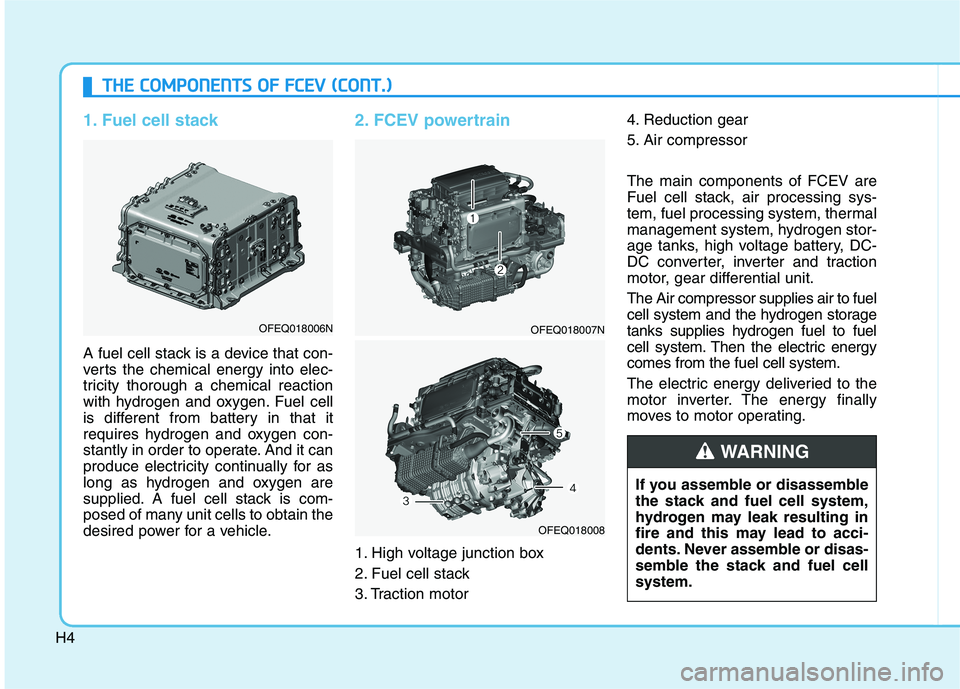
1. Fuel cell stack
A fuel cell stack is a device that con-
verts the chemical energy into elec-
tricity thorough a chemical reaction
with hydrogen and oxygen. Fuel cell
is different from battery in that it
requires hydrogen and oxygen con-
stantly in order to operate. And it can
produce electricity continually for as
long as hydrogen and oxygen are
supplied. A fuel cell stack is com-
posed of many unit cells to obtain the
desired power for a vehicle.
2. FCEV powertrain
1. High voltage junction box
2. Fuel cell stack
3. Traction motor4. Reduction gear
5. Air compressor
The main components of FCEV are
Fuel cell stack, air processing sys-
tem, fuel processing system, thermal
management system, hydrogen stor-
age tanks, high voltage battery, DC-
DC converter, inverter and traction
motor, gear differential unit.
The Air compressor supplies air to fuel
cell system and the hydrogen storage
tanks supplies hydrogen fuel to fuel
cell system. Then the electric energy
comes from the fuel cell system.
The electric energy deliveried to the
motor inverter. The energy finally
moves to motor operating.
T TH
HE
E
C
CO
OM
MP
PO
ON
NE
EN
NT
TS
S
O
OF
F
F
FC
CE
EV
V
(
(C
CO
ON
NT
T.
.)
)
OFEQ018006NOFEQ018007N
OFEQ018008
If you assemble or disassemble
the stack and fuel cell system,
hydrogen may leak resulting in
fire and this may lead to acci-
dents. Never assemble or disas-
semble the stack and fuel cell
system.
WARNING
Page 510 of 561
H5
3. High pressure hydrogen
storage tanks
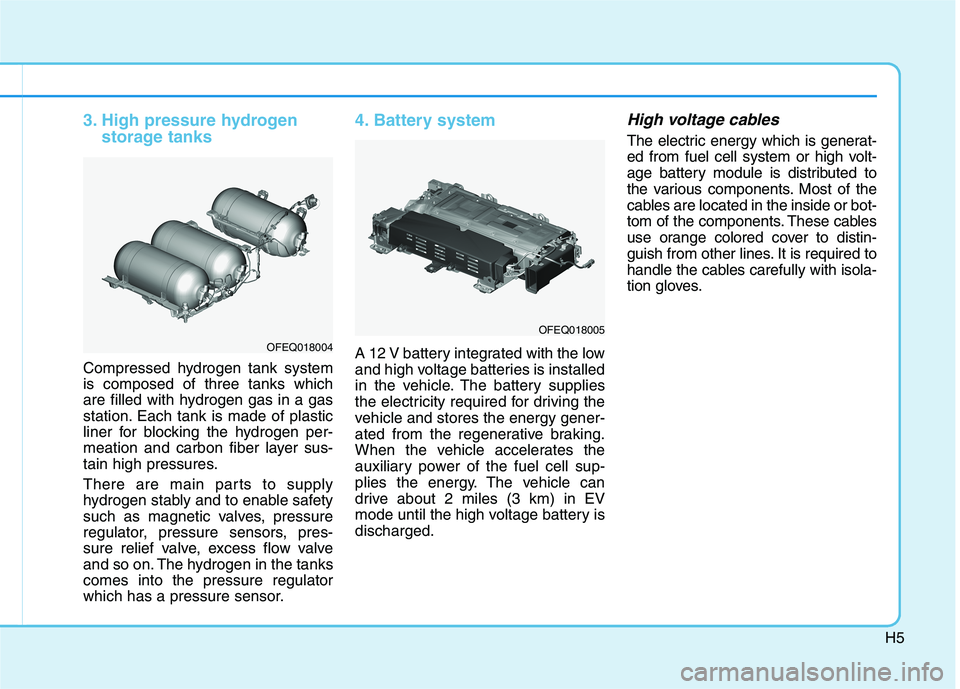
Compressed hydrogen tank system
is composed of three tanks which
are filled with hydrogen gas in a gas
station. Each tank is made of plastic
liner for blocking the hydrogen per-
meation and carbon fiber layer sus-
tain high pressures.
There are main parts to supply
hydrogen stably and to enable safety
such as magnetic valves, pressure
regulator, pressure sensors, pres-
sure relief valve, excess flow valve
and so on. The hydrogen in the tanks
comes into the pressure regulator
which has a pressure sensor.
4. Battery system
A 12 V battery integrated with the low
and high voltage batteries is installed
in the vehicle. The battery supplies
the electricity required for driving the
vehicle and stores the energy gener-
ated from the regenerative braking.
When the vehicle accelerates the
auxiliary power of the fuel cell sup-
plies the energy. The vehicle can
drive about 2 miles (3 km) in EV
mode until the high voltage battery is
discharged.
High voltage cables
The electric energy which is generat-
ed from fuel cell system or high volt-
age battery module is distributed to
the various components. Most of the
cables are located in the inside or bot-
tom of the components. These cables
use orange colored cover to distin-
guish from other lines. It is required to
handle the cables carefully with isola-
tion gloves.
OFEQ018004
OFEQ018005
Page 511 of 561
H6
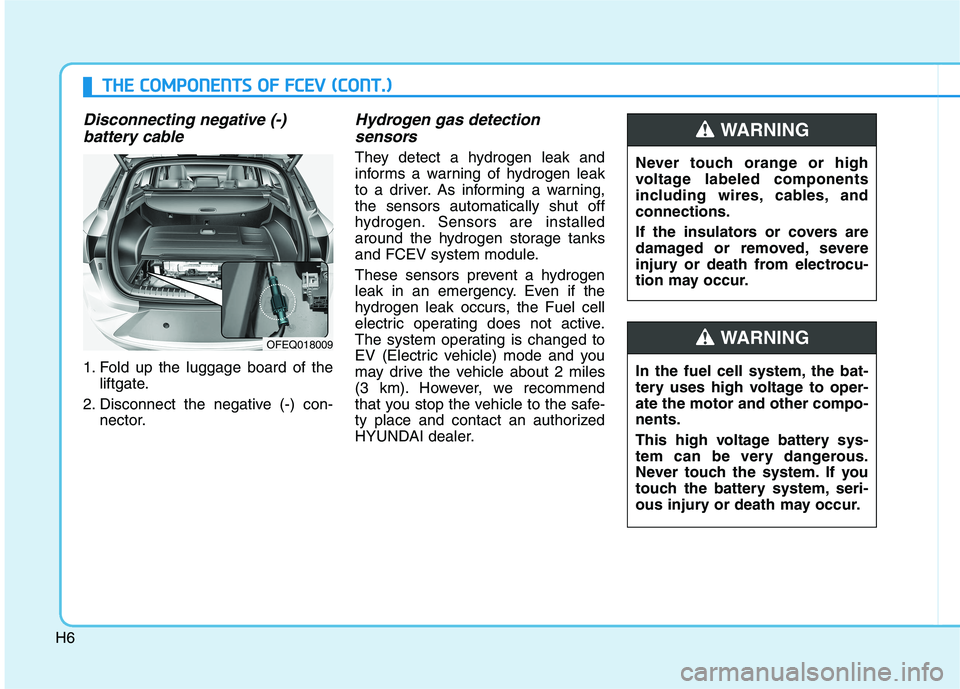
Disconnecting negative (-)
battery cable
1. Fold up the luggage board of the
liftgate.
2. Disconnect the negative (-) con-
nector.
Hydrogen gas detection
sensors
They detect a hydrogen leak and
informs a warning of hydrogen leak
to a driver. As informing a warning,
the sensors automatically shut off
hydrogen. Sensors are installed
around the hydrogen storage tanks
and FCEV system module.
These sensors prevent a hydrogen
leak in an emergency. Even if the
hydrogen leak occurs, the Fuel cell
electric operating does not active.
The system operating is changed to
EV (Electric vehicle) mode and you
may drive the vehicle about 2 miles
(3 km). However, we recommend
that you stop the vehicle to the safe-
ty place and contact an authorized
HYUNDAI dealer.
OFEQ018009
T TH
HE
E
C
CO
OM
MP
PO
ON
NE
EN
NT
TS
S
O
OF
F
F
FC
CE
EV
V
(
(C
CO
ON
NT
T.
.)
)
Never touch orange or high
voltage labeled components
including wires, cables, and
connections.
If the insulators or covers are
damaged or removed, severe
injury or death from electrocu-
tion may occur.
WARNING
In the fuel cell system, the bat-
tery uses high voltage to oper-
ate the motor and other compo-
nents.
This high voltage battery sys-
tem can be very dangerous.
Never touch the system. If you
touch the battery system, seri-
ous injury or death may occur.
WARNING
Page 513 of 561
H8
T TH
HE
E
C
CO
OM
MP
PO
ON
NE
EN
NT
TS
S
O
OF
F
F
FC
CE
EV
V
(
(C
CO
ON
NT
T.
.)
)
This vehicle uses the high volt-
age battery system to generate
high voltage.
High voltage in the battery sys-
tem is very dangerous and can
cause severe burns and electric
shock. This may result in seri-
ous injury or death.
For your safety, never touch,
replace, dismantle or remove
the high voltage battery sys-
tem including components,
cables and connectors.
Severe burns or electric
shock may result in serious
injury or death if you do not
follow this warning.
When the high voltage battery
system operates, the battery
system can be hot. Always be
careful because burns or elec-
tric shock may be caused by
high voltage.
Do not drop water or liquid on
to Fuel cell power module
compartment. The system
components are covered. If
you drop water or liquid on to
system components, it may
result in electric shock.
WARNING
When the vehicle is paint
baked, do not pass 30 min-
utes in 158°F (70°C) or 20 min-
utes in 176°F (80°C) degree.
When you clean the fuel cell
power module compartment,
do not wash using water.
Water may cause an electric
shock to occur and damage
electronic parts and compo-
nents.
CAUTION
Do not assemble or disassem-
ble the hydrogen tanks.
Improper work may damage
the performance and reliabili-
ty and unexpected problem
may occur. For hydrogen
tanks work, contact an author-
ized HYUNDAI dealer.
Never drill into, strike or oth-
erwise damage the hydrogen
tanks. Unexpected problem
may occur resulting in seri-
ous injury and death.
Never get near or put a hydro-
gen tanks in a fire. Doing so
may result in big injury.
Never use the hydrogen tank
for any other purpose.
WARNING
Page 518 of 561
H13
Information
If the fuel filler door does not open
because ice has formed around it, tap
lightly or push on the door to break
the ice and release the door. Do not
pry on the door. If necessary, spray
around the door with an approved de-
icer fluid (do not use radiator anti-
freeze) or move the vehicle to a warm
place and allow the ice to melt.
Closing the fuel filler door
1. Cover the fuel filler with the cap.
2. Close the fuel filler door until it is
latched securely.i
If the fuel filler cap requires
replacement, use parts for
replacement from an author-
ized Hyundai dealer. An incor-
rect fuel filler cap can result in
a serious malfunction of the
fuel system. Contact an
authorized HYUNDAI dealer
for replacement.
If the fuel filler door is not
completely closed, the vehicle
is not turned on. Close the
fuel filler door and turn on the
vehicle.
WARNING
According to the hydrogen
fueling station condition the
hydrogen may not be filled
fully and the driving distance
may change accordingly. The
hydrogen may not be charged
fully if the fueling station does
not satisfy the fueling method
specified in the fueling. stan-
dard (SAE J2601) or if the
hydrogen is not enough in the
station, the fueling facility
has failure, etc.
Depending on the remaining
hydrogen in the vehicle and
ambient temperature, the time
required for fueling may vary.
More time may be required for
fueling if the remaining hydro-
gen level is low and the
weather is hot. Also, required
time may be longer if the
hydrogen cooling tempera-
ture of the fueling station is
high.
The distance to empty may
vary depending on the driving
environment (weather, traffic,
etc.) and driving method
(rapid acceleration, heating
and air conditioning, etc.).WARNING
Page 520 of 561
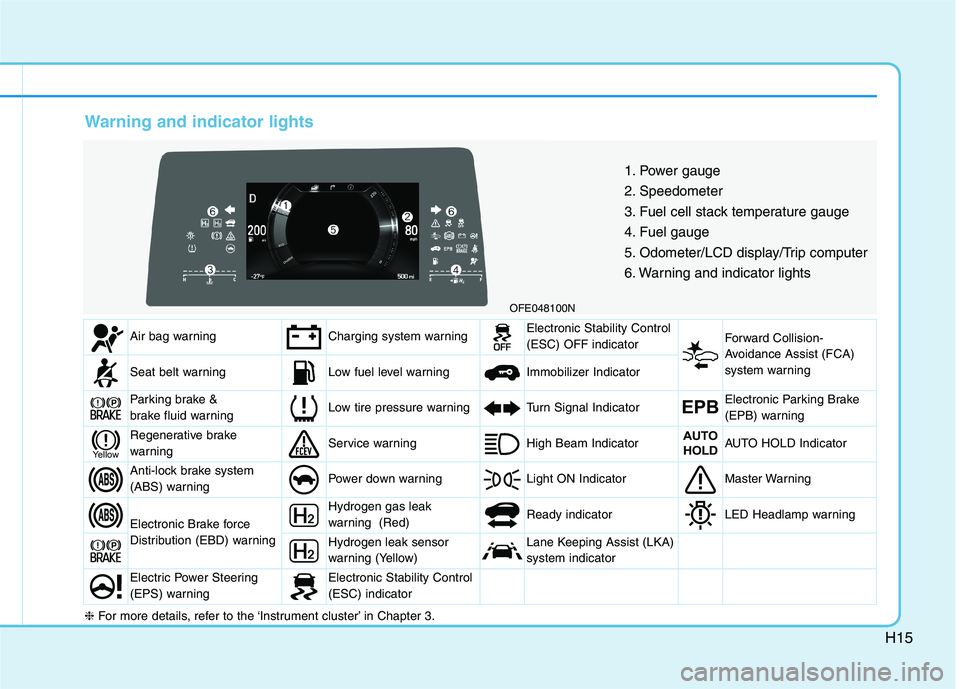
H15
Warning and indicator lights
OFE048100N
1. Power gauge
2. Speedometer
3. Fuel cell stack temperature gauge
4. Fuel gauge
5. Odometer/LCD display/Trip computer
6. Warning and indicator lights
Air bag warningCharging system warningElectronic Stability Control
(ESC) OFF indicator Forward Collision-
Avoidance Assist (FCA)
system warning
Seat belt warningLow fuel level warning Immobilizer Indicator
Parking brake &
brake fluid warningLow tire pressure warningTurn Signal IndicatorEPBElectronic Parking Brake
(EPB) warning
Regenerative brake
warningService warning High Beam IndicatorAUTO
HOLDAUTO HOLD Indicator
Anti-lock brake system
(ABS) warningPower down warning Light ON IndicatorMaster Warning
Electronic Brake force
Distribution (EBD) warning
Hydrogen gas leak
warning (Red) Ready indicatorLED Headlamp warning
Hydrogen leak sensor
warning (Yellow)Lane Keeping Assist (LKA)
system indicator
Electric Power Steering
(EPS) warningElectronic Stability Control
(ESC) indicator
Yellow
❈For more details, refer to the ‘Instrument cluster’ in Chapter 3.
Page 522 of 561
H17
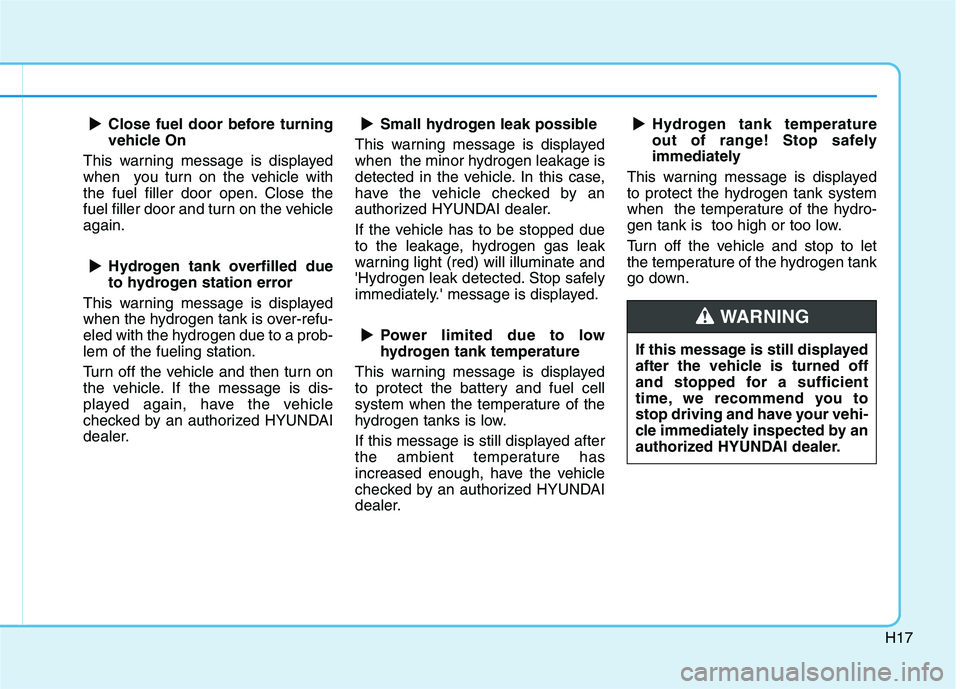
Close fuel door before turning
vehicle On
This warning message is displayed
when you turn on the vehicle with
the fuel filler door open. Close the
fuel filler door and turn on the vehicle
again.
Hydrogen tank overfilled due
to hydrogen station error
This warning message is displayed
when the hydrogen tank is over-refu-
eled with the hydrogen due to a prob-
lem of the fueling station.
Turn off the vehicle and then turn on
the vehicle. If the message is dis-
played again, have the vehicle
checked by an authorized HYUNDAI
dealer.Small hydrogen leak possible
This warning message is displayed
when the minor hydrogen leakage is
detected in the vehicle. In this case,
have the vehicle checked by an
authorized HYUNDAI dealer.
If the vehicle has to be stopped due
to the leakage, hydrogen gas leak
warning light (red) will illuminate and
'Hydrogen leak detected. Stop safely
immediately.' message is displayed.
Power limited due to low
hydrogen tank temperature
This warning message is displayed
to protect the battery and fuel cell
system when the temperature of the
hydrogen tanks is low.
If this message is still displayed after
the ambient temperature has
increased enough, have the vehicle
checked by an authorized HYUNDAI
dealer.Hydrogen tank temperature
out of range! Stop safely
immediately
This warning message is displayed
to protect the hydrogen tank system
when the temperature of the hydro-
gen tank is too high or too low.
Turn off the vehicle and stop to let
the temperature of the hydrogen tank
go down.▲ ▲
▲ ▲ ▲
▲
▲ ▲ ▲
▲
If this message is still displayed
after the vehicle is turned off
and stopped for a sufficient
time, we recommend you to
stop driving and have your vehi-
cle immediately inspected by an
authorized HYUNDAI dealer.
WARNING