battery HYUNDAI NEXO 2020 Repair Manual
[x] Cancel search | Manufacturer: HYUNDAI, Model Year: 2020, Model line: NEXO, Model: HYUNDAI NEXO 2020Pages: 561, PDF Size: 48.42 MB
Page 512 of 561
H7
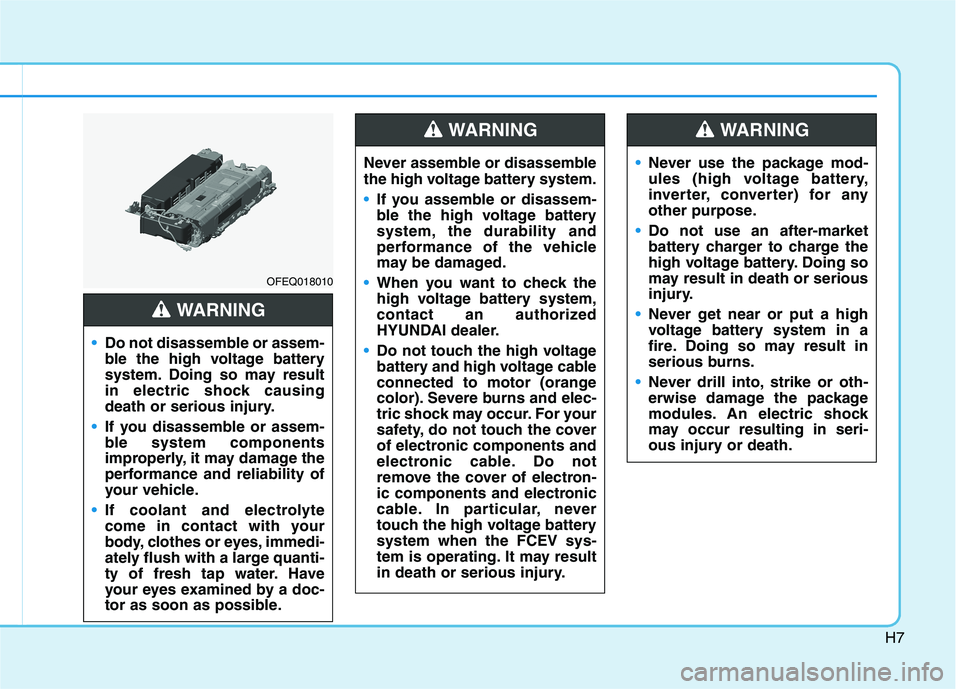
OFEQ018010
•Do not disassemble or assem-
ble the high voltage battery
system. Doing so may result
in electric shock causing
death or serious injury.
If you disassemble or assem-
ble system components
improperly, it may damage the
performance and reliability of
your vehicle.
If coolant and electrolyte
come in contact with your
body, clothes or eyes, immedi-
ately flush with a large quanti-
ty of fresh tap water. Have
your eyes examined by a doc-
tor as soon as possible.
WARNING
Never assemble or disassemble
the high voltage battery system.
If you assemble or disassem-
ble the high voltage battery
system, the durability and
performance of the vehicle
may be damaged.
When you want to check the
high voltage battery system,
contact an authorized
HYUNDAI dealer.
Do not touch the high voltage
battery and high voltage cable
connected to motor (orange
color). Severe burns and elec-
tric shock may occur. For your
safety, do not touch the cover
of electronic components and
electronic cable. Do not
remove the cover of electron-
ic components and electronic
cable. In particular, never
touch the high voltage battery
system when the FCEV sys-
tem is operating. It may result
in death or serious injury.
WARNING
Never use the package mod-
ules (high voltage battery,
inverter, converter) for any
other purpose.
Do not use an after-market
battery charger to charge the
high voltage battery. Doing so
may result in death or serious
injury.
Never get near or put a high
voltage battery system in a
fire. Doing so may result in
serious burns.
Never drill into, strike or oth-
erwise damage the package
modules. An electric shock
may occur resulting in seri-
ous injury or death.
WARNING
Page 513 of 561
H8
T TH
HE
E
C
CO
OM
MP
PO
ON
NE
EN
NT
TS
S
O
OF
F
F
FC
CE
EV
V
(
(C
CO
ON
NT
T.
.)
)
This vehicle uses the high volt-
age battery system to generate
high voltage.
High voltage in the battery sys-
tem is very dangerous and can
cause severe burns and electric
shock. This may result in seri-
ous injury or death.
For your safety, never touch,
replace, dismantle or remove
the high voltage battery sys-
tem including components,
cables and connectors.
Severe burns or electric
shock may result in serious
injury or death if you do not
follow this warning.
When the high voltage battery
system operates, the battery
system can be hot. Always be
careful because burns or elec-
tric shock may be caused by
high voltage.
Do not drop water or liquid on
to Fuel cell power module
compartment. The system
components are covered. If
you drop water or liquid on to
system components, it may
result in electric shock.
WARNING
When the vehicle is paint
baked, do not pass 30 min-
utes in 158°F (70°C) or 20 min-
utes in 176°F (80°C) degree.
When you clean the fuel cell
power module compartment,
do not wash using water.
Water may cause an electric
shock to occur and damage
electronic parts and compo-
nents.
CAUTION
Do not assemble or disassem-
ble the hydrogen tanks.
Improper work may damage
the performance and reliabili-
ty and unexpected problem
may occur. For hydrogen
tanks work, contact an author-
ized HYUNDAI dealer.
Never drill into, strike or oth-
erwise damage the hydrogen
tanks. Unexpected problem
may occur resulting in seri-
ous injury and death.
Never get near or put a hydro-
gen tanks in a fire. Doing so
may result in big injury.
Never use the hydrogen tank
for any other purpose.
WARNING
Page 514 of 561
H9
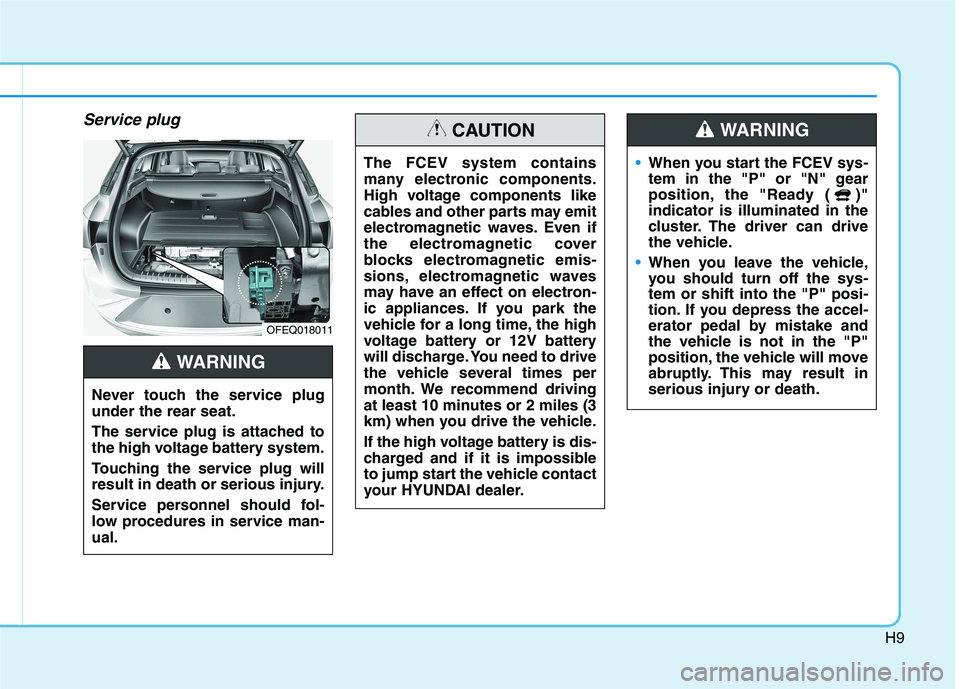
Service plug
OFEQ018011
The FCEV system contains
many electronic components.
High voltage components like
cables and other parts may emit
electromagnetic waves. Even if
the electromagnetic cover
blocks electromagnetic emis-
sions, electromagnetic waves
may have an effect on electron-
ic appliances. If you park the
vehicle for a long time, the high
voltage battery or 12V battery
will discharge. You need to drive
the vehicle several times per
month. We recommend driving
at least 10 minutes or 2 miles (3
km) when you drive the vehicle.
If the high voltage battery is dis-
charged and if it is impossible
to jump start the vehicle contact
your HYUNDAI dealer.
CAUTION
When you start the FCEV sys-
tem in the "P" or "N" gear
position, the "Ready ( )"
indicator is illuminated in the
cluster. The driver can drive
the vehicle.
When you leave the vehicle,
you should turn off the sys-
tem or shift into the "P" posi-
tion. If you depress the accel-
erator pedal by mistake and
the vehicle is not in the "P"
position, the vehicle will move
abruptly. This may result in
serious injury or death.
WARNING
Never touch the service plug
under the rear seat.
The service plug is attached to
the high voltage battery system.
Touching the service plug will
result in death or serious injury.
Service personnel should fol-
low procedures in service man-
ual.
WARNING
Page 522 of 561
H17
Close fuel door before turning
vehicle On
This warning message is displayed
when you turn on the vehicle with
the fuel filler door open. Close the
fuel filler door and turn on the vehicle
again.
Hydrogen tank overfilled due
to hydrogen station error
This warning message is displayed
when the hydrogen tank is over-refu-
eled with the hydrogen due to a prob-
lem of the fueling station.
Turn off the vehicle and then turn on
the vehicle. If the message is dis-
played again, have the vehicle
checked by an authorized HYUNDAI
dealer.Small hydrogen leak possible
This warning message is displayed
when the minor hydrogen leakage is
detected in the vehicle. In this case,
have the vehicle checked by an
authorized HYUNDAI dealer.
If the vehicle has to be stopped due
to the leakage, hydrogen gas leak
warning light (red) will illuminate and
'Hydrogen leak detected. Stop safely
immediately.' message is displayed.
Power limited due to low
hydrogen tank temperature
This warning message is displayed
to protect the battery and fuel cell
system when the temperature of the
hydrogen tanks is low.
If this message is still displayed after
the ambient temperature has
increased enough, have the vehicle
checked by an authorized HYUNDAI
dealer.Hydrogen tank temperature
out of range! Stop safely
immediately
This warning message is displayed
to protect the hydrogen tank system
when the temperature of the hydro-
gen tank is too high or too low.
Turn off the vehicle and stop to let
the temperature of the hydrogen tank
go down.▲ ▲
▲ ▲ ▲
▲
▲ ▲ ▲
▲
If this message is still displayed
after the vehicle is turned off
and stopped for a sufficient
time, we recommend you to
stop driving and have your vehi-
cle immediately inspected by an
authorized HYUNDAI dealer.
WARNING
Page 524 of 561
H19
Check fuel cell system! Stop
safely immediately
This warning message is displayed
when any serious malfunction of the
fuel cell system is detected.
In this case, immediately park the
vehicle at a safe area and turn off the
vehicle. Then turn the vehicle on
again.
If the message is displayed again,
have the vehicle checked by an
authorized HYUNDAI dealer.
Unable to start vehicle! Check
high voltage system
This warning message is displayed
when there is a malfunction with the
high voltage system.
If the vehicle will not turn on, have
the vehicle checked by an authorized
HYUNDAI dealer.Unable to start vehicle.
Hydrogen too low
This warning message is displayed
when the fuel is empty and the vehi-
cle is not turned on. The vehicle will
not turn on and we recommend that
you have your vehicle inspected by
an authorized HYUNDAI dealer.
Check FCEV System! Stop and
turn vehicle Off
This warning message is displayed
when there is a temporary malfunc-
tion with the FCEV system. Stop the
vehicle at a safe area and turn off the
vehicle. Then turn on the vehicle
after a while. If the message is dis-
played again, have the vehicle
checked by an authorized HYUNDAI
dealer.Check 12V battery. Stop safely
and engage parking brake
This warning message is displayed
when the voltage of the auxiliary bat-
tery is low. Stop the vehicle at a safe
area and turn off the vehicle. Then
turn on the vehicle after a while. If the
message is displayed again, have
the vehicle checked by an authorized
HYUNDAI dealer.
Low fuel
This warning message is displayed
when you need to refuel the vehicle.
Refuel the vehicle immediately at a
nearby fueling station.
▲ ▲ ▲
▲
▲ ▲ ▲
▲
▲ ▲ ▲
▲
Page 526 of 561
H21
FCEV mode
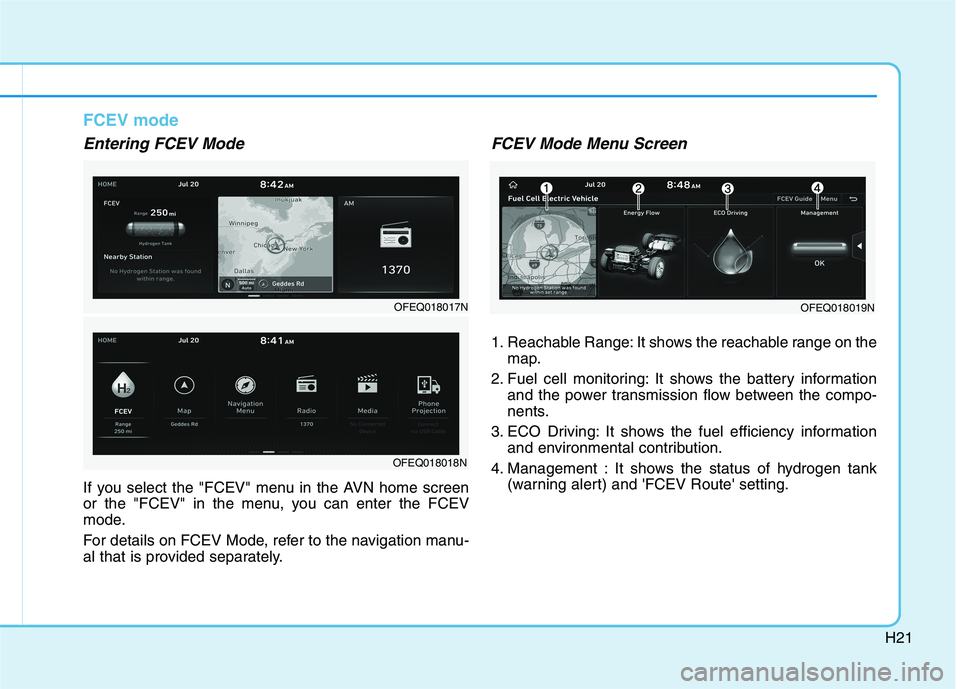
Entering FCEV Mode
If you select the "FCEV" menu in the AVN home screen
or the "FCEV" in the menu, you can enter the FCEV
mode.
For details on FCEV Mode, refer to the navigation manu-
al that is provided separately.
FCEV Mode Menu Screen
1. Reachable Range: It shows the reachable range on the
map.
2. Fuel cell monitoring: It shows the battery information
and the power transmission flow between the compo-
nents.
3. ECO Driving: It shows the fuel efficiency information
and environmental contribution.
4. Management : It shows the status of hydrogen tank
(warning alert) and 'FCEV Route' setting.
OFEQ018017NOFEQ018019N
OFEQ018018N
Page 527 of 561
H22
F FE
EA
AT
TU
UR
RE
ES
S
O
OF
F
F
FC
CE
EV
V
(
(C
CO
ON
NT
T.
.)
)
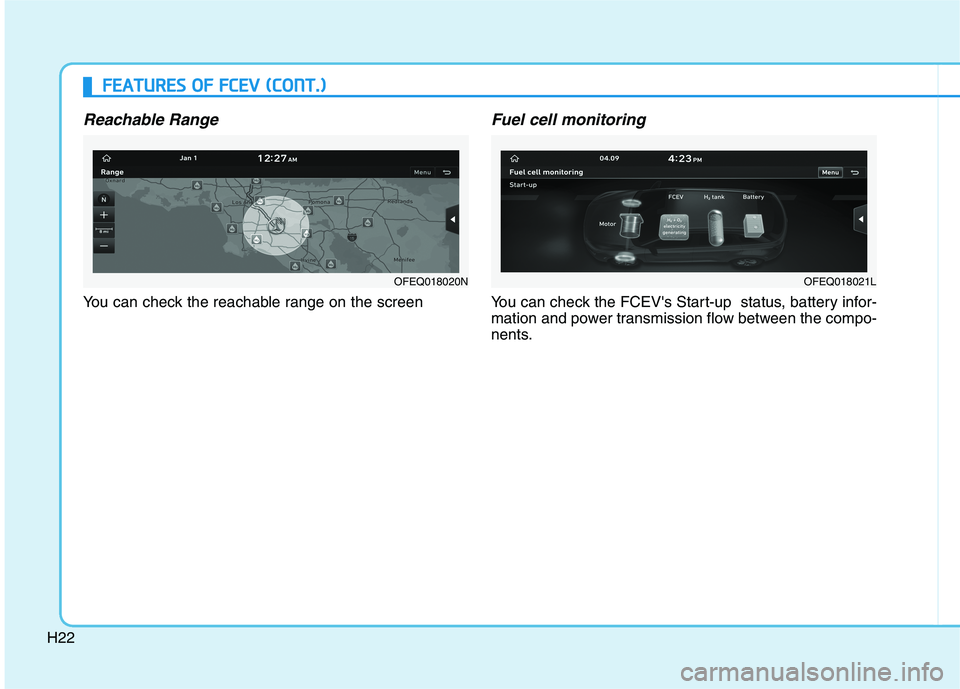
Reachable Range
You can check the reachable range on the screen
Fuel cell monitoring
You can check the FCEV's Start-up status, battery infor-
mation and power transmission flow between the compo-
nents.
OFEQ018020NOFEQ018021L
Page 530 of 561
H25
When the high voltage battery
is weak
When the high voltage battery is
weak due to driving on a hill for a
long time or accelerating and decel-
erating the vehicle repeatedly, the
acceleration performance may be
lower than usual. In this case, be
cautious not to overtake other vehi-
cles.
If the 12 volt battery is dis-
charged
This vehicle does not have a regular
12V battery that needs periodic
replacement. It is lithium ion polymer
type integrated into the high voltage
battery. The vehicle has a 12V bat-
tery protection system that cuts 12V
battery from vehicle draw to prevent
full discharge.
If the 12V battery is discharged, you
should try charging it by pressing the
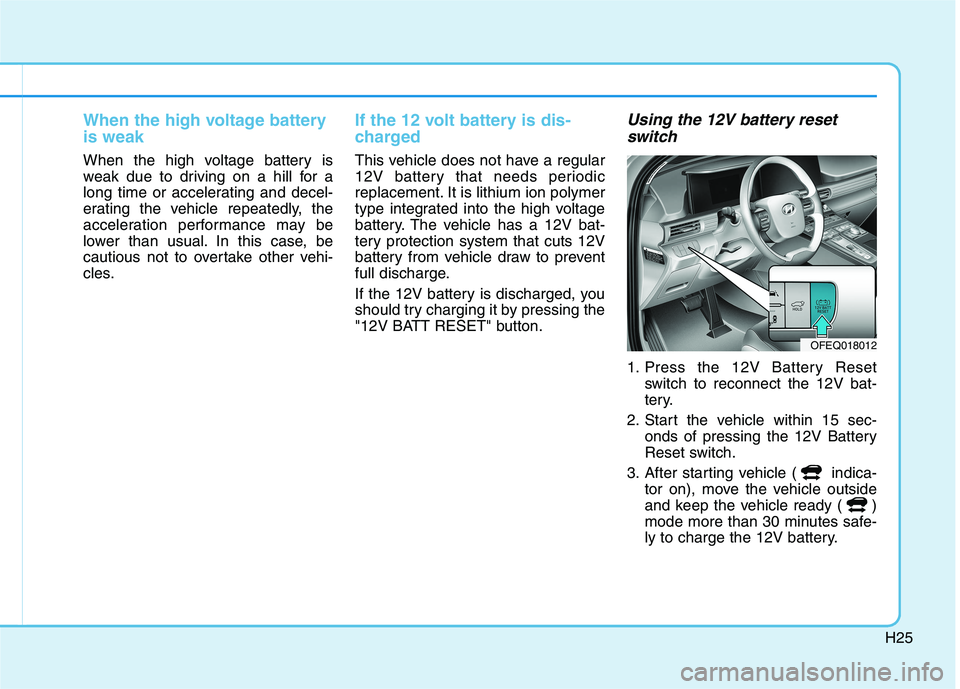
"12V BATT RESET" button.
Using the 12V battery reset
switch
1. Press the 12V Battery Reset
switch to reconnect the 12V bat-
tery.
2. Start the vehicle within 15 sec-
onds of pressing the 12V Battery
Reset switch.
3. After starting vehicle ( indica-
tor on), move the vehicle outside
and keep the vehicle ready ( )
mode more than 30 minutes safe-
ly to charge the 12V battery.
OFEQ018012
Page 531 of 561
H26
F FE
EA
AT
TU
UR
RE
ES
S
O
OF
F
F
FC
CE
EV
V
(
(C
CO
ON
NT
T.
.)
)
If you do not start the vehicle imme-
diately after pressing the 12V Battery
Reset switch, the power of 12V bat-
tery is automatically disconnected
after few seconds to save the 12V
battery from additional discharge. If
the 12V battery is disconnected prior
to starting the vehicle, press the 12V
Battery Reset switch again and then
immediately start the vehicle as
explained.
Repeated use of the 12V Battery
Reset switch without a sufficient ON
cycle (30 Min+) may cause over dis-
charge of the 12V battery, which will
prevent the vehicle from starting. If
the 12V battery is over discharged to
a point that the reset does not work,
try to jump-start the vehicle.Information
After starting the vehicle ( indica-
tor on), the 12V battery is being
charged whether the accelerator pedal
is depressed or not.
❈ ❈
For more details regarding the
jump start, refer to the 'Jump star-
ing' in Owner's manual Chapter 6.
Emergency while driving
If an accident occurs
1. Stop the vehicle, put the gear into
the P (Park) position, set the park-
ing brake, and turn the vehicle off
to prevent the hydrogen and cur-
rent from leaking.
The flow of hydrogen into the fuel
cell stack will be shut off to prevent
the current from being generated.
2. Evacuate to the safety place.
3. Call emergency services for help
and let them know the vehicle is a
Fuel Cell Electric Vehicle.
i
Page 537 of 561
H32
CategoryQuestionsAnswers
Vehicle
overview
(10 items)
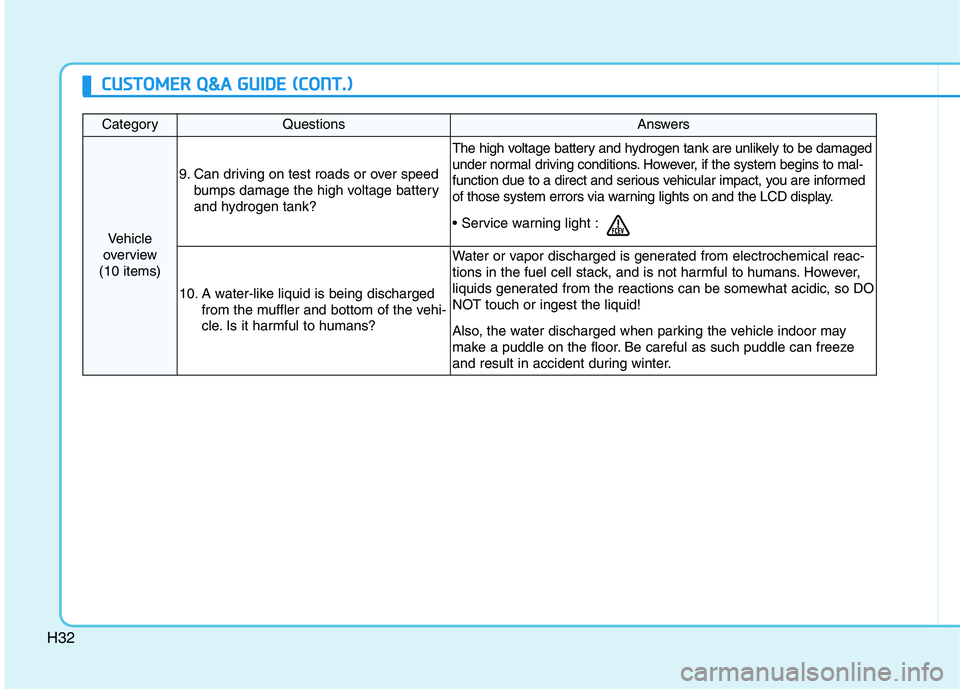
9. Can driving on test roads or over speed
bumps damage the high voltage battery
and hydrogen tank?
The high voltage battery and hydrogen tank are unlikely to be damaged
under normal driving conditions. However, if the system begins to mal-
function due to a direct and serious vehicular impact, you are informed
of those system errors via warning lights on and the LCD display.
10. A water-like liquid is being discharged
from the muffler and bottom of the vehi-
cle. Is it harmful to humans?
Water or vapor discharged is generated from electrochemical reac-
tions in the fuel cell stack, and is not harmful to humans. However,
liquids generated from the reactions can be somewhat acidic, so DO
NOT touch or ingest the liquid!
Also, the water discharged when parking the vehicle indoor may
make a puddle on the floor. Be careful as such puddle can freeze
and result in accident during winter.
C CU
US
ST
TO
OM
ME
ER
R
Q
Q&
&A
A
G
GU
UI
ID
DE
E
(
(C
CO
ON
NT
T.
.)
)