Fuel system HYUNDAI NEXO 2021 Owner's Manual
[x] Cancel search | Manufacturer: HYUNDAI, Model Year: 2021, Model line: NEXO, Model: HYUNDAI NEXO 2021Pages: 561, PDF Size: 48.42 MB
Page 470 of 561
7-45
7
Maintenance
F
FU
U S
SE
E S
S
A vehicle's electrical system is pro-
tected from electrical overload dam-
age by fuses.
This vehicle has 2 (or 3) fuse panels,
one located in the driver's side panel
bolster, the other in the fuel cell
power module compartment near the
battery. If any of your vehicle’s lights, acces-
sories, or controls do not work, check
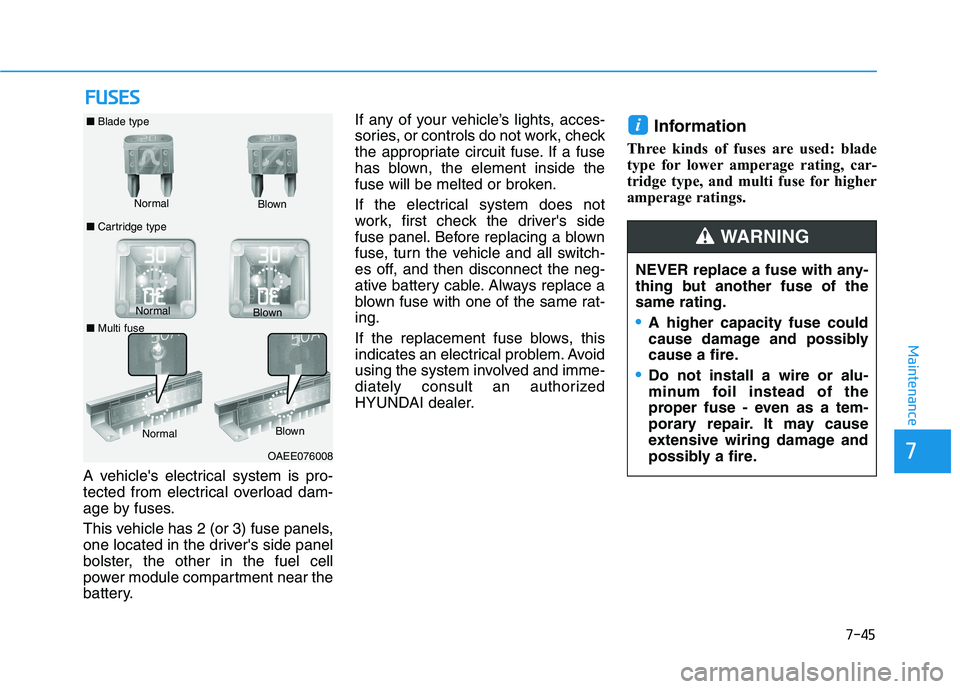
the appropriate circuit fuse. If a fuse
has blown, the element inside the
fuse will be melted or broken.
If the electrical system does not
work, first check the driver's side
fuse panel. Before replacing a blown
fuse, turn the vehicle and all switch-
es off, and then disconnect the neg-
ative battery cable. Always replace a
blown fuse with one of the same rat-
ing.
If the replacement fuse blows, this
indicates an electrical problem. Avoid
using the system involved and imme-
diately consult an authorized
HYUNDAI dealer.
Information
Three kinds of fuses are used: blade
type for lower amperage rating, car-
tridge type, and multi fuse for higher
amperage ratings.
i
NEVER replace a fuse with any-
thing but another fuse of the
same rating.
A higher capacity fuse could
cause damage and possibly
cause a fire.
Do not install a wire or alu-
minum foil instead of the
proper fuse - even as a tem-
porary repair. It may cause
extensive wiring damage and
possibly a fire.
WARNING
Normal
■
Blade type
■ Cartridge type Blown
Normal Blown
OAEE076008
Normal
Blown
■ Multi fuse
Page 473 of 561
7-48
Maintenance
Multi fuse
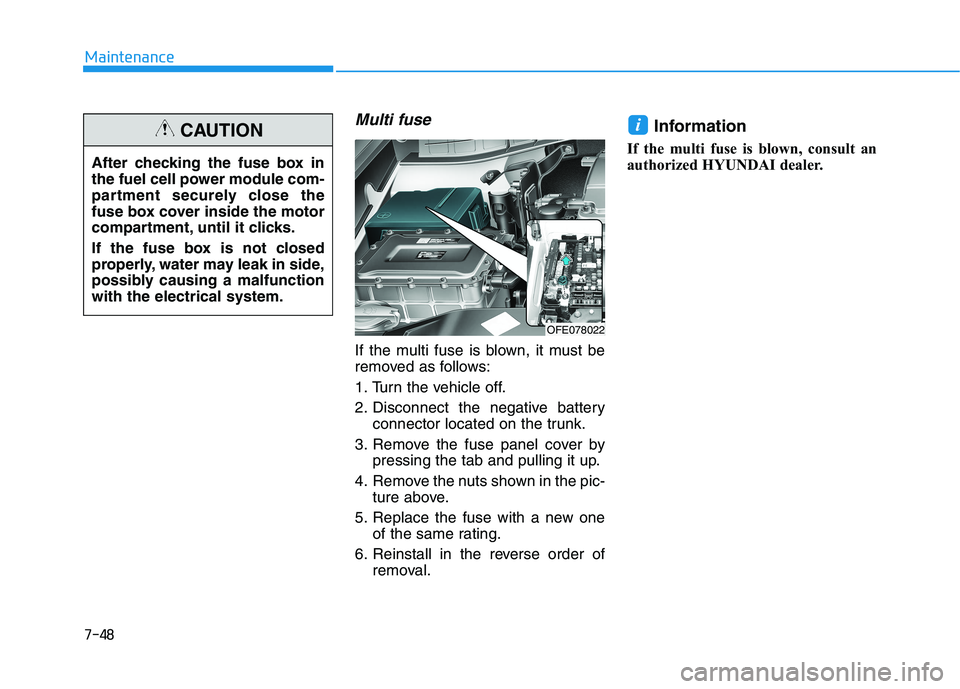
If the multi fuse is blown, it must be
removed as follows:
1. Turn the vehicle off.
2. Disconnect the negative batteryconnector located on the trunk.
3. Remove the fuse panel cover by pressing the tab and pulling it up.
4. Remove the nuts shown in the pic- ture above.
5. Replace the fuse with a new one of the same rating.
6. Reinstall in the reverse order of removal.
Information
If the multi fuse is blown, consult an
authorized HYUNDAI dealer.
i
OFE078022
After checking the fuse box in
the fuel cell power module com-
partment securely close the
fuse box cover inside the motor
compartment, until it clicks.
If the fuse box is not closed
properly, water may leak in side,
possibly causing a malfunction
with the electrical system.
CAUTION
Page 490 of 561
7-65
7
Maintenance
Bright-metal maintenance
To remove road tar and insects,use a tar remover, not a scraper or
other sharp object.
To protect the surfaces of bright- metal parts from corrosion, apply a
coating of wax or chrome preser-
vative and rub to a high luster.
During winter weather or in coastal areas, cover the bright metal parts
with a heavier coating of wax or
preservative. If necessary, coat the
parts with non-corrosive petroleum
jelly or other protective compound.
Underbody maintenance
Corrosive materials used for ice and
snow removal and dust control may
collect on the underbody. If these
materials are not removed, acceler-
ated rusting can occur on underbody
parts such as the fuel lines, frame,
floor pan and exhaust system, even
though they have been treated with
rust protection. Thoroughly flush the vehicle under-
body and wheel openings with luke-
warm or cold water once a month,
after off-road driving and at the end
of each winter. Pay special attention
to these areas because it is difficult
to see all the mud and dirt. It will do
more harm than good to wet down
the road grime without removing it.
The lower edges of doors, rocker
panels, and frame members have
drain holes that should not be
allowed to clog with dirt; trapped
water in these areas can cause rust-
ing.
Aluminum wheel maintenance
The aluminum wheels are coated
with a clear protective finish.
Do not use abrasive cleaner, pol-
ishing compound, solvent, or
wire brushes on aluminum
wheels.
Clean the wheel when it has cooled.
Use only a mild soap or neutral detergent, and rinse thoroughly
with water. Also, clean the
wheels after driving on salted
roads.
Do not wash the wheels with high-speed car wash brushes.
Do not use any cleaners con- taining acid or alkaline deter-
gents.
NOTICE
After washing the vehicle, test
the brakes while driving slowly
to see if they have been affected
by water. If braking performance
is impaired, dry the brakes by
applying them lightly while
maintaining a slow forward
speed.
WARNING
Page 506 of 561
Introduction of FCEV .........................................................H2
The components of FCEV..................................................H3
Fuel cell stack ...................................................................................H4
FCEV system module .......................................................................H4
High pressure hydrogen storage tanks ......................................H5
Battery system..................................................................................H5
Features of FCEV .............................................................H10
How to Start the Vehicle ..............................................................H10
How to Stop the Vehicle ..............................................................H11
Virtual Engine Sound System......................................................H11
Fuel filler door ................................................................................H12
Warning and indicator lights .......................................................H15
LCD Display Messages ..................................................................H16
FCEV mode.......................................................................................H21
When the high voltage battery is weak ...................................H25
If the 12 volt battery is discharged...........................................H25
Emergency while driving ..............................................................H26
Customer Q&A Guide .......................................................H30
F FC
CE
EV
V
V
Ve
eh
hi
ic
cl
le
e
S
Sy
ys
st
te
em
m
O
Ov
ve
er
rv
vi
ie
ew
w
FCEV : Fuel Cell Electric Vehicle
Page 507 of 561
H2
An FCEV is an electric vehicle which is driven using the electricity generated from the fuel cell.
The power system of the FCEV is composed of the following:
- The fuel cell stack which generates the electricity
- The device which controls the heat generated after supplying the hydrogen and air for chemical reaction of the stack
- The inverter which converts the DC created from the stack to AC
- The traction motor which generates propelling power using the supplied AC
- Air processing system
- Fuel processing system
The hydrogen tanks that stores the hydrogen supplied to the fuel cell can be fueled at 70 MPa.
❈FCEV is Fuel Cell Electric Vehicle
I
IN
NT
TR
RO
OD
DU
UC
CT
TI
IO
ON
N
O
OF
F
F
FC
CE
EV
V
Page 508 of 561
H3
T TH
HE
E
C
CO
OM
MP
PO
ON
NE
EN
NT
TS
S
O
OF
F
F
FC
CE
EV
V
OFEQ018001N/OFEQ018002/OFEQ018003/OFEQ018004/OFEQ018005
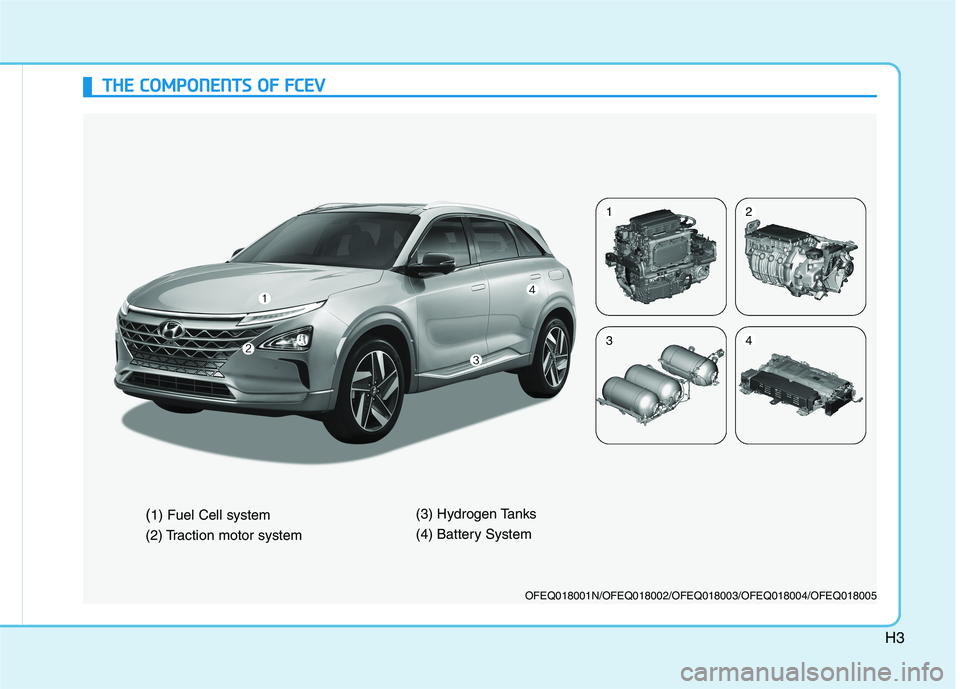
(1) Fuel Cell system
(2) Traction motor system(3) Hydrogen Tanks
(4) Battery System
12
34
Page 509 of 561
H4
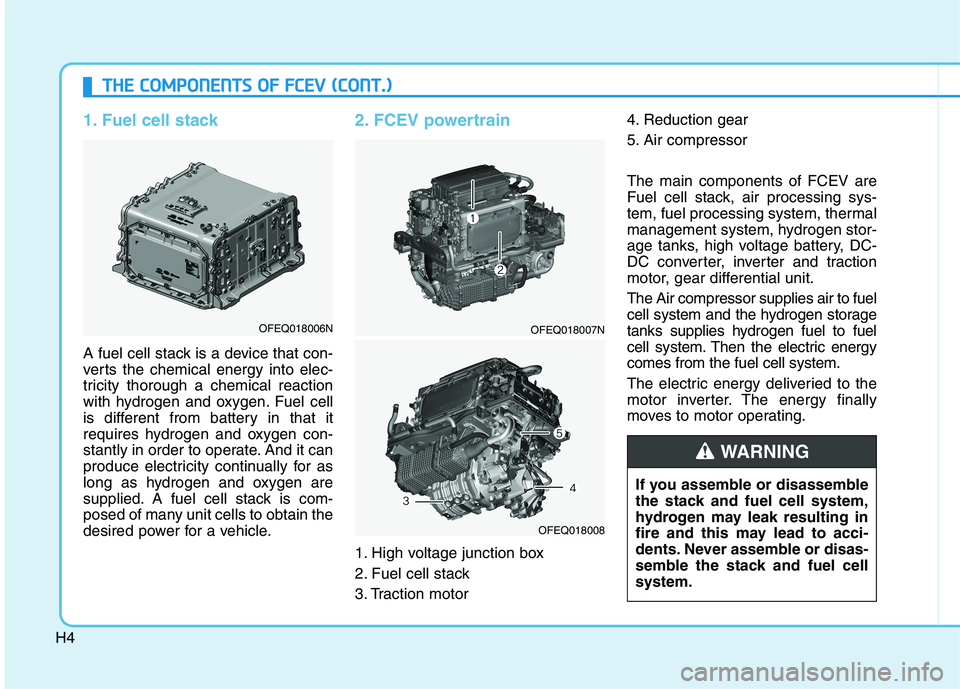
1. Fuel cell stack
A fuel cell stack is a device that con-
verts the chemical energy into elec-
tricity thorough a chemical reaction
with hydrogen and oxygen. Fuel cell
is different from battery in that it
requires hydrogen and oxygen con-
stantly in order to operate. And it can
produce electricity continually for as
long as hydrogen and oxygen are
supplied. A fuel cell stack is com-
posed of many unit cells to obtain the
desired power for a vehicle.
2. FCEV powertrain
1. High voltage junction box
2. Fuel cell stack
3. Traction motor4. Reduction gear
5. Air compressor
The main components of FCEV are
Fuel cell stack, air processing sys-
tem, fuel processing system, thermal
management system, hydrogen stor-
age tanks, high voltage battery, DC-
DC converter, inverter and traction
motor, gear differential unit.
The Air compressor supplies air to fuel
cell system and the hydrogen storage
tanks supplies hydrogen fuel to fuel
cell system. Then the electric energy
comes from the fuel cell system.
The electric energy deliveried to the
motor inverter. The energy finally
moves to motor operating.
T TH
HE
E
C
CO
OM
MP
PO
ON
NE
EN
NT
TS
S
O
OF
F
F
FC
CE
EV
V
(
(C
CO
ON
NT
T.
.)
)
OFEQ018006NOFEQ018007N
OFEQ018008
If you assemble or disassemble
the stack and fuel cell system,
hydrogen may leak resulting in
fire and this may lead to acci-
dents. Never assemble or disas-
semble the stack and fuel cell
system.
WARNING
Page 510 of 561
H5
3. High pressure hydrogen
storage tanks
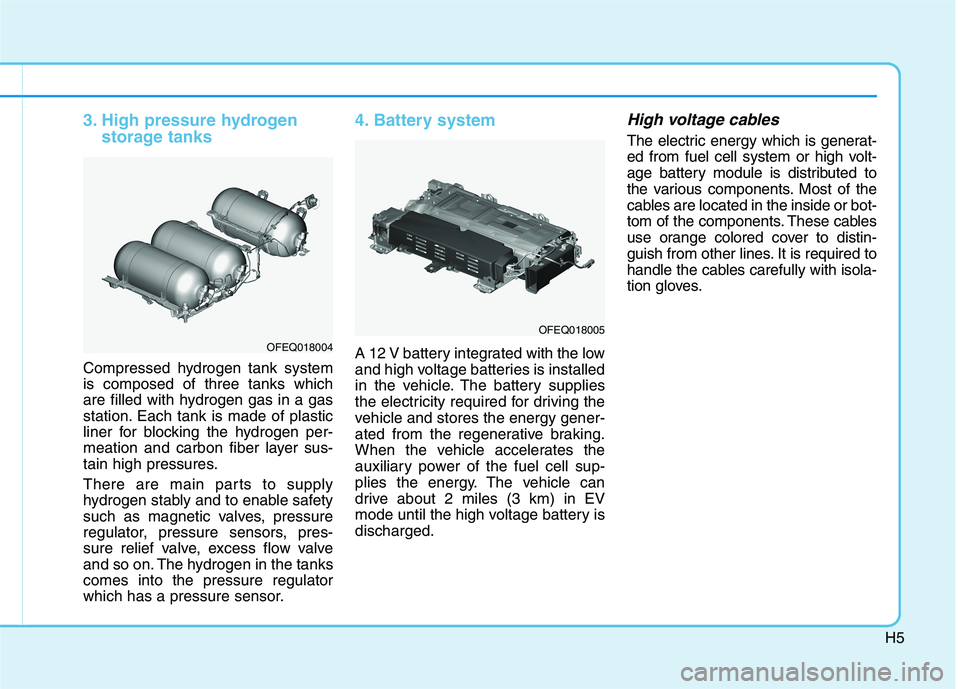
Compressed hydrogen tank system
is composed of three tanks which
are filled with hydrogen gas in a gas
station. Each tank is made of plastic
liner for blocking the hydrogen per-
meation and carbon fiber layer sus-
tain high pressures.
There are main parts to supply
hydrogen stably and to enable safety
such as magnetic valves, pressure
regulator, pressure sensors, pres-
sure relief valve, excess flow valve
and so on. The hydrogen in the tanks
comes into the pressure regulator
which has a pressure sensor.
4. Battery system
A 12 V battery integrated with the low
and high voltage batteries is installed
in the vehicle. The battery supplies
the electricity required for driving the
vehicle and stores the energy gener-
ated from the regenerative braking.
When the vehicle accelerates the
auxiliary power of the fuel cell sup-
plies the energy. The vehicle can
drive about 2 miles (3 km) in EV
mode until the high voltage battery is
discharged.
High voltage cables
The electric energy which is generat-
ed from fuel cell system or high volt-
age battery module is distributed to
the various components. Most of the
cables are located in the inside or bot-
tom of the components. These cables
use orange colored cover to distin-
guish from other lines. It is required to
handle the cables carefully with isola-
tion gloves.
OFEQ018004
OFEQ018005
Page 511 of 561
H6
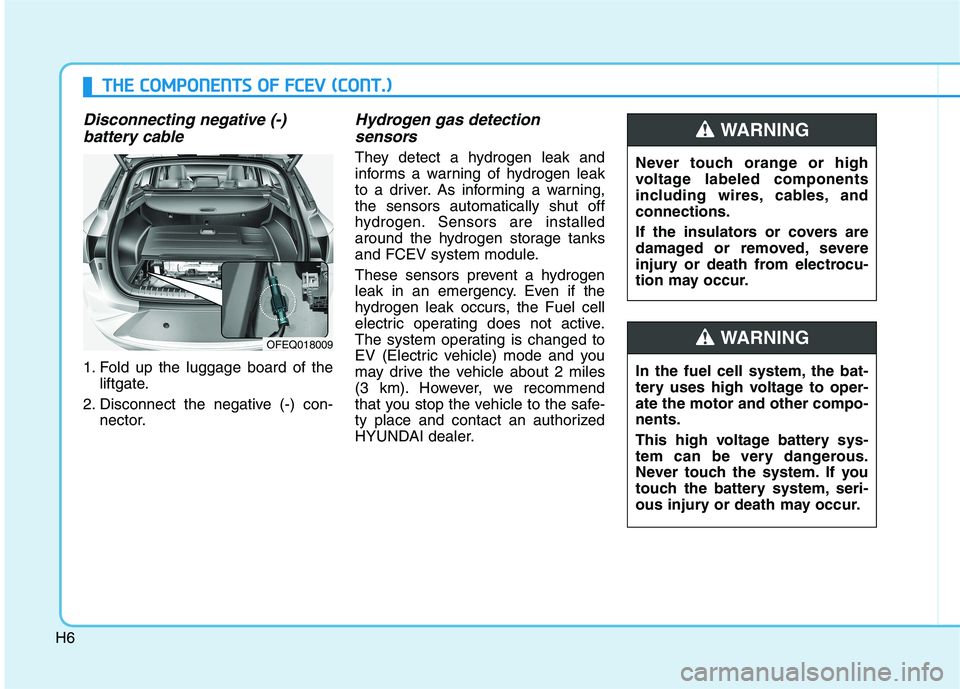
Disconnecting negative (-)
battery cable
1. Fold up the luggage board of the
liftgate.
2. Disconnect the negative (-) con-
nector.
Hydrogen gas detection
sensors
They detect a hydrogen leak and
informs a warning of hydrogen leak
to a driver. As informing a warning,
the sensors automatically shut off
hydrogen. Sensors are installed
around the hydrogen storage tanks
and FCEV system module.
These sensors prevent a hydrogen
leak in an emergency. Even if the
hydrogen leak occurs, the Fuel cell
electric operating does not active.
The system operating is changed to
EV (Electric vehicle) mode and you
may drive the vehicle about 2 miles
(3 km). However, we recommend
that you stop the vehicle to the safe-
ty place and contact an authorized
HYUNDAI dealer.
OFEQ018009
T TH
HE
E
C
CO
OM
MP
PO
ON
NE
EN
NT
TS
S
O
OF
F
F
FC
CE
EV
V
(
(C
CO
ON
NT
T.
.)
)
Never touch orange or high
voltage labeled components
including wires, cables, and
connections.
If the insulators or covers are
damaged or removed, severe
injury or death from electrocu-
tion may occur.
WARNING
In the fuel cell system, the bat-
tery uses high voltage to oper-
ate the motor and other compo-
nents.
This high voltage battery sys-
tem can be very dangerous.
Never touch the system. If you
touch the battery system, seri-
ous injury or death may occur.
WARNING
Page 513 of 561
H8
T TH
HE
E
C
CO
OM
MP
PO
ON
NE
EN
NT
TS
S
O
OF
F
F
FC
CE
EV
V
(
(C
CO
ON
NT
T.
.)
)
This vehicle uses the high volt-
age battery system to generate
high voltage.
High voltage in the battery sys-
tem is very dangerous and can
cause severe burns and electric
shock. This may result in seri-
ous injury or death.
For your safety, never touch,
replace, dismantle or remove
the high voltage battery sys-
tem including components,
cables and connectors.
Severe burns or electric
shock may result in serious
injury or death if you do not
follow this warning.
When the high voltage battery
system operates, the battery
system can be hot. Always be
careful because burns or elec-
tric shock may be caused by
high voltage.
Do not drop water or liquid on
to Fuel cell power module
compartment. The system
components are covered. If
you drop water or liquid on to
system components, it may
result in electric shock.
WARNING
When the vehicle is paint
baked, do not pass 30 min-
utes in 158°F (70°C) or 20 min-
utes in 176°F (80°C) degree.
When you clean the fuel cell
power module compartment,
do not wash using water.
Water may cause an electric
shock to occur and damage
electronic parts and compo-
nents.
CAUTION
Do not assemble or disassem-
ble the hydrogen tanks.
Improper work may damage
the performance and reliabili-
ty and unexpected problem
may occur. For hydrogen
tanks work, contact an author-
ized HYUNDAI dealer.
Never drill into, strike or oth-
erwise damage the hydrogen
tanks. Unexpected problem
may occur resulting in seri-
ous injury and death.
Never get near or put a hydro-
gen tanks in a fire. Doing so
may result in big injury.
Never use the hydrogen tank
for any other purpose.
WARNING