Fuel system HYUNDAI NEXO 2021 Service Manual
[x] Cancel search | Manufacturer: HYUNDAI, Model Year: 2021, Model line: NEXO, Model: HYUNDAI NEXO 2021Pages: 561, PDF Size: 48.42 MB
Page 539 of 561
H34
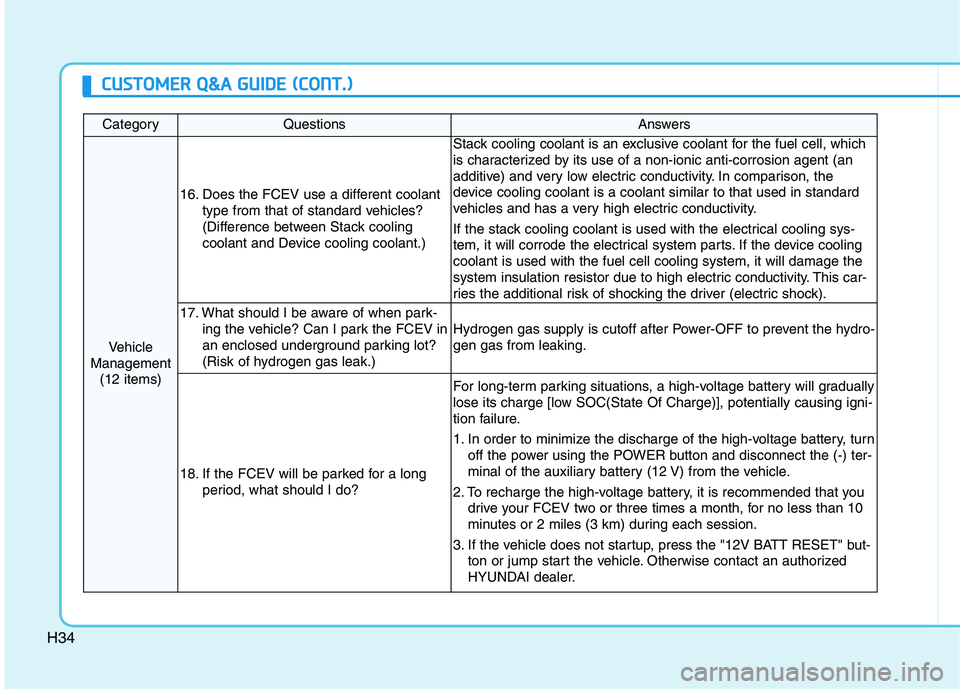
CategoryQuestionsAnswers
Vehicle
Management
(12 items)
16. Does the FCEV use a different coolant
type from that of standard vehicles?
(Difference between Stack cooling
coolant and Device cooling coolant.)
Stack cooling coolant is an exclusive coolant for the fuel cell, which
is characterized by its use of a non-ionic anti-corrosion agent (an
additive) and very low electric conductivity. In comparison, the
device cooling coolant is a coolant similar to that used in standard
vehicles and has a very high electric conductivity.
If the stack cooling coolant is used with the electrical cooling sys-
tem, it will corrode the electrical system parts. If the device cooling
coolant is used with the fuel cell cooling system, it will damage the
system insulation resistor due to high electric conductivity. This car-
ries the additional risk of shocking the driver (electric shock).
17. What should I be aware of when park-
ing the vehicle? Can I park the FCEV in
an enclosed underground parking lot?
(Risk of hydrogen gas leak.)
Hydrogen gas supply is cutoff after Power-OFF to prevent the hydro-
gen gas from leaking.
18. If the FCEV will be parked for a long
period, what should I do?
For long-term parking situations, a high-voltage battery will gradually
lose its charge [low SOC(State Of Charge)], potentially causing igni-
tion failure.
1. In order to minimize the discharge of the high-voltage battery, turn
off the power using the POWER button and disconnect the (-) ter-
minal of the auxiliary battery (12 V) from the vehicle.
2. To recharge the high-voltage battery, it is recommended that you
drive your FCEV two or three times a month, for no less than 10
minutes or 2 miles (3 km) during each session.
3. If the vehicle does not startup, press the "12V BATT RESET" but-
ton or jump start the vehicle. Otherwise contact an authorized
HYUNDAI dealer.
C CU
US
ST
TO
OM
ME
ER
R
Q
Q&
&A
A
G
GU
UI
ID
DE
E
(
(C
CO
ON
NT
T.
.)
)
Page 541 of 561
H36
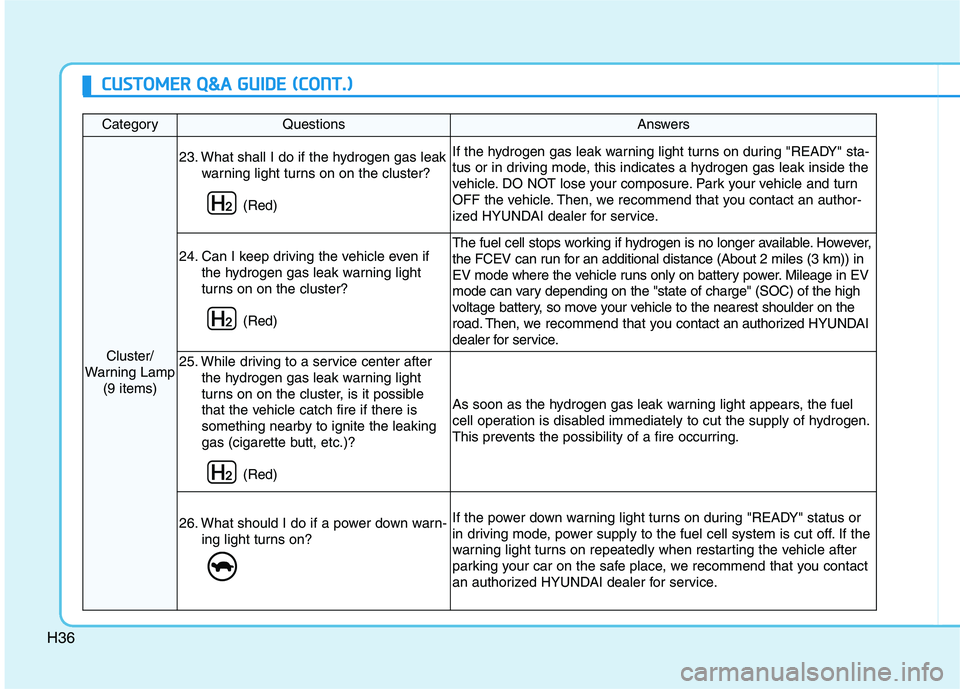
CategoryQuestionsAnswers
Cluster/
Warning Lamp
(9 items)
23. What shall I do if the hydrogen gas leak
warning light turns on on the cluster?
(Red)If the hydrogen gas leak warning light turns on during "READY" sta-
tus or in driving mode, this indicates a hydrogen gas leak inside the
vehicle. DO NOT lose your composure. Park your vehicle and turn
OFF the vehicle. Then, we recommend that you contact an author-
ized HYUNDAI dealer for service.
24. Can I keep driving the vehicle even if
the hydrogen gas leak warning light
turns on on the cluster?
(Red)The fuel cell stops working if hydrogen is no longer available. However,
the FCEV can run for an additional distance (About 2 miles (3 km)) in
EV mode where the vehicle runs only on battery power. Mileage in EV
mode can vary depending on the "state of charge" (SOC) of the high
voltage battery, so move your vehicle to the nearest shoulder on the
road. Then, we recommend that you contact an authorized HYUNDAI
dealer for service.
25. While driving to a service center after
the hydrogen gas leak warning light
turns on on the cluster, is it possible
that the vehicle catch fire if there is
something nearby to ignite the leaking
gas (cigarette butt, etc.)?
(Red)
As soon as the hydrogen gas leak warning light appears, the fuel
cell operation is disabled immediately to cut the supply of hydrogen.
This prevents the possibility of a fire occurring.
26. What should I do if a power down warn-
ing light turns on?If the power down warning light turns on during "READY" status or
in driving mode, power supply to the fuel cell system is cut off. If the
warning light turns on repeatedly when restarting the vehicle after
parking your car on the safe place, we recommend that you contact
an authorized HYUNDAI dealer for service.
C CU
US
ST
TO
OM
ME
ER
R
Q
Q&
&A
A
G
GU
UI
ID
DE
E
(
(C
CO
ON
NT
T.
.)
)
Page 542 of 561
H37
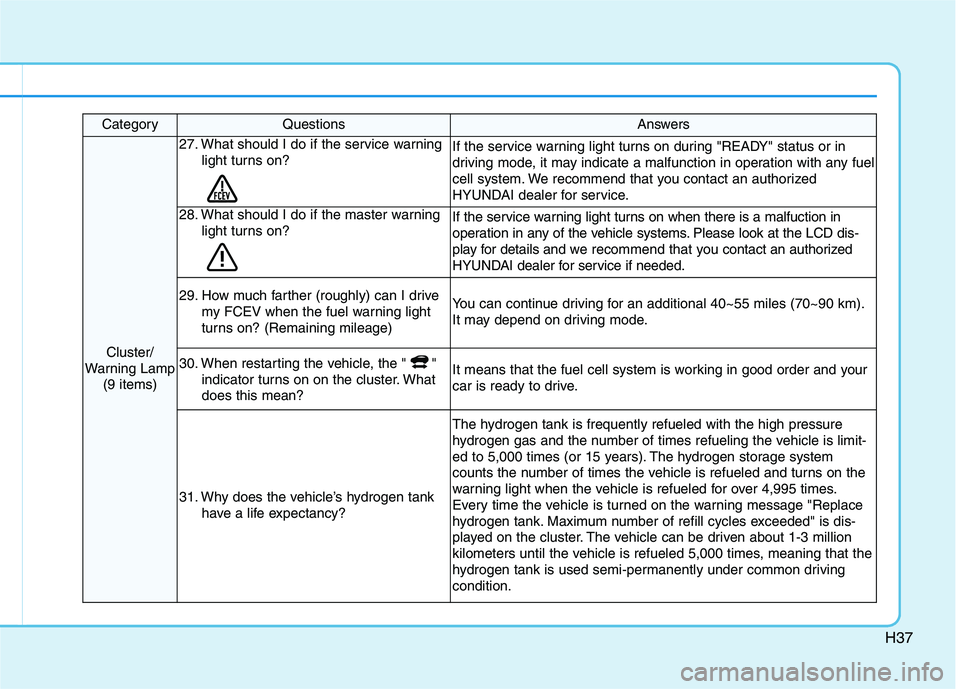
CategoryQuestionsAnswers
Cluster/
Warning Lamp
(9 items)
27. What should I do if the service warning
light turns on?If the service warning light turns on during "READY" status or in
driving mode, it may indicate a malfunction in operation with any fuel
cell system. We recommend that you contact an authorized
HYUNDAI dealer for service.
28. What should I do if the master warning
light turns on?If the service warning light turns on when there is a malfuction in
operation in any of the vehicle systems. Please look at the LCD dis-
play for details and we recommend that you contact an authorized
HYUNDAI dealer for service if needed.
29. How much farther (roughly) can I drive
my FCEV when the fuel warning light
turns on? (Remaining mileage)You can continue driving for an additional 40~55 miles (70~90 km).
It may depend on driving mode.
30. When restarting the vehicle, the " "
indicator turns on on the cluster. What
does this mean?It means that the fuel cell system is working in good order and your
car is ready to drive.
31. Why does the vehicle’s hydrogen tank
have a life expectancy?
The hydrogen tank is frequently refueled with the high pressure
hydrogen gas and the number of times refueling the vehicle is limit-
ed to 5,000 times (or 15 years). The hydrogen storage system
counts the number of times the vehicle is refueled and turns on the
warning light when the vehicle is refueled for over 4,995 times.
Every time the vehicle is turned on the warning message "Replace
hydrogen tank. Maximum number of refill cycles exceeded" is dis-
played on the cluster. The vehicle can be driven about 1-3 million
kilometers until the vehicle is refueled 5,000 times, meaning that the
hydrogen tank is used semi-permanently under common driving
condition.
Page 543 of 561
H38
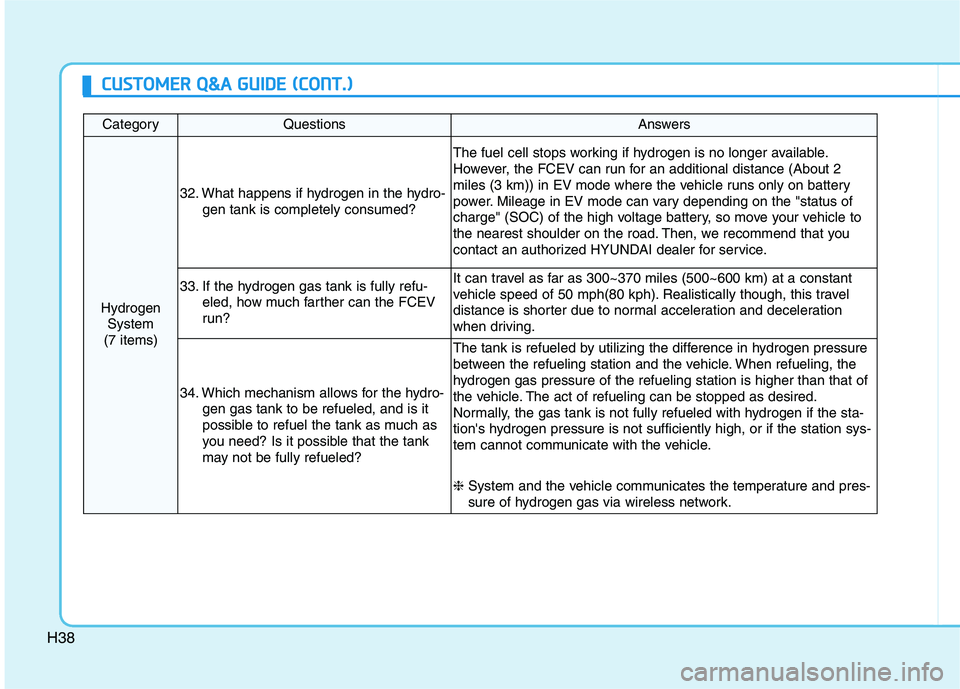
CategoryQuestionsAnswers
Hydrogen
System
(7 items)
32. What happens if hydrogen in the hydro-
gen tank is completely consumed?
The fuel cell stops working if hydrogen is no longer available.
However, the FCEV can run for an additional distance (About 2
miles (3 km)) in EV mode where the vehicle runs only on battery
power. Mileage in EV mode can vary depending on the "status of
charge" (SOC) of the high voltage battery, so move your vehicle to
the nearest shoulder on the road. Then, we recommend that you
contact an authorized HYUNDAI dealer for service.
33. If the hydrogen gas tank is fully refu-
eled, how much farther can the FCEV
run?It can travel as far as 300~370 miles (500~600 km) at a constant
vehicle speed of 50 mph(80 kph). Realistically though, this travel
distance is shorter due to normal acceleration and deceleration
when driving.
34. Which mechanism allows for the hydro-
gen gas tank to be refueled, and is it
possible to refuel the tank as much as
you need? Is it possible that the tank
may not be fully refueled?
The tank is refueled by utilizing the difference in hydrogen pressure
between the refueling station and the vehicle. When refueling, the
hydrogen gas pressure of the refueling station is higher than that of
the vehicle. The act of refueling can be stopped as desired.
Normally, the gas tank is not fully refueled with hydrogen if the sta-
tion's hydrogen pressure is not sufficiently high, or if the station sys-
tem cannot communicate with the vehicle.
❈System and the vehicle communicates the temperature and pres-
sure of hydrogen gas via wireless network.
C CU
US
ST
TO
OM
ME
ER
R
Q
Q&
&A
A
G
GU
UI
ID
DE
E
(
(C
CO
ON
NT
T.
.)
)
Page 544 of 561
H39
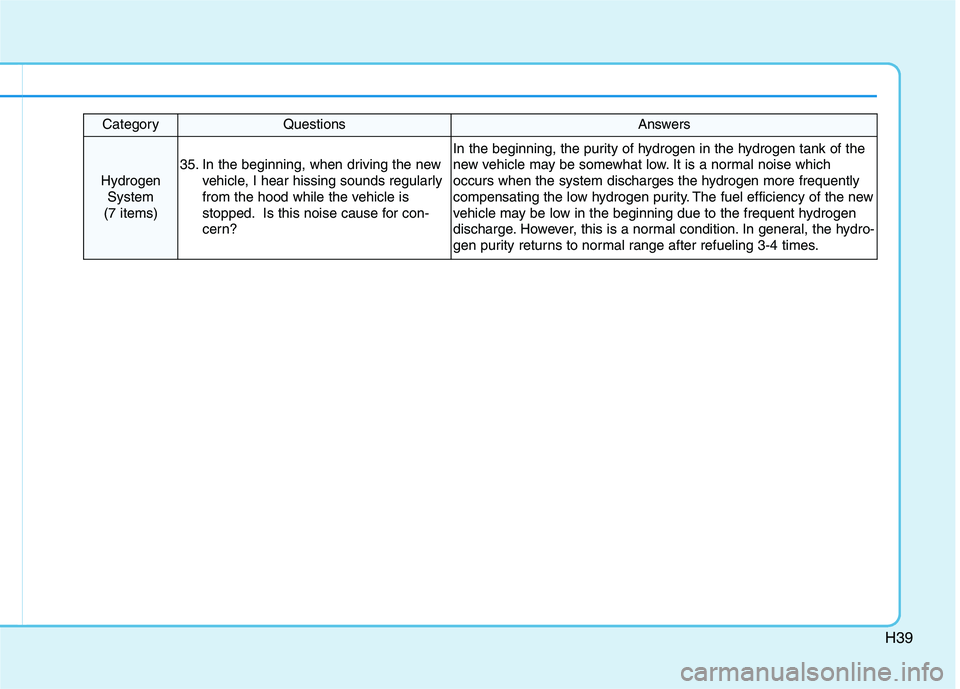
CategoryQuestionsAnswers
Hydrogen
System
(7 items)
35. In the beginning, when driving the new
vehicle, I hear hissing sounds regularly
from the hood while the vehicle is
stopped. Is this noise cause for con-
cern?
In the beginning, the purity of hydrogen in the hydrogen tank of the
new vehicle may be somewhat low. It is a normal noise which
occurs when the system discharges the hydrogen more frequently
compensating the low hydrogen purity. The fuel efficiency of the new
vehicle may be low in the beginning due to the frequent hydrogen
discharge. However, this is a normal condition. In general, the hydro-
gen purity returns to normal range after refueling 3-4 times.
Page 545 of 561
H40
C CU
US
ST
TO
OM
ME
ER
R
Q
Q&
&A
A
G
GU
UI
ID
DE
E
(
(C
CO
ON
NT
T.
.)
)
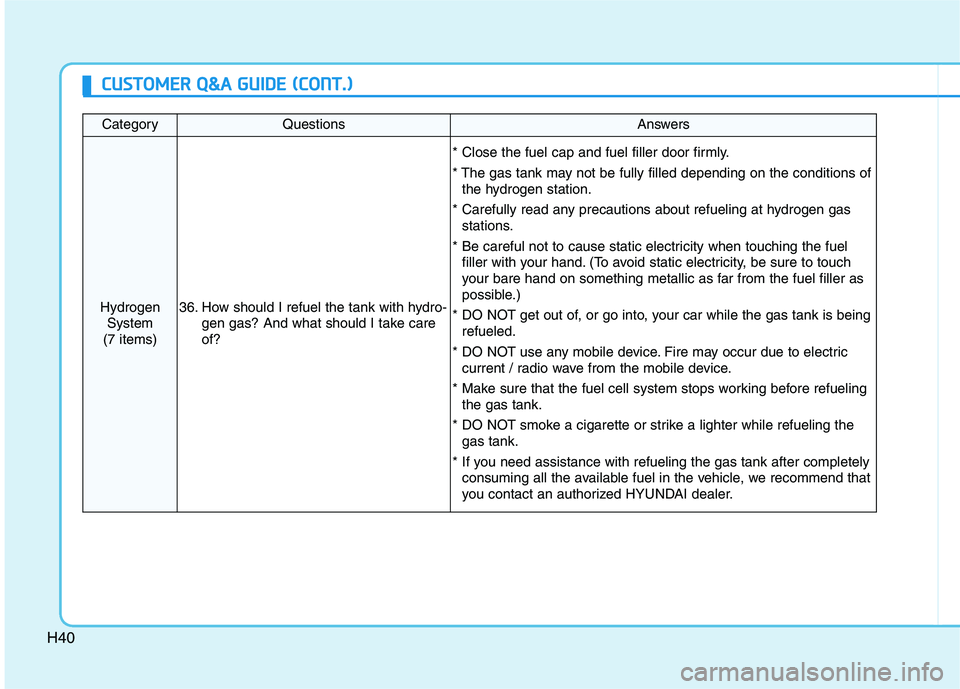
CategoryQuestionsAnswers
Hydrogen
System
(7 items)36. How should I refuel the tank with hydro-
gen gas? And what should I take care
of?
* Close the fuel cap and fuel filler door firmly.
* The gas tank may not be fully filled depending on the conditions of
the hydrogen station.
* Carefully read any precautions about refueling at hydrogen gas
stations.
* Be careful not to cause static electricity when touching the fuel
filler with your hand. (To avoid static electricity, be sure to touch
your bare hand on something metallic as far from the fuel filler as
possible.)
* DO NOT get out of, or go into, your car while the gas tank is being
refueled.
* DO NOT use any mobile device. Fire may occur due to electric
current / radio wave from the mobile device.
* Make sure that the fuel cell system stops working before refueling
the gas tank.
* DO NOT smoke a cigarette or strike a lighter while refueling the
gas tank.
* If you need assistance with refueling the gas tank after completely
consuming all the available fuel in the vehicle, we recommend that
you contact an authorized HYUNDAI dealer.
Page 546 of 561
H41
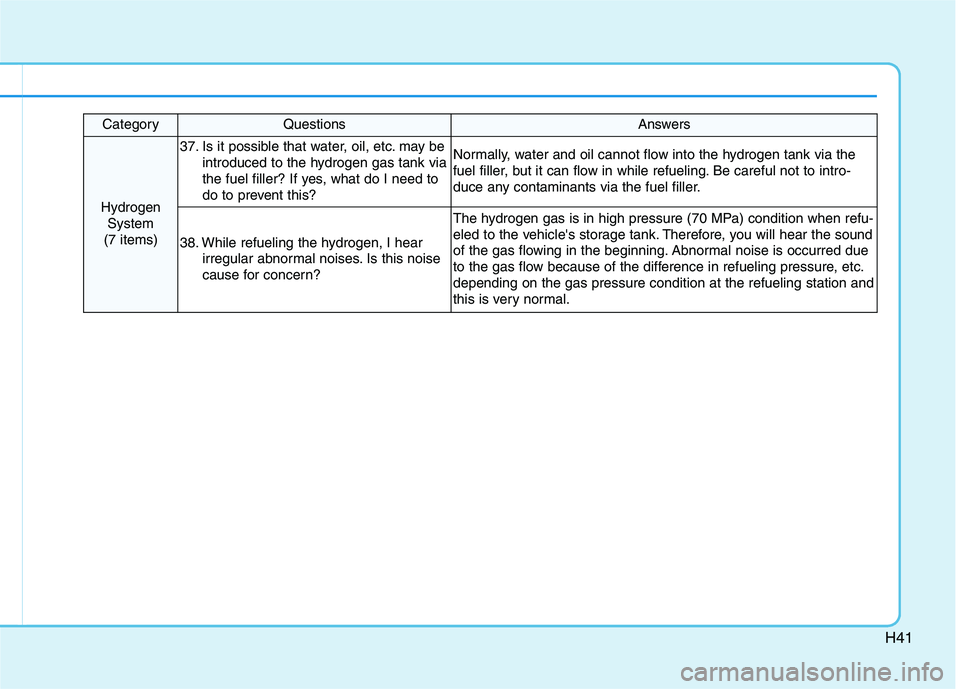
CategoryQuestionsAnswers
Hydrogen
System
(7 items)
37. Is it possible that water, oil, etc. may be
introduced to the hydrogen gas tank via
the fuel filler? If yes, what do I need to
do to prevent this?Normally, water and oil cannot flow into the hydrogen tank via the
fuel filler, but it can flow in while refueling. Be careful not to intro-
duce any contaminants via the fuel filler.
38. While refueling the hydrogen, I hear
irregular abnormal noises. Is this noise
cause for concern?
The hydrogen gas is in high pressure (70 MPa) condition when refu-
eled to the vehicle's storage tank. Therefore, you will hear the sound
of the gas flowing in the beginning. Abnormal noise is occurred due
to the gas flow because of the difference in refueling pressure, etc.
depending on the gas pressure condition at the refueling station and
this is very normal.
Page 547 of 561
H42
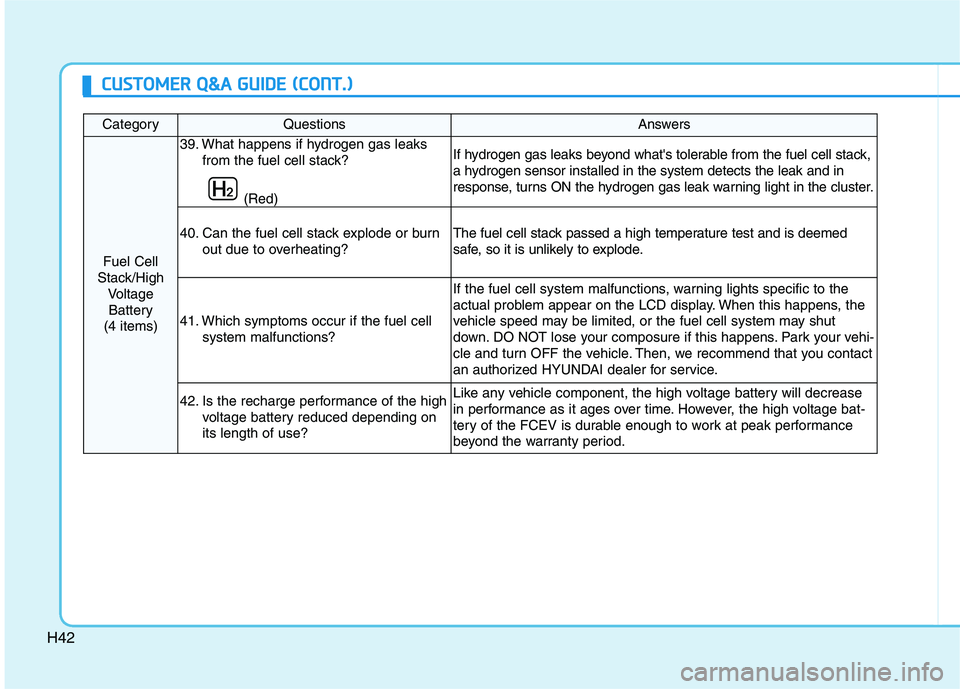
CategoryQuestionsAnswers
Fuel Cell
Stack/High
Voltage
Battery
(4 items)
39. What happens if hydrogen gas leaks
from the fuel cell stack?
(Red)If hydrogen gas leaks beyond what's tolerable from the fuel cell stack,
a hydrogen sensor installed in the system detects the leak and in
response, turns ON the hydrogen gas leak warning light in the cluster.
40. Can the fuel cell stack explode or burn
out due to overheating?The fuel cell stack passed a high temperature test and is deemed
safe, so it is unlikely to explode.
41. Which symptoms occur if the fuel cell
system malfunctions?
If the fuel cell system malfunctions, warning lights specific to the
actual problem appear on the LCD display. When this happens, the
vehicle speed may be limited, or the fuel cell system may shut
down. DO NOT lose your composure if this happens. Park your vehi-
cle and turn OFF the vehicle. Then, we recommend that you contact
an authorized HYUNDAI dealer for service.
42. Is the recharge performance of the high
voltage battery reduced depending on
its length of use? Like any vehicle component, the high voltage battery will decrease
in performance as it ages over time. However, the high voltage bat-
tery of the FCEV is durable enough to work at peak performance
beyond the warranty period.
C CU
US
ST
TO
OM
ME
ER
R
Q
Q&
&A
A
G
GU
UI
ID
DE
E
(
(C
CO
ON
NT
T.
.)
)
Page 550 of 561
H45
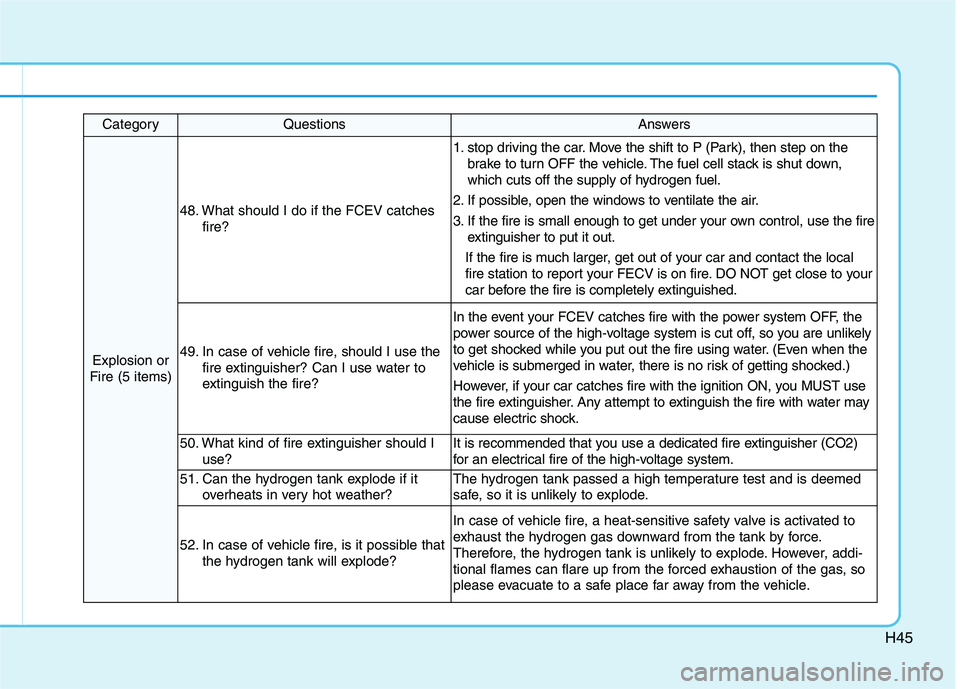
CategoryQuestionsAnswers
Explosion or
Fire (5 items)
48. What should I do if the FCEV catches
fire?
1. stop driving the car. Move the shift to P (Park), then step on the
brake to turn OFF the vehicle. The fuel cell stack is shut down,
which cuts off the supply of hydrogen fuel.
2. If possible, open the windows to ventilate the air.
3. If the fire is small enough to get under your own control, use the fire
extinguisher to put it out.
If the fire is much larger, get out of your car and contact the local
fire station to report your FECV is on fire. DO NOT get close to your
car before the fire is completely extinguished.
49. In case of vehicle fire, should I use the
fire extinguisher? Can I use water to
extinguish the fire?
In the event your FCEV catches fire with the power system OFF, the
power source of the high-voltage system is cut off, so you are unlikely
to get shocked while you put out the fire using water. (Even when the
vehicle is submerged in water, there is no risk of getting shocked.)
However, if your car catches fire with the ignition ON, you MUST use
the fire extinguisher. Any attempt to extinguish the fire with water may
cause electric shock.
50. What kind of fire extinguisher should I
use?It is recommended that you use a dedicated fire extinguisher (CO2)
for an electrical fire of the high-voltage system.
51. Can the hydrogen tank explode if it
overheats in very hot weather?The hydrogen tank passed a high temperature test and is deemed
safe, so it is unlikely to explode.
52. In case of vehicle fire, is it possible that
the hydrogen tank will explode?
In case of vehicle fire, a heat-sensitive safety valve is activated to
exhaust the hydrogen gas downward from the tank by force.
Therefore, the hydrogen tank is unlikely to explode. However, addi-
tional flames can flare up from the forced exhaustion of the gas, so
please evacuate to a safe place far away from the vehicle.
Page 554 of 561
I-4
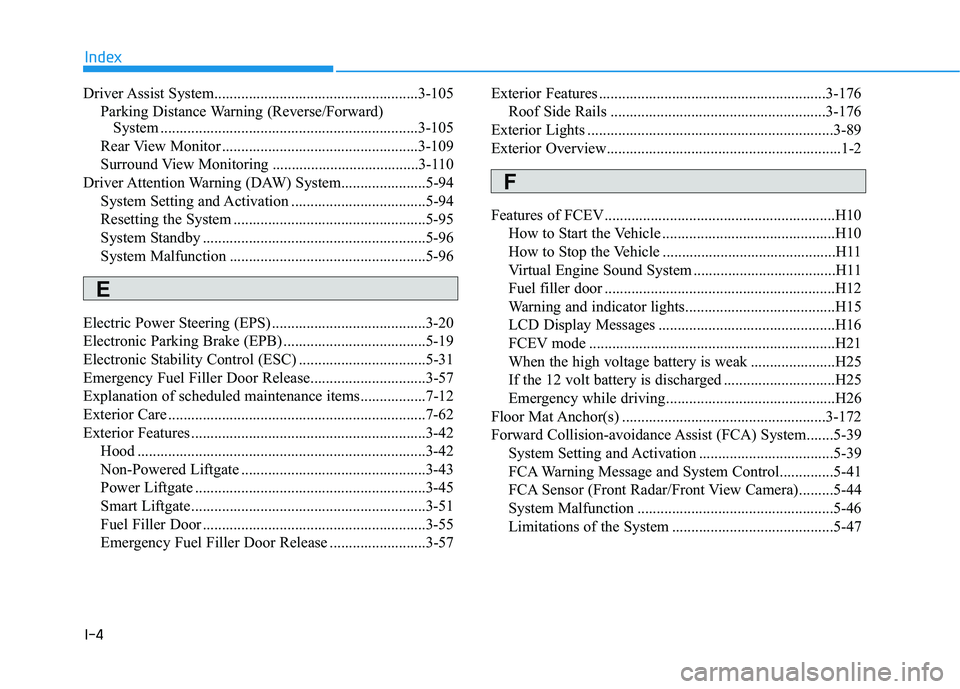
Driver Assist System.....................................................3-105
Parking Distance Warning (Reverse/Forward)
System ...................................................................3-105
Rear View Monitor ...................................................3-109
Surround View Monitoring ......................................3-110
Driver Attention Warning (DAW) System......................5-94
System Setting and Activation ...................................5-94
Resetting the System ..................................................5-95
System Standby ..........................................................5-96
System Malfunction ...................................................5-96
Electric Power Steering (EPS) ........................................3-20
Electronic Parking Brake (EPB) .....................................5-19
Electronic Stability Control (ESC) .................................5-31
Emergency Fuel Filler Door Release..............................3-57
Explanation of scheduled maintenance items.................7-12
Exterior Care ...................................................................7-62
Exterior Features .............................................................3-42
Hood ...........................................................................3-42
Non-Powered Liftgate ................................................3-43
Power Liftgate ............................................................3-45
Smart Liftgate.............................................................3-51
Fuel Filler Door ..........................................................3-55
Emergency Fuel Filler Door Release .........................3-57Exterior Features ...........................................................3-176
Roof Side Rails ........................................................3-176
Exterior Lights ................................................................3-89
Exterior Overview.............................................................1-2
Features of FCEV............................................................H10
How to Start the Vehicle .............................................H10
How to Stop the Vehicle .............................................H11
Virtual Engine Sound System .....................................H11
Fuel filler door ............................................................H12
Warning and indicator lights.......................................H15
LCD Display Messages ..............................................H16
FCEV mode ................................................................H21
When the high voltage battery is weak ......................H25
If the 12 volt battery is discharged .............................H25
Emergency while driving............................................H26
Floor Mat Anchor(s) .....................................................3-172
Forward Collision-avoidance Assist (FCA) System.......5-39
System Setting and Activation ...................................5-39
FCA Warning Message and System Control..............5-41
FCA Sensor (Front Radar/Front View Camera).........5-44
System Malfunction ...................................................5-46
Limitations of the System ..........................................5-47
Index
E
F