warning HYUNDAI NEXO 2023 Owners Manual
[x] Cancel search | Manufacturer: HYUNDAI, Model Year: 2023, Model line: NEXO, Model: HYUNDAI NEXO 2023Pages: 558, PDF Size: 35.01 MB
Page 439 of 558
7-15
7
MaintenanceThe electric motor for the cooling fan
is controlled by coolant temperature,
refrigerant pressure and vehicle
speed. As the coolant temperature
decreases, the electric motor will
automatically shut off. This is a nor-mal condition.
Changing Coolant
Have coolant changed by an author-
ized HYUNDAI dealer according tothe Maintenance Schedule at the
beginning of this chapter.To prevent damage to parts in the
fuel cell power module compart-
ment, put a thick towel around the
coolant cap before refilling the
coolant to prevent the coolant
from overflowing into parts in the
fuel cell power module compart-ment.
NOTICE
The electric motor for
the cooling fan may
continue to operate
or start up when the
vehicle is not running
and can cause serious injury.
Keep hands, clothing and tools
away from the rotating fan
blades of the cooling fan.
WARNING
Do not use coolant or antifreeze
in the washer fluid reservoir.
Coolant can severely obscure
visibility when sprayed on the
windshield and may cause loss
of vehicle control resulting in anaccident.
Coolant may also cause dam-
age to paint and body trim.
WARNING
Page 441 of 558
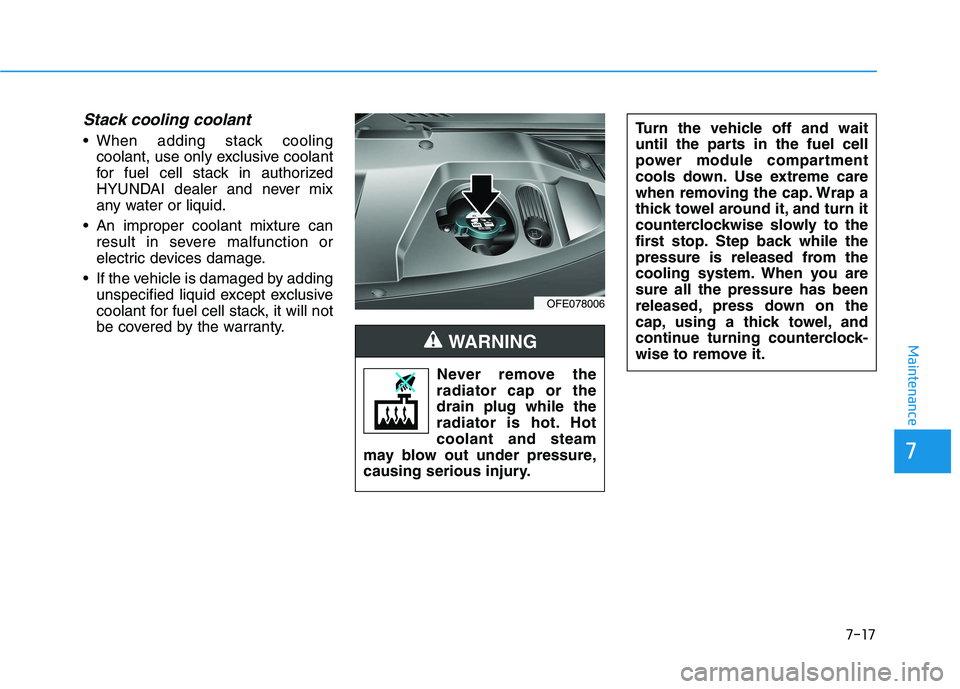
Stack cooling coolant
When adding stack coolingcoolant, use only exclusive coolant
for fuel cell stack in authorized
HYUNDAI dealer and never mix
any water or liquid.
An improper coolant mixture can result in severe malfunction or
electric devices damage.
If the vehicle is damaged by adding unspecified liquid except exclusive
coolant for fuel cell stack, it will not
be covered by the warranty.
7-17
7
Maintenance
Never remove the
radiator cap or the drain plug while the
radiator is hot. Hotcoolant and steam
may blow out under pressure,
causing serious injury.
WARNING
OFE078006 Turn the vehicle off and wait
until the parts in the fuel cell
power module compartment
cools down. Use extreme care
when removing the cap. Wrap a
thick towel around it, and turn it
counterclockwise slowly to the
first stop. Step back while the
pressure is released from the
cooling system. When you aresure all the pressure has been
released, press down on the
cap, using a thick towel, and
continue turning counterclock-
wise to remove it.
Page 442 of 558
The electric motor for the cooling fan
is controlled by coolant temperature,
refrigerant pressure and vehicle
speed. As the coolant temperature
decreases, the electric motor will
automatically shut off. This is a nor-mal condition.
Changing Coolant
For the fuel cell stack, an exclusive
coolant must be used . When chang-
ing the fuel cell stack coolant, werecommend that coolant be changed
by an authorized HYUNDAI dealeraccording to the MaintenanceSchedule at the beginning of this
chapter.To prevent damage to parts in the
fuel cell power module compart-
ment, put a thick towel around the
coolant cap before refilling the
coolant to prevent the coolant
from overflowing into parts in the
fuel cell power module compart-ment.
NOTICE
7-18
Maintenance
The electric motor for
the cooling fan may
continue to operate
or start up when the
vehicle is not running
and can cause serious injury.
Keep hands, clothing and tools
away from the rotating fan
blades of the cooling fan.
WARNING
Do not use coolant or antifreeze
in the washer fluid reservoir.
Coolant can severely obscure
visibility when sprayed on the
windshield and may cause loss
of vehicle control resulting in anaccident.
Coolant may also cause dam-
age to paint and body trim.
WARNING
Do not mix-up the caps of
device cooling coolant and
stack cooling coolant because
the fluid material is different. If
the cap is mixed, the fuel cell
system may be damage.
We recommend that you con-
sult an authorized HYUNDAI
dealer.
CAUTION
Page 443 of 558

7-19
7
Maintenance
BBRRAA KKEE FF LLUU IIDD
Checking the Brake Fluid
Level
Check the fluid level in the reservoir
periodically. The fluid level should be
between MAX and MIN marks on the
side of the reservoir.
Before removing the reservoir cap
and adding brake fluid, clean the
area around the reservoir cap thor-
oughly to prevent brake fluid contam-ination. If the level is low, add the specified
brake fluid to the MAX level. The level
will fall with accumulated mileage.
This is a normal condition associated
with the wear of the brake linings. If
the fluid level is excessively low, have
the brake system checked by an
authorized HYUNDAI dealer.
Do not allow brake fluid to con-
tact the vehicle’s body paint, as
paint damage will result.
Brake fluid, which has been exposed to open air for an
extended time should NEVER beused as its quality cannot be
guaranteed. It should be dis-
posed of properly.
Do not use the wrong kind of brake fluid. A few drops of min-
eral based oil, such as engine
oil, in your brake system can
damage brake system parts.
Information
Use only the specified brake fluid
(refer to "Recommended Lubricants
and Capacities" in chapter 8).
i
NOTICE
If the brake system requires fre-
quent additions of fluid thiscould indicate a leak in the
brake system. Have the vehicle
inspected by an authorized
HYUNDAI dealer.
WARNING
Do not allow brake fluid to come
in contact with your eyes. Ifbrake fluid comes in contact
with your eyes, flush your eyes
with clean water for at least 15
minutes and get immediatemedical attention.
WARNING
OFE078007
Page 444 of 558
7-20
MaintenanceW
W AASSHH EERR FF LLUU IIDD
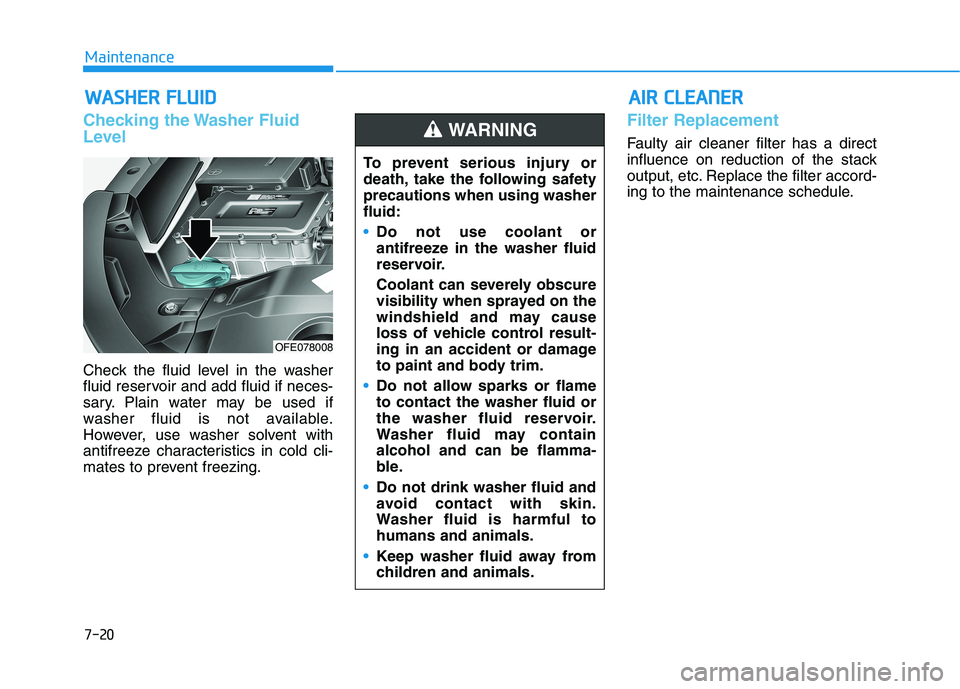
Checking the Washer Fluid
Level
Check the fluid level in the washer
fluid reservoir and add fluid if neces-
sary. Plain water may be used if
washer fluid is not available.
However, use washer solvent with
antifreeze characteristics in cold cli-
mates to prevent freezing.
Filter Replacement
Faulty air cleaner filter has a direct
influence on reduction of the stack
output, etc. Replace the filter accord-
ing to the maintenance schedule.
OFE078008 To prevent serious injury or
death, take the following safetyprecautions when using washerfluid:
Do not use coolant or
antifreeze in the washer fluid
reservoir.
Coolant can severely obscure
visibility when sprayed on the
windshield and may cause
loss of vehicle control result-
ing in an accident or damage
to paint and body trim.
Do not allow sparks or flame to contact the washer fluid or
the washer fluid reservoir.
Washer fluid may containalcohol and can be flamma-
ble.
Do not drink washer fluid and
avoid contact with skin.
Washer fluid is harmful tohumans and animals.
Keep washer fluid away from
children and animals.
WARNING
AA
IIRR CC LLEE AA NN EERR
Page 451 of 558
7-27
7
Maintenance
1122VV BB AA TTTTEERR YY
The vehicle is not equipped with a
common 12V battery which requires
periodic replacement. The battery is
a lithium polymer type integrated into
the high voltage battery. Full dis-
charge of the battery is prevented
through 12V battery protection sys-tem which can isolate the 12V bat-
tery.
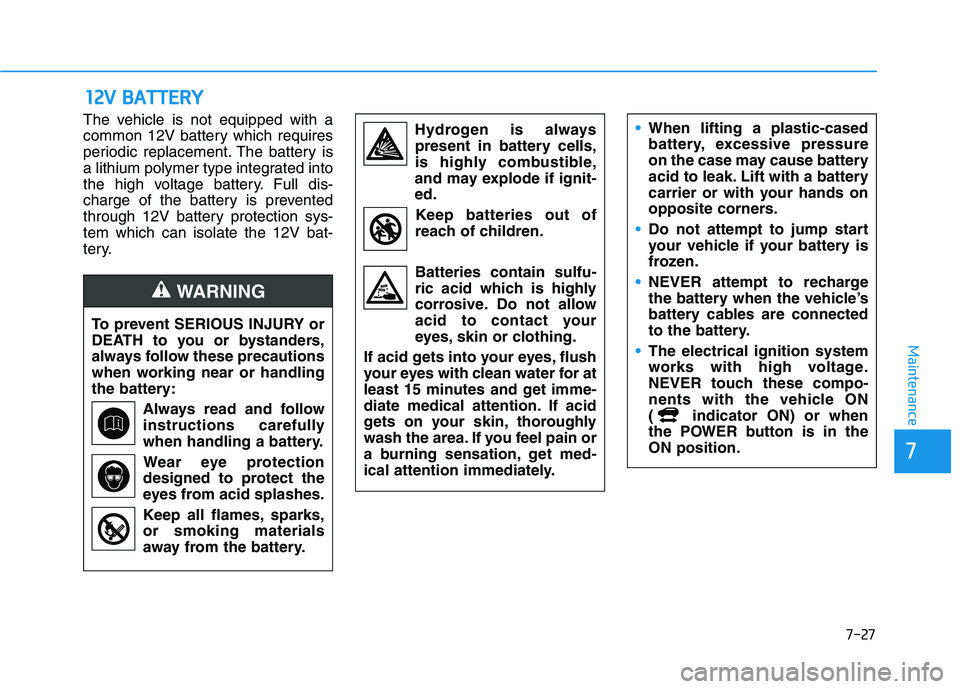
To prevent SERIOUS INJURY or
DEATH to you or bystanders,
always follow these precautions
when working near or handling
the battery: Always read and follow
instructions carefully
when handling a battery.
Wear eye protection
designed to protect the
eyes from acid splashes.
Keep all flames, sparks, or smoking materials
away from the battery.
WARNING
Hydrogen is always present in battery cells,
is highly combustible,
and may explode if ignit-ed.
Keep batteries out of
reach of children. Batteries contain sulfu-
ric acid which is highly
corrosive. Do not allow
acid to contact your
eyes, skin or clothing.
If acid gets into your eyes, flush
your eyes with clean water for at
least 15 minutes and get imme-
diate medical attention. If acid
gets on your skin, thoroughly
wash the area. If you feel pain or
a burning sensation, get med-
ical attention immediately.When lifting a plastic-cased
battery, excessive pressure
on the case may cause battery
acid to leak. Lift with a battery
carrier or with your hands on
opposite corners.
Do not attempt to jump start
your vehicle if your battery is
frozen.
NEVER attempt to recharge
the battery when the vehicle’s
battery cables are connected
to the battery.
The electrical ignition system
works with high voltage.
NEVER touch these compo-
nents with the vehicle ON
( indicator ON) or when
the POWER button is in theON position.
Page 453 of 558
7-29
7
Maintenance
TTIIRR EESS AA NN DD WW HHEEEELLSS
Tire Care
For proper maintenance, safety, and
maximum fuel economy, you must
always maintain recommended tire
inflation pressures and stay within
the load limits and weight distribution
recommended for your vehicle.ALWAYS replace tires with the
same size as each tire that
was originally supplied with
this vehicle. Using tires andwheels other than the recom-
mended sizes could cause
unusual handling characteris-
tics, poor vehicle control, or
negatively affect your vehi-
cle's Anti-Lock Brake System(ABS) resulting in a seriousaccident.
Tire failure may cause loss of
vehicle control resulting in an
accident. To reduce risk of
SERIOUS INJURY or DEATH,
take the following precautions:
Inspect your tires monthly for
proper inflation as well as
wear and damage.
The recommended cold tire
pressure for your vehicle can
be found in this manual andon the tire label located on the
driver's side center pillar.
Always use a tire pressure
gauge to measure tire pres-
sure. Tires with too much ortoo little pressure wear
unevenly causing poor han-dling.
Replace tires that are worn,
show uneven wear, or are
damaged. Worn tires can
cause loss of braking effec-
tiveness, steering) control, ortraction.
WARNING
Page 454 of 558

7-30
Maintenance
All specifications (sizes and pres-
sures) can be found on a label
attached to the driver’s side center
pillar.
Recommended Cold Tire Inflation Pressures
All tire pressures should be checked
when the tires are cold. "Cold tires"
means the vehicle has not been driv-
en for at least three hours or drivenless than 1.6 km (1 mile).
Warm tires normally exceed recom-
mended cold tire pressures by 28 to
41 kPa (4 to 6 psi). Do not release air
from warm tires to adjust the pres-sure or the tires will be under-inflat-
ed. For recommended inflation pres-
sure, refer to "Tire and Wheels" inchapter 8.Recommended pressures must
be maintained for the best ride,
vehicle handling, and minimum
tire wear.
Over-inflation or under-inflation
can reduce tire life, adversely
affect vehicle handling, and
lead to sudden tire failure that
could result in loss of vehicle
control resulting in an accident.
Severe under-inflation can lead
to severe heat build-up, causing
blowouts, tread separation andother tire failures that can result
in the loss of vehicle control
resulting in an accident. This
risk is much higher on hot days
and when driving for long peri-ods at high speeds.
WARNING
OFE088003
Page 456 of 558
7-32
Maintenance
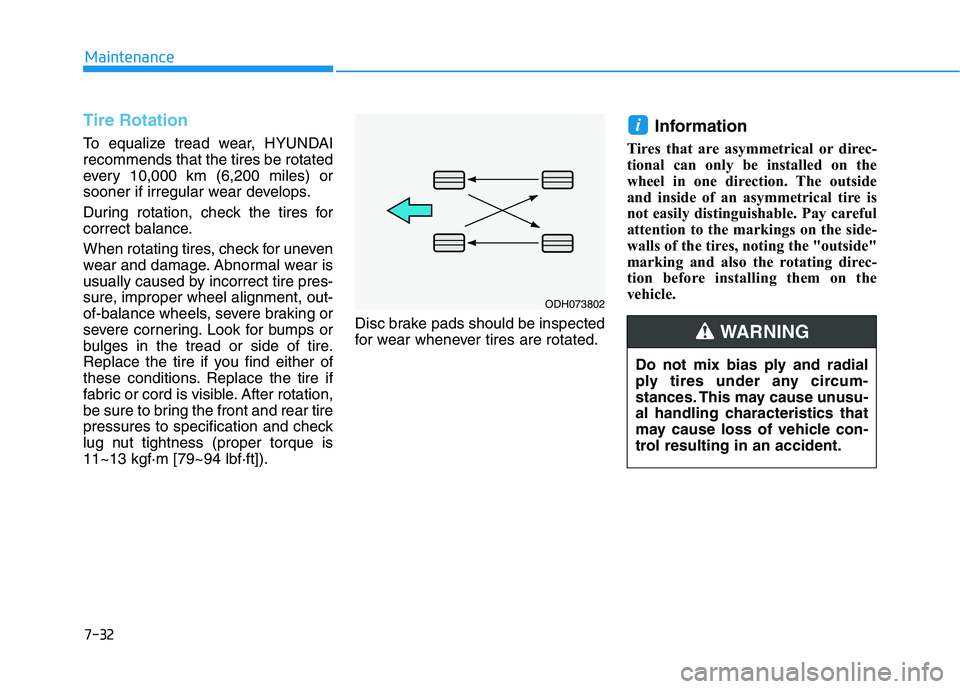
Tire Rotation
To equalize tread wear, HYUNDAI recommends that the tires be rotated
every 10,000 km (6,200 miles) or
sooner if irregular wear develops.
During rotation, check the tires for
correct balance.
When rotating tires, check for uneven
wear and damage. Abnormal wear is
usually caused by incorrect tire pres-
sure, improper wheel alignment, out-
of-balance wheels, severe braking or
severe cornering. Look for bumps or
bulges in the tread or side of tire.
Replace the tire if you find either of
these conditions. Replace the tire if
fabric or cord is visible. After rotation,
be sure to bring the front and rear tire
pressures to specification and check
lug nut tightness (proper torque is11~13 kgf·m [79~94 lbf·ft]).Disc brake pads should be inspected
for wear whenever tires are rotated. Information
Tires that are asymmetrical or direc-
tional can only be installed on the
wheel in one direction. The outside
and inside of an asymmetrical tire is
not easily distinguishable. Pay careful
attention to the markings on the side-
walls of the tires, noting the "outside"
marking and also the rotating direc-
tion before installing them on the
vehicle.
i
Do not mix bias ply and radial
ply tires under any circum-
stances. This may cause unusu-
al handling characteristics that
may cause loss of vehicle con-
trol resulting in an accident.
WARNING
ODH073802
Page 457 of 558
7-33
7
Maintenance
Wheel Alignment and Tire Balance
The wheels on your vehicle were aligned and balanced carefully at the
factory to give you the longest tire life
and best overall performance.
In most cases, you will not need to
have your wheels aligned again.
However, if you notice unusual tire
wear or your vehicle pulling one way
or the other, the alignment may needto be reset.
If you notice your vehicle vibrating
when driving on a smooth road, your
wheels may need to be rebalanced.
Improper wheel weights can dam-
age your vehicle's aluminum
wheels. Use only approved wheelweights.
Tire Replacement
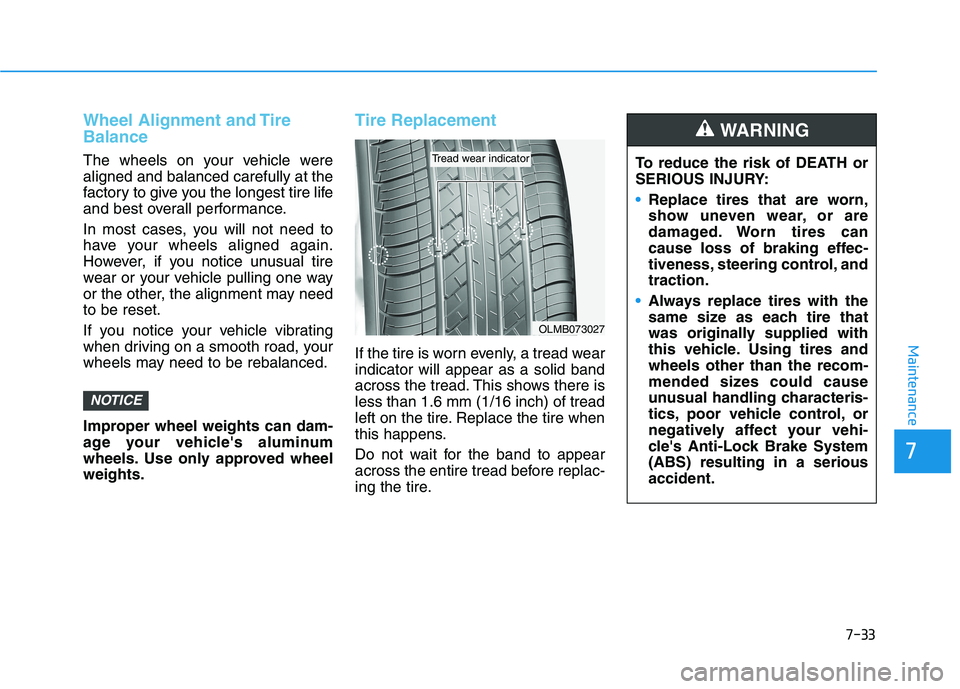
If the tire is worn evenly, a tread wear indicator will appear as a solid band
across the tread. This shows there isless than 1.6 mm (1/16 inch) of tread
left on the tire. Replace the tire when
this happens.
Do not wait for the band to appear
across the entire tread before replac-
ing the tire.
NOTICE
OLMB073027
Tread wear indicatorTo reduce the risk of DEATH or
SERIOUS INJURY:
Replace tires that are worn,
show uneven wear, or are
damaged. Worn tires can
cause loss of braking effec-
tiveness, steering control, andtraction.
Always replace tires with the
same size as each tire that
was originally supplied with
this vehicle. Using tires andwheels other than the recom-
mended sizes could cause
unusual handling characteris-
tics, poor vehicle control, or
negatively affect your vehi-
cle's Anti-Lock Brake System(ABS) resulting in a seriousaccident.
WARNING