child restraint HYUNDAI NEXO 2023 Owner's Manual
[x] Cancel search | Manufacturer: HYUNDAI, Model Year: 2023, Model line: NEXO, Model: HYUNDAI NEXO 2023Pages: 558, PDF Size: 35.01 MB
Page 70 of 558
2-55
Safety system of your vehicle
2
You can take steps to help reduce
the risk of being injured by an inflat-
ing air bag. The greatest risk is sitting
too close to the air bag. An air bag
needs space to inflate. It is recom-
mended that drivers sit as far as pos-
sible between the center of the steer-ing wheel and the chest while still
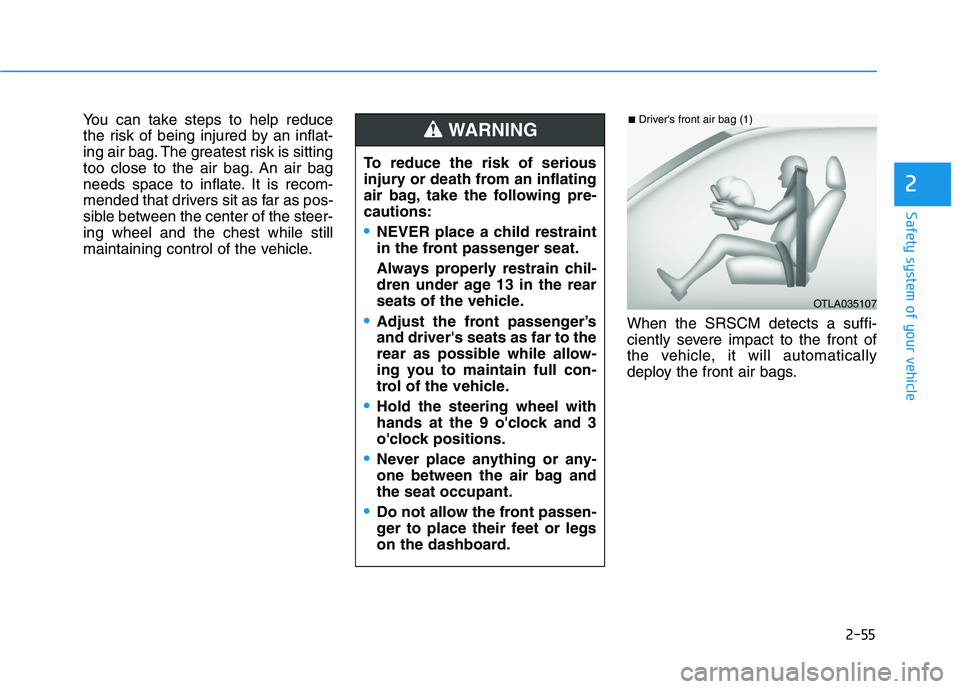
maintaining control of the vehicle.When the SRSCM detects a suffi-
ciently severe impact to the front of
the vehicle, it will automatically
deploy the front air bags.
OTLA035107
■Driver's front air bag (1)
To reduce the risk of serious
injury or death from an inflating
air bag, take the following pre-cautions:
NEVER place a child restraint
in the front passenger seat.
Always properly restrain chil-
dren under age 13 in the rear
seats of the vehicle.
Adjust the front passenger’s and driver's seats as far to the
rear as possible while allow-
ing you to maintain full con-
trol of the vehicle.
Hold the steering wheel with
hands at the 9 o'clock and 3
o'clock positions.
Never place anything or any-
one between the air bag andthe seat occupant.
Do not allow the front passen-
ger to place their feet or legs
on the dashboard.
WARNING
Page 73 of 558
2-58
Safety system of your vehicle
Occupant Classification System (OCS)
Your vehicle is equipped with an Occupant Classification System(OCS) in the front passenger's seat.
Main components of theOccupant Classification System
A detection device located within the front passenger seat cushion.
Electronic system to determine whether the passenger air bag
systems should be activated or
deactivated.
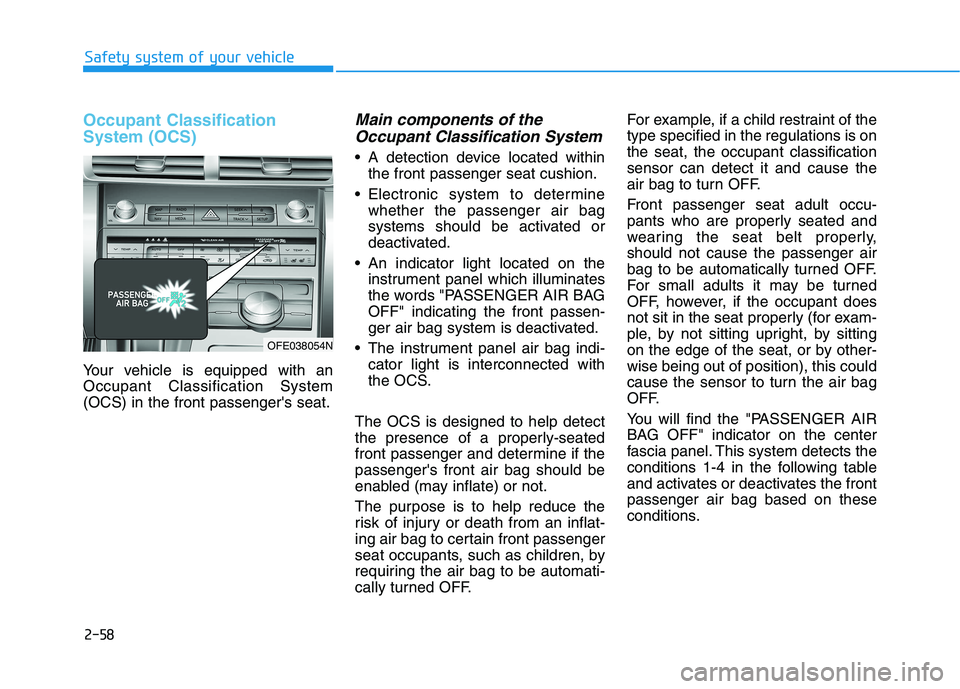
An indicator light located on the instrument panel which illuminates
the words "PASSENGER AIR BAGOFF" indicating the front passen-
ger air bag system is deactivated.
The instrument panel air bag indi- cator light is interconnected with
the OCS.
The OCS is designed to help detect
the presence of a properly-seated
front passenger and determine if thepassenger's front air bag should be
enabled (may inflate) or not.
The purpose is to help reduce the
risk of injury or death from an inflat-
ing air bag to certain front passenger
seat occupants, such as children, by
requiring the air bag to be automati-
cally turned OFF. For example, if a child restraint of thetype specified in the regulations is onthe seat, the occupant classificationsensor can detect it and cause the
air bag to turn OFF.
Front passenger seat adult occu-
pants who are properly seated and
wearing the seat belt properly,should not cause the passenger air
bag to be automatically turned OFF.
For small adults it may be turned
OFF, however, if the occupant does
not sit in the seat properly (for exam-
ple, by not sitting upright, by sitting
on the edge of the seat, or by other-wise being out of position), this could
cause the sensor to turn the air bag
OFF.
You will find the "PASSENGER AIR
BAG OFF" indicator on the center
fascia panel. This system detects the
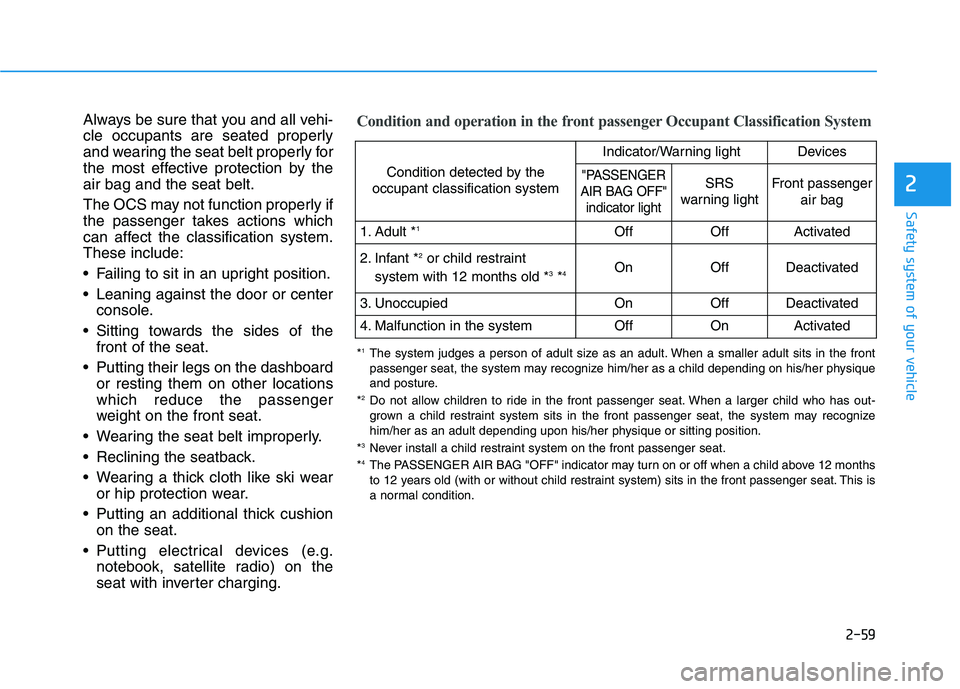
conditions 1-4 in the following table
and activates or deactivates the frontpassenger air bag based on these
conditions.
OFE038054N
Page 74 of 558
2-59
Safety system of your vehicle
2
Always be sure that you and all vehi-
cle occupants are seated properly
and wearing the seat belt properly for
the most effective protection by theair bag and the seat belt.
The OCS may not function properly if
the passenger takes actions which
can affect the classification system.These include:
Failing to sit in an upright position.
Leaning against the door or centerconsole.
Sitting towards the sides of the front of the seat.
Putting their legs on the dashboard or resting them on other locations which reduce the passenger
weight on the front seat.
Wearing the seat belt improperly.
Reclining the seatback.
Wearing a thick cloth like ski wear or hip protection wear.
Putting an additional thick cushion on the seat.
Putting electrical devices (e.g. notebook, satellite radio) on the
seat with inverter charging.Condition and operation in the front passenger Occupant Classification System
Condition detected by the
occupant classification system
Indicator/Warning lightDevices
"PASSENGER
AIR BAG OFF" indicator lightSRS
warning lightFront passenger
air bag
1. Adult * 1OffOffActivated
2. Infant * 2
or child restraint
system with 12 months old * 3
*4 OnOffDeactivated
3. Unoccupied OnOffDeactivated
4. Malfunction in the systemOffOnActivated
*
1
The system judges a person of adult size as an adult. When a smaller adult sits in the front
passenger seat, the system may recognize him/her as a child depending on his/her physique
and posture.
* 2
Do not allow children to ride in the front passenger seat. When a larger child who has out-
grown a child restraint system sits in the front passenger seat, the system may recognize
him/her as an adult depending upon his/her physique or sitting position.
* 3
Never install a child restraint system on the front passenger seat.
* 4
The PASSENGER AIR BAG "OFF" indicator may turn on or off when a child above 12 months
to 12 years old (with or without child restraint system) sits in the front passenger seat. This is
a normal condition.
Page 77 of 558
2-62
Safety system of your vehicle
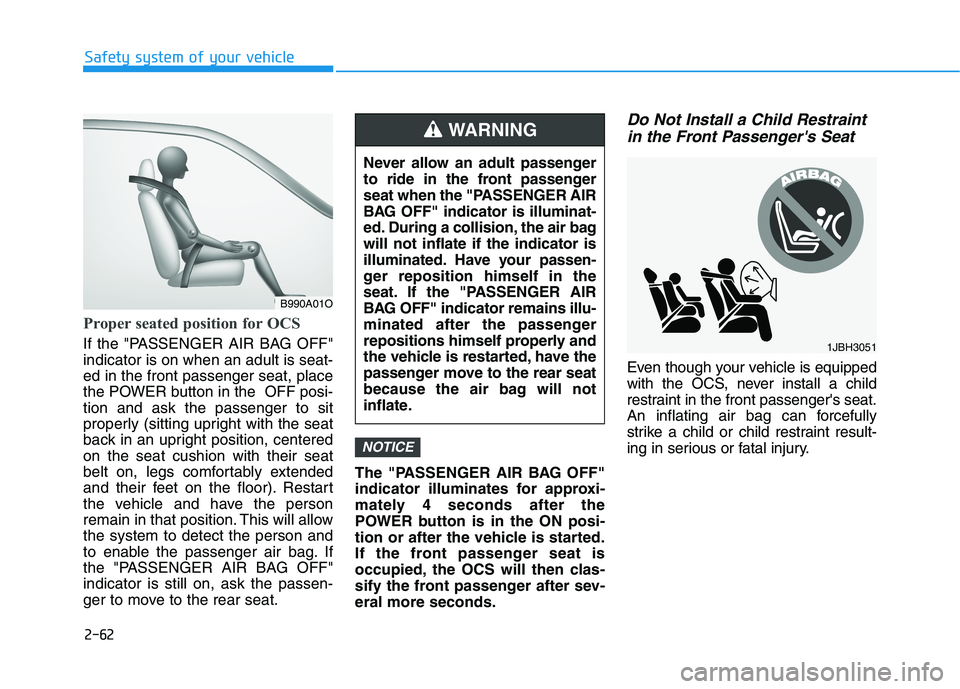
Proper seated position for OCS
If the "PASSENGER AIR BAG OFF" indicator is on when an adult is seat-ed in the front passenger seat, place
the POWER button in the OFF posi-tion and ask the passenger to sit
properly (sitting upright with the seat
back in an upright position, centeredon the seat cushion with their seat
belt on, legs comfortably extended
and their feet on the floor). Restart
the vehicle and have the person
remain in that position. This will allowthe system to detect the person and
to enable the passenger air bag. If
the "PASSENGER AIR BAG OFF"indicator is still on, ask the passen-
ger to move to the rear seat.The "PASSENGER AIR BAG OFF"
indicator illuminates for approxi-
mately 4 seconds after the
POWER button is in the ON posi-
tion or after the vehicle is started.
If the front passenger seat is
occupied, the OCS will then clas-
sify the front passenger after sev-eral more seconds.
Do Not Install a Child Restraint
in the Front Passenger's Seat
Even though your vehicle is equipped
with the OCS, never install a child
restraint in the front passenger's seat.
An inflating air bag can forcefully
strike a child or child restraint result-
ing in serious or fatal injury.
NOTICE
B990A01O Never allow an adult passenger
to ride in the front passenger
seat when the "PASSENGER AIR
BAG OFF" indicator is illuminat-
ed. During a collision, the air bagwill not inflate if the indicator is
illuminated. Have your passen-
ger reposition himself in the
seat. If the "PASSENGER AIR
BAG OFF" indicator remains illu-
minated after the passenger
repositions himself properly and
the vehicle is restarted, have the
passenger move to the rear seat
because the air bag will not
inflate.
WARNING
1JBH3051
Page 78 of 558
2-63
Safety system of your vehicle
2
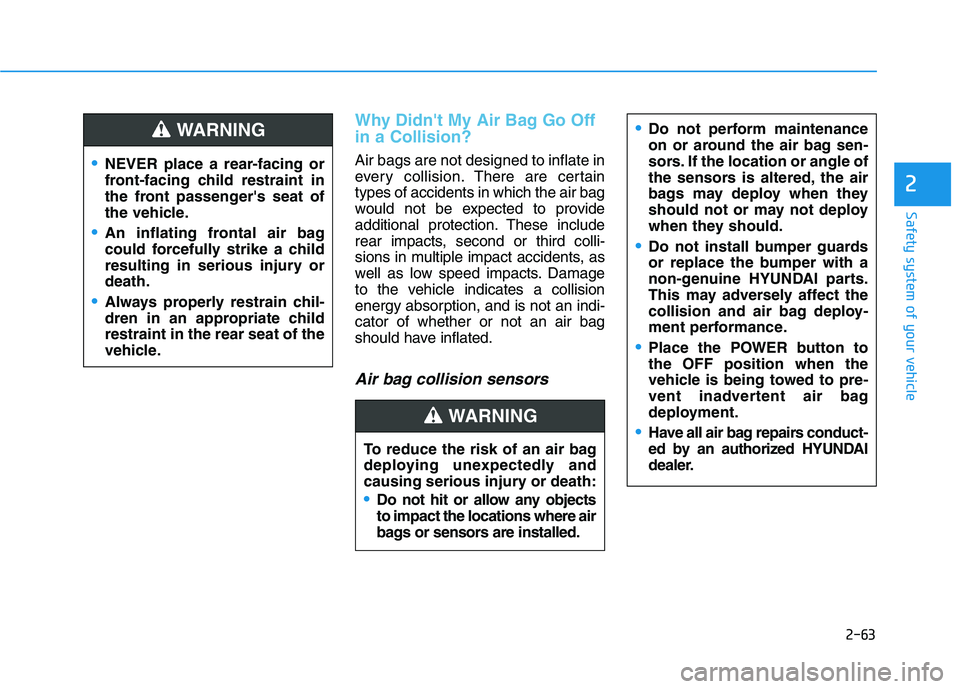
Why Didn't My Air Bag Go Off in a Collision?
Air bags are not designed to inflate in
every collision.There are certain
types of accidents in which the air bag
would not be expected to provide
additional protection. These include
rear impacts, second or third colli-
sions in multiple impact accidents, as
well as low speed impacts. Damage
to the vehicle indicates a collision
energy absorption, and is not an indi-cator of whether or not an air bag
should have inflated.
Air bag collision sensors
NEVER place a rear-facing or
front-facing child restraint in
the front passenger's seat of
the vehicle.
An inflating frontal air bag
could forcefully strike a child
resulting in serious injury ordeath.
Always properly restrain chil-
dren in an appropriate childrestraint in the rear seat of the
vehicle.
WARNING
To reduce the risk of an air bag
deploying unexpectedly and
causing serious injury or death:
Do not hit or allow any objects to impact the locations where air
bags or sensors are installed.
WARNING
Do not perform maintenance
on or around the air bag sen-
sors. If the location or angle of
the sensors is altered, the air
bags may deploy when they
should not or may not deploy
when they should.
Do not install bumper guards
or replace the bumper with a
non-genuine HYUNDAI parts.
This may adversely affect the
collision and air bag deploy-
ment performance.
Place the POWER button to the OFF position when the
vehicle is being towed to pre-
vent inadvertent air bag
deployment.
Have all air bag repairs conduct-
ed by an authorized HYUNDAI
dealer.
Page 397 of 558
5-130
Driving your vehicle
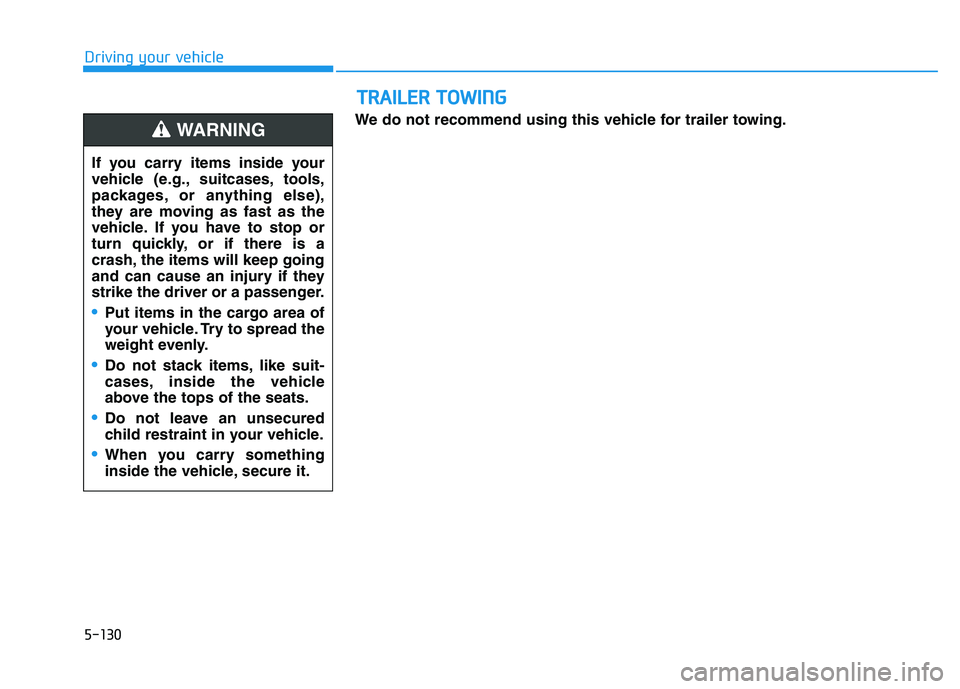
We do not recommend using this vehicle for trailer towing.
TTRR AA IILL EE RR TT OO WW IINN GG
If you carry items inside your
vehicle (e.g., suitcases, tools,
packages, or anything else),
they are moving as fast as the
vehicle. If you have to stop or
turn quickly, or if there is a
crash, the items will keep going
and can cause an injury if they
strike the driver or a passenger.
Put items in the cargo area of
your vehicle. Try to spread the
weight evenly.
Do not stack items, like suit-
cases, inside the vehicle
above the tops of the seats.
Do not leave an unsecured
child restraint in your vehicle.
When you carry something
inside the vehicle, secure it.
WARNING
Page 550 of 558
I-3
Blind-Spot View Monitor System ..................................5-77
Blind-Spot View Monitor system warning ................5-78
Operating Conditions .................................................5-77
Brake Fluid .....................................................................7-19 Checking the Brake Fluid Level ................................7-19
Braking System ...............................................................5-18 Anti-lock Brake System (ABS)..................................5-29
Auto Hold ...................................................................5-25
Disc Brake Wear Indicator .........................................5-19
Electronic Parking Brake (EPB) ................................5-19
Electronic Stability Control (ESC).............................5-31
Good Braking Practices..............................................5-36
Hill-Start Assist Control (HAC) .................................5-36
Power Brakes..............................................................5-18
Vehicle Stability Management (VSM) .......................5-34
Bulb Wattage .....................................................................8-3
Cargo Security Screen ..................................................3-174
Center Console Storage ................................................3-163
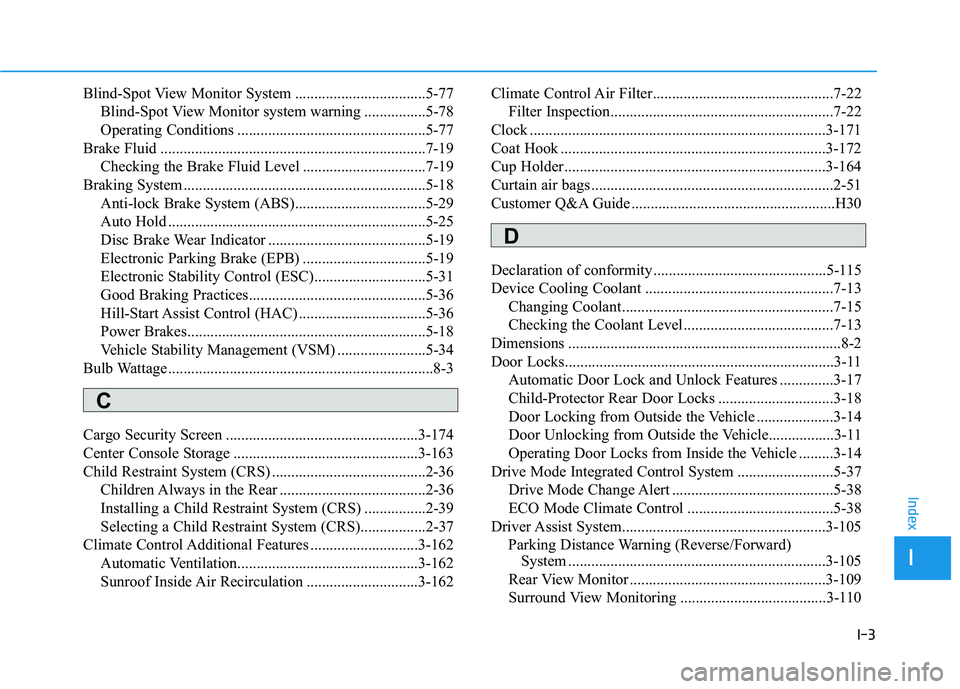
Child Restraint System (CRS) ........................................2-36 Children Always in the Rear ......................................2-36
Installing a Child Restraint System (CRS) ................2-39
Selecting a Child Restraint System (CRS).................2-37
Climate Control Additional Features ............................3-162
Automatic Ventilation...............................................3-162
Sunroof Inside Air Recirculation .............................3-162 Climate Control Air Filter...............................................7-22
Filter Inspection..........................................................7-22
Clock .............................................................................3-171
Coat Hook .....................................................................3-172
Cup Holder....................................................................3-164
Curtain air bags ...............................................................2-51
Customer Q&A Guide .....................................................H30
Declaration of conformity .............................................5-115
Device Cooling Coolant .................................................7-13
Changing Coolant.......................................................7-15
Checking the Coolant Level .......................................7-13
Dimensions .......................................................................8-2
Door Locks......................................................................3-11 Automatic Door Lock and Unlock Features ..............3-17
Child-Protector Rear Door Locks ..............................3-18
Door Locking from Outside the Vehicle ....................3-14
Door Unlocking from Outside the Vehicle.................3-11
Operating Door Locks from Inside the Vehicle .........3-14
Drive Mode Integrated Control System .........................5-37
Drive Mode Change Alert ..........................................5-38
ECO Mode Climate Control ......................................5-38
Driver Assist System.....................................................3-105 Parking Distance Warning (Reverse/Forward) System ...................................................................3-105
Rear View Monitor ...................................................3-109
Surround View Monitoring ......................................3-110
I
Index
C
D
Page 552 of 558
I-5
Front Windshield Washers ............................................3-103
Front Windshield Wipers ..............................................3-101
Fuel Cell Power Module Compartment ....................1-6, 7-3
Fuel Filler Door ..............................................................3-55
Fuses ...............................................................................7-45
Fuel Cell Power Module Compartment Panel Fuse Replacement ...................................................7-47
Fuse/Relay Panel Description ....................................7-49
Instrument Panel Fuse Replacement ..........................7-46
Gauges and Meters .........................................................3-59
Glove Box .....................................................................3-163
Hazard Warning Flasher ...................................................6-2
Head Restraints ...............................................................2-13
Heated Steering Wheel ...................................................3-22
Hill-Start Assist Control (HAC) .....................................5-36
Hood................................................................................3-42
Horn ................................................................................3-21 If the 12 Volt Battery is Discharged .................................6-5
Before Jump Starting....................................................6-5
Jump Starting................................................................6-6
If the Vehicle Overheats....................................................6-9
If the Vehicle Will Not Start .............................................6-4
If You Have a Flat Tire (With Tire Mobility Kit)...........6-17
Immobilizer System ........................................................3-10
Important Safety Precautions............................................2-2 Air Bag Hazards ...........................................................2-2
Always Wear Your Seat Belt ........................................2-2
Control Your Speed ......................................................2-3
Driver Distraction.........................................................2-2
Keep Your Vehicle in Safe Condition ..........................2-3
Restrain All Children....................................................2-2
In Case of an Emergency While Driving .........................6-2
Emergency venting of hydrogen gas............................6-3
If a fire occurs ..............................................................6-3
If a submersion in water occurs ...................................6-3
If an accident occurs.....................................................6-2
If the vehicle stalls at a crossroad or crossing .............6-3
If the vehicle stalls while driving .................................6-4
If you have a flat tire while driving .............................6-4
I
Index
G
H
I